Part 2 — CHAPTER XIX THE SAKER[196] FALCON (F. Cherrug)
D. C. (Douglas Craven) Phillott translation
CHAPTER XIX THE SAKER[196] FALCON (F. Cherrug)
[The author now mentions fourteen races and varieties of bālābān,[197] each of which he distinguishes by some special epithet.
Kabīdī (?).—The first race or variety described is apparently named kabīdī:[199]]—It has a white head, without any cheek-stripe or dark mark under the eyes.[200] With this exception the colouration is dark: the feathers of both the body and the tail[201] are without spots. It is large in size and bold in nature, and good for either crane[202] or gazelle, but, alas, it is scarce. In the whole of my experience I have met with only one.
Bālābān-i Fārsī.—Next is the Bālābān-i Fārsī, or “Saker of Fārs,” which is subdivided into the red and the white varieties. Neither has cheek stripes. The back, from the neck to the oil-bottle,[203] is covered with spots and markings, and the redder these are in tint, the better the bird. The flight-feathers,[204] seven in each wing, are also covered with spots. The feet are a very light slate-colour. The darker and smaller the beak, tongue, and nails, the better. The feet are lean, the tarsi short, the thighs stout, the chest and back broad, the wings fine and pointed, the eyes sunken, the eyebrows prominent; the neck is long, the forehead broad, the “waist” small. If the hawk has all these points, it is incomparable.
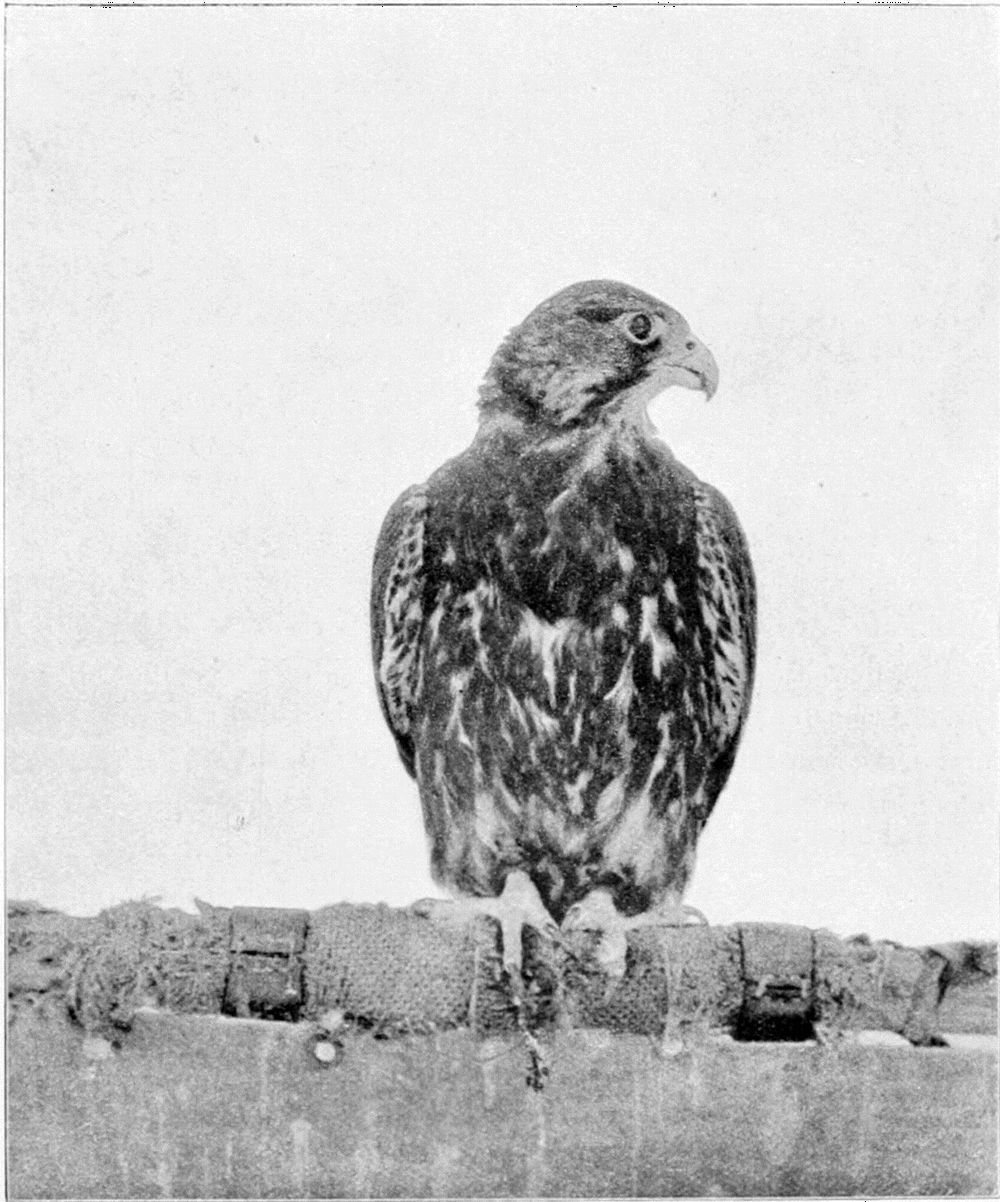
IX
YOUNG PASSAGE SAKER (DARK VARIETY)
Bālābān-i Aḥmar-i Shām.—Next is the Bālābān-i aḥmar-i Shām or the “Red Syrian Saker,” of which there are two varieties, the red and the black. In a good bird of this race, the two centre tail-feathers, called by the Arabs ʿamūd or “props,” and by the Turks qāpāq,[205] as well as the two outer tail-feathers, one on each side,[206] should be without spot or marking.
Bālābān-i Badrī.—The next race is called badrī.[207] It has a white head and no cheek stripe. The general colouration is reddish, and the back and breast are without markings. The two centre tail-feathers are sometimes with spots and sometimes without: if with spots the smaller and redder they are the better.
These four races or varieties are by the Arabs styled ḥurr ṣāfī.[208]
Badū-pasand (?).—[A variety of the Badrī has a name[209] that cannot be deciphered with certainty.] This is a variety of the Badrī, but the whole of the tail is white without the admixture of any other colouring. It is uncommon, and though it belongs to the class of ḥurr,[208] it is poor-spirited and not prized.
Jibālī.—The next race is the Mountain[210] (?) Saker. It has a little black only, under the eye. It has on the back, two, four, or six white spots, called by the Arabs Pleiades (Thurayyā). The “prop” feathers have sometimes spots and sometimes none. In any case it is not styled by the Arabs ḥurr ṣāfī, for the ḥurr ṣāfī must not only be without cheek stripes, but must also have certain other points.
The first four described are, however, all included in the ḥurr ṣāfī. According to the idiom of Arab falconers, the ḥurr ṣāfī must have the back “free from Pleiades,”[211] the “prop” feathers “clear of marks,”[212] and the two outside feathers (one on each side) “void of stain.”[213] Also it must have no cheek stripe, nor black under the eyes. Should the hawk not have these points, they class it as jibālī and not as ḥurr ṣāfī.
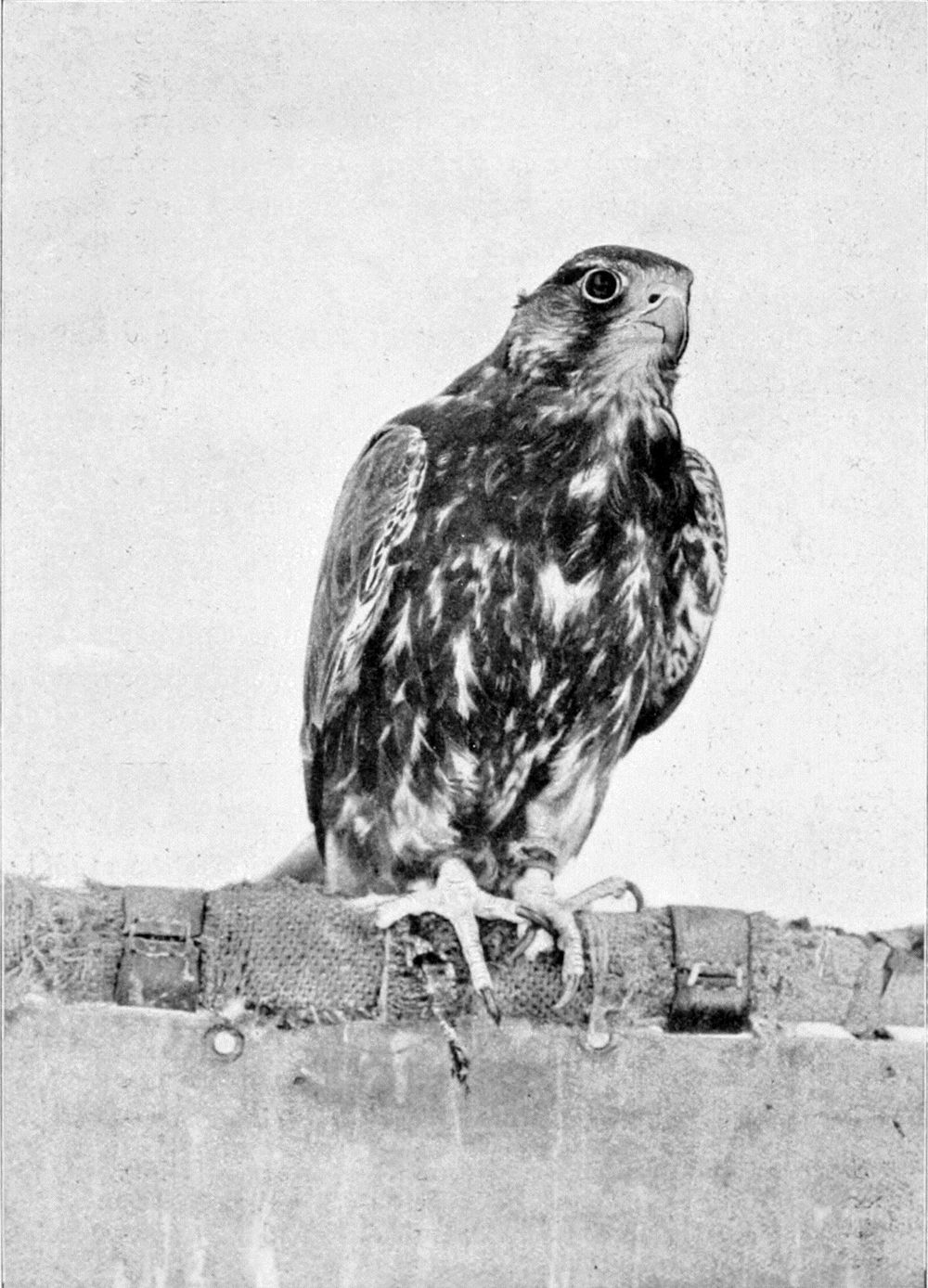
X
YOUNG PASSAGE SAKER (DARK VARIETY)
Bālābān-i Lafīf.—Next is the bālābān-i lafīf,[214] and of this there are three varieties, the yellowish, the dark, and the light. All three have cheek-stripes or dark feathers under the eyes. As in the case of the eyess chark͟h, if this race is taken from the nest it is called in Turki aitālgī, in Arabic wacharī,[215] and in Persian chark͟h. Should it have left the nest and be caught in a net, it is called (in Persian) bālābān-i lafīf.
Now as for those four races described above as ḥurr ṣāfī, I have in my many travels and constant inquiries never met with any hawk-catcher or sportsman[216] who has taken a ḥurr ṣāfī from the nest. No one even knows in what country, birds of this race breed. All I know for certain is, that in the beginning of Autumn they come to us from across the sea, from the direction of Muscat and Baḥrayn.[217] God knows where they breed and whence they travel. Those that I have seen in Persia, Turkey,[218] and Europe[219] have all been lafīf and have all had cheek stripes.
The lafīf is to the ḥurr ṣāfī what the t̤arlān is to the qizil, or what the Nejd[220] horse is to the Turkoman pony.[221] Moult after moult the ḥurr ṣāfī becomes better, whereas the lafīf flies well for not more than three seasons: after that it becomes cunning.[222] I have at present two bālābān of the ḥurr ṣāfī race, one of sixteen and one of seventeen moults; one is “Persian” and the other “Red Syrian.”[223] Both are still excellent at common crane.[224] Birds of this race, while life lasts, year by year improve, for their nature is noble.
The Bālābān-i Lafīf of Baghdad.—A variety of the Lafīf that I have met with nowhere except in Baghdad, is called by Baghdad falconers Wacharī.[225] In general colouring, it is dark with a tinge of red on the head. The flight-feathers are dark in colour and long, extending beyond the tail. It has small feet and the female is about the same size as the tiercel of the eyess chark͟h.[226] It is very swift, nearly as swift as the shāhīn. It takes the small piebald crow,[227] black partridge,[228] and stone-plover, with ease. Some few I have seen that would take houbara.
It has a great outward resemblance to the Hobby which is found round Teheran.