Part 2 — CHAPTER XVII THE SHĀHĪN[179]
D. C. (Douglas Craven) Phillott translation
CHAPTER XVII THE SHĀHĪN[179]
This species is very widely distributed. It is divided into three varieties—namely, the dark, the light and the yellow.
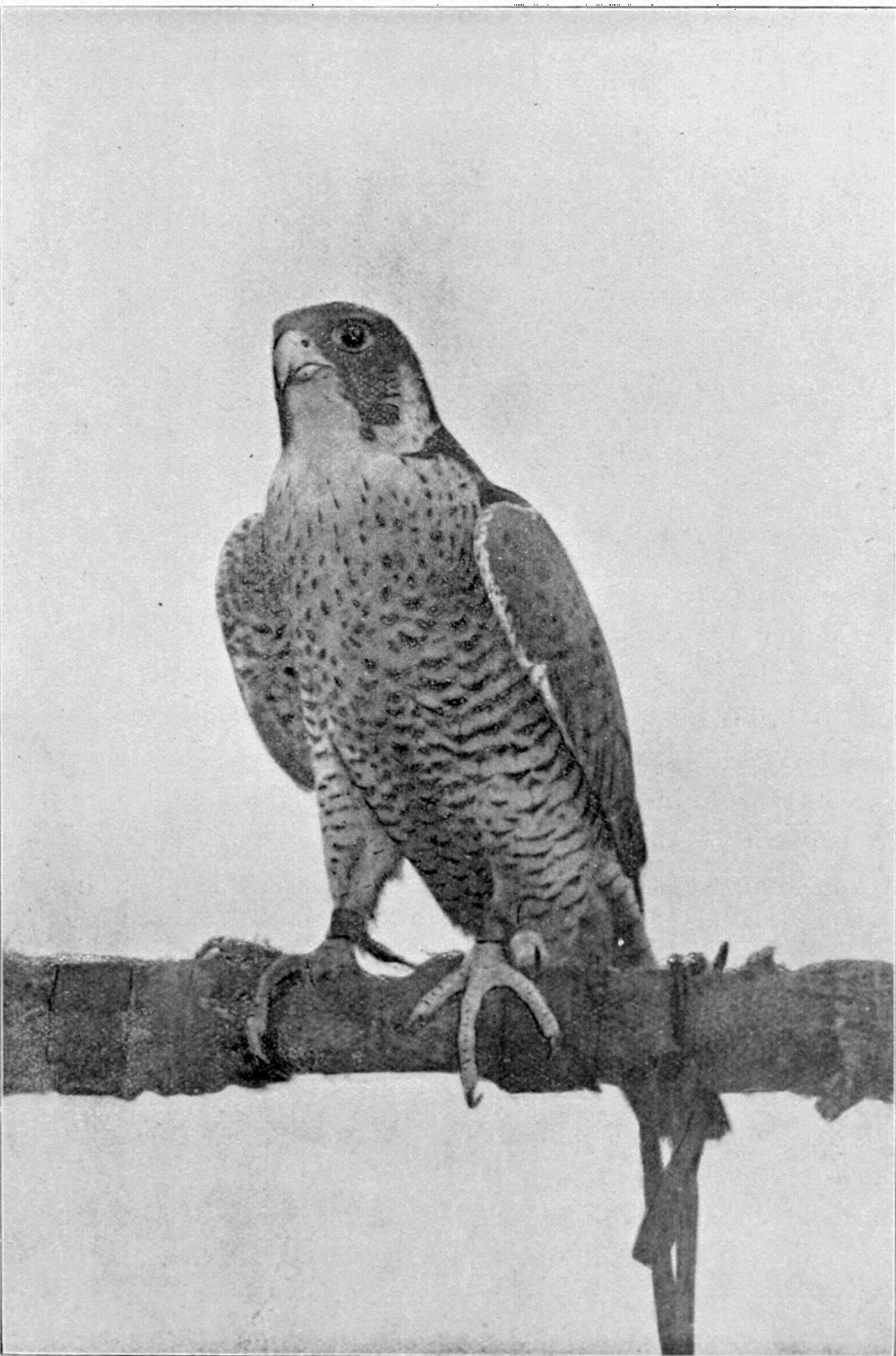
VII
INTERMEWED PEREGRINE
The best shāhīns are procured from three districts: from Urūm[180] in Ottoman territory, from Ardabīl[181] in Persia, and from the hills of Shammar[182] in Arabia on the road to the holy city of Mecca.
The Urūm shahin is particularly common in Sīvās,[183] which place may be described as the “mine” of this variety. My private opinion, however, is that this, the shahin of Urūm, is not a shahin at all, but the young of the Peregrine; i.e., when snared it is a “peregrine,” when taken from the nest a “shahin.” My reason for forming this opinion is that I happened one Spring to be in Sīvās and called on the Governor. At my request he gave me a guide, who conducted me to a spot about two farsak͟h from the city, where there was a shahin’s eyrie in the hill-side. I sat down to observe it. My patience was soon rewarded by the appearance of the parent birds, bringing food for their young. I observed the birds closely, and discovered that they were not shahins but peregrines. This strengthened my previous supposition that confusion existed between the nestling and the passage hawk of the same species.
On another occasion I met a shikārchī[184] in Sīvās, with a peregrine on his fist. “What have you there,” I asked, “and what does it kill?” His reply was, “This is a shahin, which I took myself from the nest, and which I have trained to take eagles.” I accompanied him to his house, where he showed me ten or fifteen live eagles with clipped wings, which he kept loose near the house. It appeared that they had all been taken with the falcon then on his fist. I was seized with a desire to possess her, and offered him a large price; but he declined to part with his treasure.
The Shāhīn OF Jabal Shammar.—Although the shahin from the mountains of Shammar is small, the female not exceeding in size the male of the other two species, still it is swift, bold, and easily entered to quarry, small or great. One eyrie, known by the name Jarāza, is especially famous; eyesses obtained from it are better and bolder than all others.
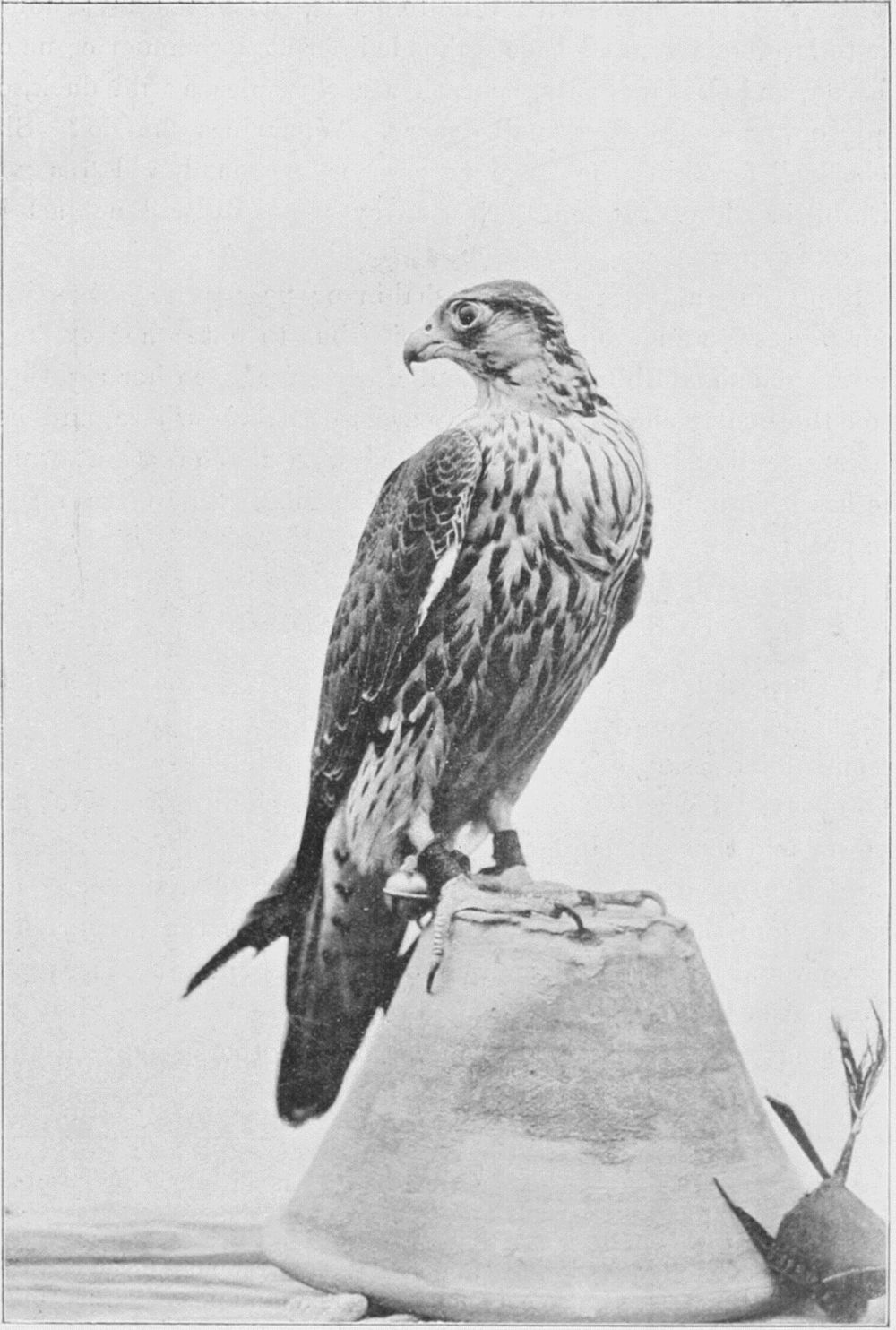
VIII
YOUNG PEREGRINE (INDIAN HOOD)
Though the passage shahin has more pace and a better wind than the eyess, it is far less tractable, for it has preyed for itself in the jungle, and is filled with overweening pride of its powers of flight. Say you have, with infinite pains, succeeded in training one to large quarry, and have unhooded her at a common crane or a heron, and that suddenly, beneath her, she spies a wild duck, or a pigeon, or some other small quarry. What does she do? She “checks,” forsaking the large quarry for the small, and fills you with bitter disappointment. Now an eyess shahin will not act in this scurvy manner.
Supposing a passage falcon, shahin or peregrine, comes into your possession and you have no choice but to enter her to large quarry, you should blind her in the left eye, for when her right eye is on the quarry she has no spare eye to cast elsewhere, and her whole attention is necessarily occupied with the quarry at which she has been unhooded. This is in accordance with the saying of the poet:—
“My left eye I will darken to the light,[185] So that I view thee only with my right.”
I have successfully made the experiment and speak from experience.
Should you, however, wish to keep her for small quarry, on no account blind her. For small quarry you will find her better than the eyess: she will ring up better, especially after Royston Crows[186] and those blackguardly yāplāq owls.[187]
As remarked previously, the passage shahin and the peregrine are one and the same, with this difference, that the peregrine is stronger and larger. The courage of the peregrine, too, is greater than that of the passage shahin.
Rūmalī[188] eyess shahins are bolder than all others—especially the dark variety.