Part 1 — CHAPTER II THE GOSHAWKS
D. C. (Douglas Craven) Phillott translation
Three species.—[The author now describes three races of goshawk, which he distinguishes by the names of Tīqūn; T̤arlān; and Qizil:[33] each of these three he sub-divides into varieties, only distinguishable from each other by slight differences in colouring, in marking, or in size. The first-named species is the white goshawk; the second is that variety or race of the common goshawk that is caught after migration into Persia; while the third is the local race that breeds in the country.
After hazarding a conjecture that the white goshawks[34] are not a true species like the T̤arlān and Qizil, but are either albinos, or else accidental varieties produced by the pairing, for one or more generations, of two exceptionally light specimens of the common goshawk, the author proceeds to describe a pure white variety of the Tīqūn, which, he says, is known to the people of Turkistan by the name of Kāfūrī.[35] He remarks that he has caught albino specimens of the Saker Falcon, and has further observed albinos of the Shāhīn, “piebald crow,”[36] peacock, sparrow, sparrow-hawk, pin-tailed sand-grouse, chukor, hoopoe, English merlin, kākulī lark, and common crane. As regards the Kāfūrī, he states his opinion that it is the offspring of albino T̤arlāns that happen to have paired for two generations. He continues:—]
White Goshawk or Tīqūn-i kāfūrī.—The female of this variety of Tīqūn is noted for its large size, the male on the contrary for being extremely small. The head, neck, back, and breast are totally devoid of markings, the plumage being white as driven snow.[37] In the immature bird the eyes have only a slightly reddish tinge, but after the first moult their hue generally deepens and turns to a ruby-red.[38] The claws and beak, though frequently white, are more often a light grey, while the cere is greenish.
E’en such the noble thorough-bred Tīqūn; May God in mercy grant us such a boon!
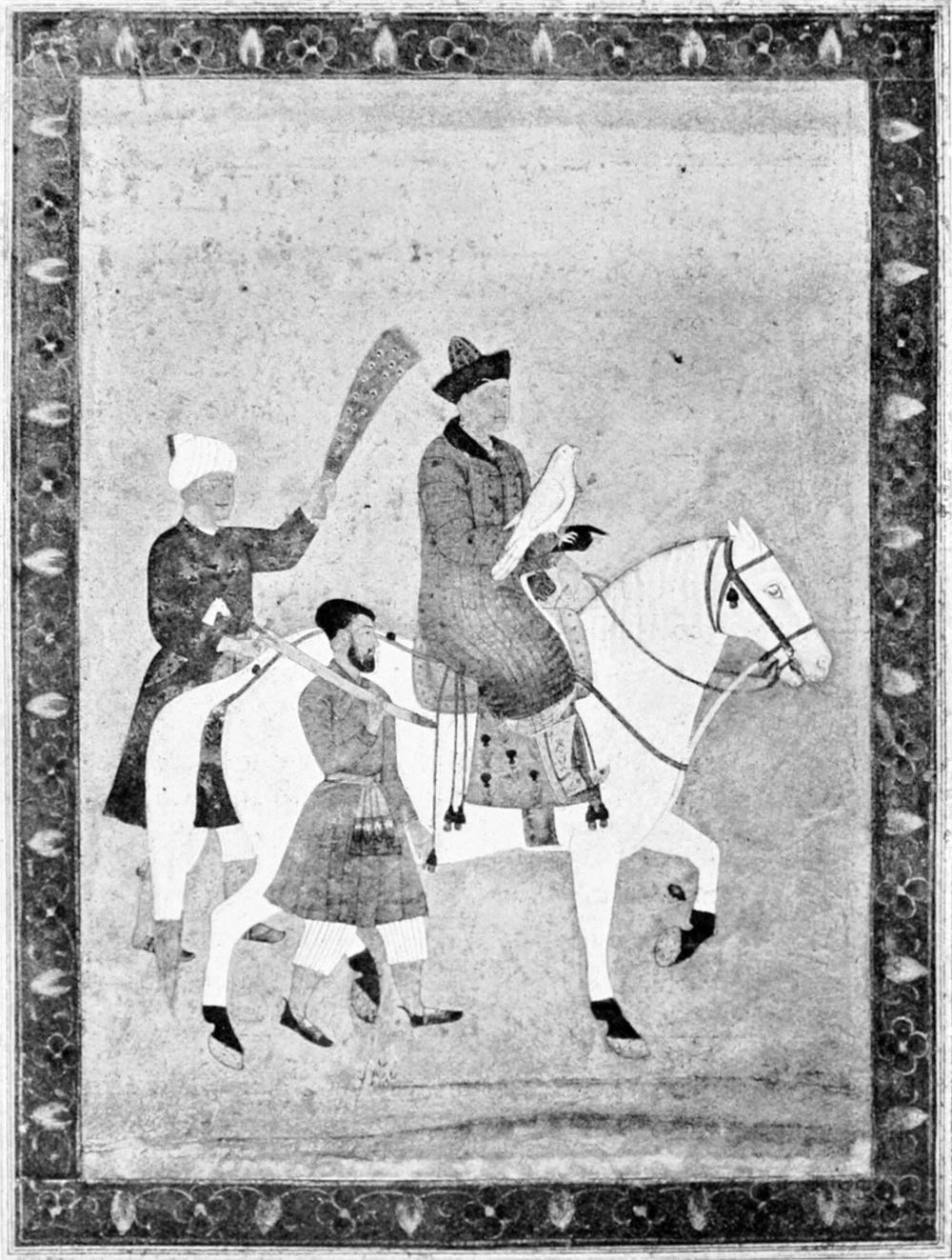
IV
FROM AN OLD PERSIAN PAINTING, INDIAN, PROBABLY OF THE MUG͟HAL PERIOD
I remember having once seen a “cast”[39] of this variety—male and female—in the possession of Fatḥ ʿAlī Shāh[40] (now a resident of Paradise), both of which were exceptionally fine performers in the field.
The people of Turkistan, who are highly skilled in the art of training goshawks, call this variety lāziqī.[41]
It is commonly believed by falconers and bird-catchers, that in the early spring, when the female goshawk is desirous of the attentions of a male, she utters loud and plaintive cries, which attract to her many species of birds. From these she selects a male of a species different from herself,[42] and the result of this union is a diversiform progeny. However, the kāfūrī or lāziqī variety is the offspring of two white parents.
The following circumstance lends some colouring of truth to this quaint belief:—
Some years ago a hawk of this species was brought from Russia and presented as a curiosity to the late Shāh, who, in turn, bestowed it on Ḥusayn ʿAlī Mīrzā,[43] Governor of the Province of Fārs. The Governor (now in the abode of the Blessed) forwarded it to me—the contemptible. It must have been a bird of four or five moults, when it came into the possession of this slave. After infinite pains I succeeded in taking with it one solitary chukor,[44] and that, too, a bird harried and worn out by another hawk. It had a very villainous and scurvy disposition. The plumage of this hawk, an unusually large female, was peculiar, in that its feathers were alternately snow-white and raven-black; the claws and beak were of the colour of mother-of-pearl, and the eyes were a reddish yellow. I feel confident her albino mother had mated with a raven, and that this spurious half-caste was the result of the union. There is some truth in the statements of the bird-catchers.
The above description is given, as it seems in some measure to support the stories of the bird-catchers. Sure and certain knowledge, however, rests with God.
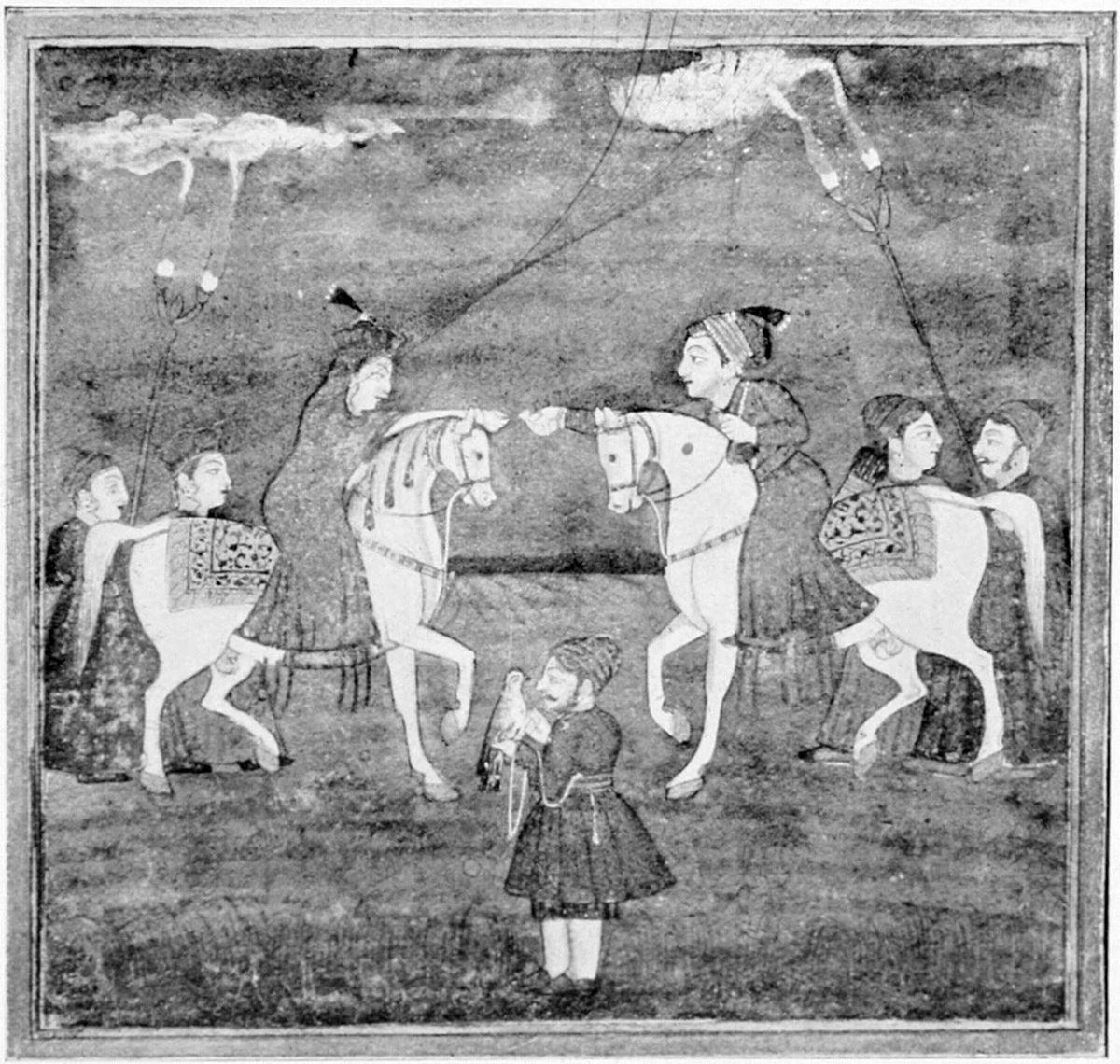
V
FROM A PAINTING IN AN ANCIENT PERSIAN MS. WRITTEN IN INDIA
Goshawk (T̤arlān).—There are three varieties of T̤arlān, the dark, the light, and the tawny. The last two are common, but though tractable and easily reclaimed,[45] they are not good at large quarry. The dark variety that has a reddish tinge, is universally acknowledged to be the best, and I have myself taken with it common crane and great bustard.[46] The colouring should be very dark, with a tinge of red in it; though this variety may be sullen and self-willed, it is also hardy and keen, and, once thoroughly reclaimed, will be as docile and obedient as any falconer could desire.
Local Race of Goshawk (Qizil).—The third species, the Qizil,[47] breeds in Māzenderān,[48] and in many other parts of Persia, and a fair number are captured in nets, each Autumn, together with the T̤arlāns. Like the last-described species, this also contains three varieties, the dark, the light, and the tawny. The dark variety with the cheek-stripe[49] is the best, and the darker this marking—with a tinge of red in it—the better the bird. With a “passage-bird”[50] of this last variety, the author has himself taken common cranes, great bustards, and “ravine-deer”[51] fawns. The difference between the wild caught Qizil and the T̤arlān is in reality very small. The latter has a somewhat finer presence, a more noble disposition, and is rather faster in flight; also from its habit of mounting higher and thus commanding a more extensive view, it is better able to mark down or “put in”[52] its quarry. It is for these reasons only that the T̤arlān has a higher value than the Qizil.[53]
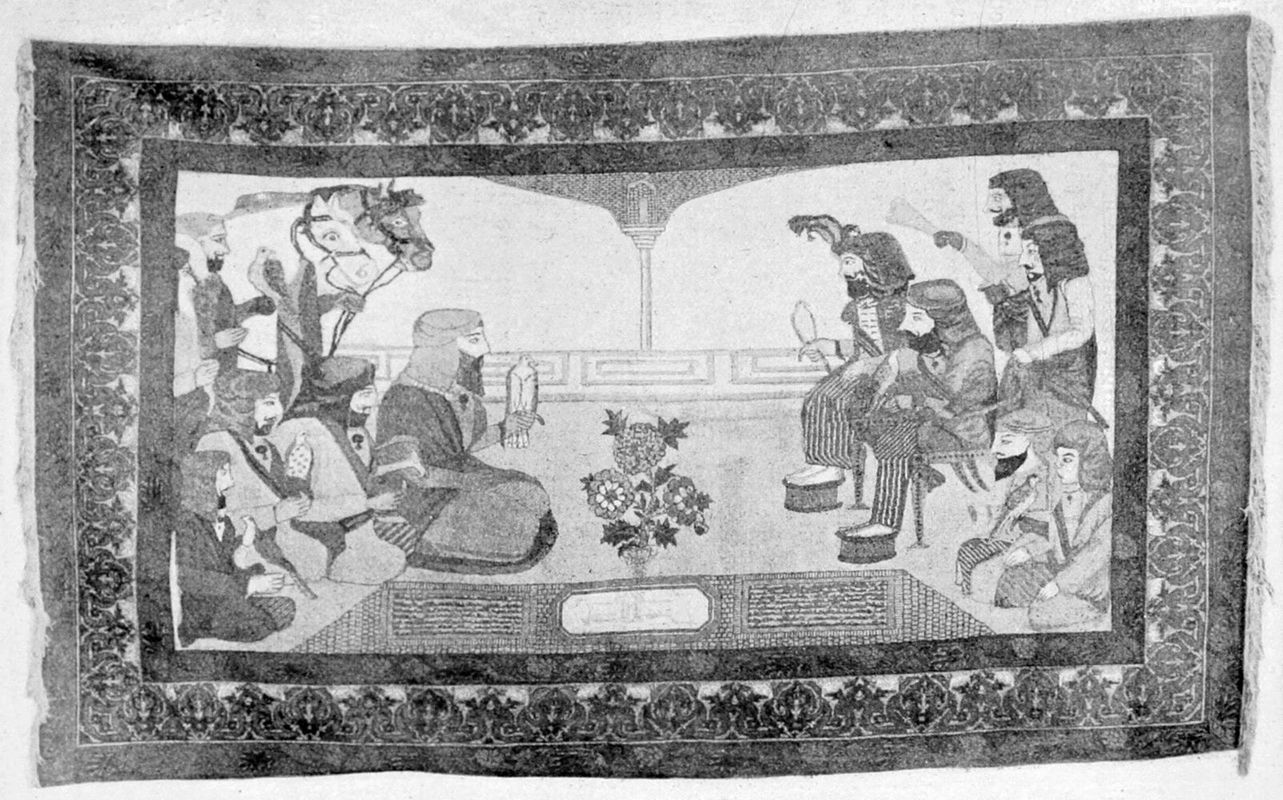
VI
PERSIAN CARPET DEPICTING THE COURT OF A SIKH MAHĀRĀJĀ
Eyess of Qizil.—The eyess[54] of the Qizil is more courageous than the “passage hawk,”[55] for it has the courage of inexperience. Reared with fostering care from its nestling days, what recks it of the frowns of Fortune? Untaught by Time, what knows it of the spoiling Eagle’s might? Though the eyess may at first excel the passage-hawk in courage, it is inferior to it in powers of flight. With increased knowledge, comes decreased courage. In a word, the nestling bears the same relation to the passage-hawk that the town-bred man does to the desert tentman.
Passage and Eyess Qizil COMPARED WITH T̤arlān.—Compared with the eyess, the passage Qizil is the better, especially that variety which has the reddish-black cheek-stripe.[56] Although inferior in powers of flight to the T̤arlān, it is better at taking large quarry, and in this quality, as well as in affection for its master, it improves moult by moult. The T̤arlān, on the contrary, with increasing age becomes a regular old soldier: it wastes the day excusing itself and shirking its duty and saying: “Oh! an eagle put me off that time;” or “Why! I didn’t see the partridge;” or else, “How clumsily you cast me! You hurt my back.” When the sun is near sinking, the cunning truant will suddenly rouse itself, and by a grand effort kill in the finest style. Well it knows that at that late hour, a full crop and no more work must needs be the reward of its single exertion. With hopes excited, its gulled master will rise early next day, and start off to make a big bag. Alas for the fair promise of last night!
Like yestere’en, to-day she fails to kill, The truant bird, blaming her master’s skill.
The T̤arlān, however, brings luck to its owner. Besides it has a nature sweet, and docile, and loyal, and true. Hence of the T̤arlān it has been said:—
One day a Knight in splendour bright His Hawk at quarry flew. The Royal Bird, soon lost to sight, Soared high into the blue, When lo! mid-air she meets a mate, Who says in tones imploring, “Return no more to leash or cage But stay in freedom soaring.” The Hawk replied:—“True friends are rare; I cannot break my oath; To stop with thee I do not dare; To lose man’s love, I’m loth.”