Part 2 — CHAPTER XXX “RECLAIMING”[400] THE PASSAGE SAKER
D. C. (Douglas Craven) Phillott translation
CHAPTER XXX “RECLAIMING”[400] THE PASSAGE SAKER
Should a passage falcon with “seeled”[401] eyes come into your possession the first thing is to examine it carefully and classify it. Having decided on the race to which the falcon belongs, fit her with some suitable name such as Ṣult̤ān, Ẓarg͟hām, Fāris, Shabīb, Ḥabīb, Maḥbūb, Shahāb, Badrān, etc.[402] Next fit her with an old hood that is soft and easy, one that will not, by hurting her eyes, make her hood-shy.[403] Let her eyes remain seeled under the hood for three days. Every day when you feed her, call her name. On the third or fourth day, i.e., as soon as she has learnt to feed freely, which she will show by searching eagerly for food when you mention her name, unseel her eyes about two hours to sunset, and then rehood her. Call her name, and when she bends her hooded head in search of food, give her a mouthful or two. Then stroke her on the breast, the thighs, and the wings, and again remove the hood that she may see daylight, and quickly replace it. Continue this treatment till half an hour before sunset. Then set her down and leave her till after the evening prayer.[404] Then again take her on the fist and sit near the lamp, with your back to the wall, so that none may come behind you and your hawk. Again call her name, and when she lowers her head reward her with a mouthful. Stroke her as before. Carry her thus for three or four hours. After that, set her on her perch for the night, fastening the hood tight that she may not cast it during the night.
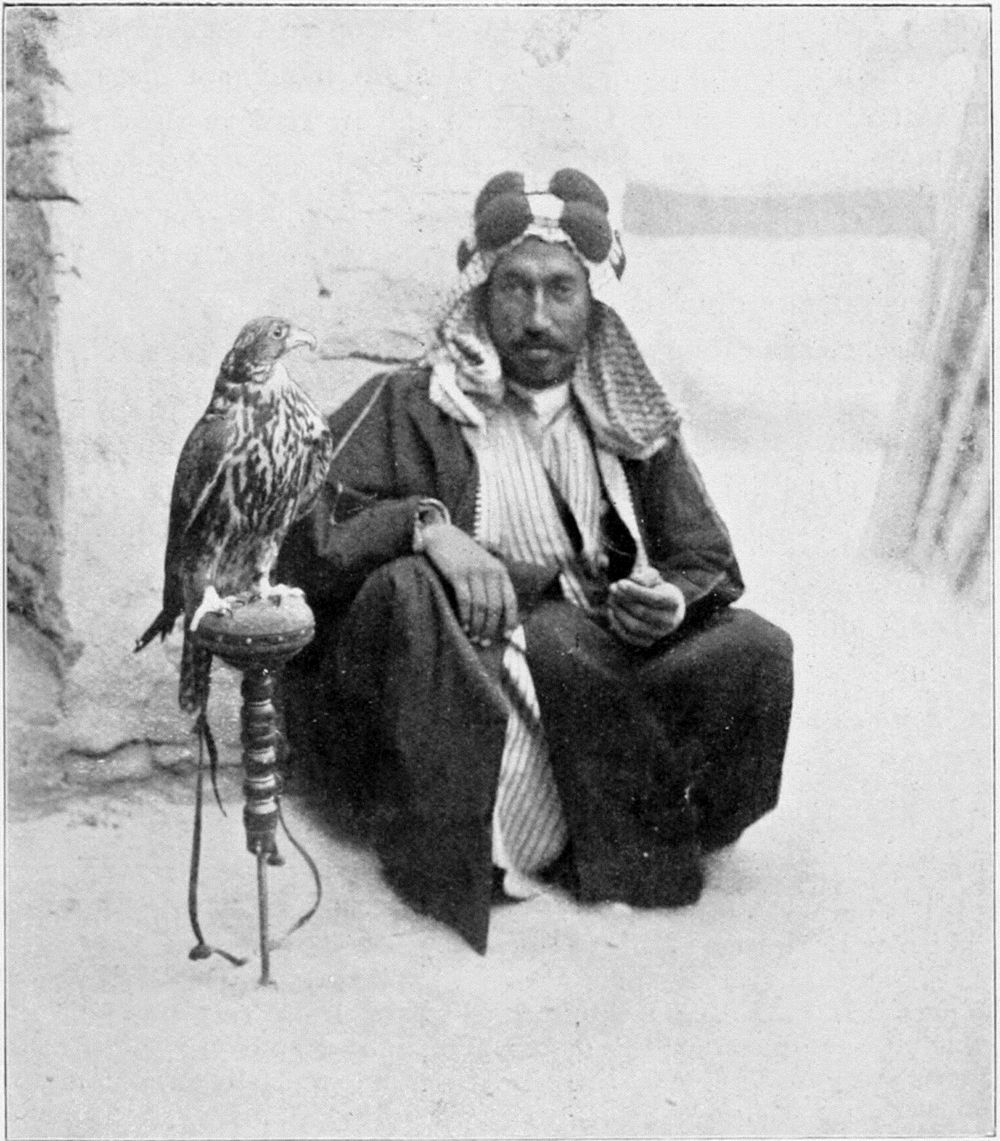
XVI
ARAB FALCONER WITH YOUNG SAKER ON PADDED AND SPIKED PERCH
Early next morning, before sunrise, take the hawk on your fist; sit with a few friends near a lamp or a fire sipping your tea or coffee, and perform your prayers. Every now and then remove the hood for about five seconds, and then rehood. For about three days feed her under the hood, calling her name. Now at early sunrise,[405] on the morning of the third or fourth day, take just sufficient meat for one meal; well wet your hawk under her wings,[406] wash her nostrils, letting a little water enter them, and set her perch[407] in a quiet place in the sun where none can disturb you, and seat yourself near on the ground. Now remove the hood and handle her a little, stroking her breast, head, and neck; then slowly carry your fist close to her perch and induce her to step on to the perch of her own accord.[408] Hold the leash in your hand, and occasionally draw it tight gently to induce her to “rouse.”[409] She is sure, after one of these rousings, to commence oiling her feathers.[410] When you see that she has carried her beak to the oil-bottle[411] near her tail, preparatory to oiling her feathers, you must sit absolutely still; do not pull the leash; keep a guard even over the way you breathe, and let her oil her feathers to her heart’s content.
If she oils her feathers very quickly and then rouses, it is a sign she is well-manned.[412] If after oiling and rousing, she a second time applies her beak to her oil-bottle, it is a sign that she is both well-manned and well-plucked.
Let her remain on the perch a little longer while she preens[410] and straightens[413] her feathers and again rouses with vigour. Immediately she rouses, take in your hand the meat you have ready, and calling her name, induce her to step on to your fist, and reward her as before. Do this a third time, but this time try and induce her to jump to your fist the length of her leash or less. Then call her name and reward her by a good feed. Now hood her and place her on the ground. Call her name and strike on the ground with your hand, in front of her.[414] If she advances even two finger breadths towards the sound, it is sufficient. Reward her by letting her pull and eat two or three mouthfuls of meat, and while she is eating pull off the hood and let her finish her meal and enjoy herself. She will by this means learn that no one wishes to harm her, and that being tame is not at all a bad thing. After feeding her take a small piece of wool, or cotton-wool, and clean her nostrils.[415] Then fasten the braces of the hood tight, and set her on her perch in the shade.[416]