Volume 2 — CHAPTER XXIV. A NAVAL STUDY FOR ALL TIME.
Reading edition
CHARTS, ETC., SUPPLIED BY THE PRESENT GOVERNMENT.—REFUSED BY A FORMER GOVERNMENT.—ALTERATION MADE IN THE CHARTS.—MR. STOKES’S AFFIDAVITS.—LETTER TO SIR JOHN BARROW.—SINGULAR ADMIRALTY MINUTE.—SECOND LETTER TO SIR JOHN BARROW.—THE CHARTS AGAIN REFUSED.—MY DEPARTURE FOR CHILI.—RENEWED APPLICATION TO THE ADMIRALTY.—KINDNESS OF THE DUKE OF SOMERSET.—DIFFERENCE OF OPINION AT THE ADMIRALTY.
It will be asked, “How is it that the matters recorded in the present volume are, after the lapse of fifty years, for the first time made public?”
The reply is, that it was not till after the publication of the preceding volume that I have been enabled to place the subject in a comprehensible point of view[1], and that only through the high sense of justice manifested by the late and present First Lords of the 2Admiralty, in furnishing me with charts and logs, access to which was prohibited by former Boards of Admiralty. On several previous occasions the attempt has been made, but from the obstinate refusal of their predecessors to afford me access to documents by which alone truth could be elicited, it has not hitherto been in my power to arrive at any more satisfactory result than that of placing my own personal and unsupported statements in opposition to the sentence of a court-martial.
The necessary materials being now conceded, in such a way as to enable me to prepare them for publication in detail, it is, therefore, for the first time in my power to vindicate myself. A brief recapitulation of former refusals, as well as of the manner in which I became possessed of such documentary testimony as will henceforth exhibit facts in a comprehensive point of view, is desirable, as placing beyond dispute matters which would otherwise be incredible.
My declaration previous to the court-martial—that it was in my capacity as a member of the House of Commons alone that I intended to oppose a vote of thanks to Lord Gambier, on the ground that no service had been rendered worthy of so high an honour—will be fresh in the remembrance of the reader[2]; and also that when, at the risk of intrenchment on the privilege of Parliament, the Board of Admiralty called upon me officially to accuse his lordship, I referred them to the logs of the fleet for such 3information relative to the attack in Aix Roads as they might require[3];—it nevertheless became evident that I was regarded as his lordship’s prosecutor! though, throughout the trial, excluded from seeing the charts before the Court, hearing the evidence, cross-examining the witnesses, or even listening to the defence![4]
On the acquittal of Lord Gambier, the ministry did not submit the vote of thanks to Parliament till six months afterwards, viz. in the session of the following year, 1810. To myself, however, the consequences were—as Lord Mulgrave had predicted—immediate; bringing me forthwith under the full weight of ministerial displeasure. The Board of Admiralty prohibited me from joining the Impérieuse in the Scheldt.
The effect of this prohibition in a manner so marked as to be unmistakeable as to its cause, produced on my mind a natural anxiety to lay before the public the reasons for a proceeding so unusual, and, as a first step, I requested of the Board permission to inspect the charts upon which—in opposition to the evidence of officers present at the attack—the decision of the court-martial had been made to rest. The request was evaded, both then and afterwards, even though persisted in up to the year 1818, when it was officially denied that the original of the most material chart was in the possession of the Admiralty. Even inspection of a copy admitted to be in their possession was refused.
An assertion of this nature might be dangerous were not ample proof at hand.
4It having come to my knowledge, from certain affidavits filed in the Court of Admiralty by Mr. Stokes, the master of Lord Gambier’s flagship, on whose chart the acquittal of Lord Gambier had been based—that, after the lapse of eight years from the court-martial! material alterations had been made by permission of the Board itself and under the direction of one of its officers—I naturally became suspicious that the charts might otherwise have been tampered with; the more so, as neither at the court-martial, nor at any period subsequent to it, had I ever been allowed to obtain even a sight of the charts in question.
The very circumstances were suspicious. On the application for head-money to the Court of Admiralty in 1817, the Court had refused to receive Mr. Stokes’s chart, on account of its palpable incorrectness. On this, Mr. Stokes applied to the Admiralty for permission to alter his chart! The permission was granted, and in this altered state it was received by the Court of Admiralty, which, on Mr. Stokes’s authority, decreed that the head-money should be given to the whole fleet, contrary to the Act of Parliament, instead of the ships which alone had taken part in the destruction of the enemy’s vessels.
Fearful that material erasures or additions had been made, I once more applied to the Board for permission to inspect the alterations. The request was again refused, though my opponents had been permitted to make what alterations and erasures they pleased.
The following are extracts from the above-mentioned affidavits of Mr. Stokes:—
5Extract from the affidavit, sworn before the High Court of Admiralty on the 13th of November, 1817, of Thomas Stokes, master of the Caledonia, as to the truth of the MSS. chart, upon which the acquittal of Lord Gambier was based; before the Court of Admiralty rejected his chart, and before the alterations were made.
“And this deponent maketh oath that the annexed paper writing marked with the letter A, being a chart of Aix Roads, is a true copy[5] made by this deponent of an original French chart found on board the French frigate L’Armide in September, 1806, which original chart is now in the Hydrographic Office in the Admiralty, and by comparing the same with the original chart he is enabled to depose, and does depose that the said chart is correct and true, and that the soundings therein stated accurately describe the soundings at low water, to the best of his judgment and belief.”
Extract from a second affidavit, sworn by Mr. Stokes, before the High Court of Admiralty, on the 17th of April, 1818, after the Court had refused to admit his chart from its incorrectness; and after the alterations had been made!
“Appeared personally, Thomas Stokes, master in the Royal Navy, and made oath that the original MSS. chart found on board the French frigate L’Armide, and marked A, annexed to his affidavit of the 13th of November, 1817, were delivered at the Hydrographic Office at the Admiralty, and this deponent for greater convenience of reference! inserted a scale of a nautic mile!! the original manuscript chart having only a scale of French toises; that in inserting a scale of a nautic mile, this deponent had allowed a thousand French toises to a nautic mile, and that Mr. Walker, the Assistant-Hydrographer, accordingly made the erasures which now appear on the face of the chart!” &c.
In these affidavits Mr. Stokes first distinctly swore 6that his chart, copied from a French MSS. was correct; 2ndly—when detected by the Court of Admiralty—that it was incorrect; 3rdly—that the original was deposited in the Hydrographic Office at the Admiralty.
My application to Sir John Barrow, then Hydrographer to the Admiralty, was as follows:—
“May 4th, 1818.
“Sir,—As it appears by the affidavit of which I enclose a copy that two charts of Aix Roads, the one stated to be a copy of the other, were deposited in the Hydrographic Office, and that the one purporting to be the copy has been delivered up for the purpose of being exhibited as evidence on the part of my opponents in a cause now pending in the High Court of Admiralty, and as it further appears that an alteration in the last-mentioned chart was made by Mr. Stokes, and a further alteration by Mr. Walker, Assistant-Hydrographer, I have to request that the Right Honourable the Lords Commissioners will be pleased to permit me to see the other or original chart of Mr. Stokes still remaining at the Hydrographic Office, in order that I may be enabled to judge for myself of the nature and effect of the alterations now acknowledged to have been made on the charts. The reasonableness of this request will, I presume, be manifest to their Lordships, and the more especially, seeing that my opponents are not only allowed similar access, but have been permitted to withdraw one of the said charts for the purpose of exhibiting it in evidence, notwithstanding that a variation from the original has been avowedly made therein.
I have, &c.,
“Cochrane.
“Sir John Barrow, Hydrographer, &c.”
To this request Sir John Barrow, on the 6th of May, returned the following refusal:—
“As Mr. Stokes’s charts have been restored to him, and a copy made for the use of the office, I am directed to acquaint 7your Lordship that my Lords cannot comply with your request in respect to the original chart, and as to the copy of the chart made in this office and now remaining here, their Lordships do not feel themselves at liberty to communicate it.
“I have the honour, &c.
“John Barrow.”
This refusal was accompanied by the following copy of a minute from the Admiralty: in which it was pretended that Stokes had only lent the original chart to the Hydrographer’s office, to be copied for the use of the Hydrographic Department—though it had been made use of to acquit an admiral, to the rejection of the charts of the fleet, as will presently be seen.
“Mr. Stokes lent the original chart to the Hydrographer’s office, to be copied for the use of that department.
“Mr. Stokes then went abroad.
“On his return he applied for his chart, which being mislaid they gave him the copy.
“Stokes, finding the alteration objected to in a court of law, applied about a month since for his own chart, the original of which was restored to him, copy being made.”—23, 141, 147.
To this singular communication and minute I returned the subjoined reply:—
“13, Henrietta Street, Covent Garden.
18th May, 1818.
“Sir,—Your letter of the 6th of May was delivered to me as I was going out of town, consequently I had no opportunity of referring to documents which I have since consulted, in order to refute the statements which the Lords of the Admiralty appear to have received.
“You inform me, by command of their Lordships, that ‘it appears by a report from the Hydrographer that Mr. Stokes had become possessed of the original chart which he 8lent to the Hydrographer’s office for the use of that department.’ This appears to imply that Mr. Stokes became possessed of the original chart at the time of the attack in the Charente under Lord Gambier, whereas Mr. Stokes made oath that it was taken from the Armide in 1806, two years and a half previous to the attack in question. As it does not appear from the Minutes of the court-martial on Lord Gambier that the original chart was then produced, and as it is not now forthcoming in the cause now pending in the Court of Admiralty, I am compelled to disbelieve its existence, or at least to believe that it underwent material alterations after it came into Mr. Stokes’s possession. The original ought to have been exhibited with the copy at the trial of Lord Gambier, and both either were or ought to have been filed in the office of the Admiralty with the Minutes of the proceedings; but whether either are so filed their Lordships have not permitted me to ascertain.
“If the original were filed, it could not afterwards have been ‘lent by Mr Stokes to the Hydrographer’s office to be copied for the use of that department.’ Even had the copy only been filed—sworn as it was by Mr. Stokes ‘to be correct!’ there could have been no necessity—if Mr. Stokes was deemed worthy of belief—for the Hydrographer to borrow the original. Eight years having elapsed since the court-martial on Lord Gambier, you inform me that ‘Mr. Stokes on his return from abroad applied for his chart accordingly, which chart happening to be mislaid, he was furnished with the copy in question,’ viz. that ‘made for the use of the Hydrographer’s department.’ It is important to observe that this is completely at variance with the affidavit of Mr. Stokes, who swears that ‘he himself made the copy,’ and that ‘both the copy and the original were delivered at the Hydrographic Office!’ It cannot fail to be observed, that to ‘deliver’ a chart at the Hydrographic Office, and to ‘lend a chart to be copied for the use of that department’—the language of the letter before me—are different expressions, conveying widely different meanings.
9“It is also material to observe that it is strange alterations at all should have been made on a chart represented to be a copy of an original, and exhibited as evidence in a court of law. That such original is not forthcoming is a very material and a very suspicious circumstance. If it be true, or if there really be any other chart than that which is described as a copy and admitted to be altered, I may fairly infer that such altered copy differs so materially and so fraudulentlyfraudulently from the original, or that the original—so called—is itself so palpable a fabrication, or has so obviously been altered, that Mr. Stokes and his employers do not dare to exhibit it in a court of law; and have withdrawn it from the Hydrographer’s office for the purpose of suppressing so convincing a proof of the fraud practised on Lord Gambier’s trial.
“Exclusive of the glaring contradiction between the statements of Mr. Stokes on the court-martial, and that which you have been commanded to make to me, when it is considered that Mr. Stokes is detected in having altered a document which he exhibits in a court of law as a correct copy of an original, and that he is no sooner detected than he endeavours to defend the alteration by declaring that it proceeded from the Hydrographer’s office, where the original was deposited; and that upon such defence leading to an application for leave to inspect the original, answer is made that such original had merely been borrowed of Mr. Stokes, and had been returned to him at his own request, and that request, too, made in consequence of the alteration in the alleged copy having been detected—it is impossible not to infer a juggle between Mr. Stokes, the Hydrographic Office, and others whom I shall not here undertake to name, for the purpose of defeating the ends of justice.
“Cochrane.
“Sir John Barrow, Hydrographer, &c.”
Receiving no reply to this letter, I subsequently addressed the following to the Secretary of the Admiralty.
10
“9, Bryanstone Street, Portman Square,
2nd July, 1818.
“Sir,—I feel it proper to inclose to you, as Secretary of the Admiralty, a copy of an affidavit, accompanied by a general outline of the chart of Basque Roads, the originals of which are filed in the High Court of Admiralty, by which their Lordships will clearly perceive that five more ships of the line might and ought to have been taken or destroyed, had the enemy been attacked between daybreak and noon on the 12th of April. And I have to request, Sir, that you will have the goodness to lay these documents before their Lordships (as well as the inclosed printed case which they have already partly seen in manuscript), with my respectful and earnest desire that their Lordships may be pleased to cause the facts therein set forth to be verified by comparing them with the original documents, logs, charts, and records in their Lordships’ possession. I am the more solicitous that the present Lords Commissioners of the Admiralty should adopt this mode of proceeding, as it will enable them decisively to judge on a subject of great national importance, and also to ascertain (what a portion of the public know) that it is not by false evidence from amongst the lower class of society alone that my character has been assailed, in order not only to perpetuate the concealment of neglect of duty, but to prevent an exposure of the perjury, forgery, and fraud by which that charge was endeavoured to be refuted.
“I beg, Sir, that you will assure their Lordships on my part, that as a deep sense of public duty alone induced me formerly to express a hope that the thanks of Parliament might not be pressed for the conduct of the affair in Basque Roads, so, in addition to that feeling, which made me disregard every private interest, I have formed a fixed determination never, whilst I exist, to rest satisfied until I expose the baseness and wickedness of the attempts made to destroy my character, which I value more than my life.
“As the affidavits of Captains Robert Kerr and Robert Hockings (which, as well as my own, are filed in the High Court of Admiralty) may immediately be made the subject of 11indictment in a court of law, and as the proceedings in the Admiralty Court have been put off under the pretence of obtaining further evidence in support of the mis-statements of these officers and the claim of Lord Gambier, I have respectfully to request that when the Lords Commissioners of the Admiralty shall have instituted an inquiry into the logs, charts, and documents, and ascertained the conduct of the before-named officers, they will be pleased to cause public justice to be done in a matter involving the character of the naval service so deeply.
“If, Sir, through their Lordships’ means, a fair investigation shall take place, it will be far more gratifying than any other course of proceeding.
“I have the honour to be, &c. &c.,
“Cochrane.
“Jno. Wilson Croker, Esq., Secretary, &c., Admiralty.”
After the above correspondence I gave up, as hopeless, all further attempts to obtain even so much as a sight of the charts without which any public explanation on my part would have been unintelligible.
In the year 1819—when nearly ruined by law expenses, fines, and deprivation of pay—in despair moreover, of surmounting the unmerited obloquy which had befallen me in England—I accepted from the Chilian government an invitation to aid in its war of independence; and removed with Lady Cochrane and our family to South America, in the vain hope of finding, amongst strangers, that sympathy which, though interested, might, in some measure compensate for the persecutions of our native land.[6] I will not attempt 12to describe the agonised feelings of this even temporary exile under such circumstances from my country, in whose annals it had been my ambition to secure an honourable position. No language of mine could convey the mental sufferings consequent on finding aspirations—founded on exertions which ought to have justified all my hopes—frustrated by the enmity of an illiberal political faction, which regarded services to the nation as nothing when opposed to the interests of party.
On my return to England, from causes which will appear in the sequel, the subject of the charts was not again officially renewed.
Latterly, however, considering that at my advanced age there was a probability of quitting the world with the stigma attached to my memory of having been the indirect cause of bringing my commander-in-chief to a court-martial—though in reality the charges were made by the Admiralty—I determined to make one more effort to obtain those documents which alone could justify the course I had deemed it my duty to pursue. In the hope that the more enlightened policy of modern times might concede the boon, which a former period of political corruption had denied, I applied to Sir John Pakington, late First Lord of the Admiralty, for permission to inspect such documents relative to the affair of Aix Roads as the Board might possess.
13Permission was kindly and promptly granted by Sir John Pakington; but Lord Derby’s ministry going out of office before the boon could be rendered available, it became necessary to renew the application to the successor of the Right Honourable Baronet, viz. his Grace the Duke of Somerset, who as promptly complied with the request. The reader may judge of my surprise on discovering, in its proper place, bound up amongst the Naval Records, in the usual official manner, the very chart the possession of which had been denied by a former Board of Admiralty!
The Duke of Somerset, moreover, with a consideration for which I feel truly grateful, ordered that whatever copies of charts I might require, should be supplied by the Hydrographic Office; so that by the kindness of Captain Washington, the eminent hydrographer to the Board, tracings of the suppressed charts have been made, and are now appended to this volume. His grace further ordered that the logs of Lord Gambier’s fleet should be submitted to the inspection of Mr. Earp, with permission to make extracts; an order fully carried out by the courtesy of Mr. Lascelles, of the Record Office, to the extent of the logs in his possession.
It is, therefore, only after the lapse of fifty-one years and in my own eighty-fifth year,—a postponement too late for my peace, but not for my justification,—that I am, from official documents, and proofs deduced from official documents which were from the first and still are in the possession of the Government, enabled to remove the stigma before alluded to, and to lay before the public such an explanation of the fabricated chart, 14together with an Admiralty copy of the chart itself, as from that evidence shall place the whole matter beyond the possibility of dispute. It will in the present day be difficult to credit the existence of such practices and evil influences of party spirit in past times as could permit an Administration, even for the purpose of preserving the prestige of a Government to claim as a glorious victory! a neglect of duty which, to use the mildest terms, was both a naval and a national dishonour.
The point which more immediately concerns myself is, however, this:—that the verdict founded on this fabricated chart, together with the subsequent official enmity directed against me in consequence of my determination to oppose the vote of thanks to Lord Gambier, was persevered in year after year, till it reached its climax in the consequences of that subsequent trial which was made the pretext for driving me from the navy, in defiance of remonstrance at the Board of Admiralty itself. I have not long been aware of the latter fact. Admiral Collier has recently informed me that Sir W.J. Hope, then one of the Naval Lords of the Admiralty, told him that considering the sentence passed against me cruel and vindictive, he refused to sign his name to the decision of the Board by which my name was struck off the Navy List.
CHART A.
Tracing from the official French Chart of the isles of Ré and d’Olleron. Tendered to the Court-Martial by Lord Cochrane, and rejected.
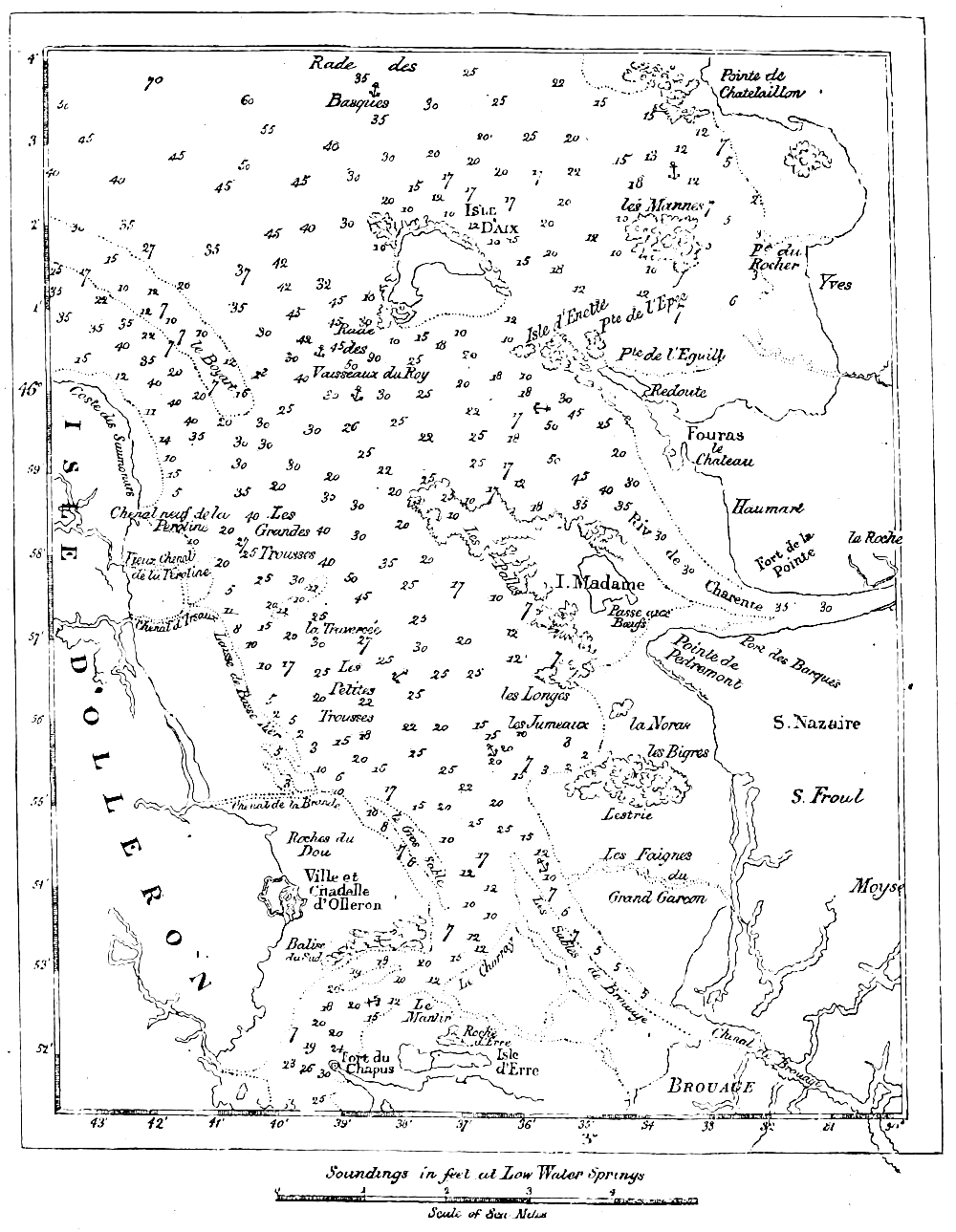
Soundings in feet at Low Water Springs London: Richard Bentley: 1860.
15