Volume 2 — CHAP. XXVII. CONDUCT OF THE COURT-MARTIAL.
Reading edition
LORD GAMBIER’s DEFENCE.—SECOND DESPATCH IGNORING THE FIRST.—ATTEMPT OF THE COURT TO STOP MY EVIDENCE.—EVIDENCE RECEIVED BECAUSE OPPOSED TO MINE.—I AM NOT PERMITTED TO HEAR THE DEFENCE.—THE LOGS TAMPERED WITH.—LORD GAMBIER’S DEFENCE AIMED AT ME UNDER AN ERRONEOUS IMPUTATION.—MY LETTER TO THE COURT CONFUTING THAT IMPUTATION.—ADMIRALTY ACCUSATION AGAINST LORD GAMBIER ON MY REFUSAL TO ACCUSE HIS LORDSHIP.—HIS INSINUATIONS AGAINST ME UNCALLED FOR.—ASSUMES THAT I AM STILL UNDER HIS COMMAND.—ENEMY ESCAPED FROM HIS OWN NEGLECT.—THE SHOALS PUT IN THE CHART TO EXCUSE THIS.—ATTEMPT TO IMPUTE BLAME TO ME AND CAPTAIN SEYMOUR.—THE TRUTH PROVED BY CAPTAIN BROUGHTON THAT LORD GAMBIER HAD NO INTENTION OF ATTACKING.ATTACKING.—LORD HOWE’S ATTACK ON THE AIX FORTS.—CLARENDON’S DESCRIPTION OF BLAKE.
The most damnatory point connected with the court-martial is—that on finding me inflexible with regard to the vote of thanks to Lord Gambier, the Board of Admiralty ordered his lordship, After his return to England, to write a second despatch containing fresh details of the action! thus superseding the first despatch written by himself as Commander-in-chief at the time of the action!!
With this extraordinary demand Lord Gambier appears to have gladly complied on the 10th of May, 1809; so that there are two despatches (Appendix A, written on the spot, and B, written in England), the first highly praising me for what I neither did nor intended to do—the second Ignoring my services altogether!! 83In fact, only mentioning me by name, as lying “about three miles from the enemy.” One step more in the second despatch, viz. that I was not in Aix Roads at all! would only have been in keeping with the assertion just quoted. Were not these contradictory documents now adduced, the denial of such an act by suppressing all mention of it in the despatches would be incredible. Nevertheless, I fearlessly assert, that to my personal conduct of the explosion vessel was solely attributable the panic produced in the enemy’s fleet, and that such conduct was one of the most desperate acts on record. There, however, they are—printed in the Appendix at the end of this volume. The naval reader may regret their reproduction, as I do, for the sake of the service, but he can no more ignore them than I can pass them over.
There is nothing like this in the records of the British or any other naval service, and the reasons for a precedent so unusual must themselves have been extraordinary. It is clear to me, that from the order of the Board of Admiralty to the Commander-in-chief to make a second report of the action in Aix Roads the court-martial took its cue. This may be a harsh conclusion, and perhaps would be so were it not corroborated by circumstances, not the least significant of which was, that the Commander-in-chief’s official report had been long before published in the Gazette! No naval reason to invalidate this official report was alleged, or could have existed.
During my examination before the Court I alluded to the fact of having “reported to the Commander-in-chief 84the ruinous state of the Ile of Aix, it having the inner fortifications completely blown up and destroyed. This I not only ascertained from the deck of the Impérieuse with perfect precision as to the side towards us, but also as to the opposite side, from personal observations made from the main-topgallant mast-head. There were thirteen guns mounted.” (Minutes, p. 58.)
This evidence, if admitted, and its truth was fully proved by the testimony of other officers, completely confirmed Lord Gambier’s previous statement to the Admiralty, that “the fortifications were no obstacle.” But now it was expedient that these fortifications should constitute the bugbear which, as was asserted, would have destroyed any British ships sent in to attack the enemy’s ships aground! and that the issue of the court-martial mainly rested on establishing the formidable character of the fortifications, a second despatch was called for. When, in my evidence, I was explaining to the Court the little danger to be apprehended from these fortifications—one of the principal points before the Court, Admiral Young stopped me with the query, “Will you consider, my Lord Cochrane, before you go on, HOW FAR THIS IS RELEVANT?”
On my insisting upon further explanation the Judge-Advocate attempted to stop me, by demanding—“Can this relate to the question asked?” The President—seeing that I would not be stopped—remarked—“Lord Cochrane states this as his reason for not taking a particular line of conduct.” I stated it for no purpose of the kind, but to show that opposition from such fortifications was hardly worth taking into consideration, and thus continued:—
85
“I have felt that if I had answered ‘Yes’ or ‘No’ to all the questions which had been put to me, I ought to be hung, and that if a court-martial were held upon me and only the answers ‘Yes’ or ‘No’ appeared to those questions, I should be hung for them.”
Judge-Advocate.—“I believe nobody has desired your Lordship to answer merely ‘Yes’ or ‘No!’”
A still more striking instance of the animus of the Court was the following attempted stoppage of Captain Beresford’s evidence.
Capt. Beresford.—“The only thing I know with respect to the Calcutta being fired, was by a conversation between Lord Cochrane and myself in the presence of Captain Bligh, Captain Maitland, and others.”
President.—“Is this strictly evidence, Mr. Judge-Advocate?”
Judge-Advocate.—“Yes! I should think it is; because I conceive it is to affect the evidence of Lord Cochrane!!!” (Minutes, p. 163.)
At the present day such proceedings in any tribunal would be thought impossible. There, however, they are on record—showing that the openly-avowed object of the court-martial was the suppression and invalidation of my evidence by any means that could be brought to bear, rather than an inquiry into the conduct of the Commander-in-chief on the merits of the case.
One point more must be noticed, relative to the manner in which the Court was conducted. Having reason to believe, as has been shown, that the inquiry was being directed against myself, I was naturally anxious to be present at the reading of the Commander-in-chief’s defence, in order to judge how far I might thereby stand affected. With this view I presented 86myself at the Court on the fifth day of the inquiry, when it was known that the defence would be made.
To my surprise the Court saw fit to refuse the privilege.
President.—“All the witnesses must withdraw.”
Lord Cochrane.—“With all due respect to the Court, in some former courts-martial the witnesses have been permitted to hear the defence.”
President.—“I never heard such a thing in my life. The Court have ruled the point.”
Lord Cochrane.—“The case of Admiral Harvey is a case in point.”
President.—“Lord Cochrane, the Court have determined the contrary.”
“(Lord Cochrane withdrew”.) (Minutes, p. 105.)
One of my reasons for wishing to be present was to ascertain what use would be made of the logs of the small vessels present in the action; it being quite clear from circumstances which had come to my knowledge that some of these had been tampered with. As such an assertion may readily be doubted, it must be confirmed.
When Mr. Earp inspected the logs at the Record Office, several, for the date of the action, were found missing from the log books. One—the log of a line of battle ship—had been torn out and was put back loose! This, however, is after-knowledge, I will rather rest the matter on circumstances at the time.
When the master of the Beagle was under examination, the subjoined conversation took place:—
President (to the Master).—“Were these things written (in the log) day by day as they occurred?”
87Master.—“Yes; everything was written every day at twelve o’clock.”
“Then what is called the log of the 6th of April was written on the 6th of April?”
Master.—“Yes.”
“And what is inserted here as of the 7th, was written on the 7th in this book?”
Master.—“Yes.”
“Is this the identical book into which it was copied from the board?”
Master.—“Yes.”
“And there never was any other log-book kept?”
Master.—“No.”
“Who kept this?”
Master.—“I kept it myself.”
President.—“It is written so fair and so neat that it bears every mark of being a fair copy!”
Judge-Advocate.—“I tell the gentleman I am sure no imputation rests upon him!”
President.—“No; not the least!”[49] (Minutes, pp. 30, 31.)
It was nevertheless a fact that it had been tampered with, as was unwittingly elicited by Mr. Bicknell from the same witness.
Question.—“You say, on your oath, that you believe everything in this log to be correct.”
Master.—“Yes.”
Question.—“How does it happen that the signals of the Impérieuse are inserted in the margin of the log amongst the columns, and not in the body of the log?”
88Master.—“I wrote that at the same time the log was written!”
“Why did you not put it in the body of the log in the narrative?”
Master.—“I made a mistake! in copying it from the log-board!” (Minutes, pp. 29, 30.)
It will thus be seen that my most material testimony was attempted to be stopped by the Court as “irrelevant;”—that the Judge-Advocate gave as a reason for receiving testimony really irrelevant, that it ought to be received because “it would affect the evidence of Lord Cochrane;”—that garbled logs were resorted to—that the whole proceedings were directed against me, and carefully in favour of Lord Gambier, by leading questions which abound in almost every page, that I was not allowed to be present whilst the witnesses were under examination, so that I had no opportunity of cross-examining them in my own vindication—a right granted to every man by the constitution of his country; and that I was refused admission to the Court during the delivery of Lord Gambier’s defence, by the Judge-Advocate himself! a most unusual course, that defence being full of the most injurious insinuations against my honour, though these were not borne out by evidence. In short, I was refused admission to the Court, though I quoted a precedent not two months old, in support of my right to be present—a right the more important to me if only from the fact of Lord Gambier having written a second despatch relative to the action in Aix Roads, in which despatch my services were altogether omitted, notwithstanding his lordship’s praises of my conduct 89in his first despatch written on the spot, where everything had transpired under his own observation.
I must now briefly advert to his lordship’s defence, but only so far as personally concerns myself.
Lord Gambier stated at the outset of his defence, that he had been compelled to demand a court-martial in consequence of “the insinuations thrown out against him by Lord Cochrane, which not only compromised his own honour, but that of brave officers and men serving under his command.” (Minutes, p. 105.)
I never threw out against his lordship a single insinuation, nor does one exist, either on the records of the Court or elsewhere. I merely told Lord Mulgrave, as narrated in the first volume, that I did not consider Lord Gambier’s services worthy of a vote of thanks from Parliament, and that on this ground, as bound by public duty to my constituents, I should resist it. As will presently be seen, this was also the opinion of many eminent men in Parliament, and on the same ground too—that of public duty. If I committed any offence in this, it was that of refusing to have my name coupled with that of Lord Gambier in the vote of thanks, and resisting an offer of an independent squadron and a regiment[50], not to persist in my determination of opposing it.
That my objection to the vote of thanks to Lord Gambier included any of the officers serving under him was a gratuitous assumption to secure sympathy for himself. As I have shown, the opinions of those officers present in the action, whose opinions were to 90be relied on, were anything but in Lord Gambier’s favour. Not a single word did I utter against any officer; though, on the ninth and last day of the court-martial, it was with the greatest difficulty, and after a positive refusal, that I succeeded in getting a denial of Lord Gambier’s unfounded assertion attached to the Minutes. It will be better to give the whole transaction.
The Right Honourable Lord Cochrane called in.
President.—“Lord Cochrane, I have received the note which you addressed to me, and have taken the sense of the Court upon it. The decision of the Court is, that as the matter to which your lordship refers does not at all bear upon the trial of Lord Gambier they cannot enter into it.”
Lord Cochrane.—“I would request, sir, that that letter may appear as an official letter to you, and that it may be entered upon the Minutes.”
President.—“The Court will take that into their consideration.”
The Court was cleared.
The Court was re-opened at one o’clock.
President.—“Lord Cochrane, the Court have taken into their consideration the note you addressed to them, and have agreed that it shall be attached to the Minutes.”
The letter was read, and is as follows:—
“August 4, 1809.
“Sir,—Having learnt from my brother officers that a report has gone abroad that I censured, in general terms, the conduct of the officers employed in the Road of Aix, on the 12th of April, I wish to have an opportunity to declare the truth on oath; considering reports of that nature highly injurious to the service of our country. I am also desirous to lay before the Court the orders given to the fireships for 91their guidance, as these will tend to elucidate and clear some of those who consider that blame has been imputed to them.
“I have the honour to be, sir,
“Your most obedient humble servant,
“Cochrane.
“Admiral Sir Roger Curtis, President.”
Let the reader mark that expression of the president, “it does not at all bear upon the trial of Lord Gambier!” Though the very first sentence of Lord Gambier’s defence was an accusation of myself upon an assumption for which there was no foundation whatever. Nothing but fear of a parliamentary debate caused that letter to be attached to the Minutes.
So clumsily was this accusation made against me, that Lord Gambier, despite the unwarrantable assumption just quoted, subsequently admitted my objection to the vote of thanks to have been solely aimed at himself, and not, as he had just said, at the officers and men of the fleet. Here are his lordship’s words:—
“Lord Cochrane warned the noble lord at the head of the Admiralty that if this measure (the vote of thanks) were attempted he should, if standing alone, oppose it; thus, without specifically objecting to thanks being given for the service performed, directing his hostility personally at me.” (Minutes, p. 107.)
That is—I should not have objected to a vote of thanks to the officers and men of the fleet, but only to himself personally. Yet in the same breath he accused me of traducing the officers and men of the fleet; with the intention, no doubt, of sheltering himself under the pretence of my having traduced them also. Could anything be more puerile? I gave no other 92“warning” to Lord Mulgrave than that which Lord Gambier correctly stated, and that I certainly did give, but without a word which could give rise to the slightest imputation on the officers and men of the fleet.
The fact is, that I never accused Lord Gambier at all, not even to Lord Mulgrave, to whom I only expressed an intention of opposing a parliamentary vote of thanks. It was the Board of Admiralty who accused him. Here are their accusations in full:—
“By the Commissioners for executing the office of Lord High Admiral of the United Kingdom of Great Britain and Ireland, &c.
“Whereas Admiral the Right Hon. Lord Gambier has, by his letter to our Secretary, of the 30th of May, 1809, requested that his conduct, as Commander-in-chief of the Channel Fleet employed in Basque Roads, between the 17th day of March and the 29th day of April, 1809, may be inquired into by a court-martial:
“And whereas, by the log-books and minutes of signals of the Caledonia, Impérieuse, and other ships employed on that service, it appears to us that the said Admiral Lord Gambier, on the 12th day of the said month of April, the enemy’s ships being then on shore, and the signal having been made that they could be destroyed, did, for a considerable time, neglect or delay taking effectual measures for destroying them: We, therefore, in compliance with his lordship’s request, and in consequence of what appears in the said log-books and minutes of signals, think fit that a court-martial shall be assembled for the purpose of examining into his lordship’s conduct, and trying him for the same: We send you herewith his lordship’s said letter, and also his letter of the 10th of the said month therein referred to, together with an attested copy of a letter of our Secretary, dated the 29th of last month, and addressed to Lord Cochrane, 93and his lordship’s reply thereto, with the log-books and minutes of signals above-mentioned: and we do hereby require and direct you to assemble a court-martial on Monday the 19th day of this month (if the witnesses shall be then ready, and if not then ready, as soon after as they shall be so) to try the said Admiral the Right Hon. Lord Gambier, for his conduct in the instance hereinbefore mentioned; and also to inquire into his whole conduct as Commander-in-chief of the Channel Fleet employed in Basque Roads, between the 17th day of March and the 29th day of April, 1809, and to try him for the same accordingly.—Given under our hands the 5th day of June, 1809.
(Signed) “Mulgrave.
“R. Bickerton.
“Wm. Domett.
“R. Moorsom.
“To Sir Roger Curtis, Bart., Admiral of the White, and Commander-in-chief of his Majesty’s ships and vessels at Spithead and in Portsmouth Harbour.
“By Command of their Lordships,
“W.W. Pole.”
There is nothing here from which it can be inferred that—to use Lord Gambier’s own words in his defence—I had driven him “to defend himself against the loose and indirect accusations of an officer so much his inferior in rank.” I had made no accusation whatever against him, having merely and only declared that the service rendered was not worth the thanks of Parliament; the frequency of such thanks for trifling service being at that period so notorious as to become subject for sarcasm, as will appear in the next chapter. Had Lord Gambier construed my parliamentary opposition rightly, he might 94have thanked me for saving him from himself, and would have done so, had not his peculiar failing, vanity, demanded an ovation for services which under evil advice he had prevented from being fully consummated. So far from accusing Lord Gambier, I was ordered by the Admiralty to do so, and refused, to my own detriment[51]; telling the Board to go to the logs of the fleet, and frame their own accusations, if they had any. Yet, even this consideration did not prevent Lord Gambier from giving utterance to the following bombast;—
“Whether Lord Cochrane supposed that he might with impunity endeavour to lower me in the opinion of my country and of my sovereign, signal marks of whose favour had at that instant been exclusively conferred upon himself,—whether his Lordship thought to raise his own reputation at the expense of mine,—and whether he expected that his threat would intimidate me to silence, I know not.” (Minutes, p. 108.)
How could I “raise my own reputation” at the expense of Lord Gambier, who had, in his first despatch, said that my conduct in the action of Aix Roads “could not be exceeded by any feat of valour hitherto achieved by the British navy;” though in his second despatch, substituted for the first after his return to England, and that too by order of the Board of Admiralty, he only remembered that I “lay with my ship about three miles from the enemy!” His lordship was not once within gunshot of the enemy, whilst my frigate was throughout engaged, and for some time single-handed, against two line-of-battle ships, and a fifty gun ship, the Calcutta, which I captured.
95So far from “raising my reputation at the expense of Lord Gambier’s,” I voluntarily stated on the court-martial, that “the feelings of Lord Gambier for the honour and interest of his country were as strong as my own.” (Minutes, p. 40.) For which mark of good nature, his lordship said in his defence, that even “in the present proceedings, Lord Cochrane stands in a situation only as an officer under my command!” (Minutes, p. 107) the meaning of which evidently was that I ought not to say anything but by order. The expression could not have had any other meaning.
I will not enter further into Lord Gambier’s unfounded recriminations upon myself, further than to remark, that even had they any foundation, in no way did they bear upon the subject of the trial, much less were they in any way connected with his defence to the inquiry as to why it was, that with a favourable wind, a rising tide, and plenty of water, he had refrained from attacking eleven ships helplessly ashore, allowing all but three to escape? This was the inquiry before the court, which, departing from the subject of inquiry, connived at its being substituted for recriminations on me for accusing Lord Gambier—though I had never done so.
Upon the real point Lord Gambier in his defence wisely abstained from trusting himself, except in such terms as the following. “If he had sent in any ships, and they should have been necessitated to remain a whole tide in the Roads of Aix; if they had been crippled in going in; if the wind, which was favourable for carrying them in, should not have shifted so as to bring 96them out again; and that even, if the wind were fair and they should lose their foremasts, the crews would not have been able to get the ships before the wind.” To this, I will add that “if,” instead of conjuring up these absurd dangers to be apprehended from an enemy of whom Lord Gambier had said to Captain Broughton, that they were “already destroyed,” his Lordship had sent in ships to finish the work, the court-martial would never have been heard of, and he would have enjoyed a legitimate triumph. I was not his enemy. Those who persuaded him not to second my efforts were so unquestionably.
Quitting these “ifs,” and calculations of possible risk and conjectural disasters, one or two points professionally connected with the defence remained to be noticed.
Lord Gambier knew, that during the ebb and rising tide, the enemy’s ships ashore were preparing to warp off with the flood, and he also knew that the only two enemy’s ships at anchor, the Foudroyant and Cassard, which at the court-martial were converted into bugbears to the whole British fleet, would be prepared in case of the attack which they naturally expected, to cut or slip, and so run for the mouth of the Charente as they did, the moment the ships aground had warped off and escaped.
When the British fleet weighed from Basque Roads, the enemy was, as Captain Broughton testified “panic struck.” When, in place of proceeding straight on to the attack, the British ships came to an anchor in Little Basque Roads, the enemy, as their own writers declare, considered “la mollesse de Lord Gambier” an unexpected 97stroke of good luck, and set energetically to work to warp off their ships from the bank on which they were stranded. As Captain Broughton rightly says, had the frigates and smaller vessels been then sent in, and a demonstration only made of others ready to follow, the destruction of the whole must have been complete. This is neither a matter of naval tactics nor science, but a commonplace consequence. It was this which caused Captain Malcolm to say, “Had it appeared to me that there was no other chance of destroying them, but by such an attack, I certainly think it ought to have been made.” (Minutes, p. 211.) And again, “Had they been attacked by the British ships, they could not, in my opinion, have been warped off from the shore, as to do so, it was necessary to lay out anchors to heave them off.” (Ibid.) There are no “ifs” or contingent disasters in Captain Malcolm’s opinion, which, as Captain Hutchinson pertinently remarks, was that of every officer in the fleet.
But even after the enemy’s ships had escaped, and the two at anchor, the Foudroyant and Cassard had run for the Charente, the Commander-in-chief allowed an hour and a half to escape before a single ship was sent into the inner roads, nor would any have been sent at all had not I taken the Impérieuse in alone, and then hoisted the signal “in want of assistance.” Had not this been done, not a single ship of the enemy’s fleet would have been destroyed, unless from the impossibility of getting her again afloat, and I am not aware that any such instance occurred.
To excuse this neglect, the hypothesis of banks and 98shoals, in the charts of Messrs. Stokes and Fairfax was resorted to, for they neither existed in the French charts, nor in reality. Coupled with this was the alleged danger of point blank shot from the dilapidated batteries!
“Scarcely,” says Lord Gambier, “had the Cæsar reached Aix Roads, before she grounded, and lay in a perilous situation exposed to the point blank shot of the batteries.” (Minutes, p. 128.) Unfortunately for this hypothesis, a careful search in the Cæsar’s log shows that she was never once touched by shot or shell!! and that in place of grounding in Aix Roads, she grounded on the Boyart Sand—on her way to Aix Roads—and that she lay there beyond the reach of shot; thus proving what other officers testified, viz. that there was plenty of room in the channel to avoid shot. The Cæsar only went a few feet too far, and came off next morning without damage of any kind.
A still less worthy part of the defence was, in laying the fault on myself and Captain, now Admiral Seymour, of the Pallas that nothing more was done. “Lord Cochrane,” says the Commander-in-chief, “remained in the Road of Aix, during the 13th and 14th, accompanied by the Pallas, sloops and gun-brigs, but nothing was attempted by those two frigates.” (Minutes, p. 129.) The fact was, that in the fight with the line-of-battle ships destroyed on the evening of the 12th, before any assistance came, the Impérieuse was severely damaged, so much so, as to occupy the whole of the 13th in repairs. This was why Admiral Seymour so gallantly stood by us, and the 14th was occupied in vain attempts even then to get a force sent in. Had 99Admiral Seymour run the Pallas alone amongst the line-of-battle ships which remained, at the mouth of the Charente, he would not have earned the high reputation he now enjoys. But when Lord Gambier threw out this questionable insinuation, he forgot to mention that Admiral Stopford lay at a short distance with two line-of-battle ships and half a dozen frigates, besides having our two frigates and all the smaller vessels under his command. Had Admiral Stopford been asked why, with such a force under his orders, he remained inactive, the reply would have not been to the Commander-in-chief’s credit. Admiral Stopford would not have been a spectator only, could he have helped himself.
I now quit this miserable subject for ever. The real fact is, that from over-persuasion of those who were jealous of a junior officer originating and being appointed to carry out plans deemed impossible by others, Lord Gambier declined to second my efforts, as Admiral Austen has plainly said in his letter previously quoted, the fact being as completely confirmed by Captain Hutchinson. This decision of his lordship was no doubt arrived at, when a council of officers were summoned on board the flag-ship, on the morning of the 12th, at which time the enemy’s fleet was lying helplessly ashore.
That, after such council, his Lordship never intended to make any attack at all on the French ships, is proved beyond question, by the subjoined testimony of Captain Broughton.
“A ship or two might have been placed, in my opinion 100against the batteries on the southern part of Ile d’Aix, so as to take off their fire AND SILENCE THEM. I mentioned to Sir H. Neale, when the signal was made for all captains in the morning, that I thought they were attackable—speaking of the confused state in which the French ships appeared to be at the time.”
“I heard my Lord Gambier the same morning say (at this council) it had been his intention to have gone against the batteries I now speak of, but as the enemy were on shore he did not think it necessary to run any unnecessary risk of the fleet when the object of their destruction seemed to be already obtained.” (Minutes, pp. 221, 222.)
That is, he admits my exertions to have destroyed the French fleet, (which was not destroyed—all except three ships having escaped) and plainly tells Captain Broughton that he will do nothing more! This should for ever decide the point.
If, however, proof be still wanted of the utter worthlessness of any opposition in the power of the enemy to offer, whether by fortifications or ships, it is to be found in the following statement at the close of Lord Gambier’s defence:—
“I conclude by observing that the service actually performed has been of great importance, as well in its immediate effects as in its ultimate consequences; for the Brest fleet is so reduced as to be no longer effective. It was upon this fleet the enemy relied for the succour and protection of their West India colonies, and the destruction of their ships was effected in their own harbour, in sight of thousands of the French. I congratulate myself and my country that this important service has been effected, under Providence, with the loss only of ten men killed, thirty-five wounded, and one missing. Not even one of the smallest of our vessels employed has been disabled from proceeding on any service that might have become necessary.” (Minutes, p. 138.)
101By this voluntary admission of Lord Gambier I am willing to be judged—feeling certain that posterity will be as fully convinced of the inability of the enemy to inflict material damage on our ships, as was Lord Gambier himself, according to his own testimony, as quoted in the above passage. As Lord Gambier truly says, no damage worth mentioning was done to any of our ships, to which I shall add, that at no period after the enemy’s ships were driven ashore were they in a condition to inflict damage. This his lordship not only admits, but proves, in the concluding paragraph of his defence, and yet the whole point of the trial is made to rest on the surmise that had Lord Gambier done anything against the enemy’s ships aground, the destruction of the British force must have been the consequence. That is, by doing nothing the enemy’s ships were destroyed; though by doing anything our own would have been in danger!!!
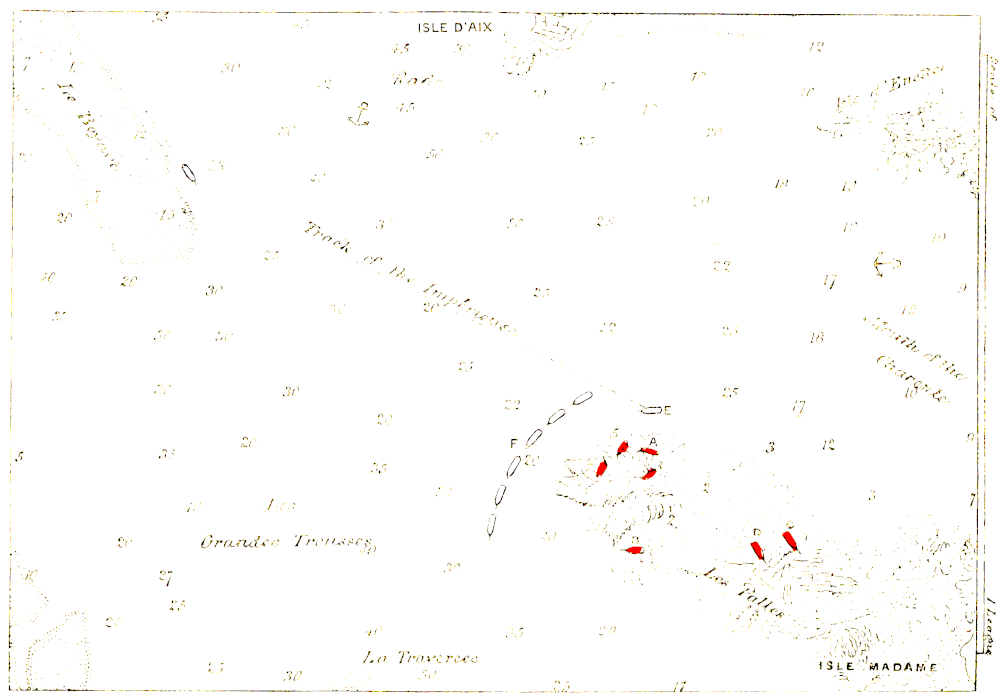
The subjoined chart B will show, at a glance, the whole affair.
CHART B
ISLE D’AIX AND LES PALLES,
Being a tracing from the official French Chart, and showing the positions of the enemy’s ships as they lay ashore on the morning of the 12th of April 1809, previous to their escape.
London: Richard Bentley: 1860.
A. Ocean three-decker and group on the north-west edge of the Palles Shoal. These were permitted to escape.
B. Calcutta, captured by the Impérieuse and set on fire.
C. Ville de Varsovie, hauled down her colours to the assisting ships. Afterwards burned.
D. Tonnerre, ditto, ditto.
The last three were destroyed on the falling tide, but no others! These being the only enemy’s ships which, after the escape of the other four, remained assailable.
E. The position taken up by the Impérieuse, she being at the time of the arrival of the assisting force engaged with the Calcutta, and with the other two ships.
F. Position of the British ships sent in after the Ocean and group had warped off, viz. within pistol shot of the sand on which the escaped ships lay till 1 p.m. aground.
102The best comment, perhaps, on the whole affair of Aix Roads is what had previously been effected with a less force than that under Lord Gambier, and when the fortifications were perfect. The subjoined historical facts should for ever put an end to all controversy on the subject, and at the same time to the untenable defence set up at this memorable court-martial.
“A well-planned and vigorous attack on the coast of France being in 1757 much desired, with a view to give a decisive blow to the marine of that kingdom (the very purpose for which Lord Gambier was sent, and which Lord Mulgrave especially impressed on me), a fleet was ordered to be got in readiness, under the command of Sir E. Hawke, Rear-Admiral Knowles being appointed second in command. On the 20th of September the fleet made the Island of Oleron, and Sir E. Hawke ordered the Vice-Admiral to proceed to Basque Road, to stand in as near to Ile d’Aix as the pilot would carry him, with such ships of his division as he thought necessary, and to batter the fort, until the garrison should either abandon it or surrender.”
“On the 22nd of September the fleet entered the bay called the Road of Basque, between the islands of Rhé and Oleron. About eight the next morning Admiral Knowles in the Neptune, with the Magnanime, Barfleur, America, Alcide, Burford, and Royal William, made sail towards Aix. Captain Howe (afterwards Earl Howe) in the Magnanime led the van. At half-past twelve the fort upon the island began to fire, but he continued to advance without exchanging a single shot, continually urging his pilot to lay his ship as close to the fort as possible. He dropped his anchor under the very walls. It was, however, near an hour before the fort struck its colours.” (Biographical Memoir of Earl Howe in the Naval Chronicle, vol. i. 1799; see also Campbell’s Lives of the Admirals.)
This was the very fort, only now in ruins,—or to 103use Lord Gambier’s words, “no obstacle, from the dilapidated condition of the fortifications”—that his lordship adduced as a reason for not endangering the British fleet by exposing the ships to its fire. Admiral Harvey had perhaps Lord Howe’s exploit in his mind’s eye when he told Lord Gambier to his face that “had Nelson been there, he would not have waited for fire-ships, but would have dashed at once at the enemy;” an assertion of which there can be no doubt, though poor Harvey was dismissed the service for this and similar opinions.
Another extract, from Lord Clarendon’s remarks on Admiral Blake, shall close the subject.
“He despised those rules which had been long in practice, to keep his ship and men out of danger, which had been held in former times a point of great ability and circumspection; as if the principal art requisite in the captain of a ship had been to be sure to come home safe again! He was the first man who brought ships to contemn castles on shore, which had been thought ever very formidable, and were discovered by him to make a noise only, and to fright those who could be rarely hurt by them.” (Clarendon’s History of the Rebellion.)
104