YOUR WATER SUPPLY AND SANITARY FACILITIES
Reading edition
One of the first major problems that confronts the city dweller starting the construction of a summer home is the water supply—or lack of it. Not only is water hard to get, comparatively speaking, but it is not always safe to use when obtained unless care is taken to see that its source is pure. Water cannot safely be declared fit for human consumption unless the surface of the well or spring remains permanently above the level of all nearby sources of pollution. Tight well platforms and casings, clean grounds and wide separation from probable channels of impure drainage are the best safeguards.
Power Pump Most Convenient
If you are content to pump your water by hand and do without a flush-type toilet and bath or shower, then a dug well with a bucket and windlass or one with a hand pump is sufficient. On the other hand, if you are wise you will install a small power pump—the cost is quite reasonable—and a storage tank, which can be either in the top of the house or on some nearby high ground. In estimating the amount of water you’ll need figure that the average bath takes 30 gallons, one flush of a toilet 4 to 6 gallons.
Government experts estimate the consumption of water per person in 24 hours is 4 to 8 gallons if only a hand pump is provided; if one faucet is installed, domestic uses require 7 to 15 gallons per person; if the house is equipped with hot and cold water in kitchen, bath and laundry, the consumption rises to 20-25 gallons, a family average of 100 gallons every 24 hours. That’s a lot of water to carry in pails or pump by hand.
If you build your cabin in the mountains, you may not have much success digging a well because bedrock may be close beneath the surface. If you build in or near some community of vacation homes, you can find out what method others employ in the neighborhood. In the more established communities you may find a co-operative water system in existence. Many of the privately developed summer home areas are served by local utility companies.
Test Your Water Frequently
If you are lucky enough to have a spring on your property, the water will probably be good—but test it first, and test it periodically thereafter—at least once a year. Then build a tight covering for the spring to keep out dirt and wandering animals and pipe the water to your house. (See illustration below.)
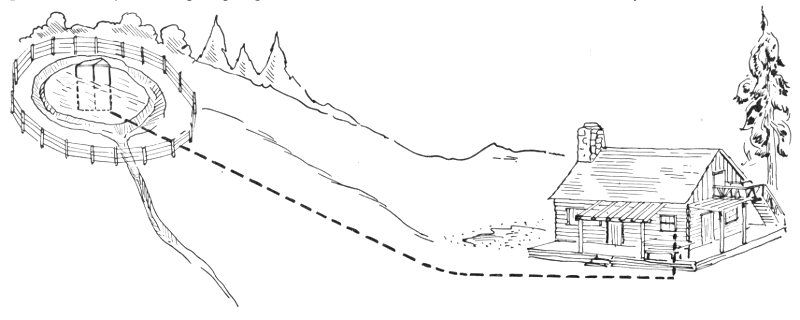
Cover your spring and fence it to keep out animals. The ditch helps prevent surface water from contaminating your house supply.
In some localities sub-surface conditions may be satisfactory for a dug well. It takes at least two men and a lot of work. One digs the earth out and the other raises it by a bucket and windlass. 7 Such a well should be lined with concrete or vitrified pipe and should have a tight covering. The best covering is a concrete well curb and a concrete or heavy wooden lid through which the pump pipe passes. A man-hole must be built, too, to allow entry for cleaning the well occasionally. (See Fig. 2.)
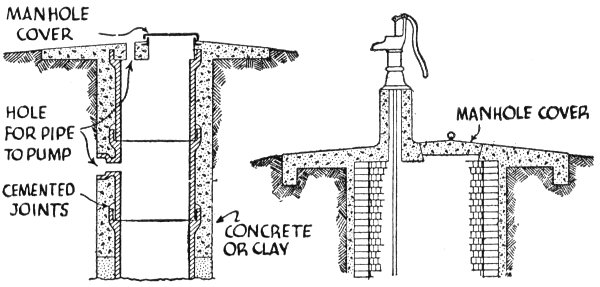
Fig. 2
MANHOLE COVER
HOLE FOR PIPE TO PUMP
CEMENTED JOINTS
CONCRETE OR CLAY
MANHOLE COVER
A driven well, which is successful in some locations, can be made by two men also, although it’s not an easy job. The point, a special length of pipe with a sharp steel point and screened openings to let the water in, is driven into the earth with a heavy maul or with a weight on a block and tackle. It is not practicable to sink such a well over 100 feet—a drilled well is easier and less trouble.
The ultimate source of your water supply should be definitely determined before you buy or lease a summer homesite. Before you start a well of any kind you would be wise to obtain the best available local advice.
Sanitation Important
The average city dweller is likely to overlook the important part sanitation plays in his daily life. Therefore, many summer homes are equipped with meager facilities for disposing of sewage. The old-fashioned “outhouse” which plays a rather comic part in song and story favored by such humorists as the late Chick Sale and James Whitcomb Riley, can hardly be considered an asset to the health and sanitation of a summer home community.
If such a building is necessary, at least follow the instructions given by the Department of Agriculture (see Farmer’s Bulletin No. 1227) so that it will be sanitary, fly-proof, easily cleaned, and as little of an “eye sore” as possible. A better type is the vault-privy with a watertight concrete vault, wide and shallow. It should have a trap at the rear to provide access for cleaning. A metal container may be substituted for the concrete work. This should have an airtight lid and must be removed frequently for cleaning.
There are a number of chemical septic tanks for sale, all of which dispose of waste matter by the action of bacteria and chemicals. They are not difficult to install. Further information may be obtained from the previously-mentioned Government bulletin.
Garbage Harbors Germs
Even though your cabin has running water and a regular flush toilet, the danger of waste disposal is not entirely eliminated. Garbage and refuse of all kinds are harbors for germs and flies can quickly spread disease germs gathered from such sources. The location of the water supply in relation to sewage disposal is of greatest importance, and it is not enough that the water source be above the distribution field of the sewer. It is a good idea to consult the nearest forest ranger, or some other person who is well acquainted with the locality, before making any such installations.
For sink drainage and kitchen waste a line of small sewer pipes, laid as shown in the accompanying diagram, is fairly adequate. Garbage and other refuse that cannot be drained away should be buried in a good-sized pit. This hole should be as nearly fly-proof as possible, and each fresh lot of refuse should be well covered with dirt or sand or sprinkled with a chloride of lime solution.
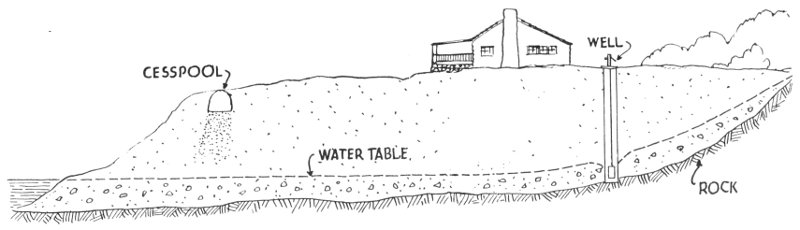
Proper relation of water supply and sewage disposal. But remember that underground water table may not slope the same as the surface. Ask your Forest Ranger.
CESSPOOL
WELL
WATER TABLE
ROCK
8