SELECTING THE SITE FOR YOUR VACATION HOME
Reading edition
Since you have decided to build a vacation home, your first problem is to find a location. The whole family will have something to say about this—half the fun of building a cabin or beach house is the planning of various details in family councils. No doubt, by the time you discover the region in which you would like to build, friends will have told you many of the important things to look for. However, here are a number that should help you.
If it is to be a summer vacation home and you have a car, the distance from home isn’t so important, because the Pacific Coast’s network of fine roads offers easy access to almost every area. On the other hand, if you are going to be a “week-ender,” don’t choose a site too far away. It isn’t fun to spend most of your weekend traveling to and from the cabin, and your friends will avoid you—but perhaps that’s your intention!
Cost of construction is important. It’s all very well to build a place out in the wilds, but the farther you go from civilization the more it costs to transport men and materials to your cabin site.
Watch the Distance
With the whole Pacific Coast to choose from it shouldn’t be too hard to find an area that suits all the family. You will be smart to pick a spot not more than an easy day’s drive from home. If it is only a few hours away, so much the better. Within less than one day’s drive from most points on the Pacific Coast you can lose yourself in a paradise of forests, lakes and mountains, or stand on the ocean shore and hear the breakers boom.
Naturally, you’ll want to invest most of your money in the cabin or beach house itself. That being the case the best place to go for low-cost mountain cabin sites is the United States Forest Service, which controls millions of acres of the finest timber and mountain country in the world. Beach property, on the other hand, is largely a commercial proposition, and you’ll more than likely have to consult your real estate dealer.
The National Forests offer cabin sites to suit every taste and every purse. However, certain areas are not open to settlement, and all cabins must conform to standards set by the Forest Service. You can’t buy the land, but you can occupy it under Special Use Permit. You get low cost, freedom from crowding and assurance that the area will not be ruined by commercialization.
The Forest Service opens new tracts for summer cabin sites when those opened in previous years are filled. Cabins are not crowded together as they are in some commercial tracts.
Many Sites Available
There are eighteen National Forests in California alone and dozens of others in the western states offering a diversity of climate and natural conditions. Of course, not all of the forests are available for cabin sites, but there is a large group from which to select. Most of the tracts available in National Forests are in groups of from six to one hundred lots or more, each lot averaging about ⅓ acre, depending upon topography and cover.
To obtain a cabin permit from the Forest Service, write or call on the Supervisor or nearest Ranger of the particular forest in which you think you’d like to live. Ask him what areas, if any, are open in his National Forest. If he has a forest officer available, he will arrange for him to visit the property with you. A personal visit is desirable but not absolutely necessary before applying for a permit.
Application for permit may be made in writing to the Forest Supervisor, or Forest Ranger, specifying the location of the property, the use to be made of it (summer cabin, hotel or resort) and the estimated cost of the improvements you intend to make.
Permits are granted strictly on a “first come—first served” basis. The cost—and this will amaze you—averages about $15 per year for 4 cabin sites, depending on the size and location of the property. Each permit is renewable annually. You may sell your cabin at any time, but the transaction must be approved by the Forest Service.
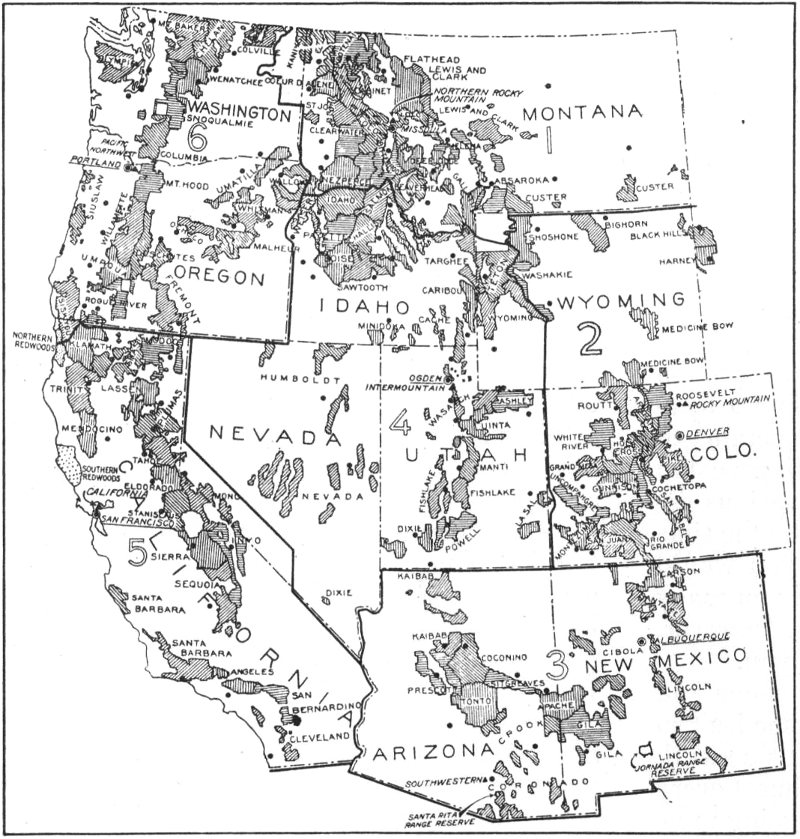
Map showing location of National Forests in the West
Don’t depend on your own knowledge of the outdoors when you pick a cabin site. The local forest officer knows more about his particular locality than anyone else, and he’ll be glad to help you.
When seeking information about a particular forest, be sure you write to the officer in charge of that forest, because he is the only one with a complete file of data on it. If you don’t know who your nearest forest supervisor is, write to the nearest regional forester. Here’s a list of offices:
Region No. 1 (Northern Idaho, Montana, South Dakota, Western Washington)—Federal Bldg., Missoula, Montana
Region No. 2 (Colorado, Nebraska, Oklahoma, South Dakota, Eastern Wyoming)—Post Office Bldg., Denver, Colorado
Region No. 3 (Arizona, New Mexico)—Federal Bldg., Albuquerque, N. M.
Region No. 4 (Colorado, Southern Idaho, Nevada, Utah, Western Wyoming)—Forest Service Bldg., Ogden, Utah
Region No. 5 (California and Western Nevada)—Phelan Bldg., San Francisco, Calif.
Region No. 6 (Oregon and Washington)—Post Office Bldg., Portland, Oregon
Region No. 7 (Kentucky, Maine, New Hampshire, Pennsylvania, Vermont, Virginia, West Virginia)—Victor Bldg., Washington, D. C.
Region No. 8 (Alabama, Arkansas, Florida, Georgia, Louisiana, Mississippi, North Carolina, South Carolina, Oklahoma, Tennessee, Texas, Puerto Rico)—Glenn Bldg., Atlanta, Ga.
Region No. 9 (Illinois, Indiana, Iowa, Michigan, Minnesota, Missouri, North Dakota, Ohio, Wisconsin)—Federal Bldg., Milwaukee, Wisconsin
Region No. 10 (Alaska)—Federal Territorial Bldg., Juneau, Alaska
When you apply for a permit, you must agree to install permanent improvements costing at least $500, including labor. Only one residence may be constructed on a lot, and in order to prevent the erection of unsightly “shacks”—some people’s ideas on cabins would surprise you—each permitee must submit his plans for approval before a permit will be issued.
All buildings and all roofs must be painted, oiled or stained. If paint is used, the color must harmonize with the forest background, and be approved by the Forest Supervisor. That does not mean that everything has to be brown and green, but the forest is no place for a pink stucco cottage.
Permanent construction must be completed by the end of the second season after the permit is issued.
Cabins built under “special use” permits must be occupied at least fifteen days each year by the permittee or his family, unless special arrangement is made with the Forest Service.
The principal requirements of the Forest Service regarding cabins are that they be built in a workmanlike manner with substantial roofs, floors, doors, windows, brick or masonry chimneys, toilets and garbage containers of a type approved by the Forest Supervisor. The general ensemble must be in harmony with the forest background. You don’t have to build your house just like your neighbor’s, but all cabins do have to be of an approved and attractive rustic style.
5
In large colonies you may be required to install a chemical toilet or septic tank, a piped water system, or other improvements to safeguard the general health of the community. Ask about these things.
If you build in a colony of summer homes, you must agree to abide by any rules and regulations agreed upon by a majority of the permit holders if they have or organize a cooperative public service group.
Choice of the actual site for a mountain cabin depends on drainage, view, shelter from storms, sunlight, ease of access, and so on. Probably the best location is one on a gentle slope, which assures that rain and snow will drain off, with the front of the cabin facing the center of interest and the principal windows placed to catch the prevailing breezes.
A slope is somewhat more difficult to build on than flat land, but in wet weather you won’t find puddles in front of the door and the floor won’t get damp. Remember, you don’t have tile sewers to carry off the water. Too steep a hillside makes building even more expensive, calling either for excavation or extra foundations. While a hillside site is attractive, it’s pretty tiresome lugging supplies up hill.
If you build on a slope or hillside, find out about the normal rainfall. You may need a watershed at the upper side of your lot to keep the run-off from trickling down into your cabin. A shallow ditch or a low wall is enough protection—but a necessary one. (See Fig. 1.)
Here are a few other details to think about: How near is the lot to a good road? It doesn’t have to be close to a main highway, but is it possible to reach your lot with a fair amount of convenience? Can you get supplies or help in case of emergency without too great effort? Next, how’s the water supply?
Water is one of the most important considerations. The forest officer can tell you what the stage of the water table is at your location, and you can decide what kind of well you will need. Above all, don’t plan to use the local trout stream or lake for drinking water. It may be a lovely lake, and the stream may ripple over pretty stones like tinkling bells, but pretty water isn’t necessarily pure water.
There are in the National Forests a number of associations of Special Use Permittees. These associations are formed partly for the advantages of collective bargaining and partly for the installation of certain facilities on a tract basis. Many of these associations have installed water systems, financed by assessments against the lot owners.
The winter climate is an important factor if you build in the snow country. In the mountains you may get snow ten feet or more in depth—and ten feet of snow weighs a lot. That requires extra sturdy construction of the cabin roof.
Actually, in a National Forest you’ll find that a good deal of the selection has been done by the Service for you. About all you have to do is to find the particular one that is most pleasing to the whole family and offers the greatest possibilities consistent with the money you have to spend. You can be absolutely sure that you will get the lot you pick out. Nor need you worry that after you get your pet cabin built someone else will build “Ye Olde Hot Dogge Shoppe” across the road.
In selecting a site for a beach house don’t be led into buying too close to the water. Remember that ocean storms often send the waves far up on land, so be sure to get expert advice on the safety of your location.
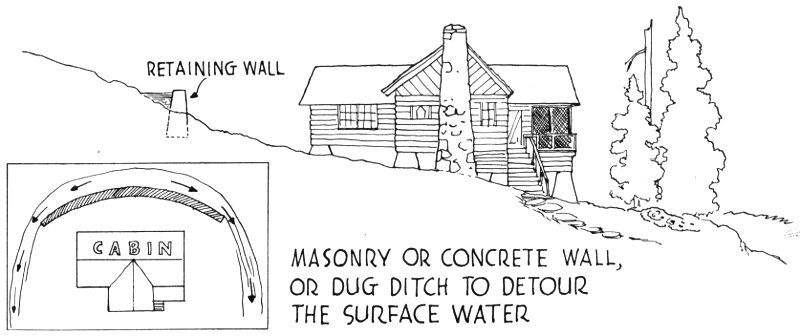
Fig. 1
RETAINING WALL
CABIN
MASONRY OR CONCRETE WALL, OR DUG DITCH TO DETOUR THE SURFACE WATER
6