GASTEROMYCETES.
Reading edition
Hymenium more or less permanently concealed, consisting in most cases of closely packed cells of which the fertile ones (the basidia) bear naked spores on distinct spicules, exposed only by the rupture or decay of the investing coat or peridium. Berkeley's Outlines.
This family has been subjected to numerous revisions since the days of Fries, when its structural characteristics were not so well understood as at present.
Montagne and Berkeley are credited with being the first to show the true structure of the hymenium in the puff-balls, as well as to demonstrate the presence of basidia. This important discovery led to the correlating of the Gasteromycetes with the Hymenomycetes under the common title Basidiomycetes, both having the spores borne upon basidia. The two families still remained distinct, however, not only because of the dissimilarity in their external features but principally on account of the difference in the disposition and character of the hymenium.
In the Hymenomycetes the hymenium is exposed to the light from the first, and the spores drop from the basidia as they mature; whereas in the Gasteromycetes the hymenial pulp, or gleba, consisting of the spores with the supporting basidia and the hyphæ, is enclosed within the substance of the fungus, and the spores are exposed only on the decay of the investing coat.
The basidia of the Gasteromycetes, though resembling those of the Hymenomycetes, are more variable in form and the number of the spores not so constant. They perform the same functions and bear spicules, sometimes in pairs, sometimes quaternate, each spicule being surmounted by a spore. They dissolve away as the spores mature and can, therefore, only be observed in the very young stage of the plant. The spores of the Gasteromycetes are usually colored and, except in the subterranean species, globose. As seen through the microscope they have often a rough warty appearance, sometimes spinulose. Paraphyses may be present as aborted basidia, but cystidia are rarely distinguished. A characteristic of a large proportion of the plants is the drying up of the hymenial substance, so that the cavity of the receptacle becomes at length filled with a dusty mass composed of spores and delicate threads, the remains of the shriveled hyphæ.
The following table will serve to show the distinctive features of the four primary divisions of the Gasteromycetes:
Lycoperdaceæ.—Hymenium fugitive, drying in a dusty mass of threads and spores, dispersed by an opening or by fissures of the peridium. Terrestrial.
Phalloideæ.—Hymenium deliquescent and slimy; receptacle pileate; volva universal. Fœtid fleshy fungi.
Hypogæi, or Hymenogastreæ.—Hymenium permanent, not becoming dusty or deliquescent except when decayed. Capillitium wanting. Subterranean.
Nidulariaceæ.—Receptacle cup-shaped or globose; spores produced on sporophores or short basidia enclosed in globose or disciform bodies (sporangia) contained within a distinct peridium. Terrestrial.
The section Lycoperdaceæ contains upwards of 500 species or more than two-thirds of the whole number of recorded species of the Gasteromycetes. Lycoperdon, Bovista, and Geaster, its most conspicuous genera, are said to contain the largest number of well-known species. A few are edible.
The Phalloideæ include about 90 species. The plants are usually ill-smelling and unwholesome. Some are stipitate, others are latticed, etc. Some are conspicuous for their bright coloring. In the young stage they are enclosed in an egg-shaped volva having a gelatinous inner stratum.
The plants of the Nidulariaceæ are very minute, tough, and widely distributed. The species Cyathus, the "bird's-nest fungus," is quite common in some localities, and is interesting because of its peculiar form. The individual plant is very small, not more than two centimeters high. It resembles an inverted bell, or a miniature wine-glass. A delicate white membrane covers the top at first. This disappears as the plant matures, revealing lentil-shaped bodies packed closely together like eggs in a nest. These oval bodies are the peridiola containing the spores. They are usually found upon rotten wood or sticks on the ground. Sixty-five species are recorded, but none are edible.
The plants of the division Hypogæi or Hymenogastreæ are subterranean in habit, preferring a sandy soil. They are usually somewhat globose in form, having a thick outer coat or peridium, though in some of the genera the outer coat is very thin or obsolete. They are dingy in color. In the young plants the interior substance somewhat resembles that of the truffle, but is streaked and mottled. When old the gleba consists of a dusty mass of threads and spores. They are known under various appellations, such as "underground puff-balls," "false truffles," etc.
The Hypogæi are analogous to the Tuberacei, except that the spores are not contained in asci as in the latter. Cooke says they appear to be the link which unites the Basidiomycetes to the Ascomycetes by means of the Tuberacei or genuine Truffles. In the young stage the basidia in the Hypogæi are easily distinguished by the aid of the microscope.
In external features and habit of growth the species of Elaphomyces, a genus of Tuberacei, closely resemble the Hypogæi, and in old age, when the asci have disappeared, it is difficult to distinguish the plants of this genus from the Hypogæi.
The genus Melanogaster contains an edible species, M. variegatus, Tulasne, commonly known in Europe as the "Red Truffle" or "False Truffle." M. variegatus is usually gregarious and subterranean in habit. The exterior is minutely granular, tawny yellow or reddish rust color; the interior soft, bluish-black, streaked with yellow, the spore mass in maturity becoming pubescent. The odor is pleasantly aromatic, and the taste sweet. Under trees in woods. The variety Broomeianus Berk. is paler in the marbling, which shows reddish instead of yellow streaks. The pulpy mass is at first white, changing to a yellowish, smoky hue.
Lycoperdaceæ and Phalloideæ.
The plants figured in Plates G and H belong to the Lycoperdaceæ and Phalloideæ.
Lycoperdaceæ.
Massee, who has given the Puff-Ball group very close study, says that in the gleba of the Lycoperdaceæ, "at a very early period two sets of hyphæ are present. One, thin-walled, colorless, septate and rich in protoplasm, gives origin to the trama, and elements of the hymenium, and usually disappears entirely after the formation of the spores; the second type consists of long thick-walled aseptate or sparsely septate, often colored hyphæ, which are persistent and form the capillitium. The latter are branches of the hyphæ forming the hymenium."
Genera Lycoperdon and Bovista.
To the genera Lycoperdon and Bovista belong most of the "Puff-balls" and all of the species figured in Plate G. In the plants of these two genera the peridium is more or less distinctly double, and the hyphæ, or delicate threads which are seen mixed with the dusty mass of spores in the mature plant, forming what is called the capillitium, are an important element in classification.
Genus Lycoperdon Tourn. In this genus the investing coat or peridium is membranaceous, vanishing above or becoming flaccid; bark or outer shell adnate, sub-persistent, breaking up into scales or warts; capillitium soft, dense, and attached to the peridium, base spongy and sterile.
Gasteromycetes. Six Types of the "Puff-Ball" Group. Edible.
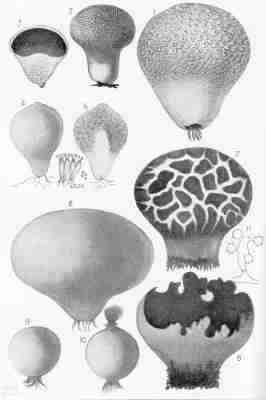
Plate G.
EDIBLE PUFF-BALLS.
Fig. 1.—Lycoperdon cælatum Fries. "Collapsing Puff-Ball."
Peridium flaccid above, with mealy coating, obtuse, at length collapsing, the sterile stratum cellulose. Inner peridium distinct from the outer all round; capillitium nearly free, collapsing when mature, threads long and brittle; spores dingy olive, turning brown; base stem-like, broad and blunt, with root, obconical, somewhat spongy. Common in pastures and open woods. Edible when young, but not much commended. Plant pale cream color.
Figs. 2 and 3.—Lycoperdon gemmatum Batsch. "Warted Puff-Ball," "Studded Puff-Ball."
Plant sub-globular, with a stem-like base; white or cinereous, turning to light greyish-brown, the surface warty, the warts unequal, the larger ones somewhat pointed, the smaller granular. As the warts fall off they leave the surface of the denuded peridium somewhat dotted or slightly reticulated. Flesh, when young, firm and whitish. The plants of this species are small, variable in form, sometimes turbinated, sometimes nearly globose, or depressed globose, but usually the basal portion is narrower than the upper portion. The stem varies in thickness and length; sometimes it is quite elongated, in some instances absent. Capillitium and spores yellowish-green, turning dark olive or brown. Columella present. When the spores are fully ripe the peridium opens by a small apical aperture for their dispersion. The plants are sometimes densely cæspitose, and crowd together on the ground or on decaying wood in large patches after warm rains. They are found both in fields and open woods during summer and autumn. They are edible when young, but not specially well flavored. There are several varieties. Plants sometimes oval or lens-shaped.
In Var. hirtum the plant is turbinate, subsessile, and hairy, with slender, spinous warts. The variety papulatum is subrotund, sessile, papillose and pulverulent, the warts being nearly uniform in size. Plants from one to two inches in height.
Figs. 4 and 5.—Lycoperdon pyriforme Schaeffer. "Pear-Shaped Puff-Ball."
Plant dingy white or brownish yellow; pear-shaped, or obovate pyriforme, sometimes approaching L. gemmatum in size and shape, but easily distinguished from that species by the surface features of the peridium and the internal hyphæ. The persistent warts which cover the surface of the peridium are so minute as to appear to the naked eye like scales. In some instances the peridium is almost smooth, and sometimes cracks in areas, inner peridium thin and tough. The hyphæ are thicker than the spores and branched, continuous with the slightly cellular base, and forming a columella inside the peridium. Spores greenish-yellow, then brownish-olive, smooth and globose.
The short stem-like base of the plant terminates in fiber-like rootlets, creeping under the soil and branching, thus attaching large clusters of the young plants together. They are often found in quantity on the mossy trunks of fallen trees.
Fig. 6.—Lycoperdon giganteum Batsch. "Giant Puff-Ball."
The Giant Puff-Ball, so generally neglected, is one of the most valuable of the edible mushrooms. It is readily distinguished from other puff-balls and allied fungi by its large size. It is subglobose in form, often flattened at the top and usually wider than deep. The peridium or rind is membranaceous, smooth, or very slightly floccose, and creamy white at first, turning to pale yellowish-brown when the plant is old. When young it is filled with a white, seemingly homogeneous fleshy substance of pleasant flavor. This substance changes, when mature, to an elastic, yellowish or olivaceous brown, cottony but dusty mass of filaments and spores. The peridium is very fragile above, cracking into areæ in the mature plant and breaking up and falling away in fragments, thus allowing the dispersion of the spores. The capillitium and spores are at first greenish-yellow, turning to dingy olive. The plants vary in size, but average from ten to twenty inches in diameter. In the columns of the Country Gentleman some years ago there appeared a description of a puff-ball of this species which weighed forty seven pounds and measured a little over eight feet in circumference. It was found in a low, moist corner of a public park. Specimens weighing from twenty to thirty pounds are recorded as being found in different parts of the country; but specimens of such large dimensions are unusual. This species is found in many parts of the United States. It is the L. bovista of Linn. Sacc.
A correspondent writes that he has found the giant puff-ball in great abundance growing on the Genessee Flats, Livingstone Co., New York. Another writes from Nebraska that it is quite abundant on the prairies there in summer. A third writes from Missouri, "Since the late rains we have had puff-balls in abundance, and find them delicious made into fritters."
The puff-balls should be gathered young. If the substance within is white and pulpy, it is in good condition for cooking, but if marked with yellow stains it should be rejected.
Vittadini says:
"When the giant puff-ball is conveniently situated you should only take one slice at a time, cutting it horizontally and using great care not to disturb its growth, to prevent decay, and thus one may have a fritter every day for a week."
Different authors write with enthusiasm of the merits of the giant puff-ball as an esculent.
Mrs. Hussey, an English botanist, gives the following receipt for "puff-ball omelet:"
First, remove the outer skin; cut in slices half an inch thick; have ready some chopped herbs, pepper, and salt; dip the slices in the yolk of an egg, and sprinkle the herbs upon them; fry in fresh butter, and eat immediately.
I have tested fine specimens of the giant puff-ball gathered in the public parks of Washington, D. C., finding it delicious eating when fried in batter.
Figs. 7 and 8.—Lycoperdon cyathiforme Bose. "Cup-shaped Puff-Ball."
Synonyms—L. fragile Vitt. L. albopurpureum Frost.
Plant nearly globose, with a short, thick, stem-like base, color varying, cinereous, brown, tinged with violet.
Rind or peridium smooth, or minutely floccose, scaly in the mature plant, cracking into somewhat angular areas, the upper portion finally falling away in fragments, leaving a wide cup-shaped base, with irregular margin, which remains long after the dispersion of the spores and capillitium. This basal portion is often tinged with the purplish hue of the spores. Spores rough, purplish-brown. Capillitium same color as the spores.
Lycoperdon cyathiforme is a more common species than L. giganteum, and is deemed quite equal to the latter in flavor. The plants are of good size, being from 4 to 10 inches in diameter.
They are frequently found in open fields and grassy places after electric storms. When sliced and fried in egg batter, they taste much like the giganteum or giant puff-ball.
A puff-ball which is not inferior to either of the two last-named species, though not as large, and perhaps not as abundant as either, is the Lycoperdon saccatum of Fries, sometimes called the "Long-stemmed puff-ball," because of its elongated stem.
The plants of this species are attractive in appearance, usually hemispherical, or lentiform in shape, with cylindrical stem-like base. The peridium is thin and delicate, breaking into fragments; creamy white in the young stage, and clothed with delicate warts, so minute as to give the surface a soft mealy appearance, the under surface somewhat plicate. Capillitium sub-persistent and dense. Both spores and capillitium brown.
LYCOPERDACEÆ.
Genus Bovista Dill. Peridium papery (or sometimes corky), persistent; the outer rind, sometimes called the bark, quite distinct from the inner, at length shelling off. Capillitium sub-compact, equal, adnate to the peridium on all sides; spores pedicillate, brownish.
Figs. 9 and 10.—Bovista plumbea Pers. Lead-Colored Bovista.
Plant small, spherical, having a double shell or peridium, the inner one white and the outer one smooth and greyish lead-color or bluish-grey, and shelling off at maturity. When young the interior is filled with a creamy white substance. This soon begins to disintegrate, and, as the spores mature, changes to a mass of dusty brown spores and threads. When the spores are ready for dissemination a small aperture appears in the top of the peridium, through which they push their way outwards like a little puff of smoke.
When young, and while the flesh is white throughout, the plant is edible, although so small that it would take a quantity to make a good dish. It is found chiefly in pastures in the autumn. Sometimes found growing in company with Agaricus campestris. Of pleasant flavor when young.
Fig. 11. Basidium and spores of a Lycoperdon highly magnified.
An English author states that inflammation of the throat and swelling of the tongue have been known to ensue from eating some of the small species of Lycoperdon in the raw state. It would be a wise precaution, therefore, to cook all of the smaller species well before eating.
The genus Scleroderma is allied to Lycoperdon, but differs from it in the absence of a capillitium, and in the thick indehiscent outer skin, or peridium, which bursts irregularly on the maturity of the spore-mass, the flocci adhering on all sides to the peridium and forming distinct veins in the central mass.
The species Scleroderma vulgare is very common in woods, and has sometimes been mistaken for a form of Truffle. The plants are not very attractive, and the odor is rank. They are subsessile and irregular in shape, with a hard outer skin, the larger form of a yellowish or greenish brown hue, and covered with large warts or scales, the smaller very minutely warty, and of a darker brown hue. The internal mass is of a bluish-black hue, threaded through with white or greyish flocci. Spores dingy. The interior becomes pulverulent when the plant matures. This species has been eaten in its young state when cooked, but the flavor is by no means equal to that of the large puff-balls. It is sometimes attacked by a fungus larger than itself, called Boletus parasiticus, and this parasite is again attacked by a species of Hypomyces, one of the genera of the Pyrenomycetes, which grows in patches upon dead fungi.
Phalloideæ or Phallaceæ.
The Phalloideæ, sometimes called the "Stink-horn" fungi on account of their fœtid odor, are not numerous, the whole number of described species being about eighty. The plants are watery, quick in growth, and decay very rapidly. They are varied in form and are quite unlike the ordinary mushroom types. In some of the genera the plants are columnar and phalloid, in other clathrate or latticed, in others again the disk is stellate, and in one genus it is coralloid, but they are all enclosed, in the early stage, in a volva which is at first hidden or partially hidden beneath the surface of the ground. A gelatinous stratum is contained within the firmer outside membrane.
Genus Ithyphallus. In this genus the cap is perforated at the top, free from the stem and reticulate. No veil. The mature plants are columnar in form with the remains of the volva enclosing the column-like stem at the base; the cap in its deeply pitted reticulations somewhat resembling that of the Morel, although of different texture.
Gasteromycetes. Phalloideæ. Figs. 1 to 6, Ithyphallus impudicus, Linn. "Fœtid Mushroom." Fig. 7, Clathrus cancellatus, Fr. "Latticed Mushroom." Unwholesome.
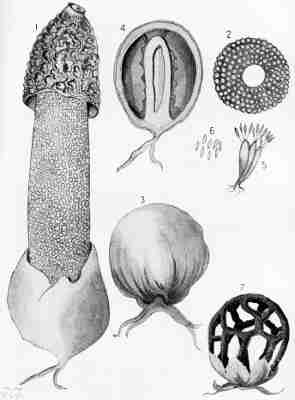
Plate H.
Figs. 1 to 6.—Ithyphallus impudicus Linn. "Fœtid Wood Witch."
In the embryonic stage the plant is enclosed in a volva which is composed of three layers, the outer one firm, the intermediate one gelatinous, and the inner one consisting of a thin membrane. The gleba, or spore-bearing portion, in the early stage forms a conical honeycombed cap within the inner shell or membrane, concealing the stem to which it is attached. The stem at this stage is very short, cylindrical, and composed of small cells filled with a gelatinous substance. The volva is about the size of a hen's egg. On maturity it ruptures at the apex. The stem rapidly expands and, elongating, elevates the cap into the air. The stem becomes open and spongy, owing to the drying of the gelatinous matter and its quick expansion.
The whole plant attains a height of from four to ten inches in a few hours. The hymenial surface is on the outside of the cap, the spores being embedded in its glutinous coated ridges and depressions. The hymenium is at first firm but rapidly deliquesces, holding the spores in the liquid mass. The cap is greenish or greenish-gray in color, changing to a dark bottle-green. In its deliquescent state the odor is very repulsive. While enclosed in the volva the unpleasant odor is not so perceptible, and it has been eaten in that condition without unpleasant effects, but in its mature stage it is considered unwholesome, and certainly its offensive odor would be quite sufficient to deter most persons from attempting to test its edible qualities. Flies, however, are very fond of the fluid, and consume it greedily and with impunity. It is found in gardens and woods, its presence being detected several rods away by the offensive odor. Specimens occur in which the color of the cap is white or reddish.
In the allied genus Mutinus the pileus is adnate and is not perforated at the apex. Mutinus caninus resembles impudicus in form, but the cap is continuous with, not free from the stem, and is crimson in color, covered with a greenish-brown, odorless mucus. The stem is hollow, whitish, tinted with a pale yellow or orange color. Not common.
Genus Clathrus Mich. In this genus the receptacle is sessile, and formed of an obovate globular net-work. At first wholly enclosed in a volva which becomes torn at the apex and falls away, leaving a calyx-like base at its point of contact with the stem.
Fig. 7.—Clathrus cancellatus Tourn.
Unwholesome.
Receptacle bright vermillion or orange red, covered at first with a greenish mucus which holds the colorless spores. Volva white or pale fawn color. Odor strongly fœtid.