APPENDIX.
Reading edition
As Chief of the Division of Microscopy, U. S. Department of Agriculture, the author prepared for the World's Columbian Exposition at Chicago a collection of models of edible and poisonous mushrooms, for which a medal and diploma were there awarded. The same collection, which now belongs to the Museum of the Department of Agriculture, was exhibited at the Atlanta Cotton Exposition in 1895, where a diploma was again awarded for it, and has since been exhibited at the exposition of 1897 in Nashville, Tenn. The models composing this collection, about one thousand in number, were made from actual specimens and colored to nature, the same species being generally represented by numerous specimens so as to illustrate the various stages in the life of the plant, habit of growth, etc.
The following is a list of the mushrooms represented in this collection, among which there are types of most of the genera in which species recorded as edible occur:
Amanita Cæsarea Schaeff. "Orange Amanita." Edible.
Amanita rubescens Pers. "The Blusher." "Reddish-Brown Amanita." Edible.
Amanita strobiliformis Vitt. "Fir-Cone" or "Pine-Cone Amanita." Edible.
Amanita pantherinus D. C. "Panther Mushroom." Poisonous.
Amanita phalloides Fr. "Poison Amanita." Poisonous.
Amanita muscaria Linn. "Fly Amanita." "False Orange." Poisonous.
Amanita verna Bull. "Spring Mushroom." "Vernal Amanita." Poisonous.
Amanitopsis vaginata Roze. "The Grizette." "Sheathed Amanitopsis." Edible.
Lepiota procera Scop. "Parasol Mushroom." "Tall Lepiota." Edible.
Lepiota racodes Vitt. "Ragged Lepiota." Edible.
Armillaria mellea Fr. "Honey Mushroom." Edible.
Tricholoma terreum Schaeff. "The Gray Cap." Edible.
Clitocybe illudens Schw. "Giant Clitocybe." Unwholesome.
Clitocybe odora Bull. "Odorous Clitocybe." Edible.
Clitocybe laccata Scop. Edible.
Collybia fusipes Bull. "Spindle-Foot Collybia." Edible.
Pleurotus ostreatus Jacq. "Oyster Mushroom." Edible.
Pleurotus ulmarius Jacq. "Elm Pleurotus." Edible.
Volvaria bombycina Schaeff. "Silky Volvaria." This species has been recorded by some authors as poisonous. Hays, after testing it, speaks well of it, and states that is eaten on the Continent.
Volvaria speciosa Fr. Not commended.
Pholiota caperata Pers. Edible.
Agaricus campester. "Field Mushroom." Edible.
Agaricus arvensis Schaeff. "Horse Mushroom." Edible.
Hypholoma sublateritium. "Brick Top." Edible.
Hypholoma Candolliana. Edible.
Coprinus comatus Fr. "Shaggy Mane Mushroom." Edible.
Coprinus atramentarius. "Inky Coprinus." Edible.
Cortinarius turmalis Fr. Edible.
Cortinarius cærulescens Fr. Edible.
Hygrophorus conicus Fr. Conical Mushroom. Has been recorded by a number of authors as poisonous. Some later writers speak of it as edible.
Hygrophorus puniceus Fr. "Purplish Hygrophorus." Edible.
Hygrophorus ceraceus Fr. "Waxen Hygrophorus." Edible.
Lactarius deliciosus Fr. "Delicious Lactarius." Edible.
Lactarius volemus Fr. "Orange-brown Lactarius." Edible.
Lactarius torminosus Fr. This mushroom is said to contain an acrid juice which acts seriously on the stomach and alimentary canal.
Lactarius rufus Fr. Intensely acrid.
Lactarius vellereus Fr. Extremely acrid.
Lactarius piperatus. "Fiery Milk Mushroom." Extremely acrid when raw. The Russians parboil it, throwing away the liquid, before preparing for pickling. A noted German chemist reports it "not very safe."
Russula alutacea Fr. Yellow-gilled Russula. Edible.
Russula virescens Fr. Edible.
Russula cyanoxantha Schaeff. "Variable Russula." Edible.
Russula emetica Fr. This mushroom is extremely acrid when raw; by some authors it is recorded as poisonous, by others as edible. Chemical analysis has shown that it contains a varying proportion of muscarin, as well as cholin, etc.
Cantharellus cibarius Fr. "The Chantarelle." Edible.
Marasmius oreades Bolt. "The Fairy Ring Mushroom." Edible.
Boletus edulis Bull. Edible.
Boletus scaber Fr. Edible.
Boletus granulatus Linn. Edible.
Boletus brevipes Pk. Edible.
Boletus luteus Linn. Edible.
Boletus pachypus Fr. Edible.
Boletus Americanus Pk. Edible.
Boletus subtomentosus Linn. Edible.
Boletus castaneus Bull. Edible.
Boletus Satanus Lenz. "White-topped Boletus." Recorded as poisonous.
Boletus luridus Schaeff. "Red-pored Boletus." Recorded as poisonous.
Strobilomyces strobilaceus Bull. Edible.
Fistulina hepatica Fr. "Beefsteak Fungus." Edible.
Polyporus sulfureus Bull. Edible.
Hydnum repandum Linn. Edible.
Hydnum erinaceum Bull. Edible.
Sparassis crispa Wulf. Edible.
Clavaria cinerea Bull. Edible.
Clavaria rugosa. Edible.
Lycoperdon gemmatum Fr. Edible.
Lycoperdon giganteum Fr. "Giant Puff-Ball." Edible.
Lycoperdon pyriforme Schaeff. "Pear-shaped Puff-Ball." Edible.
Scleroderma vulgare Fr.
Morchella esculenta Pers. Edible.
Morchella conica Bull. Edible.
Hirneola auricula Judæ Bull. Edible.
Ithyphallus impudicus Linn. Unwholesome.
Clathrus cancellatus Linn. Unwholesome.
Note.—In addition to the above there were also represented a number of coriaceous or woody species which grow upon trees, old stumps, etc.
STUDENT'S HAND-BOOK
OF
Mushrooms of America
EDIBLE AND POISONOUS.
BY THOMAS TAYLOR, M. D.
AUTHOR OF FOOD PRODUCTS, ETC.
Fellow of the A. A. A. S.; Hon. Member of the Mic. Section Royal Inst., Liverpool, England; Member of Honor of the International Medical Society of Hygiene, Brussels; Member of the American and Washington Chemical Societies; French Chemical Society, Paris; of the American Textile Society; Medical Society of Washington, D. C.; Cor. Member Academy of Arts and Sciences of Brooklyn, N. Y.; Cor. Member Mic. Societies of New York, Buffalo, etc., etc.
Published in Serial Form—No. 5—Price, 50c. per number.
WASHINGTON, D. C.: A. R. Taylor, Publisher, 238 Mass. Ave. N.E. 1897.
PUBLISHER'S NOTE.
It has not been possible to represent all the genera of mushrooms which contain species having value as esculents within the compass of this series of five pamphlets, but the demand for these promises to justify the publication, at a future date, of a second series, which the author now has in preparation.
A. R. T.
Copyright, 1898, by Thomas Taylor, M. D., and A. R. Taylor.
AGARICINI.
Leucospori—(Spores White).
Subgenus Pleurotus Fries. The Pleuroti are similar in some respects to the Tricholomas and Clitocybes, some of the species having notched gills near the stem, and others, again, having the gills decurrent, or running down the stem. Most of the species grow upon dead wood or from decaying portions of live trees. Very few grow upon the ground. The stem is mostly eccentric, lateral, or wanting; when present it is homogeneous or confluent with the substance of the cap; the substance may be compact, spongy, slightly fleshy, or membranaceous. Veil evanescent or absent. The spores are white or slightly tinted.
M. C. Cooke figures over thirty species of Pleurotus found in Great Britain, and describes 45 species found in Australia. With few exceptions, all of these grow upon wood. Very few have value as esculents.
Agaricus (Pleurotus) ostreatus, Jacq. Edible. T. Taylor, del.
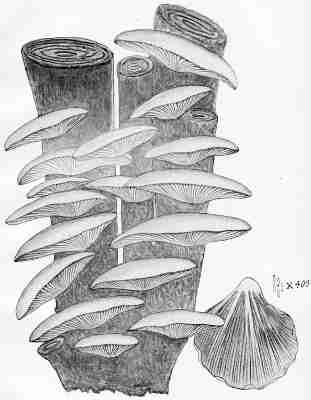
Plate J.
Ag. (Pleurotus) ostreatus Jacq. "Oyster Mushroom."
Edible.
Cap soft, fleshy, smooth, shell-shaped, white or cinereous, turning brownish or yellowish with age. Flesh white, somewhat fibrous. Gills white, broad and decurrent, anastamosing at the base. Stem usually not well defined, lateral, or absent. Spores elliptical, white. The caps are sometimes thickly clustered and closely overlapping, and sometimes wide apart. This mushroom has long been known as edible both raw and cooked. It has a pleasant but not decided flavor and must be cooked slowly and carefully to be tender and easily digestible. Old specimens are apt to be tough. It is found on decaying wood and often on fallen logs in moist places or upon decaying tree-trunks. It is frequently recurrent on the same tree. I have gathered great quantities of the Oyster mushroom during several seasons past from a fallen birch tree which spanned a small stream. The lower end of the tree rested on the moist ground at the edge of the stream. Specimens have been found on the willow, ash and poplar trees, and upon the apple and the laburnum.
Pleurotus sapidus Kalchb. Sapid Pleurotus. Edible.
This species closely resembles the Oyster mushroom in form and habit of growth, and is by some considered only a variety of P. ostreatus. It grows usually in tufts with the caps closely overlapping, varying in color white, ashy, grayish or brownish. Flesh white. The stems are white, smooth and short, mostly springing from a common base. The gills are white and very broad, and decurrent. The spores assume a very pale lilac tint on exposure to the atmosphere.
Pleurotus ulmarius Bull. "Elm Pleurotus." Edible.
The Elm Pleurotus is quite conspicuous by reason of its large size and light color. The cap is smooth and compact, usually whitish with a dull yellowish tinge in the center. Flesh white. The skin cracks very easily, giving it a scaly appearance. The gills are broad, and toothed or notched near their point of attachment to the stem as in the Tricholomas, white in color, turning yellowish with age. The stem is firm and smooth, solid and rather eccentric, thick and sometimes slightly downy near the base, from two to four inches in length. Although this mushroom seems to prefer the elm and is most frequently found on trees of that species, it is found also upon other trees, but principally the maple, the ash, the willow, and the poplar. It grows upon live trees, usually where the branches have been cut away, and upon stumps as well. Most authors recommend it as an esculent, although it has not the rich flavor of some other mushrooms. It dries well and can be kept thus for winter use. This species has a wide range and grows most abundantly in the autumn. Its resistance to cold has been frequently remarked.
AGARICINI.
Subgenus Amanita. The Amanitas are usually large and somewhat watery, the flesh brittle rather than tough. The very young plants are enveloped in a membranous wrapper, which breaks apart with the expansion of the plant, leaving a more or less persistent sheath at the base of the stem. The universal veil is distinct and free from the cuticle of the cap. The cap is convex at first, then expanded; in some species naked and smooth; in others, clothed with membranaceous patches of the volva. The stem is distinct from the fleshy substance of the cap, ringed and furnished with a volva or sheath. In some of the species this sheath is connate with the base of the stem, firm and persistent. In others, it is friable, at length nearly obsolete.
The ring is usually persistent, deflexed, more or less prominent, in rare cases pressed close against the stem, and sometimes scarcely distinguishable from it. The gills in most of the species are free from the stems, but there are exceptions to this rule. Spores white. As to geographical distribution, according to M. C. Cooke, seven-eighths of the species are distinctly located in the temperate zone, one-twentieth at a temperate elevation, and only one-twentieth presumably tropical. Out of the eighty species, about sixty are North American and European, and one species is found on the slopes of the Andes, in South America. As heretofore stated, this group among mushrooms is made responsible for most of the well authenticated cases of fatal poisoning by mushrooms. It would be judicious, therefore, for those who are not thoroughly familiar with the characteristics of the edible Amanitas to defer making experiments with them for table use until that familiarity is acquired.
Saccardo in his Sylloge describes no less than fifteen edible species of Amanita as found in different parts of the world. Of those I have personally been able to identify but three which are common in this country, and which have been well tested. Specimens of these three species are illustrated in Plates XIV and XIV½ of this pamphlet. They are each and all found in varying abundance in different parts of the United States.
Edible Amanitas. Figs. 1 to 4 Ag. (Amanita) Cæsareus, Scop. (Amanita Cæsarea) "Orange Amanita." Figs. 5 to 9 Ag. (Amanita) rubescens. Pers. "The Blusher." "Reddish Brown Amanita." EDIBLE. T. Taylor, del.
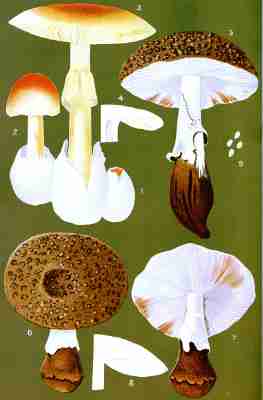
Plate XIV.
Figs. 1 to 4. Ag. (Amanita) Cæsareus Scop. (Amanita Cæsarea). "Orange Amanita," "True Orange."
Edible.
Cap at first convex, afterwards well expanded; smooth, free from warts, striate on the margin; color orange-red or bright lemon-yellow, with red disk; gills lemon-yellow, rounded near the stem, and free from it; stem equal or slightly tapering upwards, stuffed with cottony fibrils, or hollow (color clear lemon-yellow), bearing a yellowish ring near the top and sheathed at the base with large, loose, membranous, white volva. Odor faint but agreeable. Spores white, elliptical.
The whole plant is symmetrical in form, brilliant in coloring, clean and attractive in appearance. The American plant seems to differ in some slight respects from the European as figured and described in European works. In Europe the pileus or cap is said to vary in color, being sometimes white, pale yellow, red or even copper color, although it is usually orange-yellow. My own observation of the American plant of this species agrees with that of Prof. Peck in that the cap is uniform in color, being at first bright reddish-orange or even brilliant red, fading with age to yellow, either wholly or only on the margin. No white specimens have been as yet recorded in this country. The red color disappears in the dried specimens. The striations of the margin are usually quite deep and long and almost as distant as in the edible species Amanitopsis vaginata. Some European writers have described the flesh or substance of the cap as yellowish. In our plant the flesh is white, but stained with yellow or red immediately under the cuticle. Amanita Cæsarea is the only one of the Amanitas which has yellow gills.
Berkeley, in his "Outlines of British Fungi," describes A. Cæsarea as it is found in some parts of Continental Europe, but states that up to the date of his writing it had not been found in Great Britain. It is not recorded in the more recent lists of British fungi by M. C. Cooke nor in that of Australian fungi by the same author. The species has a wide range in this country, and though not very common in the North, in some localities, as in the pine and oak woods of North Carolina, it is found in great abundance. Dufour states that it is much esteemed as an esculent in France, and though rare in the northern part of that country, it is common in the center and the south of France in autumn. It is well known in different portions of Continental Europe, and is frequently figured in contrast with its very poisonous congener, Amanita muscaria, or "False Orange," commonly known as the "Fly Amanita," or "Fly-Killer."
A careless observer might mistake one for the other, but with a little attention to well-defined details the edible form can be readily distinguished from the poisonous one.
In analyzing the species the attention should be directed to the following characteristics of the two mushrooms: In A. Cæsarea the cap is smooth, the stem, gills and ring lemon-yellow, and the cup-shaped wrapper or volva which sheathes the base of the stem is white and persistently membranous.
In A. muscaria the cap is warty or shows the traces or remains of warts; the gills white, stem white, or only very slightly yellowish, and the wrapper or volva is evanescent, breaking up into ridge-like patches adhering to the base of the stem.
The Amanita Cæsarea has long been esteemed as an esculent in foreign countries, and was known in ancient times to the Greeks and Romans. It is known under the following names: "Orange," "Cæsar's mushroom," "Imperial mushroom," "Yellow-egg," "Kaiserling," etc. Mycologists who have tested it agree as to its edibility and delicate flavor.
The specimens figured in Plate XIV represent the average size of those which I have gathered in the vicinity of the District of Columbia. Much larger ones have been gathered in the woody portions of Druid Hill Park, Baltimore, Md.
Dufour writes: "This mushroom, the "true oronge," is cooked in a variety of ways, and it always constitutes an exquisite dish." This author gives the following recipes for cooking the Cæsarea, which he calls the "Oronge:"
Oronge à la bordelaise.—The stem is minced with fine herbs, bread-crumbs, and garlic, and seasoned with pepper and salt. This hash is placed in the concavity of the caps, and all is put to bake with good oil in a pan steamed in a chafing dish.
Oronge à l'Italienne.—Stew gently with a little butter and salt, then serve with a sauce composed of oil seasoned with the juice of lemon, pepper, garlic, and extract of sweet almond.
The Spanish are fond of this mushroom, and it is said to enter into their national dish, olla podrida, a mixture of meat, vegetables, and spices, whenever it can be obtained.
It is sometimes fried in butter or olive oil and seasoned with sugar.
Plate XIV.
Figs. 5 to 9.—Ag. (Amanita) rubescens Pers. (Amanita rubescens). "The Blusher," "Reddish Brown Amanita."
Edible.
Cap at first convex then expanded, margin even or very slightly striated, usually reddish-brown or reddish-fawn color, covered with mealy, more or loss persistent warts; flesh white, changing to a reddish or pinkish tinge, where cut or bruised, the reddish tinge most intense in the bulbous portion of the base of the stem; gills reaching the stem and forming decurrent lines upon it, white, becoming spotted with rusty or wine red stains when bruised or attacked by insects; stem ringed, whitish or dingy white, becoming brownish or spotted, with reddish-brown stains. The base of the stem is usually bulbous, the bulb sometimes tapering to a point at the root, and in some instances ending abruptly.
The ring or collar which encircles the stem near the top is membranous, and usually well defined.
The volva which completely envelops the young plant is very friable and soon disappears. Fragments of the volva may be seen in the shape of scales or small particles upon the mushroom stem, and in wart-like patches upon the cap. In the representations of this mushroom which appear in European works the cap is a deeper reddish-brown tint than I have found it here. The color of the cap is usually a light reddish brown or reddish gray, sometimes almost white. This species is found usually in light open woods. In a warm moist climate it appears early in the season, and can be gathered until the frosts come. Taste very pleasant.
There is a poisonous species, Amanita pantherinus, rare, which has a viscid brown warted cap bearing a slight resemblance to that of the rubescens, but the gills do not turn red when bruised, and the volva at the base of the stem is well defined and persistent.
The rubescens is very plentiful in the woods of Maryland and Virginia, and specimens have been received from different parts of the country. I have frequently eaten it stewed with butter, and found it very good eating. Hay speaks of it as being eaten in England, where it is called the "Blusher." Cooke says it is pleasant both in taste and odor. It is spoken of by French authors as of delicate flavor, and as well known in some parts of France. In preparing for the table bring the mushroom to a quick boil and pour off the first water, then stew with flavoring to suit the taste.
The specimens of this species represented in Plate XIV were collected in the woods of Forest Glen, Maryland. They are often found of much larger size and much lighter in coloring, with the stains upon the gills redder in color. The very young plants as they burst through the surface of the soil show a distinct volva at the base of the stem. In the mature plant this disappears, often leaving the slightly bulbous base quite smooth.
Agaricus (Amanita) strobiliformis, Vitt. "Fir-Cone Mushroom." Edible. From Nature. T. Taylor, del.
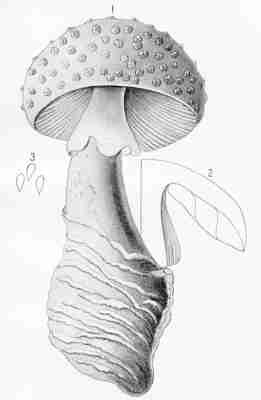
Plate XIV½.
Ag. (Amanita) strobiliformis Fries (Amanita strobiliformis). "Fir-cone Mushroom."
Edible.
Cap fleshy, convex at first, then expanded, covered with persistent white warts, margin even, white; flesh white, firm and compact; gills rounded behind and free from the stem, white; stem solid, the bulbous base tapering, furrowed with concentric and longitudinal channels at the root, and extending well into the ground, white; ring large, soon splitting; volva breaking up and appearing in concentric ridges upon the stem. Spores white.
This mushroom is very pleasant to the taste when raw as well as when cooked. It is found in light woods or on the borders of woods where the soil is somewhat friable, generally solitary, but sometimes two or three are found clustered together. The plants are sometimes so large that two or three of them would make a very good meal. Specimens have been found with the cap measuring 8 to 9 inches across when expanded, the stem varying from 6 to 8 inches in height, and from 1 to 3 inches in thickness. When young the plants are generally snowy white throughout, changing with age to a dingy white or cinereous hue. The specimens figured in the plate formed one of a cluster of three mushrooms of this species found growing in the fir woods of the District of Columbia.
During some seasons I have found the strobiliformis, or "Fir-cone mushroom," fairly plentiful in some parts of Maryland, and in other seasons it has been rare. The whole plant when young is enclosed in a white membranous wrapper.
Although this species is very generally recognized by mycologists as edible, I would advise great caution in selecting specimens for table use, since there is a dangerous species which might be mistaken for it by one not familiar with the characteristics of both species; I refer to a form of Amanita muscaria with ochraceous yellow cap which, when faded or bleached by the sun and rain, sometimes approaches, in tint, the dingy white of old or faded specimens of the strobiliformis. Both species have white gills, white stems, and white flocculent veil. The volva is evanescent in both, leaving traces of its existence in concentric ridges at the base, and part way up the stem.
In the species strobiliformis, the flesh of the cap is white throughout, as well as the cuticle.
In the yellowish muscaria, the flesh immediately beneath the cuticle of the upper surface of the cap is yellowish, frequently deepening at the disk to orange hue.
The cap of Amanita muscaria is very attractive to flies, but proves to them, as also to roaches and to some other insects, a deadly poison.
The juice of strobiliformis is not poisonous to flies. This fact may aid in identifying the species.
Subgenus Amanitopsis Roze. The species of this subgenus were formerly included in Amanita. The characteristic which separates it from Amanita is the absence of a ring on the stem. The gills are free from the stem, the spores are white, and the whole plant in youth is encased in an egg-shaped volva.[A]
Amanitopsis vaginata Roze. Edible.
This species is very common in pine and oak forests. The plant, as a whole, has a graceful aspect and grows singly or scattered through open places in the woods. It is somewhat fragile and easily broken. The cap in this species is usually a mouse-gray, sometimes slaty gray or brownish, generally umbonate in the center and distinctly striated on the margin.
The stem is white, equal, and slender in proportion to the width of the cap, and sheathed quite far up with a loose white membranous wrapper. This sheath is so slightly attached to the base of the stem that it is often left in the ground if the plant is carelessly pulled. The gills are white, or whitish, free from the stem and rounded at the outer extremity.
There is a white variety, (variety alba) A. nivalis, in which the whole plant is white, and a tawny variety (A. fulva Schaeff.) in which the cap is a pale ochraceous yellow, with the gills and stem white or whitish. In the variety A. livida or A. spadicea Grev. the cap is brown, while the stem and gills are tinged a smoky brown.
These are all edible and of fairly good flavor. Except in the absence of the ring upon the stem, the light varieties might be mistaken for small forms of the poisonous species Amanita verna or of phalloides. Great caution should therefore be observed, in gathering for the table, to be sure of the species.
Figs. 1 to 7. Ag. (Amanita) muscarius, Linn. (Amanita muscaria) "Fly Mushroom." Fig. 8. Ag. (Amanita) phalloides, Fries. Fig. 9. Ag. (Amanita) mappa Batsch. POISONOUS. T. Taylor, del.
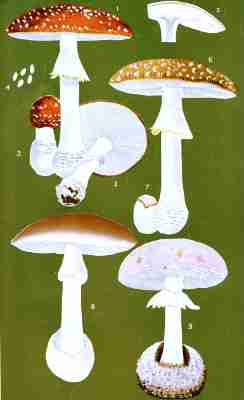
Plate XV.
Figs. 1 to 7.—Ag. (Amanita) muscarius Linn. (Amanita muscaria). "Fly Mushroom," "False Orange."
Poisonous.
Cap warty, margin striate; gills white, reaching the stem, and often forming decurrent lines upon it; stem white, stuffed, annulate, bulbous at the base, concentrically ridged or scaly at the base, and sometimes part way up, with fragments of the ruptured wrapper. Spores widely elliptical, white, .0003 to .0004 of an inch in length.
The plants of this species vary very much in size and in the color of the cap. The latter is sometimes a bright scarlet and again it is orange color, more frequently ochraceous yellow, fading to a very pale yellow tint. In the variety albus it is white. The stem is stuffed with webby fibrils and varies very much in thickness: sometimes in young specimens it is very stout, with a thick ovate bulb reaching well up towards the cap, and again it is comparatively slender and nearly equal from the cap down to a very slight bulb at the base. The very young plant is completely enveloped in a white or yellowish egg-shaped wrapper or volva, which, being friable, generally breaks up into scales, forming warts upon the upper surface of the cap. When the plant is young and moist the cap is slightly sticky. A thickish white veil extends from the stem to the inner margin of the cap. This breaks away with the growth and expansion of the plant and falls in lax folds, forming a deflexed ring round the upper portion of the stem.
This mushroom is very common in woods and forests in summer and autumn, and has a wide geographical range. It is recorded by all mycologists as poisonous. One author states that when eaten in very small quantities it acts as a cathartic, but that it causes death when eaten freely. Flies find in it a deadly poison, and the poisonous alkaloids are not destroyed by drying.
Although cases are cited where this mushroom has been eaten without injury, its fatally poisonous effects have been too well and too often tested to allow of any doubt as to the danger of eating it, even in small quantities.
Amanita Frostiana, Frost's Amanita, is a much smaller species than A. muscaria. It bears a very close resemblance to the Fly Amanita, and might easily be taken for a small form of the same. The cap is yellowish and warted, and specimens occur in which the stem and gills are slightly tinged with yellow. It is poisonous.
Plate XV.
Fig. 8.—Ag. (Amanita) phalloides Fries (Amanita phalloides) A. vernalis Bolt., A. verrucosus Curtis. "Poisonous Amanita," "Death Cup."
Poisonous.
Cap bell-shaped or ovate at first, then expanded, smooth, obtuse, viscid, margin even, creamy-white, brown, or greenish, without warts; flesh white; stem white, hollow or stuffed, bulbous at the base, annulate; gills rounded and ventricose, coarse, and persistently white, free from the stem; volva conspicuous, large, loose, adhering to the base, but free from the stem at the top, with the margin irregularly notched. In the white forms there is frequently a greenish or yellow tinge at the disk or centre of the cap. The white form is most common, but the brownish is often found in this country. I have not yet found the green-capped variety sometimes figured in European works. In the brown variety the stem and ring are often tinged with brown, as also the volva. The cap is usually from 2 to 3 inches broad, and the stem from 3 to 5 inches long. The whole plant is symmetrical in shape and clean looking, though somewhat clammy to the touch when moist. It is very common in mixed woods, in some localities, and is universally considered as fatally poisonous.
The white form of A. phalloides, although in reality bearing very little resemblance to the common field mushroom, has been mistaken for it as also for the Smooth white lepiota, and in some instances has been eaten with fatal results by those who gathered it.
The distinction between this most poisonous Amanita and the common field mushroom is well marked. In the common mushroom the gills are pink, becoming dark brown, the spores purplish brown, and the whole mushroom is stout and short stemmed, the stem being shorter than the diameter of the cap, and having no volva, or wrapper at its base. In the species A. phalloides the gills are persistently white and the bulb is distinct and broad at the base, the white cup-shaped wrapper sheathing the base of the stem like the calyx of a flower. The Smooth white lepiota shows neither volva nor trace of one, and has other distinct characteristics which distinguish it from A. phalloides. See page 14, No. 4 of this series.
The specimen figured in Plate XV grew in Maryland, where it is quite common.
Plate XV.
Fig. 9.—Ag. (Amanita) mappa (Amanita mappa) Linn., Amanita citrina, A. virosa.
Poisonous.
Cap at first convex, then expanded, dry, without a separable cuticle, not warty but showing white, yellowish, or brownish scales or patches on its upper surface; gills white, adnexed; flesh white, sometimes slightly yellowish under the skin; stem stuffed, then hollow, cylindrical, yellowish white, nearly smooth, with a distinctly bulbous base; volva white or brownish. Odor pleasant. Spores spheroidal. The cap in this species is somewhat variable in color, but those having a white cap are most common. The plant is not so tall as those of the species phalloides. It is solitary in habit, and is found usually in open woods.
Curtis and Lowerby figure mappa and phalloides under the same name.
Fig. 1. Ag. (Amanita) vernus, Bull. (Amanita verna.) "Spring Mushroom." Fig. 2. Represents section of mature plant. Fig. 3. Spores; Fig. 4. Young plant. POISONOUS. T. Taylor, del.
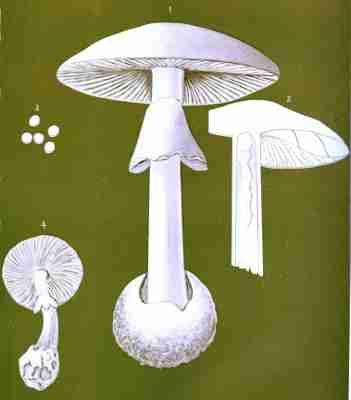
Plate XVI.
Figs. 1 to 4.—Ag. (Amanita) vernus Bull. (Amanita verna) Linn., Amanita bulbosa, Ag. solitarius. "Vernal Mushroom," "Spring Mushroom," etc.
Poisonous.
Cap at first ovate, then expanded, becoming at length slightly depressed, viscid, white; margin smooth; flesh white; gills white, free; stem white, equal, stuffed or hollow, easily splitting, floccose, with bulbous base; volva white, closely embracing the stem, but free from it at the margin; ring reflexed; spores globose, .0003 in. broad. The plant is creamy white throughout and does not seem to be easily distinguishable from the white forms of A. phalloides. Fries and some others consider this species merely a variety of Amanita phalloides, and it is regarded as equally poisonous, the poisonous principle being the same as that of A. phalloides. It is very common in mixed woods from early spring to frosty weather.