APPENDIX B.
Reading edition
Through the courtesy of Mr. Hollis Webster, Secretary of the Boston Mycological Club, the following list of mushrooms, which have been collected and eaten by members of that club during the past year, has been supplied to me:
AMANITA. A. Cæsarea Scop., "True Orange." A. rubescens Persoon. A. vaginata Bull.
LEPIOTA. L. procera Scop., "Parasol Mushroom." L. rachodes Vilt. L. Americana Pk. L. naucinoides.
ARMILLARIA. A. mellea Vahl, "Honey Mushroom."
TRICHOLOMA. T. equestre L. T. sejunctum Low, "Yellow Blusher." T. portentosum Fr. T. coryphacum Fr. T. russula Schaeff. T. columbetta Fr. T. gambosum Fr., "St. George's Mushroom." T. personatum. T. nudum.
HYGROPHORUS. H. virgineus Fr. H. fuligineus Frost. H. flavo discus Frost, "Yellow Sweet-Bread." H. hypothejus Fr. H. puniceus Fr.
LACTARIUS. L. piperatus Fr. L. deliciosus Fr. L. volemus Fr.
RUSSULA. R. virescens Fr. R. lepida Fr. R. punctata Gt. R. aurata Fr. R. ochracea Fr. R. alutacea Fr.
CANTHARELLUS. C. cibarius Fr. C. umbonatus Fr.
MARASMIUS. M. oreades Fr., "Fairy Ring." M. scorodonius Fr. M. alliaceus Fr.
HYPHOLOMA. H. sublateritium Schaeff. H. candolleanum Fr. H. perplexum. H. appendiculatum Bull.
COPRINUS. C. comatus Fr., "Shaggy Mane." C. ovatus Fr. C. atramentarius. C. micaceus Fr. C. fimetarius Fr.
CORTINARIUS. C. turmalis Fr. C. sebaceus Fr. C. cærulescens Fr. C. collinitus Fr. C. violaceus Fr. C. albo violaceus Pers. C. cinnamomeus Fr. C. cinnamomeus var. semi-sanguineus Fr.
CLITOCYBE. C. clavipes Fr. C. odora Fr. C. dealbata Low. C. laccata Scop. C. multiceps Pk. C. infundibuliformis Schaeff.
COLLYBIA. C. dryophila Bull. C. velutipes Curt.
PLEUROTUS. P. ostreatus Fr. P. sapidus Kalch. P. ulmarius Fr., Elm-tree Mushroom. P. pluteus cervinus Schaeff.
CLITOPILUS. C. prunulus Scop. C. orcella Bull. C. unitinctus Pk. C. Seymourianus Pk.
PHOLIOTA. P. caperata Pers., "The Gypsy." P. præcox (when too old is bitter). P. adiposa.
AGARICUS (Psalliota). A. arvensis. A. cretaceus Fr. A. campester L. A. silvicola Vilt.
SPARASSIS. S. crispa Fr.
CLAVARIA. (Any and all Clavarias found are generally eaten by us without identification). C. botrytes Pers. C. amethystina Bull. C. coralloides L. C. cinerea Bull. C. aurea Schaeff. C. rugosa Bull. C. pistillaris L.
LYCOPERDON. L. cyathiforme Bose. L. giganteum Batsch. L. pyriforme Schaeff. L. saccatum Fr.
MORCHELLA. M. esculenta Bull. M. conica Pers.
PEZIZA. P. aurantia Vahl.
STROBILOMYCES. S. strobilaceus Berk.
FISTULINA. F. hepatica Fr., "Beef Steak Mushroom."
POLYPORUS. P. betulinus Fr. (coriaceous when old). P. sulphureus Fr.
HYDNUM. H. imbricatum L. H. repandum L. H. caput-medusæ Bull.
Also thirteen of the Boleti.
STUDENT'S HAND-BOOK
OF
Mushrooms of America
EDIBLE AND POISONOUS.
BY THOMAS TAYLOR, M. D.
AUTHOR OF FOOD PRODUCTS, ETC.
Published in Serial Form—No. 3—Price, 50c. per number.
WASHINGTON, D. C.: A. R. Taylor, Publisher, 238 Mass. Ave. N.E. 1897.
THE NORRIS PETERS CO., PHOTO-LITHO., WASHINGTON, D. C.
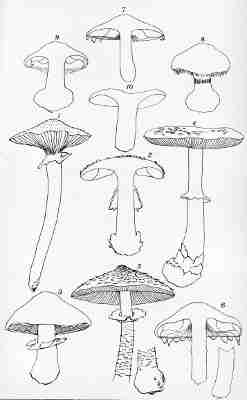
Plate E.
Plate E illustrates various forms and positions of the annulus or ring characteristic of certain species of mushrooms, together with the cortina or veil of which the ring, if present, is the remnant, in some species, either as it appears entire or as a fringe on the margin of the cap, contrasting these forms with a sectional view of a species in which the veil or ring is always wanting.
Fig. 1. Ring broad, reflexed or deflexed, or both; situated high up on the stem, as in Armillaria mellea.
Fig. 2. Ring situated about midway of the stem, deflexed and pendulous as in Amanita muscaria.
Fig. 3. Ring about half midway of the stem, split, and radiating outwards, as in Agaricus arvensis.
Fig. 4. Ring drooping.
Fig. 5. Ring persistent, movable, wholly detached, in age, from the tall and slender stem, upon which it easily slips up and down. A species of great beauty, Lepiota procera.
Fig. 6. Ring narrow, scarcely perceptible above the middle of the stem; remnants of the veil adhering to the margin of the cap as a fugacious web.
Fig. 7. Ring generally wanting—Tricholoma nudum. Remnants of the veil seen on the margin of the cap.
Fig. 8. Remnants of the veil appearing on the margin of the cap as a fringe, and particularly on the stem as a mere fibrillose zone of a darker color as in the Cortinarii.
Fig. 9. Plant exhibiting the cortina unbroken, the extremities of its delicate arachnoid threads attached to cap and stem, respectively.
Fig. 10. Section of a Russula, in which genus the ring is always wanting; veil none.
THE NORRIS PETERS CO., PHOTO-LITHO., WASHINGTON, D. C.
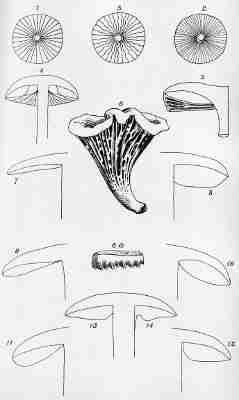
Plate F.
Plate F illustrates by section or otherwise various forms of these gill-like processes characteristic of species, considered either with regard to marginal outline or position of their posterior extremity:
Fig. 1. Gills distant.
Fig. 2. Gills crowded.
Fig. 3. Gills flexuose.
Fig. 4. Gills unequal.
Fig. 5. Bifurcated.
Fig. 6. Anastomosing veins.
Fig. 6a. Sectional view.
Fig. 7. Gills narrow.
Fig. 8. Gills broad.
Fig. 9. Lanceolate.
Fig. 10. Ventricose.
Fig. 11. Anteriorly rounded.
Fig. 12. Posteriorly rounded.
Fig. 13. Emarginate.
Fig. 14. Emarginate and denticulate.
Copyright, 1897, by Thomas Taylor, M. D., and A. R. Taylor
AGARICINI.
Subgenus Hypholoma. Hymenophore continuous with the stem, veil woven into a fugacious web, which adheres to the margin of the pileus. Gills adnate or sinuate; spores brownish purple, sometimes intense purple, almost black.—M. C. Cooke.
This subgenus has been divided into the following five groups:
Fasciculares.—Pileus smooth, tough, bright colored when dry, not hygrophanous. Examples, Ag. (Hypholoma) sublateritius and Ag. (Hypholoma) fascicularis.
Viscidi.—Pileus naked, viscid. Example, Ag. (Hypholoma) œdipus.
Velutini.—Pileus silky, with innate fibrils. Example, Ag. (Hypholoma) velutinus.
Flocculosi.—Pileus clad with floccose superficial evanescent scales. Example, Ag. (Hypholoma) cascus.
Appendiculati.—Pileus smooth and hygrophanous. Example, Ag. (Hypholoma) Candollianus.
The species are not numerous. They are generally either gregarious or cæspitose, and are often found in clusters upon tree stumps, or springing from the buried roots of stumps. A few species are found in short grass in open places; but few are recorded as edible, and one, H. fascicularis, has been classed as deleterious by Berkeley, Cooke, and some of the earlier authors. I find, however, no authenticated case of poisoning by this species, and, indeed, have as yet found no species of Hypholoma which could be satisfactorily identified as H. fascicularis.
The few species of Hypholoma which I have tested have been palatable, and one or two are of very delicate flavor.
Edible Agaricus (Hypholoma) sublateritius Fries (Hypholoma sublatertium) "Brick Top." Group from Seabrooke Woods, Md. T. Taylor, del.
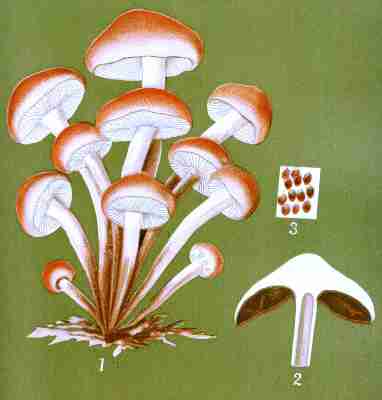
Plate VIII.
Ag. (Hypholoma) sublateritius Schaeff. "Red Tuft." (Hypholoma sublateritium) "The Brick Top."
Edible.
The cap of this species is fleshy and obtuse, convexo-plane, sometimes showing a superficial whitish cloudiness upon the margin coming from the veil, which soon disappears, leaving it smooth and dry; color tawny brick red, with pale straw margin; flesh compact and whitish, turning yellow when wilted. Stem stuffed and fibrillose, tapering downward. Near its attachment to the cap the color is very light yellow; lower down and towards the root it is covered with patches and lines of burnt sienna color. It bears no distinct ring. In very young plants the filmy veil is sometimes perceived, reaching from the margin of the cap to the stem. This disappears as the cap expands, sometimes leaving the stem obscurely annulate. Gills adnate in full-grown specimens, slightly decurrent, somewhat crowded, dingy white or cinereous, turning to dark olive, never yellow; in old or wilted specimens changing to a dark brown. In old specimens the cap is a reddish brown and the gills are sometimes stained with the purplish brown of the spores.
This is a very common species and very abundant in pine and oak woods. I have seen an oak stump in Prince George's County, Md., measuring from 3 to 4 feet in height, literally covered with mushrooms of this species. This mushroom has been recorded as suspicious by some writers, probably owing to its slightly bitter taste, but I have thoroughly tested its edible qualities, both uncooked and prepared in various ways for the table, using the caps only. It keeps well when dried, and when ground into powder, with the addition of boiling water and a little pepper and salt, makes a very pleasant and nutritious beverage. It is most abundant in the early autumn, and is gathered in this latitude well into the winter, even when the snow is on the ground.
Our American plant is less heavy and more graceful in aspect than the same species in England, as figured in English works, but the general characteristics are the same.
Ag. (Hypholoma) fascicularis Hudson, recorded as deleterious, is figured in "Cooke's Illustrations."
Dr. Berkeley thus distinguishes these two species from each other. Cap of sublateritius is obtuse, discoid; that of fascicularis, subumbonate. Flesh of the former, compact, dingy-white; that of the latter, yellow. Stem in sublateritius is "stuffed," attenuated downwards, ferruginous; stem of fascicularis hollow, thin, flexuose. The gills in both species are adnate, crowded; but in fascicularis they are also linear and deliquescent, and are yellow in color.
Note.—In the Friesian arrangement of the genera of the order Agaricini, which is adopted by M. C. Cooke, Hypholoma finds place as a subgenus of the genus Agaricus, spore series Pratelli. Saccardo in his Sylloge elevates Hypholoma to the rank of a separate genus and places it in his spore series Melanosporæ.
Edible Agaricus (Hypholoma) Candollianus, Fries., variety incertus Peck Figured from specimens collected in the District of Columbia T. Taylor, del.
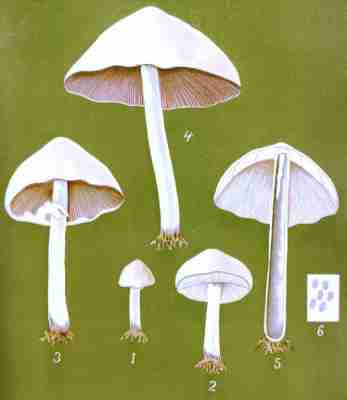
Plate IX.
Agaricus (Hypholoma) incertus Peck. (Hypholoma incertum.)
Edible.
Cap fleshy but fragile, smooth and hygrophanous, moist; at first convex, then expanding; color creamy white. Gills adnate, narrow, crowded, whitish in young specimens, turning to a pinkish dun color, later to a rosy cinnamon, sometimes showing when mature a slightly purplish tint. Stem smooth, slender, long and hollow, with slight striations near the apex, white. Specimens occur in which the stem is obscurely annulate arising from the attachment to it of fragments of the veil, but usually it is ringless.
The typical species of Hypholoma have the fleshy part of the cap confluent with the stem, but in H. incertum the stem is not confluent and is easily separated from the cap as in the Lepiotas. This mushroom was first recorded by Peck in his early reports as the variety "incertus" of the species Agaricus (Hypholoma) Candollianus, but has since been recorded by Saccardo as a distinct species, Hypholoma incertum.
Two species of Hypholoma have the same habit and sufficiently resemble incertum to be taken for it, if not carefully examined as to points of difference. These are H. Candollianum, named in honor of A. De Candolle, and H. appendiculatum. In the first named of these two species the cap is whitish, the gills at first violet in color, changing to dark cinnamon brown. In H. appendiculatum the pileus is rugose when dry, and sprinkled with atoms. It is darker in color than that of H. incertum; Cooke says tawny or pale ochre; Massee says bay, then tawny. The gills are sub-adnate, in color resembling those of H. incertum; stem slender, smooth, and white.
From the foregoing it will be seen that H. incertum agrees more nearly with H. Candollianum in the color of the cap, but more nearly with H. appendiculatum in the color of the gills. Saccardo recognizes the three as "distinct species of the genus Hypholoma." As all are edible, the slight differences observed are interesting chiefly to the mycologist. The mycophagist will find them equally valuable from a gastronomic point of view. In taste they resemble the common mushroom. They are more fragile, however, and require less cooking than the cultivated mushroom. Broiled on toast or cooked for ten minutes in a chafing dish, they make a very acceptable addition to the lunch menu.
The specimens figured in Plate IX were selected from a crop of thirty or more growing in the author's garden, in very rich soil at the base of a plum-tree stump. For several seasons past small crops have been gathered from the same spot, as well as around the base of a flourishing peach tree. Quantities of all three species have been gathered in the short grass of the Capitol grounds for a number of seasons, and in the various parks of the District of Columbia. Specimens have been received from western New York and Massachusetts. Those growing upon soil very heavily fertilized are apt to be somewhat stouter and shorter stemmed than those coming up through the short grass in the parks.