BIBLIOGRAPHY.
Reading edition
E. Fischer, etc. "Gasteromycetæ," Saccardo, Sylloge Fungorum. Vol. vii, part i. Padua, 1888.
Chas. H. Peck. "United States species of Lycoperdon."
Geo. Massee. "Monograph of the British Gasteromycetes." Annals of Botany, Nov., 1889. "Monograph of the Genus Lycoperdon" in Journal Royal Micro. Soc. London, 1887.
C. Bambeke. Morphologie du Phallus impudicus. Gand, 1889.
A. P. Morgan. "North American Geasters" in American Naturalist. Roy. 8vo. 1887.
L. and C. Tulasne. "Essai d'une Monographie des Nidulariees." Ann. des Sci. Nat. 8vo. Paris, 1844.
M. C. Cooke. The Myxomycetes of Great Britain. Plates. 8vo. London, 1877. The Myxomycetes of the United States, by the same author. New York, 1877.
Geo. Massee. A Monograph of the Myxogasters. Col. plates. Roy. 8vo. London, 1892.
A. De Bary. "Die Mycetozoon" (Schleimpilz). Plates. 8vo. Leipzig, 1864.
J. Rostafinski. Sluzowce, Mycetozoa Monografia. Plates. 4to. Paris, 1875.
Geo. A. Rex. New American Myxomycetes. Proc. Acad. Nat. Sci. Phila., part iii, Dec. 16, 1890, pp. 436-438.
Balliet Letson. "Slime Molds." The Ornithologist and Botanist. Vol. i. Binghamton, N. Y., Nov., 1891, p. 85. 1 col.
Thos. H. McBride. "The Myxomycetes of Eastern Iowa." Bulletin from the Laboratories of Natural History of the State University of Iowa. Iowa City, Iowa, 1892.
AGARICINI.
Subgenus Lepiota Fries. Veil universal and concrete, with the cuticle of the pileus breaking up in the form of scales. Gills typically free, often remote, not sinuate or decurrent. Stem generally distinct from the hymenophore. Volva absent. Habitat terrestrial, mostly found on rich soil or in grassy places. (In Saccardo's Sylloge, Lepiota is given generic rank.)
The Lepiotas have a wide geographical distribution. No less than 225 species have been recorded as found in different parts of the world. These are pretty evenly divided between the torrid and temperate zones. They are generally smaller than the Amanitas, less fleshy and somewhat dry and tough. The flesh is soft and thready, not brittle. In the plants of most of the species the cap is rough, the cuticle being broken up into tufts or scales. These tufts are readily distinguished from the warts which characterize certain species of Amanita, being formed from the breaking up of the cuticle with the concrete veil, while the wart-like excrescences seen upon Amanita muscaria, for example, are composed of fragments of the volva, which is always found enclosing the very young plants of the genus Amanita.
A few of the species are characterized by a smooth cap; in some instances it is granulose or mealy. Usually the cuticle is dry, but in a few of the species it is viscid. The stem is generally long and hollow, and, being of different texture from the flesh of the cap, is easily separated from it, often leaving a distinct socket at the junction of stem and cap. It is sometimes smooth, sometimes floccose. In some species it is bulbous at the base, in others not. The ring which encircles the stem is at first continuous with the cuticle of the cap, breaking apart with its expansion. It is sometimes movable, sometimes evanescent.
The species generally are considered edible, or innoxious. None are recorded as dangerous. A mycophagist from Augusta, Ga., reports, however, that the members of a family in that vicinity were made quite ill from eating the Lepiota Morgani, a greenish-spored species of Lepiota, while he himself ate of the same dish, experiencing no unpleasant effects. I have had no personal experience with this species.
Two edible species of Lepiota, which are widely commended as of good quality, and which are sufficiently abundant to have value as esculents, are figured in Plate XI. A third, Ag. (Lepiota) cepæstipes, var. cretaceus—Lepiota cretacea, figured in Plate XI½, is an exotic species found in greenhouses. It is of very delicate flavor.
Edible Figs. 1 to 4 Agaricus (Lepiota) procerus, Fries (Lepiota procera) "Parasol Mushroom." Figs. 5 to 9 Lepiota naucinoides Peck. (Agaricus naucinus Fries) "Smooth White Lepiota." T. Taylor, del.
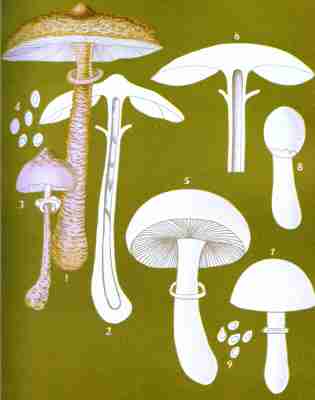
Plate XI.
Figs. 1 to 4.—Ag. (Lepiota) procerus Scop. (Lepiota procera). "Parasol Mushroom."
Edible.
Cap at first ovate, then expanded, showing distinct umbo, cuticle thick, torn into evanescent scales; gills remote from the stem, free, white, or yellowish-white; stem long, slender, variegated with brownish scales, hollow or slightly stuffed, bulbous at the base, and bearing a well-defined thickish ring, which in the mature plant is movable. Spores white, elliptical. The color of the cap varies from a light tan or ochraceous yellow to a dark reddish-brown. The surface showing beneath the lacerated cuticle is of a lighter hue than the cuticle, and is silky and fibrillose, giving the cap a somewhat shaded or spotted appearance. The flesh is dry, soft and thready, white. Taste and odor pleasant.
Cap from 3 to 5 inches broad; stem from 5 to 10 inches high.
This species is commonly found in pastures and in open grassy places; sometimes in open woods near cultivated fields, usually solitary or in very small clusters. It is a favorite among mycophagists. Lepiota racodes closely resembles Lepiota procera, and by some botanists the two are regarded as forms of the same species. In L. racodes the pileus is at first globose, expanded, and finally depressed in the centre; the cuticle is thin and broken into persistent scales; the whole plant smaller than L. procera. Flesh slightly reddish when bruised. Edible. There is also a white variety (puellaris) with a floccose squamose cap.
Plate XI.
Figs. 5 to 9.—Ag. (Lepiota) naucinus Fries (Lepiota naucinoides Peck). "Smooth White Lepiota."
Edible.
Cap at first sub-globose, then curved, the surface smooth and satiny when dry, creamy white; gills close and slightly rounded at the inner extremity towards the stem, free from the stem, white; stem white, smooth, hollow, and bulbous at the base; ring thick, distinct, movable, white. The gills, soon after gathering, become suffused with a faint pinkish or fleshy tint. The spores are white, sub-elliptical. Specimens occur in which there is a slight granulation in the centre of the cap, but they are rare. The variety squamosa shows the surface of the cap, somewhat broken into thick scales.
L. naucinoides is a very clean and attractive looking mushroom, usually symmetrical in shape. It is a fleshier mushroom than L. procera, and is found in grassy places, in lawns, sometimes in gardens, or by roadsides, especially where the soil is rich. The specimens figured in Plate XI were gathered in a rose garden, growing in loamy soil. Specimens have been received from different States, some of them much larger than those here illustrated.
This mushroom is recorded by some authors as equal in flavor to the Parasol mushroom. When stewed with butter it makes a very appetizing dish.
There is a fatally poisonous mushroom to which it bears some resemblance, and which might be taken for it, viz., Amanita verna, or "Spring mushroom." It is therefore necessary, in order to guard against such a mistake, to give particular attention to the characteristics of these two mushrooms. They are both white throughout, and both have white spores and ringed stem. Amanita verna, however, carries a white volva or cup-shaped sheath at the base of the stem, and the gills do not show a pinkish or flesh colored tinge at any stage. In Lepiota naucinoides, as in all the Lepiotas, the volva is wanting. Amanita verna is apt to be moist and clammy to the touch, and is tasteless. L. naucinoides is dry, and has a pleasant flavor. The first is found wholly in woods; the second prefers pastures, open grassy places, and gardens, though sometimes found in light woods. I have never found an Amanita in a lawn, pasture, or garden.
An edible mushroom, Agaricus (Psalliota) cretaceus, found in pastures, bears a slight resemblance to L. naucinoides, when the color of the spores and gills are not taken into consideration. In the former the gills very quickly change from their early stage of rosy pink to a dark purplish-brown color, like that of the common mushroom. The spores are purplish-brown, while in L. naucinoides the pinkish hue which tinges the fading plant is very faint, and changes to a very light tan color with age. The spores being white, the gills retain their white color for a long time, never changing to dark brown.
L. Americana Pk. A. & S., L. excoriata Schaeff., and L. rubrotincta Pk. have been tested and are of good flavor.
L. Americana has a reddish or reddish-brown cap, umbonate, with close adpressed scales and white flesh. The gills are broad and free from the stem, sometimes anastomosing near it, white; stem white, hollow, tapering towards the cap, annulate. When dried the whole plant has a brownish-red hue. When cut or bruised it sometimes exudes a reddish juice. Miss Banning reports specimens found in Druid Hill Park, Baltimore. I have gathered very beautiful specimens in Montgomery county, Md. This mushroom sometimes grows to a very large size.
L. excoriata has a pale fawn-colored cap, slightly umbonate, with thin cuticle, breaking into scales; gills remote, white; stem white, hollow, and short, nearly cylindrical. Odor faint, pleasant.
L. rubrotincta Pk. "Red-tinted Agaric." Cap reddish or pinkish, broadly umbonate and clothed with adpressed scales; gills whitish, free, and close; stem nearly equal or slightly thickened at the base, with a well-developed persistent white or pinkish ring. Spores white, sub-elliptical.
L. holosericeus Fries has a fleshy white cap, soft, silky, and fibrillose, a solid bulbous stem, with persistent broad, reflexed ring, and free ventricose, white gills. Edible. It is found in gardens and cultivated places.
L. acutesquamosa Wein, found in greenhouses and soil in gardens, is a heavy but not very tall species. The cap is obtuse, and fleshy, at first floccose. As the cap expands it bristles with erect pointed tufts or scales. The gills are white or yellowish, lanceolate and simple, free from the stem. Stem bulbous, somewhat stuffed, rough or silky below the ring, and downy above. Ring persistent. Color of cap whitish or light brown, with darker scales.
L. granulosus Batsch. Cap thin, wrinkled or corrugated, granulose, mealy; gills white, reaching the stem, sometimes free. Plants very small and varying in color—pink, yellow, and white, according to variety.
L. amiantha. Plants very small, ochraceous in color, with yellow flesh and white gills adnate and crowded.
L. cepæstipes Sow. Cap thin, broad, sub-membranaceous, broadly umbonate, adorned with mealy evanescent scales, margin irregular; gills white, at length remote. Stem hollow and floccose, narrow at top, ventricose; ring evanescent. Generally found in hothouses. Cap 1 to 3 inches broad. Stem 3 to 6 inches high. Spores white.
L. cristata is a common species found on lawns and in fields where the grass is short. The plants are small, the cap from ½ to 1½ inches in width. Not very fleshy. The cuticle of the cap is at first continuous and smooth but soon breaks into reddish scales. The stem is fistulose, slender and equal; gills free. Odor and taste somewhat strong and unpleasant.
Agaricus (Lepiota) cepæstipes—var. cretaceus, Peck. (Lepiota cretacea.) Edible. From Nature.
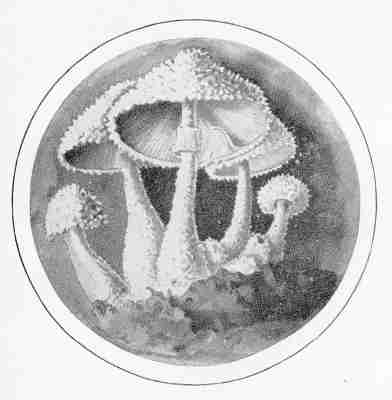
Plate XI½.
Ag. (Lepiota) cepæstipes, variety cretaceus Peck (Lepiota cretacea).
Edible.
This very delicate and beautiful agaric is found on tan and leaves in hothouses.
The specimens here delineated were gathered in one of the hothouses of the Agricultural Department and first described and figured in Food Products, No. 2, of the report of the Division of Microscopy. The plants are a pure white throughout, and both stem and pileus are covered with small chalk-white mealy tufts. Berkeley says, "this species is probably of exotic origin, as it never grows in the open air." It is also met with in the hothouses of Europe. Specimens have been received from contributors who gathered them in greenhouses in different localities. This species should not be confounded with the purplish-brown spored mushroom Agaricus (Psalliota) cretaceus, which has pink gills turning to dark brown and is allied to the common meadow mushroom.
Lepiota cretacea is a delicious mushroom when broiled, or cooked in a chafing dish, and served on hot buttered toast. It has a pleasant taste when raw.
Lepiota Morgani Peck, the "Green-Spored Lepiota," is an exception to the general type of Lepiotas in the color of its gills and spores. It is western and southern in its range. This species is described by Peck in the Botanical Gazette of March, 1897, p. 137, as follows: "Pileus fleshy, soft, at first sub-globose, then expanded, or depressed, white, the brownish or alutaceous cuticle breaking up into scales except on the disk; lamellæ close, lanceolate, remote, white, then green; stem firm, equal, or tapering upwards, sub-bulbous, smooth, webby-stuffed, whitish, tinged with brown, annulus rather large, movable; flesh both of the pileus and stem white, changing to reddish, and then to yellowish hue when cut or bruised; spores ovate, sub-elliptical, mostly uninucleate, .0004 to .0005 inches long, .0003 to .00032 broad, sordid green.
"Plant 6 to 8 inches high, pileus 5 to 9 inches broad, stem 6 to 12 lines thick. Open dry grassy places. Dayton, Ohio. A. P. Morgan."
AGARICINI.
Genus Cortinarius Fries. This genus is distinguished by a cob-web-like veil, dry persistent gills, which in the mature plants become discolored, and pulverulent with the rusty or ochraceous colored spores. The veil is very delicate, resembling a spider's web. It is not concrete with the cuticle of the cap, but extends from its margin to the stem, in the young plants sometimes concealing the gills, but disappearing as the cap expands. Sometimes a few filaments are seen depending from the margin of the cap or encircling the stem.
In the young plants of this genus the gills vary very much in color. They are whitish, clay-color, violet, dark purple, blood-red, etc., according to species, but, as the plants mature, the gills become dusted with the rust-colored falling spores, and with age usually become a rusty ochraceous, or cinnamon color. The stem in some of the species is distinctly bulbous and in others equal, cylindrical, or tapering. In identifying the species it is necessary, in order to ascertain the true color of the gills, to examine the plants at different periods of growth.
The genus Cortinarius is a large one, and contains many beautiful species. It is mainly confined to temperate regions. Not a single species has been recorded as found in Ceylon, the West Indies, or Africa, but one tropical species is found in Brazil. Nearly four hundred species have been described, and over three hundred and seventy of these belong to the United States and Europe. A few are found in the extreme southern or temperate portion of South America, and several are reported from a temperate elevation among the Himalayas. Sweden and Great Britain, with their temperate climates, claim a large proportion of the European species. Not many of the Cortinarii have been recorded as edible, and none as dangerous. The Rev. M. J. Berkeley records, however, a case of poisoning by one of the species, C. (Inoloma) bolaris Pers., which though not fatal was somewhat alarming, the symptoms being great oppression of the chest, profuse perspiration, and the enlargement for two days of the salivary glands of the patient. I have seen no other statements relating to the poisonous properties of this species, and the results alluded to may have been owing to some individual idiosyncrasy.
Berkeley, in his "Outlines," gives the following description of this mushroom: "Pileus fleshy, obsoletely umbonate, growing pale, variegated with saffron-red, adpressed, innate scales; stem stuffed, then hollow, nearly equal, squamose, of the same color as the cap; gills subdecurrent, crowded, watery, cinnamon color. Cap 1 to 2 inches broad. Stem 2 to 3 inches long." In beech woods in September and October.
The genus Cortinarius has been divided by some authors into the following six groups: (1) Phlegmacium, in which the cap is fleshy and viscid, the veil partial, and the stem firm and dry; (2) Myxacium, in which the veil is universal and glutinous, hence the cap and stem both viscid; cap thin and the gills adnate or decurrent; (3) Inoloma, in which the cap is fleshy, dry, and at first silky with innate fibrils; veil simple and stem slightly bulbous; (4) Dermocybe, in which the pileus is thinly fleshy, dry, and at first downy, becoming smooth; the veil single and fibrillose; flesh watery, colored when moist, stem equal or attenuated downwards; (5) Telamonia, in which the cap is moist, at first smooth or dotted with the superficial fragments of the veil, the stem ringed below, or peronately scaly from the remains of the universal veil; (6) Hydrocybe, in which the cap is thin and moist, not viscid, smooth, or covered with superficial white fibrils; stem rigid, not scaly, veil thin, occasionally collapsed in an irregular ring. These subdivisions have been designated as tribes by some botanists and subgenera by others, etc. To the divisions Inoloma and Phlegmacium, respectively, belong the two species illustrated in Plate XII.
Edible Figs. 1 to 4 Cortinarius (Inoloma) violaceus, Linn. "Violet Cortinarius." Figs. 5 to 7 Cortinarius (Phlegmacium) cærulescens, Fries. T. Taylor, del.
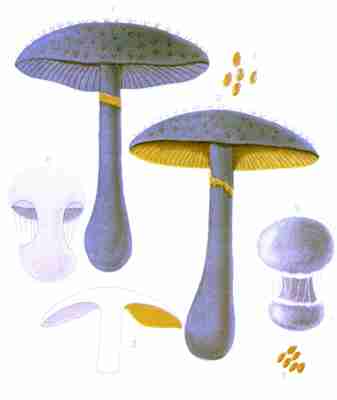
Plate XII.
Figs. 1 to 4.—Cortinarius (Inoloma) violaceus Fr. "Violet Cortinarius."
Edible.
Cap fleshy, at first convex, then nearly plane, dotted with hairy tufts or scales, margin at first involute, color purple or dark violet, flesh soft, purplish; gills distant, broad, adnate, somewhat rounded near the stem, at first purplish violet, changing to an ochraceous or brownish cinnamon color as the plant matures; stem solid, somewhat bulbous at the base, purple; cortina or veil white or tinged with violet, sometimes bluish.
This is a handsome species, and though it is somewhat rare in many localities, its pretty and unusual coloring does not allow it to be easily overlooked. It is edible, and has a mushroomy taste when raw. Agaricus nudus Bull, a purple species with white spores, is sometimes confounded with it. There are other purple species of Cortinarius not so pleasant to the taste, which bear some resemblance to C. violaceus. The specimens figured in Plate XII were gathered near Dedham, Mass., on open ground on the border of a stretch of pine woods.
Figs. 5 to 7.—Cortinarius (Phlegmacium) cærulescens.
Edible.
Cap fleshy, at first convex, then plane, surface even, viscid; color bluish or violet; gills adnexed and crowded, at first bluish, changing to violet or purplish hues; stem solid, short, and thick, with a broadly bulbous base, same color as the cap; veil filmy, single. In woods and on the borders of woods. This mushroom varies in color, the bluish or purplish tints being quite susceptible to atmospheric changes. When growing in the shade or well-sheltered places, it is much darker in hue than when exposed unsheltered to the bright sunlight. The specimen figured in Plate XII was gathered on low ground near a pine grove in Essex County, Mass.
Cortinarius (Phlegmacium) purpurascens Fr. bears a slight resemblance to cærulescens, but can be distinguished from it by the spotted or zoned character of the cap and the broadly emarginate gills.
Cortinarius turmalis, an edible autumnal species, having an ochraceous or brownish-yellow cap with emarginate or decurrent gills, the latter at first whitish, then reddish clay color, is found in abundance in some parts of Maryland. The gills are never tinged with purple or blue. The flesh is white. The plants are easily discovered by those familiar with their habitat, as they grow under pine needles in groups, forming small mounds extending over large spaces, and in these hiding places, in the autumnal months, they are free from insects and dust. I have collected a bushel of them in less than an hour in fresh condition in October. Some of the French authors do not class this species as edible. Gillet, in his Hymenomycetes of France, enumerates fifty-three edible species of Cortinarius, but places turmalis among the suspects. I find this mushroom not only edible, but very valuable, because of its abundance in the localities where found. It is often densely cæspitose. The plant, when mature, is from 3 to 5 inches high.
C. sebæceus, found also in pine woods, is recorded as edible. The plant is tall, white-stemmed, with broad tan-colored, somewhat viscid cap; emarginate gills, clay color at first, at last cinnamon color; stem solid, stout, fibrillose, and equal.
Cortinarius collinitus, Smeared Cortinarius, and Cortinarius cinnamomeus, with its variety semi-sanguinea, have also been tested, and found edible. The first of these is somewhat common. The plants when fresh are covered with a glutinous substance, and this should be removed before cooking. Cap smooth under the glutinous coat, light brown or tawny yellow in color, flesh white; gills whitish or light gray when young, cinnamon-hued in the matured plant. Stem solid, nearly equal, cylindrical, yellowish, and somewhat scaly. C. cinnamomeus belongs to the division Dermocybe. The cap is thin at first, silky with innate fibrids, becoming smooth, and varies from light brown to a dark cinnamon color. The gills are yellowish, then cinnamon; stem downy or silky, yellow. The variety semi-sanguinea has the lamellæ red, almost as in the preceding species.
C. (Phlegmacium) varius, "Variable Cortinarius," edible, has a compact fleshy viscid, even cap, brownish in color, gills at first violet, changing to cinnamon, stout solid stem, white or whitish, adorned with adpressed flocci, flesh white.
Cortinarius (Telamonia) armillatus Fries is given in M. C. Cooke's list of edible Cortinarii. Cap fleshy but not thick, fibrillose and slightly scaly, bright bay color, thin uneven margin; stem solid, dingy, rufescent, showing irregular red zones or bands elongated and slightly bulbous at the base; gills distant, broad, pallid in color at first, changing to dark cinnamon. C. (Telamonia) hæmatochelis Bull. (edible), somewhat resembles the former in color and size, though not so bright a brown. Cap thin, silky-fibrillose; gills adnate, narrow and crowded, light cinnamon; stem long, solid, dingy, with a reddish zone.
C. (Hydrocybe) castaneus Bull., Chestnut Cortinarius (edible), is found in woods and gardens. The plants of this species are usually small. Cap at first campanulate, expanding, sometimes slightly umbonate in the centre, chestnut color; gills ventricose, crowded, purplish, changing to rust color; stem short, hollow or stuffed, cartilaginous, equal, pallid, reddish brown, or tinged with violet; veil white.
Subgenus Collybia Fries. Cap at first convex, then expanded, not depressed, with an involute margin; gills reaching the stem, but not decurrent, sometimes emarginate; stem hollow, with cartilaginous bark of a different substance from the hymenophore, but confluent with it; often swollen and splitting in the middle; spores white. The plants are usually found growing upon dead tree stumps; some grow upon the ground; a few are parasitic on other fungi or springing from sclerotia, small impacted masses of mycelium. The species are generally small and firm and of slow growth. A few are edible, some few have an unpleasant odor. On account of the cartilaginous stem and the dryness of their substance, some of the smaller species are apt to be taken for Marasmii. Note: Saccardo in his Sylloge gives Collybia generic rank.
Edible Figs. 1 to 3 Agaricus (Collybia) fusipes, Bull. "Spindle Foot Collybia." Figs. 4 to 6 Agaricus (Collybia) maculatus, A. & S. "Spotted White Collybia." Figs. 7 to 9 Agaricus (Collybia) velutipes, Curt. "Velvet Footed Collybia." T. Taylor, del.
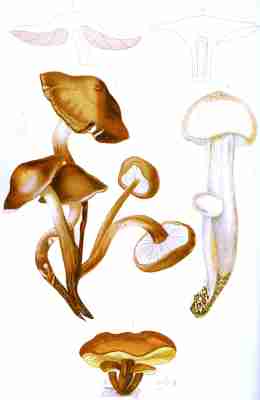
Plate XIII.
Figs. 1 to 3.—Ag. (Collybia) fusipes Bull. "Spindle-Foot Collybia."
Edible.
Cap fleshy, somewhat tough, convex, then plane, smooth, even or slightly cracked in places, umbo evanescent, reddish brown; gills adnexed, nearly free, broad, distant, at length separating near the stem, firm, white, changing to fawn color, or pale brown often spotted; stem long, stuffed, then hollow, externally cartilaginous, contorted, swollen in the middle, cracking in longitudinal slits, fusiform, tapering narrowly to a rooted base, reddish brown. On stumps in woods in the autumn. Cap 1 to 2 inches broad; stem 2 to 6 inches long. This species is densely cæspitose. It is very generally recorded among authors as edible, although the flesh is somewhat tough. It requires long and slow cooking. An English author recommends it for pickling. Only the caps should be used for this purpose.
Figs. 4 to 6.—Ag. (Collybia) maculatus A. & S. (Collybia maculata). "Spotted White Collybia."
Cap fleshy and compact, convexo-plane, obtuse, smooth, even, margin thin, at first involute, turned inwards, white; stem long and stout, externally cartilaginous, ventricose, sometimes striate, tapering towards the base; gills free, or nearly so, narrow, crowded, somewhat linear, white, becoming spotted. Taste slightly acid. The whole plant is creamy white, becoming spotted and stained throughout with rusty-brown or foxy-red tints. The plants are usually large, long stemmed, and grow in irregular clusters on decayed tree stumps in woods. Specimens of a large size have been gathered in the fir woods near Mattapoisett, Massachusetts. Cap 3 to 5 inches broad; stem 3 to 5 inches long. The variety immaculatus differs from the typical form in not becoming spotted and in the broader gills, which are serrated.
Figs. 7 to 9.—Ag. (Collybia) velutipes Curt. "Velvet-Footed Collybia."
Cap fleshy, thin, at first convex, then plane, obtuse, smooth, viscid, tawny or brownish yellow, turning dark; flesh yellowish and soft; gills slightly adnexed, pale yellow; stem tough, stuffed, externally cartilaginous, sometimes slender, but usually thick, covered with a brown velvety down, dark bay color. This is a very common species in some localities. It is densely cæspitose, growing in heavy clusters on old logs and tree trunks in parks, woods, and gardens. The plants are quite gelatinous when cooked. Group figured from illustration by M. C. Cooke.
Collybia radicata Rehl. is recorded as an edible species. The plants have a thin, slightly fleshy cap, slightly umbonate, wrinkled, and glutinous at maturity; distant, white, adnexed gills, and tall, slender, rigid stem. The latter is often twisted and usually attenuated upwards, color pale brown. It has a long tapering root entering deeply into the soil. This species is solitary in habit, and is commonly found in grass, or near decayed stumps. Cap from 2 to 3 inches in diameter, stem 6 inches to 10 inches in length.
Collybia esculenta Jacq., a small species found in pine woods as well as in pastures in the spring, is recorded as edible by a number of authors. In this species the cap is nearly plane, obtuse, and smooth, brownish; gills adnate, whitish; stem very slender, fistulose, equal, tough, smooth, reddish clay color, deeply rooting.