Part 3 — TABLE XXX
Reading edition
Class Characteristic Lines
O H He Si+++ C++ N++ He+
H He Si+++ He+ O+
H He Si+++ O+*
H He*
H He
H He Si+ Ca+
H He Si+ Ca+ Mg+
H He Si+ Ca+ Mg+
H* Si+* Ca+ Mg+
H Ca+ Mg+* Ca Fe
H Ca+ Mg+ Ca Fe
H Ca+ Ca Fe Ti
H Ca+ Ca Fe Ti
H Ca+ Ca Fe Ti G bd.
H Ca+ Ca Fe Ti G bd.
H Ca+ Ca Fe Ti G bd.
H Ca+* Ca Fe* Ti* G bd.*
H Ca+ Ca* Fe Ti TiO₂
H Ca+ Ca Fe Ti TiO₂
H Ca+ Ca Fe Ti TiO₂
The division into “arc,” “spark,” and “superspark” is clearly shown by the table. Maxima of the lines which are used as criteria of class are marked with an asterisk.
It is shown in Chapter III that the range in surface gravity is far smaller than the range in mean density. Secondly, the basis of the classification has been shown to be the degree of thermal ionization.[508] Granted that the value of the partial electron pressure is low enough, in dwarfs as well as in giants, for thermal ionization to predominate over ionization by collision, a mass of gas will pass through the same succession of ionization-stages with changing temperature, whatever the surface gravity. Any given stage of ionization will, however, be reached at a lower temperature, the lower the pressure, since, as pointed out in Chapter X,[509] lowered pressure tends to increase the degree of ionization, and will help to produce a given degree of ionization at a lower temperature.
The Draper system takes no direct account of temperature. It classifies purely by degree of ionization, and therefore, as it relates to atmospheres in which the surface gravities differ widely, it will produce classes that are not homogeneous in temperature; dwarfs will be hotter than giants of the same spectral class. Fowler and Milne[510] anticipated a difference of from 10 to 20 per cent, and differences in this sense and of this order actually occur.[511] Physically it seems to be more important to class together stars having the same atmospheric properties than stars at exactly the same effective temperature, although the latter might conceivably be better suited to some purposes.
Although giant and dwarf stars may be found with very similar spectra, it is well known that they display important differences for individual lines, and these differences have formed the basis for the estimation of spectroscopic parallaxes.[512] If the spectrum of a giant star is compared with the spectrum of a dwarf of the same temperature, the two will be found to differ. The line-intensities in the spectrum of the dwarf will place it in a spectral class nearer to the red end of the sequence—if the giant is of Class , the dwarf may be a star. There are two ways in which the stars might be brought into the same spectral class; by an alteration of temperature or by an alteration of pressure. If the temperature of the dwarf star were raised, the resulting changes in ionization in its atmosphere would produce changes in the intensities of the lines in the spectrum. At some temperature, about 15 per cent higher than the original temperature of the dwarf star, it would give a spectrum resembling that of the giant.
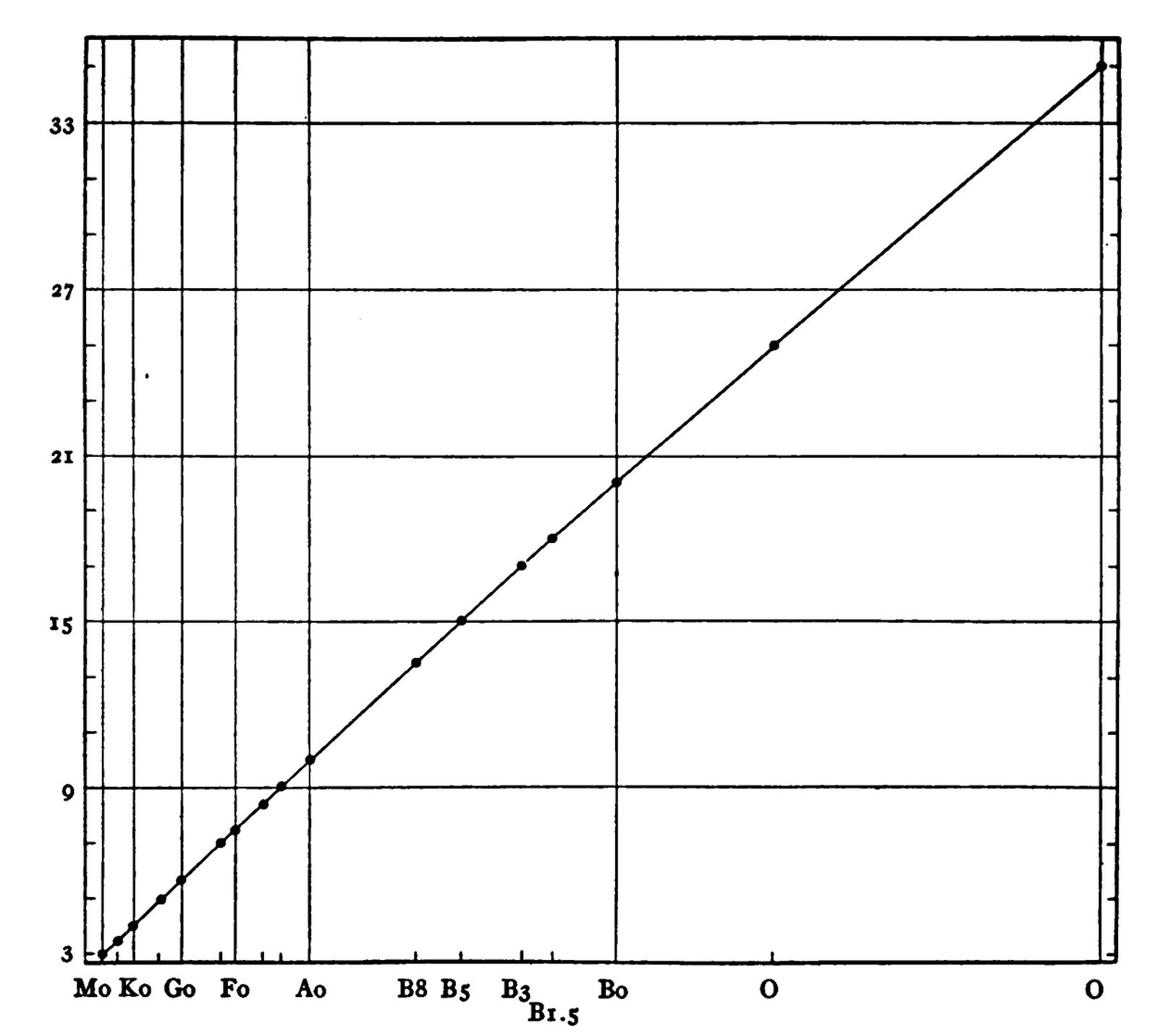
Figure 10
Schematic representation of the ionization temperature scale for the sequence of stellar classes. Ordinates are absolute temperatures in thousands of degrees; abscissae are Draper classes. The points representing the different classes have been made to lie on a straight line, so that the temperature range of the corresponding classes shall appear along the axis of abscissae. Vertical lines are drawn through , , , , , , and the upper limit of the class, in order to show the increase in temperature range for the hotter classes.
If the pressure in the atmosphere of the dwarf star were reduced, the resulting increase in the degree of ionization would also produce changes in the spectral lines, until it gave a spectrum similar to that of the giant. There is, however, no reason to suppose that the changes produced in the intensities of individual lines by these temperature and pressure changes would be in all cases exactly equal, although they would in general operate in the same direction.