Part 2 — TABLE XVII
Reading edition
Atom Ionization Potential Wave-lenght Stellar Ocurrence
1 H 13.54 1215 -
2 He 24.47 584, 557 -
3 Li 5.37 6707 *
4 Be ? 2349 -
5 B ? 2498, 2497 -
6 C ? 2479 -
7 N ? - -
8 O 13.56 1306, 1304, 1302 -
9 F ? - -
10 Ne 16.7 - -
11 Na 5.12 5896, 5890 *
12 Mg 7.61 2852 -
13 Al 5.96 3962, 3944 -
14 Si ? 2882 -
15 P ? 2553, 2536 -
16 S 10.31 1915, 1900 -
17 Cl ? - -
18 A ? - -
19 K 4.32 7699, 7665 *
20 Ca 6.09 4227 *
21 Sc ? 4247, 3652 *
22 Ti 6.5 5065, 5040, 5014 *
23 V ? 4331, 4333 *
24 Cr 6.75 4290, 4275, 5254 *
25 Mn 7.41 4034, 4033, 4031 *
26 Fe ? 2756, 2749 -
27 Co ? 3454, 3405 *
28 Ni ? 3415 *
29 Cu 7.69 3274, 3248 *
30 Zn 9.35 2139 -
31 Ga 5.97 4172, 4033 *
37 Rb 4.16 7948, 7800 *
38 Sr 5.67 4607 *
40 Zr ? 4496, 4392 *
42 Mo ? 3903, 3864, 3798 *
47 Ag 7.54 3383, 3281 *
48 Cd 8.95 2288 -
49 In 5.76 4511, 4102 *
50 Sn ? 3262 ?
55 Cs 3.88 8943, 8581 -
56 Ba 5.19 7911 -
57 La ? 3949 *
79 Au 8.72 2676, 2428 -
80 Hg 10.39 2537, 1850 -
81 Tl 6.08 5350, 3775 -
82 Pb 7.38 4058, 3684 *
It is possible to predict from the table which lines are likely to appear in the spectra of the coolest stars. The ultimate lines of Al, K, Ca, Sc, Ti, V, Cr, Mn, Co, Ni, Cu, Ga, Rb, Sr, Zr, Mo, Ag, In, Ba, La, and Pb fall in the region ordinarily photographed, and Na can be reached in the yellow. All these elements in the neutral state would therefore be anticipated in the spectra of cooler stars, and they are indeed found without exception. The ultimate lines of several elements contained in the list lie in the far ultra-violet, and cannot be detected in stellar spectra. The corresponding neutral elements will therefore not be recorded unless they also give a strong subordinate series in the photographic region. The elements C, O, S, and probably N, all have ultimate lines in the ultra-violet, and possess no subordinate series in the appropriate range of wave-length. Their apparent absence in the neutral state from stellar spectra is therefore fully explained. All of these elements appear in the hotter stars in the once or twice ionized condition. The elements H, Mg, and Si have strong subordinate series in the photographic region—the Balmer series, the “b” group, and the line[364] at 3905, respectively. They are accordingly represented in the cooler stars.
The elements contained in the table and not yet discussed are Be, B, Ne, A, F, and Cl. These elements have not been detected in stellar spectra. In seeking an explanation of their apparent absence, it has been suggested that a low relative abundance of the corresponding atoms may be responsible. Arguments from terrestrial analogy must be applied with caution, but there is reason to suspect that they may here have a legitimate application.[365] It may be suggested that boron, beryllium, neon, and argon are present in the stars in quantities too small to be detected. The halogens are unrepresented, but it is not possible to draw useful inferences until their laboratory spectra are more fully analyzed.
IONIZATION
At the lowest temperatures, then, the ultimate lines will predominate. As the temperature of the absorbing layer is raised, ionization—the complete ejection of the electron from the atom, instead of a displacement from one stationary state to another—will set in, and the tracing of the resulting spectral changes is the salient feature of the Saha theory. “Ionization can be effected in many ways. To expel an electron against the attractive force of the remainder of the molecule, work is required, and the necessary energy may be furnished by X rays or rays, or by collision with other electrons.... At high temperatures, when the conditions of maximum entropy demands an appreciable amount of ionic dissociation, the requisite energy is drawn from the environment.... The work required to ionize a single molecule, when expressed as the number of volts through which an electron must fall to acquire this energy, is the ionization potential; it may be regarded as the latent heat of evaporation of the electron from the molecule” (Milne).[366]
The analogy between ionization and evaporation illustrates very well the scope of the Saha theory, in which the process is treated as a type of chemical dissociation. Corresponding to each temperature there is a definite state of equilibrium, where the forward and backward velocities of the ionization process are equal—in other words where ionization and recombination are proceeding at the same rate. The method of statistical mechanics has been applied to this problem by Fowler and Milne.[367] Here the analysis will not be reproduced, but the formulae are required in order to illustrate the process of ionization.
The number of atoms which are unionized at any given temperature is given by the expression where = number of atoms ionized. = the “partition function.” , where is the partial pressure of electrons. = absolute temperature. = Boltzmann’s constant, = . = the ionization potential.
This is the number of atoms which is effective in absorbing the ultimate lines at that temperature. For low values of , the number of unionized atoms falls off at first very slowly with rising temperature, up to a point depending only on the ionization potential. Beyond this temperature the number of neutral atoms falls off with great rapidity. The diagram (Figure 5) illustrates the fall in the number of neutral atoms, and the consequent decay in strength of the ultimate lines. So steep is the gradient of at the higher temperatures that the quantity is best plotted logarithmically. The ultimate lines will persist, with almost undiminished intensity, up to the temperature at which the gradient of begins to increase. This critical temperature increases with ionization potential, and neutral atoms of high ionization potential should display very persistent ultimate lines as the temperature rises.
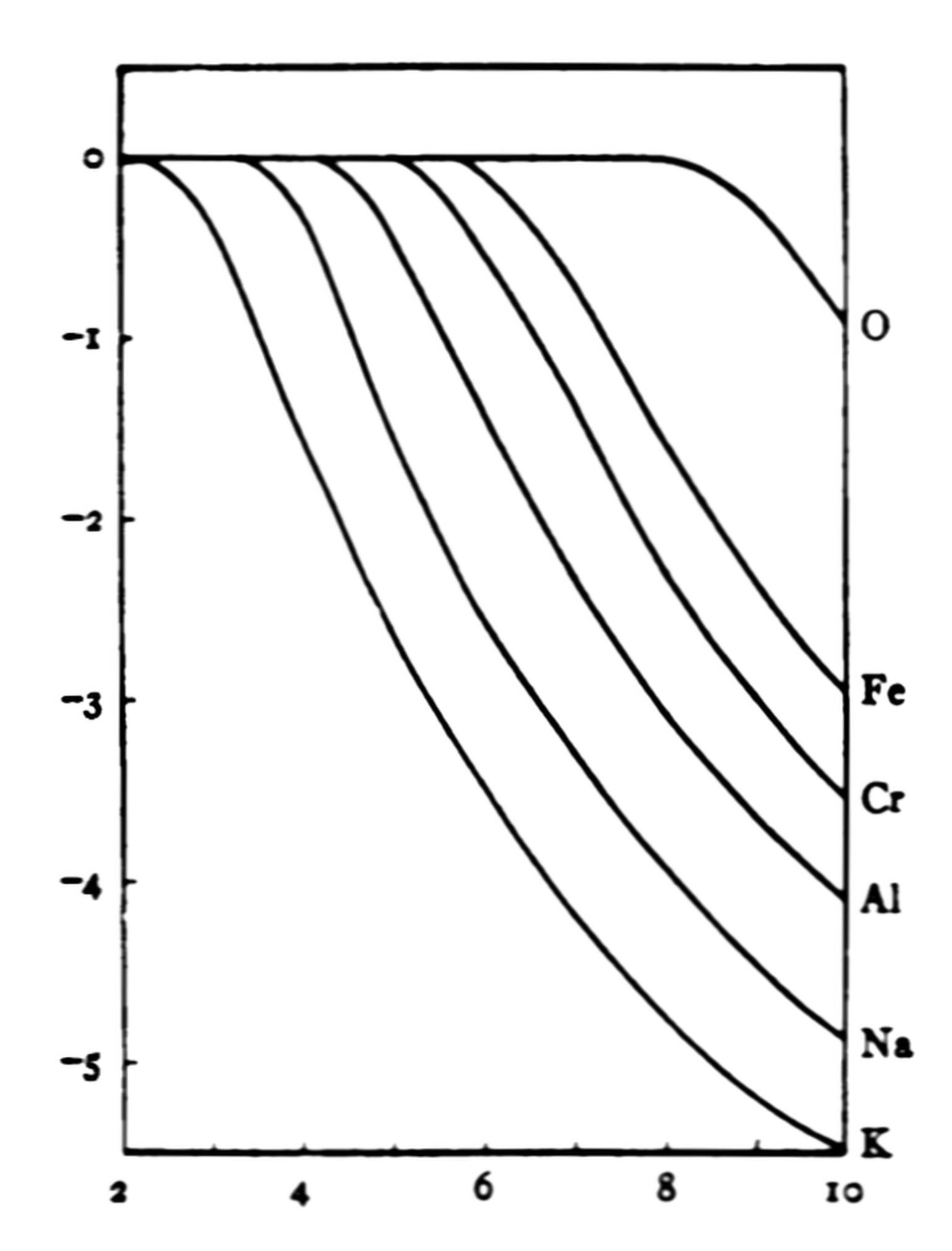
Figure 5
Ultimate lines of neutral atoms. Ordinates are logarithms of computed fractional concentrations; abscissae are temperatures in thousands of degrees. The curves show the decrease in the number of neutral atoms, with rising temperature, and the consequent decay in strength of the ultimate lines, for the atoms indicated on the right margin.
As ionization becomes more and more complete, the intensity of the ultimate lines falls off until so small a number of neutral atoms remains that their lines cease to appear in the absorption spectrum.
SUBORDINATE LINES
The neutral atom gives rise to other lines besides the ultimate lines, but these require the transfer of an electron from some stationary state, not the normal one, to another stationary state. The atom must receive a definite quantity of energy, equal to the excitation potential of the initial stationary state, in order to be in a condition to absorb a line of a subordinate series which originates from that state. If there is an appreciable energy supply, a certain fraction of the neutral atoms present will have received this excitation energy, which is of course smaller than the ionization potential, and these atoms will be in a position to absorb the subordinate series.
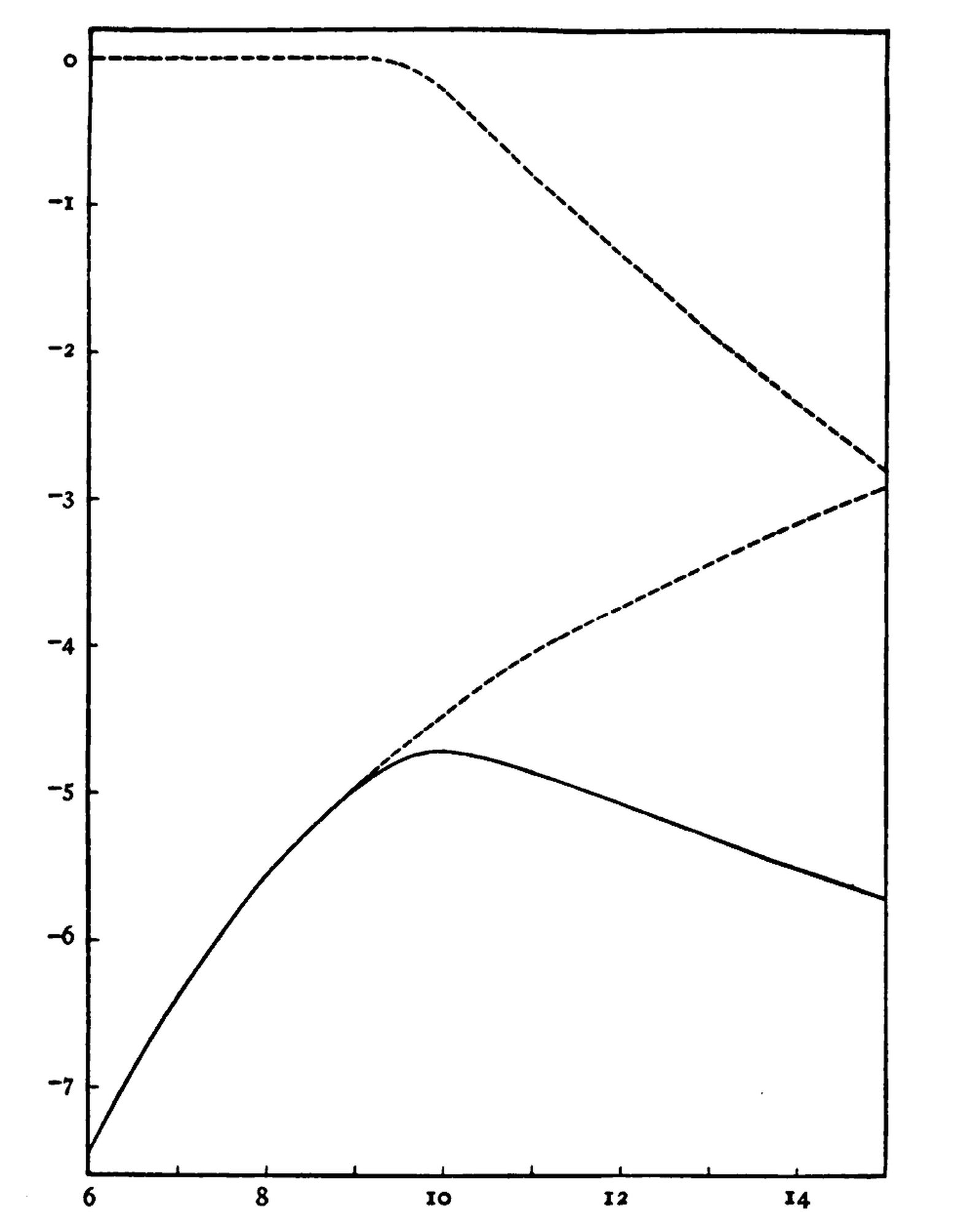
Figure 6
Production of the maximum of an absorption line. Ordinates are logarithms of computed fractional concentrations; abscissae are temperatures in thousands of degrees. The curves reproduced are those for the Mg + line at 4481. The upper broken curve represents the fraction of magnesium atoms that is singly ionized at the corresponding temperature; the lower broken curve represents the fraction of the Mg + atoms present that is in a suitable state for the absorption of 4481. The full line represents the sum of the ordinates of the dotted curves, and gives the fraction of the total number of magnesium atoms that is able to absorb 4481 at the various temperatures indicated by the abscissae.
The fraction, , of the total number of neutral atoms which have become able to absorb the lines associated with a definite excitation potential is given by Fowler and Milne as where () = excitation potential. The quantity increases with the temperature, approaching the value unity asymptotically.
The total number of atoms active in absorbing a subordinate series at any temperature is evidently the product of the number of neutral atoms and the quantity . The curves for these two quantities are plotted logarithmically in Figure 6, the magnesium line 4481 being used as an illustration. The total number of absorbing atoms may be obtained by adding the ordinates. It will be seen that the number of such atoms increases, passes through a maximum and decreases again, as the temperature is raised. The maximum for a subordinate line of the neutral atom may occur, as in the case of helium, when ionization is far advanced.
In the special case where , the second curve, which represents the growth of the fraction , becomes a straight line parallel to the temperature axis, and the first, or ionization, curve, approaches the zero ordinate asymptotically at low temperatures. The ordinate of the curve representing is zero, and the resultant sum gives a curve identical with the curve for the ultimate lines. Ultimate lines thus appear as the special case of subordinate lines for which the excitation potential is zero. This fits exactly with the definition of ultimate lines as the lines naturally absorbed by the cold vapor—no initial excitation is required to bring the atoms into a state in which they can absorb.
LINES OF IONIZED ATOMS
As soon as ionization sets in, the absorbing layer begins to contain a new kind of atom, derived from the neutral atoms by the complete ejection of one electron. These ionized atoms will absorb their own spectrum, which differs completely from that of the corresponding neutral atom; and the degree of absorption will again depend on the number of such ionized atoms present in the reversing layer.
The ionized atom has in general a spectrum corresponding exactly to that of the neutral atom preceding it in the periodic table, but with a different Rydberg constant.[368][369] Two types of lines arise, as before—ultimate and subordinate lines. For the number of atoms which can absorb the ultimate lines of the enhanced spectrum, the formula reduces to Account is here taken of the residual neutral atoms by the middle term of the denominator, which is very small, and is only of sensible magnitude for the ultimate lines, when the numerator is equal to unity.
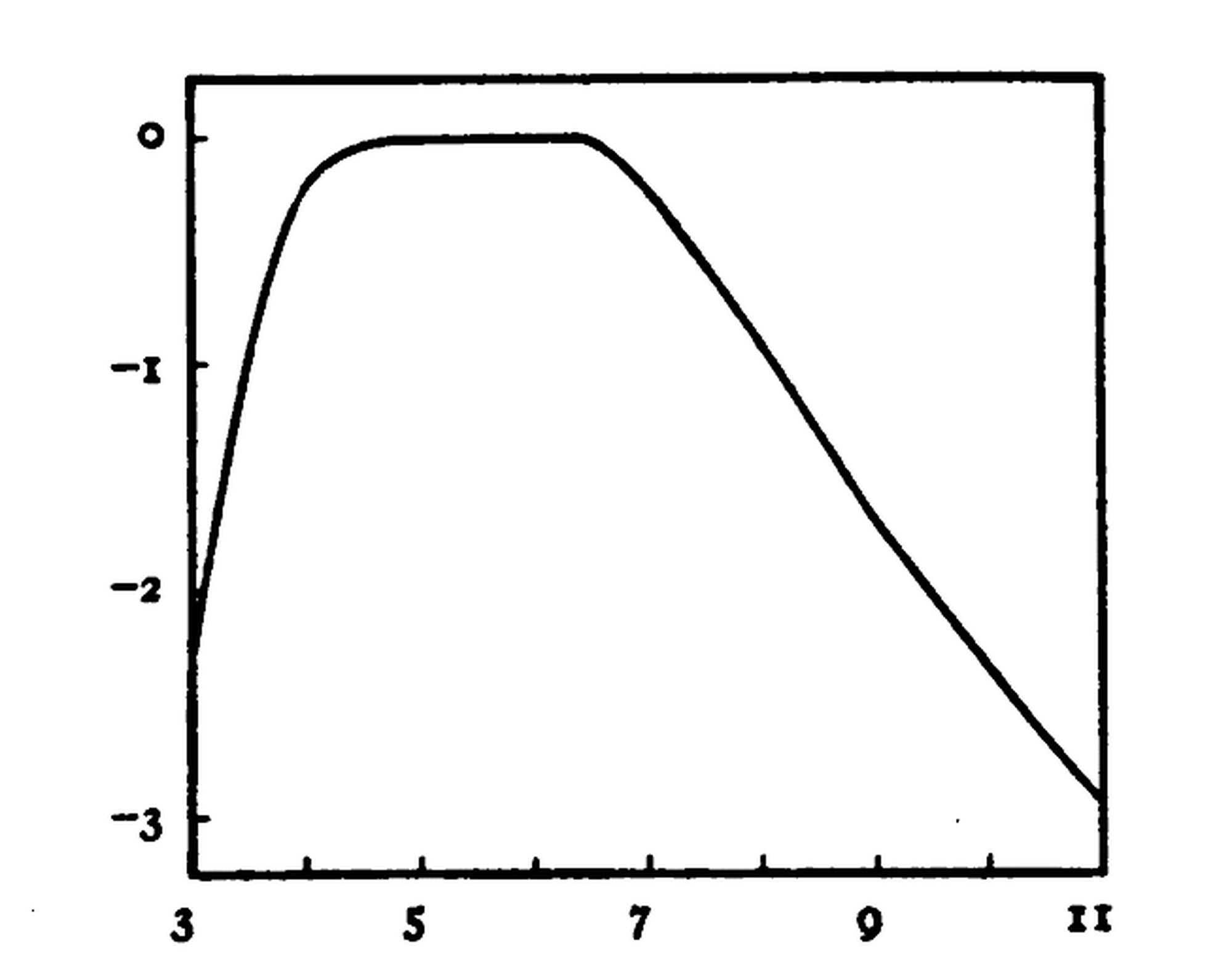
Figure 7
Maximum of the ultimate line of an ionized atom. Ordinates are logarithms of computed fractional concentrations; abscissae are temperatures in thousands of degrees. The curve is drawn for the line 4554 of Ba+, on the assumption that is .
The following curve shows the number of absorbing atoms. The flatness of the maximum is especially to be noted, suggesting that the ultimate lines of the ionized atom, like the ultimate lines of the neutral atom, will be very persistent. The and lines of Ca+, and the corresponding lines 4077 and 4215 of Sr+, and 4555 of Ba+, would thus be expected to show over a considerable range in temperature and spectrum, and this is actually found to be the case.
The subordinate lines behave substantially as do the subordinate lines of a neutral atom, rising to a maximum at a temperature which depends chiefly on the ionization potential. It is assumed in deriving the corresponding equations that in practice the number of surviving neutral atoms will be too small to affect the concentration of ionized atoms giving the subordinate lines. This assumption may be shown to be justified at maximum intensity of the absorption line, though possibly the neutral atoms are not always negligible at the first appearance of the ionized lines of a very abundant atom.
SUMMARY
The general results of raising the temperature of the absorbing layer have now been traced. Although a greatly simplified case has been considered, the observed changes in the stellar spectral sequence have been very satisfactorily predicted.
At low temperatures the lines of neutral atoms are strong, in particular the ultimate lines, such as 3930 of Fe, 3999 of Ti, 4254 of Cr, and 4033 of Mn, which are at maximum strength, and decrease at first slowly, then rapidly in the hotter stars. The subordinate lines of neutral atoms, 4455 of Ca and 4352 of Fe, for example, attain a maximum, and then fall off with rising temperature. For many of the metallic lines for which no maximum is recorded, like those of the subordinate series of Na, the theoretical maximum is at a temperature equal to that of the coolest stars examined. Atoms with ionization potential less than 5 volts will in general give maxima below 3000°.
As the temperature increases, the lines of ionized atoms begin to appear, the ultimate lines rising very quickly in intensity, and persisting almost at maximum over several spectral classes. Later in the sequence the subordinate series for ionized atoms appear, rise to a sharper maximum, and fade more rapidly. The 4481 line of Mg+, the 4267 line of C+, and the 4128 line of Si+, show this effect well.
As the fall of intensity of the lines of neutral atoms after maximum is the result of the progress of ionization, it would be expected that the lines of the ionized atom would appear while those of the neutral atom were still quite strong, and that the one series would rise in strength as the other decreased. The lines of the neutral atom may persist over a large part of the range of the ionized lines. This is the case with the 4227 line of Ca, which persists until Class , while the and lines of Ca+ have been visible throughout the whole spectral sequence, and have been decreasing in intensity from onwards, owing chiefly to the rise of second ionization and the consequent formation of Ca++, which gives a spectrum in the ultra-violet and is therefore not detected in the stars.
As the temperature is further raised, the second and third ionizations set in, and presumably follow the same procedure as has been outlined for less ionized atoms. The lines of N++, C++, Si++, and Si+++ will serve as examples. The lines of the doubly ionized atoms of the metals are in general in the ultra-violet portion of the spectrum, and the corresponding elements do not therefore appear in the hotter stars, where they would otherwise be anticipated.
Qualitatively the prediction of the theory of ionization is fully satisfied. The quantitative discussion involves more rigorous treatment, and is reserved for a later chapter.