Part 1 — TABLE III
Reading edition
Atomic Number Element Ionization potential Reference
Physical Spectroscopic Astrophysical
1 H 14.4, 13.3 13.54 1, 2, 3
2 He 25.4 24.47 5, 4
He+ 54.3 54.18 3, 5
3 Li 5.37 3
Li+ 40 6
4 Be 9.6 7
5 B 8.3 7
B+ 19.0 7
6 C+ 24.3 8
C++ 45 9, 12
7 N 16.9 10
N+ 24 9, 12
N++ 45 9, 12
8 O 15.5 13.56 3, 11
O+ 32 9, 12
O++ 50 45 12
10 Ne 16.7 13
11 Na 5.13 5.12 14, 3
Na+ 30-35 15
12 Mg 7.75 7.61 16, 3
Mg+ 14.97 3
13 Al 5.96 3
Al+ 18.18 17
Al++ 28.32 17
14 Si 10.6 8.5 18, 19
Si+ 16.27 18
Si++ 31.66 18
Si+++ 44.95 8.5 18
15 P 13.3, 10.3 20, 21
P++ 29.8 7
P+++ 45.3 7
16 S 12.2 10.31 20, 12
S+ 20 9, 12
S++ 32 9, 12
S+++ 46.8 7
17 Cl 8.2 13
18 A 15.1 22
A+ 33, 34, 41.5 23, 22, 24
19 K 4.1 4.32 14, 3
K+ 20-23 14
20 Ca 6.09 3
Ca+ 11.82 3
21 Sc 6-9 25
Sc+ 12.5 19
22 Ti 6.5 26
Ti+ 12.5 19
23 V 6-9 25
24 Cr 6.7 3
25 Mn 7.41 35
26 Fe 5.9, 8.15 7.5 28, 29, 19
Fe 13 19
27 Co 6-9 25
28 Ni 6-9 25
29 Cu 7.69 3
30 Zn 9.35 3
Zn+ 19.59 7
31 Ga 5.97 3
33 As 11.5 30
34 Se 12-13, 11.7 31, 32
35 Br 1.00 13
36 Kr 14.5 33
37 Rb 4.1 4.16 34, 3
38 Sr 5.67 3
Sr+ 10.98 3
42 Mo 7.1, 7.35 35, 36
47 Ag 7.54 3
48 Cd 8.95 3
Cd+ 18.48 7
49 In 5.75 37
51 Sb 8.5 ± 1.0 26
53 I 10.1, 8.0 38, 39
56 Ba 5.19 3
Ba+ 9.96 3
80 Hg 10.4 40
81 Tl 6.94 41
82 Pb 7.93 7.38 42
83 Bi 8.0 30
Bi+ 14.0 30
1 Horton and Davies, Proc. Roy. Soc., 97A, 1, 1920.
2 Mohler and Foote, J. Op. Soc. Am., 4, 49, 1920.
3 A. Fowler, Report on Series in Line Spectra, 1922.
4 Lyman, Phys. Rev., 21, 202, 1923.
5 Horton and Davies, Proc. Roy. Soc., 95A, 408, 1919.
6 Mohler, Science, 58, 468, 1923.
7 D. R. Hartree, unpub.
8 A. Fowler, Proc. Roy. Soc., 105A, 299, 1924.
9 Payne, H. C. 256, 1924.
10 Brandt, Zeit. f. Phys., 8, 32, 1921.
11 Hopfield, Nature, 112, 437, 1923.
12 R. H. Fowler and Milne, M. N. R. A. S., 84, 499, 1924.
13 Horton and Davies, Proc. Roy. Soc., 98A, 121, 1920.
14 Tate and Foote, Phil. Mag., 36, 64, 1918.
15 Foote, Meggers, and Mohler, Ap. J., 55, 145, 1922.
16 Foote and Mohler, Phil. Mag., 37, 33, 1919.
17 Paschen, An. d. Phys., 71, 151 and 537, 1923.
18 A. Fowler, Bakerian Lecture, 1924.
19 Menzel, H. C. 258, 1924.
20 Mohler and Foote, Phys. Rev., 15, 321, 1920.
21 Duffendack and Huthsteiner, Amer. Phys. Soc., 1924.
22 Horton and Davies, Proc. Roy. Soc., 102A, 131, 1922.
23 Shaver, Trans. Roy. Soc. Can., 16, 135, 1922.
24 Smyth and Compton, Amer. Phys. Soc., 1925.
25 Russell, Ap. J., 55, 119, 1922.
26 Kiess and Kiess, J. Op. Soc. Am., 8, 609, 1924.
27 Catalan, Phil. Trans., 223A, 1922.
28 Sommerfeld, Physica, 4, 115, 1924.
29 Gieseler and Grotrian, Zeit. f. Phys., 25, 165, 1924.
30 Ruark, Mohler, Foote, and Chenault, Nature, 112, 831, 1923.
31 Foote and Mohler, The Origin of Spectra, 67, 1922.
32 Udden, Phys. Rev., 18, 385, 1921.
33 Sponer, Zeit. f. Phys., 18, 249, 1923.
34 Foote, Rognley and Mohler, Phys. Rev., 13, 61, 1919.
35 Catalan, C. R., 176, 1063, 1923.
36 Kiess, Bur. Stan. Sci. Pap. 474, 113, 1923.
37 McLennan, Br. A. Rep., 25, 1923.
38 Foote and Mohler, The Origin of Spectra, 67, 1922.
39 Smyth and Compton, Phys. Rev., 16, 502, 1920.
40 Eldridge, Phys. Rev., 20, 456, 1922.
41 Mohler and Ruark, J. Op. Soc. Am., 7, 819, 1923.
42 Grotrian, Zeit. f. Phys., 18, 169, 1923.
By the use of one or other of the available methods, the data for neutral atoms are complete as far as atomic number 38, with the exception of carbon (6), fluorine (9) and germanium (32). The data for ionized atoms are also increasing, at the present time, in a very gratifying manner. The “hot spark” investigations of Millikan and Bowen,[14] which permit the estimation of the fifth and sixth ionization potentials of certain light atoms, are not included in the table. Under the conditions hitherto investigated in the stellar atmosphere, ionization corresponding to a potential of about fifty volts is the highest encountered, and accordingly ionization potentials that greatly exceed this value have no place in the present tabulation of astrophysically useful data. A knowledge of the higher critical potentials[15] is, however, of great interest in connection with the theoretical problems of the far interior of the star.
There are conspicuous gaps in the table, and it is to be feared that many of them are likely to remain unfilled. The spectra of the neutral atoms of carbon, phosphorus, and nitrogen have hitherto defied analysis, and our knowledge of the corresponding ionization potentials must therefore depend on physical methods. For carbon, silicon, and similar refractory materials, such methods are difficult of application; the same applies to the metals. It is therefore probable that the ionization potentials of the neutral atoms of several of the lighter elements, of the platinum metals, and of the rare earths, will remain unknown or uncertain for some time to come. None of the atoms thus omitted is of immediate astrophysical importance.
As shown in the table, the values for the ionized and doubly ionized light atoms O+, O++, C++, N++, S+, and S++ are deduced only astrophysically. It may be hoped that the spectra of these atoms will soon be arranged in series, so that an accurate value of the ionization potential may be available, in place of the approximate one deduced from the stellar evidence, for the corresponding absorption lines are of importance in the spectra of the hotter stars.
The spectroscopic ionization potentials have an advantage over the physical values, in that the corresponding state of the atom is known with certainty, whereas physical methods can in general only detect some critical potential, without assigning it definitely to a particular transition. For example, it seems likely that in some cases the first ionization, whether caused by incident radiation or by electron impacts, corresponds to the loss of an electron by the molecule: where represents the atom, and the electron. The effect of increased excitation would then be the decomposition The first reaction would produce the ionized molecule, and the second would produce the ionized and neutral atoms simultaneously. It might thus happen that the spectrum could appear without the previous appearance of the spectrum, since all of the element was present in the form before ionization.
The above is only a simple illustrative example of the possible complexity in the physical determination of ionization potentials. The interpretation of four successive critical potentials for hydrogen has been discussed by Franck, Knipping and Krüger,[16] while eight have been detected by Horton and Davies[17] for the same element. Similarly Smyth[18] discusses four critical voltages for nitrogen. No explicit attempt has yet been made to use these facts for the interpretation of astrophysical data, but they may account for the unexplained absence of some neutral elements from the cooler stars. The absence is generally to be attributed, as will be shown in Chapter V, to the non-occurrence of suitable lines in the part of the spectrum usually examined. But it is possible that the persistence of the molecule has a definite significance in the case of nitrogen, where the ionization potential is as high as 16.9 volts.
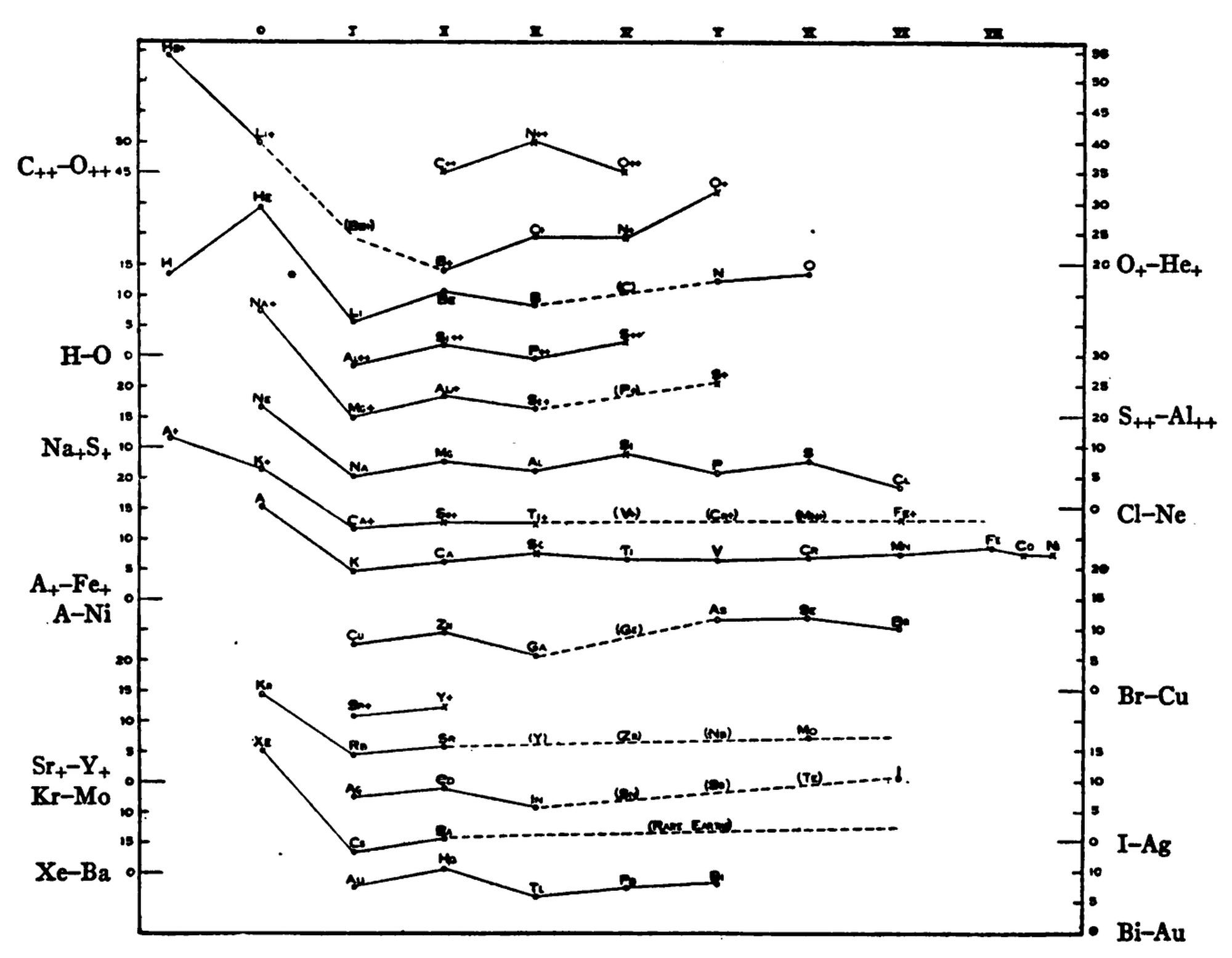
Figure 4
Relation between ionization potential and position in the periodic system. Ordinates are ionization potentials in volts, on the equal but shifted scales indicated alternately on left and right margins. Abscissae are columns of the periodic table. Physical determinations of ionization potential are indicated by open circles; dots give spectroscopic determinations, and crosses denote astrophysical estimates. Conjectural portions of the curve are indicated by broken lines, and atoms of unknown ionization potential are enclosed in parentheses.
The increasing completeness of the table of ionization potentials suggests a re-examination of the relation recently traced by the writer[19] between ionization potential and atomic number. The original diagram, in which columns of the periodic table are treated as abscissae, and the ordinates are ionization potentials on equal but shifted scales, so that analogous elements fall one below another, is here reproduced, with the addition of data more recently obtained.
The Displacement Rule of Kossell and Sommerfeld leads us to expect a pronounced similarity between the line drawn in the diagram from the point representing one element to that representing the next, and the corresponding line for the ionized atoms of the same elements, the latter being shifted one place to the left for each electron removed. The points for once and twice ionized atoms are inserted into the diagram on this principle, and the parallelism is found to exist. The regularities of the diagram and their possible significance (such, for example, as the pairing of the valency electrons, the second being harder to remove than the first) were discussed in the original paper. All the more recent data appear to confirm the conclusion there set forth, that the relation between ionization potential and atomic number is very closely the same in each period.
DURATION OF ATOMIC STATES
In addition to the critical potentials, which give a measure of the ease with which an atom is excited or ionized, astrophysical theory requires an estimate of the readiness with which an atom recovers after excitation or ionization. It appears probable that this factor, like the critical potentials, is independent of external conditions, and depends upon something that is intrinsic in the atomic structure. The “life” of the atom has been extensively investigated in the laboratory, and has been shown to be a small fraction of a second in duration. Probably this subject of “atomic lives” is still in an initial stage, and the accuracy of the results and the range of elements discussed will be greatly increased in the near future. A summary of the material obtained up to the present time is contained in the following table. Successive columns contain the atom discussed, the deduced atomic life in seconds, the authority, and the reference.
The data are practically confined to hydrogen and mercury, and for both these elements the atomic life appears to be of the order .
Astrophysical estimates of the life of the excited calcium atom have been made by Milne,[20] who derives values of the order . This is so near to the values obtained in the laboratory that it seems permissible, in the absence of further precise data, to assume an atomic life of , as a working hypothesis, for all atoms. The same value is unlikely to obtain for all atoms; in particular it may be expected to differ for atoms in different states of ionization. But here astrophysics must be entirely dependent on further laboratory work for the determination of a quantity that is of fundamental importance.