Part 3 — TABLE XXVI
Reading edition
Wave Lenght Wave Lenght Atom Series Wave Lenght Wave Lenght Atom Series
3758.8 3757.68 Ti+ 4325.2 4314.98 Ti+
3759.30 Ti+ 4321.1 Ti+
3856.2 4337.6 4337.92 Ti+
3863.2 4374.7 Ti+?
3900.7 3900.53 Ti+ 4395.3 4395.04 Ti+
3913.6 3913.45 Ti+ 4400.2 4399.77 Ti+
4003.0 4002.09 Fe+ 4417.9 4417.71 Ti+
4009.4 4444.0 4443.80 Ti+
4012.6 4012.40 Ti+ 4450.6 4450.49 Ti+
4024.8 4025.13 Ti+ 4469.5 4468.14 Ti+
4028.5 4028.35 Ti+ 4471.8 4472.93 Fe+
4030.8 4409.6 4489.21 Fe+
4053.8 4053.84 Ti+ 4491.6 4491.41 Fe+
4077.9 4077.71 Sr+ 4501.5 4501.27 Ti+
4122.8 4122.64 Fe+ 4508.5 4508.29 Fe+
4128.1 4128. Si+ 4515.4 4515.34 Fe+
4131.4 4131. Si+ 4520.3 4520.24 Fe+
4143.9 4522.9 4522.64 Fe+
4173.6 4173.47 Fe+ 4534.2 4533.97 Ti+
4179.5 4178.87 Fe+ 4534.17 Fe+
4l87.6 4556.0 4555.90 Fe+
4215.7 4215.52 Sr+ 4558.9
4233.6 4233.16 Fe+ 4564.0 4563.77 Ti+
4271.7 Fe+? 4584.0 4583.84 Fe+
4288.1 4287.88 Ti+ 4586.
4294.3 4294.10 Ti+ 4619.2 4620.52 Fe+
4297.1 4296.56 Fe+ 4629.9 4629.33 Fe+
4314.4 4312.88? Ti+ 4657.0
The foregoing tabulation contains a list of the lines that are strongly enhanced in the spectra of the c-stars. Successive columns give the approximate wave-length, taken from Miss Maury’s original list, the laboratory wave-length of the line with which the stellar line is identified, the atom, and the series relations.
The preponderating characteristic lines are clearly those of ionized iron and ionized titanium.[472] All the strong lines of these atoms are found in the c-star spectrum, and they are there stronger than in any other class. It is found that spectra possessing the c-character have in general unusually sharp and narrow lines. It is probable that the lines in the spectrum of a c-star are actually stronger, as well as sharper, than the corresponding lines in a star of the same class and lower luminosity.[473]
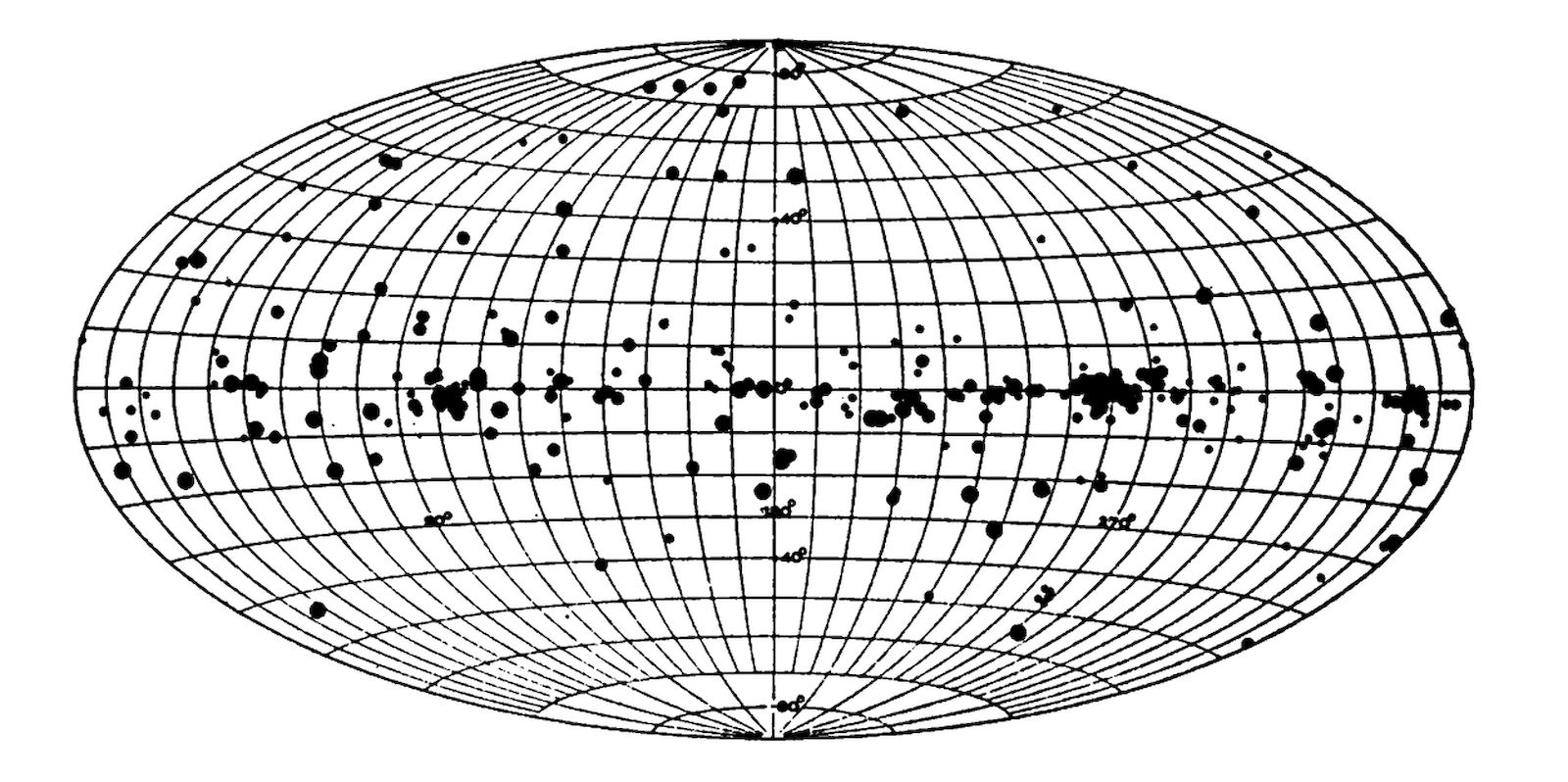
Figure 9
Galactic distribution of stars mentioned in the Draper Catalogue as having narrow lines. Four sizes of dots indicate stars of different apparent magnitudes; brighter than 5.0; 5.0-6.0; 6.0-8.0; and fainter than 8.0, respectively.
This phenomenon is connected with the question of the effective optical depth of the photosphere, and is discussed in Chapter IX.
It was first pointed out by Hertzsprung[474] that the c-character marks out a class of stars with distinct physical properties—extremely small parallaxes and proper motions, strong galactic concentration, and, accordingly, very high luminosity and volume, and low density. The last feature furnishes an interpretation of the spectral peculiarities (see Chapter X).
The reality of the c-character has been questioned owing to a misapprehension as to its criteria.[475] Fine lines always accompany the c-character, but they may be present without it. The star h Ursae Majoris is a case in point. It is listed in the Henry Draper Catalogue as having narrow lines, a remark that usually indicates the presence of the c-character. Actually the star appears to be a dwarf, of Class , with considerable proper motion. Although the lines are narrow and sharp, the spectrum has not the very typical appearance of a c-star.