MISSIONARY WORK IN AFRICA.
Reading edition
It is not alone as a commercial, scientific and political field that Africa attracts attention. No country presents stronger claims on the attention of Christian philanthropists. The Arabs entered Africa as propagandists of Islamism. The Portuguese advent was signalized by the founding of Catholic missions. When they arrived off the mouth of the Congo, in 1490, the native king, “seated on a chair of ivory, raised on a platform, dressed in glossy, highly colored skins and feathers, with a fine head-dress made of palm fibre, gave permission to the strangers to settle in his dominions, to build a church, and to propagate the Christian religion. The King himself and all his Chiefs were forthwith baptised, and the fullest scope was allowed to the Roman Catholic missionaries who accompanied the expedition to prosecute their appointed work.”
Thus runs an old chronicle. It is valuable as showing the antiquity of Christian interest in Africa, as well as showing the fine opportunity then presented for introducing the gospel into benighted lands. We say fine opportunity, because Portugal was then a power, able and willing to second every effort of the church, and the church itself was well equipped for missionary work. Its zeal was untiring. Its formula was calculated to impress the African mind. The regalia of its priesthood was captivating. Its music was pleasing and inspiring. But the sequel proved that something was wrong. The priesthood laboured arduously, establishing missions, baptizing the natives by the thousand, adapting their ceremonies and processions to heathen rites and superstitions. The process was not that of lifting pagan souls to a high Christian level, so much as a lowering of Christian principles to a heathen level. Then the church was too dependent on, too intimate with, the state. Even Portuguese historians admit that physical force was frequently employed to bring the natives more completely under the will of the priests. The accounts given of some of the floggings which took place, both of males and female, would be alternately shocking and ludicrous, but for the fact that they were associated with the propagation of religion. Also, both church and state countenanced the crime of slavery, and fattened on the infernal traffic. The ultimate result of such a system might have been easily foreseen. After a long career of so-called missionary success, during which hundreds of mission stations were founded on the entire western and on a great part of the eastern coast of Africa, and many even far inland, the priests fell under the jealousy of the chiefs, clashed with them respecting polygamy and various other customs, and were finally forced back with the receding wave of European influence, when the power of Portugal began to wane. Within one hundred years of the above described arrival of the Portuguese missionaries off the mouth of the Congo, no trace of the labors of Catholic missionaries could be found and no tradition among the natives that they had ever been there. The finest mission stations elsewhere had fallen into ruins, and only those remained which were near ports of entry and fortified commercial points.
It may be truthfully said that missionary work in Africa lay as if dead till the spirit of African discovery was revived in England by the formation of the British African Association, in the latter part of the eighteenth century. Even its first pioneers were not missionaries, but rather explorers in a commercial and scientific sense. They were, however, philanthropic Christian men, and the problem of evangelizing Africa was ever present in their minds. Among them were Leyard, Major Houghton, Mungo Park who met his death on the Upper Niger, Frederic Horeman, Mr. Nicholls, Prof. Roentgen, Mr. James Riley, Captain Tuckey who manned the first Congo expedition in 1816, Captain Gray and Major Laing, Richie and Lyon, Denham and Clapperton who pierced Bornou and visited Lake Tchad, Laing and Caillié whose glowing descriptions of Timbuctoo were read with delight.
These were followed at a later period by Richard and John Lander who really solved the problem of the Niger, and by Laird and Oldfield and Coulthurst and Davidson. Now came a time, 1841, when broader sympathies were enlisted. An expedition was organized under the direction and at the expense of the British Government which was not merely to explore the interior of the vast Continent, promote the interests of art and science, but check the slave trade, introduce legitimate commerce, advance civilization and social improvement, and thus prepare the way for the introduction of Christianity. For this purpose, treaties were to be formed with native princes, agriculture was to be encouraged, and Christian missions were to be established. Two missionaries went along, Rev. Messrs. Muller and Schon. The expedition began the ascent of the river Niger, but was soon forced to return. Failure was written over the enterprise, and the cause was the deadly climate, which had been too little studied in advance. African enterprise in the north again fell back on pioneering exploits, and we have the splendid researches of Barth, Krapf and Rebman in 1849, and in 1857 those still more brilliant efforts of Burton and Speke, who entered the continent from Zanzibar, on the east, and brought to light the mystery of Victoria Nyanza and Tanganyika. Following these came Baker, and then the immortal Livingstone, who united the pioneer and the missionary.
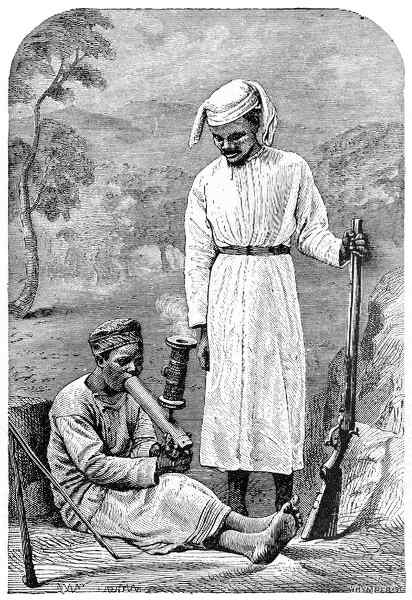
Livingstone entered Africa in 1840, under the auspices of the London Missionary Society, and founded a missionary station at Kolobeng, South Africa, 200 miles north of the Moffat station at Kuruman. He married Rev. Robert Moffat’s daughter, and was thus doubly fortified for missionary work. He labored earnestly and faithfully in his field till driven by the hostility of the Boers to provide himself another mission further north and beyond the great Kalahari desert. After suffering untold hardships in his trip across the desert, he discovered Lake Ngami, decided that it would be a good base for further missionary work, and then returned for his wife. A third time he crossed the desert, which had been regarded as impassable, and this time with his family. It was the year 1851. He reached the river Chobe after a hard struggle, his animals having perished under the bites of the poisonous tsetse fly. Here he entered the kingdom of Sebituane, the renowned warrior, whose favor he had previously secured. But that chieftain had died, and his successor detained Livingstone for a time. When a permit was obtained to go where he pleased, he pushed on 130 miles to Sesheke, and thence to the Zambesi, in the center of the continent, in the country of the famed Macololos. But finding the country too unhealthy for a permanent mission, he returned to Cape Town, whence he planned and carried to success a journey back to the Zambezi, and westward, through the Macololos and other tribes, to Loanda in Angola, quite across the continent. This was in 1852. This journey came about because, when at Cape Town, he learned of the total destruction of his parent mission station at Kolobeng by the Boers. This left him without a pastoral charge, but it proved a turning point in his life. Henceforth the field of adventure and exploration was his, and he easily became the most noted of African travelers, till Stanley established for himself a greater fame. What the Church lost a whole world gained. His further travels, how he lost and buried his faithful wife on the banks of the Shiré, his own sad death in the swamps of Lake Bangweola, the return of his dead body to Zanzibar, borne by his faithful servants Chuma and Susi, have all been described elsewhere in this volume.
The recent advance of the Portuguese toward the head-waters of the Zambesi, and their reduction of the Macololo territory to a Portuguese possession, together with the complications with other ambitious nations of Europe, likely to grow out of it, bring that strange Central African people again into prominence. The region was made known, in olden times, by the Portuguese traveler, Silva Porto, who described it as fertile, and the people as of divided tribes. But Livingstone describes the section as the empire of the Macololos, and gives many glowing descriptions of the people, their rulers, products and possessions. He was well received by them, liked their country, and left a profound impression among them, for Major Serpa Pinto, in his visit many years afterwards, found Livingstone’s name mentioned everywhere among the then detached and demoralized tribes with respect.
CHUMA AND SUSI.
KING LOBOSSI.
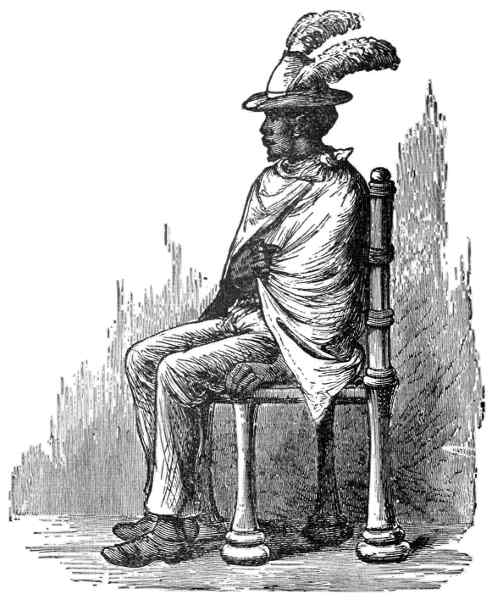
According to Livingstone, the powerful Basuto tribe, south of the Zambesi, crossed to the north side under the lead of their chief, Chibitano, and reduced the numerous tribes who inhabited the vast stretches of country as far as the river Cuando. Chibitano gave to his army, formed of different elements, and to his conquered peoples, made up of a variety of origins, the name of Cololos, hence the word Macololos, so well known throughout Africa. This powerful warrior and legislator held his conquered tribes as brethren in one common interest till his death, when they began to set up independent empires. In this disintegration the Luinas, under King Lobossi, came to the front, and are yet the most powerful of the Macololos. Pinto says that the Macololo empire is now composed of a mongrel crew—Calabares, Luinas, Ganguellas, and Macalacas—all given to drunkenness and moral brutishness. They are polygamous and deep in the slave traffic. Their country—200 miles long and over 50 wide—is full of villages and fine plantations. The Luina herds cover the plains of the upper Zambesi, and no finer cattle are to be found in Africa. Lakes abound, and while they contribute to malarial diseases, they give a rich variety of fish. The men do not take readily to farming, but the women are wonderful milkmaids and vegetable raisers. As a people, they are skillful iron-workers and wood-carvers, and expert at pottery work. They cultivate tobacco for snuff, but smoke only bangue. They dress fuller and better than most Central African people, and some of their garbs are quite fantastic.
Prof. Henry Drummond, of Glasgow, in a lecture on “The Heart of Africa,” gives a vivid description of the perils which beset missionary life in the Zambesi regions:
As his boat swept along the beautiful lake Nyassa, he noticed in the distance a few white objects on the shore. On closer inspection, they were found to be wattle and daub houses, built in English style and whitewashed. Heading his boat for the shore, he landed and began to examine what seemed to be the home of a little English colony. The first house he entered gave evidence of recent occupancy, everything being in excellent order; but no human form was to be seen or human voice to be heard. The stillness of death reigned. He entered the school-house. The benches and desks were there, as if school had been but recently dismissed; but neither teachers nor scholars were to be seen. In the blacksmith shop the anvil and hammer stood ready for service, and it seemed as if the fire had just gone out upon the hearth; but no blacksmith could be found. Pushing his investigations a little further, he came upon four or five graves. These little mounds told the whole story and explained the desolation he had seen. Within them reposed the precious dust of some of the missionaries of Livingstonia, who one by one had fallen at their post, victims of the terrible African fever. Livingstonia was Scotland’s answer in part to the challenge which Henry M. Stanley gave to the Christian world to send missionaries to eastern equatorial Africa. When that intrepid explorer, after untold hardship, had found David Livingstone, and during months of close companionship had felt the power of that consecrated life, he blew the trumpet with no uncertain sound to rouse the church to her privilege and responsibility in central Africa. But it was not till the death of the great missionary explorer, that the land which gave him birth resolved to send a little army of occupation to the region which he had opened to the Christian world. On the 18th of January, 1875, at a public meeting held in the city of Glasgow, the Free, the Reformed, and the United Presbyterian churches of Scotland founded a mission, to be called Livingstonia, and which was to be located in the region of Lake Nyassa, the most southern of the three great lakes of central Africa, with a coast of eight hundred miles. Although founded by the churches just named, it was understood that it was to be regarded as a Free Church mission, the others co-operating with men and means as opportunity offered or necessity required.
The choice of location was most appropriate, not only because Dr. Livingstone had discovered that beautiful sheet of water, but because he had requested the Free Church to plant a mission on its shores. The first company of missionaries, which included also representatives of the Established Church, who were to found a separate mission in the lake region, after immense toil and severe hardship, reached the lake, via the Zambesi and Shiré rivers, October 12th, 1875. They selected a site near Cape Maclear as their first settlement, and as soon as possible put into operation the various parts of the mission work they had been commissioned to prosecute—industrial, educational, medical and evangelistic. From the first the mission met with encouraging success, becoming not only a center of gospel light to that benighted region, but also a city of refuge to which the wretched natives fled to escape the inhuman cruelties of the slave traders. As the years rolled on, however, it was found necessary to remove the main work of the mission to a more healthful region on the lake—hence the desolation seen by Prof. Drummond—the work at Cape Maclear being now mainly evangelistic and carried on by native converts. The mission still lives and comprises four stations, one of which is situated on the Stevenson Road, a road constructed at a cost of $20,000 by an English philanthropist, and intended to promote communication between Lakes Nyassa and Tanganyika.
After this diversion, forced upon the reader by reason of Livingstone’s dual missionary and pioneering work, we turn again to the north of Africa, and to historic Egypt. Comparatively little has been done in this land by Christendom for the evangelization of its degraded population. Wesleyan missionaries were stationed at Alexandria in the early part of the century, but the field proved unpropitious and they were removed to a more promising sphere of labor. Even the Church of England, now most in favor there, has not achieved much in the way of Christianizing the people. Perhaps the American United Presbyterians have been most successful in this uninviting field. They have several missionaries there, numerous lay agents, over a score of stations and schools, and quite a following of converts and pupils. The Khedive has granted them toleration and valuable concessions. The Church of Scotland sustains one mission and several prosperous schools at Cairo, in Egypt.
In Nubia, the Mohammedan religion is so firmly fixed, that missionary effort has been almost entirely discouraged.
The Abyssinians boast of their relationship to King Solomon, resulting from the visit of the Queen of Sheba to Jerusalem. They also claim to have received their Christianity from its fountain head in Judæa, on the return of the Ethiopian eunuch to the Court of Queen Candace, after his conversion to the faith of the Gospel by Philip, the Evangelist. Whatever truth there may be in these traditions, it is a fact that the religion of the country is a species of Christianity, combined with certain Judaic observances, as circumcision, abstinence from meat, keeping of Saturday as the Sabbath, and also with many Catholic forms, as reverence for the Virgin, the calendar of saints, etc. As a missionary field the Catholics were the first to enter Abyssinia in 1620, and they succeeded in persuading the king to declare Catholicism to be the religion of the State. This bold step, however, occasioned civil wars which ended in their expulsion from the country. Jesuit missionaries from France came later, but they were also banished.
The Church of England Missionary Society in 1829 sent out two missionaries. Others followed, but little was accomplished. The well known German missionary, Herr Flad, has accomplished quite a work in recent times. The defeat and murder of the Abyssinian king was one of the sad events of 1888. It followed successful invasions of the country and the slaughter and enslavement of large numbers of Abyssinians in 1885 and 1886 by the Mahdists, and their defeat by King John in 1887. Herr Flad transmitted a letter to the British and Foreign Anti-Slavery Society from Christian Abyssinians, which is a most earnest and pathetic appeal for help from their fellow Christians and such help as will prevent their enslavement and the entire desolation of their country. Very pertinently these people, whose liberties and lives are in such imminent danger, inquire of Christians in other lands, after depicting the desolation of their own, the selling of thousands of people into slavery, and the cruel butchery of other thousands, “Why should fanatic and brutal Moslems be allowed to turn a Christian land like Abyssinia into a desert, and to extirpate Christianity from Ethiopia?” They close with this earnest plea: “For Christ’s sake make known our sad lot to our brethren and sisters in Christian lands, who fear God and love the brethren.” While Abyssinian Christianity may not be without spot, Abyssinians are God’s men and women.
Later missionary letters to the London Anti-Slavery Society say that the Mahdists have made Western Abyssinia a desert. Whole flocks and herds have been destroyed, thousands of Christians have been thrown into slavery, thousands of others have been butchered, and hundreds of the noblest inhabitants have been taken to Mecca as slaves in violation of treaties.
The English gunboat Osprey recently captured three cargoes of slaves off the island of Perim, which guards the Aden entrance to the Red Sea. When brought to the Admiralty Court at Aden they proved to be about 217 in number, chiefly Abyssinian boys and girls from 10 to 20 years of age, captured by the fierce Mohammedan Gallas, and run across to Mocha to be sold to the Mohammedans. The Foreign Missionary Committee in Scotland appeal for a special Rescued Slaves’ Fund for the support and Bible education of these captives.
In Barca, Tripoli, Fezzan, Tunis, Algiers, and Morocco, known as the Barbary States, owing to the exclusive character of the Moslem faith, all missionary effort for the evangelization of the general population has been precluded until recently. A note from Edward H. Slenny, secretary of the North Africa Mission, says Jan. 26, 1889: “I have just returned from visiting most of the missionaries connected within the North Africa Mission in Morocco, Algeria and Tunis. The prospect among the Mohammedans is encouraging and we are hoping to send out more laborers. There are now forty-one on our staff, and two more leave us in a week. We are now proposing to take up work among the Europeans as well as the Mohammedans, and also establish a station in Tripoli, which is quite without the Gospel.”
Algeria was occupied in some measure in 1881, Morocco in 1884, Tunis in 1885 and in 1889. Mr. Michell, who has been working in Tunis, accompanied by Mr. Harding, who left England February 1, landed in Tripoli the 27th. Thus far they are getting on well. They find the people more bigoted than in Tunis. Besides the work they may be able to do in the city and neighborhood, they will be able to send some Scriptures by the caravans leaving for the Soudan which, with the blessing of God, will spread the light around Lake Tchad.
A correspondent of The Christian, (London) writing from Gibraltar, says: “We have had very cheering news from Morocco. A wonderful work has sprung up among the Spanish and Jewish people of Tangier. Meetings, commenced two or three months ago, have been held in Spanish, addressed through an interpreter by some brethren of the North African Mission, and there has been an intense eagerness to hear the truth. The Holy Spirit has carried home the Gospel message with conviction to many hearts, and a few days ago the brethren informed me that seventeen Jewish and Spanish converts were baptized, and others were waiting for baptism. The meetings have been crowded night after night, so much so that the friends in Tangier contemplate hiring a music-hall, at present used for midnight revelry and sin. This revival has aroused the enmity of both rabbi and priest, consequently bitter persecution has followed. Several Jewish inquirers have been beaten in the synagogue, converts have been dismissed from their employment, and the priests have offered bribes and made threats to the Spanish converts to induce them to cease attending the meetings, but so far the converts are holding firm.”
E. F. Baldwin is meeting with great success in Morocco. He writes from Tangier:
“We have had great encouragement in the work here. For some two months we have had nightly meetings for inquirers and young converts, attended by from ten to twenty. Many have received Christ as their personal Saviour and have been at once baptized. For some weeks most of my time was occupied from morning until night talking with interested ones who visited me, and daily there would be natives in my room much of the time. At times conversions occurred daily. All of them are brought out of Mohammedan darkness. They all renounce that false religion formally at their baptism. Almost all are young men, some of good position, but most of them from among the poor. There is not one who has not prayed and spoken in our meetings from the day of his conversion.
“Two of the earliest converts are in the mountains traveling on foot without purse, scrip or pay, preaching in both Arabic and Shillah. They have been away now several weeks. Others, whose faces we have never seen, have been converted in distant places through one from here, and write us of many others believing through their word. We have reason to believe the Gospel has taken root in several places in Southern Morocco within these few weeks. Two others of our number are arranging to start at once to preach in another direction. Mr. Martain and I are also leaving as soon as we can get away, and will travel also as Christ commanded, on foot and without purse or scrip.”
Later he writes from Mogador: “For upwards of a year new accessions have been constant, and every one baptized has renounced Mohammedanism. For a time the work was seemingly much hindered by severe persecution, imprisonment, beating, disowning, banishment—these are all too familiar to the converts here in Southern Morocco. But when it was impossible to work longer here in Mogador we travelled and preached, going literally on the methods laid down in Matthew X, which we hold with, we find, increasing numbers of God’s children, to be of perpetual obligation. We have found them to contain the deep and matchless wisdom of God for missionary effort. Several others besides myself, including recently converted natives, are so travelling. The natives knowing no other methods, have gone gladly forth, without purse or scrip, on foot, taking nothing, and marvellous blessing in the way of conversion has followed the step of their simple faith. They go with no thought of pay or salary. The Father makes their simple needs His care. My own position as an unattached missionary, dependent only on God for temporal supplies (which, blessed be His name, He ceaselessly supplies), enables one to consistently instruct these native Christians in the principles and methods of Mathew x, and encourage them to go forth upon them.
“It is to this return to these first principles of mission work I attribute the constant flow of blessing we are having, and which is so exceptional in Mohammedan fields. I earnestly recommend them to others who may have the faith and are so circumstanced as to practice them. I say this without any reflection upon the more ordinary and accepted lines of mission endeavor. The field is vast and the need great, and by all and every means let the Gospel be preached.
“Just now the vigilance of our persecutors and adversaries has somewhat relaxed, and our frequent meetings (sixteen in Arabic and eight in English per week,) are well attended and we are cheered by more conversions. Several are just presenting themselves for baptism. Last night one of the most intelligent and best educated Moors I have ever met, publicly confessed Christ for the first time—both speaking and praying (as all the native Christians do from the hour of their conversion) in our meeting before many witnesses. He is one of the few ‘honorable’ ones who have been won. We trust he may become a veritable Paul. He was some months since arrested and thrown into prison on the suspicion of being a Christian, which at that time he was not. His feet, like Joseph’s, ‘they hurt with fetters,’ the scars of which he will never cease to carry. Poor fellow! He was then without the comfort that comes to a child of God in affliction, and yet enduring reproach for Christ. But God blessed his dreary sojourn in prison to his soul, and it contributed to his conversion.
“Some from among the few resident Europeans and from among the Jews also have turned to the Lord and confessed Him in baptism.
“Tidings from different places in the interior, where the word of life has been carried from here, tell us of many turning from Mohammed’s cold, hard, false faith, to the love and light the Gospel brings them. May not all this encourage the zeal and faith of scattered workers toiling in these hard Moslem fields?
“Some new workers, all committed to Mathew X lives, have just joined us. There are now six of us here, all men of course, with our lives given up to toil for Christ under his primitive instructions. A band is forming in Ayrshire, Scotland, of others who will come to us soon, we trust. Others in different places are greatly interested. We hope to have many natives together here in the summer months for training in the Word, that they may afterwards go forth two by two, without purse or scrip.”
Alfred S. Lamb writes as follows:
“Within four days’ journey of Britain one may land on African soil and find a large field—almost untouched—for Christian labor among the natives of Algeria, the Kabyles. Visiting recently among these people, and making known to them, for the first time, the glad tidings of salvation, I was much struck with the attention given to the message. Doubtless the novelty of an Englishman speaking to them in their own unwritten language, and delivering such a message as a free salvation without works, was sufficient of itself to call forth such attention. Seated one evening in a Kabyle house, I was greatly delighted with the readiness to listen to the Gospel. The wonderful story of the resurrection of Lazarus was being read, when my host announced that supper was ready, and when I liked I could have it brought up. Having expressed a desire to finish the narrative, the little company of Mohammedans continued to give the utmost attention to the words read and spoken. Supper ended, the conversation was renewed. One of our company, an honorable Marabout or religious Mohammedan, who, because of having made a pilgrimage to Mecca, was called Elhadj, entertained us while he read from an Arabian tract. The man showed us, with evident pride, a book in Arabic (I presume a portion of Scripture,) given him two years ago in Algiers by a Christian English lady who was distributing tracts among the people. Frequently during that evening’s conversation, my statements were met by the words, ‘You are right,’ ‘Truly.’ That night I had two sharing the sleeping apartment with me. Having seen me bow the knee in prayer, one of them asked me afterward if I had been praying. Replying that I had, he added, ‘May God answer your prayer!’”
The north of Africa, so long neglected by the missionaries, seems now to share in the interest that has been awakened in the whole continent.
WEST AFRICAN MUSSULMAN.
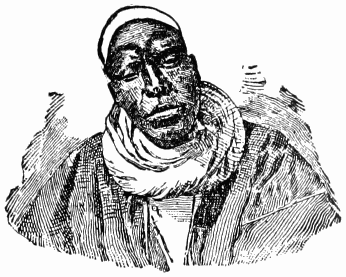
We come now to the west coast. Western Africa is divided into numerous petty States, in all of which the most degrading superstition and idolatry, with their usual concomitants of lawlessness and cruelty, are the outstanding features. The entire population was no doubt pagan at no very remote period; but in modern times the religion of Mohammed has extensively prevailed, having been jealously propagated with fire and sword by northern tribes of Arab descent. But there is not so much difference between the Mohammedanism and paganism of the negroes as many suppose. The distinction is rather nominal than real, so far as the moral conduct of the people is concerned. All profess to believe in the existence of God, if a confused notion of a higher power may be so designated; but all are entirely ignorant of the character and claims of the Divine Being, and exceedingly superstitious. The African Mussulman repeats the prayers, and observes the feasts and ceremonies prescribed in the Koran, but he has quite as much, if not more faith, in his charms and amulets, or greegrees.
Paganism in West Africa is known by the name of “fetishism.” It assumes different forms in the various tribes. It is to a large extent a system of devil worship, in connection with which the belief in witchcraft plays an important part. Not only are the deities themselves called “fetishes,” but the religious performances of acts of worship, and the offerings presented are also spoken of as “fetish,” or sacred, because they are performed and offered in honor of those deities. In the daily household worship, in every domestic and public emergency, in seasons of public calamity, when preparing for and engaged in war, in the taking of oaths, at births and deaths and funerals, and, indeed in connection with every event in life, the “fetish” superstition holds the people in the most slavish, degrading, and cruel bondage. When a death occurs a solemn assembly is held in a palaver house to inquire into its cause; and as witchcraft is the one often assigned it results in death to some unfortunate individual suspected of the crime.
To be suspected of witchcraft is the worst thing that can overtake a man or woman in Africa, and at every death it is the priests’ business to make out who has been the cause of the death. On such occasions a brother, sister, father, nay, in many cases even a mother, may be accused of the unnatural crime of having occasioned the death of their dearest. Against such a charge there exists no defense. Free room has been left to the priesthood for the execution of its malicious plottings and selfish designs, as they mostly are. It is hard to say which men dread the most, the effects of witchcraft or being themselves accused of practicing it. People avoid with the utmost carefulness and solicitude every look, every word, every act, which is in the slightest measure open to misinterpretation. If any one is seriously ill, care is taken not to be too cheerful, lest it should appear as if one was rejoicing over the expected decease. But, again, one does not dare to seem too solicitous, lest it should be surmised that he is concealing his guilt under a mantle of hypocrisy. And yet, with all these precautions, one is never secure. If such a suspicion has once been uttered against any one, neither age, nor rank, nor even known nobility of character defends him from the necessity of submitting to the ordeal of poison, the issue of which is held infallible.
The people through belief in this doctrine, are the victims of the priests and priestesses—the “fetish” men and women—who constitute a large class. The most incredible atrocities resulting from this belief form one of the darkest chapters in the history of this dark land.
Some of the superstitious rites and ceremonies of the negro race partake more of the nature of open idolatry than any of those which have yet been mentioned. For instance, they pay homage to certain lakes, rivers and mountains, which they regard as sacred, believing them to be the special dwelling places of the gods. They also adore various animals and reptiles, which they believe to be animated by the spirits of their departed ancestors. In some places large serpents are kept and fed, in houses set apart for the purpose, by the “fetish” priests. To these ugly creatures sacrifices are presented and divine homage is paid by the people at stated periods—a liberal present being always brought for the officiating priest on all such occasions.
The ruling people of the Niger delta, at Bross, New Calabar, Bonny and Opobo, are the Ijos. Every community of them had formerly its “totem,” or sacred animal, in whose species the ancestral Spirit of the tribe was supposed to dwell. So profound was this belief that the English traders in the Oil River region—the Oil Rivers embrace the tributaries of the Niger, and are so called in general because the commerce in palm-oil is large upon them—were forbidden to kill the sacred lizard of Bonny, and the more sacred python of Bross. One agent of a large trading firm at Bross found a python in his house and inconsiderately killed it. On learning of it, the Bross natives destroyed the firm’s factory and store, dragged the agent to the beach and inflicted indignities on him. The British consul considered the case, but such was the sentiment against the sacrilegious conduct of the agent, that the consul, as a matter of trade polity, was forced to decide that redress was impossible, in as much as he had brought the punishment on himself.
This “totem” worship made the monster lizard at Bonny a nuisance. They grew in number and impudence, till it was nothing unusual to see their six feet of slimy length stretched across paths and upon doorways, and to feel the lash of their serrated tails on your legs as you passed along. If one were wounded or killed, there was no end of trouble, for the irate natives were sure to carry the case to the consul on board ship, where they secured the judgment of a fine, or else taking the law into their own hands, they insulted, or assaulted the slayer till their anger was appeased.
In other parts of the delta, a shark became the tribe “totem,” or a crocodile, or water-bird, but in no part was Zoölatry—animal worship—carried to a greater extent than at Bonny and Bross, where the lizard and python were favorites. In 1884, the Church Missionary Society took the matter in hand, and finally succeeded in doing what consuls and the war-ships had failed to accomplish. The society screwed the courage of the native converts up to the sticking point and finally proclaimed the destruction of the lizards in Bonny on one Easter Sunday morning. Men and boys, armed with hatchets and sticks went about killing the ugly beasts, and so complete was their work that the day ended with their extermination. But the sickening smell which pervaded the air for days, came near producing a pestilence. It was a hard blow to native superstitions, but the riddance soon came to be acquiesced in. A change equally abrupt put an end to the python worship at Bross, and so there has been of late years, a gradual giving up of this “totem” observance among the Niger tribes, thanks to missionary rather than commercial enterprise.
Here, surely, if anywhere on the face of the earth, the Gospel, with its enlightening, purifying, and ennobling influence, was needed. What then has been done to carry it to these degraded people, and what have been the results of missionary labor among them? Take a glance first at Sierra Leone, as it was the earliest visited by the missionaries. It is situated in the southern part of Senegambia. It has an area of 319 square miles, and a population of over 80,000, nearly all blacks. Formerly it was one of the chief emporiums of the slave trade. In 1797 the British African Company purchased land from the native princes with the view of forming a settlement for the emancipated negroes who had served in British ships during the American Revolution, and who on the conclusion of peace were found in London in a most miserable condition. In 1808 this land was transferred to the British Crown, additional tracts of country being subsequently acquired. The colony has since served as an asylum for the wretched victims rescued from the holds of slave ships.
The history of missionary enterprise, in this land of sickness and death, is a chequered one. Colonial chaplains were appointed at different times, from the beginning, to minister to the government functionaries and others; but owing to frequent deaths and absences from illness, the office was often vacant. The first effort of a purely missionary character for the benefit of West Africa was made by the Baptist Missionary Society in 1795. Efforts of other societies followed in rapid succession; but it was not until after the commencement of the present century, when the Church and Wesleyan Missionary Societies undertook the work of evangelization in Western Africa, that the cause took a permanent and progressive form.
The Church Missionary Society in 1804 sent out to Sierra Leone Mr. Renner, a German, and Mr. Hartwig, a Prussian, to instruct the people in a knowledge of Divine things. In 1806 Messrs. Nylander, Butscher, and Prasse—all of whom had been trained at the Berlin Missionary Seminary, and ordained according to the rites of the Lutheran church—embarked at Liverpool to strengthen the mission. In 1816 Wm. A. B. Johnson went out as a schoolmaster to this colony. “He was a plain German laborer, having but a very limited common-school education and no marked intellectual qualifications, but he was trained in the school of Christ and was a good man, full of faith and of the Holy Spirit. It became obvious that he was called of God to preach the Gospel, and he was ordained in Africa. His period of service was brief, but marvelous in interest and power, and he raised up a native church of great value. Into the midst of these indolent, vicious, violent savages he went. He found them devil worshipers, and at first was very much disheartened. But though William Johnson distrusted himself, he had faith in Christ and his Gospel. Like Paul, he resolved to preach the simple Gospel, holding up the cross, show them plainly what the Bible says of the guilt of sin, the need of holiness, and the awful account of the Judgment Day. He simply preached the Gospel and left results with God, confident that his Word would not return to him void. For nearly a year he pursued this course. And he observed that over that apparently hopeless community a rapid and radical change was coming. Old and young began to show deep anxiety for their spiritual state and yearning for newness of life. If he went for a walk in the woods, he stumbled over little groups of awakened men and women and children, who had sought there a place to pour out their hearts to God in prayer; if he went abroad on moonlight evenings, he found the hills round about the settlement echoing with the praises of those who found salvation in Christ, and were singing hymns of deliverance. His record of the simple experiences of these converts has preserved their own crude, broken, but pathetically expressive story of the Lord’s dealings with them, and the very words in which they told of the work of grace within them. No reader could but be impressed with their deep sense of sin, their appreciation of grace, their distrust of themselves and their faith in God, their humble resolves, their tenderness of conscience, their love for the unsaved about them, and their insight into the vital truth of redemption.”
The improvement in the appearance and habits and social condition of the people that followed was nothing short of a transformation. Their chapel was five times enlarged to accommodate the ever increasing numbers who attended. “Seventy years ago, if you had gone to what was afterward known as the Regent’s Town, you would have found people, taken at different times from the holds of slave-ships, in the extreme of poverty and misery, destitution and degradation. They were as naked and as wild as beasts. They represented twenty-two hostile nations or tribes, strangers to each other’s language, and having no medium of communication, save a little broken English. They had no conception of a pure home, they were crowded together in the rudest and filthiest huts, and, in place of marriage, lived in a promiscuous intercourse that was worse than concubinage. Lazy, bestial, strangers to God, they had not only defaced his image, but well-nigh effaced even the image of humanity, and combined all the worst conditions of the most brutal, savage life, plundering and destroying one another. Here it pleased God to make a test of his grace in its uplifting and redeeming power.”
When Johnson was under the necessity of leaving for England, hundreds of both sexes accompanied him a distance of five miles to the ship and wept bitter tears at the thought of being separated from their best earthly friend. “Massa, suppose no water live here, we go with you all the way, till no feet more move.”
Similar success attended the work at other stations, so that we find Sir Charles M’Arthy, the governor, reporting in 1821 as follows in regard to the villages of these recaptured negroes: “They had all the appearance and regularity of the neatest village in England, with a church, a school, and a commodious residence for the missionaries and teachers, though in 1817 they had not been more than thought of.” In 1842 a committee of the House of Commons thus testified to the state of the colony. “To the invaluable exertions of the Church Missionary Society more especially—as also, to a considerable, as in all our African settlement, to the Wesleyan body—the highest praise is due. By their efforts nearly one-fifth of the whole population—a most unusually high proportion in any country—are at school; and the effects are visible in considerable intellectual, moral and religious improvement.”
The bishopric of Sierra Leone was founded in 1851, and some idea may be formed of the trying nature of the climate from the fact that no fewer than three bishops died within three years of their consecration. In 1862 the Native Church having been organized on an independent basis, undertook the support of its own pastors, churches, and schools, aided by a small grant from the society.
In a work entitled “The English Church in Other Lands,” it is stated that “in the first twenty years of the existence of the mission, 53 missionaries, men and women, died at their post;” but these losses seemed to draw out new zeal, and neither then, nor at any subsequent period, has there been much difficulty in filling up the ranks of the Sierra Leone Mission, or of the others established on the same coast. The first three bishops—Vidal, Weeks and Bowen—died within eight years of the creation of the See, and yet there has been no difficulty in keeping up the succession.
The present results are a sufficient reward for all the self-sacrificing devotion. There is now at Sierra Leone a self-sustaining and self-extending African church. The only white clergyman in the colony is Bishop Ingram; the whole of the pastoral work being in the hands of native clergymen. Many native missionaries, both clerical and lay, have been furnished for the Niger and Yoruba missions.
An outline of the proceedings of the Wesleyan Missionary Society in this part of the wide field may be compressed into a few sentences. Among the negroes who were conveyed from Nova Scotia to Sierra Leone in 1791, there were several who had become partially enlightened and otherwise benefited by attending services of the Methodist ministers in America. Some of these having made repeated applications to Dr. Coke for preachers of their own denomination to be sent from England, in the year 1811 the society responded to their request by the appointment of the Rev. G. Warren as their first missionary to Western Africa. He was accompanied by three English schoolmasters. They found about a hundred of the Nova Scotia settlers who called themselves “Methodists.” These simple minded people had built a rude chapel in which they were in the habit of meeting together to worship God from Sabbath to Sabbath, a few of the most intelligent among them conducting the services and instructing the rest according to the best of their ability. They received the missionary from England with the liveliest demonstrations of gratitude and joy; and to them, as well as to the poor afflicted liberated Africans, who were from time to time rescued from bondage by British cruisers and brought to Sierra Leone, his earnest ministrations were greatly blessed. But the missionary career of Mr. Warren was of short duration. He was smitten with fever and finished his course about eight months after his arrival—being the first of a large number of Wesleyan missionaries who have fallen a sacrifice to the climate of Western Africa since the commencement of the work. Other devoted missionaries followed who counted not their lives dear unto them if they could only be made instrumental in winning souls for Christ. No sooner did the intelligence arrive in England that missionaries and their wives had fallen in the holy strife, than others nobly volunteered their services, and went forth in the spirit of self-sacrifice—in many instances to share the same fate. This has been going on for three quarters of a century; and although the mortality among the agents of the society is appalling to contemplate, the social, moral, and spiritual results of the mission are grand beyond description. Congregations have been gathered, places of worship erected, native churches organized, and Christian schools established, not only in Free Town, but in most of the villages and towns in the colony. High schools have, moreover, been established for the training of native teachers and preachers, and to give a superior education to both males and females. The advancement of the people, most of whom have been rescued from slavery, in religious knowledge, general intelligence, moral conduct, and, indeed, in everything which goes to constitute genuine Christian civilization, is literally astonishing. In addition to the Church and Wesleyan Missionary Societies, who took the lead in the work of religious instruction in Sierra Leone, other agencies have been advantageously employed. The census of 1881 showed 39,000 evangelical Christians, about equally divided between the Wesleyans and the Church of England. Some reports give the nominal Christian population as high as 80,000.
In the Gambia district the inhabitants on both sides of the river are chiefly Mandingoes and Jalloffs, most of whom are Mohammedans, with a few pagans here and there. A large number of “liberated Africans,” as they are technically called, have, however, been brought to the Gambia from time to time, and located on St. Mary’s and McCarthy’s islands and in the neighboring districts, as thousands before had been taken to Sierra Leone. These are poor negro slaves of different nations and tribes who have been rescued from bondage, and landed from slave ships taken by British cruisers while in the act of pursuing their unlawful trade.
AN AFRICAN CHIEF.
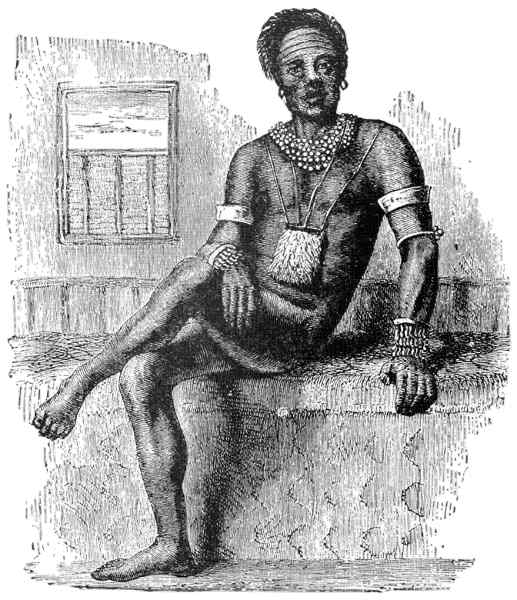
No provision had been made for the moral and religious instruction of the colonists (British,) or the native tribes of this part of Africa, when the Wesleyan Missionary Society commenced its labors in 1821. The first missionary sent out was the Rev. John Morgan. He was soon afterwards joined by the Rev. John Baker from Sierra Leone, when these two devoted servants of God began to look about for the most eligible site for a mission station. Their object being chiefly to benefit the surrounding native tribes, they were anxious if possible to establish themselves on the mainland. Accordingly they went to visit the chief of Combo, on the southern bank of the Gambia. Having offered their presents, they were graciously received by his sable majesty, who signified his consent for the strangers to settle in any part of the country which they might select as most suitable for their object. They fixed upon a place called Mandanaree, about eight miles from St. Mary’s. Although considerably elevated it was far from healthy; and when the rainy season set in both were prostrated with fever, and were obliged to move to St. Mary’s where they could have medical aid. Before the end of the year, however, Mr. Baker proceeded to the West Indies by direction of the Missionary Committee, his health having become so impaired by his long residence in West Africa, as to render a change absolutely necessary.
Mr. Morgan had recovered from his attack of fever and was pursuing his work alone, when he had the pleasure of receiving as his colleague the Rev. Wm. Bell, who had been sent from England by the committee to reinforce the mission. This devoted young missionary appeared well adapted for the enterprise upon which he had entered; but he was soon called away to the “better country.” He died of fever at St. Mary’s forty-six days after his arrival. For a time his place was taken by the Rev. Geo. Lane, from Sierra Leone, but his health also failing he was obliged to return, and he shortly afterwards finished his course. On the 14th of April, 1824, Mr. Morgan was relieved by the arrival from England of the Rev. Robert and Mrs. Hawkins, who entered upon their work at once.
By this time it had become evident that the proper place for the principal station was St. Mary’s island, and arrangements were forthwith made for the erection of a mission-house and place of worship in Bathurst, the principal town. A number of native converts were soon after united in church fellowship as the result of the faithful preaching of the Gospel; schools were organized for boys and girls, and the machinery of a promising mission station was fairly put in motion. Mr. and Mrs. Hawkins suffered much from sickness during their period of service, but they labored well and successfully, and were spared to return home in 1827, the Rev. Samuel and Mrs. Dawson being appointed to take their place. Mrs. Dawson was smitten with fever and died at Sierra Leone, on her way to the Gambia, and her sorrowful and bereaved husband proceeded to his station alone. On the 18th of November, 1828, Rev. Richard and Mrs. Marshall arrived at the Gambia from England to relieve Mr. Dawson; and the school being once more favored with the supervision of a Christian lady, and the station with an energetic missionary, the work prospered in a very pleasing manner. Mr. Marshall had labored with acceptance and success for nearly two years, when he fell a sacrifice to the climate, and finished his course with joy at Bathurst on the 19th of August, 1830. Two days after the funeral of her lamented husband, Mrs. Marshall embarked with her infant son for England. They arrived at Bristol on the first of October; and worn out with mental and bodily suffering, the lonely widow sank into the arms of death about forty-eight hours after she landed on the shores of her native country. Gambia Station was thus left without a missionary or teacher, but six months later, on the 10th of March, Rev. W. Moister and wife arrived at St. Mary’s and set to work at once to recommence the mission schools and public services. Their labors were crowned with success; and native preachers having been trained to take a part in the work, they felt that the time had come when some effort should be made to carry the Gospel to the regions beyond. With this object in view Mr. Moister made three successive journeys into the interior; and with much toil and exposure succeeded in establishing a new station at McCarthy’s Island, nearly 300 miles up the Gambia,—a station which from that day to this, a period of over half a century, has been a centre of light and influence to all around, and the spiritual birthplace of many souls. Mr. Moister was relieved in 1833 by the arrival from England of a noble band of laborers. The Rev. Wm. and Mrs. Fox took charge of St. Mary’s and Rev. Thomas and Mrs. Dove were appointed to take charge of the new station at McCarthy’s Island. They labored long and successfully in this trying portion of the mission field, and some of them fell a sacrifice to the deadly climate. They were succeeded by others in subsequent years, many of whom shared the same fate; but whilst God buried His workmen, He carried on His work. A rich harvest has been already reaped, and the work is still going on. A commodious new chapel and schoolrooms have been built at Bathurst, and a high school established for the training of native teachers and others; whilst large congregations, attentive and devout, meet together for worship.
“The Gold Coast” is the significant name given to a maritime country of Guinea, in Western Africa, in consequence of the quantity of gold dust brought down from the interior by the natives for barter with the European merchants. The Wesleyan Missionary Society commenced its labors on the “Gold Coast” in 1834. Their first station was at Cape Coast Town, and though the missionaries died in rapid succession, the station was never without a missionary for any considerable time. As the work advanced native laborers were raised up; and in succeeding years stations were established, places of worship built, congregations gathered, and Christian churches and schools organized, not only in Cape Coast Town, but also at Elmina, Commenda, Dix Cove, Appolonia, Anamabu, Domonasi, Accra, Winnibab, and other places along the coast and in the far distant interior. In 1889 they had 21,000 Christians.
PORT AND TOWN OF ELMINA. Larger.
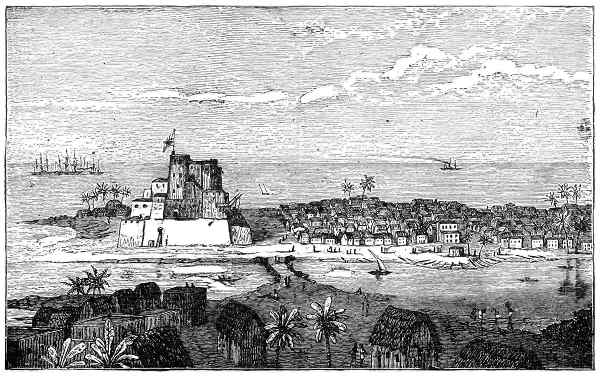
The Basle and North German Missionary Societies have also several important stations on the “Gold Coast,” at Accra, Christianburg, Akropong, and other places. During the last century the attention of Count Zinzendorf was drawn toward the propagation of the Gospel on the “Gold Coast.” Three times (1736, 1768 and 1769) missionaries were sent to Christianburg and Ningo; but all died after a short stay, without seeing any fruit of their work. They are buried, eleven in number, at Christianburg and Ningo. Upwards of half a century elapsed ere this “white man’s grave” was taken possession of again. At length in 1827, the Basle German Evangelical Mission sent out four missionaries, J. P. Henke, C. F. Salbach, J. G. Schmid, and G. Holzwarth. They arrived on the 18th of December, 1828, at Christianburg, then and until 1851 a possession of the Danish Crown. From Governor Lind they received a cordial welcome. Within nine months after their arrival three of them succumbed to the climate, two of them dying on the same day. Two years later the fourth (Henke) was removed. Three new laborers arrived in March, 1832, but in the course of four months two of them had died. The third, A. Rüs, having been raised up from the very gates of death, labored for several years, and afterwards removed to Akropong, the capital of Aquapim, a more healthful region in the interior. The Aquapims and their king proved very friendly. The reports from this new region had the effect of infusing fresh life into the society, and two missionaries, along with Miss Wolter, who became the wife of Rüs and was the first missionary lady on the “Gold Coast,” were forthwith sent to his aid. Two years thereafter, Rüs and his wife were left alone, the remorseless climate having again done its deadly work. The mission had now been in existence for ten years, and within that period no fewer than eight missionaries had died. Rüs returned in broken health to Basle in 1840. The directors of the society were greatly perplexed, as well they might be. The prevailing feeling was in favor of the abandonment of the mission, but a new inspector, the Rev. W. Hoffman, came into office. Fired with missionary zeal he proceeded in 1843 to Jamaica in order to enlist Christian emigrants for the work in Africa. Twenty-four members of the Moravian congregation there responded. They arrived in Christianburg in April of that year. Henceforth Akropong became as a city set on a hill. Rüs returned to Africa but was compelled to retire altogether from the field in 1845, his health having again completely broken down. But reinforcements were sent out by the society from time to time.
The mission now assumed a more encouraging aspect. Between 1838 and 1848 only one missionary had died, and by the close of the latter year forty natives had been gathered into the church. Ten years later the society was able to report that no fewer than eighteen missionaries, with nine married and three unmarried ladies, besides twenty-six catechists and teachers, had been settled at the stations already named and at various other places. The church members at the close of 1858 were 385. The next decade showed still more gratifying results, the numbers being 31 missionaries, 19 ladies, 25 native catechists, 15 native male, and 12 native female teachers, and 1581 church members. Out-stations were largely multiplied.
During this last period the work was developed in other directions. The Mission Trade Society had begun operations, its object being to prepare the way by means of trade based on Christian principles. Elders had been appointed to assist the missionaries in their work, and to settle minor cases of jurisdiction. Besides the day schools, boarding schools for boys and girls, a teachers’ training school, and a theological school had been established. Industrial departments too had been added at Christianburg. These are now self-supporting and are proving an important means of promoting the moral and social well-being of the natives. In these industrial schools may now be seen native shoe-makers, tailors, carpenters, and other craftsmen, busy at work plying their respective avocations, and preparing themselves for useful positions in life. Some of the missionaries have, moreover, rendered good service to literature, and to those who may succeed them in the field, by the useful dictionaries, grammars, and vocabularies which they have compiled of native languages, and the translations which they have made of Scripture into the dialects of the people among whom they labor. The entire Bible has been translated into two of the various languages—viz, in the Gâ or Akra, by the late Rev. J. Zimmerman; and in the Tshi by the Rev. Christaller—the latter language being spoken by at least a million of negroes on the “Gold Coast,” and far into the interior. During the Ashanti war in 1874 Captain Glover bore the following emphatic testimony to the piety and general good conduct of the native converts who joined the British army from some of the stations mentioned above: “Two companies of Christians, one of Akropong, and the other of Christianburg, numbering about a hundred each, under two captains, accompanied by Bible-readers of the Basle Mission, attended a morning and evening service daily, a bell ringing them regularly to prayers. In action with the enemy at Adiume, on Christmas day, they were in the advance, and behaved admirably, since which they have garrisoned Blappah. Their conduct has been orderly and soldier-like, and they have proved themselves the only reliable men of the large native force lately assembled on the Volta.”
In 1875 they sent out for the Ashanti Mission a staff of six men for two new stations—Mr. and Mrs. Ramseyer among them. One of these stations, Begorro, is not in the Ashanti territory, but is a frontier town, and a connecting link between their former “Gold Coast” Mission and Ashanti proper. It is the healthiest of all the African stations of the society. The other station, Abetifi, is the capital of Okwao, a former province of Ashanti, which gained its independence after the victory of the British army over the Ashantis. The chief of the capital, Abetiffi, told the missionaries to settle wherever they liked.
COOMASSIE THE CAPITAL OF ASHANTI. Larger.
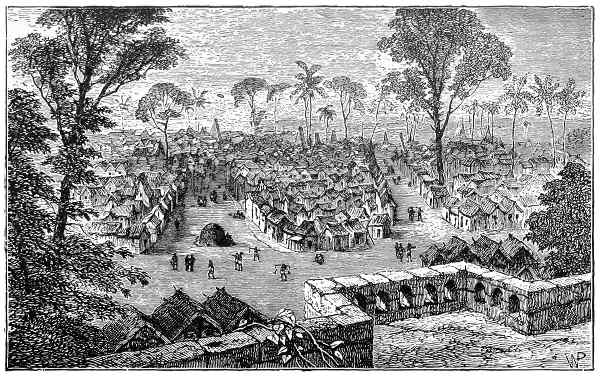
Early in 1881 two of the missionaries, accompanied by several native preachers and the necessary bearers, undertook a journey to Coomassie, the capital, in order to ascertain the disposition of the people and the prospect of establishing a mission among them. During their stay they preached regularly morning and evening, with the king’s permission, to large audiences. But the king did not desire a mission established there, and they deferred attempting to commence missionary operations in Coomassie.
One beneficial result of the war with Ashanti has been the abolition of domestic slavery in the “Gold Coast” colony.
The work of the society (Basle) generally on the west coast of Africa has been very gratifying. In 1882 under the care of the 34 European missionaries and upwards of a hundred other agents, there were some 4,000 natives, from whose minds the darkness of night has been dispelled, besides about 1,500 pupils under instruction who may be expected to do good work in the future. Many of the churches on the “Gold Coast” have attained to a position of self-support.
One single fact may be mentioned, as indicating the influence of the mission here. The king of Cape Coast in early life was the means of getting it established. He forsook the “fetish” of his country. In consequence he was cut off from the succession to the chieftainship, and publicly flogged. But after thirty years’ profession of Christianity, he was elected chief or king, and, on the occasion of the anniversary in 1864, he publicly acknowledged his obligations to the mission.
Lagos, a considerable island in the Bight of Benim, was in former times one of the most notorious slave depots on the western coast of Africa. It is situated at the mouth of a river, or rather, a large lagoon, which runs parallel with the sea for several miles, and affords water communication with the interior in the direction of Badagry, Dahomi, Abeokuta, and other parts of the Yoruba country. It is now a British settlement, with its resident lieutenant governor and staff of officers.
The population of Lagos and the neighboring native towns, both in the Yoruba and Popo countries, is of a similar character to that which is found on other parts of the coast. Perhaps it became somewhat more mixed several years ago, by the emigration from Sierra Leone of a large number of “liberated Africans,” who ventured thus to return to the countries from which they had been dragged as poor slaves, when they heard that the slave trade was abolished. Some of these emigrants had the happiness to find parents, brothers, sisters or other relatives and friends still living, who received them as alive from the dead; whilst others sought in vain for any one who could recognize them. There were many touching and affecting meetings, and great was the surprise of the natives of Lagos, Abeokuta, and other places in Yoruba and Popo countries, to see the change which had passed upon their friends and relatives by the residence of a few years in a free British colony. They all appeared decently clothed in European apparel, many of them had learned to read and write in the mission schools, and a few of them had become the happy partakers of the great salvation, which they had heard proclaimed in all its simplicity and power in the land of their exile.
It was the extensive emigration of civilized “liberated Africans” from Sierra Leone to Lagos and the neighboring towns in the Yoruba country, that led to the vigorous efforts of the Church and Wesleyan Missionary Societies to evangelize the natives of this part of Africa. The Christian emigrants who had been connected with these organizations in Sierra Leone, on reaching their destination reported to their respective ministers the state in which they found the country and earnestly requested that their friends and countrymen might be favored with the proclamation of the Gospel which had made them so happy. These appeals were cheerfully responded to by the parties concerned, and a work was commenced which for prosperity and blessing has had few parallels in the history of missions.
The Church Missionary Society was happy in the selection of the Rev. Samuel Crowther, an educated and ordained native minister, as the leader of the enterprise. The history of Mr. Crowther is equal in interest to any romance that was ever written. Torn away from his native land and sold as a slave when a mere boy in 1821, he was rescued from a Portugese slaver by a British cruiser and brought to Sierra Leone, where he was educated in the mission school, and being specially bright was sent to England. He completed his education in Islington Training Institution and was ordained by the Bishop of London. He returned to Sierra Leone and was afterwards in 1846 appointed as a missionary to Abeokuta, to labor among the Sierra Leone emigrants and others. It was here, to his inexpressible delight, he met his mother, twenty-five years after he had been snatched from her by the slave dealers; and in 1848 he had the further unspeakable joy of seeing her admitted, along with four others, into the membership of the Christian church. They were the first fruits of the mission. In 1864 he was consecrated at Canterbury Cathedral, Bishop of the Niger territory and superintendent of all the stations in the Yoruba and adjoining countries. Making the island of Lagos his headquarters, Bishop Crowther, assisted by a noble band of native missionaries, has succeeded in establishing stations, erecting churches and organizing Christian schools, not only in Lagos and Abeokuta, where the work was first commenced, but also in various towns and villages in Yoruba and Popo countries, and in several centres of population on the banks of the Niger. The principal stations on the Niger are Bonny and Bross at the mouth of the river, and Onitsha, Lokoja, New Calabar, and Egan, higher up. The last named is 350 miles from the mouth of the river. In 1877 a steamer named the Henry Venn was supplied to the mission, thus doing away with the hard labor and slow navigation by means of the old fashioned canoe in vogue on the river. An exploratory voyage made up the Binue in 1879 revealed the existence of numerous tribes ready to receive teachers.
At Bross and Bonny there has lately been a remarkable movement in the direction of Christianity, hundreds of people throwing away their idols and attending the church services, which are thronged every Sabbath. The famous Juju temple, studded with human skulls, is going to ruin. A village opposite Bonny has been named “The Land of Israel” because there is not an idol to be found in it. At an important market town thirty miles in the interior, the chiefs and people, influenced by what they had seen at Bonny, and without ever having been visited by a Christian teacher, spontaneously built a church with a galvanized iron roof, and benches to seat 300 worshipers, got a school-boy from Bross to read the church services on Sundays, and then sent to ask the Bishop to give them a missionary.
CANOE TRAVEL ON THE NIGER.
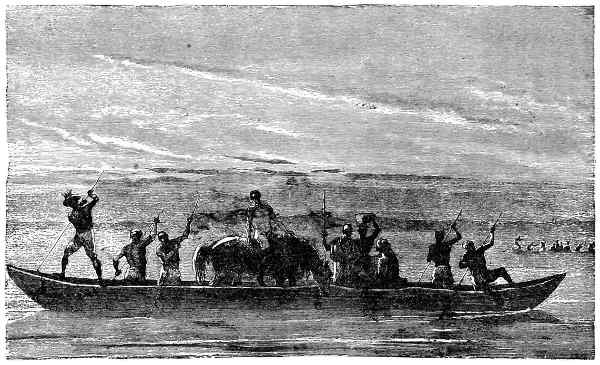
Rev. W. Allan writing from Bonny in 1889 says: “The worship of the iguana is overthrown, the priest is a regular attendant at the house of God, and the iguana itself converted into an article of food. The Juju temple, which a few years ago was decorated with 20,000 skulls of murdered victims, I found rotting away in ruin and decay. I passed through the grove which was formerly the receptacle of so many murdered infants, and I found it had become the regular highway from the town to the church, and that the priest was now a baptized Christian. At 11 o’clock I went ashore and addressed 885 worshipers, including the king, the three former heathen priests, chiefs, and a multitude of slaves, and was thankful to ascertain that the work of conversion was still going on; for, in addition to 648 persons already baptized, of whom 265 are communicants, there are over 700 at Bonny alone who are now under instruction.”
Bishop Crowther has now about 10,000 Christians under his care. He lately opened at Bonny a new church built of iron, with sittings for 1,000.
The agents of the Wesleyan Missionary Society have been as zealous and successful, in a somewhat more limited sphere, as those of the Church of England, with whom they have generally lived and labored in harmony and love. Among the emigrants from Sierra Leone there were many Wesleyans who preferred their own ministers, whilst the domain of heathendom, on every hand, was sufficiently extensive to occupy the agents of both societies. At an early period a commodious Wesleyan Mission-house and chapel were erected at Lagos, where the work has progressed in a very satisfactory manner from the beginning. Many have been converted from time to time and united in church fellowship, some of whom have gone out to make known the good news to their fellow-countrymen. To provide for the training of native preachers and teachers, as well as to give a better education to those who are in a position to need it, a Wesleyan high school has been erected and opened at Lagos, which promises to be a most useful institution. Common day-schools are also taught in connection with all the out-stations of the Lagos circuit, and the Gospel is preached to the people in two or three different languages. They have about 6,000 adherents. The drink traffic is one of the great hindrances to missionary work in this section.
Says Rev. W. Allan: “In Africa we have to contend against the devil’s missionary agency. The liquor traffic is increasing, and it is a gigantic evil—greater, even, than the slave trade—debasing the people and ruining legitimate commerce. In West Africa it has deepened the degradation of the negro instead of civilizing him. Over 180,000,000 gallons of spirits had been imported last year in the district of Sierra Leone, and in Lagos it was far larger, while all the land was strewn with demijohns. The Niger Company imported 220,000 gallons during the last two years, and 500 cases of gin and 500,000 gallons of rum were landed by the Caliban, in which I sailed from Liverpool. The selling price of rum is less than a penny a gallon, and the gin sold at three-pence a bottle. The liquor so sold was of the most execrable character.”
A lurid picture of the western part of this region has lately been presented by the English district commissioner. He says: “The population, which has been recruited for many years past by a constant influx of refugees from the surrounding tribes, falls roughly into three divisions. These are: the Popos, chiefly engaged in fishing, forestry, and farming, but averse to steady work of any sort, and much addicted to theft; the Yombas, the most enterprising people in the district; and the Houssas, who are farmers and palm-nut gatherers. The Mohammedans among them are more enterprising and industrious than the fetish worshipers; while the Christians, though few in number, form a fairly thriving community. But all are alike in ‘intense and obtuse conservatism, so long as they are left to their own devices, and in a keen spirit of petty trading.’ The sole article of their moral code is ‘to do to your neighbor as you hope to avoid being done to by him.’ It is useless to appeal to any higher motive, and it is certain that without European influence to urge them on commerce must decline. Fishing is carried on wholly in the lagoons, the people never having had the enterprise to build surf-boats, which would enable them to engage in sea-fishing. Some progress has been made in agriculture, owing to the efforts of the Roman Catholic Mission at Badagry, the administrative centre. In the Frah Kingdom, also, the local British officer has succeeded in inducing the people to plant a considerable area of fertile land with corn, so that villages which were almost starving two years ago on smoked fish are now supplying large quantities of grain to the local markets. But this increased prosperity has only increased the drunken habits of the people, who exchange for vile imported spirits the products of their labor. Katamu, the Frah capital, is rapidly falling into a ruinous state of disrepair. Every fourth or fifth house is a rum shop, and the so-called palm-wine sheds are filled every night with drunken men and women. The evils of the drink traffic are so apparent to the people themselves that they have petitioned the Governor to put an end to the sale of liquor altogether. If this were done the fertile flood lands of Frah might become a source of food supply for the whole colony. In spite of the valuable resources of the forests, nothing is done to develop them save the collection and treatment of the palm-nuts. Trading is the African’s special delight, but until quite recently the markets of Lagos were not in a prosperous condition. Now that a British firm has established a branch at Badagry, and made the place a market town, it is estimated that 5,000 persons with every variety of native produce assemble there every market day, and in eight months the monthly export has increased from £30 to £1,878. Cocoanut planting, road making, corn-growing, and the cessation of the drink traffic appear to be the official methods for civilizing the West African negro.”
An extensive district on the western coast of Africa, between Sierra Leone and Cape Coast Castle received the name of Liberia, from the circumstance of its being colonized by liberated slaves and free persons of color from America. On the 22d of November, 1888, the secretary of the Manchester Geographical Society read an interesting paper contributed by the Hon. G. B. Gudgeon, consul-general for Liberia in London. The following is an extract: “It was stated that the famous negro republic of Liberia was founded by the American Colonization Society in 1822. The work of civilizing and Christianizing the inhabitants of that almost unknown country was entirely carried on for more than twenty years by this society. The missions established along the coast and at various points inland had developed into Liberia’s prosperous towns and settlements. It became an independent state in 1847. Nearly 2,000,000 souls were subject to the rule of the Liberian Republic, consisting of about 40,000 freed slaves and their descendants, the remainder belonging to numerous aboriginal tribes. While the state possessed a seaboard of 500 miles and an interior extending over 200 miles, she had acquired no territory except by treaty, purchase, exchange, or barter. Bishop Taylor had described the country as healthy and its climate salubrious and enjoyable, without a plague of flies and with few mosquitoes. Many travelers had confirmed the bishop’s testimony. The Republic of Liberia stood before the world as the realization of the dreams of the founders of the American Colonization Society, and in many respects more than the realization. Far beyond the recognized limits of the country, and hundreds of miles away from the coast, the effects of American civilization were to be witnessed. Men of color entirely governed the republic, and if any proof were wanting of the capacity of freedmen to govern, Liberia was an interesting illustration. The ability, learning, and skill of many of Liberia’s citizens were found in their code of laws, which for humanity, justice, and morality no other country could excel. The English tongue is spoken throughout the republic except among the native tribes not yet civilized; but among these too it is making good progress.”
Rev. S. L. Johnson, who recently visited Liberia, says: “The scenery along the coast of Liberia, from Cape Mount to the Gulf of Guinea, a distance of about 600 miles, is exceedingly grand. A few miles from the coast the country rises to hills, with gigantic trees, presenting a panorama that can only be described by a skilful artist.
“Monrovia is the capital of the republic. It rests on a beautiful hill overlooking the sea, surrounded by trees. There are many fine buildings in the city, which are creditable to the Monrovian people. The president’s house is built of brick, as are also many of the buildings; others are built of stone. The wharves face the sea, where there are colored firms doing business with England, Germany, and America.
“Mr. Sherman does a large business with England and America. After my return to England I wrote to Mr. Sherman for information regarding the articles of trade. This is the answer:—‘The articles of trade are palm-oil, palm kernels, coffee, ivory, camwood, ginger, and rubber. Many of our merchants do a business of $100,000 to $150,000 a year. A vessel left here for New York on the 7th inst., with a cargo of $50,000 worth, collected within two months. In this cargo were 118,000 pounds of coffee.’
“The soil of Liberia is extremely fertile, and produces all kinds of tropical fruits, sugar-cane, indigo, Indian corn, rice, cotton, cocoa, peanuts, and coffee, the latter the finest in the world. Vegetables are cultivated with great success. There are to be found the finest dye-woods, ebony, gum plant, and the gigantic palm-trees, which produce the palm-oil. On my way to England from Africa 1,500 casks were shipt on the same steamer to Liverpool, a good share of it being from the coast of Liberia. Goats, swine, sheep, cattle, and fowls, all thrive in Liberia.
“This republic has a glorious work to accomplish in the future. It will undoubtedly be in time, the most prosperous state on the west coast of Africa. With the civil, social, and religious advantages she enjoys, she must succeed. The annexation of the kingdom of Medina, with five hundred thousand inhabitants, and her wide and fertile domain, extending over two hundred miles into the interior, will no doubt inspire renewed energy in giving fuller opportunities for the advancement of the Gospel, as well as an open door for civilization and commerce.
“Much zeal and perseverance have been displayed throughout the republic. Fine churches, school buildings, and a college are to be seen in Monrovia.
“At Nifou, on the coast of Liberia, I counted forty-nine canoes, with two or three men in each, going out fishing. At twenty-five minutes to ten we stopt at Grand Cess, Liberia. Here fifteen canoes came out, with from three to twenty men in each. These belong to the Kru tribe, the aborigines of a part of Liberia. They are a fine-looking people, and very industrious. But for this class of people I do not know what the European traders of the African steamship companies would do. All the steamers reaching Sierra Leone and the coast of Liberia take on board a gang of ‘Kru-men’ to do the work of the ship. One hundred and thirty men were taken on board our steamer to go down the coast to work. Many of them speak broken English well.”
LIBERIA. Larger.
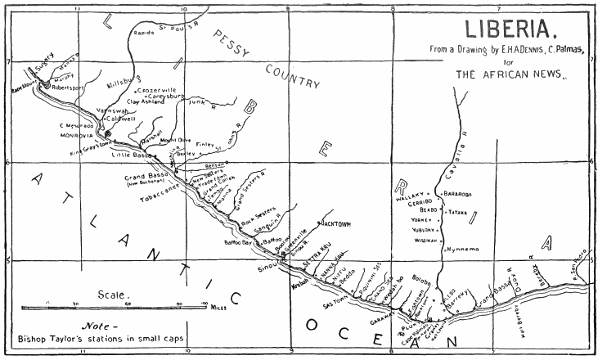
As might be expected, this territory, extending upwards of 300 miles along the coast to Cape Palmas, has been occupied by the American churches—viz. the Baptist, Methodist Episcopal, Protestant Episcopal, and Presbyterian Church (north). Much zeal and perseverance have been displayed in connection with all these agencies, and the result is seen in the parsonages, and places of worship, colleges and school buildings which have been erected in most of the towns and villages in the settlements, and in the improved morals of the people.
METHODIST PARSONAGE OF AFRICA.
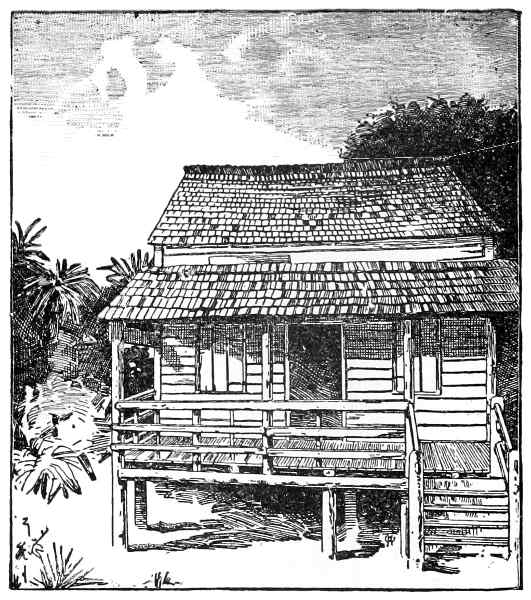
For some years past the Missionary Society of the Methodist Episcopal Church has been gradually reducing the appropriations for the carrying on of the missions from $37,000 to $2,500—a procedure that has been regarded by the conference in Liberia as inconsistent with the general spirit of the church and the growing interest felt of late years in the evangelization of Africa, and which for a time threatened to result in a severance of the ecclesiastical relations subsisting between the conference and the society. The action of the latter has been dictated solely by an earnest desire to secure in the native churches “the development of a spirit of self-reliance and independence—elements indispensable to a self-perpetuating church in any land.” The General Conference of 1888 changed the name and boundaries of the “Liberian Conference” to the “African Annual Conference” embracing the entire continent of Africa. In the other missions in Liberia there seems also a disposition to rely on foreign aid.
Fernando Po is one of the most important islands on the western coast of Africa, and enjoys many advantages from its peculiar position. It is situated in the Gulf of Guinea, about seventy miles from the coast of Benim. It is thirty miles long and twenty broad; and in its general aspect it is rugged and mountainous in the extreme, though there are some fertile valleys between the mountains, and several promising tracts of land along the shore.
Among the settlers and aborigines of Fernando Po some really useful missionary work has been done at different times, which deserves a passing notice. The first in the field were the agents of the Baptist Missionary Society. They labored for several years among the settlers of all classes with very good results, whilst the English had possession of the island; but when it was given over to the Spaniards, Roman Catholicism was proclaimed to be the established religion of the settlement, and the harshness and persecution with which the Baptist missionaries were treated by the government authorities ended in their removal to the continent. In 1870—some improvement having taken place in the Spanish government—the Primitive Methodists were induced to commence a mission in Fernando Po, the Rev. Messrs. Burnett and Roe being the first missionaries sent out. They and their successors labored for several years very successfully. In 1879, in consequence of some misunderstanding, the missionaries were again banished from the island. An appeal was at once made to the home authorities, and in the course of a few months they were allowed to return.
This question of conflict between Protestant and Catholic mission work in Africa has, at certain times and in certain places, been serious, and is greatly to be regretted, for it destroys the efficacy of both Churches, and proves a stumbling block to the natives. Pinto speaks of it with amazement, in his trip across the continent. He found places where the natives had been utterly demoralized by the spirit of contention indulged by the two Churches, and where their final answer to his advice to live at peace and deal justly with one another was, that white people might talk that way, but their actions proved that they did not mean what they said.
In former times—notably in the Spanish, French and Portuguese provinces of Africa—the Catholic mission was a part of the political establishment, and it was expected to use its influence to extend and perpetuate the power which protected it. This was equivalent to warning off all competitors as intruders. Happily this condition is undergoing rapid modification.
Similarly, the Protestant mission of other countries was treated as part of the commercial establishment, under the protection of the consul, and of the trading company, to whom the territory was allotted. Its business was therefore, in part, to cultivate the trading spirit and make its success contribute to the wealth of the parent country. This notion, too, is undergoing modification.
All of which is directly in the line of that Christian enterprise so much needed for the conversion of the African heathen.
On the mainland opposite Fernando Po, and on into the interior, good work has been done. We will speak first of the Old Calabar Mission.
Old Calabar, on an affluent of the Cross river, is a recognized centre of the trade of the Oil river sections. It has a population of 15,000 natives and 150 white. An insight into the characteristics of the natives beyond Old Calabar can best be gotten from the journey of Mr. Johnson up the Cross river in 1888. His object in making an ascent of the river was to treat with the natives and at the same time settle an old quarrel between the Union people and the tribes about Calabar. Stopping, merely to observe that the Kruboys, of whom Mr. Johnson speaks, are the Krumen—Kroomen—of the Liberian coast, among whom Bishop Taylor has, in his four years of African labors, established more than twenty missions, we let the adventurer tell his own story. He says: “Having decided to ascend the Cross river and having no steam launch at my disposal, I was obliged to make the journey in native canoes, of which I hired three, and fitted the largest with a small house in the centre for my lodging. I took with me about thirty Kruboys. These invaluable native workers come from the Liberian coast. Without their aid European enterprise on the west coast of Africa would be at a standstill; for, invariably, the negroes who are indigenous will not undertake any persistent work. The Kruboy is a strong, good tempered, faithful creature; able to row, paddle, carry, dig, wash clothes, or turn his hand to anything—in fact, he is a great deal sharper and more industrious than the average English navvy. My first object in going up the Cross river was to settle an outstanding quarrel between the people of a district called Umon and the natives of Old Calabar. Union is at a distance of about a hundred miles from the sea. The people speak a language quite distinct from the Calabar language. They were, till lately, terribly priest-ridden. Their life was a burden to them, with its load of cruel superstitious practices. The last few years, however, since they have come into contact with the missionaries, the state of affairs has greatly improved. As I appeared in the light of a mediator, I was most warmly welcomed. An imposing fleet of eighty large Calabar canoes reached Umon soon after I arrived, and formed a really pretty sight, as they were all painted in brilliant, but tasteful combinations of color, their little houses hung with bright carpets or leopard skins, each canoe being decorated with gaudy banners. The crews were most fantastically dressed in gorgeous clothes. The beating of drums, blowing of horns, and the firing of guns made a clamor most disturbing to my comfort, which I promptly stopped. I need hardly say that I had the Calabar people all under my control, for there was not only a personal attachment between us, but they knew that I was working in their interest, and the Umon people were much impressed by the way in which my shabby little despatch canoe, with two of my Kruboys in it, could marshal the imposing Calabar fleet.
“As both sides were longing to have their quarrel at an end, and were fully prepared to accept my decision, the conference was a brief one. I decided that it was six of one and half a dozen of the other. I made the Calabar people surrender the Umon captives, and the Umon surrender their Calabar prisoners. Peace was reestablished, trade was resumed, and I was free to continue my journey.
“We next visited the important Akuna-Kuna country, very populous, and inhabited by friendly, industrious people, whose chiefs very promptly and willingly concluded a treaty with the British Government, and loaded me with such an abundance of provisions—bullocks, goats, sheep, fowls, ducks, yams, and Indian corn—that our progress was seriously impeded, our canoes nearly capsized, and my Krumen suffered severely from indigestion.
AFRICAN VILLAGE AND PALAVER TREE.
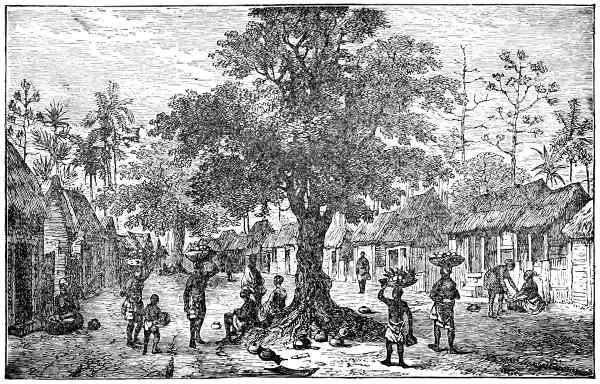
“Some distance up the river we had rather a ticklish task to perform. Another quarrel, and that a bitter one, had to be settled between the people of Akuna-Kuna and the inhabitants of Iko-Morut. Here I was awkwardly situated. Had I been enabled to travel in a steam-launch, I could have gone safely up the river, or in any direction where there was sufficient water; but traveling simply in native canoes, the inhabitants of these wild countries in the interior, who look on every stranger as an enemy, had no idea that a white man was visiting them, and often proceeded to attack us before I could make myself seen.
“As soon as we came in sight of the stockaded villages of Iko-Morut, many excited chocolate-colored natives could be seen hurrying along the banks of the stream and posting themselves in ambush behind the trees. Then first one gun, then two, three, four guns went off; then there was a regular hail of slugs and stones, whipping up the surface of the water, and, in one or two cases, whizzing over our canoes. In the face of this warm reception, it would have been impossible to proceed, for, at any moment, a shot might strike our canoes and send them to the bottom. As to returning the fire of these poor, stupid savages, nothing was further from my thoughts. It was always open to me to retreat, and, unless I could proceed peacefully and with a friendly reputation preceding me, it was futile to continue my ascent of the Cross river. So I had the canoes steered to an unoccupied sand-bank in the center of the stream, and as soon as the natives saw that we stopt, they ceased firing. Then I got into my small despatch canoe, with two interpreters, hoisted my white umbrella, and assuming my smile, quietly landed on the crowded beach, to the silent amazement of the natives, who were armed to the teeth. I was conducted to the chief, who, for a long time, could not be prevailed on to see me, on account of my presumed powers to bewitch him; but a little friendly conversation through the red screen of his apartment, and the hint that I had brought a pretty present, reassured him, and we soon made excellent friends.
“To make a long story short; the result of my stay at Iko-Morut was equally satisfactory to that of Umon. I made peace between Akuna-Kuna and Iko-Morut, and the chiefs of the latter place concluded a treaty with me.
“Then on, beyond Iko-Morut, day after day, we paddled up the beautiful stream, sometimes received by the natives in a gush of friendliness, sometimes sullenly avoided, sometimes boisterously attacked. At length, in the heart of the cannibal country, on the outskirts of Atam, where the Cross river attains its furthest reach to the north, our journey came forcibly to an end. I had several times been captured and released, several times fired at and then hugged by those who had attacked me, but the strain was becoming too great for the nerves of my Kruboys.
“As we approached one village, a shot, better directed than usual, went through the roof of my little ark, and though no doubt our ultimate reception at the village would have been the same as at the preceding ones—first sullen hostility, then timid inquiry, and lastly a cordial hand-shaking and hugging, and the giving of presents—still, before this happy consummation should come about, some of us might have been accidentally killed, or our canoes—our only means of regaining civilization—sunk or disabled; consequently I decided to turn back. Then ensued an awful afternoon, when for miles and miles we had to run the gauntlet past populous villages of cannibals, whom we had much difficulty in avoiding on our ascent of the river; and who, taking our retreat for a flight, seemed bent on capturing us or plundering our canoes and eating the wretched Kruboys, who turned blue with fright at the prospect of being eaten, as they desperately paddled down the river past shrieking natives, who waded out into the shallows, or pursued us in canoes. Every now and again we would stick on a sand bank, and the shouts of the natives would come nearer and nearer; then we would get off again, and paddle for our lives; then stick again, and so on, till at last we were out of this savage district. I hesitate to say hostile, for, wherever I landed, or was captured, I was always well treated as soon as they found out what I was like and what my objects were in visiting their country. At length we arrived in the delightful district of Apiapum, where we put up for a week at the clean and comfortable town of Ofurekpe, whose chief and people were some of the nicest, kindliest, most friendly folk I have ever seen in Africa, though they were in their practical way cannibals, like their neighbors—that is to say, they were given to eating the flesh of all whom they might catch in war. I did not here observe that other kind of cannibalism which I have occasionally met on the Upper Cross river, which is of a sentimental character, namely, where the old people of that tribe, when they become toothless and useless, are knocked on the head, smoke-dried, pounded into paste, and re-absorbed into the bosom of the family.”
The Old Calabar Mission originated with the Jamaica Presbytery of what is now the United Presbyterian Church of Scotland. The first band of missionaries, led by Mr. Hope Waddell, a member of the Jamaica Presbytery, reached their field of labor on the Old Calabar river on April 10th, 1846. They were cordially welcomed by King Eyamba and the chiefs of Duke Town, as also by King Eyo of Creek Town and his chiefs. Suitable sites for mission stations were readily granted. Mr. Waddell held a service with Eyamba and his chiefs the first Sunday after his arrival, and presented the former with a Bible.
Mission houses and schools were in due time erected at both stations, a printing press being also usefully employed in scattering the seeds of Divine truth. At Creek Town the first sermon was preached in the court yard of King Eyo’s palace, the king himself acting as interpreter.
The mission was reinforced in July, 1847, by the arrival of additional missionaries from Jamaica.
In May previous King Eyamba died. It was the occasion of one of those scenes of cruelty, too common in heathen lands.
Notwithstanding the efforts of the missionaries, no fewer than a hundred victims were sacrificed, among whom were thirty of the king’s wives. Here is the account given of the burial: “The people dug a large hole in one of King Eyamba’s yards, and having decked him in his gayest apparel, with the crown on his head, placed him between two sofas, and laid him in the grave. They killed his personal attendants, umbrella carrier, snuff box bearer, etc., (these the king was supposed to need in the world of spirits), by cutting off their heads, and with their insignia of office threw them in above the body; and after depositing a quantity of chop and of coppers, they cover all carefully up, that no trace of a grave could be seen. Over this spot a quantity of food is daily placed.”