AFRIC’S LIGHTS AND SHADOWS.
Reading edition
ARNOT IN CENTRAL AFRICA.
“My idea of Africa had been that of a land very much desert, or else marshy and almost uninhabitable. But here was a region rich, fertile and beautiful, well watered, and, better still, with many people living all along the banks of the rivers. Of course, we had varied kinds of receptions. At one place, among the Bakuti, it was very remarkable how the people seemed to open their ears and hearts and gave their time. I spent ten days among them. The first five I went among their villages, having large meetings. As I could speak a dialect which many of them understood, I could explain myself quite freely to them. They became very much interested in what they heard me say, and they said among themselves: ‘We are only tiring the white man out by coming day after day to our villages; we will go to him.’ So, for the last five days they gathered together, and we had all-day meetings—a most extraordinary time, I might say, for Africa. They kept up the discussions among themselves, and before I left at least two of the men stood up in the midst of their tribe and declared for Jesus before all their friends, in their own simple language.
“We had to leave these people, and went on traveling from day to day. At one point we had rather a different reception. We had pitched our camp in the midst of long grass. Toward evening, as we were getting things in order, we found the grass round our camp was on fire. As soon as the men succeeded in extinguishing the flames eight of them were missing. Then we understood an enemy had surrounded us, set the grass on fire, and carried off all the stragglers. There was nothing to do but to find their trail and follow them up. After a ten-miles’ journey we reached a little village in the forest where they were resting. They thought we had come to fight with them, and they rushed out with their guns, bows and arrows, and spears, to receive us. My men, thirty or forty in number, being only Africans, got into fighting order and began to load their guns for action. I was a little way behind, and did not take in the situation at once. Seeing how things were going, I ran forward, seized a little stool, and held it up in the air as a signal of peace. This arrested the enemy, and at last two of them came forward to hear what I had to say. After a little talk it turned out that the whole thing was a mistake. They thought we had come to their country to rob and plunder them, and quite naturally, in self-defense, they wished to have the first hit at us. Next day we spent the time in receiving presents and telling them of the things we had been speaking to the people all along the road.
“At another point on the journey there was a chief who had heard about the things of God. He was intensely interested in the reports, and he came himself, to see me. Before we had time to settle down to speak, he said: ‘All the huntsmen have been called in; the women are in from the fields; we are all here, and we want you at once to begin your conversation with us about the Great Spirit and those things you have been talking of along the road.’ After talking with them for some hours, the chief asked me to go with him to their village. He said there were some old people there who could not come down to hear me with the others, he wanted me very much to go and see them. I went up to the village and conversed with these poor old broken-down people, one after another, and it was most touching. They shook hands with me and looked me in the face with such a look! Some of them were too old to understand the things I had been telling to the younger people; they could only look wistfully at me and shake me by the hand. It reminded me of an old man I had spoken with on the upper Zambesi. After leaving my hut he came back to the door and said: ‘It is so strange for me to hear these things for the first time, and I so old.’ Truly, it must strike them strangely. There are many physical difficulties connected with travel in Africa, and I would be the last to urge any particular individual to go out there. But there are no difficulties in the preaching of the Word. As soon as you learn a little of the language you can have all the attention of the people and all their time. I may say, in going among them, it is important to get some standing at their native courts. I have always taken the place of an ambassador from another country, and have demanded from them a hearing. This is the surest way of getting the attention, not only of the chief, but of all the people.”
KILLED BY AN ELEPHANT.
“A sad termination of an heroic defender of a righteous cause, was the death of Mr. Deane, the recent chief of Stanley Falls Station, Congo State. Capt. Coquilhat, one of Mr. Stanley’s faithful coadjutors in founding the State of Congo, gives, in his official report, the following statement: ‘In August last (1887), a female slave escaped from the Arab camp at Stanley Falls, and sought refuge in the Congo State Station there. Her surrender was demanded and refused. The Arabs were very angry, and made threats of war, which Mr. Deane disregarded. The slave-hunters had about 2,000 troops, while the garrison of the station numbered about fifty. The steamer Stanley then arrived, and the Arabs kept quiet till she left; but, the day after her departure, they attacked the station without warning, and, in course of three days, made four attacks, which were repulsed, the garrison losing two men and the Arabs sixty. At the end of the third day, the Haussa soldiers and the Bangalas refused to fight longer, as their rifle ammunition was spent.’ [The Haussas are native soldiers hired by the Congo State. They come from near Acra, on the Gulf of Guinea. The Bangalas belong to a desperate and warlike tribe, that fought Stanley on his first trip down the Congo.] ‘So these native soldiers took to their canoes at nightfall on the 26th of August, and went down the river. Mr. Deane and Mr. Dubois, the only white men in the garrison, remained behind with eight men to fire the buildings and destroy the stores. This they did, blowing up the two cannon and the remaining gunpowder, and then escaped themselves from the island, on which the station was located, to the north bank of the Congo, and made their way along its bank on foot, in the dark. On their way, the banks being very steep, Dubois fell into the river. Mr. Deane jumped in after him, and succeeded in getting him on to a rock; but poor Dubois was drowned in attempting to get from the rock to the mainland. Deane sought refuge among the natives, and found them most friendly. They showed him great devotion, taking him from one place of shelter to another, hiding him from the Arabs, supplying him with food, and keeping him till he was rescued.’ The Haussas and Bangalas arrived in their canoes at Bangala Station, where Capt. Coquilhat was stationed as Commander-in-Chief of that department, on September 7th. The captain at once went up in the steamer Henry Reed, then in the service of the Congo Government, and, finding the Stanley Falls Station in ruins and in the hands of the Arabs, he went in search of Mr. Deane, and after three days of diligent inquiry, found him, and rescued him from the fury of the Arabs.
“It is sad to relate, as I learn from Bradley L. Burr, our chief missionary at Kimpoko, Stanley Pool, that recently Mr. Deane, in an elephant hunt, was charged and killed by an Upper Congo elephant.
“Those who brave the perils of Africa ought always to be prepared to die. The destruction of the Arab slave trade, and the redemption of Africa, will cost the lives of more than 1,000 missionary heroes and heroines. People who want to run home from Africa before they see the elephant had better go to Barnum’s show and stay at home.” Wm. Taylor.
THE AFRICAN PUFF ADDER.
“It is essentially a forest animal, its true habitat being among the fallen leaves in the deep shade of the trees by the banks of streams. Now, in such a position, at the distance of a foot or two, its appearance so exactly resembling the forest bed as to be almost indistinguishable from it. I was once just throwing myself under a tree to rest, when stooping to clear the spot, I noticed a peculiar pattern among the leaves. I started back in horror to find a puff adder of the largest size, its thick back only visible and its fangs only a few inches from my face as I stooped. It was lying concealed among fallen leaves so like itself that but for the exceptional caution which in African travel becomes a habit, I should certainly have sat down on it, and to sit down on a puff adder is to sit down for the last time. I think this semi-somnolent attitude is not always the mere attitude of repose. This reptile lay lengthwise concealed, all but a few inches, among the withered leaves. Now, the peculiarity of the puff adder is that he strikes backward. Lying on the ground, therefore, it commands as it were, its whole rear, and the moment any part is touched the head doubles backward with inconceivable swiftness, and the poison fangs close on their victim. The puff adder in this way forms a sort of horrid trap set in the woods, which may be altogether unperceived till it shuts with a sudden spring on its prey.” Henry Drummond.
THE KASAI REGION.
“I have been here a month, and I am far from regretting my new residence. Luluaburg resembles none of the other State stations. This is the country of plantations, of cattle, of large undulated hills covered with short grass. We lead here rather the life of the Boers (farmers) than that of the Congo.
“We break bulls to ride, and they are as valuable as horses. They are sometimes vicious enough, but one becomes accustomed to that. Nevertheless, a horse could never do what a bull does: swim the rivers, climb the most rugged hills, and descend the steepest slopes with an admirable surety of foot and peerless vigor.
“I have broken for my service a huge chestnut bull; he travels very well, and you would be astonished to see me on that beast overleap obstacle at a gallop, as easily as the best horse of the course.
TRAVEL ON BULL-BACK TO NATIVE ESCORT.
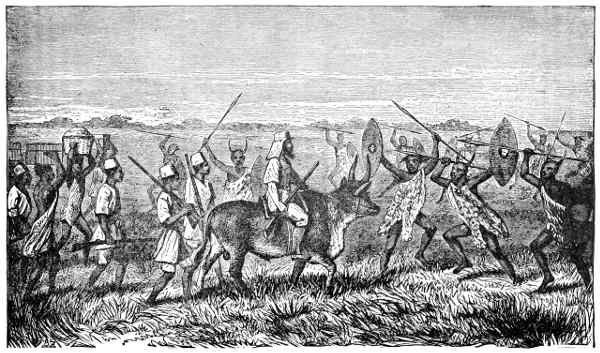
“We have already thirty animals at the station. Every day we have butter and cheese. Mr. Puissant has charge of the dairy, and he performs his work well.
“As to the natives of the region, they are much the best negroes I know. In short, I am greatly pleased here, and am never sick.”
Mr. Legat, who sends this news, is the veteran of the Congo State agents. He was of the party of 1881, and has not left the country since that epoch.
A LITTLE CONGO HERO.
On the Congo, near the equator, live the Bengala, with whom the explorer, Stanley, had his hardest battle when he floated down the great river. They are the most powerful and intelligent of the Upper Congo natives, and since Capt. Coquilhat, four years ago, established a station in their country they have become good friends of the whites. A while ago an exciting event occurred in one of their many villages, and Essalaka, the chief, went to Capt. Coquilhat to tell him about it.
“You know the big island near my town,” he said. “Well, yesterday, soon after the sun came up, one of my women and our little boy started for the island in a canoe. The boy is some dozen of moons old. (Capt. Coquilhat says about twelve years old.) He said that while his mother was paddling she saw something in the water, and leaned over to look at it. Then he saw a crocodile seize his mother and drag her out of the canoe. Then the crocodile and the woman sank out of sight.
“The paddle was lying in the canoe. The boy picked it up to paddle back to the village. Then he thought, ‘Oh, if I could only scare the crocodile and get mother back!’ He could tell by the moving water where the crocodile was. He was swimming under the surface toward the island. Then the boy followed the crocodile just as fast as he could paddle. Very soon the crocodile reached the island and went out on land. He laid the woman’s body on the ground. Then he went back into the river and swam away. You know why he did this. He wanted his mate and started out to find her.
“Then the little boy paddled fast to where his mother was lying. He jumped out of the boat and ran to her. There was a big wound in her breast. Her eyes were shut. He felt sure she was dead. He is strong, but he could not lift her. He dragged her to the canoe. He knew the crocodile might come back at any moment and kill him, too. He used all his strength. Little by little he got his mother’s body into the canoe. Then he pushed away from the shore and started home.
“We had not seen the boy and his mother at all. Suddenly we heard shouting on the river, and we saw the boy paddling as hard as he could. Every two or three strokes he would look behind. Then we saw a crocodile swimming fast toward the canoe. If he reached it you know what he would do. He would upset it with a blow, and both the boy and his mother would be lost.
“Eight or nine of us jumped into canoes and started for the boy. The crocodile had nearly overtaken the canoe, but we reached it in time. We scared the crocodile away, and brought the canoe to the shore. The boy stepped out on the ground and fell down. He was so frightened and tired. We carried him into one of my huts, and took his mother’s body in there, too. We thought she was dead.
“But after a little while she opened her eyes. She could whisper only two or three words. She asked for the boy. We laid him beside her on her arm. She stroked him two or three times with her hand. But she was hurt so badly. Then she shut her eyes and did not open them or speak again. Oh! how the little boy cried. But he had saved his mother’s body from the crocodile.”
As Essalake told this story the tears coursed down his cheek. “I have seen in this savage tribe,” writes Capt. Coquilhat, “men and their wives who really love each other, and veritable honeymoons among young couples. The child feels for his father the fear and respect which his authority inspires, but he truly loves his mother and has a tender interest in her even after he becomes a man.”
FORMER OBSTACLES REMOVED.
“Missionaries who go to Africa now, may think they have a hard time, but they can know but little of the obstacles in the way of the pioneers, and it will be profitable to notice a few of the things which hindered the marked success of missionaries fifty years ago, that are now largely removed.
“(1) The terrible slave trade prevailed all along the western coast, from the Gambia to Loanda. These foreign traders hated the missionary and did all they could to keep him out, well knowing that the two could not dwell together. They said to the kings where I labored, respecting my predecessor who began the mission in a nest of slave traders: ‘If you do not drive that man from the country, we will have to leave,’
“They prejudiced the natives against the missionary, by lies and misrepresentation; they demoralized them by the rum, guns and powder, which they paid for slaves. They induced and encouraged internal wars for the purpose of securing prisoners to be sold as slaves.
“By these means, large districts of the country were devastated (as I have seen), a disregard of human rights and life fostered, and a prevailing desire for rum and self-indulgence generally created.
“Thus, when the missionaries came they did not appreciate them, or their work. They only cared for what slave-traders brought them.
“And as they held the coasts, the missionaries could not reach the interior. They must begin on the low, sickly coasts, amid such unfavorable surroundings, or do nothing. My predecessor desired and planned to locate in the interior, but the way was thus blockaded. And so all along the coast.
“But now that obstacle is removed; the country is open, and missionaries can go where they chose a field, and find a people ready to receive them.
“(2) The ignorance of the people was a bar to progress. They did not understand the objects of the missionary, nor the difference between missionaries and traders. So, when missionaries went to Ujiji, the people began to bring them slaves to sell, knowing of no other motive they could have in coming to their country.
“And, in other places, they have welcomed a mission because it brought trade to their country. And, looking upon missionaries as traders, they once had to pay rent for the privilege of living in the country as traders. Thus my predecessor had to agree to pay $100 a year (in gold) that he might have a place to preach and teach their children. And he had to feed, clothe and provide everything for the children. And this I did for six years after him. We were willing to do this till they learned the value of education and the Gospel, and that we might prepare native teachers. And, besides, we had to make many presents, because we had their children!
“So it was forty years ago; but not now. They have learned that the missionaries bring only blessings to their country, and they are anxious to have their children ‘learn books,’ and be ‘taught white man’s way.’ They also wish to learn about God and how to be saved. And to obtain these blessings they are willing to give something—willing to give land for missionaries to build school-houses, and help the missionary build his house, and pay tuition for the children, and help the preacher.
“In very many places they are begging for a missionary. At a point on the Niger, where the steamers landed, the people ran to the wharf to meet every boat, saying, ‘Has the teacher come?’ (No one had promised a teacher.) ‘If the teacher will come, and teach us white man’s book, we will give him plenty to eat and take good care of him!’
“Another king said: ‘I do not wish to die till I can see a school house built, where my children can be taught; and a church, where my people may learn about God.’
“Another king came from the country to Liberia to obtain a missionary for his people.
“I have had chiefs come from the interior to beg for a mission, and after giving them one, I have seen them become followers of Jesus.
“Thus from many places they cry: ‘Come over and help us!’ Very different from fifty years ago!
“(3) The lack of written languages and books was a great obstacle. While the nations had regular languages (nearly 700 in Africa), they were all unwritten, and, of course, they had no books and no knowledge of the world or the way of salvation through Christ. This universal ignorance was the mother of gross superstition and horrible cruelties.
“To learn the language and prepare school books, and translate the Bible, was a slow process.
“To-day, over fifty of these languages are reduced to writing. The Bible is printed in ten of them, and portions of it in over thirty more. And many of them have school books, papers, and some literature.
“Here is a great advance, the benefit of which modern laborers can take advantage.
“And this same work is widely and continually going on. Light is spreading and desire increasing.
“Along the western coast, English is extensively taught, as also the French, German and Portuguese, where these nations have colonies and trading posts.
“(4) Lack of native help, at first, made progress slow. The white man was alone amid millions. His ways were all strange and inimitable. He was dressed, while they were naked. He read books, while they had none. He worshiped God, while they trusted in idols and charms. He seemed far above them and the idea of reaching his plane, hopeless.
“But, with great patience and unwearied perseverance, the pioneers toiled on, teaching, preaching, learning languages, writing elementary books, instructing children and youth, to prepare native helpers.
“To-day, there are about 8,000 ordained and unordained native preachers, and thousands of teachers and hundreds of thousands of pupils who are being prepared for future helpers—an army of native workers—and many are running to and fro and knowledge is being increased.
“Modern missionaries can now obtain interpreters for almost all parts of Africa, and this is a great help, which calls for heartfelt thanksgiving and praise to God who has wrought these favorable changes.
“I will mention but one more obstacle: (5) The sickly climate. During the first fifty years of missionary life in West and East Africa, the mortality was fearful. Probably 500 missionaries have died in the missions on the west coast. Nearly twenty died in the Mendi Mission where I labored. The Church Missionary Society lost fifty-three in the first twenty years. Three English Bishops died within eight years.
“In the Basle Mission, on the Gold Coast, in fifty-eight years, ninety-one missionaries died. And so it has been in Liberia, in Lagos, Gaboon, and in many other places. All societies have lost many, so that a book written by an Englishman was entitled “The White Man’s Grave.” The last three years I was in Africa I buried four white missionaries.
“But, thank God, it is different now. They have better houses and more comforts and have learned better how to take care of their health, so that the mortality in these same places is not half so much as it used to be.
“And missionaries can now reach the healthy high lands where they can live as well as here. So we will ‘Thank God and take courage.’
“In the same line more might be mentioned, but enough has been noted to show that there is no good cause for discouragement in the glorious work of saving Africa, to whom we owe such an unspeakable debt.
“With so many obstacles removed, and so many helps now prepared to our hand, while vast fields are opening and loud calls are wafted to us on every breeze, we may well be encouraged to put forth more vigorous efforts to give the Gospel to that people in this generation.” Rev. Geo. Thompson.
STANLEY ON THE GOMBE.
On his way to Ujiji to rescue Livingstone, Stanley passed through the lands of the Manyara, which are plains stretching for a distance of 135 miles, well cultivated, thickly strewn with villages, and abounding in game, which finds a haunt amid the tall grasses. He had never seen such a hunter’s paradise as that on the river Gombe, which waters the country. Buffaloes, zebras, giraffes and antelope, roamed through the magnificent parks of the section, affording excellent sport for the natives, and inviting the traveler to halt for a time in order to enjoy the thrill of a hunt.
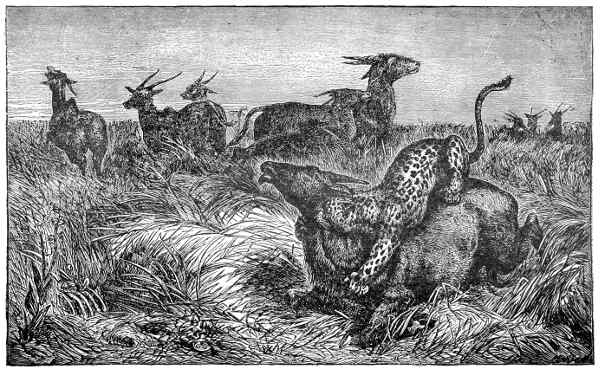
The antelope of this section is large and powerful. It goes by name of “springbock,” because it takes tremendous leaps of ten to twelve feet when running. When pursued, it is pleasing and curious to see the whole herd leaping over each other’s heads, and looking back while they are in the air. They are exceedingly swift, and cannot be overtaken by a horse. They migrate annually from the interior toward the coast, and after remaining in the lowlands for two to three months, begin a gradual journey toward the interior. During these inward journeys their gregarious instincts are in full sway, and herds of hundreds may be seen on the grassy plains.
When travelling thus in large herds, they are the victims of beasts of prey, as lions, leopards and hyenas, which attack them at every favorable opportunity and seldom fail to secure rich feasts. Their flesh is excellent eating, and the springbock, together with other varieties of the antelope species, furnishes the venison of the African continent.
As he continued his way along the course of the Gombe, feasting his vision upon the beautiful scenes before him, he came suddenly upon a scene which he says “delighted the innermost recesses” of his soul. Just before him were “ten zebras switching their beautiful striped bodies, and biting one another.” Of these he succeeded in killing one, and then, content with the result of the hunt, he retired to camp. Before doing so, however, he thought he would take a bath in the placid waters of the river. He says: “I sought out the most shady spot under a wide-spreading mimosa, from which the ground sloped, smooth as a lawn, to the still, clear water. I ventured to undress, and had already stepped to my ankles in the water and had brought my hands together for a glorious dive, when my attention was attracted by an enormously long body which shot into view, occupying the spot beneath the surface which I was about to explore by a ‘header.’ Great heavens! it was a crocodile! I sprang back instinctively, and this proved my salvation, for the monster turned away with a disappointed look, and I was left to congratulate myself upon my narrow escape from his jaws, and to register a vow never to be tempted again by the treacherous calm of an African river.”
LEOPARD ATTACKING A SPRINGBOCK.
CHRISTIAN HEROES IN AFRICA.
“My subject is not so much Africa, its people, its customs and its misfortunes, as the Christian pioneers and their work. The United Moravian brethren at Herrnhut in Germany, more than a century and a half ago, were stirred up to send out a missionary to the poor Hottentots, who were treated as dogs by the Dutch colonists. George Schmidt at once offered himself to go out, and suffered hardship with a persecuted race, and, having been blessed by the conversion of a few, was forbidden to baptize them, and summarily sent back to Europe by men who called themselves Protestants, and who were jealous of their own liberty. Fifty years later (1792), the United Brethren sent out three more missionaries, who founded the illustrious mission of Genádendál, or Vale of Grace, on the very walls of the ruined house of George Schmidt, seven years after the great patriarch of African missions had been called to his reward, dying, like Livingstone and Krapf, on his knees.
“The London and Wesleyan societies, the Established Church of England, the Free Church of Scotland, and the American Board of Foreign Missions, took up a share in the blessed work amidst other races of South Africa, and out of their ranks by faith Moffat undertook to translate the Bible into the language of the Be-Chuána, Wilder into the language of the Zulu, and Boyce, Appleyard, and others, into the language of the Ama-Xosa, or Káfir—languages deemed at the time to be incapable of expressing simple ideas, but which, deftly handled, proved to be apt exponents of every variety of human thought, with an unlimited vocabulary, and an unsurpassed symmetry of structure.
“Moffat’s son-in-law, Livingstone, abandoned his home, his chapel, and his school, and started off on his great missionary progress, which was destined to illuminate all Africa south of the Equator. By faith he bore up under the perils, the fatigues, the opposition and the bereavement of his dear wife, who sleeps on the shore of the Zambesi. He worked his way to Benguéla, on the west coast, Kilimáni on the east, and Nyangwé on the River Congo to the north, discovering new rivers, new lakes, new tribes, and new languages. From the drops of sweat which fell from his limbs in those great travels have sprung up, like flowers, Christian missions, founded by men of different denominations and different views of church government, but united in the fear of God, love of Africa, and veneration for Livingstone. To the impulse, given by this great apostle, must be attributed the missions of the Established Church of Scotland at Blantyre, the Free Church of Scotland at Livingstonia, the London Society on Lake Tangányika, and the Universities Mission at Zanzibar. But to this servant of God it was not conceded to see one single fruit of his labors. He saw no mission spring up; like Moses, he only beheld the promised land from Pisgah; he died without knowing of the secret of the source of the Nile and the Congo.
“Krapf and Rebman sat year after year at the watch-tower of Mombása, waiting till the day should dawn, calling to each other: ‘Watchman, what of the night?’ writing home descriptions of vast lakes, and snow-capped mountains on the Equator, causing themselves to be derided, both as missionaries and geographers; yet they lived to be honored in both capacities, they lived to see the day dawn at last, to hear of Frere-Town being established as a station for released slaves at Mombása, to hear of those internal seas being navigated, and that snow-capped mountain being visited. In his old age Krapf in tearful gratitude read Henry Stanley’s challenge, which rang with trumpet-sound from the capital of Uganda, and was gallantly answered by the Church Missionary Society, and he lived to hear of the great Apostle’s Street, which by faith he had suggested, being carried out from Zanzibar to the Great Lakes, to be extended westward down the Congo, until hands are shaken with the Baptist missionaries working up that river from the west.
“The good Baptist Society established themselves in the island of Fernando Po, and, driven thence by the intolerance of the Spaniards, they crossed over to the mainland, and found what seemed once, but, alas! is no longer, a more enduring inheritance in the Kamerún Mountains. By faith here Saker lived, labored and died, translating the Holy Scriptures into the language of the Dualla, but leaving his work to be revised by his young daughter, opening out a new field for the talent and zeal of women. Hence in fullness of time by faith Comber started to conquer new kingdoms of the Congo, making, alas! the heavy sacrifice of the life of his wife at San Salvador, before he reached Stanley Pool, with the great heart of Africa open to his assault; for in their hands the Baptist missionaries had carried gentle peace, and their vessel with that name still carries them onward on their blessed and peaceful enterprise.
“Our good brethren in North America were among the first to send out their agents to West and South Africa, to pay back the debt which they owed, and to atone for the wrong which their forefathers had inflicted. The sun was thus taken back to the east, to lighten those sitting in darkness. Each and every one of their churches have vied in the desire to found strong missions, translate the Holy Scriptures, and to press forward the work of freedom, education, civilization and evangelization.
“The holy and humble-hearted Protestant churches on the continent of Europe, less amply endowed in material resources, but more richly in intellect, industry and self-consecration, have sent forth a golden stream of missionaries from the centers of Basle and Canton de Vaud in Switzerland; of Barmen, Breman, Berlin, Herrnhut and Hermannsburg in Germany; from Norway, Sweden, Finland and France, to hold the fort in the most exposed situations, to suffer imprisonment, to achieve great literary works, to found living churches, and attract to themselves the affections of the African.
“Samuel Crowther was rescued from the captivity into which he, like Joseph, had been sold by his brethren, was restored to his country, to be no longer a slave, but a teacher, a leader, a benefactor, and an example; he was set apart to give the lie to the enemies of the African, to stultify the idle taunt, that a negro is incapable, by his nature, of culture, piety, honesty, and social virtues; he was raised up to mark an epoch in the sad chronicle of his persecuted race, and to be the first fruit of the coming harvest of African pastors and evangelists. His son Dandison, Henry Johnson and James Johnson were blessed with the great grace of being allowed to tread in his footsteps.
“If any of my readers desire to know the real worth of the African missionary, let them read the lives of Mrs. Hinderer at Ibadán, and Mrs. Wakefield at Ribé, and of many other noble men and women, of whom this self-seeking world was not worthy, who left comforts at home to labor among the Africans; who, in spite of overpowering maladies, have been, like Hannington, unwilling to leave the country of their choice, and determined to return in spite of the warning voice of their doctor, or who, like him, have died as good confessors.
“Time would fail me to tell of Schlenker, and Reichardt, and Schön; of Goldie and Edgerley; of Casálls, Mabille and Coillard; of James Stewart, of Lovedale, and his namesake on the Nyassa; of Grant and Wilson; of Ramseyer and Christaller; of Mackensie, the Bishop who died on the River Shiré; and of Steere the Bishop who sealed up the translation of the last chapter of Isaiah ready for the printer, and then fell asleep at Zanzibar; of Parker, the Bishop, wise and gentle, holy and self-restrained, who was called to his rest on the southern shores of Victoria Nyanza; of Wakefield and New; of Stern, Mayer and Flad; of Southon, the medical missionary, who died at Urambo; of dear Mullens, who could not hold himself back from the fight, and who sleeps in Usagára; of many a gentle ladies’ grave—for women have never been found wanting to share the honor and the danger of the Cross.” Robert N. Cust, L. L. D.
THE BOILING POT ORDEAL.
Mr. Arnot says of the Zambesi Valley: “A small company gathered in front of my hut, and began an animated discussion, which grew hotter and hotter, and shortly a large fire was kindled, and a pot of water set on it. I was told that this was a trial for witchcraft, and that the two persons charged had to wash their hands in the water, and if after twenty-four hours the skin came off, the victims were to be burnt alive. First one, then the other, dipt his hands into the fiercely-boiling water, lifting some up and pouring it over the wrist. Twenty-four hours told its tale, and I saw the poor fellows marched off to be burned before a howling, cursing crowd. Such scenes, I afterward found, were almost of daily occurrence.
“I proposed to the king to require both the accuser and the accused to put their hands into the boiling water. The king is strongly in favor of this proposal, and would try any means to stop this fearful system of murder, which is thinning out many of his best men, but the nation is so strongly in favor of the practice that he can do nothing. An old friend of mine, Wizini, who took quite a fatherly care and interest in me, was charged with witchcraft. He pleaded earnestly to be spared the terrible trial, and was reprieved because of his years, but he was banished from his people and country for life, for no other reason than that a neighbor had an ill-feeling against him. Had he been first to the king with his complaint, he might have seen his neighbor burned or banished instead of himself. I much missed this old man.
“When manners and customs are referred to, the particular district must be borne in mind. Africa is an immense continent, and there is as much variety in the customs of the different tribes as in their languages. Certain tribes take delight in cruelty and bloodshed; others have a religious fear of shedding human blood, and treat aged people with every kindness to secure their good-will after death. By other tribes the aged would be cast out as mere food for wild animals.”
THE ADVENTURES OF A SLAVE.
A lad who was recently baptized at the Baptist mission on the Congo, relates a strange story of his adventures. His name is Kayembe. When he was 10 years old an Arab caravan passed through the district in which he lived with his parents. His people lived in terror for nearly two months, part of the time in the jungle. One morning, the slavers came with drums and singing. Kayembe’s father, after throwing a spear at an assailant, was shot dead, and his hand cut off as a trophy. Kayembe fled to the jungle, but was caught by some Nyangwe men, who took him with them and went from town to town killing men and little children and catching the women. Children who tried to follow their mothers were beaten back. Finally Kayembe was taken to Stanley Falls, where he was sold to a state soldier, a Zanzibari. This man, when he was taken sick, sold him to a Hausa soldier, who, when his time was up, took him to Leopoldville, at Stanley Pool, and the lad fell into the hands of the mission as the personal boy of Mr. Biggs. After Mr. Biggs died, Kayembe manifested great grief and came under Mr. Bentley’s care, and a year ago professed to have given his heart to the Savior. He was not more than thirteen years old then, and his baptism was delayed, but both by his words and his life he has shown himself to be a Christian, and in March last he was baptized. His capture and the death of his father are a terrible memory to him, though he is full of thankfulness that he has come to learn of the Savior. He has chosen a small town, about an hour from Wathen, which he regards as his field for Christian work; thither he often goes to find an audience of fifteen or twenty.
ARAB CRUELTIES IN AFRICA.
Letters to the secretary of the Free Church Missionary Society, from East Central Africa show that the power of the Arabs in the region is rather decreasing, but they still continue formidable. Many of the native supporters of the Arabs are deserting to the missionaries. These latter and the agents of the African Lakes Company, with the assistance of friendly negroes, have been successful in keeping the Arabs somewhat in check, but the Arabs still destroy a number of the negroes. Many instances are recorded of the Arabs lying in ambush and shooting down natives as they make their way to and from their gardens. About three months ago the slavers, assisted by the Chief Merere, made a raid and destroyed a number of native villages at Ukume, killing, burning and plundering wherever they went. Many of the inhabitants escaped to the hills. Some thirty young women were taken captive, and afterward sold, the children crying for their murdered parents. Some of them were clubbed and others thrown into the flames from the burning huts. Much anxiety is felt regarding the fate of the white men on the shores of Lake Tanganyika.
A LION HUNT.
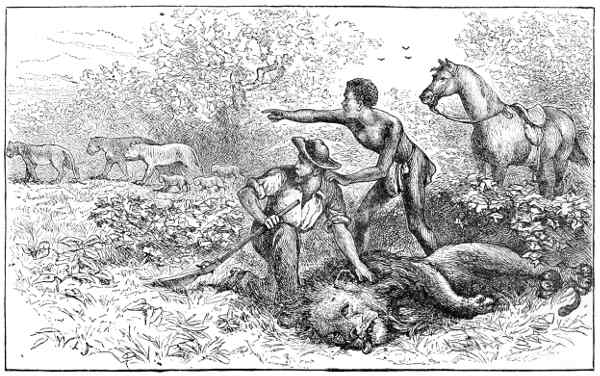
Col. Baker thus describes a lion hunt in the Shooli country: “The grass had been set on fire by the natives, but as the wind was light the game advanced at an easy pace. Presently I saw a splendid buck antelope advancing toward me. Just as I was going to fire, a long yellow tail suddenly rose, and an instant later a fine lion flashed into view, disturbed by the approaching flames. The lion and antelope crossed paths. Both seemed startled, but soon the antelope bounded away, leaving the lion with his head toward my position.
“Not wishing a closer acquaintance, I aimed directly at his chest and fired. The lion rolled completely over, roared tremendously, and turned three successive somersaults, but to my astonishment appeared to recover. I immediately fired my left-hand barrel. Quick as a flash he bounded toward me, and charged on my two native companions. I quickly snatched one of their guns and stepped out from behind the ant-hill which I had used for a cover. The beast appeared to be diverted from his charge by the suddenness of my movement, and turned as if to retreat. I let him have a full charge of back-shot in his hind-quarters, and he continued his retreat into the high grass.
“Groans now issued from the grass, and the natives proposed to attack the beast with spears if I would back them up with my rifle. We approached the spot and soon found the beast within the grass. I would not let the natives approach near enough to use their spears, but fired the right barrel of my rifle, at a distance of twenty yards. The immediate reply was a determined charge, and the infuriated beast came bounding toward us with mouth agape and roaring furiously. The natives threw their spears, but missed. I fired my left-hand barrel, but nothing was equal to the task of stopping that deadly charge. We all had to run for our lives, back to the protection of the ant-hill, where our reserve fire arms were. Snatching up a rifle, I fired directly into his heart, just as he had one of the natives fairly within reach. This sent him reeling backwards, and he beat a retreat to his original cover.
“I now quickly reloaded, and, ordering every one to keep out of the way, I walked cautiously toward his cover. There I saw him sitting on his haunches, and glaring savagely in a direction opposite to the one in which I was approaching. I aimed directly for his neck, at a distance of twelve yards, and must have broken it, for the beast fell over stone dead. It was a fine specimen, and had certainly afforded enough excitement for one day’s hunt. On cutting the beast open we discovered in its stomach the freshly eaten remains of an antelope calf, simply torn into lumps of two or three pounds each. The natives regarded this as too dainty a morsel to let escape, and so divided it among themselves for supper.”
A LION HUNT.
MOHAMMEDAN INFLUENCE.
Lieutenant Wissmann’s contribution to the “Proceedings of the Royal Geographical Society,” throws light on the question of Mohammedanism and missions in West Central Africa. The writer’s experience of Mohammedan influences upon the native populations is in direct contrast with the assertion that the creed of Islam is that best suited to their needs. He gives a graphic account of two visits to Bagna Pesihi, and certain villages of the Bene Ki, a division of the Basonge, in Central Africa, before and after the arrival of a gang of Arab traders on the scene.
On the first occasion, he was welcomed by a prosperous and contented tribe, whose condition and occupations bore ample evidence to the existence of its villages for decades in peace and security, free from the disturbing elements of war and slave-hunts, pestilence and superstition. The huts of the natives were roomy and clean, fitted with shady porches, and surrounded by carefully kept fields and gardens, in which were grown all manner of useful plants and fruits including hemp, sugar, tobacco, sweet potatoes, maize, manioc and millet. A thicket of bananas and plantains occupied the back of each homestead, and shady palm groves supplied their owners with nuts, oils, fibers and wine. Goats, sheep and fowls abounded, and no one seemed afraid of thieves. The people all had a well-fed air, and were anxious to trade, their supplies being plentiful and extremely cheap. A fowl could be purchased for a large cowrie shell, and a goat for a yard of calico. Everywhere the visitors found a cheerful, courteous and contented population, uncontaminated by the vices of civilization, and yet not wholly ignorant of its arts.
Four years later Lieutenant Wissmann chanced to be in the same district, and after the privations of a toilsome march through dense, inhospitable forests, rejoiced as he drew near to the palm groves of the Bagna Pesihi. A dense growth of grass covered the formerly well-trimmed paths.
“As we approach the skirt of the groves we are struck by the dead silence which reigns. No laughter is to be heard, no sign of a welcome from our old friends. The silence of death breathes over the lofty crowns of the palms, slowly waving in the wind. We enter, and it is in vain we look to the right and left for the happy homesteads and the happy old scenes. Tall grass covers everything, and a charred pole here and there, and a few banana trees are the only evidences that a man once dwelt here. Bleached skulls by the roadside, and the skeletons of human hands attached to poles tell the story of what has happened here since our last visit.”
It appeared that the notorious Tippoo Tib had been there to “trade,” and in the course of that process had killed all who offered resistance, carried off the women, and devastated the fields, gardens and banana groves. Bands of destroyers from the same gang had returned again and again, and those who escaped the sword perished by the small-pox and famine, which the marauders left in their train. The whole tribe of the Bene Ki ceased to exist, and only a few remnants found refuge in a neighboring state.
Such must be counted amongst the results of Arab “trading” in Africa, and if it is at such cost that the blessings of Mohammedan civilization are purchased by the native races, it is no wonder that they are not considered a desirable acquisition. Even if it be true that Christianity is sometimes tardy of operation in its beneficent effects upon the blacks, Christian missionaries and Christian traders can at least boast that they have not wittingly acted otherwise than beneficently towards them.
A VICTIM OF SUPERSTITION.
The following incident is related by Bishop Crowther: “A slave who lived at Alenso was decoyed to a neighboring village under the pretence that he was appointed to offer a goat as a sacrifice to a dead man. On arrival at the house where the corpse was laid out, the goat was taken from the slave, and he was at once pounced on by two stalwart men and bound fast in chains. The poor man saw at once that he himself, not the goat, was to be the victim. He calmly addressed the people around, saying he was quite willing to die and need not be put in chains. A pipe was brought to him, which he smoked, a new cloth replaced his rags, and while he was having his last smoke the daughter of the deceased chief stood before him and began to eulogize her dead father, telling of his former greatness and achievements. The address was directed to the victim, that he might repeat the same to the inhabitants of the spirit world when he arrived there.
“The news of the intended sacrifice was soon circulated. It reached the ears of the missionary, Rev. J. Buck, who, with some Sierra Leone friends, hastened to the spot. A large hole had been already dug; the poor man was led into it, and ordered to lie on his back with his arms spread out. The missionary and his friends used all possible arguments, entreaties, and pleadings for his release, but in vain. They offered to give bullocks for sacrifice instead of the man, but these were flatly refused; and while they stood entreating, the corpse was brought and placed on the poor slave. He was then ordered to embrace it, and obeyed. The missionary and his friends turned away from the horrible sight as the grave was being filled, burying the living as a sacrifice with the dead.”
HEROIC WOMEN.
While great praise has been bestowed on certain heroic missionaries and explorers who have braved the dangers of Africa, little has been said concerning the women who have endured equal hardships amid the same hostile tribes and inhospitable climates. Mrs. Livingstone laid down her life while accompanying her husband on his second great tour in Africa. Mrs. Hore made her home for several years on an island in Lake Tanganyika. Mrs. Holub was with her husband when he was attacked by the natives and robbed of everything, and endured with him the hunger and fatigue of which they both well-nigh perished. Mrs. Pringle traveled in a canoe several hundred miles up the Zambesi and Shiré rivers to Lake Nyassa. Lady Baker was travelling companion to her husband when he discovered Albert Nyanza. And now we are told that three ladies will accompany Mr. Arnot and his wife as missionaries to Garenganze, and to accomplish the journey they will have to be carried in hammocks for hundreds of miles. Women who accompanied Bishop Taylor have shown a degree of courage in venturing into the perils of Africa which promise well for their heroic enterprise. “White women have certainly had their full share of the hardships and sufferings of pioneer work in Africa.”
MARY MOFFAT’S FAITH.
In the life of Robert Moffatt, first edited by their son, we are reminded that for ten years the early mission in Bechuana Land was carried on without one ray of encouragement for the faithful workers. No convert was made. The directors at home, to the great grief of the devoted missionaries, began to question the wisdom of continuing the mission. A year or two longer the darkness reigned. A friend from England sent word to Mrs. Moffat, asking what gift she should send out to her, and the brave woman wrote back: “Send a communion service, it will be sure to be needed.” At last the breath of the Lord moved on the hearts of the Bechuanas. A little group of six were united into the first Christian church, and that communion service from England, singularly delayed, reached Kuruman just the day before the appointed time for the administration of the Lord’s Supper.
TATAKA, LIBERIA.
“A word from Tataka Mission, this beautiful June day (June 6, 1889), may be interesting. A shower of rain has just fallen and everything looks refreshed, and as I sit on our veranda and look around I wish I could have some of my friends look at the fair picture. All nature is beautiful, but these darkened minds, as dark as their skins, can see no beauty in it. They never gather flowers, for their beauty; at times they bring in a few leaves and roots for medicine.
“At my right hand is a woman cutting wood. This is part of the women’s work, and they have learned the art of using their cutlasses so well, that, in a short time, they cut and carry on their heads more than I can raise from the ground.
“At this season the sounds of drum and dancing can be heard most every night in merry-making. After crops have been gathered, these poor creatures, to whom enough to eat is their all, spend their strength in dancing out their joy.
“The people recognize there is a God, but only in severe illness do they call on Him. Then their pitiful wail of ‘Oh, Niswa! Oh, Niswa!’ is touching. The devil is really their god and to him they pay rites and ceremonies and of him they are terribly afraid. We talk to them of God and heaven, of wrong and right, and they say: ‘Yes, it be good, but that be white man’s ‘fash,’ we be devil-men.’ They haven’t a desire beside their pot of rice and palm butter and mat to sleep on.
“Our little farm looks nicely now; 500 coffee trees just set out, a new lot of edoes and sweet potatoes and yams coming on, with plenty of rice in the house. Meat we seldom see, fish occasionally can be bought from the natives, but they catch but few and want them for their own ‘chop.’
“The laws and customs of this land are very loose. A man has just done another a foul wrong. He found he was to be called to account, and ran to another town to beg some of the ‘big’ men to go to his town and beg him off. As they say in English: ‘Please, I beg you, do your heart good; I beg you let it pass.’ And they are so persistent with their ‘m-ba-ta’s’ (I beg you), that you are glad to let them go. Thus evil goes unpunished.
“Another custom, that of buying women, is the most dreadful to us. A girl is chosen for a boy when he is still a growing lad. When he is a man and she about 15 to 17 he wants to take her to his house as his woman. He has to pay the whole price settled on: usually two bullocks, two goats, with some cloth, pots, etc. Then if he does not have the means to pay he goes to any man in his family, that is a ‘head man,’ and demands pay for his woman. Just this week one of our big men had to sell his little five-year-old daughter to get money to give his nephew to pay for his wife. Sometimes this is very hard for the parents to do, but their country fash demands it. Some one had to do the same for them. A second or third woman is bought by their own earnings or comes to them by the death of their brothers. When a man dies his women are divided among the nearest relatives, and are their women thereafter. The first one is head woman, and occupies the big house; each of the others has a small house.
“Every day’s experience shows us how difficult it is to do any real good among this Taboo people. They will shake you by the hand and smile in your face, but behind your back do all they can to overthrow the mission. The green-eyed monster jealousy lives here. A man cannot come out and say, I will do this or that; if he did, he would soon die.
“They will tell you with a good deal of pride, ‘We be devil-men.’” Rose A. Bower.
A NATIVE WAR DANCE.
When Baker arrived in the Obbo country, he found the people in a great state of excitement owing to the presence of a marauding band of Arabs who had announced a raid on the neighboring Madi people. While it was plain that the proposed raid was wholly for booty in slaves and ivory, the Obbo people were easily influenced, and found in it an opportunity to revenge themselves for some old or imaginary grievance.
They are a fine, athletic people, and somewhat fantastic, as things go in Central Africa. As nothing is ever done among them without a grand palaver, the chief called the tribe into consultation, which turned out to be a very formal affair. The warriors all appeared fully armed with spear and shield, and their bodies painted in various patterns with red ochre and white pipe clay. Their heads were ornamented with really tasteful arrangements of cowrie shells and ostrich feathers, the latter often hanging down their backs in graceful folds.
The consultation proceeded for some time with due regard to forms and with an apparent desire to get at a majority sentiment, when of a sudden it ended with an outburst from the warriors, and then filing away into sets or lines, each line indulging in pantomimic charges upon an imaginary enemy, and going through all the manœuvers of a fierce contest. Their activity was simply wonderful, and if they could have brought that show of vigorous athleticism and that terrible determination of countenance to bear upon their Madi enemies they must have carried consternation into their ranks. The exhilarating and ostentatious ceremony proved to be the national war-dance of the tribe, which takes place as a ratification of the results of a tribal palaver, when the sentiment has been unanimous for war.
NATIVE WAR-DANCE.
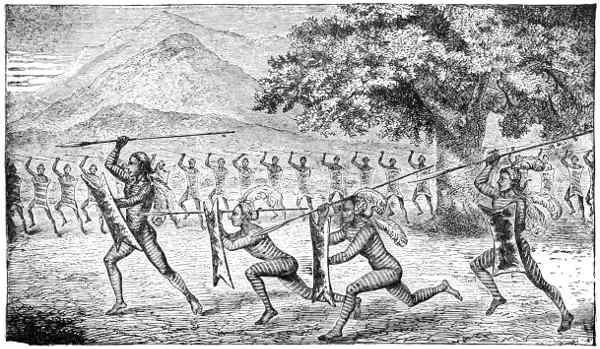
It was a pity to see these fine fellows so imposed upon by the wily Arabs, but they seemed to be wholly under their influence, for no sooner had the war-dance ended, which it did more through the exhaustion of the participants than through a desire to stop, than the chief arose and delivered a most voluble and vehement address, urging upon his warriors to assist the Arabs in their proposed raid and to beat the Madi people at all hazards. Several other speakers talked in a similar strain, with the effect of arousing the greatest enthusiasm. The result was that the Arab leader started on his raid with 120 of his own armed followers, surrounded and supported by the entire warlike force of the Obbos.
AFRICAN GAME LAWS.
Eastward of Lake Albert Nyanza is the Shooli country. In the midst of this tribe Col. Baker established Fort Fatiko. While awaiting reinforcements, he cultivated the friendship of the natives and soon found himself on excellent terms with them. The grass was fit to burn and the hunting season had fairly commenced. All the natives devote themselves to this important pursuit, for the chase supplies the Shooli with clothing. Though the women are naked, every man wears an antelope skin slung across his shoulders, so arranged as to be tolerably decent.
All the waste tracts of the Shooli and Unyoro country are claimed by individual proprietors who possess the right to hunt game therein by inheritance. Thus in Africa the principle of the English game preserve exists, though without definite metes and bounds. Yet a breach of their primitive game laws would be regarded by the public as a disgrace to the guilty individual, precisely as poaching is a disgrace in England.
The rights of game are among the first rudiments of property. Man in a primitive state is a hunter, depending for his clothing upon the skins of wild animals, and upon their flesh for his subsistence; therefore the beast that he kills upon the desert must be his property; and in a public hunt, should he be the first to wound a wild animal, he will have gained an increased interest or share in the flesh by having reduced the chance of its escape. Thus public opinion, which we must regard as the foundation of equity, rewards him with a distinct and special right, which becomes law.
It is impossible to trace the origin of game laws in Central Africa, but it is nevertheless interesting to find that such rights are generally acknowledged, and that large tracts of uninhabited country are possessed by individuals which are simply manorial. These rights are inherited, descending from father to the eldest son.
When the grass is sufficiently dry to burn, the whole thoughts of the community are centered upon sport. Baker, being a great hunter, associated with them. Their favorite method of hunting is with nets, each man being provided with a net, some 30 feet long and 11 feet deep. A council was called and it was decided that the hunt should take place on the manors of certain individuals whose property was contiguous.
At length the day of the hunt arrived, when several thousand people collected at a certain rendezvous, about nine miles distant from Fatiko, the best neighborhood for game. “At a little before 5 A.M.,” says Baker, “I started on my solitary but powerful horse, Jamoos. Descending the rocky terrace from the station at Fatiko, we were at once in the lovely, park-like glades, diversified by bold granite rocks, among which were scattered the graceful drooping acacias in clumps of dense foliage. Crossing the clear, rippling stream, we clambered up the steep bank on the opposite side, and, after a ride of about a mile and a half, we gained the water-shed, and commenced a gradual descent towards the west. We were now joined by numerous people, both men, women, and children, all of whom were bent upon the hunt. The men carried their nets and spears; the boys were also armed with lighter weapons, and the very little fellows carried tiny lances, all of which had been carefully sharpened for the expected game. The women were in great numbers, and upon that day the villages were quite deserted. Babies accompanied their mothers, strapped upon their backs with leathern bands, and protected from the weather by the usual tortoise-like coverings of gourd-shells. Thus it may be imagined that the Shooli tribe were born hunters, as they had accompanied the public hunts from their earliest infancy.
“As we proceeded, the number of natives increased, but there was no noise or loud talking. Every one appeared thoroughly to understand his duties. Having crossed the beautiful Un-y-Amé river, we entered the game country. A line of about a mile and a half was quickly protected by netting, and the natives were already in position.
“Each man had lashed his net to that of his neighbor and supported it with bamboos, which were secured with ropes fastened to twisted grass. Thus the entire net resembled a fence, that would be invisible to the game in the high grass, until, when driven, they should burst suddenly upon it.
“The grass was as dry as straw, and several thousand acres were to be fired up to windward, which would compel the animals to run before the flames, until they reached the netting placed a few paces in front, where the high grass had been purposely cleared to resist the advance of the fire. Before each section of net, a man was concealed both within and without, behind a screen, simply formed of the long grass tied together at the top.
“The rule of sport decided that the proprietor of each section of netting of twelve yards length would be entitled to all game that should be killed within these limits, but that the owners of the manors which formed the hunt upon that day should receive a hind-leg from every animal captured.
“This was fair play; but in such hunts a breach of the peace was of common occurrence, as a large animal might charge the net and receive a spear from the owner of the section, after which he might break back, and eventually be killed in the net of another hunter; which would cause a hot dispute.
“The nets had been arranged with perfect stillness, and the men having concealed themselves, we were placed in positions on the extreme flanks with the rifles.
“Everything was ready, and men had already been stationed at regular intervals about two miles to windward, where they waited with their fire-stick for the appointed signal. A shrill whistle disturbed the silence. This signal was repeated at intervals to windward. In a few minutes after the signal, a long line of separate thin pillars of smoke ascended into the blue sky, forming a band extending over about two miles of the horizon.
“The thin pillars rapidly thickened, and became dense volumes, until at length they united, and formed a long black cloud of smoke that drifted before the wind over the bright yellow surface of the high grass. The natives were so thoroughly concealed, that no one would have supposed that a human being besides ourselves was in the neighborhood. The wind was brisk, and the fire travelled at about four miles an hour. We could soon hear the distant roar, as the great volume of flame shot high through the centre of the smoke.
“Presently I saw a slate-colored mass trotting along the face of the opposite slope, about 250 yards distant. I quickly made out a rhinoceros, and I was in hopes that he was coming towards me. Suddenly he turned to my right, and continued along the face of the inclination.
“Some of the beautiful leucotis antelope, here known as gemsbock, being of a small variety, now appeared and centered towards me, but halted when they approached the stream, and listened. The game understood the hunting as well as the natives. In the same manner that the young children went out to hunt with their parents, so had the wild animals been hunted together with their parents ever since their birth.
“The leucotis now charged across the stream; at the same time a herd of hartebeest dashed past. I knocked over one, and with the left-hand barrel I wounded a leucotis. At this moment a lion and lioness, that had been disturbed by the fire in our rear, came bounding along. I was just going to take a shot, when, as my finger was on the trigger, I saw the head of a native rise out of the grass exactly in the line of fire; then another head popped up from a native who had been concealed, and rather than risk an accident I allowed the lions to pass. In one magnificent bound they cleared the stream, and disappeared in the high grass.
“The fire was advancing rapidly, and the game was coming up fast. A small herd of leucotis crossed the brook, and I killed another, but the smoke had become so thick that I was nearly blinded. It was at length impossible to see; the roar of the fire and the heat were terrific, as the blast swept before the advancing flames, and filled the air and eyes with fine black ashes. I literally had to turn and run hard into fresher atmosphere to get a gasp of cool air, and to wipe my streaming eyes. Just as I emerged from the smoke, a leucotis came past, and received both the right and left bullets in a good place, before it fell.
“The fire reached the stream and at once expired. The wind swept the smoke on before, and left in view the velvety black surface, that had been completely denuded by the flames.
“The natives had killed many antelopes, but the rhinoceros had gone through their nets like a cobweb. Several buffaloes had been seen, but they had broken out in a different direction. I had placed five antelopes to my credit in this day’s sport.”
VIVI, ON THE CONGO.
“Vivi could be made a beautiful place, if we only had water, but this is a big if, and yet I think not impossible. Last Sabbath I went to the villages and preached to one king and some of his people. He seemed interested and said I must come again. Then we went to another village, where they were having a palaver over a sick man. There were many men, women, boys, and even babies present.
“Their ngongo (or doctor) was seated in the midst, with the sick man near by. The doctor had a cloth spread out in front of him on the ground, that contained nearly everything—vegetable, mineral, animal, birds’ claws, chickens’ feet, goats’ feet and hides, teeth and claws of wild animals. There were also roots, nuts, dirt and many other things. There were some leaves lying on top of this collection, with something on them that reminded me of a cow’s cud, half-chewed, which he fixt up as a dose.
“He divided the cud in three parts, placing one part in a wooden dish with some leaves. Then he cut off bits of roots or something, and put in each of these three piles, taking at the same time a little of each in his mouth. After chewing it quite thoroughly, he spit several times on each pile. After water had been poured on it, the dish was surrounded by the women. Then he squeezed the juice out of the little heaps in the dish. At two different times the sick man took a swallow of the juice. Then the doctor took a sharp knife and cut his own tongue, till it bled freely. The blood ran down on a staff and a green leaf that lay in front of him; then he took up the leaf and staff and rubbed the blood on different parts of his body. This, with much more nonsense, was carried on, when I tried to get a hearing, but nothing of this kind could be done till the palaver was over, and the sick man was finished.
“I like Vivi, and as we must have a receiving and transport station here, I am doing what I can to make it a success. In addition to repairing the buildings already here, I am going to put up some stone buildings. They will not be expensive, as stone is abundant, and much more durable than wood for building, being fire and ant-proof. I am also trying to do something in the way of self-support by getting around me some cattle, sheep, goats, ducks, chickens, pigeons, etc.; and growing such native fruits and produce as do well here at Vivi. This will be convenient in the event of war, smallpox or famine—I mean such famine as might occur from not being able to get supplies from home or here, at the time we need them. Mr. McKitrick, a gentleman of the A. B. M. U. Mission, called a few days ago, saying they could not buy a goat or chicken on the south side of the river. In the past few days the Baptists and traders have been over here buying chickens. Soon, unless some one turns his attention to raising these things, there will be none to buy. They bring now one piece and a half (thirty to fifty cents) for one fowl.
“The chief wanted to buy 100 fowls from me a few days ago. With a ready sale for all the sheep, goats, ducks, chickens, etc., can you not see self-support in the future for Vivi?
“Nearly every steamer brings many Europeans, State men, and missionaries, and they are paid salaries, and expect to buy their living instead of producing it. They cannot depend on the natives for supplies; they must be raised by some one else or be imported. Now these are my reasons why I think self-support should not be lost sight of.
“All our live stock is doing well, though this is the hard pull for them, if there is any; for we have had no rain for about four months, and will have none for about three months more. Sheep and goats do well here. This is no experiment. The calves, I may soon say cattle, are doing finely. If two will do well here, twenty or thirty will do the same, as there is an immense range for them to graze over.
“My father keeps a herd of nice wild cattle about a half day’s walk from here. He has already given me two whole bullocks since I came to Vivi, and also two large deer as big as mules, and a good deal better. I really think shipping meat from America or England will soon be a thing of the past.
“The buffalo and deer here are likely to last a good while, for though they are frequently shot at, few are killed. A buffalo I killed a few days ago had in it two slugs, shot by the natives, I suppose. They are a sturdy animal, willing to defend themselves and their young to the death, and desperate when at bay.
BUFFALO DEFENDING HER YOUNG.
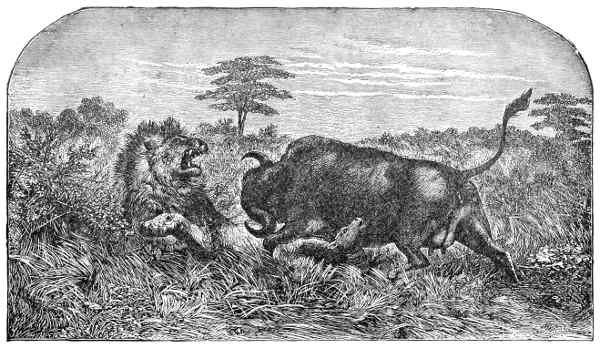
“This country will produce an abundance, but white men must show the natives how to do it. It is here now as it used to be in California. The last ten years of my life were spent on the Pacific Coast, when thousands of people returned from there, abusing the people and the country. I have met train after train of returning emigrants, who said: “Go back! go back! go back to God’s country! People are starving; all are lies about California and Oregon being good countries; on all the Pacific Coast there are no places for poor people.”
“But all this did not stop the emigration west, and the Pacific slope has proved a rich country. Persons come to Africa, and return giving bad reports; still they come, and will come, for this country has great advantages.” Rev. J. C. Teter.
RUM ON THE CONGO.
Bishop Newman has presented to Congress a memorial from the World’s W. C. T. U. praying that immediate and decisive steps be taken to suppress the liquor traffic in the Congo Free State and the basin of the Niger. The memorial shows that during 1885 more than 10,000,000 gallons of the cheapest and vilest spirits ever manufactured were sent from the United States, Germany, Holland, England, France, and Portugal to the natives of Africa. The quantities contributed by the different nations were:
United States, 737,650 gallons; Germany, 7,823,000 gallons; the Netherlands, 1,099,146 gallons; France (“pure alcohol”), 406,000 gallons; England, 311,400 gallons; Portugal, 91,524 gallons.
The memorial, continuing, says that abundant evidence proves that this deadly rum has developed in the natives an alcoholic passion almost without parallel, and has sunk them into a state of degradation lower than they occupied before they had contact with our commerce and civilization. The march of commerce will soon place the rum traders in communication with over 50,000,000 of savages, and unless the traffic is totally suppressed, the result will be most disastrous to the cause of humanity, a reproach to the Christian nations who supply it, and an outrage second only to the slave trade itself.
The purposes of the memorial and of the arguments made by Bishop Newman and Mr. Hornady are to bring about such a revision of the General Act of the Berlin Conference as shall completely suppress the liquor traffic in the territory in question; to obtain a law from Congress prohibiting the exportation of liquor from this country to any part of Africa, and to persuade the United States Government to use its influence to induce other governments to co-operate.
PALAVERING.
The council, consultation, or palaver, is one of Africa’s fixed institutions. We have unfortunately, and unfairly, adopted the word “palaver” to express our notion of what the natives regard with all seriousness, and what is, in their polity, as necessary as an American deliberative body or a treaty-making power are to us. A “palaver” is an idle talk. An African palaver may appear to be very idle to us, and considering its length—sometimes days and even weeks—it is a terrible bore to white people who have to wait till it ends.
The palaver is universal in Africa. Every village has its council place, its assembly hut or its palaver tree. Palaver proceedings are always formal and deliberate. There must be a palaver in order to declare war and make peace. When one tribe, or chief, asks anything of another, it must be granted or refused, through a palaver. Visits of white people to a tribe, the right to remain, to trade, to build, to preach, and to go away again, are all subjects requiring a palaver. Bishop Taylor has found it to be a capital way of making a Christian impression on the minds of his African auditors, to call them together in sacred palaver, and he secures their assent to such doctrines as they accept, as results of a palaver rather than as individual professions.
When parties of native travelers meet in desert, plain or forest, there is always a consultation, or palaver. Notes are compared in this way, intentions are expressed, views are made known. The palaver, or council, is thus the parliament and newspaper of Africa. It runs all through the country, just as do the traveling paths, which extend from ocean to ocean. You meet it in Bechuanaland, on the Zambesi, at Bihè, on Nyassa, Tanganyika, Victoria Nyanza, the Nile, Congo, Niger, Gambia. Sekhomo of Kalihari, squats with his council on burning sands. Mtesa of Uganda, holds a council as lordly as the Shah of Persia. Iboko of the Congo, palavers for nine days over the landing of a little steamer.
Irksome as the palaver must prove to white people, it ought not to be forgotten that natives enjoy it, and its sessions are valves for the escape of passions which otherwise might result in great harm.
EMIN PASHA AT ZANZIBAR.
For weeks after the arrival of Stanley and his rescuing party at Zanzibar, the life of Emin Pasha, on account of his severe accident, was despaired of. Indeed, not until a very late period has he been able to communicate with any one. Meanwhile, rumors of difference between him and Stanley became current, and the opinion was entertained that Emin would not go to Europe at all, but only awaited an opportunity to return again to his abandoned provinces.
SEKHOMO AND HIS COUNCIL.
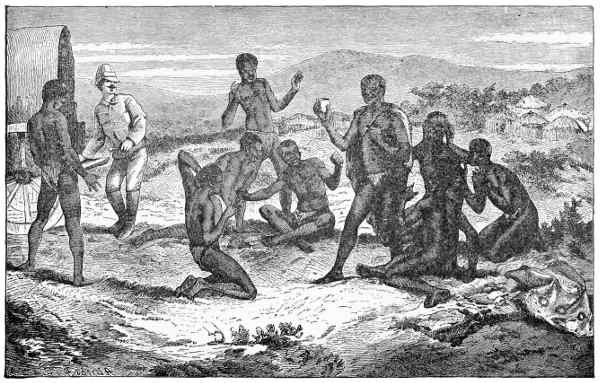
One of his first visitors, after his illness, was an American journalist, who secured the following points:
“The American people would very much like you to say, in plain language, Pasha, so that all may fully understand, why you left your post and came out with Mr. Stanley?”
“Well, you see,” replied Emin, “Mr. Stanley brought orders from the Khedive of Egypt for me to return with him. I am an Egyptian officer, and have no option but to obey the Khedive’s orders. I did not wish to leave, and if the Khedive should order me back again to-morrow, and would provide me with men and means to maintain my position, I would return with the greatest pleasure.”
“Do you wish the American public to understand, then, Pasha, that you could have maintained your position and were under no necessity of coming away with Mr. Stanley, had you not received orders from the Khedive to do so?”
“I think if Mr. Stanley would have consented to wait, much could have been done. Things had got to be very bad, however, and Mr. Stanley would not wait. He seemed only anxious that I and my people, the Egyptians, should go as quickly as we could with him to the coast.”
“Were you and your people in great need of assistance when Mr. Stanley reached you, Pasha?”
“We were very glad to have Mr. Stanley come to our relief, of course, and we all feel very grateful to the people of England for the great interest they have taken in us; but we were in no great need of anything but ammunition. Food was very plenty with us.
“The soldiers had gardens, cows, wives, and plenty of everything to eat. They were much better off than they ever had been in Egypt or the Soudan. They had come to regard the province as their home and had no wish to ever return to Egypt. They considered that they were fighting for their homes, and so fought well and bravely so long as there was a chance of success and the hope of assistance from our friends without. It was only when there was no longer anything to hope for, and when we read to them the message that they must leave with Mr. Stanley or never expect any more assistance from the Egyptian Government, that they began to waver in their allegiance to me. Poor fellows, what could they do? They didn’t wish to leave; the Khalifa’s forces were advancing up the Nile, they now had everything to gain and nothing to lose by turning against me. I do not blame them; they are but Africans, and nothing else was to be expected of them.
“Mr. Stanley was in such haste to go, he would not wait. If Mr. Stanley had consented to wait we might have pushed forward stations to the northeast corner of the Victoria Nyanza, and there we could have met the English Company’s caravans. I do not know Mr. Stanley’s reasons for being in such a hurry to leave. Perhaps he himself will tell you this.” (Mr. Stanley had already said that after getting Emin and as many of his people who wanted to go, together, at Kavalis, his great concern was to get them safely to the coast. As for attempting to open new roads with a crowd of helpless women and children in his charge, he couldn’t think of such a thing, etc.)
“It was rumored that you had vast stores of ivory in hand, Pasha; what of that?”
“Ivory! I had collected for the Government more than 6,000 fine large tusks since our communication had been cut off. I had ivory enough, if I could have got it to market, to have paid off all the back salaries of my people, and have had a handsome surplus besides.” (Six thousand fine large tusks would weigh in the neighborhood of 200 American tons, worth in Zanzibar about $6,000 per ton. The value in Emin’s stations would, of course, in no wise approach this great sum of value—$1,200,000. Emin told the writer that he valued his stores of ivory, as they lay in his stations, at about £70,000.)
“We couldn’t bring it with us,” the Pasha continued, “so I threw most of it into the Nile to prevent the enemy from getting it. Some, however, in outlying stations I intrusted to the care of friendly native chiefs, not knowing what chances and what opportunities time might bring.”
THE SAS TOWN TRIBE OF WEST AFRICA.
“The officers of this tribe are as follows:
“The ‘town master’ is really emperor, as in him is vested the power of life and death. If the tribe wishes to disobey a town master’s commands, they must kill him first. This is done in so many instances that few town masters die a natural death.
“The ‘ground king’ is their weather prophet, and he is supposed to manufacture the weather. He may be king for only a month or two, seldom long, as the weather he makes may not suit.
“Their ‘soldier king’ answers to our general in the army.
“They have three ‘butchers,’ who do all the killing for the feasts.
“Their ‘town lawyer’ answers to our attorney-general.
“The duty of their ‘peace-maker’ is what his name indicates.
“They have thirty old men or chiefs, whose duties are to watch the town and people, and to act as the king’s cabinet.
“The laws of the tribe are made by the king and his cabinet. Some of them are curious, and sometimes severe. For instance, one law forbids the town master and the butchers from ever leaving the town, on pain of death. Another is that when a person is accused of witchery, he or she must drink the deadly saswood, or have their brains knocked out. This tea is a potion from the saswood tree, which grows all over this country and is a deadly poison. To make sure of its full effect, the suspected person is made to drink a copious draft. As this is likely to produce emesis, the large quantity is often their salvation.
“These people are so superstitious that they will not leave a hole in their house open at night for fear of being witched.
“Here polygamy has all the evils of that life. If a wife is dissatisfied with her husband, she can run away to any man she chooses, and he must receive her, and pay to her former husband the price he paid for her. This may put the second man to quite a disadvantage, often giving him more wives than he can pay for. The lot of a wife is very hard. She must make the farm, grow all the rice, carry all the wood, seven or eight miles, on her head, and do all the cooking. Besides this she must stand all the ill-temper of her jealous husband, and this, perhaps, with a baby strapped on her back.
“When a man thinks one of his wives is unchaste, he gets a pan of palm-oil, and heating it as hot as he can, he makes the wife put her hand in and pick up a stone from the bottom of the pan; his theory being, that, if his charge be true, the oil will catch fire and burn her hand. If this does not satisfy him, the poisonous draught of the saswood is resorted to.
“These people eat nearly everything that grows, animal or vegetable. I have seen them eat elephant lungs, green ants, chicken heads and intestines. When they kill a bullock, they eat all of him, even cooking the hide with the hair on. As I said, everything goes for food, even rotten bananas. But with all of their rotten chop, they are healthy, strong and vigorous men, women and children.
“Their only garment is about four feet of cloth, for all those above sixteen years of age; those younger go entirely naked.
“They all sleep on the bare ground with a stick for a pillow, and of course, skin diseases are quite prevalent.
“They are a kind people to one another. I have stood at the spring, when the women were coming after water, which they carry in four-gallon pots on the top of their head, and one always helps the other to lift her load up, and so it is in everything. If a party of natives are together, and you give them a banana, it is divided between every one of them. I very seldom hear a baby cry; and I must say that here babies have a chance to live, as they are not weaned for two years, and are humored in every way.
“The Sas-Town tribes work hard for the white man, for very little pay. I have seen a woman carry a box, weighing 120 pounds, two and a half miles for two leaves of tobacco, worth one and one-eighth cents.
“These people are ignorant, but willing and quick to learn. They have some natural orators among them, as I have seen at their ‘palavers.’” C. E. Gunnison.
AN INTERRUPTED JOURNEY.
When Livingstone was marching down the valley of the Zambezi, and had crossed its great northern affluent, the Loangwe, he found himself and party of carriers in the midst of a dense forest. All of his riding oxen had been killed by the tsetse fly, except one, and this had been so reduced in strength as to be unable to carry the traveler more than half the time. Therefore such a thing as forced journeys were out of the question. There was nothing to do but to proceed leisurely, and this the party were doing,—pushing now through thick clumps of forest, and now through tangled bush, as best they might.
While thus threading their way through a forest clump, there was a rush and a roar off to the left, and almost instantly three huge buffaloes made their appearance, running as if they been badly frightened in the direction whence they came. As the bush was thick and high, they evidently did not see that their course was directly athwart that of the traveling party, and so they rushed right into the midst of the carriers, before they had time to clear the way. Livingstone’s ox, frightened at the unexpected dash, made a plunge forward, nearly throwing its rider off, but thereby escaping the fury of the charging buffaloes. When he turned, he saw one of his carriers flying through the air at a height of twenty feet, having been tossed by the foremost of the animals, whose fright seems to have been turned into rage at sight of human beings.
AN INTERRUPTED JOURNEY.
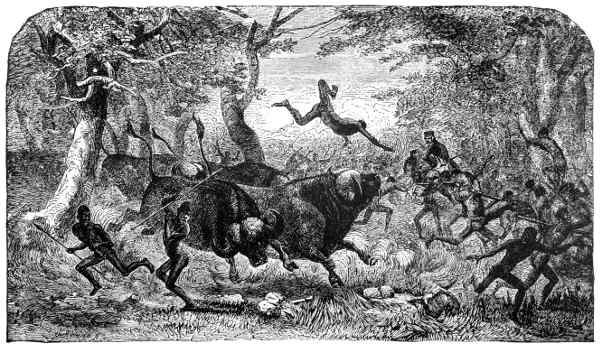
The buffaloes rushed by and Livingstone hastened to his carrier, expecting to find him dead or badly gored. But strange to say he was only bruised and frightened, and was quickly able to resume his load. On inquiry, Livingstone found that the carrier had drawn his misfortune on himself. Instead of doing as the others had done, making for a friendly tree, he had thrown down his load, and as the leading buffalo was dashing by, he had given it a vicious stab in the side, whereupon the beast had savagely turned upon him and sent him high into the air.
IN MONROVIA.
“The heathen that leap out of the vices and degradation and superstition and the deep darkness of their former lives, into active, working, intelligent Christians, are, I am inclined to think, the product of a facile pen from an overhopeful brain. It is not easy to shake off lifetime habits, customs hoary, and to them venerable, because their ancestors as far back as can be traced, have practiced them, and at once ascend into the region of a sublime faith, and from visible objects and ceremonies whereby wrath of the great demon power is averted, and his favor propitiated, turn to the King, invisible, immortal.
“The cerements of old superstition enwrap them. Neither can we ‘loose him and let him go’ the moment the new desires are born in him. His efforts are something like a child that is just learning to walk; he takes a step or two, wavers and drops back into some past habit, but like a child he is helped up and put on his feet again. I went down to Krutown last week to school. I heard tom-toms and saw the people on one street out for a gala day—all ‘dressed up,’ The women were painted with different kinds of clay, and had a great quantity of leopard teeth around their wrists and neck, plenty of brass anklets and armlets, and a towel or breakfast shawl thrown loosely and gracefully over one shoulder. Quite a number had on a cloth extending nearly to their feet, but all their bodies were bare to the hips; a great many held silk umbrellas over their heads, and all had a self-conscious air of being ‘well dressed.’ I went on and opened school. One of my Bible scholars was absent, a man of 40 or 45, who had learned to read, and showed such a meek and quiet spirit. I named him Fletcher. I asked where Fletcher was. ‘Him got a new wife, you no see that big play? Well that be him friends making for him.’ Next day he was in his place as usual. I asked why he took another wife. ‘Mammy, the woman done run away from him husband and come to me, and I no fittee send him back; I take him.’ That was all there was, no feeling of having done wrong. Polygamy is the greatest obstacle one meets in this part of Africa. The women are ashamed to belong—yes, belong, for the man buys her—to a man who is so poor he cannot buy more than one or two wives. It is not the patriarchal system some think, for the women are every now and then running away to some other man. Some never say a word, but let the man have his wife, others demand the amount the husband paid for her, others again make a big palaver. A court is called and after several hearings, which sometimes last two and three weeks, the wife is restored or returned to her husband, and both seem satisfied. It is almost impossible to do any teaching or evangelistic work when one man’s wife runs away to another man—the latter’s friends make merry by beating tom-toms, singing, dancing and drinking rum.
“These are some of the things that a missionary has to meet, and which greatly retard the work. Then time has no value to them. Plenty of chop, and not a desire and not an emotion beyond that. Like the prostrate figure in Peale’s Court of Death, the head and feet touch the waters of oblivion. So with the heathen here; the past and the future are alike impenetrable, incomprehensible.” Mary Sharp.
A SAMPLE SERMON.
The following is a sample sermon in Kru English which has been found well adapted for the comprehension of the Cavalla river natives:
Niswa make many worlds. Most of the stars are worlds much larger than this world, and I believe Niswa has plenty good people in all of them. The devils once had “their habitation” in one of those great worlds. They were good spirits then, and very strong, but they live for make bad and fight against Niswa, and were driven away from their home, and “fell like lightning from heaven,” and they hide away in the dark caves of our world. They be fit to live in this world till it finish. Then all the devils that come down from their great world, and all the bad people of this world will be condemned at Niswa’s judgment seat and be sent down to hell—“the place prepared for the devil” and all his followers. There they will all be locked in forever.
This world is one of the little worlds that Niswa made, and for people for this world he made one man and one woman, and join them together as man and wife. The man and his wife were clean and pure like Niswa.
One fine day the chief devil of all the army of them came and make palaver with the woman, and she make palaver with her husband, and the man and woman got bad, and join the devil in his rebellion against Niswa. As soon as they turned against Niswa and joined the devil’s army to fight against Him, the devil-nature struck right through them. Then they were called to answer at the bar of justice before the great King, and were found guilty and condemned to die. Their bodies be fit to rot in the ground, and their spirits to be turned with all the devils into hell forever. The Saswood cup of death and hell was put into the hands of the man and woman to drink. Niswa has one Son just like himself. Not a son born of a mother. Niswa no be born of a woman. He be Niswa without “beginning of days or end of life.” So His Beloved Son, just like Him, be without “beginning of days or end of life.” Niswa and his Son look at the man and woman and their cup of death and feel very sorry for them. Then the Son pray, “O Father, let me ransom this man and woman and all their seed.” Then Niswa and his Beloved Son have palaver, and make agreement about the man and woman. The Father agree to give His Son a ransom for them. The Son agree at a set time to join himself to a son born from “the seed of the woman” and live with her children, and show them the mind, the light, the love of Niswa; and teach them all Niswa’s good ways, and then drink their Saswood cup of death—to die for them, and the third day after to rise again from the dead, to be forever their living redeemer, their lawyer in Niswa’s court, and their doctor to heal them.