MISSIONARY WORK IN AFRICA. (continued 4)
Reading edition
In Kaffaria most of the religious denominations and missionary societies at work in the Eastern Province of Cape Colony are at work here also.
In Natal, the Church of England has been unfortunate in the part it has taken in the work there. As early as 1838 a missionary, a teacher and a doctor, were sent out by the Church Missionary Society. Soon afterwards others were sent to evangelize the natives, but war breaking out the work was entirely relinquished. In 1853 Natal was constituted a diocese and Dr. Colenso was consecrated the first bishop; but, according to his own confession, instead of converting the natives to Christianity, he was himself converted by a Zulu Kaffir, and proceeded at once to encourage polygamy and other heathen practices. Another bishop was appointed, but Dr. Colenso determined not to be superseded, and a scene of wrangling and litigation ensued, painful to contemplate. Churches have been built in several towns for the benefit of the settlers, but not much has been done for the religious instruction of the natives by the Church of England.
The American Board of Foreign Missions sent out missionaries in 1834. They were men of superior learning and intelligence. They have labored chiefly among the natives. By their literary ability and persevering efforts they have rendered good service to the cause of God by the part they have taken in the translation of the Scriptures and their remonstrances with Bishop Colenso. The Berlin, Hermannsburg, Swedish, Norwegian, London and Wesleyan Missionary Societies have representatives in Natal. The Dutch Reformed Church and the Scotch Presbyterians have a few ministers and churches as have also the Free Church of Scotland and the Independents.
The Rev. James Scott of Impolweni, Natal, writes to the Free Church Monthly in reference to an interesting work among the Dutch Boers, and extending to the Zulus in the northern portion of Natal about Greytown. Most of the Boers belong to the Dutch Reformed Church, and while they have attended outwardly to Christian ordinances, they have heretofore cared little for the native population. Three years ago a religious awakening began among these Boers, and the genuineness of this interest was shown by their desire to reach the Zulus, whom they had regarded as little better than animals. There are now fifteen preaching places where the Gospel is proclaimed, and which Mr. Scott says are simply the farmhouses of the Boers. He speaks of seeing eighty Boers and three or four hundred Zulus gather together for worship. The Zulus come from kraals and villages, both old and young, some clothed, but most of them heathen in their blankets. Over one hundred in Greytown have been formed into a native church in connection with the Dutch church. This work is now being carried forward under the direction of a committee of the Dutch farmers, employing three native Evangelists. One of these evangelists is the son of the Zulu warrior who in 1836, at the signal from Dingaan, the cruel tyrant, fell upon the Dutch leader Retief and his party of about seventy men, murdering them all in cold blood. This father still lives, and is a member of the Christian church and listens gladly to his son as he preaches the gospel of peace.
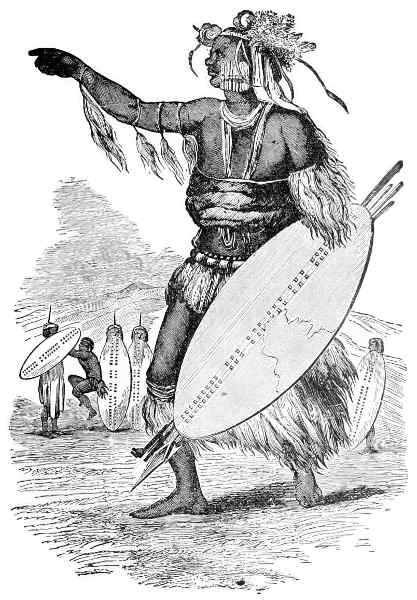
NATIVE WARRIOR.
The Orange Free State is an independent Dutch republic. The whites, Dutch, English, and other Europeans greatly outnumber the colored persons, who are of different tribes, but chiefly half-castes. The religious instruction of these people is fairly provided for by the different agencies now at work among them. The Dutch Reformed church of course takes the lead, and they have erected places of worship, appointed ministers, and gathered congregations in all the towns and villages and in many of the rural districts. The Berlin and Wesleyan Missionary Societies are also doing a good work especially among the wandering tribes of Bechuanas, Baralongs, and Korannas. In Zululand, previous to the war in 1879, the Propagation Society of the Church of England, and the Hermannsburg and Norwegian Missionary Societies, had established stations, and attempted the evangelization of the natives, but with very slender results. On the breaking out of hostilities, all the missionaries and teachers had to leave the country. They have since returned and gone to work under more favorable auspices.
It is stated that a nephew of the late King Cetewayo, after six years in Sweden in theological and other studies has gone back to carry on mission work in his native land.
No people in South Africa have benefited more by missionary labor than those in Basutoland. The agents of the French Evangelical Society have taken the lead in the work, having entered the field in 1833. They have many flourishing stations, and their efforts have been very successful in converting the heathen and in diffusing among the people general knowledge calculated to promote their civilization and social elevation. The Wesleyan missionaries have also established important and prosperous stations. By the presence and influence of the missionaries, industrious habits have become the distinctive characteristics of the Christian Basutos. The commercial relations of the country have been facilitated. A great impulse has been given to agriculture, in so much that the general aspect of the country, even in those parts that have not come under the influence of the Gospel, has been transformed. This has been strongly testified to by Mr. Griffiths, the British commissioner.
One of the most pleasing incidents in Pinto’s narrative is his meeting with the Coillard missionary family at Luchuma, on the Cuando. They were French missionaries, and the family was composed of Mr. and Mrs. Coillard and a niece, Elise. At the time of the meeting, Mr. Coillard was on his way to King Lobossi, to receive his reply to a request to enter his country for missionary purposes—a request which, by the way, was denied. This failure made it necessary for Mr. Coillard to return to Bamanguato, so the family and Pinto joined resources and took up the line of march together.
More than fifty years ago the land of the Basutos, whose boundaries touch the colonies of the Cape and of Natal on the south and of the Orange Free State on the west, became the abode of numerous French Protestant missionaries. They worked so faithfully that the native sense of savagery disappeared and the Basutos came to be the most civilized of the South African tribes. Now the Christian schools of Basuto number thousands of pupils. After a time the missionaries extended their field of work, but were finally headed off by the Boers and forced back to Pretoria. It was then that François Coillard was placed in charge of the Leribe Mission. He pushed his way north amid hardships and danger, till made a prisoner by the Matebelis and dragged before their chief, Lo-Bengula. What the missionary and the ladies of his family suffered during the time they remained in the power of that terrible chief is a sad and painful story. They were at length released and ordered to leave the country. On reaching Shoshong, the capital of Bamanguato, Coillard determined to renew his efforts in another direction. So he struck out for the Baroze region, having first sent a request to King Lobossi for admission and countenance. It was while on this mission to the Upper Zambesi that Pinto met him and his family. Pinto says of him: “He and his wife had resided in Africa for twenty years. He is warmly attached to the aborigines, to whose civilization he has devoted his life. He is the best and kindest man I ever came across. To a superior intelligence he unites an indomitable will and the necessary firmness to carry out any enterprise, however difficult.”
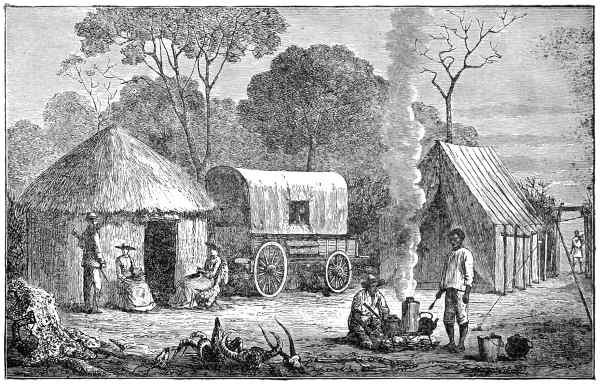
INTERIOR OF THE COILLARD CAMP.
On the south side of the Zambesi and north of latitude 24°, Africa is divided from sea to sea into three distinct races. On the east are the Vatuas; between are the Matebelis, or Zulus; westward are the Bamanguatos. They are all sworn enemies. The king of the latter, at the time of Pinto’s visit was Khama, a Christian convert, educated by the English, a civilized man of intelligence and superior good sense. True, he usurped the throne, but he treated his family with leniency, and became the idol of his people. Unlike every other native governor in Africa, Khama was unselfish. He spent his wealth for his people, and encouraged all to labor, that they might grow rich in herds and flocks. And they were not only rich in cattle, but were fine agriculturists; fond, too, of out-door sports, being experts in the hunting of game, as the antelope, ostrich, giraffe, elephant, etc. Though a Portuguese and influenced by the Latin church, Pinto gives this account of missionary work in South Central Africa: “How is it that in the midst of so many barbarous peoples there should be one so different from the others? It is due, I firmly believe, to the English missionaries. If I do not hesitate to aver that the labors of many missionaries, and especially of many African missionaries, are sterile, or even worse, I am just as ready to admit, from the evidence of my own senses, that others yield favorable, or apparently favorable results.
“Man is but fallible, and it is easy to conceive that when far removed from the social influences by which he has been surrounded from his infancy, lost, so to speak, amid the ignorant peoples of Africa, and inhabiting an inhospitable clime, his mind should undergo a remarkable change. This must be the general rule, which has, of course, its exceptions. The exceptions are the men who rest their faith on those ‘blossoms of the soul’ which give comfort to the wrecked mariner and aid the monk to suffer martyrdom at the hands of those to whom he brings the blessings of civilization. They who possess these inestimable treasures may, if left to themselves, pursue their way and attain to a sublime end, but such are veritable exceptions. Flesh is weak, and weaker still is human spirit. Were it otherwise, we might dispense with laws and governments, and society would be organized on a different basis. The ‘blossoms of the soul’ would suffice to govern the world.
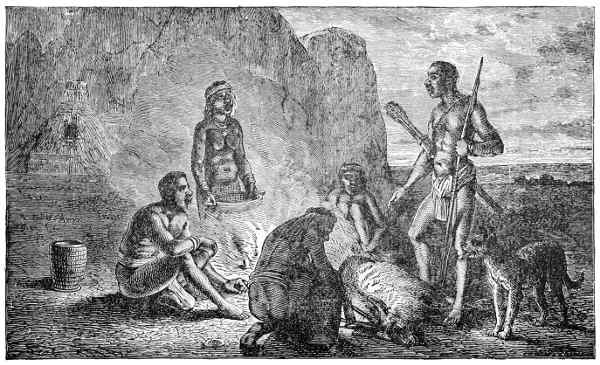
AT HOME AFTER THE HUNT.
“The passions to which man is subject will often lead the missionary—but a man and with all a man’s weakness—to pursue a wrong course. The strife between Catholics and Protestants in the African missions is an example of this. The Protestant missionaries (I mean, of course, the bad ones) say to the negro. ‘The Catholic missionary is so poor he cannot even afford to buy a wife,’ and thus seek to injure him, for it is as great a crime to be poor in Africa as in Europe. On the other hand the Catholics leave no stone unturned to throw discredit on the Protestants. From this strife springs revolt, the real cause of mission barrenness, where so many beliefs are struggling for mastery. To the south of the tropics the country swarms with missionaries, and to the south of the tropics England is engaged in perpetual war with the native populations. It is because the evil labors of many undo the good labors of some.
“Let us however, put aside the evil ones and speak only of the good. I have spoken of King Khama and his Bamanguato people. The king’s work was well done, but those who made it possible deserve more credit. The first workman in that field was Rev. Mr. Price, recently charged with the mission at Ujiji on Lake Tanganyika. The second was Rev. Mr. Mackenzie, the Kuruman missionary. The third was the Rev. Mr. Eburn, now among these people. It is with the utmost pleasure I cite these worthy names, and put them forward as noble examples to all workers in the fields of African civilization.”
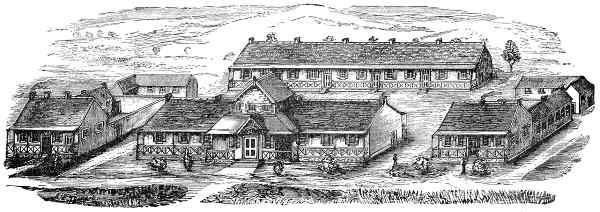
The above named Rev. Mr. Mackenzie took charge of the Kuruman mission in the Crown Colony of Bechuanaland in 1876, and his first work was to found and build a memorial institution to his predecessor, the lamented Dr. Moffat, for the education of native ministers. A fund of $100,000 was subscribed in England for this purpose and soon a substantial set of structures arose as a witness to Dr. Wm. Mackenzie’s zeal and the profound respect in which Dr. Moffat was held.
MOFFAT INSTITUTION—KURUMAN.
Says the Rev. A. Boegner: “Basutoland has frequently been saved from the destruction of its nationality by the intervention of the missionaries, and the natives blessed their name. The result in respect to education is that we have 80 elementary schools, having together 4,666 pupils, besides the normal school and the higher girls’ school, with 30 or 40 pupils, and 15 industrial, biblical, and theological school stations, 94 out-stations, 19 missionaries, 176 native workers, 6,029 communicants and 3,412 catechumens.”
In Bechuanaland many of the tribes, especially the Batlapins and the Baralongs, have for several years past been favored with the means of religious instruction by the agents of the London and Wesleyan Missionary Societies. It was among these people that the celebrated Dr. Moffat achieved his greatest success, and it was into their language that he succeeded in translating the Scriptures. And it was from a station among them that Dr. Livingstone started on his first adventurous journey of discovery. Thousands of these people have been to a considerable extent civilized, evangelized, and many have been taught to read the word of God for themselves. The earliest attempt to carry the Gospel to the Bechuanas was made in 1800 by Messrs. Edwards and Kok, agents of the Dutch Missionary Society in Cape Town. It proved unsuccessful. They were succeeded by the travellers Lichenstein in 1805, and Burchell in 1812, and during the latter year by the well-known Rev. John Campbell, who may be regarded as the earliest pioneer missionary to the Bechuanas, the two agents of the Cape Town Society being known among the Batlapins rather as traders than missionaries. In accordance with a request made to Mr. Campbell by the chief Mothibi, who said, “Send missionaries, I will be a father to them,” the London Missionary Society appointed Messrs. Evans and Hamilton to Lallakoo, which they reached in 1816. Their hopes of a welcome were, however, doomed to disappointment. The Bechuanas, with Mothibi’s, consent, reyoked the wagons of the missionaries and sent them away, hooting after them in genuine heathen fashion. They did not want “the teaching,” fearing it would be with them as with the people of Griqua Town, “who” they said “once wore a ‘kaross’ but now wear clothes; once had two wives but now only one.” Mr. Robert Moffat made the next attempt to introduce the Gospel among these people and was more successful. We have not space to give even an outline of the career of this wonderful man. One illustration, however, will suffice to show at once his character and that of the people among whom he labored so long and well. During a time of severe drought when the heavens were as brass and the earth as iron, the cattle were dying rapidly, and the emaciated people were living on roots and reptiles. The rainmakers were consulted. They attributed the cause of the drought to the prayers of the missionaries, and to the bell of the chapel, which they said frightened the clouds! The chief soon appeared at the missionaries’ door, spear in hand, with twelve attendants, and ordered them to leave the country, threatening violent measures if they refused. Mrs. Moffat stood at her cottage door with a baby in her arms watching the result at this crisis. Looking the chief straight in the face, Moffat calmly replied: “We were unwilling to leave you. We are now resolved to stay at our post. As for your threats we pity you; for you know not what you do. But although we have suffered much, we do not consider that it amounts to persecution, and are prepared to expect it from those who know no better. If resolved to get rid of us you must take stronger measures to succeed, for our hearts are with you. You may shed my blood, or you may burn our dwelling; but I know you will not touch my wife and children. As for me, my decision is made. I do not leave your country.” Then throwing open his coat, he stood erect and fearless. “Now then,” he proceeded, “if you will, drive your spears to my heart; and when you have slain me, my companions will know that the hour is come for them to depart.” Turning to his attendants the chief said, “These men must have ten lives. When they are so fearless of death, there must be something of immortality.” All danger was now past. The intrepid missionary had got access to their hearts, and they were, for the time at least, subdued.
The country long known as Griqualand is situated beyond the Orange river, and around its junction with the Vaal.
MOFFAT’S COURAGE.
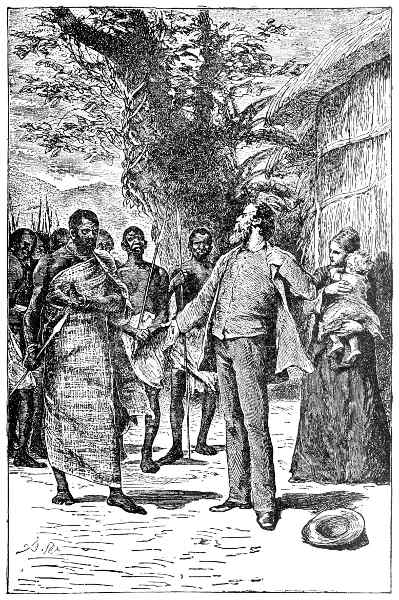
The Griquas are a mixed race, of which there are several clans vulgarly called “Bastards,” being the descendants of Dutch Boers and their Hottentot slaves. They are a tall, athletic, good looking race, of light olive complexion. They speak a debased patois of the Dutch language, as do most of the colored inhabitants of South Africa. About the year 1833 the Griquas began to collect and settle in the country which bears their name, and to rally round a leader or chief named Adam Kok, who displayed considerable tact and skill in governing the people who acknowledged his chieftainship. Some time after, a part of the clan separated themselves from the rest, and gathered round a man named Waterboer, who became their captain or chief. Both of these chiefs, for many years, received annual grants from the Colonial Government on condition of their loyalty and good conduct. They and their people were ultimately removed by an arrangement with the government authorities to a region known as “No Man’s Land;” and of late years have become scattered. In all their locations they are generally now regarded as British subjects, and they have gradually advanced to a pleasing state of civilization and general knowledge. They are largely indebted to the missionaries for the respectable position to which they have attained among the native tribes. The honored instruments in their moral and social elevation have chiefly been the agents of the London Missionary Society who have labored among them for many years with remarkable energy, zeal and success. The Wesleyan Missionary Society have also some prosperous stations in some of the Griqua settlements where no other agencies are at work, and the results of their labors have been very encouraging.
In Namaqualand, under circumstances of peculiar trial and privation the Wesleyan and Rhenish Societies have labored with commendable zeal and diligence. Some time ago the Wesleyan stations were by a mutual arrangement transferred to the German missionaries.
In Damaraland missionaries have labored earnestly for many years, but the results thus far have been meagre.
What has been the sum total accomplished by the missionary societies in South Africa?
The Wesleyan Missionary Society began work there in 1814. Extending its operations by degrees from the Cape Colony to Kaffaria, Natal, and the Bechuana regions, it now numbers forty stations, sixty missionaries, and more than 6,000 members. The Rhenish Society which commenced operations in this field in 1829, now numbers more than 10,000 members; and the Berlin, which commenced in 1833 and has 8,000 members. The American Board which entered the field in 1834, has grown into three missions, the Zulu, the East African and the West African, and now numbers 30 stations, 48 laborers from America, more than 40 native assistants, about 2,000 under instruction and 7,000 adherents. Besides these the French Society is doing a great work among the Bechuana and other tribes. The Norwegians are laboring among the Zulus, the Scotch among the Kafirs, the Hanoverians and the Church of England in Natal and Zululand.
These with a few other organizations make more than a dozen societies at work in South Africa, occupying more than 200 stations, and employing about 500 foreign laborers, besides a much larger force of native helpers. Of the success and value of these labors we get some idea when we find it estimated that not less than 40,000 souls have been brought in this way into Christ’s kingdom, 50,000 children gathered into Christian schools, and 100,000 men and women blessed with the direct teaching of the Gospel.
EAST AFRICAN MISSIONS.
Leaving South Africa we will now consider briefly what has been done by the missionaries in Eastern Africa and that part of Central Africa reached by way of the east coast. Here there seemed to be less opposition to the entrance of the Gospel than in some other parts of Africa. Dominant superstitions do not stand so much in the way of its reception. There is less idolatry or fetish worship, such as is found on the western coast, and there are fewer barbarous or unnatural rites. The greatest hindrance has been the Arab slave trade, which, driven from the west coast had established itself on the east coast. The unwise course of the Germans who established a commercial enterprise there in 1889 has led to Arab hostilities that appear disastrous in the extreme to missionary work for the present, especially among the Ugandas.
LARI AND MADI NATIVES.
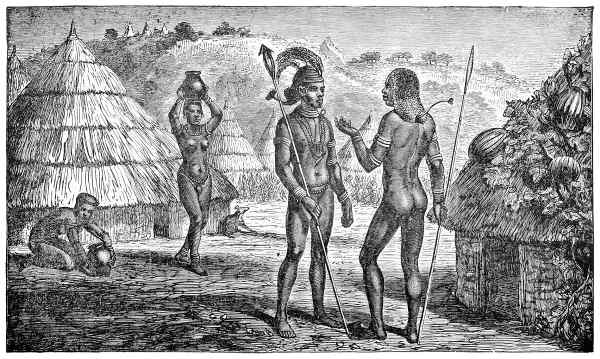
There are very extensive missionary interests in East Africa. No less than thirteen societies are at work on the coast or in the interior. It will be more convenient, in considering what has been accomplished, to note the work done by each society separately, rather than to follow our usual order of treatment by tribe or locality.
As the Church Missionary Society was first in the field we will notice its efforts first.
The first missionary was Dr. Krapff, a zealous and devoted German. He had previously labored for several years among the Lari and Madi natives of the province of Shoa, and when the Abyssinian government prohibited his longer residence there he removed to Mombasa, where he laid the foundation of a new station under promising circumstances. When the way appeared to open up for usefulness among the Gallas and other important tribes, Dr. Krapff was joined by four additional laborers who were sent out by the society to aid him in his work. Their headquarters were at Kisulidini and the mission had every promise of success. But death soon thinned the ranks and disappointed many hopes. Only one of the missionary band, Mr. Rebmann, had strength to hold out against the climate. He remained at his solitary post of duty several years after the Doctor had been obliged to embark for Europe; but in 1856 he was driven by the hostile incursions of savage native tribes to take refuge in the island of Mombasa, and for two years the mission on the mainland seemed to be at an end. Mr. Rebmann resolved not to lose sight of its ruins, however, and employed his waiting time in preparing a translation of the Bible into the language of the people among whom he labored. At length the desire of the lonely missionary was gratified by a cordial invitation to return to Kisulidini, and the hearty welcome he received on going there proved that there was further work for him to do among this people. For years he labored single-handed among this people and managed to keep alive the spark of light which Dr. Krapff had been the means of kindling. After long and patient waiting relief came. The deep interest called forth by Dr. Livingstone’s last despatches and death, stirred up the church at home to fresh efforts on behalf of the African race, and a much needed reinforcement was sent out to strengthen the mission on the eastern coast, including Mr. Price and Jacob Wainwright, Livingstone’s faithful negro servant. When they arrived at Kisulidini they found Mr. Rebmann aged and feeble, and almost blind, but still the centre of a little band of native converts at the old mission premises. This mission now comprises eight stations with Mombasa as its base. The constituency at these stations is composed chiefly of liberated slaves, who are rescued by British cruisers from slave dhows and handed over to the mission, now living in comfort as free men, cultivating their own little plots of ground, building their own little huts on the society’s land, enjoying the rest of the Lord’s day, seeing their children taught to read and write like the white man, and having access at all times for counsel and guidance to patient and sympathizing Englishmen.
Recently, their former masters combined and threatened to destroy the stations if their slaves were not given up. How this catastrophy was averted by the tact and generosity of Mr. Mackenzie the following will tell: “At Mombasa, Frere Town and Rabai, on the east coast of Africa, the English Church Missionary Society has for some time been carrying on a work similar to that which has been so greatly blessed at Sierra Leone and other places on the west coast. The natives who have been rescued from the Arab slave vessels by the British cruisers have been taken to the first-named towns, where they have been cared for and instructed by the missionaries of the society, and a large number of them have become new creatures in Christ Jesus, and are now diligent in tilling the soil or in following other industrial pursuits.
“For several years fugitive slaves from the adjoining country have sought refuge at the mission stations from the oppressions of their Mohammedan masters. Every effort has been made by the missions to prevent mere runaways from settling around the stations; but it has lately been found that many who came and placed themselves under Christian teaching, and who were supposed to be free natives, were really fugitive slaves. Many of them have embraced Christianity, been baptized, and are leading ‘quiet and peaceable lives in all godliness and honesty.’
“Suddenly the former Mohammedan masters of the fugitives combined and threatened destruction to the missions unless they were given up again to slavery. It has been a time of great anxiety to the missionaries, and in this crisis they could only commit all to the Lord. Happily the danger has been averted by the wise and timely action of Mr. Mackenzie, the chief agent of the new Imperial British East Africa Company, whose headquarters are at Mombasa. Mr. Mackenzie saw that if the régime of this politico-commercial company began with the restoration of a thousand escaped slaves to the slave owners, its influence would be seriously injured. He has, therefore, undertaken to compensate the Arab slave-owners, on condition that the whole of this fugitive slave population, a large portion of which is Christian, are declared free forever. This arrangement has delighted all parties. A grand feast has been given by the Mohammedans to Mr. Mackenzie, while the slaves are set free and the missions are saved.”
This society had also a line of stations stretching from Zanzibar to Uganda. They were nine in number, beginning with Mambola and Mpwapwa, nearly due west from Zanzibar, and including Usambiro, Msalala and Nasa, south of Victoria Nyanza, and Rubaga, in Uganda, north of the great lake. The origin of the mission in Uganda was on this wise: “When Stanley went away from Uganda, Mtesa, the king, said to him, ‘Stamee, say to the white people, when you write to them, that I am like a man sitting in darkness, or born blind, and that all I ask is that I may be taught how to see, then I shall continue a Christian while I live.’ Mtesa’s appeal, through Stanley, to English Christians, had its response. The Church Missionary Society sent several missionaries, who were heartily welcomed by Mtesa, and protected as long as he lived.”
As public attention has recently, and for different reasons, been very generally directed to Uganda, it may not be amiss to give a more detailed account of the situation and prospects there.
Near the shores of those majestic lakes—Albert and Victoria Nyanza—which give rise to the Nile, are large tribes, akin to one another in speech and habit, and quite advanced in civilization, as things go in Africa. They are the Baganda, Luganda and Uganda, all of which have been visited and described by Stanley and other well-known travellers. Of these, the Uganda are the most numerous and advanced. This region was for a long time looked upon as a fair field for missionary enterprise, irrespective of the fact that it had been an old and favorite stamping ground for Arab traders and slave dealers, whose influence would naturally be against Christian intervention. But in 1876, missionaries went out from England, and founded several missions, mostly in the Uganda country. They proved to be prosperous, and fast became the centres of Christian communities, whose influence was felt from one lake to the other. But after over ten years of prosperity, a civil war broke out, instigated by the Arabs, which resulted in the enthronement of Mwanga, who was hostile to the missionaries and their Christian converts. He signalized the first year of his reign by the murder of Bishop Hannington and the massacre of many of his Christian subjects. By 1889, all but one of this missionary band had perished either through disease or royal cruelty, and their converts were forced to become refugees. The survivor, Mr. Mackay, after being held as a hostage for months, was finally released, and made his escape to Usambiro, where he took up work with the hope that at no distant day he might be able to extend it back into the abandoned lake regions.
In his “Emin Pasha in Central Africa,” Mr. R. W. Felkin thus sketches the character of the two great Uganda kings, Mtesa and Mwanga:
“Mtesa was first heard of in Europe from Speke and Grant, who visited Uganda in 1862. He professed to trace back his descent to Kintu (or Ham) the founder of the dynasty. When I visited him in 1879 he was about 45 years of age, a splendid man, some six feet high, well formed and strongly built. He had an oval face, and his features were well cut.
“He had large, mild eyes, but if roused by anger or mirth they were lit up by a dangerous fire. He had lost the pure Mhuma features through admixture of Negro blood, but still retained sufficient characteristics of that tribe to prevent all doubt as to his origin. All his movements were very graceful; his hands were slender, well formed, and supple; he was generally dressed in a simple white Arab kaftan. It is somewhat difficult to describe his character; he was intensely proud, very egotistical, and, until near the end of his life, he thought himself to be the greatest king on earth. In his youth, and in fact until 1878, there is no doubt that he was cruel, but an illness from which he suffered certainly softened him.
“His chiefs often said to me, ‘Oh, if Mtesa were well, there would be plenty of executions.’ It has been said that he was extremely changeable and fickle, and to superficial observers he was so; that is to say, as far as his intercourse with Europeans went. If, however, one looks a little deeper into his character, he finds that his apparent vacillation was overruled by a fixed idea, which was to benefit his people, increase his own importance, and to get as much as possible out of the strangers who visited his court. This explains his being one day a friend to the Arabs, on another to the Protestants, and on a third to the Catholics. A newcomer, especially if he had a large caravan, was always the favorite of the hour. It is not difficult for any one to enter Uganda, but to get away again is no easy task, unless he is going for a fresh supply of goods. Mtesa liked Europeans and Arabs to be present at his court; it gave him prestige, and he also wished his people to learn as much as they could from the white men, for he well knew and appreciated their superior knowledge. In manners he was courteous and gentlemanly, and he could order any one off to execution with a smile on his countenance. His mental capacity was of a very high order. He was shrewd and intelligent; he could read and write Arabic, and could speak several native languages. He had a splendid memory, and enjoyed a good argument very keenly. If he could only get Protestants, Catholics and Arabs to join in a discussion before him, he was in his element, and although apparently siding with one or other, who might happen to be at the time his especial favor, he took care to maintain his own ground, and I do not believe that he ever really gave up the least bit of belief in his old Pagan ideas. While too shrewd and intelligent to believe in the grosser superstitions which find credit among his people, he was yet so superstitious that if he dreamt of any of the gods of his country he believed it to be an ill omen, and offered human sacrifices to appease the anger of the offended deity. Shortly after I left Uganda, he dreamt of his father, and in consequence had 500 people put to death. He also believed that if he dreamt of any living person it was a sign that they meditated treachery, and he condemned them forthwith to death. This supposed power of divination is said to be hereditary in the royal race. In concluding my remarks about Mtesa, I may say that he denied his Wahuma origin; not only, however, did his features betray him, but many of the traditions he held regarding his ancestors, especially his descent from Ham, point conclusively to an origin in the old Christianity of Abyssinia.
“When I was in Uganda, Mtesa had 200 or 300 women always residing at his court. He did not know exactly how many wives he had, but said that they certainly numbered 700. He had seventy sons and eighty-eight daughters.
“Mwanga is the present king of Uganda, having been chosen by the three hereditary chiefs at the death of his father, Mtesa, and it is certainly to be attributed to the influence of the missionaries in Uganda, that the usual bloodshed which attends the succession to the throne in Uganda, did not take place. On ascending the throne he was about 16 years of age, and up to that time had been a simple, harmless youth, but his high position soon turned his head, and he became suspicious, abominably cruel and really brutal. He began to drink and to smoke bang, and up to the present time his rule has been characterized by tyranny and bloodshed, far surpassing anything that happened in his father’s time. Nor does he appear to possess those good characteristics which certainly caused his father to deserve some respect. A number of Christians, Protestants and Catholics have been tortured and burned at the stake by his orders, and Bishop Hannington was murdered by his command at Lubwa, on the borders of Uganda.”
A writer in the N. Y. Evangelist observes further:
“Of course, Mwanga was a coward as well as a cruel and bloodstained despot. Because he made Uganda impenetrable, no direct news from Wadelai about the movements of Stanley or Emin Pasha could reach Zanzibar. Very naturally he was obliged to face an insurrection. To save his worthless life he fled from his kingdom, and his older brother, Kiwewa, succeeded him. Because under his rule the missionaries were again in favor, Kiwewa was soon forced to abdicate before an insurrection incited by the Arabs, whom the policy of his brother had brought into the kingdom, and in which such of his own subjects who opposed the missionaries cheerfully participated. While about a score of missionaries escaped unharmed, all missionary property was destroyed, many native missionaries were murdered, the Arabs became dominant in Uganda, and the kingdom, it may be for several years, is closed against Christianity. The living missionaries have quite recently been ransomed.
“What is to be the influence of this new Arab kingdom in Central Africa? This, with many, is a pressing question. In answering it we must remember that these so-called Arabs really have in their veins no Arab blood. They are coast Arabs of the lowest classes, and the proud and strong Uganda chiefs will not submit for any considerable length of time to the rule of any such men. They may use such men; they will never become their slaves. The country is more likely to be broken up into hostile sections. These may wear themselves out in wars against each other, and thus may be realized the hope that the British East African Company, from their new territory between Victoria Nyanza and the coast, would push its influence and its operations over Uganda, and the whole lake region of Central Africa. These Arab slave-traders are certainly not the men to construct or reconstruct an empire. Those who know them best see no prospect that they will be able by intrigue, which is their only agency, to sustain themselves in Uganda.
“The character and habits of the Uganda people seem to forbid their enslavement. They are the only people in Central Africa that clothe themselves from head to foot. Besides their own ingenious utensils for housekeeping, the chase and war, thousands of European weapons and implements are found in their possession, and being ready workers in iron, they immediately imitate what they import. They are apt linguists, and their children have rapidly acquired the French and English languages from the missionaries. They have neither idols nor fetishes. They have no affiliations with Mohammedanism, and are not likely to become its subjects for any considerable time. There is still good reason to hope for a better future for Uganda.”
TINDER-BOX, FLINT AND STEEL.
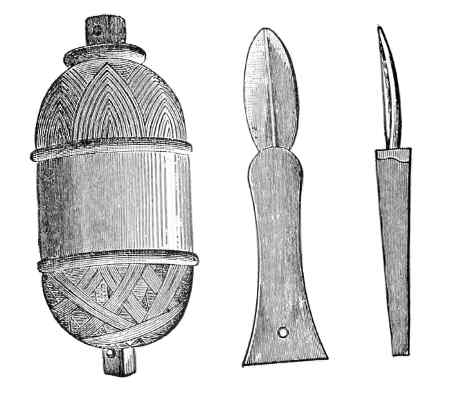
The London Missionary Society has ever been forward to enter new fields of labor. On Livingstone’s return to England, after his great journey across the continent of Africa in 1856, he urged this society, in whose service he had previously been engaged, to establish a mission on the banks of the Zambesi, with a tribe of natives known as the Makololo, with the view of reaching other tribes in the interior through them. A mission was organized accordingly, which was to start from the Cape of Good Hope direct for the interior. This journey was to be made in the usual South African style, namely, in wagons drawn by long teams of oxen. Livingstone himself went round by the eastern coast, purposing to meet the missionaries in the valley of the Zambesi, and to introduce them to the chiefs with whom he was personally acquainted. The missionaries selected for this purpose were Revs. Helmore and Price, the first of whom was a middle-aged minister, with a wife and family, and had labored in South Africa for several years previously, whilst Mr. Price was a young man recently married, and was entering upon mission work for the first time. The incidents of the journey, as well as the issue of this mission were the most afflictive and distressing. The mission wagons had scarcely passed the boundary of the Cape Colony when water and grass for the oxen became scarce, and their progress was accordingly slow and dreary. Many of their oxen died and their places were supplied with difficulty by cattle purchased from the natives. When they came to cross the outskirts of the desert of Kalahara their sufferings were terrible. They at length reached the valley of the Zambesi where they had an ample supply of grass and water; but they soon found themselves in a low, swampy, unhealthy country, and when they reached their destination in the Makololo country, they did not meet with the cordial reception from the chief and his people which they expected. Dr. Livingstone, who was engaged in exploring the lower branches of the Zambesi was moreover unable to meet them as he intended. They naturally became discouraged; and before they got anything done of consequence in the way of teaching the people, the chief still withholding his consent to their movements, the country fever broke out among them with fearful violence. Mr. Helmore’s four children, who suffered so much from thirst in the desert, were smitten down one after another and died. They were buried but a short time when graves were made beside them for both their parents. Mr. and Mrs. Price began to think of retracing their steps to the Cape Colony, and at length with heavy hearts they yoked the oxen to the wagons and started toward civilization. But in crossing the desert Mrs. Price also died, so that Mr. Price was left to return alone.
BOUND FOR THE INTERIOR DURING THE RAINY SEASON.
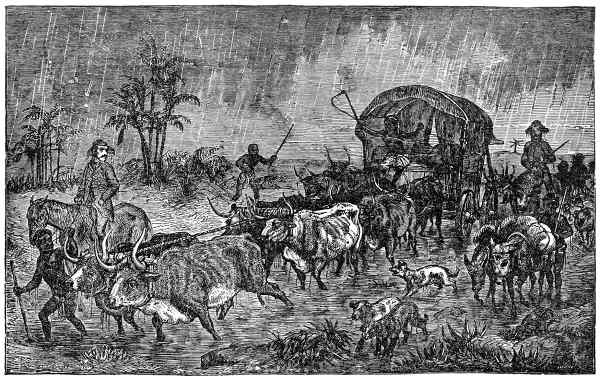
In 1877 in response to an application made by the son and successor of the chief in Makololo, the Rev. J. D. Hepburn, of Shoshong, and outpost of the Bechuana mission, commenced a mission on Lake Ngami, two native evangelists who had completed their studies at Kuruman were settled there and are doing good work.
The London Society goes further west than any of the other societies and plants two stations on Lake Tanganyika, and one at Urambo in the Unyamwezi, south of the Victoria Nyanza and near the stations of the Church Missionary Society.
The Universities’ Mission has twelve stations, one in Zanzibar, four in the Usambara country north of Zanzibar, four on or near the river Rovuma and three on the east shore of Lake Nyassa.
The mission of the Free Church of Scotland on the shores of Lake Nyassa was founded in 1861 by Rev. Dr. James Stewart. Reinforcements were sent out in 1875. They took with them the steam launch Llala to be used upon the waters of Lake Nyassa. In 1876 Dr. Wm. Black, an ordained medical missionary, an agriculturist, an engineer, and a weaver, joined them. In 1879 Miss Watterston joined the staff, as female medical missionary and superintendent of the girls’ boarding and training school. In 1880 they met with a great loss in the death of their agriculturist, John Gunn, who had proved himself helpful in every department of work.
The Free Church of Scotland has recently opened a new mission at Malinda, on the high plain north of Lake Nyassa. The station is surrounded by seventeen villages, embosomed in gardens of magnificent bananas. At Karonga two services are held every Sabbath, and the congregation numbers 600 natives. Dr. Cross attempted to push his work into the highlands, but was driven back, and compelled to rely on Capt. Lugard’s armed force of 150 natives. These aggressive movements against the missions in Nyassaland, as elsewhere, are attributable to Arab slave traders, who are the worst enemies Christianity has to contend with in Africa. They now have five stations on Lake Nyassa.
The Established Church of Scotland Mission was founded in 1875 by Mr. Henry Henderson. The staff comprised a medical missionary, an agriculturist, a blacksmith, a carpenter, a joiner and a seaman and boatbuilder. To Mr. Henderson belongs the credit of having selected an incomparable site. It was originally intended that the mission should be planted in the neighborhood of Lake Nyassa; but he found a more suitable locality in the highlands above the Shiré, east of the cataracts, and midway between Magomero and Mount Soché. The ground rises from the river in a succession of terraces. It is about 3,000 feet above the sea, and extends from twelve to fifteen miles in breadth. Gushing springs and flowing streams abound. The scenery is beautiful and picturesque. The soil is fertile. There is abundance of good timber and iron ore. The chiefs are friendly and the people are willing to receive instruction. And, what is an essential requisite, the climate is in a high degree salubrious. In the words of Livingstone, “it needs no quinine.”
The settlement, which is named Blantyre, after Livingstone’s birth-place, was planned and laid out under the superintendence of Dr. Stewart and Mr. James Stewart. On the farm and gardens surrounding, over 500 natives of both sexes are employed. Mr. Henderson having returned, on the completion of the special work for which he was appointed, Rev. Duff Macdonald and wife were sent out in 1878. They were soon after recalled on account of difficulties arising from the mission’s claim to exercise civil jurisdiction over the settlement. Rev. David Clement Scott was appointed to take their place.
One of the most important works in connection with Livingstonia, the name of the Free Church of Scotland’s Mission, and Blantyre Mission, was the formation of a road, projected by Dr. Stewart and surveyed by Mr. J. Stewart. It varies from six to ten feet in width, and extends from the Upper Shiré, at the head of the cataracts, for a distance of about thirty-five miles to Blantyre, and thence for nearly an equal distance through a steep and rugged country to Ramakukan’s, at the foot of the cataract. Facilities are thus afforded for communication with the coast. The expense of its construction was borne equally by the two missions. A traveller who has frequently visited this region writes as follows:
“The outlet for the waters of Lake Nyassa is the river Shiré which flows into the Zambesi. Except for a short distance in one part, this river is navigable throughout its course; and at about sixty or seventy miles after it leaves the lake it takes a bend westward, and here below Matope, a station of the African Lakes Company, it becomes unnavigable by reason of the Murchison Cataracts. Below these is another station of the African Lakes Company at Katunga’s, and from here there is no further difficulty in navigating the river. All goods, therefore, and passengers bound for Nyassa, are landed from the African Lakes Company’s steamer at Katunga’s, and after a journey of some seventy miles across a ridge of high ground are put on the river again at Matope. About half-way between Katunga’s and Matope is the African Lakes Company’s store and settlement at Mandala, and little more than a mile from it the flourishing mission village of Blantyre of the Established Church of Scotland. It is wonderful to see this village, with its gardens, schools, and houses, in the midst of Africa. The writer has twice, within the last three years, when visiting Nyassa, experienced the generous hospitality of Mandala and Blantyre, and so can speak from his own personal observation. Being situated on such high ground, the climate is much more favorable to Europeans than at most mission stations in that region. It is easier also, for the same reason, to grow fruits and vegetables imported from Europe. It is difficult to overestimate the effect of such a settlement as a civilizing agency in the country. Mr. Hetherwick, who was in charge of the station for some time in Mr. Scott’s absence, has mastered the language of the great Yao tribe, and has lately published a translation of St. Matthew’s Gospel, which shows a wonderful grasp of the genius of the language. Mr. Hetherwick has now returned to his mission station, some fifty miles to the northeast, under Mount Zomba. Mr. Scott is said to be equally a master of Chinyanja, the language of the Nyassa tribes. The English government have recognized the important influence these settlements are likely to have by appointing a consul on Nyassa, who has lately built a house close to the flourishing coffee and sugar plantations of Mr. Buchanan under Mount Zomba, about forty miles from Blantyre, and near Lake Kilwa or Shirwa. Mr. Buchanan is also a good Yao scholar, and takes care to teach the people, who come to him in considerable numbers for employment. Situated high up on the slope of Mount Zomba, which rises precipitously above it, the streams which rush down from its summit are diverted and distributed so as to form a system of irrigation. Mr. Buchanan’s plantation is a picture of beauty and prosperity, and offers every prospect of health and permanence.
“When we come to Lake Nyassa, we find missions established on each side of the lake. On the west side are the stations at Cape Maclear and Bandawe, while connected with the latter are sub-stations, among which is an important mission to the Angoni, a marauding tribe of Zulu origin. Dr. Laws, at Bandawe, has been a long time in the country, and has thoroughly won the confidence of the people. On one occasion, when the writer visited him, some five or six hundred people assembled in his schools, in which large numbers of children are taught daily. The Universities’ Missions are on the east side of the lake.”
The United Methodist Free Churches in 1863 began a mission at Ribé, about eighteen miles north of Mombasa. The ministers selected for this service were the Revs. New and Wakefield. For several years they were engaged in preparatory work, erecting buildings, cultivating garden grounds, exploring the country, learning the native language, preparing translations, teaching school, and preaching as they had opportunity. Their difficulties were numerous and their progress slow. The unhealthy character of the climate here, as on the western coast, is the greatest hindrance to the progress of the work. Rev. C. New fell a sacrifice to its fatal influence in 1876, and Mrs. Wakefield died later, but others have taken their places. They now have two stations in the Mombasa District, Ribé and Joursee and one in Gallaland.
Several German societies are also represented in East Africa. The New Kirchen Society has had since 1887 a station at Ngao, on the Tana in the Suabali country, with two missionaries. The Evangelical Lutheran Missionary Society of Bavaria has stations at Junba, and at Mbangu among the Wakamba, six hours inland, with three missionaries. The Berlin Society have stations at Zanzibar and Dar-es-Salam where one of the massacres took place.
The Roman Catholics—French and German—have several stations in East Africa. The French have three stations on or near Lake Victoria Nyanza, the most important of which is the one in Uganda under Pere Lourdel; two at Lake Tanganyika; one at Bagamoya, west of Zanzibar, and one or two others. The Jesuits have also a few stations, and the German Catholics have one at Dar-es-Salam. These are all the societies at work in East Africa. As we look at their achievements, to human ken they do not appear commensurate with what they have cost. We do not mean of course in money, though that has been great, one society alone having spent $500,000, but in the sacrifice of human health and human lives. Four bishops, Mackenzie, Steere, Hannington, Parker, and a great army of missionaries, some of them nobly and highly-gifted men, have given up their lives for East Africa. We can but reverence the heroism which has led them forth to die in a strange land. The apparent results are meagre and even some of these seem likely to be destroyed; but we dare not say their lives have been needlessly wasted. In human warfare when a fortress has to be stormed, does the knowledge of the fact that many of the flower of his army will perish in the attempt, cause the general to hesitate? Do the soldiers refuse to obey the command, because the undertaking is fraught with danger? Were they to do so they would be branded as cowards. East Africa is a part of the world and Christ’s command surely includes the taking of such almost impregnable fortresses as frown upon his soldiers in that dark region. Then, too, the time has been short; great results may follow in the future the work that has already been done.
We have not written anything concerning missionary work in the Soudan simply because nothing has been done in that vast region. Dr. Guinness says of it: “The Soudan is the true home of the negro, a vaster region than the Congo, which is 4,000 miles across, with its twelve nations, and not a mission station. It is the last region of any magnitude unpenetrated by the Gospel.” Through Dr. Guinness’ influence a number of the most active workers in the Y. M. C. A., in Kansas, Nebraska and Minnesota have decided to be pioneers in this densely populated part of Africa. They propose to enter, by the way of Liberia and the Kong mountains, the Soudan of the Niger and Lake Tchad, where are nearly 100,000,000 of people without a missionary. They mean to form a living tie between that region and their associations and churches at home.
We have followed the footsteps of the missionaries over all the Dark Continent only stopping to note the most important of their achievements. Their sacrifices have been recorded and will not be forgotten. Though their sufferings have been great, they have been of short duration, for Africa seems to be the “short cut” to the skies.
We close our account of missionary work in Africa with the following from Mr. Grant: “The successes of the past, the openings of the present, and the demand for the future, should awaken a redoubled devotion to the blessed work. In no age of the world, in no history of continents, can anything be found so surprising as the discoveries and developments made in Africa since the days of those pioneer missionaries, Schmidt and Vanderkemp. It would take long to tell how her bays have been sounded since their time, how her plains have been spanned, her mountains scaled, her rivers threaded, lakes discovered, diamonds found, and a goodly number of grand highways projected into even the remotest parts of that, till of late little known, yet most marvelous land of the sun; and all under the gracious ordering of the Lord, that men freighted with the blessings of the Gospel of God’s own dear Son might enter and occupy. Ethiopia, all Africa, is on tiptoe of expectancy, only waiting to know who God is, that she may stretch out her hands to Him, and be lifted into His truth and grace.”