AFRICAN RESOURCES. (continued 2)
Reading edition
The people are still the Banyamwezi. Besides being skilled in weaving cotton and in net-making, they are expert copper workers. In forging they use a cone-shaped hammer, without a handle. They use bellows, made of goat skin and wood. With these they smelt large ingots of copper in a pot, and pour it into moulds, which give a rough shape to the article they wish to forge.
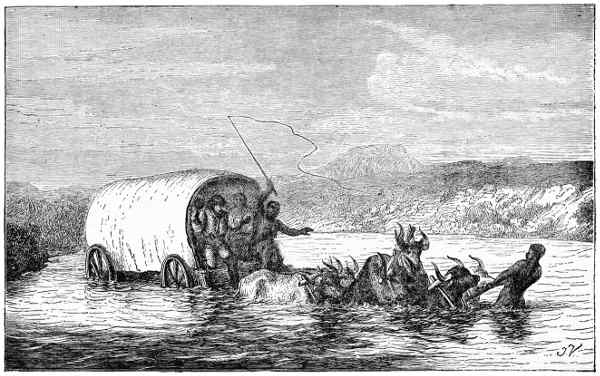
Livingstone’s observations in this section taught him that there was no such thing as a rainy zone, to account for the periodical rise of rivers like the Nile and Congo. From May to October is a comparatively dry season, and from October to May almost every day gave a thunder shower, but there is no such continuous down pour as has been imagined by meteorologists in Europe. He accounts for the humidity of both the Congo and Zambesi watersheds, by the meeting of the easterly and westerly winds in that section, thus precipitating the evaporations of both oceans in mid-Africa. It is certain that the Congo does not get its yellow hue from its head waters, for all the streams run clear even when swollen. The sponges, or bogs, which are so frequent are accounted for by the fact that some six to eight feet beneath the surface is a formation of sand which cakes at the bottom, thus holding up the saturated soil above and preventing the escape of the water. The same is true of large sections on the Zambesi, and especially in the Kalahari Desert, though the vegetable mould is wanting on the top. In that desert wells must be dug only so deep. If water does not come, they must be dug in another place. To puncture the substratum of caked sand is to make an escape for the water, and create a dearth in an entire drainage system. A peculiarity of the sponge everywhere is that it absorbs so much water as to keep the streams from flooding till long after the shower. Then they assume what would be an unaccountable flow, but for knowledge of the fact that it has taken several hours for the rain-fall to penetrate them. When traveling on the Limda, Livingstone had great trouble with his ox teams, which became invariably bogged in the sponges, and when they saw the clear sand in the centre of the streams, they usually plunged headforemost for it, leaving nothing in sight but their tails.
DANGEROUS FORDING.
Livingstone’s return from Bangweola to Cassembe gave him no opportunity for observation, owing to the fact that the tribes were at war with one another, instigated by the Arabs, who were gathering a rich crop of slaves. Yet this misfortune was compensated in part by a return of his deserters to his service, on his arrival at Cassembe, thereby enabling him to continue his northward journey more comfortably, and to run the gauntlet of the contending tribes with greater safety.
His journey to Tanganyika, arrival at Ujiji, sickness there, receipt of welcome stores from the coast, slow recovery, make a sad history, but does not add to our knowledge of the natural features and resources of the Congo region. However, our interest is again awakened in this heroic adventurer when we find him once more on his feet and resolved to visit the land of the Manyuema, off to the west and on the Lualaba, in the very heart of the Upper Congo valley, and the stamping ground of the now celebrated Tippoo Tib. The Manyuema country was then unknown, and Livingstone went in the trail of the first of those Arab hordes which ever visited it, but whose repeated visits in quest of ivory and slaves have carried murder, fire, theft and destruction to a once undisturbed, if not happy people.
The journey lay from Kasenge, on the west coast of Tanganyika, near its middle, in a north-west direction to the great market town of Nyangwe, on the Lualaba, or Upper Congo. He found the route hilly but comparatively open. Villages were frequent and the natives friendly, till the Manyuema themselves were reached. There was an abundance of elephants and buffaloes, which kept them supplied with meat. Where forests grew, the trees were of gigantic proportions, and very dense, affording a complete escape for wild animals when exhausted or crippled in the chase. The native huts were of a superior kind, with sleeping apartments raised from the ground. The soil was fertile, and the cultivation of vegetables was general. On the route they came into the region of the oil-palm, which does not flourish eastward of this, but assumes a more gigantic growth as the western coast is approached.
A little more than midway between Tanganyika and Nyangwe, is Bambarre, a flourishing village, surrounded by gardens, which the men help to cultivate, though all the other duties of farm and house are imposed upon the women, who are actual “hewers of wood and drawers of water” for the tribe. They made willing carriers, and are of comely form. Here the soko is believed to be a charm for rain. One was caught for meteorological purposes, with the result that the captor had the ends of two fingers and toes bitten off. Livingstone saw the nest of a soko, or gorilla, and pronounced it a poor architectural contrivance. A young soko, however, he regarded as the most wonderful object in nature, so ugly as to excite astonishment, yet so quaint as to stimulate curiosity. Like the kangaroo, it leaves one in doubt whether repulsion or attraction is uppermost in the mind when viewing it. In the vicinity are hot springs, and earthquakes are common, passing from east to west. The tribes of Bambarre hold the Manyuema in great fear, regarding them as of man eating propensity.
Leaving Bambarre, Livingstone was soon in the extensive country of the famed Manyuema, a tribe, or rather an entire people, hardly surpassed for size and power by even the Zulus, Macololos, Ugandas or Niam-Niams, a tribe whose name is one of terror far below Stanley Falls and far above Nyangwe, and whose unamiable qualities have of late years been greatly increased by the hold which Tippoo Tib, the Arab imperator on Lualaba, has gotten upon them.
Livingstone’s journey toward their capital was through the most remarkable country he had seen in Central Africa. He had elephant and rhinoceros meat of his own shooting, and plenty to trade to the natives for other dainties. The land is a beautiful succession of hills and dales. The villages are frequent and perched on the slopes so as to secure quick drainage. The streets run east and west in order that the blazing sun may lick up the moisture. The dwellings are in perfect line, with low thatched roofs, and every here and there are larger establishments with grounds, which answer for public assemblages. The walls are of beaten clay, and the insides are cosy and clean. The clay walls are so compact as to stand for ages, and frequently men return, after a site has been deserted for generations, to repair and re-occupy their ancestral abodes. The people practice the rite of circumcision, after the manner of the Abyssinians or Hebrews. The women are good housekeepers, and preserve their food from the ants, which are in great numbers and of many varieties, by slinging it from the ceiling of their huts in earthen pots or neatly made baskets.
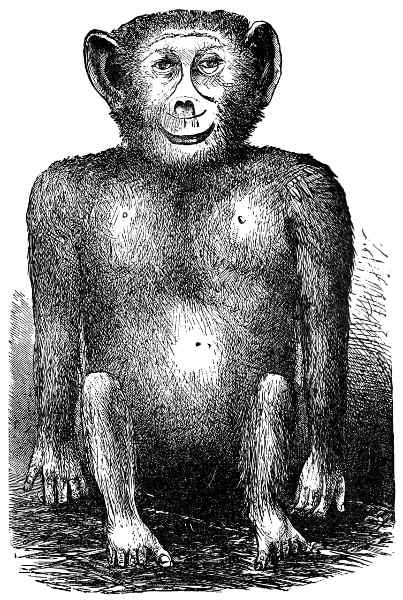
A YOUNG SOKO.
Palms crown the heights of all the mountains and hills, and the forests, usually of a width of five miles between the groups of villages, are indescribable for their luxuriance and beauty. Climbers fold themselves gracefully over the gigantic trees, wild fruit abounds, and monkeys and brilliant birds skip and flit from bough to bough, with continuous chatter and chirp. The soil is excessively rich and the people cultivate largely, even though they are much separated by feuds and dense forest reaches. Their maize bends its fruit stalk round like a hook. They insert poles in the ground for fences, and these soon sprout making substantial and impervious hedges. Climbing plants are trained from pole to pole, and to these are suspended the ears of corn to dry. This upright granary forms a wall around the entire village, and the women take down corn at their will and distribute it to the men. The women are very naked. They are thrifty, however, and may be seen on any market day carrying their produce to the villages on their heads, or slung in receptacles over their shoulders. No women could be fonder of beads and ornaments than they, and Livingstone found them easy to trade with, when at all friendly.
The receptions Livingstone met with in the various villages, as he neared the Lualaba, were as various as the humors of the people. Some received him gladly, others with suspicion, and still others with rudeness, saying, “If you have food at home, why come you so far and spend your beads to buy it here?” On the Luamo, a tributary of the Lualaba, two hundred yards broad and very deep, the chiefs proved so hostile as to refuse to lend their canoes to the party to cross over. The women were particularly outspoken, and claimed that the party were identical with the cruel strangers (Arabs) who had lately robbed them. At length the warriors of the place surrounded the party, with their spears and huge wooden shields, and marched them bodily out of the district.
Wherever the wood has been cleared in this section, the soil immediately brings a crop of gigantic grasses. These are burned annually. Livingstone’s way now deflected to the north, through kindlier villages, separated by damp forests. The rainy season was on and the streams were all swollen. Evidences of large game were all around him. He passed an elephant trap, which was made of a log of heavy wood twenty feet long, with a hole at one end through which a vine passed to suspend it. At the other end a lance of wood, four feet long, is inserted. A latch string runs to the ground, which, when touched by the animal’s foot, causes the log to fall, and its great weight drives the lance into the animal’s body.
The people here were more friendly and very curious as they never had seen a white man before. They have a terrible dread of the Arabs, and strange to say the Arabs feared them as much, for nothing could convince an Arab that the Manyuema are not cannibals. It must be remembered that Livingstone wrote some years ago and before the Arabs acquired supremacy over these natives. It is a peculiarity of African tribes that nothing can exceed the terror inspired by a reputation in another tribe for cannibalism. It was a common thing on the Shiré and Zambesi, for Livingstone to hear the natives there speak of tribes far away to the north—like diseases, they are always far away—who eat human bodies, and on every occasion the fact was related with the utmost horror and disgust. Livingstone never took stock in these stories, nor in the wilder ones of the Arabs, and he mentions no authenticated case of cannibalism in all his volumes. It is more than likely that African cannibalism exists only in the imagination of persons who prefer sensation to fact.
Livingstone seems to have become bewildered on this northward journey, and crossed his track with the intention of making more directly for the Lualaba. Though he found the people kind and the country indescribably rich in vegetation, the way was difficult owing to the softness of the ground and the swollen streams. He however succeeded, with much hardship, in getting back to the route direct from Bambarre to the river. On this route the villages were almost continuous, as many as nine being passed in a single day. The people were kindly disposed and very curious. They brought food willingly, traded eagerly, preferring bracelets to beads, and in one village he was received by a band, composed of calabashes. Goat and sheep herds were plenty, tended mostly by children, who lived among and loved their charges as if they were human beings.
A grass burning resulted in the capture of four sokos by the natives, besides other animals. The full grown soko would do well to stand for a picture of the devil. One of them, it appears, was a young one which gave Livingstone an opportunity for study. His light-yellow face showed off his ugly whiskers and faint apology for a beard. The forehead, villainously low, with high ears, was well in the back-ground of a great dog mouth. The teeth were slightly human but the canines showed the beast by their large development. The hands, or rather fingers, were like those of the natives. The flesh of the feet was yellow. The eagerness with which the Manyuema devoured it left the impression that eating sokos was a good way to get up a reputation for cannibalism.
The soko sometimes kills the leopard by seizing both paws and biting them, but often gets disemboweled in the attempt. Lions kill sokos with a bound, tear them to pieces, but seldom eat them. They live in communities of about ten, each male having a single wife. Interference with a wife is visited by the resentment of all the other males, who catch and cuff the offender till he screams for mercy.
Livingstone was now sorely detained by sickness and the desertion of his carriers. The delay gave him opportunity to note the characteristics of the Manyuema country with more particularity. It is not a healthy country, not so much from fever as from debility of the whole system induced by damp, cold and indigestion. This general weakness is ascribed by some to the free use of maize as food, which produces weakness of the bowels and choleraic purging. Rheumatism is common and cuts the natives off. The Arabs fear this disease, and when attacked come to a stand-still till it is cured. Tape worm is frequent, and the natives know no remedy for it.
The natives have wonderful stores of ivory which the Arabs are eager for. They cultivate the ground with the hoe, but their hoeing is little better than scraping the ground, and cutting through the roots of the grasses. This careless husbandry leaves the roots of maize, ground-nuts, sweet-potatoes and sorghum to find their way into the rich, soft soil, which they succeed in doing. The ground-nuts and cassava hold their own against the grasses for years. Bananas grow vigorously on the cleared spaces.
The great want of the Manyuema is national life. Of this they have none. Each head man is independent of each other. Of industry they have no lack and the villagers are orderly toward each other, but they go no further. If a man of another district ventures among them, he is not regarded with more favor as a Manyuema than one of a herd of buffaloes is by the rest, and on the slightest provocation he is likely to be killed. They buy their wives from one another. A pretty girl brings ten goats. The new wife is led to the new home by the husband, where five days are spent, then she is led back to her home for five days, after which she comes to her new home permanently. Many of the women are handsome, having perfect forms and limbs. The conviction of Livingstone, after his experience with these people, was that if a man goes with a good-natured and civil tongue, he may pass through the worst people in Africa unharmed. He also draws a fine line between the unmixed and mixed African races, by a narrative of experience on the Shiré river. One of a mixed race stepped into the water to swim off to a boat, and was seized by a crocodile. The poor fellow held up his hands and screamed for help. Not a man went to his help, but allowed him to perish. When at Senna, in the Makololo country, a woman was seized by a crocodile. Instantly four natives rushed unbidden and rescued her, though they knew nothing about her. These incidents are typical of the two races. Those of mixed blood possess the vices of both races and the virtues of neither.
The fact that there is no supreme chief among the Manyuema, makes it difficult to punish murder except by war, and the feud is made worse, being transmitted from generation to generation. This state of affairs, when it came to be understood by such a crafty statesman as Tippoo Tib, contributed to his victory over the people, and that peculiar sovereignty which he exercises.
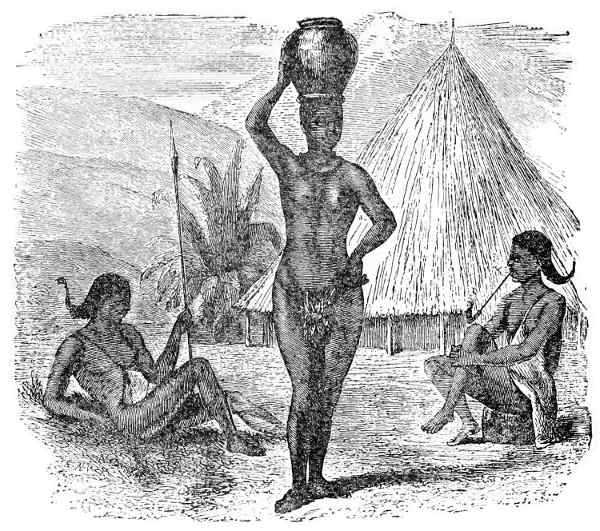
Livingstone got away from this place of confinement, and crossed the Mamohela, on his journey to Nyangwe. The country was a fine grassy plain watered by numerous rills, and skirted by mountains on either side, on which perched the neat villages of the natives. Then forests intervene of even more luxuriant growth than before, to be again succeeded by plains. The people seem to grow more stately and shapely, the women being singularly perfect in hands, feet and limbs, and of light brown color, but all with the orifices of their noses enlarged by excessive snuff taking. The humor of the villagers depended on how lately they had been raided by the Arabs. They seemed also to grow more clever in art, for now many forges were seen in active operation where iron was being shaped into spears and utensils.
MANYUEMA WOMEN.
At length the Lualaba is reached at Nyangwe, the capital of the Manyuema country, and the greatest market town in Central Africa. Long before Livingstone reached it he met upon the route hundreds of women wending their way thither with their marketing in baskets on their heads or slung in receptacles on their shoulders. As they trudged cheerfully along full of thought as to what they would receive in exchange or what they would buy, he could not help contrasting their condition with that of the women bent on a like errand in his own country, where the labor might be the same, but where there was happy exemption from such scenes of bloodshed as he was forced to witness while there. But as these have been already narrated the reader is here spared their horrible review.
The Manyuema prefer to do all their business in open market. If one says, “Come, sell me that fowl, or cloth,” the reply is, “Come to the market place.” The values there are more satisfactory and the transaction is open. The people had a fear of Livingstone, because they could not disassociate him from the Arab half-castes who had brought upon them untold misery.
He found the Lualaba at Nyangwe to be twenty feet deep in mid stream and subject to annual overflow just like the Nile—a mighty river, he says, three thousand yards wide, with steep banks and full of islands. The current runs at the rate of two miles an hour. His greatest trouble was to get a canoe to take him across the river. The natives thought his request for a large canoe, with which he intended to explore the river, meant war upon them, so they sent only small ones, capable of carrying two or three men, and which were entirely unfit for his purposes. The Manyuema on the left bank of the Lualaba, opposite Nyangwe, are called Bagenya. There are salt springs in their district, and they manufacture the salt for the Nyangwe market, by boiling the brine.
The salutations of the Manyuema are the same as those of the Bechuana people of the Kalihari desert, and indeed many of their customs reminded Livingstone of what he had seen south of the Zambesi, among the respective tribes. The natives of Nyangwe denied to Livingstone the stories of cannibalism that had been circulated about them. They never eat human flesh, unless it be the bodies of enemies killed in war, and not then through any liking for the flesh, which is salty and unpalatable, but because it makes them “dream of the dead man,” and, as it were, kill them over in their sleep. This a very comfortable way of getting a second vengeance, and is nearly allied to the reasoning which is at the bottom of cannibalism in the South Sea Islands, to wit, belief that the blood of a brave and fallen enemy transplants his bravery to the veins of him who partakes of it. Cannibalism, for the sheer love of eating human flesh, don’t exist in the world. It is a creation of the imagination, a product of the tale telling spirit, and is not fair to the pagan races.
Livingstone seems never to tire of praising the physical proportions of the Manyuema and says, he would back a company of them, for shape of head and physical form, male and female, against the whole Anthropological Society. He was surprised at the extent of country embraced in the Arab incursions. On questioning the slaves brought to Nyangwe by these marauders, he found them members of tribes far up and down the Lualaba, and westward of it many days’ journey. The copper of Kantanga reaches the Nyangwe market, and is readily bought up at high figures, in barter.
The great market of Nyangwe is held every third day. It is a busy scene, and every trader is in dead earnest. Venders of fish run about with potsherds full of snails and small fishes, or with smoked fishes strung on twigs, to exchange for cassava, potatoes, grain, bananas, flour, palm-oil, fowls, salt, pepper, and various vegetables. Each is bent on exchanging food for relishes, and the assertions of quality are as strong as in a civilized mart. The sweat stands out on their faces, cocks crow briskly from the baskets, and pigs squeal from their inclosures. Iron utensils, traps and cages are exchanged for cloth, which is put away for carriage in their capacious baskets. They deal fairly, and when differences arise, they appeal to each other and settle things readily on a basis of natural justice. With so much food changing hands among a throng which frequently numbers 3,000 souls, much benefit is derived, for some of them come twenty-five miles afoot. The men flaunt about in a nervous and excited way, but the women are the hardest workers. The potters hold up their wares and beat them with their knuckles to prove their quality by the sound. It is all a scene of fine natural acting—the eagerness with which they assert the value of their wares, and the withering looks of disgust when the buyer sees fit to reject the proffered article. Little girls run about selling cups of water to the thirsty traders, just as lemonade or ice-water boys ply their art in London during a procession. They are close buyers and sellers, prone to exaggerate the merits of their articles, yet satisfied when a bargain is clinched. Honesty is a rule, and when anything is stolen among the Manyuema, they know that it is the work of the Arab slaves.
The Manyuema children do not creep as white children do, but begin by putting forward one foot and using one knee. The fish of the Lualaba are of the same variety as in Lake Nyassa. Cakes made of ground-nuts are a common fare, as on the west coast. All Livingstone’s persuasions could not induce the natives to hire him a canoe large enough to navigate the river with. The Arabs had inflamed their imaginations by painting him as an enemy in disguise, but their real purpose was to keep control of all the larger boats themselves to assist in their river forays. Baffled by both natives and Arabs, and after waiting for many weary weeks at Nyangwe, he resolved to return to Ujiji, on Lake Tanganyika.
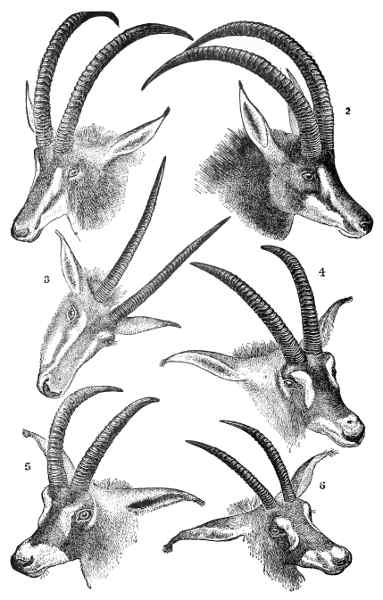
His return journey was a repetition of the sights and scenes already described, varied of course by new opportunities for observing natural features and events. On nearing the Mamohela, he passed through a most populous region, with well constructed villages, abounding in goats, fowls, dogs, and pigs, with vegetable food of every tropical variety in plenty, while palm toddy, tobacco and bangue (Indian hemp) furnished them the dainties. The soil was so fruitful that a mere scraping with a hoe rendered a generous return. The forests afforded elephants, zebras, buffaloes and antelopes, and in the streams were abundance of fish. The antelope species in Africa is rich in variety, stalwart in form, and heavy horned. Those of the Chobe river are dappled in color and very beautiful. The quichobo is a rare species, and is more of a goat than an antelope. It has amphibious qualities, and when frightened will jump into the water and remain beneath the surface till danger has passed. At this point Livingstone was given a secret which would have been worth a fortune to him had he possessed it in time to have saved the camels, mules and buffaloes with which he started on this journey from the coast. It was to the effect that lion’s fat was a cure for the bite of the tsetse fly. As he had never seen a fat lion, he was incredulous, till assured that the Basango lions, in common with all other beasts, actually took on fat. A vial of the precious stuff was handed him, a proof of the fact that such a thing as lion fat did really exist. The cattle raising tribes of the plains west of Tanganyika, know the virtue of this ointment, and use it when they drive their herds toward the markets on the eastern coast.
TYPES OF AFRICAN ANTELOPES.
Sickness on the rest of the route to Tanganyika impaired his powers of observation and description. In general he found the country beautiful and fertile, but much disturbed by raiders. On his arrival at Tanganyika he was ferried across to Ujiji. Sick and in despair, his faithful Susi came rushing at the top of his speed one morning and gasped out, “An Englishman!” This was Stanley, on his mission of rescue. This meeting, and how the two explorers navigated Tanganyika, together with other things that went to make up one of the most remarkable interviews in history, are described elsewhere in this volume.
One would have thought that Livingstone could not fail to accompany Stanley home. But he did not, and, weakened as he was by disease, proclaimed to his rescuer a programme which embraced a journey round the south end of Tanganyika, southward across the Chambesi, round the south end of Lake Bangweola, due west to the mythical ancient fountains and thence to the copper-mines of Kantanga. All this, he says, “to certify that no other sources of the Nile can come from the south without being seen by me.” What heroism was here, yet in his condition, what infatuation! Poor man, deluded, self-sacrificial traveler, illy-advised adventurer! All this long journey, from the time he struck the Chambesi, months and months before, to Moero, to Tanganyika, to Bambare, to the Lualaba and Nyangwe, had been through the water system of the Upper Congo, and had nothing at all to do with the Nile sources, and now, going back to Bangweola and to the Chambesi for the purpose of contributing further to knowledge of the ultimate Nile sources, discovery of which he regarded as worth the sacrifice of his life, he was but stamping through the Congo basin again, and revealing the sources of a river which found an outlet in the Atlantic. But such were the uncertainties which confronted all these early African explorers. Even Stanley was uncertain whither the Lualaba would lead when he embarked on its waters, and although is volume furnished proof that it could not be the Nile, he was still prepared, from its northern course, to accept it as such, till it took its westward turn and straightened out for its Atlantic exit.
Writing on African beliefs, he says: “The African’s idea seems to be that they are under control of a power superior to themselves—apart from and invisible; good, but frequently evil and dangerous. This may have been the earliest religious feeling of dependence on Divine power, without any conscious feeling of its nature. Idols may have come in to give definite ideas of superior power, and the primitive faith or impression obtained by Revelation seems to have mingled with their idolatry, without any sense of incongruity. The origin of the primitive faith in Africans and others seems always to have been a Divine influence on their dark minds, which has proved persistent in all ages. One portion of primitive belief—the continued existence of departed spirits—seems to have no connection whatever with dreams, or, as we should say, with ‘ghost seeing,’ for great agony is felt in prospect of bodily mutilation, or burning of the body after death, as that is believed to render a return to one’s native land impossible. They feel as if it would shut them off from all intercourse with relatives after death. They would lose the power of doing good to those once loved, and evil to those who deserved their revenge. Take the case of the slaves in the yoke, singing songs of hate and revenge against those who sold them into slavery. They thought it right so to harbor hatred, though most of the party had been sold for crimes—adultery, stealing etc,—which they knew to be sins.”
In Central Africa one is struck with the fact that children have so few games. Life is a serious business, and amusement is derived from imitating the vocations of their parents—hut building, making little gardens, bows and arrows, shields and spears. In Southern Africa boys are very ingenious little fellows and have several games. They shoot birds with bows and arrows, practice with the kiri, and teach linnets to sing. They are expert at making guns and traps for small animals, and in making and using bird-lime. They make play guns with a trigger which go off with a spring and have cotton fluff as smoke. They shoot locusts very cleverly with these toy guns.
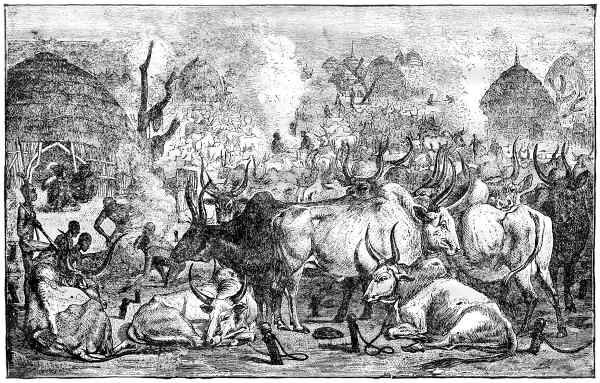
DINKA CATTLE HERD. Larger.
Desperate as Livingstone’s last undertaking seemed, he was well equipped for it by the receipt of fifty-seven porters sent up from Zanzibar by Stanley and a supply of cattle and donkeys. He found that much cotton was cultivated on the shores of Tanganyika, that the highlands surrounding the lake are cut into deep ravines, and that game was plenty everywhere, elephants, buffaloes, water buck, rhinoceri, hippopotami, zebras. The lake puts off numerous arms or bays into the mountains, some of which are of great width, cutting off travel entirely except at a distance from its shores.
Even before he had rounded the southern end of Tanganyika, he was out of heart with the experiment of using donkeys as carriers. He had all along contended that this hardy animal could be taken through regions infested with the deadly tsetse fly, even though horses, mules, dogs and oxen might perish. But he, for a second time, witnessed the death of one donkey after another from the bites of the African pest-fly. His cattle fared somewhat better, this time, but even they proved a poor means of keeping up a food supply, being apt to wander, subject to swellings from fly-stings, and a constant invitation to raiders. True, he escaped this last calamity, but other travelers in different parts of Africa have been less fortunate, as their accounts show.
As he passed down into the section which furnishes the head-streams of Lake Moero, the rains descended in volumes, the streams were swollen, the people were unkind, and travel became dismal and difficult, beyond any former experience. He was troubled with sickness and the desertion of his men. A leopard broke into his camp, at night, and attacked a woman carrier. Her screams frightened his last donkey and it ran away. The slave traders had stirred up the villages, so that trade for the necessaries of life was always difficult. He found the country a succession of hills and plains, forests and high grasses, with every evidence of great fertility. Dura, or the flour of sorghum seed, furnishes the staple food. His narrative of the streams he crossed is bewildering, but it shows the great plentitude of these Congo sources and quite reconciles one to the mighty volume of that magnificent river. With such an abundance of lively sources it must very largely defy active Equatorial evaporation and be at all seasons a surely navigable and valuable commercial water-way.
The sponges were now all full from the continuous rains, so that a stream 100 feet wide, had to be approached through a bog of twice that width. His last cow died, and he was wholly dependent on the natives for food. Pushing on, and bearing gently westward, he came into the immediate region of Bangweola. All around was flat, water-covered plain, alive with elephants and other large game. Every camping place was infested with ants. Life was miserable for the entire party, and Livingstone himself was so weak as to be incapable of passing the river and swamps, except by being carried.
He entered the lake with canoes, and pushed off to one of its numerous islands, or at least what he supposed to be an island, though it afterwards turned out to be only a rise in the plain which surrounds the true lake, and which was then entirely water-covered. The Basiba people occupy the northern shore of the lake. They proved to be hospitable and supplied plenty of fish and fowls with an occasional sheep. At every village a party of male and female drummers and dancers turned up, who gave music and exhibitions in dancing.
Crossing the mouth of the Chambesi in canoes, and entering the Kabinga country, he found a cattle raising section, though the cattle are wild. Elephants were plenty and very destructive of crops. The entire country about the lake was reedy and flooded. Many of the depressions in the plain were now arms of the lake, extending for twenty or thirty miles and so wide as to be seen across with difficulty. The journey now was mostly by canoes, and the camps were on elevations in the plain, which were now islands. Lions made the night hideous with their roaring. Fish and other food was abundant. The mouth of river after river was passed as it debouched into the lake. Livingstone grows weaker with every days’ exertion. It is only by the most herculean effort that he reaches Chitambo on the south side of the lake. His ability to observe and note has passed away. His power as a traveler and explorer is gone. Death seized him in Chitambo’s village, and his faithful Chuma and Susi bore his remains to the coast for transport to England.
We know of the Chambesi, of Lake Bangweola, of the Luapula, of Lake Moero, of the Lualaba, and of this magnificent section of the Upper Congo basin, from Livingstone. True, we know little of it, because the heroic traveler was sick unto death while threading the mazes of forest and plain which give character to the section. But he has given such an inkling of its wonderful resources of soil, animal life and people as to create fresh interest in the region and furnish supplementary evidence to all that has been said or dreamed of the wealth of the Congo basin.
The last of the sections into which Stanley divides the Congo basin is that of Tanganyika. This great lake is 391 miles long and 24 broad, with an area of 9400 square miles. The territory about the lake, belonging to the Congo water system, embraces 93,000 square miles. It is thickly populated, and contains probably 2,500,000 persons. The lake itself is 2750 feet above the sea, and it is bounded by mountains, north and south, which rise from 1500 to 2500 feet above its surface. The slopes of these mountains lead to lofty plateaus, which are fertile, densely peopled, and well covered with cattle herds. The natives are of a superior type, peaceably inclined and much attached to their pastoral occupations, and to the raising of sorghum, millet and maize. At various towns on the lake are large communities of Arab traders, the most noted being at Ujiji, where Stanley met Livingstone on his celebrated journey of rescue. The International Association supports a flourishing mission on the east side of the lake, and others have been recently founded.
In general this section supports the natural products indigenous to the Congo basin, though the oil-palm is not seen east of Ujiji. Around the lake the natives make a larger use of the cereals, than further west, where the banana and manioc grow more luxuriantly. There is hardly any finer market in Africa than that of Ujiji, where may be seen for sale an intermixture of products such as would do credit to a first-class city, were it not for the fact that human beings often constitute one of the articles of merchandise. On any propitious market day may be seen a full supply of maize, millet, beans, ground-nuts, sugar-cane, wild-fruit, palm-oil, bananas, plantains, honey, ivory, goats, sheep, cattle, fowls, fish, tobacco, nets, copper and iron ware, cloth, barks, hoes, spears, arrows, swords, etc., etc. On the northwest side of this section, at Uvira, are iron works of no mean proportions, whose products are iron wire and various iron utensils for both household and agricultural purposes.
In his recapitulation of resources, Stanley estimates the Congo basin to contain as follows:—
Area in square Length of
Sections. miles. Population. Navigation.
Lower Congo, 33,000 297,000 110
Upper Congo, 1,090,000 43,884,000 5,250
Lualaba, 246,000 4,920,000 1,100
Chambesi, 46,000 460,000 400
Tanganyika, 93,000 2,325,000 391
————— ————— ———
1,508,000 51,886,000 7,251
The ownership of the great basin, as determined at the Berlin conference, is as follows:—
Countries. Areas. Population.
French Territory, 62,400 2,121,600
Portuguese Territory, 30,700 276,300
Unclaimed, 349,700 6,910,000
Congo Free State, 1,065,200 42,608,000
Inquiring, exacting commerce is ever ready with practical questions. When it has listened with attentive ear to Stanley’s bewildering estimates, astounding calculations and captivating statements, it coldly asks what return shall we find for our wares and for the expense and trouble of landing them in these tropical markets? He boldly replies, you cannot shut your eyes to the fact that Western Africa is already contributing her half of a trade with Europe, which already exceeds $150,000,000 a year. This comes almost exclusively from a coast line 2900 miles long. Enlarge this line, by adding the 6000 miles of navigable waters which are embraced in the Congo basin, and this trade by the products which would thereby find an outlet, and you would have a traffic equal to $500,000,000 annually. Improve this inland navigation by a railroad around the cataracts of the Congo, enlist the sympathies and energies of the 43,000,000 of people who inhabit the basin, or even of the 4,483,000 who dwell on navigable banks of the water-ways, give them some idea of the incomputable wealth that is over, around and under them, and which may be had by simply reaching for it, regard them as men and deal with them as such, and then you will soon realize that the Congo banks are worth far more to commerce, mile for mile, than the ocean shores. And well might he say this, for the banks of the Congo are a succession of villages, alive with people imbued with the trading spirit, well acquainted with the value of oils, rubber, dye-woods and gums, anxious for cloth, brass-rods, beads and trinkets. This cannot be said of all places on the sea-coast. Stanley narrates that eager natives have followed him for miles offering ivory and red wood powder for cloth, and that when they failed to effect a trade, they would ask in despair, “Well, what is it you do want? Tell us and we will get it for you.”
So sanguine was Stanley of the commercial situation on the Congo and in tropical Africa that he ventured to tell the practical merchantmen of Manchester how they could triple the commerce of the entire west coast of Africa by building two sections of narrow gauge railway, each 52 and 95 miles long, connected by steamboat navigation, or a continuous railway of 235 miles long, around Livingstone Falls, and thereby opening the Upper Congo to steamboats. Such a step would insure the active coöperation of more than a million of native traders who are waiting to be told what they can furnish out of their inexhaustible treasures, besides those they have already set a value on, as iron, oil ground-nuts, gum, rubber, orchilla, camwood, myrrh, frankincense, furs, skins, feathers, copper, fibres, beeswax, nutmegs, ginger, etc.
Stanley showed how a few factories at available points for the conversion of cruder articles into those of smaller bulk, and how the trading posts which were sure to spring up on the site of every important village, would gather in sufficient wares to tax the capacity of such a railroad as he contemplated to the uttermost, and realize a handsome income on the investment. He even gave estimates of the cost of the enterprise, which have been borne out by the practical engineers who have since taken the work of building it in hand.
He showed further how human and animal carriers had failed to solve the problem of porterage around Livingstone Falls, although the interests beyond, identified with the work of the International Association and with Christian missions, were expending annually a sum equal to 51⁄2 per cent. on the estimated cost of a railway.
He eloquently concludes his survey of tropical African resources thus: “Until the latter half of the nineteenth century the world was ignorant of what lay beyond the rapids of Isangila, or how slight was the obstacle which lay between civilization and the broad natural highway which cleared the dark virgin regions of Africa into two equal halves, and how nature had found a hundred other navigable channels by which access could be gained to her latest gift to mankind. As a unit of that mankind for which nature reserved it, I rejoice that so large an area of the earth still lies to be developed by the coming races; I rejoice to find that it is not only high in value, but that it excels all other known lands for the number and rare variety of precious gifts with which nature has endowed it.
“Let us take North America for instance, and the richest portion of it, viz: the Mississippi basin, to compare with the Congo basin, previous to its development by that mixture of races called modern Americans. When De Soto navigated the Father of Waters, and the Indians were undisputed masters of the ample river basin, the spirit of enterprise would have found in the natural productions some furs and timber.
“The Congo basin is, however, much more promising at the same stage of undevelopment. The forests on the banks of the Congo are filled with precious red-wood, lignum vitæ, mahogany and fragrant gum trees. At their base may be found inexhaustible quantities of fossil gum, with which the carriages and furnitures of civilized countries are varnished; their foliage is draped with orchilla, useful for dye. The red-wood when cut down, chipped and rasped, produces a deep crimson colored powder, giving a valuable coloring; the creepers which hang in festoons from the trees are generally those from which India rubber is produced, the best of which is worth fifty cents a pound in a crude state; the nuts of the oil palm give forth a butter which is a staple article of commerce; while the fibres of others will make the best cordage. Among the wild shrubs are frequently found the coffee-plant. In its plains, jungles and swamps, luxuriate the elephants, whose teeth furnish ivory worth from two to three dollars a pound in an unworked condition; its waters teem with numberless herds of hippopotami, whose tusks are also valuable; furs of the lion, leopard, monkey, otter; hides of the antelope, buffalo, goat and cattle, may also be obtained. But what is of more value, it possesses over 40,000,000 of moderately industrious and workable people, which the red Indians never were. And if we speak of prospective advantages and benefits to be derived from this late gift of nature, they are not much inferior in number or value to those of the well developed Mississippi valley. The copper of Lake Superior is rivalled by that of the Kwilu valley and of Bembé. Rice, cotton, tobacco, maize, coffee, sugar and wheat thrive equally well on the broad plains of the Congo. This is only known after the superficial examination of a limited line which is not much over fifty miles wide. I have heard of gold and silver, but the fact of their existence requires confirmation and I am not disposed to touch upon what I do not personally know.
“For climate, the Mississippi valley is superior, but a large part of the Congo basin, at present inaccessible to the immigrant, is blessed with a temperature under which Europeans may thrive and multiply. There is no portion of it where the European trader may not fix his residence for years, and develop commerce to his own profit with as little risk as is incurred in India.
“It is specially with a view to rouse the spirit of trade that I dilate upon the advantages possessed by the Congo basin, and not as a field for the pauper immigrant. There are over 40,000,000 of native paupers within the area described, who are poor and degraded already, merely because they are compassed round by hostile forces of nature and man, denying them contact and intercourse with the elements which might have ameliorated the unhappiness of their condition. European pauperism planted amongst them would soon degenerate to the low level of aboriginal degradation. It is a cautious trader who advances, not without the means of retreat; the enterprising mercantile factor who with one hand receives the raw produce from the native, in exchange for the finished product of the manufacturer’s loom—the European middleman who has his home in Europe but his heart in Africa—is the man who is wanted. These are they who can direct and teach the black pauper what to gather of the multitude of things around him and in his neighborhood. They are the missionaries of commerce, adapted for nowhere so well as for the Congo basin, where are so many idle hands, and such abundant opportunities all within a natural “ring fence.” Those entirely weak-minded, irresolute and servile people who profess scepticism, and project it before them always as a shield to hide their own cowardice from general observation, it is not my purpose to attempt to interest in Africa. Of the 325,000,000 of people in civilized Europe, there must be some surely to whom the gospel of enterprise I preach will present a few items of fact worthy of retention in the memory, and capable of inspiring a certain amount of action. I am encouraged in this belief by the rapid absorption of several ideas which I have promulgated during the last few years respecting the Dark Continent. Pious missionaries have set forth devotedly to instil in the dull mindless tribes the sacred germs of religion; but their material difficulties are so great that the progress they have made bears no proportion to the courage and zeal they have exhibited. I now turn to the worldly wise traders for whose benefit and convenience a railway must be constructed.”