MISSIONARY WORK IN AFRICA. (continued 3)
Reading edition
“Four years ago, after waiting four or five days in Dondo trying in vain to get carriers, we depended on half-a-dozen Kabindas, whom we hired in Loanda, on good recommendations, as a standby in case we should fail. We were repeatedly told by men of long experience in Angola, that ‘it would be impossible for us, as strangers, especially as we would neither drink nor sell, nor give rum, gin nor wine, to get any carriers for the interior.’ ‘The traders, with their long and widely extended experience, facilities and free rations of grog, can’t get more than half the carriers required at this time.’ ‘One gentleman of my acquaintance,’ said, ‘I had 5,000 bags of coffee at Kazengo, thirty-six miles from Dondo, and could not put it into the market for want of carriers.’
“So, a part of our pioneer party, viz: myself, Willie Mead, W. P. Dodson, Joseph Wilks, Henry Kelley, the Vey boy from Liberia, determined to make a start on Friday night (about June 1, 1885,) even if we should have to do our own carrying, for the Kabindas whom he had hired refused to carry for us; and they had a lot of their own luggage, twice as much as regular carriers take with them.
“I learned from an old trader, who had thirty years of observation along our contemplated line of work in Angola, that Nhanguepepo was the best site for a mission between Dondo and Pungo Andongo. So we aimed to reach this first and best place. About 9 o’clock, on that night, we succeeded in getting six Kabindas to shoulder each a load of our luggage and food for the trip, leaving one Kabinda with Dr. Summers and C. M. McLean, in care of a large amount of our stuff at Dondo, stored in our tents, inside of a stone wall enclosure, said to have been a slave pen in the dark days of old. I and my little party of missionaries each took a load of stuff, and struggled up the mountain range four miles to Pambos, arriving about midnight. We spread our bed on the ground and got a little sleep. Before sunrise I had carried wood and made a fire, and had on the tea-kettle. The Kabindas looked grimly on, but declined to help with the camp work. Breakfast over, we made a move for our march, but the K.’s refused to pick up their loads. All my kind talk, and Brother M.’s scolding, failed to move them, so we ‘were stuck in the mud.’ We got the men through the English house in Loanda, and about 9 P.M. I saw Mr. N., the head of the English house, coming in his ‘tipoia,’ carried by men from his farm at Kazengo. So I went a little way from our camp, and met him, and explained to him the situation.
“He said: ‘The trouble is the Kabindas are not carriers. They are sailors and porters and gentlemen’s servants. They were represented to you as good for any service to which you might want to put them, but they have not been trained to work of this sort.’
“I replied: ‘Well, Mr. N., if you can prevail on the fellows to carry till we can reach an interior village we can pick up all the carriers we need.’
“‘Yes; I’ll try.’ He had a palaver with the men, and they agreed to carry till we could find natives who would do it. Then we cleared the camp and marched about four miles, and stopped at a small hamlet for our lunch, and there we hired half-a-dozen men to carry the loads of the K.’s to Nhanguepepo, and we transferred our knapsack to the K.’s.
“The price quoted in Dondo for carriers to Nhangue was ‘sixty-four makutas’ ($1.92) per man. We offered that, but could not get a man. The price asked by these country fellows was but ‘twenty-five makutas’ (seventy-five cents), confirming the theory I had advanced, ‘If we can get to the country villages inland, we can get all the carriers we may require.’ So with our new team we went on about five miles and camped at Mutamba, and rested on the Sabbath. Many villagers called to see the show, the sight of white men, and exhibited great interest in us. We had our worship and a good day of rest. On Monday morning the K.’s refused to carry unless we would hire another carrier, which we did, and soon found that they overloaded the carriers by tying their luggage to our cargoes. We could not speak their language, and they knew but little of ours, so it was of no avail to try to reason with them about their oppressions; but soon after I reached Nhanguepepo, I settled with them, and sent them back to the sea where they belonged.
“On my trip last week I had no trouble with carriers. I started from Mutamba at 6 A.M., walked twelve miles to Kasoki, took lunch and rested till 2.30 P.M.; marched seven miles further to Ndanji a Menia on the divide of a range of mountains, and camped without a tent, just where we pitched our tent four years ago, and I was reminded of the trouble we then had with our carriers. The villagers we had hired complained of the bad treatment they had received from the Kabindas, besides overloading them with their luggage, and refused, to go any further. I quietly offered to give them extra pay, and thus induced them to proceed with their big load to Nhanguepepo.
“I had a refreshing sleep at Ndanji a Menia last Friday night, took lunch on Saturday at Endumba, and reached Nhangue—nineteen miles—at 5 P.M., and was joyously received by our dear Brother Rudolph.
“I have tramped the fifty-one miles between this and Dondo, back and forth many times, but never with less fatigue than on my trip last week. I don’t purpose to give a history of all those journeys through the mountains, but simply note a few points of contrast between my first trip, and the one of last week. We arrived in the midst of drought and ‘famine’ four years ago. We came through from Dondo dry-shod, but last Friday I doffed my boots and waded the pools and streams seven times, and on Saturday five times, and I found it to be pleasant and healthful to my feet.
“Till railroads shall be built through this country, the best mode of traveling, and the most healthful, is to walk, and ‘wade.’ As for speed in a journey of a few hundred miles, a man on foot will out-travel a bull, or even a good horse. Persons who travel in a ‘tipoia,’ amid the rattle of sleigh bells, and the shouts of their carriers, are not in a position to receive my statement, but I base it, not on a theory, but on facts from the field of action.
“When we were here four years ago, we lived in tents near the Caravansary for about three months. We had been invited by the Governor-General, Sr. Amaral, to settle on Government land wherever we chose, and the Government would make us a grant of any amount required up to 2,400 acres. Having explored the Nhanguepepo region pretty thoroughly, we concluded that the Lord would have us open a mission here. Our families and a number of our young men were waiting—in Loanda at a heavy expense—for us to open fields for them; and the dry season was passing away, so we had to proceed as expeditiously as possible.
“I opened a mortar bed for making adobes (sun-dried brick) preparatory to the erection of a mission house near the Caravansary, where crowds of carriers, many of whom were from a distance of five or six hundred miles east of us, camped every night. Having made inquiry I believed the site I had selected was Government land, but was notified by the “Commandante,” before I had proceeded with my adobe-making, that all the land about the Caravansary was private property. He was very kind to us, but wanted to sell us the house in which he lived, a roomy, substantial building, with adjoining roofless walls of solid masonry of much larger extent. I saw on examination that the property would be suitable for our purposes of residence for our large families, and for a receiving and training station for new recruits from home in coming time, being a high, breezy, healthful region; but we had no money. However, firmly believing that the God of Abraham would lead us, and provide for us, I wrote to our people in Loanda to come on as quickly as they could. Owing to the continued illness of a large proportion of them, and the difficulty and delay in getting steamer passage up the Coanza on account of the drought and low state of the river, our people came in groups in July and August. I was notified at the time of their transit that our money in Loanda was all used up. As strangers, we could not ask for ‘credit,’ and as servants of God, doing business solely for Him, and not for ourselves, I did not think it necessary, nor feel at liberty to try to put His credit on the market, so I worked and waited.
“My people could not travel inland without money to pay their carriers, and we had no place in which to shelter them, even if they could get in. Our cloth was all of one kind—white cotton, which became popular and marketable months later, but at that time was declared to be entirely unsuitable for the market, and hence could not be passed off at any price. Money was the thing required, and without it our people in transit could neither travel beyond Dondo, nor stop and pay expenses. I did not doubt that I was working in the order of God’s providence, hence could not and did not doubt that He would lead us, and provide for these demands on us, outside of our abundant home supplies which He had already provided. The fact is, I brought into the country, in money, only the small sum of about $1,200, and $1,000 of that had been handed to me by dear Brother Critchlow to meet ’emergencies’ in Loanda. Heavy duties, house-rent for forty persons with high rates for wood, water, etc., soon swallowed that amount. But just in our extremity, Mr. J. T., a Church of England man in the City of London, gave us £250—over $1,200.
“The Lord thus tided us over that bar. So in our extremity of need, as before described, the God of ‘the Church of England’ as well as of our own, through His servant J. T. of London, gave us £250 more. With that we bought the Nhanguepepo property of the Commandante, and settled our people here, also at Pungo Andongo, and Malange.
“I proposed that our Nhangue Station should bear the name of our London brother, but when I spoke to him about it, he replied, ‘No, Bishop Taylor, no! that is an honor I do not deserve. I live at home in comfort. Call it after somebody who has suffered and done something for God among the heathen.’
“All the members of the families, and young men appointed to Nhanguepepo four years ago, are still at the front making a record for God and heaven, save Nellie and Edna Mead, who have gone to represent us in the home country of our King. Brother Carl Rudolph, however, is the only one who remains at Nhangue, and is at present in sole charge of the station, and is breaking in native workers, and is likely to make this a training station of native, rather than an American agency. If such should turn out to be in the line of God’s wisdom, and gracious leading, all the better. These are acclimatized, know the languages, and the life of the people, and have many advantages over foreign agency. The foreign missionary is sent by the Holy Spirit ‘to prepare the way of the Lord,’ but the sooner he can train and trust the native-born men and women whom God shall call to be heralds and witnesses of the truth, the better.
“The station buildings that were in good repair when we took possession, remain so; some portions not entirely furnished with ant-proof rafters, need repairs. Many of the walled rooms have been roofed and utilized.
“A walled room we have, 18x40 feet, would answer for a chapel and school-room. We hope to have it covered and fitted up this dry season. We are also building this season a new stone wall around our corral, and must have a shed for milking the cows.
“A new house, 18x40 feet, of adobe bricks, has been put up near our main building, and a farm house of adobe brick, 20x40 feet, a mile distant, at the mission farm.
“A great deal of material work has thus been done in the four years. I provided for putting in a herd of cattle here before I left, nearly four years ago. The herd increased and went up to a total of 144 head, including calves. To protect them from thieves and from wolves they have to be carefully guarded by two boys by day and secured within heavy stone walls by night. One night, about two years ago, the herd got out of the ‘corral’ and went to their grazing ground, and a pack of wolves killed and partly devoured one of the cows. Later, a couple of wolves managed to get hold of a calf that seemed to have laid near the gate. Some natives heard their barking and raised an alarm, which frightened the wolves away. Brothers Withey and Rudolph went out with a light, and found the calf outside the gate, and one of its legs broken. It appeared to have been dragged through an opening in the gate, caused by a broken bar, and thus got its leg broken. It was midnight, but Brother Rudolph at once slaughtered and dressed the calf for food. Meantime he preached to the crowd of natives thus drawn together about the devil-wolves which were in pursuit of them, and said their only refuge is in the fold of Jesus; that they should not go outside, nor lie down to sleep too near the gate.
“The crowding together of so large a herd of cattle proved to be unwholesome for them, especially in the wet season, when they could not keep the corral clean. Many of them became afflicted with an itchy, festering skin disease, though otherwise healthy and fat. Such were separated from the main herd to prevent possible contagion, and were gradually slaughtered and used to meet the demand for beef, fresh or dried; others proved to be ‘lean kine,’ which greatly ran down in weight during the dry season, when the grass was short; some milk cows were poor in the quantity and quality of their milk; others would not yield to kind treatment; all these varieties, noted as unprofitable stock to keep, were sold or slaughtered, so that now of ‘the survival of the fittest’ we have left a herd of eighty-four head, including calves; beside selected seed for a herd at our Pungo Andongo Mission, which now numbers twenty head, old and young.
“Brothers Withey and Gordon were both merchants for years at home; hence very proficient in that line, but not so well adapted to farming or mechanics; so the Lord is giving them success in establishing a commercial business, both at Nhanguepepo, and at Pungo Andongo. It was contemplated from the start that when such men should be put down by the Lord in a good place, and shall so be led by His Spirit and Providence, that trading posts should constitute one branch of our school industries. These give ample support now to the two stations named, but are still assisted from home in taxes, repairs and new additions to church properties.
“The foundation industry, however, is farming, fruit, coffee-growing, etc., (1) because of its intrinsic value, present and future. (2) That we may thus train boys and girls for industrial pursuits, by which, when grown, they may secure good homes of their own and form Christian communities as a basis of self-supporting churches and schools.
“The soil of Nhangue is abundant, rich and ready for the plow, but thus far, owing to the great attention given to building, to the stock, and to merchandizing, and the departure of so many who ran well for a season, our farming interest has suffered; but Brother Rudolph will give the farming and industrial school-boys and girls to help and to be helped, a fair trial, as soon as we supply him with an assistant, and, by the blessing of God, he will, I am sure, make a success which will demonstrate grand possibilities on that line. This is essential, even if the stores should far exceed absolute self-support, which they will do if kept solely in charge of such men as we have named; but all the boys we train can’t be merchants. The school work commenced with promise nearly four years ago, has not made decided progress, for the same reasons named in regard to farming, but good results are manifest from the educational work, especially in some of the boys trained by our good brother, Wm. P. Dodson, who give evidence of their genuine conversion to God. In spite of all discouragements, which, among ourselves, have not been small nor few, God is at the front and will lead all who abide there with Him to early and glorious successes on all the lines of our movement, especially in the salvation of the heathen around us. I am so assured of this that I am praising Him now for the coming work of salvation among the heathen. Glory to God! Glory to God! Wm. Taylor.”
NHANGUEPEPO.
“Arrived in Nhanguepepo by a walk of fifty-one miles from Dondo, on Saturday, June 1, 1889. At present we have but one missionary on this station, Brother Carl Rudolph, but he is doing the work of two or three by breaking in the native boys. He has a self-supporting store of varieties, a large herd of cattle, is building a stone wall for enlarged corral for the cattle, teaching and preaching daily, and preparing to put in a large crop of corn, beans, manioc, sweet potatoes, sugar cane, etc.
“This was designed for a receiving and training station for our newly arriving recruits from America, but instead it has become a training station for native boys who are acclimatized, who know the language of the country and the life of the people, and have many points of adaptability which a foreigner must spend years to acquire, and meantime is likely to get sick—home sick, and skip out. Yet native agency can’t be trained without competent men of God to train them. God has developed such from our first force whom we settled in Angola four years ago, who will do a wonderful and widely extended work, even if no more should come. If we can get more from home, who, like these, will stick, and do and die for Jesus in Africa, well; but otherwise, Angola, already self-supporting, except some help in repairing and enlarging our mission properties, will be worked by our present force of Americans and the natives themselves. We have the nucleus of a Methodist Episcopal Church in Nhanguepepo, now consisting of half-a-dozen saved boys, and others are seeking.
“On Sabbath, the 2d inst., I was late in rising from bed, just off a journey; indeed, I wished, at any rate, to spend part of the day in Sabbatic rest in that way. But, I was going to say, as I lay in bed, a blind man, whom I met here four years ago, came to see me. He is a native of Dondo, and learned there to read and write in Portuguese, and speaks that language as well as his own Kimbundu, but for years he has been blind, and lives alone in a hut not far from our house. His name is Esessah. He expressed great pleasure in meeting me again, and Brother Rudolph gave him a seat by my bedside, and sat down near him. After the compliments of the occasion I said to myself: ‘This is my chance for Sunday morning preaching, which has been the habit of my life for the last forty-seven years. If the Holy Spirit will use me this morning we can get this poor man saved. He has groped in the dark a long time; to walk in the light for the remaining time of his pilgrimage, and then leap into the joyous brightness of eternal day, will be a blessed gain for this poor man.’ So I said: ‘Brother Ruldolph, I want to preach to this man, and have you put it in plain Portuguese or Kimbundu.’ Brother Carl is perfect in love to God and man, and his whole soul and life are devoted to such work, and he is well up in those languages. So I gave him my Gospel Short Cut to the mind, conscience and heart of the heathen. The Spirit of God put Divine electric fire into it, which broke us down with weeping again and again. At the close of the discourse, the three of us went on our knees. I was led to pray that the Divine Spirit would make his repentance so deep and expressive, and his conversion to God so clear and distinctive, as to leave no ground for doubt in his mind, nor ours, and which would give point and force to his testimony to his heathen neighbors. So I and Carl led in prayer, then the blind heathen broke out in audible prayer, and wept, prayed and wept, till finally he submitted to treatment and received the Lord Jesus, the Great Physician, and was straightway pardoned and healed, and gave a clear testimony to the facts in his case.
“We did not call to see him on Monday. I thought it was well to leave him alone with God for a season, but on Tuesday, yesterday, Brother Carl and I went to his hut, and he received us joyfully. He is not at all a noisy man, but courteous, unobtrusive and very sensible, and in low, distinct articulation, he is a fluent talker. We had a long teaching talk with him, and heard his most clear and distinct testimony to the saving power of God in his head and heart. I led in vocal prayer, Carl followed and then Esessah prayed intelligently and earnestly. As we were leaving, Carl and he embraced each other and wept, and held each other and wept on for some time: meantime, I was waiting in the path, and tearfully thanking God for such a sight in the midst of heathendom. Glory to God! The big rain drops are falling on us. A thunder-gust of glory will sweep through these mountains, soon followed by the regular ‘former and latter rains’ in this season. Glory to God! My eyes shall not dim much with age till I shall see these things. Let all the people who have been praying for us, praise God for the glory to be revealed. Wm. Taylor.”
FROM NHANGUEPEPO TO PUNGO ANDONGO.
“Thursday, June 6, 1889.—I left Nhangue at 6.30 this morning, with my two carriers, whom I seldom see on the path, being usually ahead of them. Two miles out I called to see the Assistant Commandante. He and the Commandante called to see me the other day, and of course I returned their call. A Commandante, appointed by the Portuguese Provincial Government, has charge of a detachment of soldiers, and is also a magistrate of a certain district of the Province. Some of them are Portuguese. The others, probably the larger proportion, are Africans, who have had some advantages of education. They have been courteous and kind to me and to my missionaries almost invariably, and we reciprocate cordially.
“Three miles on my way I called to pay my respects to Sr. Jacintho, a Portuguese trader, whom we used to call ‘the honeyman,’ because he occasionally, when we were strangers in a strange land, presented us with a bottle of honey to sweeten us up a bit. We bought of him some of our best cattle in starting to form our herd.
“In the forenoon I walked fourteen miles to Sangue. On my first trip over this path, to settle Joseph Wilks in Pungo Andongo, we spent a night at the house of the Commandante at Sangue.
“I had been overworked at Nhangue, and was not in good condition for walking that day, and, on reaching Sangue, soon found a corduroy bedstead in a private room, and laid me down to rest. I heard Brother Wilks say to our host, “Bispo doente, muito doente”—Bishop sick, very sick. I said to myself: “If my kind Father will give me a refreshing night’s rest across these rough irregular poles, we will see before to-morrow night who will be the delicate brother.”
“In due time our host sent me a basin of delicious native soup, which refreshed me very much, and though I spent much of the night in turning over, I slept well in the intervals, and was up with the day-dawn and ready for a march of twenty-four miles. We waded through long reaches of sand in the path, which made wearisome walking for us. Wilks was good for a long pull, but he had no more to say about “Bisbo doente,” as the walk that day put him up for all he could do to keep up, and to hold out till we reached Pungo Andongo, a little before sunset. We were kindly received and entertained at the trading ‘factory’ of Sanza Laurie & Co.
“Marcus Zagury, a member of this firm, had visited us at Nhangue a few days before, and gave us full information and encouragement in regard to Pungo Andongo, as the place for planting a mission, and tendered us the hospitality of their house. The evening of our arrival had been set for an entertainment—a big dinner—for the Government officials and traders of the town at this house; so we made somewhat the acquaintance of those gentlemen, also of a Catholic priest, who was an East Indian. All spoke encouraging words to us, but of course did not engage to paddle our canoe for us. Next day we rented from Sr. Zagury, at a cheap rate, a pretty good house for a school and for residence of the mission family, and I left Brother Wilks in charge and returned to Nhangue.
“These are some of the remembrances that crowd on me today, as I lay down on the leaves for noon rest and lunch at Sangue. In the afternoon of to-day I walked nine miles further to ‘Queongwa’ (Kaongwa), not a town, but a camping-ground for carriers and travelers, and a house for upper-class natives, with some villages contiguous and a running stream of water the year round, which is of great utility in this country. Brother Withy, our Superintendent, has bought a sight here for planting a mission school for the towns of this vicinity.
“A resident here, who has always shown kindness to my missionaries, Sr. Candanga, met me in the path and gave me a welcome to his house of ‘wattle and daub.’ It is 60x18 feet, divides into two large end rooms and a central hall.
“One of these seemed to be reserved for strangers, furnished with a table, two or three chairs, and a European double bedstead with mattress and spread, which he put at my disposal. I had a good portable bed which I preferred to any other, but to honor his hospitality I spread my bedding on his bedstead and enjoyed a night of balmy sleep.
“I had walked twenty-three miles during the day, waded the waters eight times, and verified the truth—the ‘rest of a laboring man is sweet.’
“On Friday, June 7th, I was up at peep ‘o day, rolled up my bedding, took my lunch in my hand, and was on the path long before the sunshine struck the tops of the mountains, and walked to Pungo, about fourteen miles distant, by 11 A.M.
“My second tramp over this path was in company with Sister Wilks and Agnes, in August, 1889, on their way to join Brother Wilks at Pungo. Such was the immense avoirdupois of Sister W. that at Dondo we spent a week in trying to get carriers to take her thence to Nhangue. All our men travel on foot, but the ladies are carried by a couple of strong men—two also as alternates—in a hammock suspended from a long pole. We could find no carriers for her at Nhangue, so she walked fourteen miles to Sangue. On the way that day, we met Brother Wilks coming to meet wife and daughter. Agnes was carried and took a fever; the mother walking, and perspiring freely and sluicing the sewerage of her system, was in no danger of fever. When we reached Sangue, I hired a native to get four strong men to carry her next day to Pungo. He succeeded, but it was 8 A.M. before we could get them on to the path. We stopped at Queongwa for lunch. At 2 P.M., when we were ready and anxious to proceed on our journey, we found our carriers had just hung on the pot for boiling their breakfast. It was Saturday, and fourteen weary miles between us and Pongo, so Brother Wilks ordered them to their burdens: ‘No time now for cooking. You should have done that an hour ago, and we can’t wait any longer. We must be off now.’ The carriers replied: ‘We can’t go any further to-day; we will camp right here, and rest till tomorrow.’
“I waited till their temper abated, and went to them, and said: ‘You have had a heavy load, boys, and I know you must be very tired and hungry; so, cook away, and eat a good breakfast, and then come on. I and this lady whom you have engaged to carry through to Pungo Andongo to-day, will walk on till you overtake us,’ Then without waiting for a reply, we took the path, and in about an hour afterward they overtook us and shouldered the ‘mulker grande’—woman large—and struggled on. We reached the mission house about 10 P.M., when the poor fellows were relieved of a heavy load from their shoulders, and I from my mind.
“On this day, June 7, 1889, when about a mile short of our mission house in Pungo, I was met by Bertie Withey, a wholly consecrated lad of sixteen and one half years. He was a boy of twelve when he, with his parents and three sisters younger than himself, enlisted for this work. These children, like their parents, walk humbly before God on the line of supreme loyalty and love. They are well up in the use of the Portuguese language, and in the Kimbundu. The native people here bear the name of ‘Umbunda’ plural, Mubunda singular. Kimbundu with them means language. So with them it would be tautology to say Kimbundu language.
“Our missionary occupants here at present are Chas. W. Gordon, Sister Withey, Bertie, Lottie and Flossie; the eldest sister, Stella, being with her father at Dondo. Sister Withey is quite unwell just now. She has passed through the fiery ordeal of bilious fever in this country a number of times, but lives in the light and love of holiness, and carries no anxious care of any sort a bit longer than the casting of ‘all her cares on Jesus who careth for her.’ Her husband and she came to this work under a conscious call from God, and consecrated themselves and their children to it for life. One of the stipulations was that, if either should be struck down by the hand of Death, the other should remain in the work and train the children to stick to it to the end of their lives.
“Now, while I write I hear Lottie and Flossie quietly conversing with each other in the Kimbundu, seemingly oblivious of the English language.
“Brother Gordon is one of the forty who came with me four years and four months ago. He is slender but symmetrical in his build, blue eyes, pleasant countenance, gentle and courteous, firmly adhering to the principles of truth and righteousness. He was rather delicate in health at first, but has grown strong and healthy by all sorts of hard work in the radius of our mission industries. He has a clear head, is a good school-teacher, a good wayside preacher of the Gospel to a crowd, or to one poor native, or to any dignitary of the Provincial Government, and walks in love, perfect love to God, and is in profound sympathy with men. Brother Withey and he, from years of experience in Massachusetts, are our trained merchants. With the surplus of their earnings, in that line during the past year, above self-support of this station, they have bought and paid for the new mission property, before mentioned, at Queongwa, and a mission farm of probably three hundred acres of good land, bounded on one side by an ever-running stream of water, with many valuable fruit trees and a substantial adobe house, 55x18 feet, divided into three rooms. They are this dry season putting on a new roof, and will put the whole premises under good repair. This is the industrial school farm of the Pungo Andongo mission, and is sixty yards short of a mile west of it.
“In competent hands, suitably located, a store, like the one here, constitutes an important branch of our industries. Conducted, as it is, on strict principles of truth and honesty, it sheds light into the commercial sphere of this country, and brings our missionary traders into personal contact with native carriers and merchants from a radius east and south, covering the countries of the Lundas, Kiokos, Bilundas, Libolas and still others, 500 or 600 miles distant from this place.
“The traders are of different European nationalities, and, in the main, are smooth and gentlemanly in their bearing toward their neighbors, and we always get on pleasantly with them; but they are free to say our ‘principles are entirely impracticable in this country and can’t succeed.’
“The popular method of business here is: On the arrival of a caravan, laden with rubber, beeswax, ivory, etc., (1) to serve its traders and carriers with free rations of rum; (2) free rations of food. With that they usually pass the first night in a large, well-covered shed built for their accommodation. Camp-fires, cooking, eating and drinking is the order in every direction. After the feasting, comes the dancing, with clapping of hands, and singing and shouting at the top of their stentorian voices. This is kept up through most of the night. (3) From the traders further, a free distribution of cheap fancy goods, dressing up the head men of the caravan in broadcloth coats and pants, highly-colored silk sashes and umbrellas, and in a display of these, with music, they march through the town and back to the camp.
REED DANCE BY MOONLIGHT.
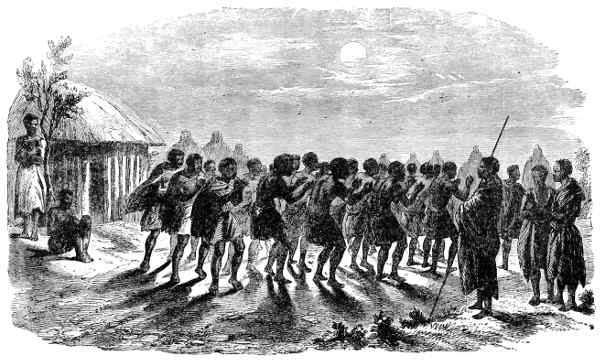
“Then (4) comes the weighing of the rubber, wax, ivory, etc., and payment in cloth of various kinds and colors, flint-lock guns, powder, beads, knives and fancy goods in variety, and rum in huge bottles encased in willow wicker-work. In the ‘Mohamba’ of the carriers—a kind of long basket—five of these demijohns are placed, weighing from seventy to eighty pounds, to be carried often 500 or 600 miles.
“(5) ‘The dispatch,’ just before the departure of the caravan, which consists of throwing out into the crowd, caps, hats and toys in variety for a grab game of the carriers. I once saw two fellows grab a cap, who pulled and hauled and quarreled till a third fellow ran up with his knife and cut the cap in two, and stopt the strife.
“Our Christian traders provide some accommodations for shelter and comfort for native carriers and traders. Those who come for the first time call for rum.
“‘We don’t sell rum; don’t use, nor keep it in the store.’ Some fellows here, the other day, disputed Brother Gordon’s statement, saying, ‘Don’t I see it there,’ pointing to some cans of kerosene.
“‘Well, do you want to try some of that?’
“‘Yes; that is what we want.’
“So he drew some and passed it to them, saying, ‘Now, you had better put it to your nose first.’ One or two of them smelled it, and passed it back with a look of surprise and horror.
“‘Well, we want some tobacco.’
“‘We don’t use tobacco; don’t sell it; don’t keep it to sell.’
“‘Do you want to buy rubber?’
“‘Yes, I am ready to buy your rubber,’
“‘What will you give us in exchange for our rubber?’
“‘I will give you money, if you like; or give you cloth, rice, fish, sugar, soap, anything you want, except rum, tobacco, beads and trinkets—such things as can do you no good. We sell nothing but what will be useful to you.’
“‘How much you give us for our rubber?’
“‘When I examine to see its quality I will show you whatever you want, and how much I will give you for each ‘arroba’ (thirty-two pounds). We give you no ‘matebeesh’—gifts—like other traders, and can afford to give you a good price for your rubber. If you, then, think that you can do better elsewhere, you can take your rubber away to the best market you can find. We want you to do the best you can for yourselves; remember, the men who give you things so freely, cannot afford to do it out of their own pockets; they must therefore take it out of you in their prices of purchase or sale.’
“Some leave us quietly, but many remain, and see, and confess to a fair deal. Then comes a free friendly talk about their country, and their people, and a Gospel talk about ‘Nzambi’—God.
“The people who thus trade with us go away in every direction, telling their friends they have become acquainted with ‘another people,’
“Thus our holy brethren are making more than a missionary self-support, and business increasing daily, and not only have their regular Sabbath services in the Kimbundu, but are talking six days a week beside; from morning till night they are talking in the Kimbundu of Jesus and Salvation to people who listen attentively, and repeat with great accuracy and earnestness any new thing that comes into their ears.
“All this talk, which I have indicated through the English language, transpired in the Kimbundu, so that our missionary traders are daily learning the vernacular of the country much more rapidly and accurately than they could if confined to their libraries, especially as there was but a single fragmentary grammar, till one of our missionaries, Hèli Chatelain, learned from the people who speak accurately, and has since printed a grammar and the Gospel by John; but as these are just from the press, our people have become familiar with the Kimbundu by direct and daily contact with the people without the aid of books.
“On Saturday, June 8th, Brother Gordon and Bertie slept alternately night after night at the farm-house, and in the morning see that the hired men get early to work, and look after the cattle and send them out to pasture, and then return in time for breakfast.
“I went to the farm-house early this morning and found Brother Gordon reading and explaining Scripture truth to the hired men in their own Kimbundu. When one grasped a new thought, he repeated it to the rest, with a glowing face.
“Our cattle herd here is not large, but growing, and of choice stock. They require daily attention. Any fresh wounds on any of them will soon mortify if not properly attended to. I saw Brother Gordon lasso a couple of young bullocks this morning, almost as dexterously as I used to see the Spaniards do it in California. It took him about a minute to lasso one, throw him, tie his legs, and put a bar across his neck, so that the animal was entirely helpless. The object was, daily to clean and dress a wound till fully healed.
“A wild plant grows plentifully in this country, called by the natives ‘Lukange,’ a decoction of which applied hot—not to scald—appears to be more effective than carbolic acid. First, a cleansing of the wound with soap and warm water; second, an application of the lukange by means of a syringe. Then, to prevent ‘flyblow’ and its consequences, a preparation of salt and baked tobacco, pulverized, is applied. The nicotine of tobacco, boiled out, is the great remedy used by Australian sheep growers for killing a bad breed of lice, which would otherwise destroy their flocks. Tobacco is certainly a very poisonous, destructive weed, and death to vermin.
“On Sabbath, 9th, Brother Gordon had a teaching and preaching meeting in the chapel at 10 A.M., then I preached a short discourse, and he interpreted into the Kimbundu. We had first and last about thirty native hearers. Some of them were greatly interested, and repeated to the rest the new thought that had just struck him.
“At the close, a soldier, who was among the most attentive of the hearers, said, ‘I want to turn to God, and receive Jesus and be saved.’
“Brother Gordon questioned him about giving up all his sins, and let Jesus take them all away.
“He said, ‘Yes, I’ll give up everything that is wrong, and let Jesus save me,’
“Then Brother Gordon asked if he had more than one wife?
“‘Yes, I have two; but I am willing to give up either the one or the other; but I want you to tell me which one I should give up?’ Then, just as we were hoping to help him to come to Jesus, he had to respond to a call to duty as a soldier, and left, and we have not seen him since. Brother Gordon knows him, and will seek opportunity to help him.
“Our mission house here, of solid adobe walls, 3 feet thick, is about 100 feet front by 20 wide, for 82 feet, and the remaining 18 feet forms an L extension back about 50 feet, which is the chapel; the 82 feet being divided into four apartments, one of which is the room for trade. Back of the house is an abundant supply of oranges, mangoes in their season, and some other varieties, the whole covering about half an acre of ground; ‘the best site in town’ for all our purposes. Our committee bought it, and paid for it over three years ago.
“On Monday, 10th, I again visited Brother Gordon at the farm this morning, and visited on the premises, near a large tree, the grave of dear Sister Dodson—Miss Brannon. They had been united in marriage but about six months. She had on her wedding garment when called by the Master, and went quickly into the royal guest chamber of the King. Her short and sure way from Boston to heaven was through Angola in Africa.
“To-day Brother Gordon and I took breakfast with Sr. Coimbra—“Costa & Coimbra,” the largest business firm in Pungo Andongo. We took breakfast with Sr. Coimbra, seven miles this side of Malange, nearly four years ago. He is a kind, social man of the world.
“On Tuesday, 11th, preparing for an early start to-morrow morning for Malange. Will go alone, of course, except the occasional sight of my two carriers, yet in ‘blessed fellowship divine,’ never alone nor lonely. Wm. Taylor.”
FROM PUNGO ANDONGO TO MALANGE.
“On Wednesday, 7 A.M., June 12th, I started from Pungo. My two carriers, engaged yesterday, had not reported at 7 A.M., so I started on my journey, leaving orders for them to join me at Korima, ten miles out.
“I waited at Korima nearly an hour when they arrived, so we lunched and rested till 1.30 P.M. I walked that P.M. fifteen miles, and lodged at Kalunda Quartel. Quartel is not a hotel, but nevertheless a lodging place for travelers who carry their own bed and provisions. It is a rude barracks, for a small detachment of soldiers, under a Commandante, who lives in his own residence contiguous. I meant to stop at the house of the Commandante, who attended our preaching at Pungo last Sabbath, and dined with us, and who expressed a strong desire to have us establish a mission at Kalunda. It was, however, an hour after dark when I arrived at the Quartel, and the soldiers said it was a long distance to the house of the Commandante, so I waited about an hour for my carriers, and then took my cold lunch, put up my bed in a room without doors, and slept well. Was up and off at 6.15 in the morning, having rolled up my bedstead and bedding, and taken my breakfast in the early dawn. I walked thirteen miles, and waited three hours for my carriers, which put my dinner off till 3, so I walked but six miles that evening, and lodged in a rude construction of poles, with roof, but sides not covered with mortar or grass. It gave shelter from dew and afforded fresh outdoor air, which is always my preference in this country. I found several native travelers, with a camp-fire blazing when I arrived, among whom was a woman, husband and little girl of about 6 years. I spoke kindly to the naked little thing, and the parents were delighted. After I retired I was entertained till I lost consciousness in sleep, by the singing of the little six-year-old, who never heard a Christian hymn or tune in her life. She sang the words and tunes of about half-a-dozen native songs, and when she seemed to run out of words she sang on, ‘La, la, la, la,’ I thought of the countless millions of little children in Africa, all heirs of ‘the free gift which is unto the justification of life,’ and as susceptible of being ‘trained up in the way they should go,’ as the children of England or America; but, I said, with tears, Where are the trainers? O thou Creator and Redeemer of mankind, how long, how long?
“Friday, 14th, I walked thirteen miles, lunched and rested a couple of hours, and six miles farther landed me in Malange. Just as I crossed the Malange River, I met Brothers Samuel J. and William H. Mead, and Robert Shields, accompanied by Mrs. Ardella and Miss Bertha Mead, mounted on bull backs, with portable organ, base viol, cornet, etc., on their way to Kolamosheeta, where I had lunched that day, to hold religious services.
“The people of that town are hungry for the truth of God. I begged them not to stop for me, but to go on to their appointment, but they replied that the people would not assemble till their arrival was announced, and said they ‘were going out at this time, thinking they might meet me there.’ So they returned and I accompanied them to the mission-house in Malange. Malange is sixty-two miles distant from Pungo Andongo.
“The fifty-one miles of travel from Dondo to Nhanguepepo is mainly through a region of rugged mountains and precipitous cliffs of solid rock, opening out into the long and widening grassy plateaus of Nhanguepepo. The thirty-eight miles from Nhangue to Pungo extend through and mainly across a series of ridges and hollows sparsely covered with scrubby timber. The soil not so rich, hence grass not so heavy and grass fires not so hot; therefore there is half a chance for trees to grow, with no chance at all from Dondo to Nhangue, except some very sappy varieties of but little value.
“From Pungo on for twenty miles the ridges are much broader and not so high as those described; there is more sand, less grass and heavier, but still scrub-timber. Then for eight or ten miles we cross low, beautifully rounded grassy ridges, with a little streams of water near the surface, about half a mile apart between the ridges. Then, for most of the way to Malange we cross ridges less fertile, much higher, with an ascent of from two to four miles. The whole line of march bears southeasterly. All appears to be a good grazing country, with many herds of cattle, but not a tithe of the number required to keep the grass down, and thus keep up good short grass pasturage the year round, and preclude the great ‘prairie fires,’ which destroy the young timber and prevent the growth of forests. For many miles around Malange, there is a fair supply of good hard-wood timber in variety.
“Sam Mead, Ardella his wife, and Bertha his niece, and I came together to Malange, nearly four years ago. Sr. J. Preitas was then in charge of the long established business house of Sanza Laurie & Co., in Malange, and gave us the temporary use of a house for our missionaries. After a day or two here, he informed me that Sanza Laurie & Co. intended soon to close out their business in Malange, and that I had better buy their house and town lot on which it stood, containing an acre of land and some banana trees. The house was an extension of house added to house joined into solid walls, about one-third of wattle and earth, and the rest of adobe brick. The last one added, forty feet in length, was new, consisting simply of walls with no roof. The frontage of the whole was about 165 feet, by a width of 18 feet. I inquired: ‘What is the price of the whole property, house and land?’
“He replied: ‘You can have it for two hundred milreis, $214.’
“I said: ‘I’ll give that amount,’ and the bargain was closed in about as few words as I have written. It is worth four times that amount now. The plates, girders and timbers are nearly all of ant-proof, and almost everlasting hard-wood, most of which are as solid to-day apparently as when new. One of them has a fire-proof covering by means of a double roof. On the lower is a heavy layer of cement of adobe clay, precluding rats, rain and fire. Over this is a thatch roof of long native grass. On the sunny side it has kept dry and sound, but on the north side our brethren have put on new thatch, cleaned and whitewashed the rooms, and finished the new forty-foot room, and fitted it up for a school-room and chapel, which is the seventh room in the building.
“In the few days I was here, four years ago, Brother Sam and I selected and stept off a mission-farm adjoining our mission-house. He and Brother Gordon fenced, cleared and planted several acres in corn, beans, manioc, sweet potatoes, etc., and everything grew beautifully, but the brethren were kept indoors by illness for a few days, and just what an old Portuguese settler predicted came to pass, their fencing was all stolen for firewood, and the cattle and hogs devoured every green thing from the premises. Bad outlook for self-support. It was in the midst of a ‘three years’ drought,’ which precluded the growth of supplies at our other Angola stations, but our farm was not far from the ‘laguna,’ a lake, a few hundred yards wide, and perhaps a mile long, occasioned by the spread of the Malange River over a plain, which gave moisture to the soil for a considerable distance from its shore. We did not seek to get nearer to the lake for fear of malaria, being warned of that peril by old residents.
“A fair share of the supplies for the first year of food, tools, and a little money, came to Malange for six missionaries, including Bertha, in her thirteenth year, with fresh supplies for the second year, and seven new missionaries to help to use them up, but all that was but to keep the wolf away, and afford means for the development of self-support. Sister Ardella’s health was so far gone, for months, that it was believed her life depended on her having apartments in a second story. But there were none in town, so a two-story house must be built. In the changes that were one way and another rapidly occurring, for the most part by attacks of home-sickness, that carried them off and clear out of the country, most of the work devolved on Brother Sam Mead, till two years ago his cousin, Brother Willie H. Mead and family moved hither from Nhangue, preceded by Brother Robert Shields, sent out by our Committee from Ireland. These have all stuck to the work here to which God called them, except that Edna Mead, a ripe Christian of about 12 years of age, at the call of God went up to join her sister, Nellie, in their heavenly home.
“The results of this unpromising attempt at self-support I will sketch in my next letter. Wm. Taylor.”
MISSIONARY SELF-SUPPORT AT MALANGE.
“Malange Station received, at the beginning, its proportion of cloth, provisions, tools and a little money to tide a small band of workers—Sam Mead, Ardella his wife, and Bertha Mead, of 13, his niece, and two young men—through the first year, which proved to be the second of a ‘three years’ drought and famine.’
“So a partial supply was sent for the ensuing year to prevent suffering from want. Meantime, the ‘tent-making’ by the missionaries, to ‘make ends meet,’ would have sufficed in a pinch, but the subsidy was salutary and safe, for they were not of the sort to be surfeited and suffocated even by an excess of supplies if they had had them, taking real pleasure in ‘scratching’ for themselves. Two years were required for apprenticeship, experimenting in many things, with everything to learn essential to self-support.
“About the beginning of the third year, after various changes by the coming and going of new workers, the coming of Willie H. Mead, with his family from Nhanguepepo, to join his cousin, Sam—about the beginning of the third year, marked the period when self-support really began to abound.
“Minnie Mead, Willie’s wife, turned in $40 by her sewing machine. Hèli Chatelain an equal sum by teaching languages to some traders. Robert Shields, from his private purse, put in $22. Willie has put in $80 per year from the rents of some property he has in Vermont, his old home, and, within a few months after arrival, put in $200 from pit-sawing and selling lumber. Most of these sums, with about $100 worth of goods sent as a present from Ireland to Brother Shields, were used to stock a little store for a small commercial business, as one branch of industry which was felt to be specially needful.
“Most of the business of the labor market of Angola is transacted through copper coin currency. It is so difficult to procure and keep a supply of it on hand that to purchase it, even with gold, ten per cent. premium has to be paid. The patrons of a variety shop bring in for the purchase of things they require a good supply of the copper coin.
“Robert Shields, having served a regular apprenticeship to the grocery business in Ireland, with an additional experience in it of a year and a half, was appointed to take charge of this industry, and work it in connection with his studies, and special evangelizing among the villagers adjacent to Malange.
“The farm selected at the beginning was found to be too near the town, and the whole work of ‘a season’ on it having been destroyed in a night, there was no ground of hope for anything better by a repetition of the experiment of fencing and farming there. So Sam Mead, in a state of semi-desperation, mounted one of his bulls and managed to struggle through grass as high as his head to explore the lake shore, along which he found a neglected farm, on which were growing many valuable fruit trees; he also discovered that the farm, save its lake-side boundary, was enclosed by a strong growing hedge, and contained a body of about 300 acres of black clay and loam of the most productive quality. He immediately sought for the owner—the heir to the man deceased, who had spent so much time, toil and money on it, and he bought and paid for it with money belonging to Ardella, his wife. He then went to work with a will, under a new inspiration of hope, assisted for a time by Brothers Rudolph and Gordon, and produced abundantly a variety of tropical and temperate zone products for food.
“The mechanical industries were under the special charge of Wm. H. Mead. His sons—Johnnie and Sammy, the former about 12, and the latter nearly 11—out of school-hours are valuable helpers in each department, alternating where needed most.
“Willie’s two pit-saws, in the two years he has been in Malange, have turned out $1,500 worth of planks and scantling, about half of which he sold, and used up the other half on improvements of mission property. To haul the logs from the forest, Sam had the oxen and Willie bought a huge Portuguese cart, with wheels of hard-wood, about four feet in diameter, and a hard-wood frame to match, all very strong and durable.
“The outlay of the earnings of these workers, for the past two years, over and above self-supporting subsistence, may be seen in the following exhibit:
“(1) The roofing and fitting up for school and chapel purposes of the unfinished hall, 18x40 feet, belonging to the block of buildings first bought for the mission. The girders, plates, rafters and collar beams are all of enduring hard-wood. The roof is double; the nether is covered with fire-proof clay; the upper with thatch grass. The shutters and doors, and frames for both, are of sawn hard-wood. Its slab benches, without backs, give quite a ‘rise’ to people always accustomed to sit on the ground. The cost of these improvements in material, labor and money is estimated to have been $300.
“(2) The farm-house, 15x20 feet; corn crib, about 6x11 feet, set on posts, capt with inverted tin-pans, to prevent the rats from getting up; and two out-houses, about 10x10 feet, and a corral of heavy logs for the cattle, cost a total of $100.
“(3) Willie Mead’s saw-pits, a shed, workshop and appliances, located in the mission yard, cost about $100.
“(4) A new mission-house on the same lot on which stands the old one. It is 24x30 feet, two stories high. The lower story is built of dressed stone, the upper of adobe brick, solid walls, below and above, three and one-half feet thick, with a second-story, veranda front and rear of the building. Double fire-proof roof—as the chapel roof before described. Doors, window shutters, and frames of both, together with the verandas and upper-story floors, are all sawn hard-wood. The lower floor and walks outside are of flag-stones. It is the only two-story house in Malange, and believed to be the only house in Angola furnished with a chimney and fireplace, which adds greatly to its comfort in the really cold weather of Malange at this season of the year. The upper story is used by Sam and Ardella, and about half a dozen of their adopted native children. The lower story has also sleeping accommodations, but is the dining-room for Sam, Ardella, Robert Shields and Bertha, and the school ‘internoes.’ The house is not large, but most symmetrical and substantial, and is prophetic of progress, and bears from the veranda facing the street a tall flag-staff from which floats the flag of our home country—the stars and stripes.
“The brethren estimate the cost of this building, in materials, money and labor, at $800. To buy all the materials, and depend on hiring workmen, it could not be done for that amount. It will be observed that the aggregate outlay for these improvements amounts to $1,300, not a dollar of which was furnished by our Transit and Building Fund Society; the brethren preferring to do it themselves than to ask for or receive aid from home. They are now engaged in building a wall round our Malange Mission premises 1,000 feet long.
“(5) The farm Brother Sam bought, with its field of sugar cane, so thickly set as to defy anything short of an elephant a passage through it; its fruit orchard; its live stock of twenty herd of cattle, including three yoke of oxen; and eleven breeding sows and male, and chickens, is worth in the market one thousand dollars.
“As soon as Sam began to inquire for the owner, others began to compete with him as bidders for it, so, to avoid the peril of delay, he bought it at the earliest possible moment, and had it deeded to himself, and has held it in good faith for the mission. During my recent visit to Malange, I offered to refund Ardella’s money with interest.
“Sam and Ardella laid the subject before the Lord, and returned answer, that, having given themselves and all they have to God for his self-supporting missions in Africa, they refuse a refund; but will immediately deed the farm and all the appurtenances thereunto belonging to the Transit and Building Fund Society, to be held in trust for the self-supporting missions of the Methodist Episcopal Church. I put the matter into the hands of Brother C. W. Gordon, our legal attorney, and the conveyance will be made, no doubt, before this MS. can be printed.
“The building of the new house has absorbed a large proportion of the stock in trade of their little store. They were quite disinclined to allow me to help them stock it up a bit, but I prevailed on them to accept the small amount of $214.
“As Willie Mead is a noted mechanical genius, on the short-cut-cheap-line, adapted to a country like this, and as Malange has greatly the advantage of any of our other Angola missions in timber supply, and the farthest inland, he should have an outfit of tools and machinery for a few branches of industry well adapted to that locality. This need has been in part provided for. Our Committee has sent a new supply of farming implements and carpenter’s tools for Malange, soon to arrive.
“I have, on my return trip to the sea, ordered them a turning lathe from Nhangue; also a farmer’s outfit, the gift of Thomas Walker & Sons, of England; and have sent from Dondo a blacksmith’s anvil, vice, tongs, etc. What Malange yet needs is a small steam-engine, of four or five horse-power, with ‘arbor’ and belting, and other appliances, and a thousand feet of small piping for pumping water, to run by steam, (1) their sugar cane crushing mill; (2) their corn meal grinding mill; (3) their turning lathe; (4) a small circular saw of eighteen or twenty inches diameter, also a small circular cross-cut saw, the saw to be sent from home with the engine, belting, and water-piping. We don’t want for Malange a saw mill, big engine, or anything costly or too heavy for easy transport on the heads of natives 150 miles from Dondo to Malange. Willie Mead did not ask for these things, but needs them for mission industrial teaching, in connection with his powerful preaching in the Portuguese language. He was proposing to sell his little property in Vermont, to use the money derivable from the sale of his homestead, to buy the engine, etc., as above, for Malange Mission, but I protest against that. Such men as the Meads are just the men we can afford to help with certainty of broad self-supporting missionary independency and wide-spread efficiency, without danger of dependency. Wm. Taylor.”
RETURN FROM MALANGE TO DONDO.
“I was planning to leave Malange, Monday, 24th of June, but ‘Magady was dying,’ so I yielded to the request of our brethren and sisters, and postponed till Wednesday, the 26th. Magady was a ‘Labola boy,’ who, as a little fellow, gave himself to Sam and Arda, nearly four years ago. He was very black, but pronounced by some as ‘the most beautiful boy they ever saw.’ The people on the south side of the Coanza, from its mouth up for 250 miles, are called Kasamas; thence on for 200 or 300 miles, a similar people are called the Libólos. Neither will allow the Portuguese people to travel through their country.
“Magady’s story was that his parents were dead, and that his uncle treated him so badly he ran away from his country, and became cook for the Malange mission. He was taught to know, to fear and to love the Lord, and to sing our hymns. For about two years he was a consistent Christian. Then, through the intrigues of an influential, designing, bad man, he was enticed into bad company, and forsook the Lord. Then he was visited by a disease of his head. He would be walking along, and fall as suddenly as if shot by a Remington rifle, and lie some time in a state of insensibility, but that was as nothing compared with severe and sudden pains in his head that caused him to scream aloud at all hours, day and night. None but himself attempted to diagnose his case. He said ‘Gan N’Zambi’ sent it on him for his wicked departure from Him, and would destroy his body, but had forgiven him, and washed his spirit, and that he was sure he would soon go to live with God, and was anxiously waiting for the call of the King. About 2 P. M. Monday, June 24th, he died. Willie Mead made him a hard-wood coffin, and lined and covered it with white cotton cloth, and he was laid in a grave six feet deep in our own mission burial-ground, where dear Edna Mead sleeps. I conducted the funeral service, about thirty persons being present—a ‘brand snatched from the burning,’ our first Angola representative in heaven.
“During my sojourn in Malange, this trip, I slept in my own bed, as usual, set up in the second-story veranda of our new house, overlooking the street. The nights were very cold and the winds very high, but I rested sweetly, and improved the tone of my health. For two years I had endured an unmitigated high pressure of care and anxiety, on account of the combinations against the success of my work, within and without, front and rear, threatening the life of my missions. But for the great kindness and care of my gracious God and Father it would have killed me. Viewing the blessed harmony and efficiency of our workers from Loanda, and on for 390 miles to Malange, I set up my Ebenezer, and wept, wept, and praised God softly, softly. Then I rested my weary spirit on the bosom of Jesus, and resigned my way-worn body to sleep. There, in the breezes of the high veranda, days and nights together, I slept and slept, and waked, only to say ‘thank God,’ and slept again. Then I got up feeling as fresh as the morning. I bade adieu to my kindred dear in Malange, and left at a quarter to eight Wednesday morning, June 26th, and Friday P.M. reached Pungo Andongo, and had a blessed two days’ sojourn with Brother Gordon, Sisters Withey, Bertha, Lottie and Flossie—holy, lovely people. Brother Gordon is a master in the Portuguese and Kimbundu. We preached an hour Sunday A.M. I knew his rendering into Kimbundu was clear and forcible, by its manifest effect on the hearers. It was their regular chapel service for each Sabbath. The soldier who was awakened on my way out has been called away on duty, so that we can’t report progress in his case, but half-a-dozen men, or more, came forward on this occasion as seekers of pardon, and prayed audibly, but did not appear to enter into life.
“I left for Nhangue, Monday morning, July 1st. Brother Gordon accompanied me fourteen miles to Queongwa, to show me a mission farm Brother Withey recently bought there, of probably 250 acres. We went through it that afternoon, from end to end. It is bounded on the west by a bold running stream, and on the north by the caravan path, stretching across a ridge of fertile soil over 200 rods wide. The former owner was with us, and wanted to sell us the lower end of the same ridge, extending from this path about 200 rods to the hollow, northward, where it is bounded by another little river, till it flows into the one that bounds the whole tract on the west side, and has another shallow stream flowing through the addition near its eastern boundary. So, as this new survey, of about 200 acres, was offered to us at a very small figure, we bought it. The former purchase from self-supporting earnings, has already been conveyed to the T. and B. F. Soc. for the M. E. Church, and this will be, or is by this time.
“Brother Gordon is a symmetrical, lovely character, and efficient in everything he takes hold of. When Brother Withey and he took hold of our little store in Pungo a little over a year ago, its assets were $200, now over $1,000, and the preaching done across the counter in all holy conversation and honest dealing, is a power for God in that centre of far-reaching influence.
“I reached Nhangue on Tuesday P.M., and rested Wednesday till 4 P.M. We had a preaching and baptismal service. Brother Rudolph has had several young natives converted during my absence. Here, as at Malange, many candidates for baptism we had to put off for better preparation. We baptized none of responsible years who were not well recommended by missionaries who had been training them for many months, and who were assured, from their profession and lives, of real conversion to God, and declined to baptize any children whose parents were not prepared publicly to pledge themselves to teach or have their children taught their baptismal relation and obligations to God, and to trust Him for His baptismal pledges to them. Those rejected were disappointed. However, on Wednesday P.M., I baptized twenty-one little children, and several converted lads, and five new probationers were added to our native church, making thirteen natives at Nhanguepepo, and twenty-one at Malange.
“On Thursday morning, Brother Karl accompanied me as far as Nellie Mead’s grave, under a shade tree, about two rods from the caravan trail. A construction of solid masonry, about 5x8 feet, and two feet high, covers her consecrated bones, all given to God before she left America, and laid at the front, according to her covenant, to live and die for Jesus in Africa. She was a natural musician, and has gone to take lessons where ‘the new song’ is attuned to the ‘harpers’ of the melody of heaven. She was one of our children, of the same age, but less stature, of Bertha Mead. Dear little Willie Hicks sleeps beside her, and will, with her, wake up at the first call, early in the morning.
“I bade dear Karl adieu, and walked that day twenty-six miles, and camped at Kasoki, and next day, July 5th, walked twenty-five miles, and put up with dear Brother Withey and Stella, at our mission-house at Dondo. I thus completed my walk of 300 miles with less weariness than the same route cost me nearly four years ago. Glory to God, my patient loving Father in heaven and here in the mountains and vales in Africa! Wm. Taylor.”
Writing in September, 1889, Bishop Taylor says of his Congo missions:
“Vivi is about 100 miles from the ocean, on the north side of the Congo River.
“Old Vivi, founded by Mr. Stanley, is reached by climbing a steep ascent of half a mile or more from the steamboat landing and Government warehouses at the river-side. It is now entirely deserted. Proceeding by the same road along the slope of the ridge on which old Vivi stands, and thence across a deep glen and up another steep hill, we reach ‘Vivi Top,’ the site of the first capital of the State. It is located on a broad and beautiful plateau, commanding a full view of several miles of the river with its whirlpools and sweeping currents. The villages of Matadi, Tundua, the site of Underhill Mission of the English Baptists, and several trading stations, all dressed in white paint and lime, stand out and grace the scene on the south bank of the great river.
“The Government imported and built several large houses of wood and iron at Vivi. One of the houses, I was informed, cost the Governor-General $17,000. We could have bought it for $9,000, but had to decline the generous offer for lack of means.
MISSION HOUSE AT VIVI.
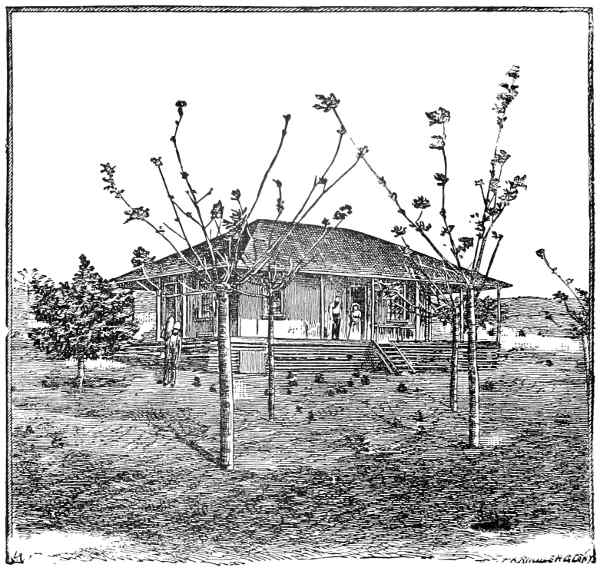
“The large houses were taken down and shipt to Boma, the present capital, about fifty miles below Vivi, and were reconstructed on Boma plateau.
“We bought the site of the old capital, comprising about twelve acres of land and a few small buildings, sufficiently capacious for our needs for a few years, for $768.
“The plateau being so high and dry, I did not apply for much land, considering it unsuitable for profitable cultivation. We require the site for a receiving station for the transport of supplies for our contemplated industrial stations in the interior north of the Congo, and the great Upper Congo, and Kasai countries.
“I now perceive that under the judicious management of my Preacher-in-Charge, J. C. Teter, Vivi will become, in the near future, a self-supporting station, and the most beautiful mission premises on either bank of the river. On my recent arrival in Vivi, about the 8th of August, with the dry season far advanced, I was delighted to find, on the high and dry soil of Vivi, a field of manioc, beautifully green and growing. The mango and palm trees on the place when we came into possession have made a remarkable growth during my absence, and are full of fruit; a young orchard of choice varieties of tropical fruits are getting a fine start, and in the garden plenty of yams as large as my head. I also find a promising start in the production of live stock. We already have at Vivi eight choice African sheep; twenty-five goats, which multiply like rabbits; 100 chickens, and a male and a female calf. Brother Teter built a house for the sheep, another for the goats, and a corral for the calves. These are not in care of keepers or dogs during the day, and they return to their houses in the evenings and are shut in from the leopards. One of those dangerous customers reached his paw in through a slight opening in the wall of the goat house, and tore a fine female goat so that it was necessary to kill her. The morning after my arrival I went with Brother Teter to see the goats come out of their fortress. As they came rushing through the door, I was surprised and amused to see three monkeys mounted on the backs of goats, as pompously riding out to the grazing grounds as if the flock belonged to them. They lodge with the goats by night, and spend most of their time with them through the day, and are often seen riding as erect as a drill sergeant of cavalry. They spend many of their leisure hours in picking bugs and burrs off the goats, and playing with the kids. Their indescribable antics are enough to make a dog laugh, and to relieve a confirmed dyspeptic of the blues.
“Brother Teter is building of stone a snake-proof chicken-house. A lesson of sad experience led him to build of solid masonry. Some months ago, Sister Teter went into the chicken-house, then in use, to look after a sitting hen. While stooping over the nest, which she thought was occupied by the hen, she felt something like a jet of spray come into her face, and this was quickly repeated two or three times, filling her eyes with the poison of a “spitting snake,” which lay coiled in the nest. All that night she suffered, in total blindness, indescribable agony of pain. By the prompt application of powerful remedies her life was saved, and her sight restored, but her health was injured by the poison. The dear woman was quite unwell on my recent arrival, but seemed quite restored before I left.
“I have furnished a glimpse of the sunny side of Vivi, produced by the genius and industry of our faithful Preacher-in-Charge. Our Vivi Station and our cause have suffered temporarily by the disaffection and departure of those who were numbered with us; but their departure has left us in peace and harmony, with the possibility and certainty of success in the work to which God has called us. ‘They went out from us, but they were not of us; for if they had been of us, they would no doubt have continued with us,’ There are many not very good, and many who are very good, who are ‘not of us’ and not ‘with us’ in our Self-Supporting Mission movement. When such of either class, by mistake, get into our list of workers, the best thing for all concerned is for them to get out, as quietly and as quickly as possible. We are sorry for them, and cease not to love them and to pray for them.
“On Wednesday afternoon, the 14th of August, accompanied by Lutete, a native man, employed to carry my blankets and food, I took the path for Isangala; distant, ’tis said, fifty-five miles from Vivi. We walked twelve miles, and put up for the night at a new mission just being opened by Mr. and Mrs. Reed and Mr. Bullikist, recently sent out as missionaries by Dr. Simpson, of New York.
“They seem to be earnest Christians, and will, I trust, make a soul-saving success. They are having three native houses built, each about 12x18 feet, which will give shelter for three or four years. Their faithful dog shared in their tent lodgings, till one night, a few weeks since, a leopard or panther scented him, took ‘a fancy to him,’ and carried him off. Brother Reed is expert in the use of a gun, and supplies his table with venison from the prairies. Soon after his arrival, he went out and killed a deer, and a native king and some of his people came and claimed and clamored for it. Reed got their attention, and, leveling his rifle at a tree, he put an explosive bullet into a knot and tore it to pieces. He then drew his revolver, and discharged it a few times in the air. His argument had its effect on their minds, and they quietly retired.
“At 7 o’clock next day, having disposed of a good breakfast, I took the trail, and walked seventeen miles, to Matamba Creek, by 3 P.M. I was quite disinclined to camp so early, but there being no available water for seven miles beyond, I made my pallet on the ground and turned in for the night. I usually have my very comfortable portable bedstead, but going only for a short stay at Isangala, I took but one carrier instead of two, my usual number.
“Passing through Bunde Valley to-day, I saw a herd of nine or ten koko—a huge deer as big as a donkey, with longer legs. They bounded away a few rods, and at the distance of about a hundred yards stood and looked at us till we passed out of sight. My Winchester would have brought one of them down if it had been with me, instead of at Vivi.
“Twice, later in the day, we were within easy shot of large red deer. On my return, in the same valley, which is about eight miles long, stretching between mountains or high hills north and south of it, and abounding in game, I was within easy shot of a koko, which stood and looked at me without moving. We also heard buffalo in a jungle of grass and bushes, not thirty yards from us. I saw plenty of game when I traveled this path over two years ago, but I don’t carry a gun in traveling, having enough to do to carry myself, and no time for curing and packing the meat, if taken.
“I went out from Vivi with Brother Teter, the other day, to get meat for use. Our hunting-ground was about ten miles from home. The first day we got no meat, but saw many koko and deer. The second day at noon, we had nothing, and were getting into a position to sympathize with a hungry hunter of the olden time who sold his birthright for a pot of soup with no venison in it. Teter was becoming desperate, for he is a noted hunter, hungry for meat, and withal had a reputation to sustain. As soon as we got our lunch of all we had, he took my Winchester and set off alone. When he had gone half a mile from camp, he ‘stalked’ a small herd of koko, and shot a young buck through the neck and killed him, and then emptied the gun-chamber of its dozen cartridges in trying to bring down another buck. He shot off its right fore leg, and shot off the sinews of the left one, and put a bullet into its hip, but he would not down. Teter, having no more cartridges, left the gun and pursued the wounded deer and stoned him to death. We had with us two Liberia boys. We camped near by for the night, and before the morning dawn, we had the larger buck cut into thin slices and cured by the fire. The younger one, about a year and a half old, was carried whole to Vivi, by a hired native. Our Liberia boys, with a good supply of fresh meat, were so refreshed in their minds that they sang the songs of Moody and Sankey, almost incessantly, for days. The deer of this section are smaller than the antelope and gemsbock varieties which we read of in other sections, and which offer such royal sport for those who go equipped for hunting.
HUNTING THE GEMBOCK.
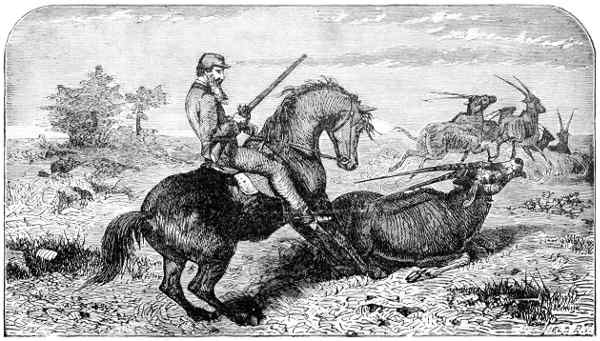
“On Friday, we walked from Matamba Creek, twenty-three miles to Isangala. By my usual speed of three miles an hour, I made the distance from Vivi to Isangala, fifty-two miles instead of fifty-five, as per Mr. Stanley. I was, however, in fine condition for walking, and may have overstept my ordinary gait. Arriving at Isangala, I came first to the station of the State, and by invitation of Mons. C. La Jeune, the Government Chief of Isangala, I stopt for half an hour in pleasant conversation, and then proceeded a few hundred yards to our Isangala Mission Station.
“I found our faithful missionaries, Brothers White and Rasmussen, in good heath, and happy in the Lord.
“They have built a cheap but comfortable house, about 15x40 feet, also a kitchen and warehouse for storing our stuff. They have made a garden also, which yields a goodly portion of their support. A single yam, dug while I was there, weighed twenty-two pounds. Beside vegetables, they have a large flock of chickens. These brethren both belong to our transport corps, but have done this station work beside, and have made good progress toward the mastery of the Fiot or Congo language.
“Brother Rasmussen, though but two and a half years in this country, speaks the Fiot fluently, and preaches in it in the villages contiguous. I remained with those dear brethren from Friday evening till Tuesday, the 20th. We had Blessed Communion with the Holy Trinity and with each other. On Sabbath, I preached to a company of natives, and Brother Rasmussen interpreted without hitch or hesitation. In another year or two this dear brother, under the anointing of the Holy Spirit, can go forth as an apostle among the nations of Congo.
“One part of my business was to advise with these brethren on the possible solution of our steamer problem. I had talked up all the points with Brother Teter, and he was so sure these brethren would concur in our conclusions, he thought it quite sufficient for me to write them, and thus save myself the labor of a rough walk of over a hundred miles. I said: ‘Nay, brother, I will walk it, and get the unbiased decisions of their own judgment, and enlist the free good-will and effective co-operation of the brethren in the work before us under a new impulse which personal contact would communicate.’
“Before intimating the conclusions reached at Vivi, I drew out the candid opinions and judgment of these brethren, and found they were of exactly the same mind with us. When by mistake we take the ‘wrong road,’ and travel a long distance in it, it seems a grievance to us to face about and trudge our weary way back to the ‘cross-roads,’ but however much it may go against the grain, that is the thing to do. It seems to lighten the task a little, if some unfortunate fellow can be branded as ‘the scape-goat’ to bear the blame of the mistake, for we all are of kin to that dear lady we read about, who tried to make a scape-goat of the devil; and to the unmanly man, who had the honor to be her husband, and tried to make a scape-goat of his wife. But our well-intentioned mistake was not a sin and we have no need of a scape-goat.
“Well, without enumerating the sources of clearer light, and the new conditions and changes which have intervened in the last two years, our unanimous judgment is that the Lord wants our present steamer for the Lower Congo,—and a much lighter one for the Upper Congo and Kasai water-ways two or three years hence. We will, as soon as the Lord will help us, occupy our station at Luluaburg, vacant since the death of Dr. Summers, and hold our footing in that vast and populous region.
BISHOP TAYLOR’S MISSIONS ON THE LOWER CONGO. (underlined) Larger.
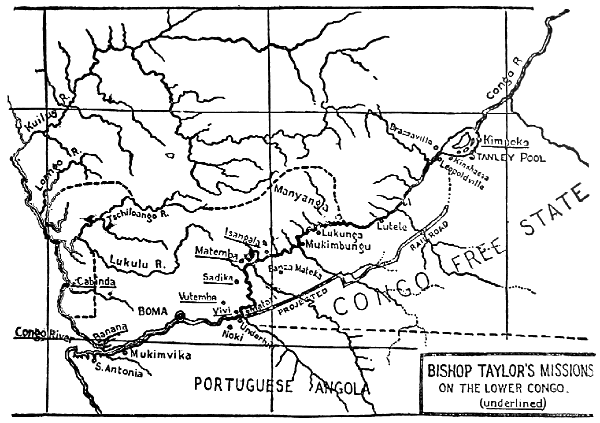
“I believe the Lord has a special providential purpose to fulfil in settling us on the north side of the Lower Congo. He wants us to occupy a densely populated, and utterly neglected region, so far as missionaries are concerned, belonging to the Free State of Congo, extending 230 miles, from Banana to Manyanga, and 100 miles wide. So that, while we shall, the Lord willing, carry out our plan of planting missions in the countries of the Upper Kasai and Sankuru Rivers, we will also provide for these vast regions so near us. Our steamer will be available for the supply of all these vast fields. Beside all this, if our time and space will permit, we can carry for our neighbors any variety of freights, except intoxicating liquors. Our plan, from the beginning, was in connection with books and Gospel preaching, to establish industries to employ the natives, and prepare them for usefulness. So, if it shall please the Lord to give us a money-saving and a money-making transport service, direct from Banana to the regions before-named, it will be in perfect accord with our plan of missionary work for this country, and furnish us means for its more rapid extension.
“Much of the work will be done by natives, whom we shall train, and our own missionaries engaged in it will not be throwing away either time or opportunity. Associating daily with the people, mastering their languages, visiting their homes, employing them in business, bettering their condition, exhibiting to them in all our words and ways the loving spirit of Christ, and unfolding to them the hidden treasures of Divine light and life is the kind of missionary work specially adapted to these nations. There is no personal money-making motive nor purpose in it. ‘We are workers together with God.’ We can trust Him for board and lodging while in His service, and trust Him for reward when the work is done.
“During my absence from Congo of over a year and a half, Brother Teter, in charge at Vivi, has had to stand firmly in defense of me, my Committee, and my cause of Self-Supporting Missions, and having a few sets of my books, he is continually lending them to the traders and State officials stationed along the river from Vivi to Banana. Among these was Mons. C. La Jeune, who became so interested in them, that at our recent meeting in Isangala, he asked me to allow him to translate and print some of them into the French language, for circulation in Belgium. He said he was soon going home for at least six months, and would in that time make the translations and arrangements for their sale. I had the pleasure of giving him a written permission to do as he desired.
“The officers of the Congo State, from the Governor-General down, are extremely polite and obliging, but the amount of Governmental tape that belongs essentially to the administration of an old European Government is a means of grace, especially the grace of patience to an American pioneer.
“On Sunday, 25th, I preached in the open to twenty-six seated, attentive English-speaking negroes from Liberia, Acra and Lagos, and a crowd that stood and looked on. There are many scores of such people employed at Boma, and their numbers are increasing. A great deal of missionary money has been expended in civilizing and Christianizing these people, especially those from the missions of the coast of Guinea, by the Lutheran, Church of England and Wesleyan Methodists. They are very anxious for a place of worship in Boma, it being the capital of the State in which, by the will of God, we will plant hundreds of mission stations in the near future. We ought to have a mission-school and church in Boma. To accomplish all this next year we really lack but one thing, and that is, the money. The cheap stations we establish in the wild regions of the heathen are not of the style required for Boma. A plain, substantial building for residence, school and preaching services would cost about $5,000. Wm. Taylor.”
SOUTH AFRICAN MISSION FIELDS.
South Africa next engages our attention. Passing by its natural scenery, soil, productions, climate, its cities, towns and villages, manners and customs of its many native tribes, and the character of its colonists, we will confine ourselves strictly to what has been done for the moral and religious welfare of the inhabitants. And first of the Western Province of Cape Colony.
The Dutch Reformed church being that of the original colonists is the strongest religious denomination, and it is numerously represented in most of the towns and villages throughout the country. Formerly it was regarded as the church of the white people alone. It was not till the advent of the missionaries that the Dutch church awoke to the necessity of doing something for the natives. Lately they have nobly redeemed their character and in connection with many of their churches a large amount of missionary work is done. The same was true of the Church of England. Now, with the aid of funds from home, they have been erecting churches and school buildings in the towns and villages and appointing ministers and teachers to labor among all classes. Lutherans, Presbyterians and Baptists were also represented by churches in Cape Town but they did nothing for the masses of the people.
Cape Colony, in common with other parts of South Africa, is chiefly indebted to the missionary societies for the moral and religious instruction of the masses.
The Moravians had the honor of being the first in the field, the Rev. Geo. Schmidt having gone out to the Cape as early as 1737. A writer in the Missionary Review in 1889 says:
“Foremost in the fight with ignorance and evil in South Africa stands the figure of George Schmidt, prepared for the hardships of his missionary life by six years of imprisonment for conscience’ sake in Bohemia, during which his brother in tribulation, Melchior Nitschmann, died in his arms. Whence came the zeal which moved Schmidt to make his way alone to South Africa in 1737, and to dwell among his little colony of Hottentots in Bavianskloof, until in 1743 the persecutions of the Dutch settlers and clergy drove him from the country, and their intrigues prevented his return? Whence came the ardent heart’s desire, which led him day by day to a quiet spot near his German home, and there poured itself out in prayers for his orphaned flock far away, until, like Livingstone, he died on his knees pleading for Africa? Such burning love and such persistent prayer are not of man, they are of God. And though the answer tarried long—yes, fifty years—it came before this century commenced. George Schmidt was no longer on earth to hear the reports of the three men upon whom his mantle fell—how they found the spot which he had cultivated, the ruins of his hut yet visible, the whole valley a haunt of wild beasts; and, better, how they found one surviving member of that little congregation of 47 who had long waited and hoped for the return of the beloved teacher. This was an aged blind Hottentot woman, who welcomed them as Schmidt’s brothers with “Thanks be to God,” and unrolled from two sheep-skins her greatest treasure, a Dutch New Testament which he had given her. Soon this so-called Bavianskloof (i.e. Baboon’s Glen) was changed into “The Vale of Grace” (in Dutch, Genadendal), and where Schmidt’s poor hut stood there is now a large settlement, with a congregation of more than 3,000 members. From this center the work has spread over Cape Colony, and beyond its borders into independent Kaffaria. Now its two provinces include 16 stations with their filials, where 60 missionary agents have charge of 12,300 converts.”
The Evangelical French Missionary Society has stations at Wallington and Waggonmaker’s Valley, but its principal field is in the interior. The Berlin Missionary Society are also represented in the Riversdale district. The Rhenish Missionary Society also occupies many important stations. The London Missionary Society began its work in 1799, and has made its influence to be felt for good in various parts of the country. The Wesleyan Missionary Society commenced its labors in 1814. They were hindered for a few years by the government authorities, but in the course of time they made great progress in building churches and mission premises, and in organizing schools all over the Colony.
The Eastern Province of Cape Colony is also indebted to the missionary societies for religious instruction. Prosperous stations of the Moravian, Berlin, Rhenish, French Evangelical, Presbyterian, London, and Wesleyan Missionary Societies have been established in various places. The two societies last mentioned, however, have been most extensively engaged in purely missionary work. The London Society began in 1799 by sending out Dr. Vanderkemp and the Wesleyan in 1820, the Rev. William Shaw being the pioneer missionary. The temporal and spiritual benefits resulting from the labors of these two societies to the people of different tribes and languages in the Eastern Province of the Cape Colony were very marked.