MISSIONARY WORK IN AFRICA. (continued 2)
Reading edition
In February, 1850, an Egbo law was passed abolishing the inhuman practice of sacrificing human beings when a king or chief died. It is spoken of as “A good day for Calabar”—“One memorable in the annals of the land.” About the same time the marriage ceremony was introduced—King Eyo having witnessed the first regular marriage.
On the suggestion of Mr. Waddell, their domestic idol, which consisted of a stick surmounted by a human skull and adorned with feathers, was expelled from every house.
The death of King Eyo in December, 1858, put the Egbo law to the test. Much excitement prevailed. Fears were entertained that the old superstition would triumph. Happily no such dreaded result followed. Other heathen practices were one by one abandoned through the influence of the mission.
The mission extended its sphere of operations from time to time—Ikunetu, situated on the Great Cross river, about twenty miles above Creek Town, being occupied in 1856, and Ikorofiong, also on the Cross river, about twenty miles above Ikunetu, in 1858. The Presbytery of Old Calabar was established September 1st, 1858, under the designation of the Presbytery of Biafra.
In 1878 Mr. Thomas Campbell, the European evangelist at Old Town, accompanied by a number of natives, explored in two directions—first in Oban, up the Qua river, and then beyond Nyango, on the Calabar river. Everywhere he was well received by the chiefs and people. On September 6th, 1880, there was an agreement entered into between D. Hopkins, Esq., British consul, and the kings and chiefs of Calabar, in accordance with which a number of superstitious and cruel customs are held as criminal and punishable by law. These include the murder of twin children, human sacrifices, the killing of people accused of witchcraft, the giving of the esere or poison bean, the stripping of helpless women in the public streets, etc., etc.
In the Missionary Record, June, 1881, appears the following intelligence: “The mission which seemed so long fruitless, is now one of the most fruitful in the whole earth. The increasing number and activity of the communicants, the increasing number of students in training as teachers and evangelists, and the manifestations of a Christian liberality not yet reached at home, tell of the changes which the Gospel has wrought. We ploughed in hope: we sowed in tears: and now already we reap in joy. The most recent tidings are the most heart-stirring. A new tribe, which had long resisted our approach, has been visited. They had never seen among them a white man till they looked on the face of the devoted Samuel Edgerly. They invite teachers to settle among them. They offer us suitable sites. The country is far beyond the swamps; it is high and healthy. This favorable entrance was greatly aided by the wise and good King Eyo, who sent a prince to accompany Mr. Edgerly beyond Umon to Akuna Kuna. When the expedition returned and the king heard the result, he gave utterance to one of the noblest of sentiments. ‘God,’ said he, when Mr. Edgerly had told his tale, ‘has unlatched the door, and wishes us to push it open.’”
Such results as have been achieved at the Old Calabar Mission are worth all the money and toil and sacrifice of health and even of life which they have cost.
The mission to the Cameroons was established in 1845 by the Baptist Missionary Society. When the missionaries of that society were expelled from the neighboring island of Fernando Po, where they had been laboring since 1841, they settled among the Isubus at Bimbia, where a mission had previously been projected. The mission was afterwards extended to King Bell’s Town in an easterly direction, the people inhabiting that region being the Dualas. The entire New Testament has been translated into the languages of both tribes.
The Gaboon Mission was called into existence by the American Board in 1842. Baraka was the first station occupied. It was transferred in 1870 to the Mission Board of the American Presbyterian Church (north.) The Mpongwes on the coast, and the Shekanis, Bakalais, and Pangwes in the interior, are the tribes embraced in the field of operation. Not much progress has been made owing to the opposition of the Roman Catholics. In all the French possessions on the west coast of Africa the Roman Catholics predominate and very little has been accomplished. Recently the Paris Evangelical Missionary Society has been doing a good work at Senegal and other settlements.
We come now to Angola. Angola was discovered by European mariners long before Christopher Columbus had given to the world another continent, yet many years passed before the value of the discovery was recognized and the country taken possession of and occupied by the Portuguese, at that period when Portugal was made remarkable by the commercial enterprise and maritime prowess of its people, more than three hundred years ago.
For several years before the occupation of Angola, the king of Congo had been doing a large and lucrative trade with the Portuguese in slaves. The sources from which were drawn victims to keep alive this nefarious barter were never failing. The superstitions of the people, their customs and habits, a season of drouth, a failure of crops, in fact anything, even the least trivial happenings, were all factors giving Congo’s king excuse for the selling of his subjects to securing wealth; wealth represented by many wives, granaries filled to bursting with manioc, and wooded hills and fertile valleys stocked to overrunning with flocks of sheep and droves of lowing kine; wealth which enabled Congo to dominate and overawe all contemporary tribes, and which naturally incited the jealousy of other kings and chiefs who ruled over the natives of other districts in this country of Congoland.
Among the savage rulers who were envious of the power of their rival, was Nmbea, king of Angola, autocrat of a large and densely populated country. Holding at his disposal millions of helpless and superstitious subjects, Nmbea soon recognized that by copying the practices of his powerful neighbor he, with but little difficulty, would also become chief and powerful. So, moved by this desire, he opened a correspondence with the Portuguese. He sent one of the rich men of his tribe, with presents of slaves, ivory and strangely wrought curios, as ambassadors to the Portuguese court at Lisbon, with instructions to endeavor to have the Portuguese establish trading relations between the two kingdoms.
At this time the attention of the Portuguese queen and the people generally was attracted towards Brazil. Enterprising colonists, venturesome explorers and wealth seekers of all classes saw in this South American district a new Cathay. Thousands from among the patrician, as well as other thousands from more humble circles, rushed into that new land, necessarily causing large sums of money to follow in their wake. The enthusiasm with which this American opportunity was cultivated and the resultant drain from the royal treasury and from the coffers of the people caused Queen Catherine to receive with indifference all stories of African wealth. Thus obstacles were formed which prevented Nmbea from carrying out his plans until several years had passed, when the growing demands for slaves, needed to supply labor in Brazilian mines and on East Indian coffee farms, had become a matter of great importance. Then the request of Angola’s king was considered, and a party of Portuguese were landed at a place in his kingdom which they called St. Paul de Loanda.
In the selection of this place these adventurers were most fortunate, for it was not long before trade, in ever-increasing volume, flowed towards the sea coast at this point. The growth of the city was rapid and, despite wars with native tribes and trouble with marauding Dutch, it grew wealthy and powerful. Large and beautiful cathedrals were built, imposing palaces were erected as were many important public buildings, and dotted here and there about the suburbs, were fruitful farms and valuable plantations. So with the moving years the city waxed strong and mighty, thriving on its traffic in human flesh. But a time came when this trade was shaken to its base and the prosperity of its citizens brought to a temporary end.
The inhabitants of the civilized world began to look with disfavor upon the slave traffic, and were induced to attempt its suppression. This, for Loanda, was the writing on the wall, for it meant the placing of an embargo upon the trade which was the only source from which the city derived revenue for its support. Philanthropy succeeded, and as a consequence Loanda’s glory faded. The palaces passed away, the stately cathedrals crumbled into ruins and the large and costly slave barracoons became useless except as fuel for the poor.
ST. PAUL DE LOANDA. Larger.
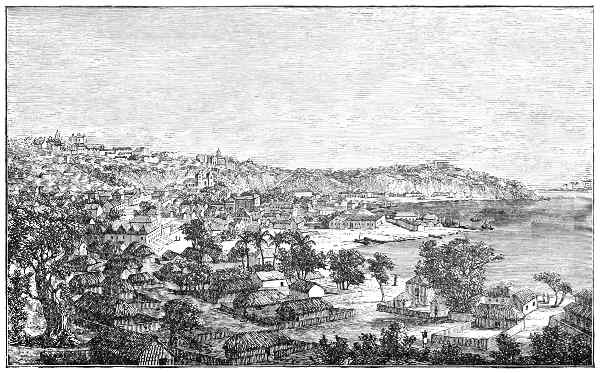
Then for years death-like quiet reigned in the city, and all signs of commerce ceased. But this stagnation was not to last forever. England and other commercial nations of Europe, in their efforts to find markets for the sale of the products of their mills and workshops, had established depots for trade at almost every important place in the world. The eyes of European merchants were turned towards the prolific field of southwest Africa.
Stories which told how great wealth was to be gained in African trade began to be chronicled in the exchanges of all the great commercial centres, and a wave of commercial endeavor was put in motion, which carried with it many richly freighted barks to again fill the harbor of the African city of St. Paul de Loanda. Since then Loanda has improved beyond all expectation, and now the vessels of four lines of steamers as well as many sailing craft are constantly in the harbor loading and discharging their cargoes. Many large public buildings have been built. Acres of flat and swampy shore have been reclaimed and are now utilized for docks and wharfs. Ruins of churches and monasteries have been cleared away and walks and squares have been laid out and planted. There are many shops supplied with all kinds of European goods. Pipes have been laid, through which flows into the city sweet water from the river Bengo, nine miles away, and when the railway, now in course of construction, is in operation to bring the products of the farms, plantations and rich forests of the interior to the city, Loanda will have become a fair specimen of a thriving tropical town.
The city is situated on the shore of a large and beautiful bay and is divided into a lower and an upper town. The “Cidade Buixa,” or lower town, which is built on the flat shore which fringes the water of the bay, nestles at the base of a hill and straggles up its rising sides until it joins the “Cidade Alto.” The upper town stretches along the brow of the elevation and sweeps outward towards the ocean until it ends at a bold and rocky precipice where Fort St. Miguels, a frowning sentinel, watches over the safety of the port.
The harbor is a bay where a thousand ships might at one time ride at anchor and find secure protection from the severest storm. A long, low and narrow neck of land, called Isle of Palms, leaves the mainland about twelve miles to the south and runs north until it reaches a point opposite the city, where it flattens out its surface of sunlit sands to give protection to the harbor of which it forms the southern boundary.
FOREST SCENE IN ANGOLA.
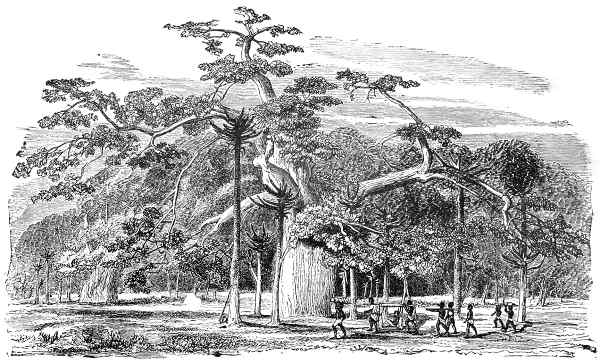
This spit of land is partly covered with groves of cocoa palms, among which the residents of the city have erected many small houses where they visit daily to enjoy surf bathing. On other parts of this sandy breakwater are numerous villages occupied by native fishermen, who make an easy living.
Loanda contains a population of nearly 20,000 people, about one-third of whom are white. The houses, as a rule, are built of stone and roofed with tile, and are large and commodious. The houses all have spacious yards attached, in which are situated the stores, kitchens, wells and habitations of the slaves and servants. Arranged in this manner, and with wide and spacious streets, the city is very open and comparatively healthy. It covers a large expanse of ground. The principal business street contains a number of fine structures. On it are situated the buildings of the Banco da Ultra Marenho, the barracks of the military police, the custom-house and the offices of the foreign consuls. There are also three hotels, many stores and warerooms, several billiard rooms and cafés. In the middle of the street rows of banyan trees have been planted, making a shady walk, where the natives gather to buy and sell.
These open-air sales, called in Bunda talk “Quitanda” market, are well patronized. Four uprights, a few “Loandas” mats for a shed, a stone-bowled pipe and a wooden pillow, are all the furnishings needed to make comfortable the colored women merchants. On the ground and all around the booths are laid out pieces of cotton, cheap calico, brilliantly colored handkerchiefs, native-made baskets containing balls and reels of cotton, beads, needles, pins, etc., cheap crockery and cutlery, empty bottles and balls of different colored clay. Suspended from the uprights and resting against the trees are stacks of native tobacco, plaited into rolls or wound about sticks and sold by inches. The venders at these open sales are always women, and as a rule are clean and comely. They are shrewd sellers and close buyers, and in a few years become, from a native’s point of view, quite wealthy. When conducting the business of the day, they squat or lie down upon the sand and indulge in quip and joke, and gossip with one another and their customers.
Covering a whole square in the center of the lower town is the general market. It is a large, square, uncovered enclosure made of terra cotta and brick, built in excellent taste. All the public buildings of Loanda are under the direct control of the military police and are well conducted.
At break of day one hears the loud sound of many horns, trumpets and beating drums. Down through the flower scented streets, in soldierly order moving, with burnished guns and glistening bayonets, 100 blacks, all dressed in spotless white, come marching until they reach the market gates. Here good Father Anselmo, of the Ursulines, pours out a benediction upon the market and the awaiting people. When the gates are opened the police take their stations and the market is ready to receive the buyers and sellers of the day. Through the open portals into the market flows a stream of laughing, singing men and women. One carries upon her head a large basket, from whose open top protrudes the heads of cackling geese and scolding hens. Another has a pot of neichineas (water oil). Some bring meat and others vegetables. Millions of fleas and “jiggers” are always present, and in and out among the wares run countless naked and dirty children. The buyers and sellers shout aloud in boisterous tone.
Besides this market there is another given up entirely to the sale of fish. In the haze of early morning, far out upon the ocean, hundreds of black spots are seen bobbing up and down upon the water. They are the canoes of the fishermen who are hastening towards the land with the fruit of their night’s labor. In a little time they reach the shore and their scaly cargoes are tumbled out upon the sands. The women and children at once proceed to clean the fish. In one spot they arrange the fish for drying, while others salt and pack them in barrels for shipment. Others, again, fry, boil and roast the fish and all are eating raw or half-cooked fish, interspersing everything with shouting, singing, dancing and grunts of satisfaction.
During the period when the city’s prosperity was interrupted, its streets were left uncared for and their beautiful pavements became covered with a bed of loose red sand, which was washed by the rain down from the surrounding hills. This drifting still continues, rendering walking so very difficult that it is indulged in only by the convicts and natives. The better classes have resource to the “maxilla.” The “maxilla” is a flat frame of canework with one or two arms at the side and a low back provided with a cushion. This frame is hung by cords to a hook on a palm pole, about eighteen feet long, and is carried upon the shoulders of two blacks, who travel with it easily at the rate of three or four miles an hour. It is covered with an awning of oiled cloth and has silk curtains hung all around it.
Loanda is a convict settlement, but, contrary to what might be expected, its people are remarkably law-abiding. This may arise from the fact that discovered law-breakers are punished most severely, often dying under the lash. The convicts, as a rule, are store-keepers and farmers. They are prosperous, and soon become contented with their lot and rarely return to Europe. Ignorant and unrefined, they assimilate readily with the native classes, and take part in all their pleasures.
The “batuco,” country dance, is the popular form of amusement. A “batuco” is danced in the following fashion: A large ring is formed of men and women. On the outside several fires are kept burning, near which are assembled the musicians with horns, drums and the twanging “maremba.” Others clap their hands and sing a kind of chorus. Two dancers, a man and a woman, jump with a yell into the ring, shuffle their feet with great rapidity, passing backwards and forwards. Then facing one another, suddenly advance and bring their breasts together with a whack. These dances are not in great favor with the better class of free blacks, but this does not prevent them from occurring every night. Although the abolition of slavery is supposed to have taken place in 1878, almost all servants are slaves. They are well treated, however, as public opinion condemns harshness and quite a rivalry exists in having household slaves well dressed and happy looking.
The city has no places of public amusement except a theatre, but this for some time has not been used on account of a social war between the married women and those who do not consider the marriage ceremony essential to their welfare. There is a fair military band, however, which plays twice a week in the park in the upper town, and there is hardly a night that there is not something going on at some of the private homes. A dance at the Governor’s palace is certain to be given once a mouth.
The aborigines of Loanda owe much to the Catholic Church. Its priests have taught the natives many trades and industries. There are four newspapers published in the city, but they deal mainly in unpleasant personalities.
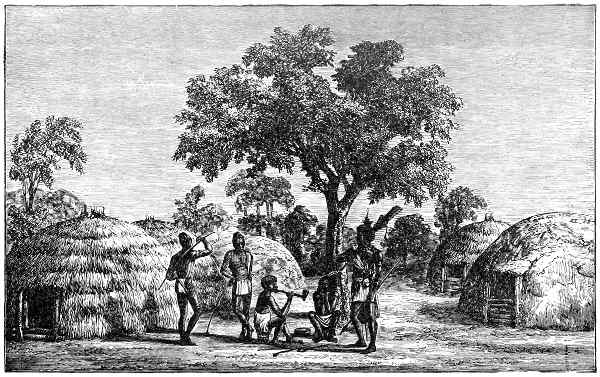
Even more important than Angola, in a commercial and political sense, is the Portuguese province to the south, known as Benguella, with Benguella as the capital. The town is an old one and has not shared the decay incident to the early Portuguese settlements on the western coast. The harbor is excellent, and is the entrepôt to the celebrated Bihé section, through a series of tribes which Pinto visited and which he describes as of superior physique and intelligence. Benguella was once the seat of an active slave trade, and Monteiro says, in his volume published in 1875, that he has seen caravans of 3,000 blacks coming into Benguella from Bihé, fully 1,000 of which were slaves. The white settlers cleared many fine plantations about Benguella, which they stocked with slaves and upon which large crops of cotton were formerly raised. The contiguous tribe is the Mundombe, wild and roving, dirty and selfish, little clothed and living in low round-roofed huts. Cattle are their principal riches, yet they seldom partake of their flesh, except upon feast days, when the whole tribe assembles, and as many as 300 head of fine cattle are dispatched in a single day.
It is only within the last few years that this region has been entered by the Protestant missionaries. In 1880 the American Board sent out three missionaries to Benguella, the port of the Bihé country. They were Rev. Walter W. Bagster, grandson of Samuel Bagster, publisher of the Polyglot Bible, and the leader of the expedition; the Rev. Wm. H. Sanders, son of a missionary in Ceylon; and Mr. Samuel T. Miller, both of whose parents were slaves. The kings of Bailunda and Bihé showed themselves friendly, and the missionaries, since reinforced, entered hopefully upon their work. On February 22, 1882, Mr. Bagster died from malarial fever. Bishop Taylor has opened up a number of stations in Angola, of which mention will be made when we come to speak of his work in establishing self-supporting missions in Africa.
MUNDOMES AND HUTS.
A wonderful field has been opened up along the mighty Congo for missionary effort. Ten years ago the king of Belgium entered upon the development of the Congo region and the establishment of a new African State. An official report of the progress attained has just been rendered, giving these facts: The Lower Congo has been opened up to navigation by large vessels as far as Boma, soundings having been made and the course marked out by buoys; a cadastral survey of the Lower Congo has been made as a step towards the preparation of a general map of the entire region; justice is regularly administered in the Lower Congo, and a trustworthy and cheap postal service has been established. At Banana, Boma, and Leopoldville medical establishments, under the direction of Belgian doctors, have been founded, and a considerable armed force of blacks, officered by Europeans, has been called into existence. The caravan route between Matadi and Leopoldville is as free from danger as a European road, and a complete service of porterage by natives has been established. A railway has been projected and the route almost entirely surveyed. The state has established herds of cattle at various stations, and in the very heart of Africa; on the waters of the Upper Congo there is a fleet of steamers every year increasing in number. A loan of 150,000,000 francs has been authorized and the first issue subscribed. Many of the more intelligent natives from the country drained by the Upper Congo have taken service with the State, and numerous trading factories have been established as far up the river as Bangala and Leuebo. In addition several private companies have been formed for developing the country, and finally geographical discoveries of the greatest importance have been made, either by the officers of the State or by travelers who received great assistance in their work from the State.
Speaking of the Congo Mission Dr. Pierson in the Missionary Review says: “A grand open door is that which God has set before our Baptist brethren in the Congo basin! a million square miles in the heart of equatorial Africa, made accessible by the great Congo and its tributaries.
“The great lakes, Nyassa, Victoria, Tanganyika, are comparatively isolated; but the Congo and its branches present from 4,000 to 6,000 miles of river roadway, needing only steamers or canoes to give access to these teeming millions. One starts at the mouth of this imperial stream and ascends 125 miles of navigable river, then for 185 miles encounters rapids and cataracts; but beyond that for over 1,000 miles, from Stanley Pool to Stanley Falls, is one grand stretch of navigable river, with branches running each way navigable from 100 to 800 miles, and leading into the heart of this rich and populous territory.
“The people from the river-mouth up to Stanley Pool and the Equator line are being civilized by contact with white traders, and their pagan customs largely modified. They speak one language, musical, of large capacity of expression and easy of acquisition, and along this line the seven Congo stations are already planted. Beyond the point where the Congo crosses the Equator, lies another vast population, more degraded, less civilized, and needing at once the full array of Christian institutions, but yet entirely destitute.
“Their moral and spiritual state is hardly conceivable without contact with them. With no idea of God or immortality, they worship fetish charms; sickness is not brought about by natural causes, but is the result of enchantment; hence the medicine-man must trace disease and death to some unhappy human victim or victims, who must suffer the witch’s penalty. One death therefore means another—it may be a dozen. Here runaway slaves are crucified, robbers buried alive, young men cruelly decapitated, and human beings are even devoured for meat.
“And yet this people, after centuries of virtual seclusion, are now both literally and morally accessible. They welcome missionaries, come to the chapels, and prove teachable. Even now cruel customs and superstitious notions are giving way before patient, humble, scriptural instruction. The walls are down, and the hosts of God have but to march straight on and take what Dr. Sims calls ‘the last stronghold of Paganism,’
“Wonderfully indeed has God linked Protestant, Greek, Roman Catholic, and even Moslem nations in the administration of the Congo Free State. Never was such a highway open for the Gospel since our Lord ascended.
“The Arabs from Zanzibar and the coast are moving toward Stanley Falls and the north country, establishing themselves in large villages to capture slaves and carry on nefarious traffic, while the Protestant forces slowly move upward from the west. The question is, Who is to occupy the Congo Basin? and the question is to be settled at once. This great highway of rivers means traffic and travel; this rich and splendid tropical country invites trade and settlement. Into whose hands shall such a heritage be surrendered? The Christian Church must give prompt answer by action, her reply must be a taking possession, and the old law is the new one: ‘Every place that the sole of your feet shall tread upon shall be yours,’ the resolutions of enthusiastic missionary conventions, the prayers of all Christendom, the planting of the banner of the cross at a few commanding points—all this will not do. We must send out enough Christian laborers to measure off that soil with their own feet.
“‘But it is unhealthy?’ So are all tropical and especially equatorial climes to those who are not accustomed to the intense and steady heat, and do not use common sense in adapting their clothing, eating and drinking, and habits of life, to these peculiar surroundings. One must not go from temperate to torrid zone, and wear the garments, eat the heating food, use the stimulating drinks, risk the exhausting labors, or even live in the same unventilated houses which are permissible in cooler latitudes. A trip to New Orleans or Florida has proved fatal to many a fool who would not take advice. Even the heroism of the Gospel does not demand needless exposure or careless venture.
“Here is a grand opportunity. It may be doubted whether there has been anything like it since the clarion voice of our Great Captain trumpeted forth the last commission. Ethiopia is stretching forth her hands unto God. On those hands are the marks of manacles which England and America helped to rivet there. There is but one atonement we can make for Africa’s wrongs—it is to lay down our lives, if need be, to redeem her sable sons from the captivity of sin.
NATIVE GRASS HOUSE ON THE CONGO.
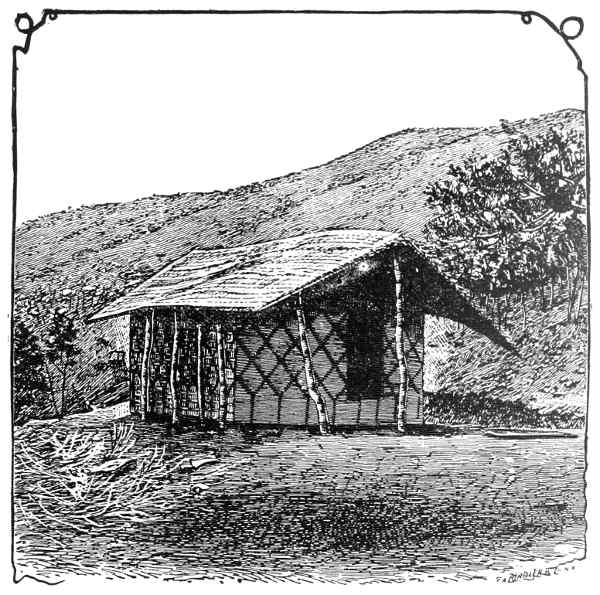
“We ought to turn this Congo into a river of life, crowd its waters with a flotilla of Henry Reeds, line its banks with a thousand chapel spires, plant its villages with Christian schools, let the Congo Free State mark its very territory with the sign of Christian institutions, so that to cross its border will be to pass from darkness into light. Where is our Christian enterprise, that such a work, with such a field and such promise, should wait for workmen and for money! What do our converted young men want, as a chance to crowd life with heroic service, that the Congo Basin does not attract them! Here what a century ago would have taken fifty years to accomplish, may be done in five. The unexplored interior is open, the ‘Dark Continent’ waits to be illuminated. Nature has cast up her highway of waters, and there is no need to gather out the stones. Give us only the two-wheeled chariot, with steam as the steed to draw it, and the men and women to go in it bearing the Gospel, and from end to end of this highway we can scatter the leaves of that tree which are for the healing of the nations.
“Where are the successors of Moffatt and Livingstone! What a hero was he who dared forty attacks of fever and then died on his knees beside Lake Bangweolo, that he might open up the dark recesses of Africa to the missionary! Let us pour men and money at the feet of our Lord. We have not yet paid our debt to Simon the Cyrenean and the Eunuch of Ethiopia!”
The Baptist church has for years carried on energetic mission work in Africa. The English Baptist Missionary Society, working in co-operation with American Baptists, has pushed its way, by means of flourishing stations far up the Congo and into the interior. In 1885, it presented a steamer, on the Upper Congo, to the American missionaries, and then proceeded to build another for its own use. Dr. Guinness, the president of this large and prosperous society, on a visit to the United States in 1889, spoke thus of the missionary field in Africa: “Stanley was three years in discovering the source of the Congo, and though he met hundreds of strange tribes in that journey of 1000 miles, he never saw a mission station. He found difficulty in coming down this region, but our missionaries sent out to evangelize this country found their difficulty in going up. We found it comparatively easy to found a station near the mouth, and as far as a hundred miles up. After years of labor we reached Stanley Pool, which is the key to the interior, but not without the loss of hundreds of lives.
“The mission in Africa is in its infancy. Africa is a world in itself. The languages spoken would take more than ten hours to enumerate, as there are over 600. They are principally the great Soudanese groups. I gave a year to making the first grammar of the Congo language that was ever prepared. More than 1000 natives have been converted. In this work there is the stage of pure indifference, succeeded by one of inquiry, then hostility, and finally acquiescence. The natives themselves become in many cases messengers of the Gospel.
“I don’t know under Heaven, unless it be in China, a more hopeful mission than that Congo field, and here it is for you. You have now water-way to the whole of it. It is healthy, notwithstanding all statements to the contrary. The interior is healthy, because it is high land, well watered, richly wooded, moderate in its climate, and rich in population. The trouble with missionaries has been that they stick to the coast line, which is malarious. Instead of keeping up in the ordinary way in red-tape style a particular station with a few missionaries, you want to make an advance into this great interior parish. It is no use for your people in this country to say: ‘This is the colored men’s work, let them do it,’ They are not suited to be the explorers and controllers of such movements. White men must be the leaders and lay the foundation, when the colored men will be the helpers.”
Mr. Guinness is maturing plans for a grand advance of three columns of missionaries to go simultaneously up the three branches of the Congo—northern, central and southern. The central one may be considered as started a fortnight since, by the departure of eight missionaries from London, to work as an English auxiliary to the American Baptist Missionary Union.
Mr. Richards, of the American Baptist Missionary Union, reports that the work at Banza Manteke, the place where so many converts have been baptized, is still prospering. The young church has been greatly tried by persecution as well as by sickness and death. Not less than twenty of those baptized have died, and the fatality has been a great stumbling-block to the heathen, who have asserted that the sickness was sent by their gods because they have been neglected. This has prevented many from accepting the Christian faith. The heathen are bitterly opposed, and would take the lives of the Christians if they could. Recently 17 were baptized, and others are asking for the ordinance, and the knowledge of the truth is spreading far and wide.
Those who become intimately acquainted with the negro race as found in various parts of Africa bear testimony to its good qualities. The coast negro who has learned some of the vices of civilization is undoubtedly a sorry specimen of humanity; but where native tribes can be found uncontaminated by contact with foreigners, they exhibit sterling qualities. Rev. George Grenfell, who has visited all the tribes along the Congo, says that the negro would stand his ground before the white man. “There is a vitality of race and power about him that is going to make him take his place some day among the nations of earth.” In support of this opinion, he gives several incidents showing the vigor and fidelity of the natives, and especially mentioned an incident which he witnessed at Banza Manteka, the station at which the American Baptists have recently received so many converts. Three years ago their place was a stronghold of grossest superstitions, and there seemed no hope of a spiritual harvest; but as Mr. Grenfell was coming down the river, on his way to England, he met a band of native evangelists going forth on an evangelistic tour. They had set out of their own accord, without even the knowledge of the missionary, evidently taking upon themselves the Lord’s command to go and preach the Gospel. They had not only forsaken their own superstitions, but were vigorously seeking to propagate their new faith.
We have thus given in brief outline a sketch of the work done on the west coast of Africa and some of the countries in Central Africa which are reached through the west coast. In no part of the world has the Gospel achieved more signal triumphs than here, among this barbarous people. When the present century opened, the slave trade, with its untold horrors, held everywhere undisputed sway. Human sacrifices and other cruelties were fearfully prevalent. Revellings and abominable idolatries, with the other works of the flesh described in the fifth chapter of Galatians, were indulged in to a frightful extent and without the slightest restraint. There was then not one ray of light to relieve the dense darkness that universally prevailed. It is otherwise now. Though little has been done compared with what remains to be done, still the slave trade and many other cruel practices have received their death blow. The standard of the Cross has been planted all along the western shores, and even far into the interior of that great continent. In all West Africa, called “The White Man’s Grave,” from Senegambia on the north, where the Paris Society is laboring, to Benguella on the south, where the American Board has begun to work, there are more than a hundred stations and over 200 English, German, French and native missionaries, belonging to sixteen societies, with 120,000 converts. And were it not for the evils of civilization, which are so much easier for the poor barbarians to learn than the virtues, there would be nothing to prevent the universal spread of the Gospel in Western Africa, for the people there are willing to receive the simple proclamation of Divine truth, and the Christian church is awaking to the glorious privilege of making it known unto them.
Little mention has been made of the work of Bishop Taylor in this sketch of the missions of Western Africa. His work is of such recent date, and of so unique a character that we deemed it of sufficient importance to warrant a fuller treatment than could be given in connection with the other missions. By this method also we can give a much clearer idea of what he has done. As his mission stations are confined to Western Africa, and regions entered by way of the west coast, this is the proper place to speak of his enterprise.
Perhaps the most notable missionary movement of the age is that started by Bishop Wm. Taylor of the Methodist Episcopal Church, on the continent of Africa. Bishop Taylor is of Scotch-Irish parentage, his grand parents having immigrated from County Armah, Ireland, to Virginia about 130 years ago. They were Revolutionary patriots and so hostile to slavery that they set all slaves free, belonging to the family. His father, Stuart Taylor, married Martha A. Hickman, and they settled in Rockbridge County in 1819. They were Presbyterians, but eventually became converts to Methodism. The son, William, was born May 21, 1821. In 1843 he was attached to the Baltimore Conference. He came into notice as a Methodist street preacher, of extraordinary power, in San Francisco, in 1849. He established a church there and continued to preach till 1856. Being a natural pioneer in the mission field, full of pluck and original ideas, he visited other parts of the United States and went into Canada and England. Then he went to the West Indies and into British Guiana, preaching and founding churches. Next, he visited Australia, where he met with a success which may well be called phenomenal. The same success attended his trip to Tasmania and New Zealand. With a foot that never tired, he went to South Africa and then to the Island of Ceylon, awakening the people by his eloquence and earnestness. He returned through India, arousing the sleeping nations, and leaving as a permanent monument to his fame the fully organized South India Methodist Conference.
SOME OF BISHOP TAYLOR’S MISSIONARIES. 1: Rev. B. F. Kephart, St. Paul, Minn. 2: Mrs. Kephart. 3: Agnes McAllister, Troy, Ohio. 4: Barbara Millard, Hemmingford, Quebec. 5: Eddy H. Greely, Fostoria, Ohio. 6: Georgina Dean, Des Moines, Iowa. 7: Clara Binkley, Bristol, Ontario. 8: K. Val. Eckman, Fulda, Minn. 9: Robt. C. Griffith, Gotland, Sweden.
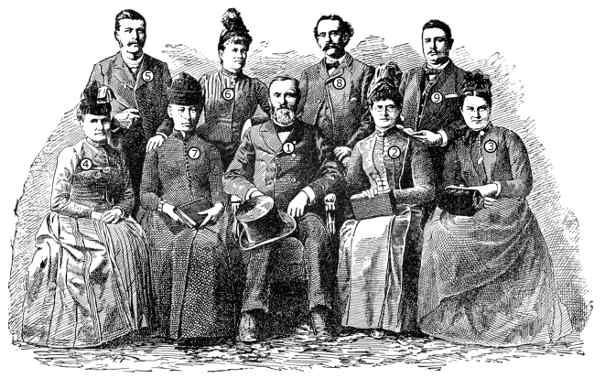
He was now in the midst of his powers, and with well defined aims as to the plan and scope of mission establishments. As to himself, personal work was what was required; as to the missions, a sense of independence which would conduce to their growth and perpetuity. No mission was to be an asylum for lazy, superannuated men and women, drawing on a home fund for support, but each was to be self-supporting as far as possible, after its period of juvenility was over. Full of this impression he entered the Brazilian country, or for that matter, South America at large, and began a work of founding missions which astounded his church and the world by its success. Schools and churches sprang up as if by magic, right in the midst of populations wedded to the old Catholic creeds and forms, and the effect of his evangelism is as far reaching as time.
After this he turned his attention to Africa, as a field calling most loudly for civilization and Christianity; and more, as the field best suited to his evangelizing methods. He was elected Bishop of Africa by the General Conference of the Methodist Church, in May, 1884, and sailed for his new and limitless parish in December, 1884. After four years of heroic struggle, with successes which in every way justified his labors and plans, he returned to the United States in April, 1888, and sailed again for Africa in December of the same year, having equipped and sent in advance, November 13, 1888, twenty new missionaries.
His Transit and Building Fund bore the expense, and it was well supplied for the emergency by voluntary contributions from the United States and Canada. Fifteen homes in Africa became a requisite for these Christian workers, together with at least a year’s sustenance. Still the fund failed not, but had to spare for the Bishop’s personal comfort. Thus at one end of the Christian line work inured to the supply of necessities which should lead up to self-support in the missionary field, and at the other end it shaped for the development of those indigenous resources which should establish independence.
The characteristics of his work, aside from his individual energy, wonderful ingenuity, and magnetic power, are:
(1) Self-supporting Missions. Missionaries are provided with a suitable outfit, have their passage paid, are provided with a home and seeds for planting. They are expected to do the best with the first year’s equipment, and to take such steps as will put them on an independent footing by the second year. This is not more a test of their own industry and efficiency, than an example to the natives to live in peace and adopt civilized means of obtaining a livelihood. It is an invitation to heroic spirits to enter the mission field, and is an earnest of tact and endurance which must prove of infinite value to those with whom they are in contact. It is the nearest approach any church has ever made to the thought, that a spiritual avenue to the heathen, and especially the shrewd African heathen, is most direct when it leads up through his business and work-a-day instincts to his heart.
(2) Native Coöperation. This is best assured by appearing to be on an equality with them. The missionary who is backed by a home exchequer and who is not compelled to resort to ordinary means of subsistence, is apt to grow exclusive and become a source of envy and suspicion. He is far more potential when he is as much one of his people as circumstances will allow, and like them dependent on the ordinary laws of industry for subsistence. There is but little risk in this to the man of energy, skill and health, where climate and soil are favorable for production, and all nature conspires to reward industry. It attracts the natives, secures their confidence and coöperation, and adapts them for the almost unconscious receipt of enlightenment and Christianity. Nothing so disarms them of suspicion, or serves better to silence controversy, than this quiet show of permanent settlement in their midst and the atmosphere of thrifty contentment which surrounds a newly-made mission home and vegetable garden.
(3) Elements of a Pure Civilization. The school goes with the mission, the garden and field with the school. Sermons there are, but not to the neglect of school work. School-hours there are, but not to the neglect of soil cultivation. Practical education is paramount. The seeds, the trees, the plants, which are fitted for the climate, are planted and tended, and the natives are asked to come and work by the side of the missionary and to learn the art of turning the earth to account. Thus a primitive Industrial School is started in every mission, and the laws of thrift and self-dependence go hand in hand with those of morality and spirituality. As things have gone, it is surely a novel, and perhaps a hard, life for a missionary, but in that it is an effective means of conversion and enlightenment, the sacrifice does not seem too great. After all, does it not entirely meet the objections of those who so vehemently urge that the only way to make missionary work successful among African natives is to wait until commerce has reconciled them to contact with the outer world?
(4) Not Confined to the Ordinary Ministry. It opens the field of missionary endeavor to earnest, moral men of every occupation. Teachers, artisans, laborers in every branch of industry, become invaluable servants of the Lord, under this system. Children as well as parents may share the honors of introducing Christ in this practical way, the key to which is example. What so inspiring as the confidence of equality and co-labor! To be like a teacher in what appertains to material welfare, is father to a wish to be like him or her in what appertains to spiritual welfare.
(5) Coast-Line Missions. These are practicable and necessary at first. But they are only evangelical bases for the more numerous and grander structures soon to be erected within the continent.
In support of his system the Bishop brings to bear an experience wider than that of any living missionary, to which must be added a special study of the African natives and the entire African situation.
He says that the untutored heathen of Africa have no vain philosophy by which to explain away their perception of God as a great personal being. They have their “greegrees,” “charms” and “armulets,” but they never pray to them, they cry to God in the day of trouble. In the extreme south God’s name is “Dahlah,” “Tixo” and “Enkosi.” In south central Africa His name is “En Zambe.” The Zambesi river is called after God. On the west coast his name is “Niswah.” All these words express clear perceptions of one great God of heaven and earth.
He further relates that one day he was preaching to King Damassi of the Ama Pondo nation, about the resurrection. One of the king’s counsellors expressed dissent from the Bishop’s doctrine. The king, a giant in physique, frowned at him and said: “Hold your tongue you scoundrel! You know well our fathers believed in the resurrection of the dead, and so do we.”
When a Kaffirman dies they dig a grave about two feet wide and five deep and let the corpse down in a squatting position. But before it is lowered they seat him beside the grave, to allow anyone who wishes to talk with it. This is consequence of their belief that though the spirit has left the body it still lingers near for a last communication with friend or foe. If any present has an unadjusted quarrel with the hovering spirit, he approaches and makes his peace, and then begs that the shade will not return to bewitch his children or cattle. Others come and send messages of peace to their fathers by means of the departing spirit, and still others send word very much as if the departure of a spirit were a sure means of communication between this and the final home of good people. When analyzed, their belief is supreme that the body returns to dust at death, but that the spirit is immortal; that the spirit retains all its faculties and forces, and has independent senses corresponding with the bodily senses; that good spirits dwell with God in happiness and that those who follow will commune with them. These things they have never learned from books, nor teachers. They are intuitions.
In February, 1888, Bishop Taylor visited a dead chief, near Tataka on the Cavalla river. He had been a prominent man, a giant in size, and had given leave to found a mission in his tribe. But he knew no language but his own and had never heard the Gospel preached. He was found sleeping tranquilly in death, and inquiry revealed the fact that he had talked all through the night of his death with “Niswah”—God—and had called on Him repeatedly—“Niswah I am your man!” “Niswah, I trust you!” “Niswah, I accept you!” Belief, even unto salvation, could not have been seemingly stronger.
To translate the Christian Bible into the languages spoken by those among whom missionary effort is put forth, has always been regarded as a necessary step to successful apostolic work. It would be an herculean, if not impossible task in a country where languages are so numerous and dialects so diverse as in Africa. Even if not so, the task requires scholarship of a high order, patience such as few mortals possess, time which might count for much if otherwise employed, and an exchequer which can be drawn upon indefinitely. Bishop Taylor has reversed the old procedure in his missionary contact with the African natives. Still recognizing the necessity for learning their languages in order to facilitate communication, he, however, insists that they shall learn ours, as a means of fuller expression of ideas, and especially of those ideas which represent newly acquired knowledge and quickened spiritual emotions. But how should he overcome the formidable obstacle our language presents, in its complicated grammar and orthography, to all foreigners? Especially, how should the African boy and girl, in the mission school, be taught what our own more favored boys and girls find so appallingly difficult? The Bishop’s way out of it was to introduce the phonetic, or natural sound, element into his mission schools. It proved, in common parlance, a hit from the start. Here is a sample of his English, as phonetically adapted for his African pupils:
“Bishop Taylor findz our English mod ov speling wun ov the gratest drabaksin teching the nativz; and also wun ov the gratist obstiklz in redusing the nativ languajez to riting. Mishunarez evri whar hav kompland ov thez dificultez. Bishop Taylor haz kut the Gordian not; or at lest haz so far swung los from komun uzaj az to adopt Pitman’z fonetik stil ov reding, riting and teching.
“Just rit a fu pajz, speling az we do her; and then, ‘just for the fun ov it,’ rit a few letrz to frendz in the sam stil. Bi the tim u hav dun so, u wil be enamrd with its ez, and son will pronouns it butiful az wel az ezi. Tech it to sum children and se how qikli tha wil mastr it.”
Probably no better description can be given of what has already been accomplished, than that found in his report to the Missionary Committee, which we give in full, and in extracts from his recent letters.
BISHOP TAYLOR’S REPORT TO THE MISSIONARY COMMITTEE.
“Dear Brethren and Fellow-laborers in the work of the Lord:
“I respectfully submit the following report of our new missions in Africa. The report of the African Conference I sent, as usual, to the missionary secretaries immediately after its adjournment last February. I might repeat the same here, but did not retain a copy, and leaving Liberia in April, and ever since moving on, I have not received a copy of the printed minutes.
“I will, in this report, note the stations in the order in which I visited them this year, and not in the order of time in which they were founded.
“West Coast Stations.—Most of these stations commenced, with mission-houses erected on them, two years ago, when a portion of them were supplied with missionaries, a portion not till March of this year; and two or three remain to be supplied. Miss Dingman and Miss Bates have gone out since I left Liberia, and I have not heard where Brother Kephart has stationed them. It was understood from the beginning that we could not take boarding-scholars, nor open our school-work regularly till we could produce from the soil plenty of native food for their sustenance, and build school-houses. I arranged for building fourteen houses in our missions on the west coast this year for chapel and school purposes. I have received no general report since I left in April; hence, I cannot say how many of these houses have been completed. They were to be good frame and weather-boarded and shingle-roofed houses, 18×25 feet, and will, I doubt not, be all finished before the end of this year.
“Cavalla River District.—B. F. Kephart, P. E.
“(1) Wissikah Station, about forty miles up from the mouth of the river. Its king, chiefs and people received a missionary, built him a good native house and supported him for several months, when he was removed to supply a larger station vacated by one who withdrew from our work; so Wissikah remains to be supplied. Probable value of our land and improvements on Wissikah Station, $500.
“(2) Yubloky, ascending the stream, also on the west bank of Cavalla river. Missionary, J. R. Ellery. A good basis of self-sustentation already laid. Probable value, $1,000.
“(3) Yorkey.—Andrew Ortlip, missionary. Regular preaching in both of these stations, and some progress in teaching. Probable value, $1,000.
“(4) Tataka, on the east bank of the river, Miss Rose Bowers and Miss Annie Whitfield, missionaries. These are very earnest missionaries, and have done an immense amount of hard work, teaching, talking of God and salvation to the people in their own houses and growing most of their own food. Probable value of land improvements, $1,000.
“(5) Beabo.—H. Garwood, missionary. Brother Garwood was appointed to Beabo last March, and will, I trust, make a success, which was but limited under the administration of his predecessor, who is a good man but not a self-supporting success, and has hence returned home. Beabo is on the west bank of the river, and has adequate resources of self-support, and of opportunities for usefulness. Probable value, $900.
“(6) Bararobo, on the east bank. Chas. Owens and E. O. Harris, missionaries. This station, with two energetic young men to develop its capabilities, will, I hope, in the near future prove a success. Probable value, $900.
“(7) Gerribo, west bank. A mission-house built two years ago, but the station remains to be supplied. Probable value, $800.
“(8) Wallaky is the big town of the Gerribo tribe, twelve miles west of Gerribo town, on west bank of the river. Our missionary at Wallaky is Wm. Schneidmiller, a zealous young man from Baltimore. Having been brought up in a city, he has much to learn to become an effective backwoods pioneer; but he has faith, love, push, and patience and is succeeding. Probable value, $900.
“We have traveled nearly a hundred miles up the river, almost equal to the Hudson, and then west twelve miles to Wallaky. Now we go south by a narrow path over rugged mountain, hills and dales, a distance of about forty miles to—
“(9) Plebo.—Wm. Yancey and wife, missionaries. A hopeful young station of good possibilities. Probable value, $900.
“Nine miles walking westerly we reach
“(10) Barreky.—Wm. Warner and wife, missionaries. They are hard workers, and are bound to make self-support. Brother Warner is mastering the native language, and when ready to preach in it, will have open to him a circuit of eleven towns belonging to the Barreky tribe. Probable value, $900.
“On eight of the ten stations just named, we have frame, weather-boarded, shingle-roofed houses, the floors elevated about six feet above ground; the whole set on pillars of native logs from the forest. In all these places, also, school-houses, as before intimated, are being built. Each station is in a tribe entirely distinct and separate from every other tribe, and each river town represents a larger population far back in the interior of the wild country.
“Cape Palmas District.—B. F. Kephart, P. E. Brother Kephart is Presiding Elder of Mt. Scott and Tubmantown Circuit. Sister Kephart is a grand helper. They are teaching the people the blessedness of giving adequately to support their pastors. These people are confronted by two formidable difficulties, their old-established habits of being helped, and their poverty and lack of ability to help themselves; but they are being blest in giving like the Widow of Serepta, and will, I hope, work their way out.
“Clarence Gunnison, our missionary carpenter, and Prof. E. H. Greely. B. A., to be principal of our academy and missionary training-school in Cape Palmas, as soon as we shall get the seminary repaired, have their headquarters at Cape Palmas, but are engaged in building school-houses, and will then (D.V.) repair the seminary buildings, both in Cape Palmas and in Monrovia. We had unexpected detention in getting suitable lumber for repairs, but can now get the best Norway pine delivered on the ground at a cheap rate.
“(11) Pluky, across Hoffman River, from Cape Palmas, is the beginning of our Kru coast line of stations. Miss Lizzie McNeal is the missionary. Though two years in the station, we have not yet built a mission-house in Pluky. Miss McNeal teaches school in a native house in the midst of the town, and preaches on Sabbath days under the shade of a bread-fruit tree. Her school-house is crowded, and she has six of her boys and three girls converted to God, who testify for Jesus in her meetings, and help her in her soul-saving work. Probable value, $800, in land. Miss Barbara Miller assists her temporarily, but her specialties are kindergarten and music, awaiting the opening of the academy.
GARAWAY MISSION HOUSE.
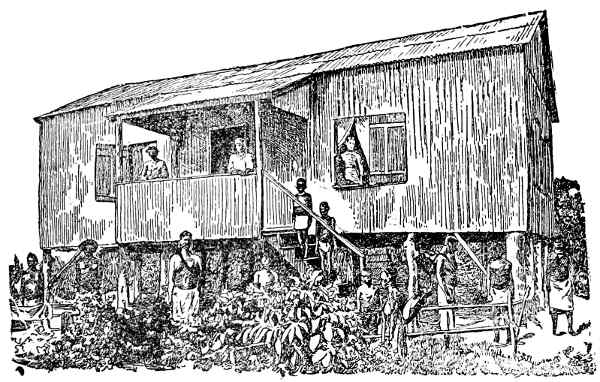
“(12) Garaway, twenty miles northwest of Cape Palmas. Miss Agnes McAllister is in charge of the station, and Miss Clara Binkley has special charge of our educational department, both working successfully as missionaries. Aunt Rachel, a Liberian widow woman, runs the farm, and produces indigenous food enough to feed two or three stations. This is a station of great promise. Probable value, $1,200. We have a precious deposit in a little cemetery on the plain, in sight of the mission-house, of the consecrated blood and bones of dear Brother Gardner and dear Sister Meeker.
“(13) Piquinini Ses.—Miss Anna Beynon is in special charge of the household department. Miss Georgianna Dean has charge of the school-work, and Victor Hugo, a young German missionary, has charge of the school farm. Mrs. Nelson, a Liberian widow, is chief cook. They are succeeding hopefully for beginners. This station is about thirty miles northwest of Cape Palmas. Probable value, $1,100.
“(14) Grand Ses.—Jas. B. Robertson, assisted by Mr. Hanse, a Congo young man, who was saved at a series of meetings I conducted in Cape Palmas, in 1885. They are just getting started in their work, but already see signs of awakening among the people. Probable value, $1,100.
“(15) Sas Town.—Missionaries, K. Valentine Eckman, R. C. Griffith. I spent a month in Sas Town last spring, and we have there a church organization of probationers, numbering twenty-five Krumen. Probable value, $1,400.
“(16) Niffu. To be supplied. Probable value, $1,000.
“(17) Nanna Kru.—Henry Wright appointed last April, not heard from since. Probable value, $1,000.
“(18) Settra Kru.—B. J. Turner and wife. A fair promise of success in farming, teaching and preaching. Probable value, $1,100.
“On each of these Kru stations named, except Pluky, we have a mission-house of frame, elevated on pillars, six feet above ground; floors of boards from the saw-pits of Liberia, siding and roofing of galvanized iron; each house measuring in length thirty-six feet, breadth twenty-two feet, beside veranda, providing space for a central hall, 12x22 feet, and two rooms at each end, 11x12 feet. There is not a Liberian or foreigner of any sort in any of the stations named on Cavalla River or Kru Coast, except our missionaries, all heathens, as nude as any on the Congo, except a few men of them who ‘follow the sea,’ hence, our houses, which would not be admired in New York City, are considered to be ‘houses of big America for true.’
“(19) Ebenezer, west side of Sinou River, nearly twenty miles from Sinou. New house just completed. Z. Roberts in charge. A school of over twenty scholars opened. The king of the tribe has proclaimed Sunday as God’s, and ordered his people not to work on God’s day, but go to his house and hear his Word. This mission supersedes Jacktown, on the east bank of Sinou River, where we proposed last spring to found a mission, but did not. Ebenezer is worth to us $800 at least.
“(20) Benson River.—Missionary, Dr. Dan Williams. This is in Grand Bassa Country, difficult of access; hence, in my hasty voyages along the coast I have not yet been able to visit the Doctor, and cannot report definitely. He is holding on, and will, I hope, hold out and make a success in all his departments of work. The station ought to be worth $800.
“The Benson River Station is in the bounds of Grand Bassa District. We arranged for building on two other stations in Grand Bassa Country at the same time that I provided for Benson River; namely, King Kie Peter’s big town, and Jo Benson’s town; but at last account the houses were not built, so for the time we drop them off our list. They are on a great caravan trail to the populous interior. We will take them up or better ones by and by.
“From the west coast we proceed by steamer to the great Congo country. Two days above Congo mouth we land at Mayumba, and proceed in boats seventeen miles up an inland lake to Mamby, where Miss Martha E. Kah is stationed, and where our Brother A. I. Sortore sleeps in Christ. When we settled there it was in the bounds of the ‘Free State of Congo,’ but later the published decrees of the Berlin Conference put it under the wing of the French Government. The French authorities have recognized and registered our native title to 100 acres of good land, and are not unfriendly to us by any means, but ‘by law’ forbid us to teach any language but French. Good has been done at Mamby, and is being done. Owing to this disability we have proposed to abandon it, but Martha Kah is entirely unwilling to leave, and as it is our only footing in French territory, and as they hold a vast region, peopled by numerous nations of African heathen, we have thought it best thus far to hold on to Mamby. Probable value, $1,000.
“(21) Kabinda, near the Congo mouth. I never have had time to make the acquaintance of any person at Kabinda. Having full confidence in J. L. Judson as a man of superior ability and integrity, I gave him letters to the Portuguese governor of Kabinda, requesting the consent and co-operation of his excellency, to enable Judson to found a mission there. His excellency received him most cordially, gave him a public dinner, the merchants of the place being guests. For a year he reported extraordinary success in every department of his work. He went in by a dash, and went out like a flash—by sudden death.
“I called at Kabinda last May, and learned from a merchant there that King Frank, of whom Judson bought our mission premises, held the property for nonpayment, which Judson had reported all settled, conveyed, and deed recorded. King Frank, at the time of my call, was absent away up the coast, so that I could not reach the exact facts. I have written to the merchant whom I met, requesting him to find out the facts, but have as yet received no reply. So things at Kabinda are in a tangle at present. I have not yet found time to go and unravel it. To recover it or lose it will neither make nor break us, but we shall regret to lose it.
“Passing the mouth of the Congo River, we proceed by steamer over 300 miles to the beautiful land-locked harbor of St. Paul de Loanda. This Portuguese town has many massive buildings, including churches in ruins, dating back over 300 years. It has an estimated population of 5,000, a few hundred of whom are Portuguese (one English house of business), the rest being negroes. From the beginning we have had adequate self-supporting resources in Loanda from the Portuguese patronage of our schools, and have now, but at present we lack the teaching corps requisite.
“Wm. P. Dodson, who succeeded C. M. McLean, who returned home last May on account of sickness, is our minister at Loanda. He is a holy young man, a good linguist in Portuguese and Kimbundu, and is doing a good work. He has one fine young native man saved, whom I baptized during my recent visit. I learn since that he is leading a new life, and becoming a valuable helper in our work. Our mission property in Loanda is worth at least $10,000. It is quite unnecessary for Loanda or for any other station we have in Africa to add ‘and no debts,’ for we have none.
“We are trying to find just the right man and wife for our school in Loanda, but would rather wait for years than to get unsuitable persons.
“From Loanda we proceed by steamer sixty miles south by sea, and cross the bar into the mouth of Coanza River, as large as the Hudson, and ascend 180 miles to Dondo, at the head of steamboat navigation. Dondo is a noted trading centre, and has a population of about 5,000, mostly negroes.
“We had good property in Dondo, worth about $5,000. A great deal of hard work, successful preparatory work, has been done in Dondo. Its school-work and machine-shop were self-supporting when manned, but is now in the same position as Loanda, awaiting good workers to man it.
MAP OF ANGOLA. Larger.
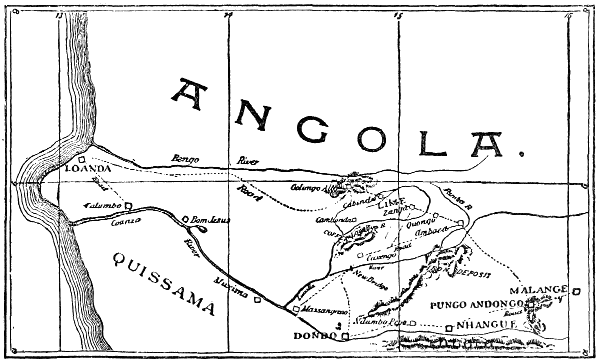
“Our Presiding Elder, E. A. Withey, of Angola District, and his daughter Stella, a rare linguist in Portuguese and Kimbundu, and of great missionary promise, were holding the fort at Dondo when I recently visited that region. Their home was at Pungo Andongo, eighty-nine miles distant. Stella and I walked a mile or more to visit the graves of Sister Cooper, and of our grandest Dondo worker, Mrs. Mary Myers Davenport, M.D., in the cemetery, which is inclosed by a high stone wall. Her last words are inscribed on her tombstone. They were addressed to Him who was nearest and dearest to her in that lone hour—to Jesus: ‘I die for Thee, here in Africa.’ She would have died for Jesus anywhere, but had consecrated her all to him ‘for Africa.’ In about a month from that time our dear Stella, so ripe for heaven, but so greatly needed in Africa, was laid by her side. So that three of our missionary heroines sleep in Jesus at Dondo. Their ashes are among the guarantees of our ultimate success in giving life to millions in Africa, who are ‘dead in trespasses and sins.’
“From Dondo, we ‘take it afoot’ fifty-one miles over hills, mountains and vales, by the old caravan trail of the ages to Nhanguepepo Mission Station. Our property there is worth about $6,000. It was designed to be a receiving station, in which our new-comers might be acclimatized, taught native languages and prepared for advance work. Under the superintendency of Brother Withey a great preparatory work has been done at this station. It has, however, become specially a training school for native agency, under the leadership of one young man of our first party from America, Carl Rudolph. We already have an organized Methodist Episcopal Church at this station, composed of thirteen converted native men and boys, who are giving good proof of the genuineness of the change wrought in them by the Holy Spirit. From 5 to 6 o’clock every morning they have a meeting for worship, Scripture reading and exposition by Carl, singing, prayers and testimony for Jesus by all in English, Portuguese and Kimbundu, intermingled with hallelujah shouts of praise to N’Zambi the God of their fathers and of our fathers.
“The forenoon is devoted to manual labor by all hands, then school and religious exercises in the afternoon. The work of each day is distributed; two of our boys, called “pastors,” have the care of about 100 head of cattle belonging to the mission. Several boys are taught to yoke and work oxen in sled or plow; several boys have learned to be stone-masons, and when I was there last were engaged in building a stone wall round the cattle corral. One boy is trained to business in the little store belonging to the mission. One very trusty fellow is the man-of-all work about the house and the cook. All these varieties of work are done by our own converted people, and not by heathen hirelings. This station yields ample sustentation for all these workers. The brethren are making improvements continually, and paying for them out of their net profits. In building a chapel next summer they may need a little help, but probably not.
“Dear Nellie Mead, one of ‘our children’ of 1885, natural musician and lovely Christian, died at the age of about 16 at this station. A tomb of rude masonry marks the sacred spot, near the caravan trail, where Nellie and baby Willie Hicks will wait till Jesus comes.
“A march of thirty-eight miles easterly along the same old path brings us to Pungo Andongo, a great place for trade, a town of probably 1,200 or 1,500 population. It is wedged in between stupendous mountains, in solid blocks of conglomerate of small stones of basalt and flint, perpendicular for a thousand feet on all sides. We have a large adobe-house, including chapel and store-room, and nearly an acre of ground with fruit-bearing trees in the town, and a good farm of about 300 acres a mile out, worth probably altogether about $4,000.
“That is the residence of A. E. Withey and Mrs. Withey. Their son Bertie, in his seventeenth year, tall and commanding, speaks fluently the languages of the country and has in him the making of a grand missionary. His two little sisters, Lottie and Flossie, are among the Lord’s chosen ones. The developed stand-by of this station is Charles A. Gordon. He is a young man of marvelous ability, adapted to every variety of our work. In preaching power in all the languages of that region he is second to none. Withey and Gordon are our principal merchants, and while doing a good business, in the meantime, by truth, honesty and holy living and faithful testimony for Jesus in different languages are bringing the Gospel into contact with a large class of traders from the far interior, who could not be reached by ordinary methods.
“Pungo Andongo Station has crossed the lines of sustentation and of absolute self-support, and is making money to open new stations in the regions beyond. We have two missionary graves at Pungo Andongo, one of Henry Kelley, a noble missionary apprentice from the Vey Tribe of Liberia, and the other of dear Sister Dodson (formerly Miss Brannon, from Boston). They both ‘sleep in Jesus,’ and will rise quickly to his call in the morning.
“An onward march of sixty-two miles brings us to Malange, a town of probably 2,000 population, and noted for its merchandise. Our people there are Samuel J. Mead, P. E., his wife Ardella, refined, well educated and a fine musician, at the head of our school-work. Willie Mead is head of the mechanical department; his wife is especially engaged in teaching missionaries. They are all noble specimens of vigorous minds, holy hearts, healthy bodies and superior linguists and workers. Robert Shields, a young missionary from Ireland, who was brought up at home for a merchant, runs a small mission store at Malange, preaches in the Kimbundu, and has a growing circuit extending among the villages of the surrounding country. Our Kimbundu teacher in the school was Bertha Mead, niece of Samuel J. Mead. She was one of ‘our children’ in 1855. She was wholly devoted to God and his work. On the first Sabbath of my visit to Malange, last June, she was united in marriage to Robert Shields. Immediately after her marriage she put my sermon for the occasion into Kimbundu, without hesitation, in distinct utterances, full of unction, which stirred a crowded audience, a number of whom were from the kingdom of Lunda, about 600 miles further east. In Sunday-school of the afternoon of that memorable day I heard Bertha put forty-one questions from the No. 1 Catechism of our church, and the school together answered the whole of them promptly; first in English and then in Kimbundu. The native people of that country are known by the name of the Umbunda people. Kimbundu is the name of their language. An interesting episode occurred while the forty-one questions were being asked and answered. The old king, who lived nineteen miles distant from Malange, was present, and manifested great interest in the proceedings, and interjected a question, of course, in his own language, which was: ‘Why did not the first man and his wife go right to God, and confess their sins, and get forgiveness?’ Bertha answered him, of course, in his own language, to this effect: ‘They were not guilty simply of a private offense against their Father, but a crime against the government of the great King of all worlds. The penalty involved was death and eternal banishment to a dreadful place prepared for the devil and all his followers, called ‘Inferno.’ God had to break his own word, dishonor his government, and destroy the legal safeguards he had established to protect the rights of his true and loyal subjects, or execute the penalty of law on that guilty man and his wife. Moreover, the devil-nature had struck clear through that man and his wife. They had become so full of lies and deceit that they had no desire to repent, so that all the Judge could righteously do was to pass sentence on them and turn them over to the executioners of justice.’ The heathen king leaned over and listened with great attention, and his countenance was like that of a man awaiting his sentence to be hung. Bertha went on and pictured the guilty pair standing at the bar of justice, each holding the saswood cup of death in hand, awaiting the order to drink it and die. ‘Then the Son of God was very sorry for the man and his woman, and talked with his Father about them, and made a covenant with his Father to redeem them. He would at a day agreed on unite himself with a son descended from the guilty woman, and drink their cup of death, and provide for them his ‘cup of salvation,’ and would protect God’s truth, righteousness and government, and provide deliverance, purity and everlasting happiness for the guilty man and his wife, and for all their family—the whole race of mankind.’ As Bertha went on to describe how Jesus did, according to his covenant, come into the world and teach all people the right way for them to walk in, and did die for man the most awful of all deaths—‘even the death of the cross’—and did arise from the dead and is now our law-giver in God’s Court, and our doctor to heal and purify us, and invites all to come to him, ‘and he will give them rest,’ the old chief seemed to take it all in through open eyes, ears and mouth till he could no longer restrain his feelings, and broke out and cried and laughed immoderately, and yelled at the top of his voice, and clapt his hands for joy. He had never heard the ‘good news’ before. I, meantime, quietly wept and prayed, and then thanked God. I remember how Bertha and our other dear missionary children used to ramble with me over the hills of Loanda. I was the only big playmate they had, and they used to wait anxiously for the shades of evening in which to have a stroll with their big brother; and now to see my tall, modest Bertha with perfect ease breaking the bread of life to the heathen fathers, I have no remembrance of ever before quietly weeping so much in one day as I did that day.
“Brother Samuel Mead has adopted eight native boys and girls, and is bringing them up in the way they should go. His hour for morning family worship is from 4 to 5 o’clock. The alarm clock rouses them all at 4 A.M. In fifteen minutes they are all washed and dressed. The services vary and are full of life and interest: Scripture reading and explanation, singing of a number of different hymns in three different languages. None are called on to pray, but voluntarily they all lead in turn, some in English, some in Portuguese and some in Kimbundu. I kept account one morning and found that sixteen different ones led in prayer at that meeting. From 11 A.M. to 12 M., Sam Mead joins Willie’s family in a similar service. No family worship in the evenings, as many of them are taken up by public meetings in the chapel.
“Our church, organized at Malange at the time of my visit, contained twenty-one natives, all probationers, of course, but baptized and saved. The tide is rising.
“Our property at Malange is worth probably $6,000. Samuel J. Mead has charge of a big farm and is making it pay. Brother Willie trained four native men to run two pit-saws, and in the last year has turned out $1,500 worth of lumber, which sells for cash at the saw-pits. These men are also preachers, and preach several times each week in the Portuguese language. In labor, money and building material they have recently completed a new two-story mission-house and other mission improvements, amounting to an aggregate cost of $1,200, without any help from home. Men who are making money and attending to all their duties as missionaries have a legal right, under the Decalogue and Discipline, to a fair compensation from their net earnings; but all the missionaries we have still abiding in our Angola Missions, go in with the self-sacrificing, suffering Jesus under the ‘new Commandment.’ They invest their lives with all they possess, including all the money they have or can make in his soul-saving work in Africa, and have no separate purse which they call their own. If on this line of life they should suffer lack, or bring the Lord in debt to them, it would indeed be ‘a new thing under the sun.’
“We have graves at Malange also. Mrs. Dr. Smith, an estimable Christian lady, sleeps there. Dear Edna Mead, one of ‘our children’ of 1885, a lovely Christian, perhaps of 12 years, sleeps in our own cemetery on our mission farm. While I was there last June, we buried a Libolo young man—brought up and saved in our mission—in our cemetery; and six weeks after her marriage, our dear Bertha, our grand missionary Bertha, was smitten down and laid there to rest.
“A great many good people in the Church on earth do not believe in my missions, but God means that the Church above all shall think well of us: hence, he has not taken from us a single dwarfish, shabby specimen, but from the beginning has selected from the front ranks of the very best we had, so that we are not ashamed of our representative missionaries in heaven. Nearly all of our present force in Angola have made a marvelous achievement in the mastery of the Portuguese and Kimbundu languages. Prof. H. Chatelain has printed them in the form of a grammar, beside a primer and the Gospel by John in the Kimbundu. The rest of our people there, the same as himself, learned the vernacular by direct and daily contact with the natives, but Brother Chatelain’s books are of great value to them, both in advance study and in teaching.
“Our Angola Missions were commenced a little over four years ago. They have furnished many useful lessons from the school of experience, and demonstrated the possibilities of success in the three great departments of our work, educational, industrial and evangelical, and of early self-sustentation later, absolute self-support and then self-propagation—founding new missions without help from home. Our work has to be run mainly along the lines of human impossibilities, combining rare human adaptabilities with Divine power and special providences under the immediate administration of the Holy Spirit. Hence, our greatest difficulty is to find young men and women possessing these rare adaptabilities. We have them now in Angola, and also on the Congo and west coast, but the sifting at the front required to get them is too big a contract for me. I can only do the best I can, and commit and intrust all the issues to God. He works out his will patiently and kindly. The people he sends home are good Christians, but on account of personal disabilities, or family relationship and responsibilities, find themselves disqualified for this peculiar style of work and not able to make self-support, and hence quietly leave for home. Many of such would gladly stay if we would pay them a salary, which we cannot do, though we don’t question their natural rights. Thus we lose numbers and gain unity and strength.
“From Malange, a tramp of 1,000 miles northeast will bring us to Luluaburg, in the Bashalange Country, discovered by Dr. Pogge and Lieut. Wissmann, in 1883. The Governor-General of the Independent State of Congo, at my request, gave to Dr. Summers, one of our men from Malange, permission to found a station for our mission at Luluaburg, which he did, and built two houses on it, and was making good progress when he became worn out by disease and died. I hope soon to send a successor to dear Dr. Summers.
“I have arranged at the land office in Boma for the completion of their conveyance of title by deed to our mission property at Luluaburg, on my return to Boma in April next (D.V.). Those vast countries of the Upper Kasai and Sankuru Rivers are immensely populous. By the will of God we shall hold our footing and a few years hence shall (D.V.) plant a conference in that county.
“From Luluaburg, a week of foot traveling northwest will bring us to Lueba, at the junction of the Lulua and Kasai Rivers. Thence, in a little steamer descending the Kasai River about 800 miles, we sweep through ‘Qua mouth’ into the Congo, descending which seventy miles we will tie up at Kimpoko, near the northeast angle of Stanley Pool. We opened this station in 1886, designed as a way-station for our transportation to the countries of the Upper Kasai. The Lord is by delay preparing us the better to go up and possess the land in his set time. He meantime approves of our good intentions. We have now stationed at Kimpoko, Bradley L. Burr, Dr. Harrison, Hiram Elkins and his wife Roxy. At Kimpoko, we made an irrigating ditch a mile long, drawing from a bold mountain creek an abundant supply of water to insure good crops at all seasons. We have there about ten acres under cultivation, and grow in profusion all the indigenous food that we can use. To provide good beef in abundance and ready money, Brother Burr goes out for a few hours and kills a hippopotamus or two. They are in demand among the traders and the natives for food. Brother Burr recently sold three in Kimpoko for $80. Brother Burr, who is our Presiding Elder at Kimpoko, writes that the station has been nearly self-sustaining from the beginning, but entirely so since the beginning of this year. They are building a new mission-house this dry season, about 15x80 feet. In this work they may require a little help—a few bales of cloth from home. At a low estimate, our property in Kimpoko is worth at least $1,000.
“From Kimpoko we go by oars or steamer twenty miles to the lower end of Stanley Pool—Leopoldville. Thence by foot 100 miles to South Manyanga (which is called the North Bank route; by the south route we walk from Leopoldville 231 miles to Matadi or Lower Congo). From Manyanga we go by a launch of three or four tons capacity, propelled by oars and sails and currents, eighty-eight miles to Isangala. We have had a station at Isangala for over two years, on which we have built good native houses, but had not bought the site of the Government till my last visit to the land office at Boma. The site, containing seven and one-half acres, cost us nearly $80. A good garden spot. Our brethren dug a yam from their garden in Isangala when I was there, a few weeks ago, which weighed twenty-two pounds—more wholesome and delicious, if possible, than Irish potatoes. Our paying industry there will be in the transport line of business. As our Vivi Station is at the highest point of small steamer navigation, so Isangala is the lowest point of the middle passage of the Congo from Isangala, eighty-eight miles to Manyanga. Our site at Isangala, with improvements, is worth $300. We would refuse the offer of five times that amount on account of prospective value.
“Our missionaries at Isangala are Wm. O. White and Wm. Rasmussen. Both have made good progress in the mastery of the Fiot or Congo language; but Rasmussen is a prodigy in language. He interpreted for me with great fluency and force and is preaching in many contiguous villages. He has been out two and a half years, and (D.V.) will soon be an able envangelist to go forth among the native nations and receive from them a support. A journey over the mountains and vales of fifty-five miles will bring us to Vivi Mission Station. We bought this site—the seat of government before it was settled at Boma—over two years ago, for $768. We have there but twelve acres of land, but can procure more if needed. It is a high plateau and seems so dry that I did not think we could farm to advantage. We needed the place for a receiving and transport station; but to my agreeable surprise on my recent visit, I find that J. C. Teter, our Preacher-in-Charge and transport agent, has near the end of the dry season an acre and a half of green growing manioc, an orchard of young palm and mango trees, and plantains and yams growing in a profusion of life and fruitfulness. In the way of live-stock he has twenty-five goats, eight sheep, two head of young cattle, half a dozen muscovy-ducks and 100 chickens, and when short of meat he takes his gun and goes out and kills a deer or a buffalo. While I was with him, a few weeks ago, he killed two koko bucks. The koko is a species of deer, but as big as a donkey. So in every place we settle, we find that God has resources of self-support of some kind waiting to be developed. Vivi will be self-supporting in the near future, and the most beautiful station on the Congo. At any rate, J. C. Teter and Mary Lindsay, his wife, can make it such if the Lord shall continue to them life and health. Probable value, $2,000.
“One hundred miles by steamer down the Congo to Banana brings us within an hour and a half by oars of our mission-station at Matumba. Miss Mary Kildare, a superior teacher, linguist and missionary, is our sole occupant of the station at Matumba. I bought of the Government nearly ten acres of good ground there for nearly $120, having previously bought the native title. We have a comfortable little house of galvanized iron, 22x24 feet, set on pillars six feet above ground. The house is divided into two rooms, 12x12 feet, and a veranda, 12x124 feet, inclosed by a balustrading and a gate, and is used for a school-room. She has now a school of twenty scholars. She does her preaching mostly in the village; the house is in an inclosure of nearly an acre, surrounded by a high fence, with strong gate, which is locked up at 9 P.M. daily. So Mary, the dear lady, is perfectly contented, and is doing good work for God. She is an Irish lady, and paid her own passage to go to Africa to work for nothing. I took her recently a box of Liberian coffee-seed, which she has in a nursery growing beautifully, and she has a fruit orchard coming on.
“Our property at Matumba is worth $1,000. Two years ago, we started three stations between Vivi and Isangala—Vumtomby Vivi, Sadi Kabanza and Matamba. We built pretty good houses at a total cost of $30, not counting our labor. One of the noblest young missionaries we had, John A. Newth, of London, sleeps all alone in his station at Sadi Kabanza. Dear Brother Newth!—I was with him much and under a great variety of circumstances, and highly prized his lovable character and great versatility of practical talent. He loved his field of labor and would have made a success if the Master had not called him from labor to reward. This was in 1888, but belongs to this chapter of unreported history. The people I appointed to work Vumtomby Vivi and Matumba Stations became dissatisfied with their work and huddled together at Vivi with others of kindred spirit and worked against us.
“‘Then they went out from us, but were not of us; for if they had been of us they would no doubt have continued with us,’
“‘This is the same old breed, Of which we read. I do not think They become extinct, But expose them to the weather, Give them time and tether, And they leave us altogether, And peace abides.’
“Since that, Brother Reed and wife and Brother Bullikist, very good people, sent out by Dr. Simpson, of New York, have opened a station nearly midway between Vumtomby Vivi and Sadi Kabanza, so when we get ready to go out to found new stations we shall prefer, instead of resuming work at those vacated, to go into the more populous regions of the interior. The Congo State has a strip of country densely populated, 100 miles from the north bank of the Congo and extending from Banana 250 miles to Manyanga, all unoccupied and open to us, except a few new stations near the Congo. So God is opening a vast field for us on the Lower Congo, as well as on the Upper Congo and Kasai. I did not set out to found any new stations this year, and have not, except to consent to the birth of Ebenezer Station on Sinou River. Our business this year was to find out or to put in the guarantees of self-support for each station. We have found out that most of those founded in the short period of the work are self-supporting in the main. In our new Liberian stations, beside abundance of fruit and vegetables for food, our principal or most reliable resource in marketable value is coffee. So I provided, before leaving Liberia last April, that every station having men who can utilize oxen and plow, should be furnished with a plow and a yoke of cattle and that every occupied station should be supplied with as many coffee scions as they can plant and cultivate up to 1,000 plants for each station and provided each station with a bushel of coffee-seed to be planted in nursery, from which to enlarge each coffee orchard as fast as the ground can be cleared and the coffee scions set out up to 5,000 or 6,000 trees. Coffee means money, and it is only a question of industry, patience and time. It requires about five years to make a coffee orchard productive, but with a little attention it will yield a plentiful annual crop—two crops in Liberia—for fifty years without resetting. We ought to give all the stations a good start in cattle, (say) a dozen head for each one. God is manifestly with us along the lines of our work, and success is certain, and the glory will be wholly his.
“The teaching force of all the facts in the case, as we now see them, leads us clearly to the conclusion that we need our steamer on the Lower Congo much more than on the Upper. So, the Lord permitting, we will put her together at the base of the hill on which Vivi Mission is located, during the next dry season. She will carry goods from the side of ocean steamers at Banana 100 miles up to her berth, in the mouth of a little creek in which she will be constructed, the highest point of steamer navigation. This will save us exorbitant rates of freight up the river and land our goods where we want them, and give other missions a chance to reduce their heavy leakage of the same sort. The price for carrying to Stanley Pool is twice as large now as two years ago. We can’t pay such prices and found the stations in the Upper Kasai. That we feel (D.V.) bound to do; but with our steamer on the Lower Congo and a steel boat of our own, of three or four tons, to be worked by oars and sails on the middle passage, to carry freights from Isangala to Manyanga, will give us the inside track of the freight business to those upper countries, and cut down our expenses more than a half of the present rate, and do work for other missions as well. Except in leadership and superintendency, all this heavy work will be done by natives, whom we wish to employ and train to habits of industry—one of the auxiliaries of our mission work.
STEAM WAGONS FOR HAULING AT VIVI.
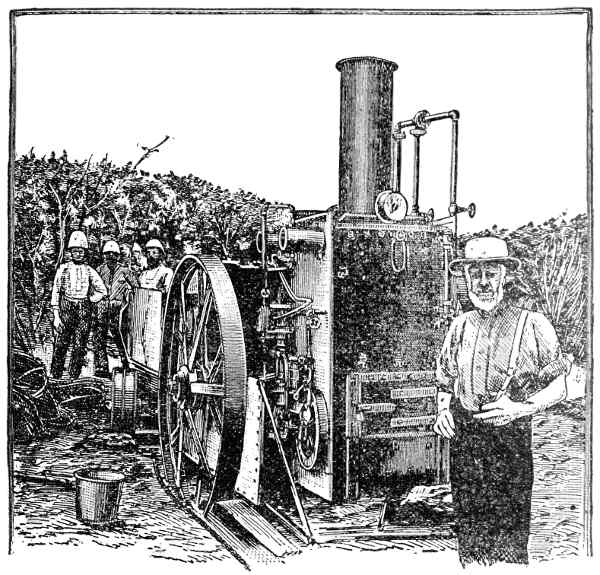
“The steamers on the Upper Congo water-ways have multiplied from four or five to a dozen in the past three years, so that we can get passage for the few missionaries we want to put in to hold our Kasai pre-emption claim till we can work up from our lease, and by and by send up a small steamer of our own for our enlarged Kasai work. I am on my way now to make final arrangements with the builder of our steamer to put her up and launch her at the earliest practicable moment, and will, the Lord permitting, be back to Liberia in December. I will ask Richard Grant to furnish a statement of the total expenditures.
“In regard to appropriations, I remark: (1) That if the Committee wish to enlarge the appropriation to the African (Liberia) Conference, I make no objection, but I ask at least for the continuance of the usual amount of $2,500, sent altogether as it was last year, and have the distribution at Conference for the whole year.
“(2) If the Committee are pleased to order $500 subject to my call, all right. I did not draw it last year, because I had not time to use it for the purpose I had in mind.
“(3) If the Committee will appropriate $10,000 or $5,000 for the establishment of self-supporting schools for the principal countries of Liberian population, for the education alike of the Liberian and the heathen children, I will administer it as carefully as possible and report progress. It would take five or six years to grow marketable values adequate to self-support, but quantities of food can be produced from the first or second year.—October 4, 1889.”
Writing in June 1889, Bishop Taylor speaks as follows concerning his Angola Missions:
MARCH FROM DONDO TO NHANGUEPEPO.
“Nhanguepepo, Monday, June 3, 1889.
“I left Dondo last Thursday morning. Brother Withey walked with me about a mile. Four carriers—who brought cargoes from Nhanguepepo, arriving in Dondo on Tuesday, and taking a day for rest—were ready to start on their return trip on Thursday. I employed two of them, one to carry my bed and the other my food, and half a cargo for Brother Withey. We spent the first night at Mutamba, thirteen miles out, stopping about eight miles out for lunch, and four hours of rest.