EGYPT AND THE NILE. (continued 2)
Reading edition
DRIVING A PRAIRIE WITH FIRE.
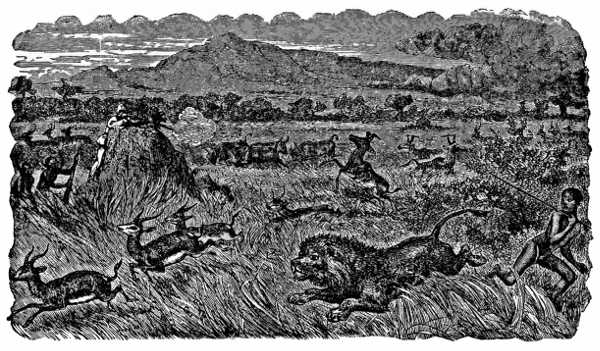
A strong fortification was built at Fatiko, which was finished by December, and reinforcements were sent for from Gondokoro. It was the hunting season, and many expeditions were organized for the capture of game, in which the natives joined with a hearty good will. Besides the rifle in skilled hands, the net of the natives for the capture of antelope and smaller game was much relied on, and once all enjoyed the magnificent sight of a tropical prairie on fire, with its leaping game of royal proportions, to be brought down almost at will, provided the hunter was not demoralized with its number and size.
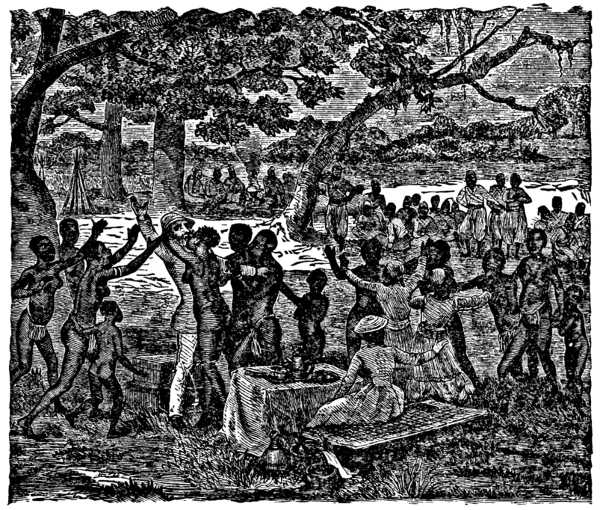
AFFECTIONATE RESULTS OF FREEDOM.
While at Fatiko, an embassy came from King Mtesa of the Uganda professing friendship and offering an army of 6000 men for,—he did not know what, but to punish any natives who might appear to be antagonistic, especially Kabba Rega.
By March, 1873, reinforcements from Gondokoro arrived in pitiable plight. Baker’s forces were now 620 strong. He re-inforced his various military stations. Then he liberated the numerous slaves the upward troops had taken from the slave hunters. Most of these were women and back in their native country. They accepted liberty with demonstrations of joy, rushed to the officers and men on whom they lavished hugs and kisses, and danced away in a delirium of excitement.
Colonel Baker’s time would expire in April. Therefore he timed his return to Gondokoro so as to be there by the first of the month, 1873. The whole situation was changed. There was scarcely a vestige of the neat station he had left. The slave dealers had carried things with a high hand, and had demoralized the troops. Filth and disorder had taken the place of cleanliness and discipline. Things were put to rights by May, and on the 25 of that month Baker started down the Nile, leaving his “Forty Thieves” as part of the Gondokoro garrison.
On June 29, Colonel Baker, Mrs. Baker and the officers of this celebrated expedition arrived at Kartoum, and reached Cairo on August 24, whence they sailed for England.
He concludes his history thus:—“The first steps in establishing the authority of a new government among tribes hitherto savage and intractable were of necessity accompanied by military operations. War is inseparable from annexation, and the law of force, resorted to in self-defence, was absolutely indispensable to prove the superiority of the power that was eventually to govern. The end justified the means.
“At the commencement of the expedition I had felt that the object of the enterprise—‘the suppression of the slave trade’—was one for which I could confidently ask a blessing.
“A firm belief in Providential support has not been unrewarded. In the midst of sickness and malaria we had strength; from acts of treachery we were preserved unharmed; in personal encounters we remained unscathed. In the end, every opposition was overcome: hatred and subordination yielded to discipline and order. A paternal government extended its protection through lands hitherto a field for anarchy and slavery. The territory within my rule was purged from the slave trade. The natives of the great Shooli tribe, relieved from their oppressors, clung to the protecting government. The White Nile, for a distance of 1,600 miles from Kartoum to Central Africa, was cleansed from the abomination of a traffic which had hitherto sullied its waters.
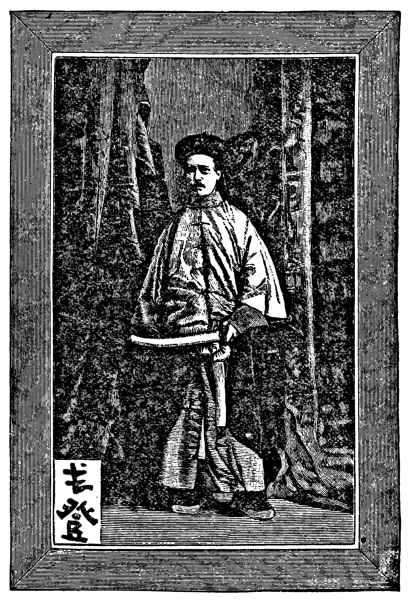
GORDON AS MANDARIN.
“Every cloud had passed away, and the term of my office expired in peace and sunshine. In this result, I humbly traced God’s blessing.”
Baker’s picture is much overdrawn. The situation in the Soudan has never been promising. In 1874, Colonel James Gordon was made Governor General of all these equatorial provinces which Baker had annexed to Egypt. Gordon was a brave enthusiast, who had acquired the title of “Chinese” Gordon, because he had organized an army at Shanghai, and, as Brigadier, helped the Chinese Government to put down a dangerous rebellion. He had received the order of Mandarin, had infinite faith in himself, and a wonderful faculty for controlling the unruly elements in oriental countries. He did some wonderful work in the Soudan in suppressing the slave-trade, disarming the Bashi-Bazouks, reconciling the natives, and preventing the Government at Cairo from parcelling out these equatorial districts to Arab slave dealers. He worked hard, organized quite an army, and had a power in the Soudan which was imperial, and which he turned to good uses. But in 1879, he differed with the Khedive and resigned. Then England and France deposed the Khedive, Ismial, and set up Tewfik, under pretext of financial reform. But these two countries could not agree as to a financial policy. France withdrew, and left England to work out the Egyptian problem. The problem is all in a nutshell. English ascendancy in Egypt is deemed necessary to protect the Suez Canal and her water way to India. For this she bombarded and reduced Alexandria in 1882 and established a suzerainty over Egypt—Turkey giving forced assent, and France refusing to join in the mix.
The new Khedive was helpless—purposely so. England planted within Egypt an army of occupation and took virtual directorship of her institutions. But the provinces all around, especially those newly annexed by Baker, revolted. Their Moslem occupants would not acknowledge English interference and sovereignty. Soudan was in rebellion both east and west of the Nile. England sent several small armies toward the interior and fought many doubtful battles. At length the project of reducing the Soudan was given over. But how to get the garrisons out of the leading strongholds in safety became a great problem. That at Kartoum was the largest, numbering several hundred, with a large contingent of women and children. It would be death for any of these garrisons to leave their fortifications and try boats down the Nile, or escape by camel back across the desert. Yet England was committed to the duty of relieving them.
PORTRAIT OF GORDON.
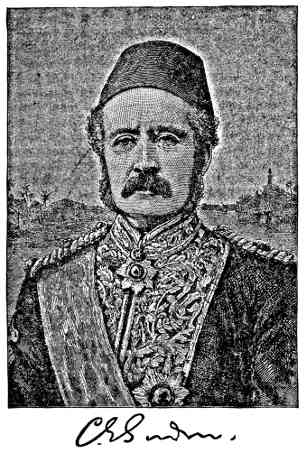
The rebellion was under the lead of the Mahdi, a Moslem prophet, who claimed to be raised up to save his people and religion. His followers were numerous and desperate. Gordon thought the old influence he had acquired over these people when Governor General of the Soudan, would avail him for the purpose of getting the forlorn garrisons away in safety. He was therefore re-appointed Governor General in 1884, and started with Colonel Stewart for Kartoum. There they were besieged for ten months by the Mahdi’s troops, and there Gordon was killed (January 27, 1885) by the enemy, and all his garrison surrendered or were killed. The English sent an army of 8,000 men up the Nile to rescue Gordon, and part of it got nearly to Kartoum, when word of the sad fate that had befallen the garrison reached it. The expedition retreated, and since then the Soudan and Upper Nile have been given over to the old Arab and slave stealing element.