YOUNG CONTRIBUTORS' DEPARTMENT.
Reading edition
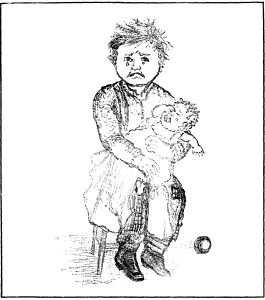
TWO YOUNG MARTYRS. (Drawn by a Young Contributor.)
"TOO-LOO!"
The Blue Jay courted the Yellow Cuckoo; 'Neath its nest he would stay all day long, Smoothing his feathers of silver and blue, Telling his love in a song: "Too-loo! too-loo! Oh, fly with me, My sweet Cuckoo, Across the sea!" The Cuckoo came gayly forth from her nest; But just then an arrow flew by, Piercing the bird's soft yellow breast, Who died with a single sigh. "Too-loo! too-loo!" The Blue Jay said; "What shall I do? My love is dead!" The Cuckoo lay cold and still on the ground— Dead, past all help to save; And by a Bird-defender was found, Who dug her a little grave. "Too-loo! too-loo!" Was the sorrowful lay, For the gentle Cuckoo Sung by the Jay. AMY R.
"MARY AND HER LAMB."
(A Critique.)
"Mary had a little lamb."
In this poem each stanza, we may say each line, is unalloyed gold. Let us examine the first line.
"Mary." The name strikes us at once as belonging to one pure as the inside of an apple-bloom; and the rest of the poem assures us, that by making Mary's name an index to Mary's character, we have not been misled. A master's hand is visible from the first word.
"A little lamb." The poet does not take for granted, as one of less genius would, that because a lamb is mentioned the reader necessarily sees in his mind's eye one of the frolicsome, gentle, confiding creatures commonly accepted as an emblem of meekness. Not at all. The lamb is not only a lamb—it is a little lamb. Thus never in the whole course of the poem can we by any oversight look upon Mary's treasure as a sheep; it retains its infantile sweetness and grace through the entire narration. The poet thus draws our attention to the youth of the animal, in order to palliate the little creature's after-guilt. This is done with such grace and delicacy, that it is scarcely perceptible.
The line, as a whole, shows a touch of high art seldom seen in so short a poem. The writer knows human nature—that, we see at a glance. Else, would he not have entered into a detailed account of Mary's parentage, her appearance, place of residence, or, at least, the manner in which she became possessed of the lamb. But no; all is left to the imagination. Mary may be as blonde as the "Fair one with golden locks," as dark as "Black Agnes." Each reader has a heroine after his own heart, and each is satisfied.
"Its fleece was white as snow."
No black sheep (or lamb) could we in any way imagine as a companion of Mary—gentle, affectionate, pure little Mary. All her associates must be pure as herself.
"And everywhere that Mary went The lamb was sure to go."
Does not this suit the character given to Mary by her name? We can image to ourselves the lost lamb, the mournful bleating for its mother, its hunger and cold. In the depth of its misery we see Mary's sweet face bending pityingly over it; she raises it, takes it home, it revives, and loves her; she loves it in return. Can we wonder that it follows in her footsteps wherever she goes? Those two lines tell more than many a volume; but they must be read feelingly, or all is lost.
Now follows a tale of wrong-doing and of subsequent punishment. This is, indeed, a master-stroke; for this climax we were not prepared.
"It followed her to school one day, Which was against the rule."
Although the lamb follows its mistress everywhere, school is a tabooed place. Yet the little creature cannot live without Mary, who has departed fair and fresh as Overbury's "Happy Milkmaid." Long are the hours that must elapse ere Mary's return, and the lamb tires of the waiting. "It followed her to school one day." How innocent an act that seems!—how natural! Then we read the next line,—"Which was against the rule," and the lamb's action is turned from innocence to guilt. Mary's favorite, that we have seen heretofore in only a good light, violates deliberately a rule of the school which Mary attends. The short sight of the animal's spiritual eyes prevents it from knowing the extent of the disgrace to which it is to be subjected. At present the end justifies the means in its little heart, and it leaves its pleasant home to wander schoolward, and we are left to imagine its thoughts on the way.
A scene in the school-house bursts upon us, and
"It makes the children laugh and play To see a lamb at school."
This is another instance in which we are shown the poet's knowledge of human nature. At anything less than the sight of a lamb the little scholars are too well trained to laugh. This has no precedent. They have been told how to behave should a dog enter the room, or should a ludicrous error in lessons occur; but when a lamb trots soberly in,—not gamboling now; conscience already whispers; remorse eats at the little creature's peace of mind,—it is not to be expected that order can be longer maintained, and the school, with the exception of Mary, runs riot. Mary is perhaps, meanwhile, reproaching her pet with a look "more in sorrow than in anger;" she is too gentle to scold, but that glance completely fills the lamb's cup of sorrow; it is yet to overrun, and the drop is soon poured in—the deep beneath "the lowest deep" is soon reached.
"For this the teacher turned him out."
It was his duty, reader; judge him not harshly.
"But still he lingered near."
This, at least, was not forbidden,—to wait for his little mistress.
"And waited patiently about Till Mary did appear."
How fraught with significance is that one word, "patiently!" All too eager before, that was the lamb's fault, "and grievously hath [he] answered it." He has turned over a new leaf, and wandering aimlessly about, now nibbling a cowslip, now rolling in the young grass to still the remorse gnawing at his heart, we can imagine him resolving to be a better lamb in the future,—to grow more worthy Mary's love.
"'What makes the lamb love Mary so?' The eager children cry."
All have noticed this devotion—all wonder at it. The teacher answers in words that prove how well we read Mary's affectionate nature:
"'Why, Mary loves the lamb, you know,' The teacher did reply."
What could be a more worthy ending to so fine a poem than that the loves of the two, human and brute, should be recognized by all Mary's little world, her school-mates and her teacher. More poems like this, sentiments so pure clad in plain Saxon words, would make our world—wonderful and beautiful, as it now is—a fitter place of dwelling for "men and the children of men." We regret but one point about this gem,—that its author is "A Great Unknown."
C. McK.
THE DEATH OF PRINCE WILLIAM.
There was a prince named William, And he had a sister, too; He was sailing o'er the English Channel, Over the Channel so blue. His father had gone ahead; And he made the boat go fast, But soon it struck upon a rock; There was a shock to the very mast! And everybody did wail, And everybody did cry, Because everybody thought That everybody must die! Prince William rushed into a boat,— Several lords and he,— And he was steering for the land, Across the dark blue sea. In the midst of the general weeping, He heard his sister's cry, And he made the boat go back, For he would not let her die! When he got near the ship, When he was touching her side, Down the side of the big ship Everybody did glide. Down went the little boat, Too frail for such a load; Down went the people in it, And the people that rowed. Down went the big ship, Her topmast in the air, And, if a person were near enough, He might see a man clinging there. The name of this man was Berold, And he was a butcher by trade, And by the help of a buff garment On the top of the water he stayed. In the morning some fishermen came And delivered him from the mast; And after he was recovered, His tale he told at last. When the king heard of the death of his children, He fainted away for a while, And from that day he was never, Never was seen to smile! H.W.
ALLIE'S SUNSHINE.
"A snowy, windy day. Oh, how dismal!" sighed Allie. "I wish it would clear off, so that I could go out-doors and play."
With this, Allie, who had been standing by the window gazing out at the gray sky, sat down and commenced to read that beautiful book, "May Stanhope." After reading quietly for more than an hour, she laid down the book, exclaiming: "I can and will try to be of some use in the world. I do nothing but mope when it rains, or when anything goes wrong. I will try to help others who need my help. I will ask mamma if I can carry something to Miss Davies. I am sure she needs some help."
"Oh, the sun is shining!" Allie jumped up, and ran out of the room to ask her mother if she would let her go to Miss Davies's. While she is gone I will tell you briefly who she is. Her name is Allie Harris, and she is a bright little girl, only apt to be dull on dark days.
Her mother gave the desired permission, and after wrapping herself up warmly, she took the well-filled basket that her mother had prepared, and set out on her errand of mercy. She soon reached Miss Davies's tiny cottage. She knocked, and a cheery voice bade her enter. She walked into a neat room, barely but cleanly furnished. At one end of it, beside a window, around which an ivy was growing, sat a bright-faced little woman sewing. She looked up and greeted Allie pleasantly. Allie shyly made known her errand, and stayed with Miss Davies all the afternoon, singing and reading aloud while Miss Davies sewed.
When it began to grow dark she bade Miss Davies a cheerful good-by, and went merrily home. She said to her mother, "I have learned the true secret of happiness at last." By doing good to others you will forget your own unhappiness, and be made happy in return; while, if you mope and try to be disagreeable, you will be miserable.
F.H.
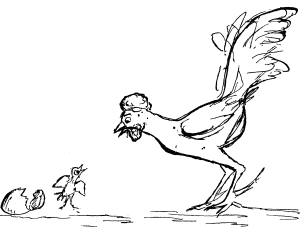
"H'M! DOES YOUR MOTHER KNOW YOU'RE OUT?" (Drawn by a Young Contributor.)