JACK'S CHRISTMAS
Reading edition
BY EMMA K. PARRISH.
Jack had just heard of Christmas for the first time! Ten years old, and never knew about Christmas before! Jack's mother was a weary, overworked woman, and had no heart to tell the children about merry times and beautiful things in which they could have no share.
His parents were very poor. When I tell you that they lived in a log-house you might think so, although some people live very comfortably in log-houses. But when I say that the snow drifted through the cracks in the roof until the chamber floor was fit to go sleighing on, and that it was so cold down-stairs that the gravy froze on the children's plates while they were eating breakfast, and that the little girls had no shoes but cloth ones which their mother sewed to their stockings, you will see that they were poor indeed. Mrs. Boyd, Jack's mother, generally went about her work with a shawl tied around her, and a comforter over her ears, on account of the ear-ache; and on the coldest days she kept Jack's little sisters wrapped up from head to foot and perched on chairs near the stove, so they wouldn't freeze. No; she didn't feel much like telling them about Christmas, when she didn't know but they would freeze to death, or, may be, starve, before that time. But Jack found out. He was going to school that winter, and one learns so much at school! He came home one night brimful of the news that Christmas would be there in three weeks, and that Santa Claus would come down chimneys and say, "I wish you Merry Christmas!" and then put lots of nice things in all the stockings.
Mrs. Boyd heard him talking, and was glad the children were enjoying themselves, but hoped from her heart that they wouldn't expect anything, only to be bitterly disappointed. Most of that evening little Janey, the youngest girl, sat singing:
"Wis' you Melly Kitsmas! Wis' you Melly Kitsmas!"
in a quaint, little minor key, that wasn't plaintive enough to be sad, nor merry enough to be jolly, but only a sweet monotony of sounds and words showing that she was contented, and didn't feel any of the dreadful aches and pains which sometimes distressed her so.
For a week, Jack wondered and mused within himself how he could get something for Christmas presents for his little sisters. He couldn't make anything at home without their seeing it, nor at school without the teacher's seeing it, or else the big boys plaguing him about it. Besides, he would rather buy something pretty, such as they had never seen before—china dolls in pink dresses, or something of that kind. One morning, however, Jack discovered some quail-tracks in the snow near the straw-stack, and he no longer wondered about ways and means, but in a moment was awake to the importance of this discovery. That very evening he made a wooden trap, and the next morning early set it near the stack, and laid an inviting train of wheat quite up to it, and scattered a little inside. He told his sisters, Mary and Janey, about the trap, but not about what he meant to do with the quails when he caught them. That afternoon Jack went to his trap, and to his unbounded joy found an imprisoned quail, frozen quite stiff. He quickly set the trap again, and ran to the house with his bird. All that evening he worked at quail-traps and made three more.
It was so much warmer that their mother let the children stay up a little later than usual; and Mary ventured to bring out her playthings and Janey's. These were two dolls, some bits of broken dishes, and a few little pine blocks. Mary watched her mother's face until she was sure she was "feeling good," before she ventured to begin a play, because on days when mother was very discouraged, it made her feel worse if the children were noisy, and so they would keep quiet and speak in whispers.
"Does Santa Claus bring dolls?" asked Mary, suddenly, of Jack.
"Oh yes; dolls with pretty dresses on; and little bunnits and pink shoes; and little cubberds to keep their clothes in, and chairs, and everything," said Jack, enthusiastically.
"Oh, my!" sighed Mary, as she looked dolefully at their poor little heap of toys.
Reader, their dolls were cobs, with square pieces of calico tied around them for dresses; and after hearing what Jack said, it wasn't so much fun playing, and the little girls soon went to bed. After they were asleep, Mrs. Boyd said, reproachfully:
"Jack, I wish you wouldn't say anything more about Christmas to the children."
"Why, is it bad?" asked Jack, so astonished that he stopped whittling.
"No, of course not; but you're getting their heads full of notions about fine things they never can have."
Jack's eyes twinkled.
"Oh, but you don't understand, mother," said he; "may be Santy Claus will come this year."
His mother shook her head.
"You know I caught one quail to-day?" whispered Jack.
"Well!" said his mother.
"Well, I'm going to save 'em all the week, and Saturday take 'em to the meat-man in the village. I guess he'll buy 'em. I heard that quails were fetching two cents apiece. And I'm going to get enough money to buy the girls something nice, and you must make 'em hang up their stockings, mother, and then we'll put the things in after they get asleep."
His mother smiled quite cheerfully. "Well," said she, "do the best you can."
Their father was away that evening. He was generally away evenings, because most of the neighbors had cozier firesides than his, besides apples, and sometimes cider; and so he passed many a pleasant hour in gossip and farm-talk, while his own little family shivered gloomily at home.
By Saturday morning Jack had ten quails. The four traps had not been as fruitful as they ought to have been, perhaps, but this was doing very well, and he trudged joyfully to town with his game hanging on a stick over his shoulder. The meat-man did indeed give two cents apiece for quails, and he invited Jack to bring as many more as he could get.
The next Saturday was only two days before Christmas, and how beautiful were all the stores on the village street! Even the groceries had Christmas toys and Christmas trees. A good many boys and girls stood around the store windows pointing out the things they most admired, and wondering what Santa Claus would bring them. Jack had fifteen quails, which brought him thirty cents; so he was now the owner of half a dollar, which was more money than he had ever possessed in all his life before. But when two dolls were bought, and they weren't very fine dolls either, there were only twenty cents left. Jack did mean to buy something for his mother too, but he had to give that up, and after looking over the bright colored toy-books in the show-case, he selected two little primers, one with a pink cover and one with a blue one, and with a big ache in his throat, parted with his last ten cents for candy. How very, very little he was buying after all, and not one thing for his dear mother who had sat up till two o'clock the night before, mending his ragged clothes for him.
Jack's heart was very heavy as he walked out of the gay store with such a little package, but it sank still lower when his father's tall form loomed up suddenly before him right in front of the door.
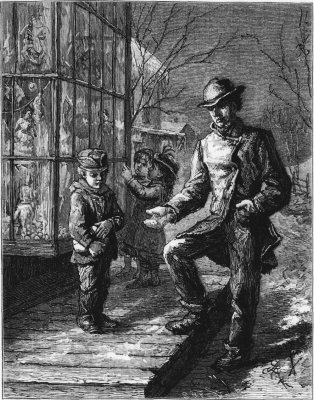
"'LET ME SEE 'EM,' SAID HIS FATHER."
"What you doing here?" he asked, sternly.
"Been buying a few things," said Jack.
"Let me see 'em," said his father.
Jack tremblingly opened his package.
"Where'd you get the money?"
"With quails," said Jack, meekly.
His father fumbled over the things with his big, mittened hand, and said quite gently: "For the girls, I s'pose."
"Yes, sir," answered Jack, beginning to feel relieved.
"Well, run along home."
Jack was only too happy to do so. There wasn't much sympathy between him and his father, nor, indeed, between his father and any of the family—that is, there didn't seem to be; but I guess the stream was frozen over, and only needed a few gleams of sunshine to make it bubble on, laughing and gurgling as in the best of hearts.
Jack related his adventures to his mother in whispers, and hid the Christmas articles in the wash-boiler until such time as they should be wanted for certain small stockings. He told his mother how sorry he was not to have a present for her, and that little speech went a long way toward making her happy. That night she sat up—I wouldn't dare tell you how late—making cookies,—something that hadn't been in the house before that winter. She cut them out in all manner of shapes that feminine ingenuity and a case-knife could compass, not forgetting a bird for Janey, with a remarkably plump bill, and a little girl for Mary, with the toes turned out. She also made some balls of brown sugar (the Boyds never thought of such a luxury as white sugar), to make believe candy, for she didn't know Jack had bought any candy.
Now I am going to tell what Mr. Boyd did after he met Jack by the toy-store. He had gone to the village to have a "good time." That didn't mean, as it does with some men, to get tipsy; but it meant he was going to Munger's grocery, where he could meet people, and talk and joke, and keep warm.
Mr. Boyd had been chopping wood for a farmer, and had received his pay; but instead of going dutifully home and consulting with his wife about what he should buy, he was going to "look around" and see what Munger had. He was touched at the sight of Jack's poor little package of gifts, but I doubt if it would have made much impression on his mind if somebody hadn't walked in to Munger's and asked in a brisk, loud voice: "Got any Brazil nuts, Munger?"
The man with the brisk voice bought I don't know how many quarts of Brazil nuts, and walnuts, and filberts, and almonds, with all the loungers looking on, very much interested in the spectacle. Then he bought raisins, and candy, and oranges, Mr. Munger growing more smiling every minute.
"Going to keep Christmas, I guess," said he, rubbing his hands together.
"That I am; 'Christmas comes but once a year,' and there are little folks up at our house who've been looking for it with all their eyes for a fortnight."
Then he bought a bushel of apples, and, filling a peck measure with them, passed them around among the men who sat and stood about the stove.
"Take 'em home to your little folks if you don't want 'em," he said, when any one hesitated.
There were three or four apples apiece, and Mr. Boyd put all his in his pockets, with a slight feeling of Christmas warmth beginning to thaw his heart.
After this cheery purchaser had gone, some one asked: "Who is that chap?"
"He's the new superintendent of the Orphant Asylum," answered Mr. Munger, rubbing his hands again; "and a mighty nice man he is, too. Pays for all them things out of his own pocket. Very fond of children. Always likes to see 'em happy."
There were two or three men around that stove who hung their heads, and Mr. Boyd was one of them. He hung his the lowest, perhaps because he had the longest neck. I don't know what the other men did,—something good and pleasant, I hope,—but Mr. Boyd thought and thought. First he thought how the "orphants" were going to have a brighter and merrier Christmas than his own children, who had both father and mother. Then he thought about sweet, patient little Janey, and quiet Mary, and generous Jack, who had taken so much pains to give pleasure to his sisters, and a great rush of shame filled his heart. Now, when Mr. Boyd was once thoroughly aroused, he was alive through the whole of his long frame. He thumped his knee with his fist, then arose and walked to the counter, where he dealt out rapid orders to the astonished grocer for nuts, candies and oranges; not in such large quantities, to be sure, as the "orphants'" friend had done, but generous enough for three children. And he bought a calico dress for his wife, a pair of shoes for each of the little girls, and a cap for Jack. That store contained everything, from grind-stones to slate-pencils, and from whale-oil to peppermint-drops. These purchases, together with some needful groceries, took all Mr. Boyd's money, except a few pennies, but a Christmas don't-care feeling pervaded his being, and he borrowed a bag, into which he stowed his goods, and set out for home.
It was a pretty heavy bagful, but its heaviness only made Mr. Boyd's heart the lighter. When he reached home, he stood the bag up in one corner, as if it held turnips, and said, "Don't meddle with that, children." Then he went out and spent the rest of the short day in chopping wood, which was very cheering to his wife. So many Sundays had dawned with just wood enough to cook breakfast, that Mrs. Boyd began to dread that day particularly, for her husband was almost sure to go right away after breakfast and spend the whole day at the neighbors' houses, while his own family shivered around a half-empty stove.
Mr. Boyd said never a word about the bag, and the unsuspecting household thought it contained corn or some other uninteresting vegetable, and paid little attention to it. It also stood there all the next day, and the children grew quite used to the sight of it.
Sunday went by quietly, and, to the surprise of all, Mr. Boyd stayed at home, making it his especial business to hold Janey on his lap, and keep the stove well filled with wood. Janey wasn't feeling well that day, and this unusual attention to her made the family very kindly disposed toward their father, whom of late they had come to regard almost as an alien.
Jack, whose shoes were not yet worn out, went to Sunday-school, and after his return the winter day was soon gone. Then he began to fidget, and was very desirous that his mother should put the little girls to bed; while, strange to say, his father was desirous that the whole family should go to bed, except himself. In course of time the little girls were asleep in their trundle bed, with their little red stockings hanging behind the door. Mr. Boyd sat with his back to the door, so Jack slipped in his presents without his father's seeing him, and went to his cold bed upstairs.
"Aint you going to hang up your stocking, mother?" asked Mr. Boyd after Jack had gone.
Mrs. Boyd looked startled.
"Why, no," she answered, hesitatingly, not knowing whether the question was asked in irony or in earnest.
"You better," said Mr. Boyd, going to the bag in the corner, and beginning to untie the strings.
He laid out package after package on the floor. His wife knelt down by them in a maze of astonishment. Then, with a great deal of enjoyment, Mr. Boyd untied them one by one, showing candy, nuts, oranges, shoes, and all the rest, except the calico dress, which he kept out of sight.
Aladdin felt very fine when he found the cave-full of precious stones, but I don't believe he was much happier than Mrs. Boyd. Her eyes were so full of tears that there seemed to be about eight pairs of shoes, ten bags, and half a dozen Mr. Boyds; but she managed to lay hands on the real one, and him she embraced fervently. Then she brought out the cookies and sugar balls she had made, and said to her husband, in a very shame-faced way:
"See my poor presents; I didn't know the children would have anything nice, and I made these. I guess I wont put 'em in their stockings though, now."
But Mr. Boyd insisted on their going in with the other things, and I think they were prized by the children a little more dearly, if such a thing could be possible, than those which they called their "boughten" presents.
Now, I can't begin to describe the joyful time they had the next morning, and particularly, the utter astonishment of Jack, who didn't expect a thing, and hadn't even hung up a stocking. When that devoted boy recognized one of his own gray socks crammed full of knobs and bunches, with a beautiful plush cap on top, he was almost out of his wits. Likewise, Mrs. Boyd's surprise was great at the discovery of her new dress. The little girls were too happy that day to do much else but count and arrange and re-arrange their delightful Christmas presents.
Mr. Boyd killed a chicken, and Jack contributed four quails which he had caught since market-day, and the festival of Christmas was kept with much hilarity by the Boyd family.
The neighbors, one by one, were surprised that Mr. Boyd hadn't dropped in, as he usually did on Sundays and holidays. But Mr. Boyd was engaged elsewhere. And this was only the beginning of good days for that family, for, somehow, the Christmas feeling seemed to last through all the year with Mr. Boyd, and through many other years; and the little ball set rolling by Jack with his quail-traps, grew to be a mighty globe of happiness for the whole family.