THE FAMOUS HORSES OF VENICE.
Reading edition
BY MARY LLOYD.
No doubt you all know something of Venice, that wonderful and fairy-like city which seems to rise up out of the sea; with its bridges and gondolas; its marble palaces coming down to the water's edge; its gay ladies and stately doges. What a magnificent pageant was that which took place every Ascension Day, when the doge and all his court sailed grandly out in the "Bucentaur," or state galley, with gay colors flying, to the tune of lively music, and went through the oft-repeated ceremony of dropping a ring into the Adriatic, in token of marriage between the sea and Venice! This was a custom instituted as far back as 1177. The Venetians having espoused the cause of the pope, Alexander III., against the emperor, Frederic Barbarossa, gained a great victory over the imperial fleet, and the pope, in grateful remembrance of the event, presented the doge with the ring symbolizing the subjection of the Adriatic to Venice.
But one of the most wonderful things about Venice is that, with the exception of those I intend to tell you about, there are no horses there. How charming it must be, you think, when you want to visit a friend, to run down the marble steps of some old palace, step into a gondola, and glide swiftly and noiselessly away, instead of jolting and rumbling along over the cobble-stones! And then to come back by moonlight, and hear the low plash of the oar in the water, and the distant voices of the boatmen singing some love-sick song,—oh, it's as good as a play!
Of course there are no carts in Venice; and the fish-man, the vegetable-man, the butcher, the baker, and the candlestick maker, all glide softly up in their boats to the kitchen door with their vendibles, and chaffer and haggle with the cook for half an hour, after the manner of market-men the world over.
So you see the little black-eyed Venetian boys and girls gaze on the brazen horses in St. Mark's Square with as much wonder and curiosity as ours when we look upon a griffin or a unicorn.
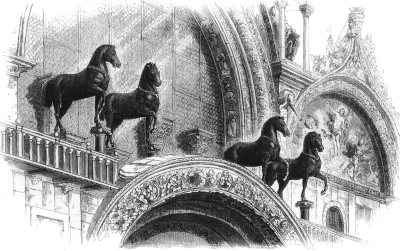
THE HORSES OF ST. MARK'S.
These horses—there are four of them—have quite a history of their own. They once formed part of a group made by a celebrated sculptor of antiquity, named Lysippus. He was of such acknowledged merit that he was one of the three included in the famous edict of Alexander, which gave to Apelles the sole right of painting his portrait, to Lysippus that of sculpturing his form in any style, and to Pyrgoteles that of engraving it upon precious stones.
Lysippus executed a group of twenty-five equestrian statues of the Macedonian horses that fell at the passage of the Granicus, and of this group the horses now at Venice formed a part. They were carried from Alexandria to Rome by Augustus, who placed them on his triumphal arch. Afterward Nero, Domitian and Trajan, successfully transferred them to arches of their own.
When Constantine removed the capital of the Roman empire to the ancient Byzantium, he sought to beautify it by all means in his power, and for this purpose he removed a great number of works of art from Rome to Constantinople, and among them these bronze horses of Lysippus.
In the early part of the thirteenth century the nobles of France and Germany, who were going on the fourth crusade, arrived at Venice and stipulated with the Venetians for means of transport to the Holy Land. But instead of proceeding to Jerusalem they were diverted from their original intention, and, under the leadership of the blind old doge, Dandolo, they captured the city of Constantinople. The fall of the city was followed by an almost total destruction of the works of art by which it had been adorned; for the Latins disgraced themselves by a more ruthless vandalism than that of the Vandals themselves.
But out of the wreck the four bronze horses were saved and carried in triumph to Venice, where they were placed over the central porch of St. Mark's Cathedral. There they stood until Napoleon Bonaparte in 1797 removed them with other trophies to Paris; but after his downfall they were restored, and, as Byron says in "Childe Harold":
"Before St. Mark still glow his steeds of brass, Their gilded collars glittering in the sun; But is not Doria's menace come to pass? Are they not bridled?"—
Apropos of the last two lines I have quoted, I must tell you an incident of history.
During the middle ages, when so many of the Italian cities existed as independent republics, there was a great deal of rivalry between Genoa and Venice, the most important of them. Both were wealthy commercial cities; both strove for the supremacy of the sea, upon which much of their prosperity depended, and each strove to gain the advantage over the other. This led to many wars between them, when sometimes one would gain the upper hand, and sometimes the other. At length, in the year 1379, the Genoese defeated the Venetians in the battle of Pola, and then took Chiozza, which commanded, as one might say, the entrance to Venice. The Venetians, alarmed beyond measure, sent an embassy to the Genoese commander, Pietro Doria, agreeing to any terms whatever, imploring only that he would spare the city. They also sent the chief of the prisoners they had taken in the war in order to appease the fierce anger of the general. "Take back your captives, ye gentlemen of Venice," was the too confident reply of the haughty Doria; "we will release them and their companions. On God's faith, ye shall have no peace till we put a curb into the mouths of those wild horses of St. Mark's. Place but the reins once in our hands, and we shall know how to bridle them for the future."
Armed with the courage and energy which despair alone can give, the Venetians rallied for the defence of their city. Women and children joined in the preparations. All private feuds, jealousies and animosities were forgotten in the common danger. All were animated by the one feeling of implacable hatred of the Genoese. Pisani, an old commander, who had been unjustly imprisoned through the envy of his fellow-citizens, was released and put in command of the fleet. On coming out of his cell, he was surrounded by those who had injured him, who implored him to forget the injustice with which he had been treated. He partook of the sacrament with them in token of complete forgetfulness and forgiveness, and then proceeded against the enemy. The confidence of the republic had not been misplaced. His bravery, skill and foresight, together with the aid of another brave captain, Carl Zeno, saved the city, retook Chiozza, and completely humiliated the Genoese, who were now willing to sue for peace. So that, after all, Doria's angry menace was the means of saving the independence of the city, and the proud possession of the bronze horses of St. Mark's.