THE TOWER-MOUNTAIN
Reading edition
BY GUSTAVUS FRANKENSTEIN.
I.
Many years ago, I was roving in a land strange and wonderful to me. It was a tropical country, and I was wandering alone among the grand scenery of the mountains, and the luxuriant vegetation of the hill-sides and valleys.
I had with me but few implements, and these, such as were light and easy to carry. A hunting-knife, a small hatchet, a canteen and a few marching necessaries made up my kit.
One day while rambling about, living on the bountiful supplies of fruit nature provides in that charming region, I came to a deep lake surrounded by steep hills. On the opposite side of this lake I could see a narrow gap or cleft, which seemed to lead to the higher ground. I therefore made a raft,—not without considerable trouble,—and paddled it across the lake. I found the gap quite narrow at its entrance, but it soon became wider, while far forward, at the end of the chasm, there appeared to be a series of rude steps.
I fastened the raft to the rock, in doing which I had the ill luck to drop my hatchet into the deep water, and, notwithstanding the evil omen, made my way into the crevice. I passed over the rough bottom of the chasm until I came to the steps; these I ascended. At a height of about a hundred feet I came to a wall of rock, the top of which I could just reach with the ends of my fingers. By a great effort, I got a good hold of the edge of the rock, and drew myself up.
When I stood at last upon the upper ground, I saw before me the most beautiful trees and flowers I had yet met with. On either side the rocks retreated and rose steeply to the summits I had partially seen from the lake below. As I passed on and surveyed the plateau, I found it to be a valley about a mile in diameter, encompassed by precipices more or less abrupt. With but little trouble I found a place of easy ascent, and soon climbed to the top of the rocky wall.
The delight I now experienced surpassed everything I had ever known. Spread out before me, as I stood upon an eminence somewhat above the general level, was a vast expanse overflowing with vegetation and extending for miles in every direction, whilst all round about rose the mighty domes and pinnacles of snow-clad mountains. I stood in the midst of the sublimest mountain scenery in the world. I could look down upon the beautiful lake, and up at the giant peaks, and all about me upon the fruitful verdure, whilst the atmosphere was charged with delightful odors, and a pleasant breeze tempered the sweet warm air.
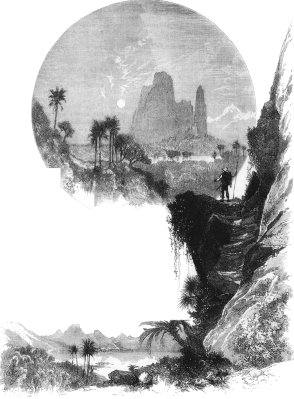
THE VIEW FROM THE LEDGE.
As here was a delightful climate, fruit in abundance, and scenery soul-exalting, of whose glory one could never grow tired, I felt rather pleased with the thought "Why not stay here? Why not remain in this beautiful place as long as circumstances will permit?"
All nature seemed here so lovely that I resolved to wander no further.
While gazing around at all this grandeur and beauty, my attention was particularly drawn to a group of lofty peaks which rose in the midst of this smiling garden. The sides of the towering eminences seemed almost perpendicular, and they were about three or four thousand feet high.
I soon gave up all hope of ever reaching the top, but in examining the rock I found at its base a great cavern, so high and wide that a very large building might have stood in it, with plenty of room to spare. The sides and roof sparkled with crystals of all hues, and were singularly and picturesquely variegated with differently colored veins running through them; and, as the cave opened toward the east, with a large clear space in front of it, nothing could have been more splendid than when the morning sun shone full into the vast chamber and lighted it up with dazzling brilliancy.
In that chamber I made my humble home.
Near one of the streams that flowed over the precipice into the lake, grew several species of very tall grasses, with great bushy heads of long silky fibers that adorned and protected their flowers and fruit. Of these fine strong threads I made a hammock, which I suspended from a strong frame bound together with these tough fibers, placing it a few feet back from the mouth of the cavern. Thus, I had an excellent bed, and if I should need covering there were plenty of palm-leaves at hand for the purpose. But in that torrid climate there was little need of extra protection; the air of the cavern was of just that delightful coolness which refreshes but does not chill.
Now, imagine me waking in the morning just as the dawn tinted the rosy east, refreshed with sweet slumbers and rejoicing to behold the light, rocking myself gently in my pretty hammock, and hailing the uprising sun with a merry song,—and would you not suppose there was one happy man in this great world?
While the day was yet young I would take a bath in the clear, soft water of a little stream near by. Then, when all was sparkling and bright in my humble house, I would partake with keen appetite of the precious fruits of my unlimited and self-producing garden.
In the neighboring streams were many kinds of fishes, some of which I knew to be very good eating, and I could have caught and eaten as many birds as I wished; but the fruits and nuts were so plentiful, and of so many different sorts, that I cared for, and, indeed, needed, no other kind of food.
Thus, several months passed away, and I was not weary of this paradise. There was enough to occupy my mind in the examination of the structure and mode of growth of a vast number of species of plants. Their flowering, their fruitage, and their decay offered a boundless field for thought, and kept up a never-flagging interest.
For the first four months the sun traced his course through the heavens to the north of me; I knew, therefore, that I was almost immediately under the equator. For several days at the end of the four months, the sun rose directly in the east, passing through the sky in a line dividing it almost exactly into halves north and south. After that, for six months, I had the great luminary to the south of me.
In all this time there was but little change in the weather. A short period without rain was the exception. Otherwise, the mornings and evenings were invariably clear, with a refreshing rain of about two hours' duration in the middle of the day. In the afternoon the sun was, of course, away from my cavern, shining upon the opposite side of the mountain of solid rock, which rendered my abode delightfully cool in the greatest heat of the day. Toward the end of the short dry period, magnificent thunder-showers passed over my domain. Nothing could be more glorious than these electrical displays of an equatorial sky, as I sat snug and safe within the rocky shelter. The heaviest shower could not wet me, the water without ran with a swift descent, from the cave, and over the precipice into the lake below. It was not likely that the lightning would take the trouble to creep in under the rock and there find me out. And as for the thunder, I was not in the least afraid of it, but gloried in its loud peals and distant reverberations among the encompassing mountains.
It was during the violence of one of these tempests that a parrot flew into my comfortable quarters.
"Hallo! my fine fellow!" said I. "Where do you come from, and what do you want here?"
It flew about the room looking for a place to perch, trying to find a footing against the wall, slipping down, and flying up again.
I left it free to find its own roosting-place, or fly out of the cavern, as it liked. I had seen a few parrots of the same kind, outside in my garden, had heard them chattering and shrieking amidst the foliage, and had always been very much amused with their odd ways, and pleased with the brilliance and the glitter of their splendid plumage. But I never tried or cared to capture the gorgeous, noisy birds, or any other of the creatures that were always to be seen around me. Indeed, from the very first, the living things in this lovely valley appeared to be uncommonly tame; and in time no bird or other animal showed the least fear on my approach, regarding me no more than any other creature that never did them harm. Of course, this came of my never molesting them. But I never thought of getting on familiar terms with any of them, although scarcely a day passed that some of these animals did not come and eat of the fruit by the side of that which I was plucking. I never laid hands on them, but always let them go about their own business. They soon became accustomed to my umbrella even, for I early made one of these necessities of a torrid climate; and although at first when I had occasion to walk in the sun my appearance shaded by the portable roof caused unusual chattering and commotion, I speedily took on a familiar look to them. In the same way I became an object of curiosity when I plucked a leaf and made of it a cup to drink from. But at length all signs of strangeness vanished, and there even came to be a kind of friendship between us.
I therefore concerned myself no more about the parrot, thinking that, of course, as soon as the rain should stop, the bird would fly away.
I had made a small table of three slabs of rock, where I frequently placed fruits, nuts, roots and the like, that I might have in case I should feel hungry when in my house, and yet not care to eat the fruit directly from the plant, which I most generally preferred. Of course, too, it was always desirable to have provisions on hand when it rained.
The next morning, when I awoke, the rain was still descending, for it was just at this time that it rained for three or four days together.
I always had a healthy relish for the good things of this world, and, as there was no rosy dawn to look at, my eyes immediately went in search of the breakfast-table.
"What!" I exclaimed; and I sat upright in my hammock.
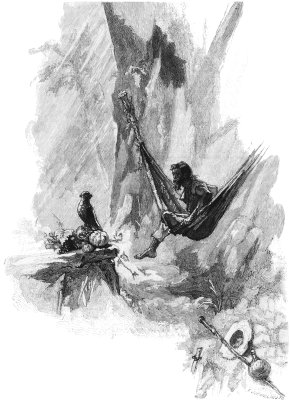
There was the parrot on the table.
I eyed him for some time, and then I cried out:
"You little thief! Stealing my food, are you?"
The parrot sat there, but said never a word. He merely raised one of his claws and sleeked up the feathers on the back of his neck, in the way his family know so well. Then, raising the feathers of his crest, he gave utterance to a very faint shriek.
"Get out of this, you rascal!" I cried and immediately got up and went toward him with the purpose of putting him out.
I approached the table very rapidly, expecting that the bird would fly away. But he remained motionless. I was about to lay rude hands on him, but I desisted.
"Why do violence to the creature? Why mar the serenity of this peaceful vale?" I said to myself. "And why make such ado about a little fruit when there is abundance on every hand?"
Happening just then to glance at the fruit, it seemed to me that it had not been disturbed.
I examined it more closely, and began to feel I had done the parrot great injustice. There it lay, just as I had left it the night before; there was no evidence whatever of its having been picked at, and I came to the comforting conclusion that the handsome bird had broken no moral law.
The parrot rose greatly in my esteem at this happy discovery.
"Friend Parrot," said I, "I beg pardon for having so rashly jumped to the conclusion that you had been guilty of theft. I believe that you have touched nothing of the things which belong to me. Indeed, I am sure that you have not. That you have so scrupulously regarded the rights of property is to me the source of infinite gratification, and fills me with the highest admiration of your character. To show you that I am disinclined to let virtue go unrewarded, I accord you my permission to stay here while I am eating my breakfast, and when I have finished, you too may eat some, if you like."
Then, having arranged my toilet, I began to partake of the good things that lay on the table, the parrot all the while looking at me with lively interest. I could not help being amused at his significant performances. He turned his knowing head one way, and then another, now sidewise toward the fruits, and then obliquely up at me, as I sat enjoying the repast, enlivening his gestures with gentle prattle, and yet never making a single demonstration in the direction of my food. He put me in such good humor that I was impelled to say to him:
"Friend Parrot, I don't mind being sociable; and if you are inclined to do me the favor of honoring me with your company, I most respectfully invite you to partake of this humble collation." And, taking up one of the choicest nuts in the collection, I handed it to him forthwith.
He took it promptly, and proceeded to crack and munch it in regular parrot fashion.
"You must excuse me," I resumed, "that my viands are not of the choicest cooking, and that I have no servants to wait upon my highly esteemed guest, and that there are no silver knives and forks and spoons to eat with in the latest civilized style, but I have rid myself of all those things, and am glad of it."
The parrot nodded his head approvingly, as much as to say, "Right, quite right."
The poor bird was very hungry, and I let him eat his fill.
Breakfast over, my guest flew upon my shoulder and was disposed to be affectionate. He delicately pecked at my lips, drew his bill gently across my cheeks, and pulled my hair with his claws.
"Come, come! friend Parrot, none of your soft billing and cooing. Leave that to women and children."
So I gave my friend politely to understand that I did not care for such pretty endearments; and, soon comprehending the force of my objection, he very sensibly desisted from bestowing further attention upon me, and thenceforth kept his handsome person reasonably aloof.
I entertained my friend two days, during which I gave him much valuable advice, and, which was more to the purpose and perhaps better appreciated, plenty to eat.
On the morning of the third day, the sun rose in all his beauty again, and I fully expected the bird would fly away. He was in no hurry to go, however. I went out, wandered about, and toward noon returned home. Still the parrot was there. So it was the next day, and the next. I did not want to resort to force and drive him away.
Finally I said to him one day:
"Friend Parrot; since I see you are in no hurry to leave my humble home, and that it evidently grieves you to lose the pleasure of my society, I shall not eject you forcibly from the premises. Stay, therefore, as long as it shall please you. I will share with you food, and shelter from the sun and rain. And whenever you grow weary of this my society, tired of this plain habitation, or disgusted generally with civilization, and wish to return to the freedom of savage life, you are at liberty to go. 'Tis a large door, always open, out of which you can fly; and when you are gone I shall shed no tears over your departure."
The bird seemed really to comprehend the drift of my discourse, and from that time forward we lived upon the most intimate terms, which, however, never passed the bounds of mutual respect.
Now, if we were to live in such close ties of friendship, it was necessary that my friend should have a name, and that he, too, should be able to address me by mine. The title, "Friend Parrot," was rather too formal, and his screeching at me in some unmeaning way every time he wanted me could not for long be tolerated.
So, "Mr. Parrot" said I, "you are Mr. Parrot no longer. Your name is 'Pippity.'"
He soon learned his new name, and then said I:
"Pippity! my name is 'Frank.'"
It was incredible how rapidly he learned mine.
"Further, Pippity," I continued, "you must learn the names of the things round about us."
Instruction began at once. For several days he had to be told the names of things many times before he was able to repeat them correctly; but after that, and apparently all of a sudden, he seemed to have caught a bright idea and to thoroughly understand my method of teaching.
From that time on, when the name of a thing was made plain to him, he seemed to grasp it immediately and never forgot it. This expedited matters wonderfully, for I liked to talk to him and observe his efforts to repeat what I said, so there was ample conversation, though somewhat one-sided, going on in our ancient dwelling. I marveled at the parrot's extraordinary power; but what astonished me above all was his wonderful memory, and his unlimited capacity for taking in new ideas. Sometimes I would ask him, after an interval of weeks, some name of a thing I had taught him, and the answer was invariably correct. On such occasions I would say to him:
"Pippity, what's that?"
He would tell me immediately; and I laughed outright when, one day, as we were strolling through the forest, I stumbled over a stone, and the parrot, perching on it, pecked it with his bill, and then, looking up at me askance, asked:
"What's that?"
That was a phrase I had unwittingly taught him. And now I began more than ever to perceive his extraordinary genius.
Thenceforth it was "What's that?" and "What's that?" and actually the fellow wanted to learn more quickly than I could teach.
Once, after this intelligent bird had been with me for some months, we were sitting quietly in our domicile, shaded from the afternoon sun by our lofty rock-built palace, enjoying the beauties of creation, when all at once he broke out in his clear, melodious voice:
"Tell me something new!"
I looked at him in amazement. I had never taught him to say that; but undoubtedly he must have heard me say, at some time or other, "Pippity, now I will tell you something new." Yet how the bird had managed to turn the phrase grammatically to himself puzzled me not a little.
However, I soon began to teach him something else that was new, for I had been thinking that it was time that he should learn the names of the plants,—at least of the most interesting and useful. So it was not long before Pippity had a fair acquaintance with botany.
Nearly a year had now rolled round, when one day Pippity was missing. What could have happened to him? Had he grown tired of my society? Did he begin to think that, after all, savage freedom was to be preferred to dull, systematic civilization? Had he come to the conclusion that much learning is, at best, but vanity? Did he want to go babbling again in chaotic gibberish rather than to talk smoothly by rote?
Two days passed, in which to drive away any natural feeling of loneliness at the parrot's absence, I set down notes as concisely as possible of what had occurred to me so far. For this purpose I used the point of my knife and thin slabs of mica, wishing to save the small stock of memorandum paper in my note-book and journals as much as I could. At other times I had used bark and similar things to write on, but the mica was more durable, and more easily stowed away. It was my intention to make a still more condensed series of notes on the paper I had by me, whenever I should feel like undertaking the task. The juice of berries would serve for ink, and a feather or light reed would make as good a pen as I should want. This plan I carried out afterward.
On the third day Pippity returned, and, as he came flying into the palace, "Pippity, Pippity!" I cried, "I thought you were never coming back. Have you been to see your old friends?" He hung his head demurely, and said nothing.
Although I had told Pippity, when he had first sought my hospitality, that I would shed no tears over his departure, if at any time he might see fit to leave me, I must confess that I was very glad when he came back. His society was agreeable. He was a good listener, and he was by no means an idler, as far as that kind of honorable work is concerned which consists in keeping body and soul together. For example, strolling through our fertile garden, if I should happen to see some fine fruit high on a tree, Pippity would fly up to it at my bidding, and, cutting its stem with his bill, would quickly bring it to the ground.
"Pippity," I would say, "do you see that extra fine bunch of bananas up there? Now, do you go up and cut the stalk, while I stand below and catch the luscious treasure on this soft bed of leaves."
And, before I would be done speaking, Pippity would already be pretty well advanced with his work. For getting nuts, and such fruit as it was desirable to take carefully from plants at great heights, his services were invaluable.
It is a remarkable fact that, although we had such an abundance of tropical fruits, as well as a large proportion of temperate productions, on our domain, the cocoa-nut was not one of them. I remembered that, in coming up from the lake, I had seen large numbers of cocoa-nut trees growing on the small flat at which I first arrived about nine hundred feet below the level of our palace plateau.
It would be an agreeable diversion, I thought, to go down there and get some of those nuts, and it undoubtedly would be quite a treat to Pippity to share them with me.
"So," said I, "Pippity, I am going down this narrow gorge to the lake; cocoa-nuts grow there, and I mean that you and I shall have some. Keep house while I am gone. I shall start with the first peep of dawn, while it is cool, and be back some time in the afternoon."
I had made some baskets, in which we hung up the fruit we gathered. One of these I took, and went down the declivity. I soon filled the basket with good cocoa-nuts, saw plenty of monkeys, and was much amused at their lively antics, and at their astonishment at seeing one so much like them, and yet so different. I then returned—not, however, without being obliged to throw away quite a number of the nuts before reaching the top, in order to lessen the burden, which was light enough at first, but which seemed to grow heavier and heavier as I proceeded.
As soon as Pippity saw me, he cried out:
"Cocoa-nuts! Cocoa-nuts!"
We relished them so much that I went down after them quite often, always leaving Pippity at home to mind the house.
On one occasion, while I was gathering these nuts, I was startled by a loud shrieking not far off, and, looking in the direction of the noise, I saw that there was a great commotion among the monkeys—about a hundred of them squealing and yelling and gesticulating at once. It was on the ground, where the monkey-crowd swayed to and fro like any civilized mob. I ran up to see what the fracas was about, but not without some misgivings as to the risk of meddling in other people's business.
(To be continued.)