SINGING PINS.
Reading edition
BY HARLAN H. BALLARD.
It has been said, you know, that all the millions of pins which are lost every year are picked up by fairies and hammered out on elfin anvils into notes of music. There are some who say that this statement must be received with caution, although they admit that the half and quarter notes do bear a very singular resemblance to pins.
I confess that I shared the doubts of this latter class of persons until a few evenings since; for although I knew well enough that pins were bright and sharp enough in their way, I never had been able to discover one of a musical turn of mind.
But having on a certain evening heard a choir of pins singing "Yankee Doodle" till you would have thought that their heads must ache forever after, I hereby withdraw all my objections, and express my decided opinion that the above-named theory of the future life of pins is fully as accurate as any other with which I am acquainted.
The chorus of pins who were singing "Yankee Doodle" were standing at the time on a piece of pine-board, and were evidently very much stuck up.
One of their number, however, when asked if they were not rather too self-important, bent his head quickly downward, and replied that he couldn't see the point, which was exceedingly brassy for a pin.
They looked for all the world as if they were a line of music which, impatient of being forever kept under key and behind bars, had revolted under the leadership of an intrepid staff-officer, and marched right out of Sister Mary's instruction-book.
Indeed, from a remark which the staff-officer let fall, to the effect that if they did not all see sharp they would soon be flat again, nothing else would be natural than to accept that supposition as the truth.
Pins they were of all papers and polish.
They were not ranged according to height, as good soldiers should be, nor did they all stand erect, but each seemed bent on having his own way.
Their heads varied greatly from an even line, and on the whole they looked far more like the notes of music which they had been, than like the orderly row of singing-pins which they aspired to be. They had a scaly appearance.
My small brother had assumed the management of this curious chorus, and I was much amused at the manner in which he drilled them. For he coolly picked up the splendid staff-officer by his head and poked the first bass with his point, as if to say, "Time—sing!" Whereupon that pin set up a deep, twanging growl, to express his disapprobation of that method of drill.
In like manner did my brother treat each of the pins in succession. Then it appeared that each had a different voice, and was capable of producing but one sound. Moreover, they had been so arranged that, as they uttered each one his peculiar note, the sounds followed each other in such a manner as to produce the lively and patriotic air of "Yankee Doodle." This was very wonderful and pleasing.
"Well, Johnny," said I, as soon as I could stop laughing, "that's pretty good. Where did you pick that up?"
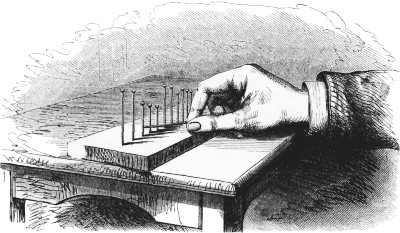
TUNING THE PINS.
"Oh, a feller told me," said he. "'T aint nothing to do. All there is of it is to get a tune in your head, and then drive a pin down in a board, and keep a-driving, and trying it till it sounds like the first note in the tune. Then stick up another for the second note, and so on."
"How can you raise a pin to a higher note?" said I.
"Hammer her down farther," said he.
"And to make a lower note?" I asked.
"Pull her up a little," said he.
"How do you manage the time?"
"Oh, when you want to go slow, you put the pins a good ways apart; and when you want to go fast, you plant 'em thicker."
The next day I found that this ridiculous brother of mine had set up a pin-organ in a circular form. He had made one of those little whirligigs which spin around when they are held over the register or by a stove-pipe, and then had connected it by a string with a wheel. This wheel, as it turned, set an upright shaft in motion, and from this there projected a stick armed at the end with a pin. This was arranged, as is shown in the cut, so that when it revolved, the pin in the stick played upon the pins in the circle, and rattled off the "Mulligan Guards" at a tremendous pace.
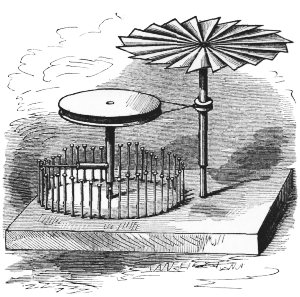
THE PIN-ORGAN.
Johnny says that he invented the circular arrangement, and that all the boys he knows are making these pin-organs for themselves, which I am not at all surprised to hear.