THE MAGICIAN AND HIS BEE.
Reading edition
BY P.F.
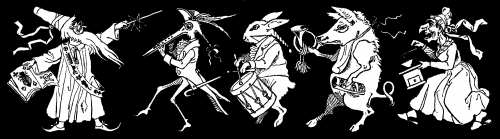
It was a spelling bee. The magician had never had one, but he thought it was better late than never, and so he sent word around that he would have his bee just outside of the town, on the green grass. Everybody came, because they had to. When the magician said they must do a thing, there was no help for it. So they all marched in a long procession, the magician at the head with his dictionary open at the "bee" page. Every now and then he turned around and waved his wand, so as to keep the musicians in good time. The cock-of-the-walk led the band and he played on his own bill, which had holes in it, like a flute. The rabbit beat the drum, and the pig blew the horn, while old Mother Clink, who was mustered in to make up the quartette, was obliged to play on the coffee-mill, because she understood no other instrument.
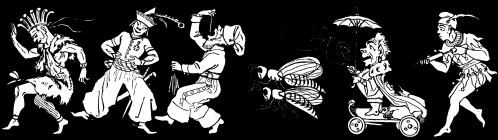
The king came, with his three body-guards marching in front. The first guard was a wild savage with bare legs, and a gnat stung him on the knee, which made the second guard laugh so much that the third one who carried the candles had a chance to eat a penny-dip, without any person seeing him. The king rode in his chariot, drawn by two wasps. He was a very warm gentleman, and not only carried a parasol to keep off the sun, but the head ninny-hammer squirted water on the small of his back to keep him cool.
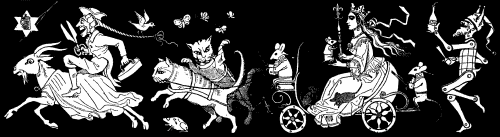
The court tailor rode on a goat, and he carried his shears and the goose he ironed with. He balanced himself pretty well until a bird sat on his queue, and that bent him over backward so that he nearly fell off.
The queen also came; she was bigger than the king and had to have cats to draw her chariot. The cats fought a good deal, but the driver, who was a mouse, managed to get them along. The footman was also a mouse, and the queen had two pet mice that sat at her feet or played with her scepter. After the queen came the chief jumping jack, who did funny tricks with bottles as he danced along.
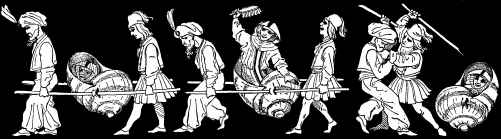
Then came the ladies of the court. They sat in nautilus shells, which were each borne by two bearers. The first shell went along nicely, but the men who carried the second were lazy and the lady beat them with a hair-brush. As for the bearers of the last shell, they had a fight and took their poles to beat each other, leaving their shell, with the lady in it, on the ground. She didn't mind, for she thought that if they went off and left her, she wouldn't have to do any spelling. So she stayed in her shell and smiled very contentedly.
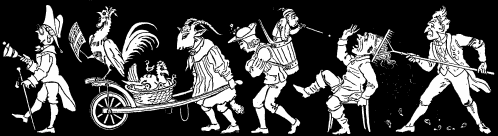
The town bell-man walked along in grand state ringing his bell, and the cock-who-could-n't-walk rode on a wheelbarrow and crowed by note. The old ram wheeled the barrow, in which was also a basket containing the hen and chickens. The smallest chicken tried to crow in tune with his father, but nobody could hear whether he crowed right or wrong—and what is more, nobody cared.
The monkey didn't walk, but was carried in a bucket by a mountaineer, and he blew peas through a tube at the palace steward who was having his hair combed by the court barber. It was so late that the barber had to hurry, and so he used a rake instead of a comb. The steward did not like this, but there was so little time that nothing else could be done, for the procession was already moving.
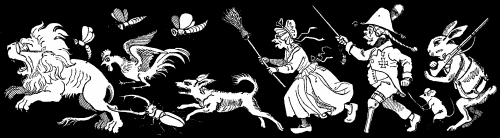
There was a lion who lived at the Town-hall. He was very wise, and his business was to bite criminals. When he heard about the bee he thought he would have to go, but the moment he showed himself in the street all the relatives of the criminals got after him. The wasps stung him, a game-cock pecked at him, a beetle nipped him, a dog barked at him, an old woman ran after him with a broom, a wooden-legged soldier pursued him with a sword, a rat gave chase to him, while a rabbit took down his shot-gun and cried out, fiercely, that he would blow the top of that old lion's head off, if he could only get a fair crack at him.
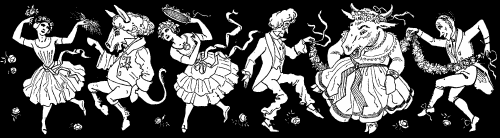
Two of the liveliest animals in the town were the donkey and the old cow. They went to the bee, but they danced along as if they didn't care at all whether they spelled cat with a c or a k. They each had two partners. The donkey had two regular danseuses, but the cow had to content herself with the court librarian and the apothecary.
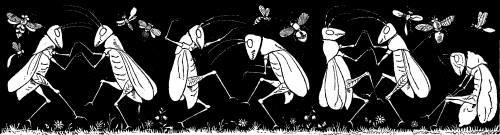
Out in the green grass where the company assembled there were a lot of grasshoppers and little gnats. The grasshoppers said to each other, "We can't put letters together to make words, so let us dance for a spell," which they did,—all but one poor young creature who had no partner, and who sat sorrowfully on one side, while the others skipped gayly about.
As soon as the people and the chickens and donkeys and wasps and cows and all the others were seated, side by side, in two long rows, the magician gave out the first word. It was "Roe-dough-mon-taide"—at least that was the way he pronounced it. The king and the queen were at the heads of the two lines, and it was their duty to begin,—first the king, and then the queen, if he missed.
But neither of them had ever heard of the word, and so they didn't try. Then one of the wasps tried, and afterward a ram, a rabbit, and the head ninny-hammer; but they made sad work of it. Then each one of the company made an effort and did his, her or its very best, but it was of no use; they could not spell the word.
Uprose then the little chicken that had stood on his mother's back and tried to crow in tune with his father, and he cried out: "Give it up!"
"Wrong!" said the magician. "That's not it. You are all now under the influence of a powerful spell. Here you will remain until some one can correctly answer my question."
They are all there yet. How long would you, my reader, have to sit on the grass before you could spell that word?