A CHAT ABOUT POTTERY.
Reading edition
BY EDWIN C. TAYLOR.
"Did you see those funny little china figures at the Centennial when you were there?" asked Willie of his cousin Al on their way home from school one day.
"What figures, Will? Do you mean those large red clay things from England, or the Chinese figures that Mr. Wu had at his place?" said Al.
"I don't mean either; I said small figures. Don't you remember a splendid show of pottery near the music-stand in the main building?" asked Will.
"Yes," said Al. "Well, there was a lot of figures of London street people, and some were the funniest-looking things you ever saw."
"I saw so much china and 'pottery,' as you call it, that I hardly recollect any of it. But 'pottery,' I thought, meant merely flower-pots and other ordinary stone-ware?"
"Why, no," said Willie; "it means anything that is formed of earth and hardened by fire. I heard Uncle Jack say so, and he knows, doesn't he?" said Willie, decidedly.
"Of course; but people do call these things 'china' or 'porcelain' as well as 'pottery,' don't they?"
"Yes; but Uncle Jack says 'pottery' means all those together, and 'porcelain,' 'majolica,' and other names like that are names of different kinds of pottery," answered Willie.
"Well," said Al, "let's ask Uncle Jack to tell us all about it. What do you say?"
"Yes; let's ask him this very night."
When the lads reached home they told their plan to Willie's sister Matie, and then all three determined to carry it out.
"Rap-a-tap, tap," sounded briskly at the library door after supper. "Come in," was the response, and in bounded the three children, their faces lighted up with smiles at the prospect of spending an evening with Uncle Jack.
"Welcome, youngsters," said he, in a cheery tone. "But you look as if you were expecting something; what is it?"
"Oh, Uncle Jack, we want you to tell us all about pottery," cried the boys.
"Yes, please do," chimed in Matie.
"All about pottery? Why, my dear children, that's very like asking me to tell you all about the whole civilized world, for a complete history of one would be almost a history of the other; and I could hardly do that, you know," said Uncle Jack, with a smile.
"Willie said you could talk about pottery all night," cried Matie.
"And so I might, dear, and not get further than the ABC of its history, after all," answered Uncle Jack.
"But how many kinds are there, uncle?" asked Will.
"That question demands an answer that must teach something," said Uncle Jack. "There are two general kinds."
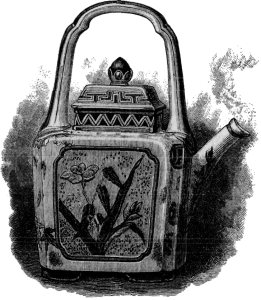
TEA-STAND (ROYAL WORCESTER PORCELAIN)
"Why, I saw a thousand kinds at the Centennial," interrupted Al, with a wise look.
"That may be," said his uncle. "But then, too, you saw a thousand kinds of people, and yet all those people were either men or women; so all pottery comes under the two general classes of 'hard paste' and 'soft paste.'"
"Why, none of it was soft, Uncle Jack, was it? I thought it was all baked hard," said Will, looking incredulous.
"So all pottery is baked hard, for, until it is made hard by firing, it is only wet clay and sand,—in pretty shapes, perhaps, but not fit for any use or ornament,—and is not yet pottery."
"Then why is it called 'soft?'"
"You've seen pieces of stone that you could grind to powder under your heel? You'd call them 'soft.' Other pieces you couldn't crush, and you'd call them 'hard.' That is something like what is meant by 'hard' and 'soft' applied to pottery,—at least, 'soft' doesn't mean soft like putty."
"But if it's all baked, why isn't it all hard alike?" asked Will.
"Because different clays are used, and different degrees of heat applied. At one time we get a kind of pottery that can be scratched with a knife, at another a ware too hard to be so scratched; the one is called 'soft paste' and the other 'hard paste.'"
The boys seemed to be satisfied with this explanation.
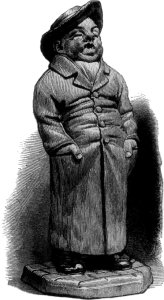
LONDON CABMAN (ROYAL WORCESTER PORCELAIN)
"Uncle, didn't you see at the Centennial some funny little figures representing all sorts of London street-people?" asked Will.
"Yes, and I brought one with me, I think. Ah! here's one," he said, showing them a droll little man about four inches high, "and it looks very like a London cabman—or 'cabby,' as he is called."
"He's very homely," said Matie. "Where was he made, Uncle Jack?"
Her uncle turned the figure over, and, looking at a small round impression on the under side, answered: "At the Royal Worcester Works in England, where some of the best of modern porcelain has been made."
"Is that hard paste or soft, Uncle Jack?" asked Willie, while Al, as if inclined to test the matter, began a search in his pockets for a knife.
"This is hard paste porcelain; it is 'translucent,'—that is, it shows the light through," and he held the little cabman before the lamp.
"Here's another piece from the same factory," continued he, selecting a second specimen from the cabinet. "This is a copy of the Chinese 'conventional dog,' made of blue 'crackle-ware.' You see, the glaze is cracked all over the surface," he added.
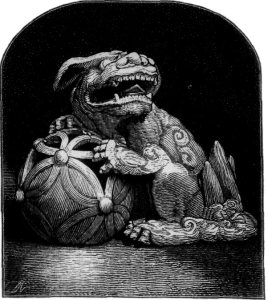
CHINESE DOG (ROYAL WORCESTER PORCELAIN)
"Who ever saw a blue dog?" cried Matie.
"In life, no one, my dear; but there are many things in Chinese art that are not much like living objects."
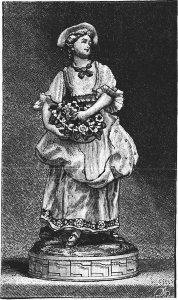
DRESDEN CHINA.
"I suppose you have all heard of Dresden china," presently continued her uncle.
"Oh yes, sir!" cried Al. "Aunt Susie had a Dresden tea-pot that belonged to her grandmother, and she said the tea always tasted better out of it than from anything else."
"Well, here is an excellent French copy of an old Dresden figure. It is a pretty flower-girl. See how gracefully she reaches for a nosegay from her basket. I have seen bouquets of Dresden porcelain that you could hardly distinguish from real flowers," said Uncle Jack.
"You'd hardly think that such a beautiful thing was made from common earth," said Will.
"Nor is it," said his uncle. "This kind of china is made from a very fine and very rare clay that, for a long time, was found only in China and the Corean islands; but about a hundred and sixty years ago, a noted chemist of Meissen, in Saxony, named Böttcher, discovered a bed of it there, and manufactured the first true porcelain made in Europe," said Uncle Jack.
"Why couldn't they get the fine clay from China and make their porcelain anywhere?" asked Will.

MARK OF DRESDEN CHINA.
"Because the Chinese jealously kept all their clay to themselves," answered Uncle Jack.
"How did that man come to discover where the clay was, and if it was of the right kind?" asked Al.

MARK OF WORCESTER PORCELAIN.
"By a strange chance. According to the fashion of the time, men powdered their hair, using wheat flour for that purpose. One day a neighbor of the chemist, in traveling an unfrequented part of the country, observed on his horse's hoofs some white sticky clay, and it occurred to him that this white clay, dried and powdered, would make an excellent and cheap substitute for wheat flour as a hair powder. So he carried a little home with him, and some of it finally reached Böttcher. The chemist found it extremely heavy, and, fearing the presence of some metal hurtful to the skin, he tested the clay in his laboratory. To his surprise and joy this white hair-powder proved itself possessed of the same qualities as the veritable Chinese kaolin, as their clay is called."
"Why, that sounds like a story," said Matie.
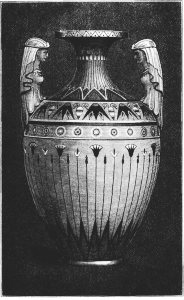
TERRA COTTA VASE.
"Here now," said Uncle Jack, "is a vase; that might carry the mind back thousands of years, to the time when bodies were burned instead of buried, and the ashes kept in just such urns as this."
"Is that vase thousands of years old?" asked Matie.
"No, dear; this vase is only modeled after the ancient cinerary urns, as they were called, and was made a year or two ago by Ipsen, of Copenhagen."
"That isn't porcelain, is it, uncle?" asked Al.
"No, this is 'terra cotta,' which is Italian for 'earth cooked.' Those beautiful lines of color and gilding are painted on the surface."
"Did you ever see any real antique vases, uncle?" asked Willie.
"Why, certainly. There are some in the Cesnola collection at our Metropolitan Museum of Art in Fourteenth street that are known to have been made 1,400 years before the Christian era. They were found on the island of Cyprus, in the Mediterranean Sea, by General Di Cesnola, who dug up a great many articles,—statues, ornaments of gold, silver and bronze, beautiful glass bottles, and many domestic utensils. I saw a cullender made of such earthenware as we have in the kitchen at this day; it had been used as a milk-strainer, and particles of dried milk were still clinging to its sides, after lying buried more than three thousand years."
"Oh, we must go and see them!" cried Matie and the boys.
"Yes, you certainly should go," said their uncle. "You would see some very curious things there, and the elegant forms of many of the articles would show you that a love for beauty has existed almost as long as man has lived."
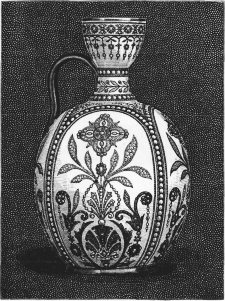
JEWELED PORCELAIN.
"You were thinking of ancient times when you said the history of pottery was almost that of the civilized world; weren't you, uncle?" asked Will.
"Yes," answered his uncle, taking from his cabinet a small jug covered with rich gilding, and glistening as if set with precious stones.
"Oh, isn't that lovely?" cried Matie.
"Well, yes; some people think that this jeweled porcelain, as it is called, is among the choicest of Copeland's works."
"Whose, sir?"
"Copeland, of Stoke-upon-Trent, where are some of the largest potteries in England."
"But don't you like it, uncle?" asked Matie.
"I do admire it very much, Matie; but not so much as some more simple objects that I have. Here is something that will explain my meaning," he added, taking from the cabinet a little vase of grayish-brown with darker indented lines drawn in the form of small animals, flowers and foliage.
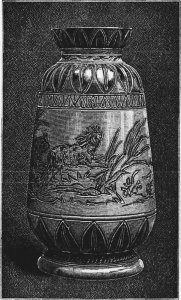
DOULTON WARE.
"Oh, I've seen ever so many pieces like that, and I thought they were common stone-ware, the same as the kitchen dishes," said Al.
"They are of common clay, it is true, but look at the drawing of the figures," said his uncle, pointing to the tracery upon the surface of the vase.
"Why, yes; it almost seems as if that little rabbit would run away, it is so life-like," said Willie.
"It was not only for its beauty that I valued this vase, but for the story that it tells," said Uncle Jack. "In the first place it tells that the simple earth we walk upon can be made by man into works of enduring beauty."
"Where was that vase made, uncle?" asked Willie.
"At the Doulton Works, Lambeth, England."
"What is the rest of the story about it?" inquired Al.
"For many years, common drain-pipes and building-tiles were the only things made at the Doulton works; but some of the pottery people went to an art school, and they thought it would be a good idea to ornament some of the common things they made with the designs they had learned to draw at school. So, with a bit of pointed stick, they made some of their favorite pictures on the soft clay objects; and when these were fired, the glaze flowed into the lines, making them darker than the other parts, and thus the drawings showed plainly."
"And since they found that out, have they given up making common pipes and tiles?" asked Willie, with a look of interest.
"They still make quantities of those things at the Doulton works, but the young men and women who had received drawing lessons and applied their knowledge so well are the authors, I might almost say, of a new style of artistic pottery," said Uncle Jack, in reply.
"Why, that was splendid, wasn't it?" cried Matie.
"Indeed it was a triumph not only for them, but for art itself, and it shows what a good influence art has on even the humblest people," said Uncle Jack. "Now can you see why I did not value my little vase most for its beauty?"
"Oh yes, sir! for when you see it, you think of the potters who became artists," said Will.
"Yes, and I never see any work of art or of patient industry without trying to understand the meaning its maker meant it to carry, and to remember the toils that were perhaps endured in its production," replied his uncle. Then, turning to Matie, he said: "I brought this little 'English pug-dog' for you, Matie. He doesn't bite, and you'll not need to give him any food," and he put upon the table a comical little porcelain dog with a wry nose.
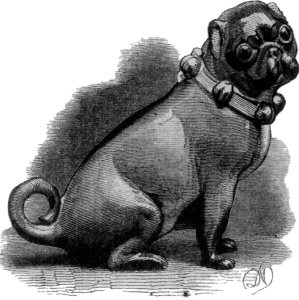
ENGLISH PUG IN PORCELAIN.
"Oh! isn't it funny? What an ugly black nose it has!" cried Matie. "Will the black come off?"
"Oh, no!"
"Why not?" asked Al.
"Because it's fired; that is, after having been painted, the dog was placed in a furnace and heated so as to melt the coloring matter, which had been mixed with other ingredients, so that it flowed on the surface, and cooled hard like glass."
"Are the colors like those I have in my paint-box?" asked Willie.
"No. They put the color on, worked up with what is called a flux, and the mixture has the appearance of thin mud, showing no color at all; the different tints are seen only after 'firing.'"
"How can they tell what it's going to look like, if they don't see the color?"
"That is one of the nice points of the 'ceramic art,' and much skill and fine imagination are required to produce some of the wonderful combinations of color seen upon Italian majolica."
"Why do they call it majolica?" asked Al.
"The name is derived from the Spanish island of Majorca in the Mediterranean Sea, one of the places in Europe where glazed pottery was first made. About the twelfth century, some Moorish potters had settled there and carried their art with them."
"Did you ever see any of the old Italian majolica, uncle?" asked Al.

MAJOLICA PLATE FROM CASTELLANI COLLECTION.
"Yes; in the splendid Castellani collection there are some of the very best specimens of the finest majolica ever made,—that produced in the fifteenth century by Giorgio Andreoli of Gubbio, and others who followed him."
"Where is Gubbio?" asked Al.
"In Italy."
"Is the Castellani collection in Italy?"
"No, it's at the Metropolitan Museum, too; but only on loan at present, though an effort is being made to purchase and keep it in this country forever. I hope it will be successful, for it is a grand collection. But I must tell you that when the French came to manufacture majolica, most of which by that time was made in the little Italian town of Faenza, they called the ware faience, after it. This name is applied to most soft paste glazed pottery, while majolica is a ware that has a peculiar luster, and in different lights displays all the colors of the rainbow. Much ordinary glazed, unlustered pottery is incorrectly called majolica, however."
"How do they make the luster, uncle?"
"By coating the ware with certain metallic oxides, which, at the last of the many necessary firings, diffuses a glaze over the surface."
"You said the painting was one of the 'nice points of the ceramic art,' uncle. What does 'ceramic' mean?" asked Willie.
"It is sometimes spelled K-e-r-a-m-i-c, keramic, and comes from the Greek word χεραμος, signifying 'potters' clay,' and hence, in a general sense, pottery of every kind and methods of producing it."
Here Matie, who had been hugging her little pug for some time, began to grow very sleepy, so Uncle Jack dismissed the children with a "good-night" all around.
The door closed softly, and the little ones ran off to their beds, while Uncle Jack leaned back in his easy chair in a pleasant reverie, which we will leave him to enjoy.