THE LETTER-BOX.
Reading edition
Bangor, Me.
Dear St. Nicholas: I am reading “Lord Fauntleroy,” and like it very much, and I hope that the next number will be that the Earl will want the mother to Lord Fauntleroy to come up and live with them. I remain, yours truly,
K. W. S.
Buffalo, N. Y.
Dear St. Nicholas: I like you so much that I wish you would come every week instead of every month. I like the story of “Little Lord Fauntleroy” best of all. But you must not let him lose his title.
M. C. W.
During the last few months, many of those who have been so deeply interested in “Little Lord Fauntleroy” have formed their own eager opinions of just how that beautiful story could, would, or should end. But all such readers, including K. W. S. and M. C. W., will agree that in the concluding chapters, printed this month, Mrs. Burnett has anticipated or fully satisfied their utmost desires.
Cloverleigh, Pa.
Dear St Nicholas: We are three little girls just the same age, for we are triplets. We look and dress just alike, and our big old brother calls us the “three little maids from school.” We have a pony, a big dog, and a little cat, but we have no little boy to play with, and we wish that little Lord Fauntleroy was a really, truly boy and could come and play with us. We send our love to you, dear St. Nicholas, and we hope that this, our very first letter, will be printed to surprise our dear Mamma and Papa, and to spite our big brother, who says nobody would print such a silly thing. Your loving little maids,
Rosy F., Daisy F., Pansy F.
Here it is in print, dear little maids,—with St. Nicholas’s compliments to you and the big brother.
Detroit, Mich.
Dear St. Nicholas: I am nine years old; I have three sisters, two older and one younger than I. Susie, the eldest, is a great girl for reading; Helen, the next, is very fond of dolls,—she has six; but Edna, the younger, is a little rogue and likes to play ball with the boys best. We have taken you long before I can remember. I enjoy the story of “Little Lord Fauntleroy” very much. Is it a good long story? I hope it is. I went to see the game of base-ball on the 19th between the Chicagos and Detroits. I enjoy playing base-ball very much; although I am only nine years old, I think I can pitch a curve. I hope you will publish this. Your faithful reader,
James C. M.
A Correction.
Colorado Springs, Col.
Editor of St. Nicholas: I should like to correct two errors that in some way have crept into my article on “Fishes and their Young,” in the June St. Nicholas. The two fishes figured on page 601 are described under the cut as being from the Sea of Galilee, and the impression given that they belong to the genus Ophiocephalus. They really belong to the genus Chromis, and are found in Lake Tiberias. On page 602, the description of the sea-horse—“These have a perfect pouch, into which the infant fishes are taken as soon as hatched”—is wrong; it should read, The eggs are taken into the pouch as soon as laid and kept until hatched.
Very truly yours,
C. F. Holder.
Pt. Chautauqua, N. Y.
Dear St. Nicholas: I have been reading “Little Lord Fauntleroy,” and it is one of the very few stories by which I am perfectly fascinated. I am going to write a story myself, sometime, although I have tried more than once, and they got so stale I couldn’t finish them. But I am writing one now, and I am going to finish it, however stale it may get, or die in the attempt.
Whenever I read a real nice story, I just sit and wonder how any person can ever think of so many things to happen in such a mysterious yet “every-day” kind of way, and come out in the end all cleared up, and just as plain as though it had really happened! Then my wonder grows into admiration, and my admiration into awe, my awe into actual reverence, and then I throw down my book and give it up as past understanding, and go outdoors and play. I am on pins and needles to know whether “Ceddie” was the real Lord Fauntleroy or not; but he must be,—he’s too good not to be!
Next Tuesday I shall be fourteen. I take the whole care of the horse, and, of course, of the barn, too, and as father and mother are in Brooklyn, I am Papa! It is very wearing to have such a multitude of responsibilities, but I think that I shall be able to keep my family (one member of which is an unruly little girl of twenty) straight until my father comes to take the burden off my shoulders.
Your venerable and careworn friend,
Arthur Mason M.
St. Louis, Mo.
Dear St. Nicholas: I am one of your little readers, nine years old. My sister began taking St. Nicholas in 1876, and, though she is now grown, papa still takes it for me. I have never written to you before, but I enjoy the “Letter-box” very much, and especially the letters about the pets the children have. I would like to tell you about three pets we had. They were a black-and-tan dog named Cricket, a Maltese kitten named Tiny, and a pet chicken named Dick. They played together, and ate and slept together. The dog had a rug on the side porch, and they would lie down and cuddle up beside him, and all sleep soundly. Morning, noon, and night we set a pan of milk out, and the three pets would gather around and all drink at once. At play they would roll over each other, and never, at any time, did they disagree or seem to be tired of each other. The kitten and chicken are both dead now, but we have the little dog yet; and he knows a great many tricks, and seems to understand whatever he hears us say about him, and always minds what we tell him. If my letter is not too long, I hope you will print it. I love your magazine very much, and am always impatient for it to come.
Your little friend,
M. C. S.
With the foregoing letter came also a letter from M. C. S.’s mother, conveying such kind and hearty words that St. Nicholas can not refrain from printing it also:
St. Louis, Mo.
Dear St. Nicholas: I wish I could tell you what a blessing your magazine has been to our children, of whom the eldest, now almost nineteen years old, enjoys it as much as her little sister of nine. I have found it a great assistance in amusing and instructing my little ones, and I am sure they will never feel old enough to give it up.
We wish you a long and prosperous life, and hope you may for many years to come send the same joy and delight to the hearts of children everywhere that you have in years past, and to ours.
Respectfully,
Mrs. S. E. S.
Memphis, Tenn.
Dear St. Nicholas: I have been taking you for nearly five years, but I never wrote you a letter before. I think little Lord Fauntleroy is the sweetest little fellow I ever read about. Every time I get a new number of St. Nicholas, I sit down on the rug by mamma and read “Little Lord Fauntleroy” out loud for mamma and my little sister to hear. Mamma and papa both like it ever so much. I liked “Davy and the Goblin” very much, too, and was sorry when it ended. But if I were to go on telling you how many of your stories I liked, I would make you so tired you would never put my letter in print. I am eleven years old, and I live out in the suburbs of Memphis. I sometimes get to studying out every one of the Brownies’ faces, and whenever I do, it makes me laugh heartily.
Your faithful reader,
E. P. P.
Gardiner’s Island, N. Y.
Dear St. Nicholas: We have taken you for four years, and are very glad when you come to us every month. We live on an island, and are not very far away from Montauk Point, L. I. The island is very beautiful, and of about three thousand five hundred acres.
When we drive in the woods, we watch for the lovely deer, which are wild and leap away when they hear the slightest sound.
We each have our riding-horse, and enjoy it very much here.
We like the “Letter-box” very much, and enjoy the letters from Europe. My sister and I have crossed the Atlantic six times. Last winter we spent in Germany studying. I liked the stories of “Art and Artists” and “From Bach to Wagner” very much. Hoping my letter is not too long, and that you will find a corner for it in the “Letter-box,” as it is my first,
Very truly yours,
Coralie L. G.
Montvale Springs, Blount Co., E. Tenn.
Dear St. Nicholas: I have heard people say that no one is perfect, but I guess they did not know you, for the only fault that any one could possibly find with you is that you don’t come often enough. You were so much company to me all last winter! For I live at a summer resort, and the children all go away in the fall, and there is no school near, and my sister and I have to be taught by a governess. I forgot to be lonesome while you were telling me such nice stories.
I am ten years old.
I hope you will live to be a thousand years old, and make every boy and girl that gets acquainted with you as happy as you make me. Good-bye, dear, good friend.
Yours forever,
Frank J. E.
Dublin, Ireland.
Dear St. Nicholas: I wonder if you ever had a letter from Ireland. I have an uncle in America who sends you to me; we all like you very much. The story of “Little Lord Fauntleroy” is so nice. I have one sister and one brother; also a cousin who lives with us. I do hope this will be printed, as this is my first letter to a magazine. I remain, your constant reader,
Florence E.
Spring Hill, Tenn.
Dear St. Nicholas: I am a little Tennessee girl, and I live in Maury Co. Mother gave you to me last year for a Christmas present. Papa took you for me this year; and I think that “Little Lord Fauntleroy” is the best thing of all. My little brother is four years old; he likes the Brownies best. He calls one of our Jersey calves “Dhonabar,” after a horse told about in St. Nicholas. I have a beautiful little brown pony. His name is Bun. I am eight years old.
Your little friend,
Irene M. C.
By an error in filing, several letters concerning curve-pitching were overlooked two months ago, and so they failed to appear with the others in the August “Letter-box.” But as the friendly correspondents who sent them have taken great pains to explain their theories, it would be unjust to withhold the letters and diagrams from the thousands of boy-readers who are interested in the vexed questions of how and why a ball curves. Some of these letters, therefore, are presented here; the remaining two or three will appear in next month’s “Letter-box.”
Franklin, Pa.
Dear St. Nicholas: May I have a word with your readers on that vexed subject, curve-pitching? Though I am not one of your subscribers, I have a younger brother who has been one for several years, and who also pitches for an amateur club here. Through him I have verified for myself the fact that a ball will curve in the direction in which it is rotating; i. e., it will curve to the right, or “in,” if it rotate in the direction of the hands of a watch, and vice versa. In this, I think, any careful observer of a curving ball will agree with me.
Now, all will admit, I think, that if it were possible to throw a ball in a straight line without any rotation whatever, there would be a cushion of air of greater density than the surrounding atmosphere exactly in front of the ball, and a partial vacuum behind it. Nor would this cushion of air have definite limits, but it would thin out gradually as it streams over the sides of the ball, thus (Fig. 1):
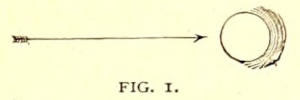
FIG. 1.
But now, suppose the ball be rotating rapidly to the right, in the direction of the hands of a watch. The sides of the ball, as they rotate, must carry by friction some of the surrounding air with them. That is, the point b (Fig. 2), as the ball rotates, will tend to carry air from its present location around to d, and so with any other point on the ball in proportion as it is on or near the equator of rotation.
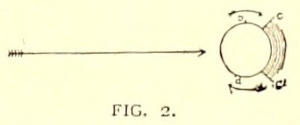
FIG. 2.
But when each point on the ball’s equator reaches the point c with its load of air, it meets with a resistance produced by this cushion of air in front of the ball, and, in order to pass on, must leave its load behind it. In other words the air carried around in the direction b c d becomes massed against the cushion in front, and the cushion is thickened at and around the point c. And, on the other hand, each point on the equator tends to carry the air from the right-hand side of the cushion, the point c, and consequently, to decrease the density or thickness of the cushion at that point. So that we soon have the cushion of air not exactly in front of the ball, but somewhat to the left of front; thus (Fig. 3):
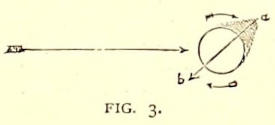
FIG. 3.
Now, since action is always equal to reaction, the cushion of air must push back against the ball just as hard as the ball pushes against it. And since the cushion is thickest where the combined forces of the ball are greatest, the cushion must push back hardest in the direction of a line drawn through the thickest part of the cushion and the center of the ball; i. e., in the line a, b, Fig. 3, a direction against that of the onward motion of the ball, and to the right of it.
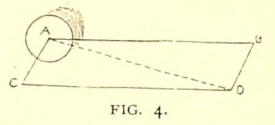
FIG. 4.
Finally, if at any instant we represent the force of the ball and its direction by the line A, B (Fig. 4), and the backward push of the cushion and its direction by the line A, C, then, according to the law of physics, that, “if two forces act on a point, and if lines be drawn from that point, representing the forces in magnitude and direction, and on these lines, as sides, a parallelogram be constructed, their resultant will be represented in magnitude and direction by the diagonal which passes through that point,” the line A, D will represent the actual force and direction of the ball at the given instant.
But both the forces, A, B and A, C, are constantly decreasing from the moment the ball leaves the pitcher’s hand, and, moreover, the force A, B decreases more rapidly than the force A, C, inasmuch as A, B is acting against the resistance of the air plus the attraction of gravity, while A, C is acting against the resistance of the air alone. Consequently, the direction of A, D is being constantly changed and away from A, B, and becomes a curve, instead of a straight or broken line. This curve will obviously have the direction, A, D (Fig. 5), or to the right, which is the direction in which a ball rotating to the right will curve.
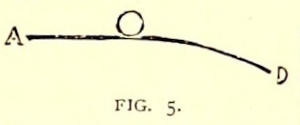
FIG. 5.
This reasoning will hold for a ball rotating in any direction, so long as the axis of rotation is, or tends to be, at right angles to the line of progression. The problem of the “drift” of a projectile from a rifle or rifled cannon is entirely different, and one I should like to see discussed after this one of “curving” is settled to your readers’ satisfaction.
I think the above explanation solves the problem as well as explains all the fallacies of your former correspondents.
Very respectfully,
S. P. E.
Annapolis.
Dear St. Nicholas: In your February number are two letters about curved pitching: one written presumably by an army officer, from Fort Monroe,—the other from Philadelphia, presumably by a naval officer. The army man states facts, and gives no explanation; the navy man fails to solve a well-known problem.
In the days of smooth bores and spherical cannon-balls (round like a base-ball, only larger), eccentricity, or difference between the position of the center of figure and center of gravity, or weight, had a very perceptible effect upon range and accuracy. Placing the projectile in the gun, with the center of gravity to the right, when the gun was fired, the projectile or cannon-ball took up a motion of rotation from left to right, and deviated to the right (Fig. 1); placing it toward the upper part of the bore, the ball rotated from down up, and deviated upward, or the range was increased (Fig. 2).
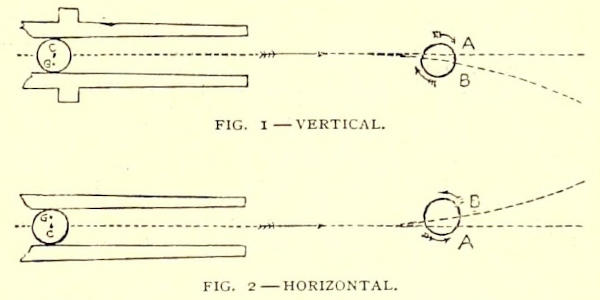
FIG. 1—VERTICAL.
FIG. 2—HORIZONTAL.
C. Center of shot. G. Center of gravity. A. Half ball moving toward the resisting air. B. Half ball moving away from the resisting air.
All bodies free to move will follow the line of least resistance. The force acting upon the ball (the resultant of the forward movement, and the opposing resistance of the air) will be away from that half of the ball moving toward the resisting air, as the ball, in its effort to take up the line of least resistance, is pushed away; no part of it is retarded. This it what a “curve-pitcher” does.
A billiard ball having received a strong “draw,” or backward rotation, striking another to one side of the center, makes a very perceptible curve after impact, until the original motion of translation has been overcome.
All these things were known before curved pitching ever was spoken of. Curved pitching was discovered accidentally, although, strange to say, many base-ball players were known always “to throw crooked,” or with a curve.
Yours truly,
E. B. Barry, Lieut. U. S. N.
Bridgeport, Conn.
Dear St. Nicholas: Having seen so many articles in your “Letter-box,” on Mr. Harvey’s excellent story, “How Science Won the Game,” I thought I would write to you in regard to it.
I have carefully tried the experiments of throwing the ball so that it would twist in the directions indicated by the different writers, and so far but one method has been correct in every particular; namely, the one given by F. C. J. in the May number.
I wish I had been at the county fair when Arthur Dart’s father offered ten dollars to any one who would successfully perform the “three stake proof,” as I am certain that I should have made that amount by the operation, whether I had been asked to pitch the “in” or “out” curve, both of which I find equally easy to accomplish.
The question of why the ball curves after it has left the hand, I account for as follows: If the “in” curve is to be pitched, the ball touches the index finger the last thing before leaving the hand, and, as it does so, the hand is quickly and forcibly clenched, so that the ball is given a twirling motion. Therefore it curves to the right (provided it is thrown with the right hand). In the case of the “out” curve, the ball touches the thumb the last thing before leaving the hand, and consequently twists to the left, producing the “out” curve.
The “out” curve is so called because it is a ball thrown to a right-handed batsman when in position, so that it curves out toward the end of his bat, while the “in” curve is a ball thrown to a batsman which curves in toward his body.
The following may be safely taken as a rule as to curve-pitching. If the ball be thrown so it twists the way shown in Fig. 1, the ball will curve in; but, if it be thrown so it will twist as indicated by Fig. 2, the ball will curve out.
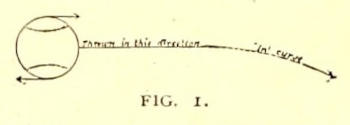
FIG. 1.
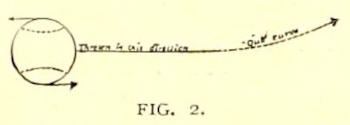
FIG. 2.
Trusting that this explanation is clear and satisfactory, and hoping to see it in the “Letter-box,” I remain the stanch friend and admirer of our National Game,
Will P. Snikpoh.
Fishkill, N. Y.
Dear St. Nicholas: I have been reading with much interest the letters concerning the curving of a base-ball, and would now like to try my hand at offering an explanation. The theory that I present is not original, being taken from “Wood’s Analytical Mechanics,” p. 462, but it seems to be the one offering the best explanation of the actual facts of the case. I will omit what mathematics there is in it, in order to render it a little more easily understood.
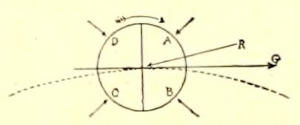
Suppose a ball is moving toward G, and rotating in the direction shown by the arrow. Then the two quadrants A and D will move with equal velocities. B and C will also move with equal velocities, but B and C will not move as fast as A and D, because in the case of A and D the velocity due to rotation is to be added to that of direct forward motion, and in the case of B and C it is to be subtracted. Now the pressure of the air on a moving body varies, as some power of the velocity of the body; that is, the greater the velocity, the greater the pressure. The quadrant A moves against the air with a certain velocity, and the total pressure of the air on that quadrant will be a force, acting toward the center (if we neglect friction), which may be represented by the arrow at A. The quadrant B moves against the air with a less velocity than A; hence the pressure is less. Let it be represented by the arrow at B. The quadrant C moves away from the air with a velocity equal to B; hence the pressure on C must be less than that on B. The quadrant D moves away from the air with a velocity greater than that of C; hence the pressure on D will be less than that on C. Evidently now from this arrangement of forces the resultant force will lie somewhat in the position shown by the arrow R. This will tend to force the ball away from the direct line of flight and to curve it as shown by the dotted line.
Thus we see that it is the pressure of the atmosphere that curves the ball, and not the friction. The tendency of the latter is to curve the ball in the opposite direction, but this tendency is unappreciable. This is where the mistake of your correspondent in the February number lies; namely, in considering the friction instead of the pressure. The explanation of F. C. J. in the May number seems to me more correct. The theory of “A Curver” in the May number, that a ball could be curved more easily in a vacuum than in the air, is entirely wrong. It violates Newton’s first law of motion. “A body continues in a state of rest or of uniform motion in a straight line unless acted upon by some external force.” In a vacuum there would be no external force, and the ball would not curve at all. Prof. Wood, in the article referred to, proves that the more slowly a ball is thrown with a given velocity of rotation the more will it curve. Does any one know how this is practically? Hoping that I have not taken up too much of your space,
I am, very sincerely yours,
J. R. S.
Brady City, McCulloch, Texas.
Dear St. Nicholas: Seeing Mr. Stevens’s letter on the “curve” in your April number, I am tempted to reply to it. Unfortunately, the data on which his theory is founded are incorrect. A ball twisting to the left will curve, not to the right, but to the left.
May I offer another explanation. The facts are that: 1, the axis of rotation is perpendicular to (or rather the plane of rotation or twist is parallel to) the plane in which the curve lies; and, 2, that the curve is in the same direction as the twist.
When a ball is thrown with sufficient velocity, the air is (as Mr. Stevens tells us) “compacted in front of the ball.” When there is little or no twist, the resistance of the air is equal on both sides of the ball, and there is no curve.
Now, if the wind be blowing across the path of the ball, the resistance is unequal, and the ball curves away from the wind; so that in practice allowance is made for this curve when throwing a ball in a high wind.
When there is no wind, but the ball is thrown with sufficient velocity to create considerable resistance from the air, and at the same time is twisted so as to rotate on its axis, then the resistance offered at a, c (Fig. 1) is greater than that offered at a, b; for a, c is advancing with the velocity of the throw plus the velocity of the twist, while a, b is advancing with the velocity of the throw minus the velocity of the twist. Consequently a greater resisting force being exerted at a, c than at a, b, the ball yields and is forced into the curve B, A′, just as a cross wind would deflect it. The result is a curve—because the forces are constant while the ball is in motion.
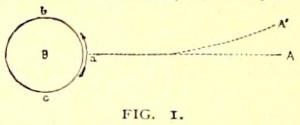
FIG. 1.
Again, conceive of the ball B (Fig. 2) as at rest and the wind acting on a, b in the direction c, a. The angle of incidence being equal to the angle of deflection, the result will be to force the ball in the direction c′, a—the same result as is produced by the wind acting on a sail.
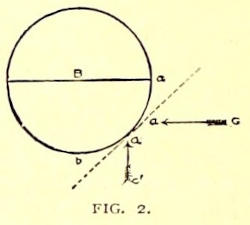
FIG. 2.
On this theory, the relation of the velocity of the twist to the velocity of the throw will determine the nature and degree of the curve, and the point of departure from the straight line.
If the ball be thrown too slowly, there is not sufficient resistance to affect its course materially. If it is thrown too swiftly, the velocity of the throw will overcome the tendency of the twist, and there will be no perceptible curve.
For this reason the ball, when first thrown, will proceed in an apparently straight line until its initial velocity is so far diminished as to nearly equal the velocity of rotation, when it will begin to curve.
Again, the ball would have a tendency to curve in the direction of rotation were there no resistance from the air. For, in the plane of rotation the circumference at c moves more rapidly toward A than at the point b (Fig. 3); hence it has a tendency to advance over a greater distance than b in a given time, but is held back by b. This gives centrifugal and centripetal forces acting from b to c, and a consequent tendency of c to revolve around b, which, in connection with the motion of both toward a, would give the curved line a-A′ as the path of the ball.
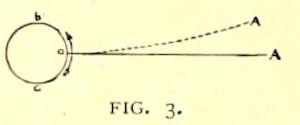
FIG. 3.
As a familiar example, take a child’s wooden hoop and toss it from you with sufficient upward tendency to overcome gravity, at the same time causing it to revolve rapidly in a plane parallel to the horizon, and you will find that it will describe a curve in the direction of the rotation and fall at your feet. This is an extreme illustration of this factor of the base-ball curve; the diameter of the hoop being so much the greater, of course gives a far greater velocity of rotation in comparison to that of projection than the smaller diameter of the base-ball can give.
This same principle is involved in the explanation of the motion of the boomerang of the Australians and the toy of the same name.
Yours sincerely,
Robert S. Dod.
Our thanks are due to the young friends whose names here follow, for pleasant letters which they have sent us, but which are crowded out of the “Letter-box”:
Arthur E. Clark, Jr., A. G. C., M. M. Stevens, Urbanna Myrover, “Gladys, Gipsy, Sibyl,” Blue Bell, “Hie” and “Tie,” T. A. T., May Elden, Herman N. Steele, “Yum” and “Tum,” Daisy Smith, Phil Riley, Annie M. Porter, Daisy A. C., Lucy E. D., Mable H. W., Amelia N. F., and Annie L. D., Francie Mackenzie, “Maiden Hair and Moonlight,” Mabel F. Rigby, W., I. S. B., E. T. C., Carl W., Isabel Eldridge, Kittie Loper, Aimée and Goldina Mendelson, Herbert A. Megraw, Gerald B. Wadsworth, F. W. L., Amy D. Smith, Imogene Avis, May, David Blair, and May E. Masten.