THE CHILDREN’S EXHIBITION.
Reading edition
By Charles Barnard.
One morning last March there appeared in the New York newspapers an advertisement of a “Children’s Industrial Exhibition.” At first many persons could not imagine what it could be. But when the doors were opened and the reporters went to look at the exhibition, the newspapers began to tell of the many curious things to be seen in the hall. No such exhibition had ever been seen in New York, and then people began to wonder why one had not been held before. Now the true way to understand a thing is to look at it again and again. It so happened that I went to this exhibition several times, and that a St. Nicholas artist went too, and so perhaps we can together give you an idea of the principal things that were on view at that curious show.
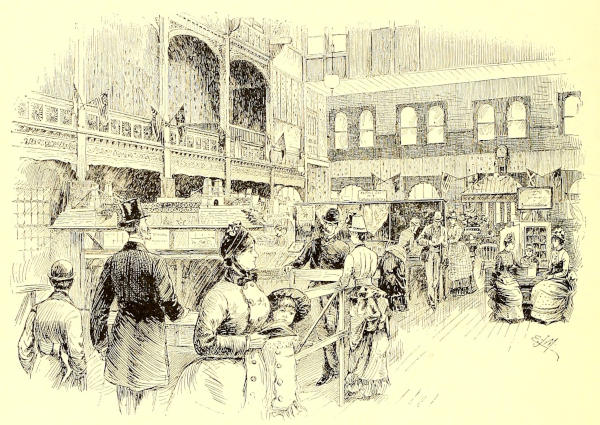
GENERAL VIEW OF THE EXHIBITION.
The exhibition was held in a large and handsome hall, and was arranged just like any grand fair intended to exhibit the artistic or mechanical achievements of men and women. There was only this difference: the objects to be seen were all made by little women and very youthful men. There were medals to be given for the best work, and there was a catalogue, and there were officials to explain everything to the visitors. Were there sums on slates, compositions, exercises or examples of penmanship? No. Better than these—very much better—there were real things made by boys and girls with their own hands, and, best of all, things made in school.
On entering the hall, however, the first objects to attract attention were those made by boys at home and out of school. These objects were arranged on tables by themselves, some of the work being by children in New York, and some by young folk in Yonkers. There were wood-carvings, hammered brasswork, drawings and designs, embroidery, and hundreds of curious things either useful or merely ornamental; models of boats, houses, shops, forts, and even a carousel with woolly elephants that career madly around the ring whenever the clockwork is wound up. Some of the things were well made, but many were very poorly done, which shows that we must go to school to learn to make boats as well as to learn to do sums in long division. The work of the girls showed more training than that of the boys, and the sewing was very good,—some of the artistic sewing being worthy of high praise.
Speaking of sewing, our old St. Nicholas friends, the kitchen-garden and the cooking-garden, were wonderfully displayed with full examples and models, and even a tea-table set in proper order precisely as arranged by the little housekeepers. The exhibit was well worth looking at, and there was always a crowd around the table, but for us it was chiefly interesting because there the noble art of sewing was demonstrated precisely as if it were a lesson in geography.
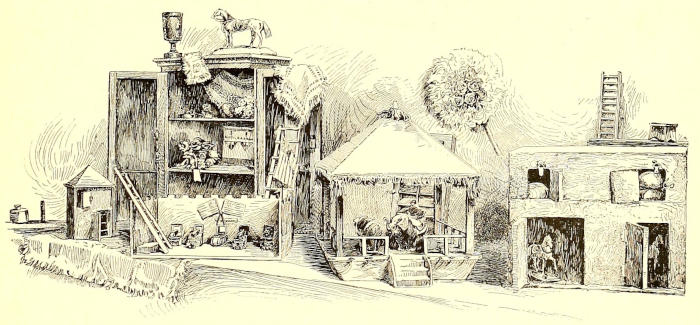
PART OF THE EXHIBIT BY THE CHILDREN OF YONKERS, NEW YORK.
The true way to study about islands and capes and all the other divisions of land and water is to have some sand and water in a box, and then to build up the sand into miniature islands and capes, just like the real things out-of-doors. When I went to school, all the boys could say, “An island is a portion of land entirely surrounded by water,” and yet not a boy in the class knew that he lived on an island. So it is with sewing. The girls I knew years ago cried so hard over the long, dreary seams, that I used to be glad I was not a girl. But nowadays there is sewing without weeping: a neat box all ready for school,—with thimbles, needles, pins, thread, scissors; hundreds of pieces of cloth, basted and ready to be stitched; no dreary seams to tire young fingers, but easy graded lessons, like a needle-work kindergarten. And as we crossed the exhibition-hall, we saw another method. There on a long table were hundreds of garments and parts of garments made by the public-school girls of Philadelphia. There, in a frame, were all the lessons arranged in regular order, showing every step—hemming, over-seaming, back-stitching and running, reversible seam, felling, gathering, darning, and mending, up to the fine art of button-hole making. The girls are from eight to fifteen years of age, and that work they did in school, while attending to their regular school lessons. We passed on to the tables where the work of school-girls of Boston and New Haven and Hoboken was shown; and in every instance, we saw regular, graded lessons in needle-work, from the plainest hemming up to the finest embroidery. New York girls, too, in the schools of the Children’s Aid Society, in mission and church schools, showed by their samples that they also were students of stitchery. I saw one piece of sewing that seemed truly wonderful. It was in a glass case, and it was the “graduation exercises” of a young girl, fourteen years of age, on leaving Fräulein Calm’s school in Cassel, Germany. It consisted of half a yard of muslin ornamented with every kind of sewing that can be done on a machine; half a yard of dress fabric worked up by hand into the most beautiful pleatings, in a style that would bring tears of joy to the manly eyes of a ladies’ tailor; a piece of wonderful patching; and a square of darning so perfect that it was impossible to tell which was the new cloth, and which the old garment. Why, the girl must have been a finished dress-maker! She could earn good wages to-morrow by simply showing her “graduation exercise.” And as we turned to a dozen other exhibits in the hall, we saw more sewing, from the work of the first class in hemming up to that of the little dress-makers, who could cut, fit, and make their own clothes.
What can boys do? Judging by their grand exhibit, we thought to ourselves “they can do almost anything!” Some boys who attend one of the uptown schools on the east side had formed a club for home work and study in mechanics, and there was a table filled with their work. It was chiefly models in wood of real things the boys had seen—a crane, a dumb-waiter, a stone-saw, a pile-driver, and other mechanical implements. It was all excellent work, but it was home work done out of school hours.
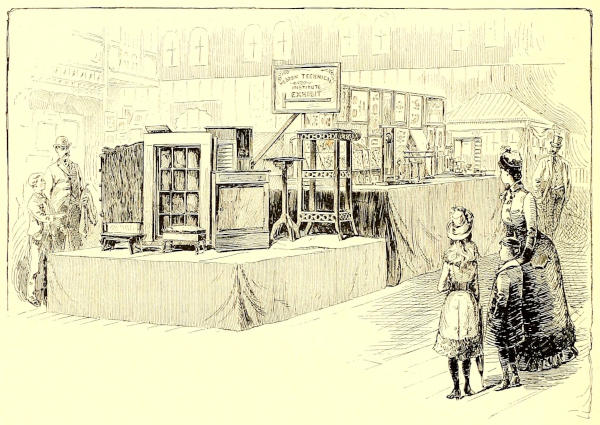
EXHIBIT OF THE HEBREW TECHNICAL INSTITUTE.
The opposite table showed school work done by the boys of the Hebrew Technical Institute. Those young master mechanics, it seems, attended school every day and at the same time learned the use of tools, the pencil, the saw, the hammer, and the plane. First of all, every boy had to learn to draw, not merely to make a pretty picture of something, but to make a regular working-drawing, so that the real thing could be constructed from it, and so that when the thing is finished, the drawing will be a true picture of it, whatever it may be. So we found there regular graded lessons in drawing, and in making joints in wood, and in construction. As the boy improves, he studies pattern-making and learns to make a mold from the pattern, and to melt lead and make a casting. We saw all the carpentry lessons arranged in order, and glanced at every lesson a boy has to take, from learning to draw to making a step-ladder. There were stools, tables, small bureaus, and other furniture made, finished, stained, and varnished by boys in the school. There was even a window-frame ready to put in the wall of a house, with sash, blinds, and all, complete and in working order; and the boy who made it was only fourteen years old.
There are in every school queer girls or odd boys who somehow fail often and are at the foot of every class. These children may be as bright as any, but there is nothing in the school to bring them out. In this exhibition we found the work of some such girls and boys. They see beautiful things in fields and wood, and they have wise teachers. It is not every child that can express itself in a composition. These boys and girls express the ideas that are in them with a pencil. They study real, living things, plants and flowers, and they learn to place the forms of these things on paper and add to them something of their own day-dreams, and soon every one who sees them exclaims: “What beautiful designs!” These so-called dull children who never can understand the multiplication table, and who shed useless tears over the tables of weights and measures, here find the right kind of school for them: and they appeared, with their work, in this children’s exhibition, as bright, as interested, as eager to learn as any prize-medal scholar in any grammar school.
Now we must not think that only the quiet, thoughtful girls can do such work. Every child has some sense of beauty; the trouble is that unless it is given instruction in such things, it will probably never, except by accident, find out what it can do. They are wiser about such things in Chicago.
On the wall of the exhibition-room, under the gallery, was a grand display of work, and so arranged that we could see just what every child in the public schools of Chicago studies from year to year. The pictures were arranged in three rows to illustrate the different kinds of work; and below the pictures, on a long table, was a collection of little models, made by the children in the schools. There were balls, cubes, and pyramids shaped in clay by little hands. Even the youngest children in primary schools can do this. Why, it is only fun, to shape the soft clay! Of course, every little seven-year-old fellow is in a hurry every morning to get to so grand a school, where he learns what a cube is by making a true, fair cube in soft clay. Having learned to make various shapes in clay, he then learns to make simple outlines of the same objects by placing straws together in those shapes on his desk. Next, he can go one step further, and with a pair of scissors cut cardboard into shapes that represent those forms. Then he can proceed to use these shapes in various ways to make designs, or he can cut in paper or in white wood, with a scroll-saw, pretty figures suggested by the clay-models. He can even make new lines on the old shapes, and decorate the clay forms he first made.
If your teacher tells you that a cube is a “rectangular parallelopiped, which has its six sides squares,” you may think it is all right, and say it after him without tripping, and yet not have the least notion that the wooden blocks on which you learned your letters were all cubes. This Chicago youngster would not use those dreadful words to describe a cube. He would make one and give you a picture of it. Did he not construct one out of wet clay? He knows a cube anywhere, and he will never forget it. All his life long he will see cubes of every size, and he will know in an instant whether they are true cubes with all the six sides truly square. And if you give him a piece of paper, he will cut it out into a perfect cross, and then fold it up in a certain way and make a box that is a cube. Besides all this, his cubes are ornamented, so that he is already an artist, and enjoys making things beautiful.
The picture here given shows the three ways in which the Chicago primary scholar works. At the base are the forms he constructs in clay; then the outlines made of bits of straw; then the figures cut out of cardboard; and finally the decorated figures made from these forms. In this way, he studies construction or making things; representation, or picture-making; and decoration, or the making of beautiful figures that are like the things he constructed and represented. We walked along that beautiful exhibit and saw hundreds of things molded in clay or cut out of soap or carved in wood, and then saw the drawings and ornaments made from those things. We perceived just how the Chicago boy or girl goes on from work with straw to simple drawings on a slate, and then to finished drawings in pencil on paper, until we wondered if every child in Chicago is to be an artist.
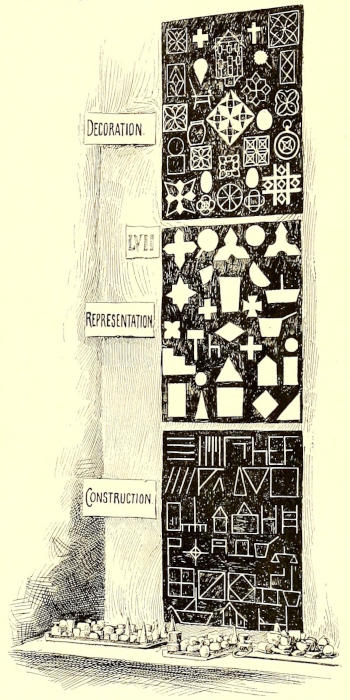
PART OF THE EXHIBIT BY THE CHICAGO PUBLIC-SCHOOLS.
Next to that fine display of children’s work from Chicago came a series of drawings by the pupils of the schools of Worcester, Mass. Here, too, we find the boys and girls making drawings of real things that they have made themselves or that were made by others. The first drawings are to show how the things are constructed, the others to show how they look. Then the pupils take flowers or other objects and make from them original designs that may be used for decoration. In this exhibit, too, were beautiful pictures in water-colors to show that the young artists understood the harmony of colors. If the exhibition had shown us nothing more than the admirable work by those Massachusetts boys and girls, it would have well repaid us for coming.
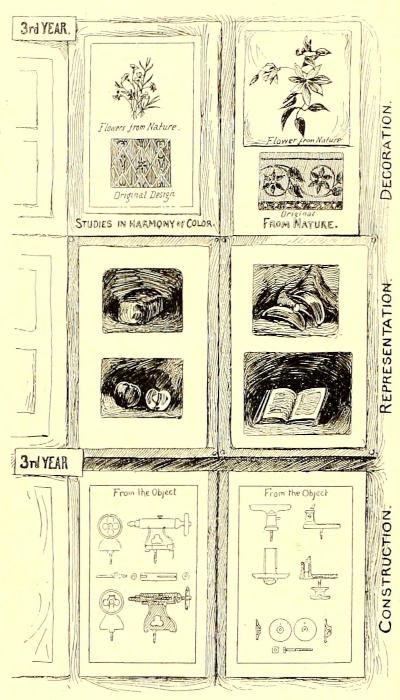
PART OF THE EXHIBIT BY THE PUBLIC SCHOOLS OF WORCESTER, MASS.
Next to the Worcester exhibit stood the New Haven tables. What fine times those New England children must have! Here we found more drawings, by Connecticut boys and girls, showing that they also know how things are made, and how they look on paper. Here, too, were more of those curious shapes, cut out of paper, to be folded up into cubes and prisms, cylinders and pyramids. There even were little pots and pans, cut out of paper, every part made by itself from a drawing, and the little model made by pasting the parts together. What an easy way that must be to study squares and circles, parallel lines and the whole family of angles! New Haven boys will never stumble over that trying old question, as to the difference between two square feet and two feet square. They learn all about it in a new kind of game with scissors and paper and a pot of paste. We might spend hours in looking over the work of those New Haven boys and girls—the handsome furniture, the neat sewing and pretty embroidery, the “busy work” of kindergarten tots, and the carpentry work of the big boys; and the more we studied that school work, the more we should wish, probably, that all schools were like those schools.
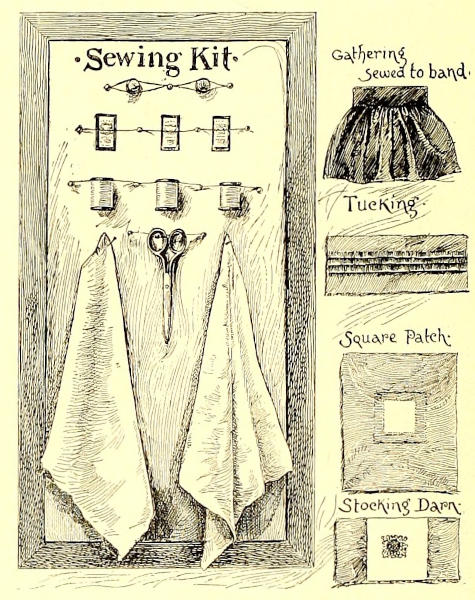
SEWING-KIT FURNISHED TO GIRL PUPILS OF THE PHILADELPHIA PUBLIC SCHOOLS. SAMPLES OF WORK.
Leaving the New Haven tables we came to the grand exhibit made by the school-children of Philadelphia. In that city, there are twenty-five thousand girls studying plain sewing every week of the school year. The piled-up tables loaded with sewing showed only a small part of the work. On other tables we could see excellent designs and work in hammered brass, fine carvings, and even furniture and stamped leather-work. Then there was one very interesting table. On the wall above it were working drawings showing how wooden joints of all kinds are made; and on the table itself were dovetails, mortises and tenons admirably done in wood. There too were pieces of cast iron chipped and filed into various shapes. Very few workmen in shops could do better, and yet all we saw was the work of public-school boys.
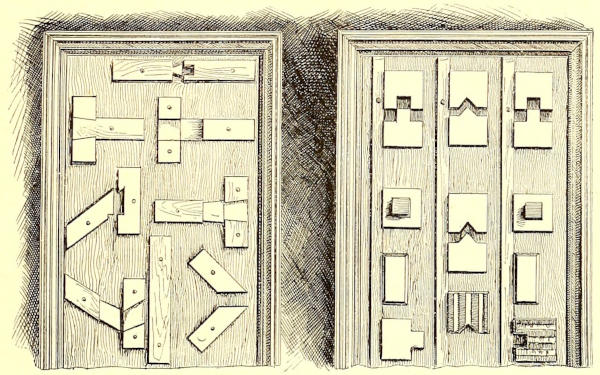
SAMPLES OF JOINING-WORK IN WOOD AND METAL, SENT BY THE PHILADELPHIA MANUAL TRAINING SCHOOL.
As we turned away from those tables, we saw another marked “St. Louis.” Here was shown more work by little hands, more drawings, too, and all proving that those Western youngsters are having happy times in school with busy fingers. Next, we came upon some excellent drawings by pupils of a South End Industrial School at Boston. The boys of that school have a printing-press, and the girls can make bread as well as trim bonnets, for they exhibited both the hats and the loaves. Jamestown, in New York, is also teaching its boys and girls to work with their hands, and some of their work in the exhibition is excellent.
Did you ever think what it is to be blind?—to be unable to tell whether the paper you hold in your hand is white or blue or some other color. How could we do anything if we could not see? But in the Children’s Exhibition, on a table covered with knitting and fancy work of blind children, was the strangest display of all—kindergarten work made by a hundred blind girls and boys! No bad work in it either; it all was neat and perfect. Yet those children have never seen the work their young hands have made.
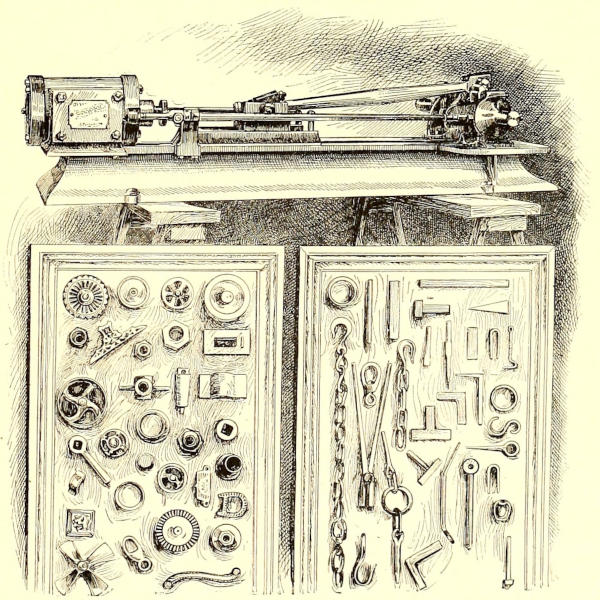
PART OF THE EXHIBIT SENT BY THE MANUAL TRAINING SCHOOL OF CHICAGO.
A boy may lose a foot or a leg and be a cripple all his life. Shall he give up in despair and do nothing, or beg, which would be even worse? No. He has his hands and a brave heart. He will have a manly spirit even if he has a broken body. Well, on a table near the blind children’s work, was a collection of brooms and brushes,—new, well-made brushes, as good as you can find, and all made by the young workmen of the Crippled Boys’ Brush Shop in New York.
There, too, were tables loaded with work from four orphan asylums in New York and Brooklyn, and we saw sewing, bread-making, net-making and cabinet-work done by young hands that have lost their hold on fathers’ and mothers’ fingers. Other friendly hands are leading them to be useful and skillful in many good works.
We may have been accustomed to think of Indian boys and girls as little savages, unable to do anything except to use a bow and arrow or to take care of the wigwam. But the exhibition included also a display of objects made by Indian children at school. There was a set of harness, a pair of shoes, and some sensible coffee-pots made by Indian boys and girls. Like so many others, they are learning to use their hands.
We may pity those halt and blind, those neglected children from the wilderness, and those little ones who have known grief; but see how brave they are! They have wiped away all tears and found it sweet and wise to learn to work, to forget their griefs in industry. Depend upon it, if we had learned nothing more by coming to this exhibition than this, we should have learned a great deal—that work is a cure for many ills, that work actually means happiness.
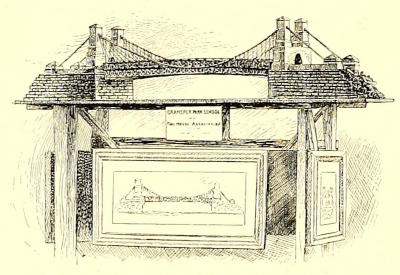
WORKING-DRAWINGS AND MODEL OF A SUSPENSION BRIDGE. DRAWN AND CONSTRUCTED BY THE BOYS OF THE GRAMERCY PARK SCHOOL.
Near the door of the main hall was a fine model of a suspension bridge with towers and cables complete. Beneath it were drawings showing how the bridge was made. This was the work of the boys of the Gramercy Park School and Tool-house Association. They drew the plans, and constructed the model bridge from the working drawings. They built up the foundations and towers, piece by piece, and strung the cables and suspended the roadway. All, too, while the builders were attending school and without loss of time from their regular lessons.
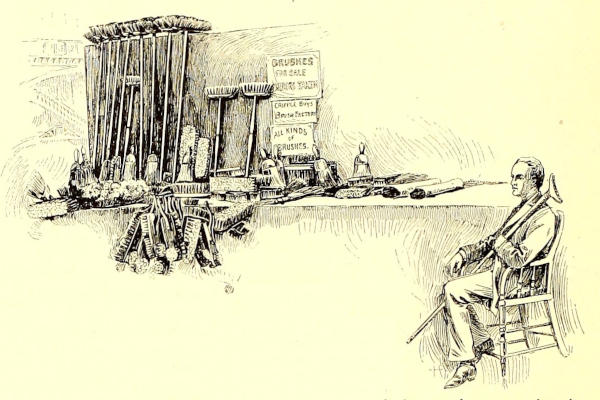
EXHIBIT BY THE CRIPPLED BOYS’ BRUSH FACTORY.
And even now I have not told you of half the things in that beautiful exhibition. As we sat there, people were flocking in, young and old, teachers and pupils, eager to see what children can do.
And now, what does it all mean? Let us have a little talk about it.
To that exhibition, more than four thousand children sent the work of their hands. We do not think of them as Western children, as Eastern boys, or New York girls, as Hebrews, Catholics, as orphans, or blind, or anything else. They are children at school, and there is the wonder of it all. It is plain their schools are not like other schools and are very different from those I saw when a boy. It is plain that those children can do many things that children without their advantages can not do. And besides, they are probably happier than any children who ever went to school before.
Let us see why this is so. Most children go to primary school and then to grammar school and perhaps to high school and college, or to some private school. This exhibition plainly shows us that there is a new kind of school, that there are new lessons and new teachers coming. Books we must have. To learn, we must read; but we may read all about boats, and yet we can never learn to sail a boat till we take the tiller in hand and trim the sail before the breeze. The book will help wonderfully in telling us the names of things in the boat and, if we have read about sailing, we shall more quickly learn to sail; but we certainly never shall learn till we are in a real boat. We can read in a book how to turn a heel in knitting, and may commit to memory whole rules about “throwing off two and purl four,” and all the rest; yet where is the girl who can learn to knit without having the needles in her hands?
This then is the idea of the new school—to use the hands as well as the eyes. Boys and girls who go to the ordinary schools, where only books are used, will graduate knowing a great deal; but a boy who goes to one of these new schools, where, besides the books, there are pencils and tools, work-benches as well as writing-books, will know more. The other boys and girls may forget more than half they read, but he will remember everything he learned at the drawing-table or at the work-bench, as long as he lives. He will also remember more of that which he reads because his work with his hands helps him to understand what he reads.
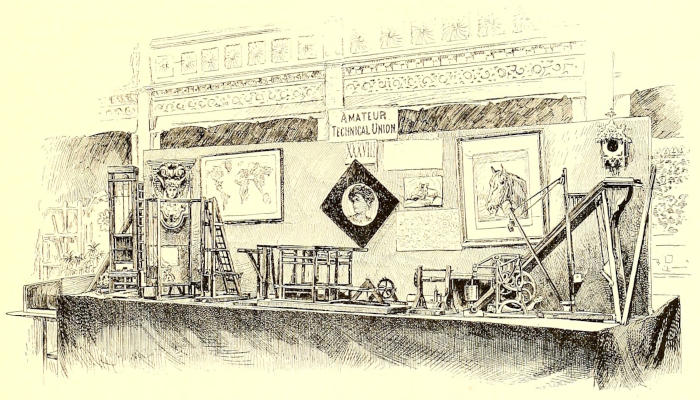
EXHIBIT OF THE AMATEUR TECHNICAL UNION.
Again, a boy who goes to one of the new schools, where once a week he spends two hours in a shop, and works with his hands, say to make a square block of wood “true,”—exact to the hundredth part of an inch,—will soon see that bad work is not square, is not true and fair. A piece of false work will seem ugly and show bad workmanship. He will go out of the shop proud that he can do true work; and all false things, whether in wood or only in thought, will seem bad and wrong to that boy. He can not make a crooked joint in woodwork and be satisfied; neither is he likely to be content with crooked work in word or deed.
The four thousand children whose work filled that exhibition hall, read books and study lessons precisely as do you; but they do more. For two, or perhaps four, hours every week they lay down their books and take up those splendid tools, the pencil, the needle, the hammer, the saw, and the file. Are they any less readers than those who only read? No; they are better readers, because they are workers; because by work they better understand reading.
I remember long ago a tear-stained book of tables of weights and measures, and a teacher’s impatience with a stupid child who could not master the “tables.” And I have seen a school where the tables were written on a blackboard—thus: “two pints are equal to one quart,” and on a stand in the school-room was a tin pint measure and a tin quart measure, and a box of dry sand. Every happy youngster had a chance to fill that pint with sand and pour the sand in the quart measure. Two pints filled it. He knew it. Did he not see it, did not every boy try it? Ah! Now they knew what it all meant. It was as plain as day that two pints of sand were equal to one quart of sand; and with merry smiles those six-year-old philosophers learned the tables of measures; and they will never forget them. This is, in brief, what is meant by industrial education. To learn by using the hands,—to study from things as well as from books. This is the new school, these are the new lessons. The children who can sew, or design, or draw, or carve wood, or do joinering work, or cast metals, or work in clay and brass, are the best-educated children, because they use their hands as well as their eyes and their brains.
You may say that in such schools all the boys will become mechanics, and all the girls become dress-makers. Some may, many will not; and yet whatever they do, be it preaching, keeping a store, or singing in concerts, they will do their work better than those who only read in books. The new schools are the best schools. Will there not be more of them every year? I think parents will see that it is an excellent thing for all boys and girls to learn to use their hands, that not to use the hands at all is to be helpless in the great school we all attend when we are men and women. The exhibition held last March may be only the beginning of a new education wherein the hard lessons of the books, that no little fellow ever could understand, shall give place to bright and interesting books about work and about things. There may yet be shops in every schoolyard, and embroidery frames on every girl’s desk. There will be books, of course, and there also may be tools. There will be examinations indeed, but there may also be in every town an exhibition like the one I have told you of; and the fathers and mothers and all the good people flocking to the schools may see what the children can do with their hands. There will be speeches and recitations and music as now, and there may also be drawings and brasswork, embroidery, and designs in clay and in wood; and every child may be able to work as well as to study. No more tears over unmeaning lessons, but everywhere pleasure and interest because study is joined to work, and to learning is added industry.