ABOUT BREATHING.
Reading edition
By Hellen Clark Swazey.
It is a curious fact that, although breathing is a very simple and necessary accomplishment, there are a great many people who have forgotten how to do it in the best way. If you will watch a perfectly healthy baby when it is asleep, you will see that its shoulders are quite low and even, that its mouth is usually closed, and that it is breathing comfortably from its lower chest. We know that the lungs are the chief purifiers of the blood; but to perform their duty satisfactorily the air-cells of the lungs must be filled with filtered air and they must have plenty of room in which to work,—so we are, on the whole, well satisfied with the baby’s method of breathing. In fact, we have reason to believe that the system has been taught by Nature herself; and when we can get Nature’s methods at first hand, it is seldom worth while to try to improve upon them very much.
But when the baby grows up, if it chance to be a girl, her clothing is usually such that it interferes with the free action of muscles that are concerned in enlarging the cavity of the chest, so that the lower part of the lungs, which should be busy taking in their share of oxygen to make the blood fresh and bright, are seldom used, and the blood goes away from the lungs only partly freed from its impurities, while the lungs themselves do not get exercise enough for their own good.
But tight dressing, though the most serious hindrance to the habit of good breathing, is not the only obstacle. There are careless ways of sitting and standing that draw the shoulders forward and cramp the chest; and it is as hard for the lungs to do good work when the chest is narrow and constricted as it is for a closely bandaged hand to set a copy of clear, graceful penmanship. Then there are lazy ways of breathing, and one-sided ways of breathing, and the particularly bad habit of breathing through the mouth. Now the nose was meant to breathe through, and it is marvelously arranged for filtering the impurities out of the air, and for changing it to a suitable temperature for entering the lungs. The mouth has no such apparatus, and when air is swallowed through the mouth instead of breathed through the nose, it has an injurious effect upon the lungs. A story is told of an Indian who had a personal encounter with a white man much his superior in size and strength, and who was asked afterward if he was not afraid. “Me never afraid of man who keeps mouth open,” was the immediate reply. Indeed, breathing through the mouth gives a foolish and weak expression to the face, as you may see by watching any one asleep with the mouth open.
It is well to establish the habit of deep breathing if it does not already exist, but, in addition to this, the reserve air which is left in the lungs after an ordinary expiration should be expelled and the lungs thoroughly ventilated at least twice every day. First, then, see to it that the air in the room is as pure and fresh as out-of-door air can make it. Then, with all tight and superfluous clothing removed, lie flat on the back and, with the mouth firmly closed, take a full, deep breath. Hold it eight or ten seconds, and then let it out. Take another, and yet another breath in the same way.
After that, take a breath into the lungs as slowly as possible, beginning to fill them at their lowest extremities, and inhaling gradually until they are filled to their full capacity, when the air should be exhaled in the same slow and steady manner in which it was taken in. Repeat this exercise three or four times. Now watch and see if the shoulders are kept drawn down and immovable while the air is inhaled, as they should be, or if they are drawn up, and are thus robbing the diaphragm and muscles of forced breathing of half their exercise.
When you have taken this movement again to make sure that the shoulders are in good position, throw your arms vertically over your head and take another quick, full inspiration, swinging the arms rapidly to the sides close to the body and back again over the head. Swing the arms up and down four times on the same breath, and repeat the exercise three or four times.
After this, it is a good plan to stand erect with the arms horizontal at the sides, and vigorously clap the hands from that position over the head a few times. When taking such movements in an erect position, always keep the chin two or three inches back of the vertical.
A few such exercises as these, for five or ten minutes at night and morning, will promote refreshing sleep and give increased vitality for duties and occupations of the day; and it may be noted in conclusion that an anæmic or low condition of the blood is seldom found where there is an established habit of full, deep breathing with the mouth closed.
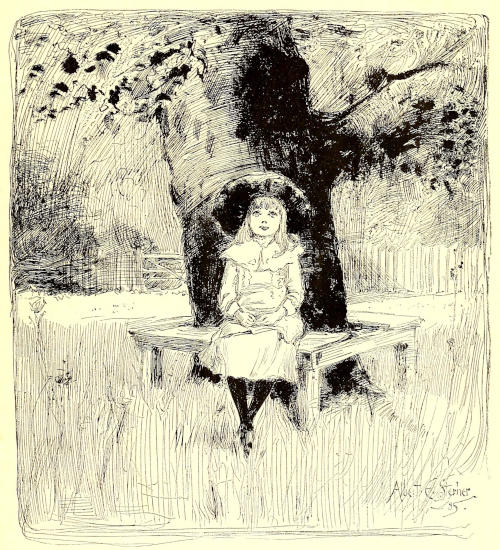
BESSIE: “WHAT DOES ‘INHERIT’ MEAN, I WONDER? NURSE SAYS THAT MY GRANDPA’S PAPA PLANTED THIS TREE, AND THAT I’LL HAVE TO INHERIT IT. I DON’T SEE WHY HE DIDN’T INHERIT IT HIMSELF!”