SOME CURIOUS MARINERS.
Reading edition
By C. F. Holder.
One bright spring morning, two boys were walking out into the open country, near the little village of Cowes, on the Isle of Wight. Each lad carried under his arm a miniature cutter. It was the day of the great race between the Sea Mew and the Prince Albert, the reputations of which, as winning cruisers, had been earned in many a hard-fought battle on the pond then in sight. A number of boys were already at the shore, and their boats, beating up and down the lake, gave it a very animated appearance. As Ralph and Dick approached, bringing the champion cutters, all the competitors moved to the head of the lake, and soon the signal for the race was given. The Sea Mew and the Prince Albert got off first; then came the smaller boats; while following up the race, some in a skiff and some along shore, the boys shouted and cheered the imaginary skippers of the various crafts, who, it must be confessed, sailed them in a rather curious way. As the Prince Albert rounded the stake on the homestretch, a queer personage came aboard. The boys were allowed to put their crafts about, and Ralph had waded out and was just about to stop his boat, when it came in collision with a floating mass of leaves that threw it up into the wind. From the wrecked leaves nimbly darted the only survivor, a large spider, so alarmed at the catastrophe that it reached the crosstrees of the Prince Albert before it even looked about it.
“The Prince has been boarded by a shipwrecked crew!” shouted Ralph, giving the mast a rap that sent the spider to the topmast-head.
“Let him stay,” said Dick, picking up the leaves that now floated by. “You ran him down, and now you must take him ashore, or we’ll treat you as they did the man in America who was tarred and feathered and carried in a cart.”
So the spider was taken back by the cutter to the starting-point, and it must have brought good luck to the cutter, for the Prince Albert came in ahead and won the “cup,” as the boys called the old-fashioned blue soup-tureen, ornamented with figures of Neptune and dolphins. And within this receptacle the shipwrecked spider was carefully placed after the race was over.
“Here’s his craft!” said Dick. “Let’s put it in some water and see if he’ll take to it again.”
So the “cup” was filled and the layer of leaves thrown in, when the spider, without a moment’s hesitation, leaped into the water from the side of the tureen—or “cup”—and soon clambered upon the leaves, much to the amusement of the young yachtsmen, who had gathered around to see what it would do.
In this manner, Dick and Ralph carried the spider home to Dick’s father, who told the boys, much to their astonishment, that it was a ship-building spider.
“Examine the leaves more closely,” he said. “Don’t you find that the bunch has not been accidentally caught together, but that the leaves have been drawn carefully one over another, and fastened together by silken cords, forming a perfect boat?”
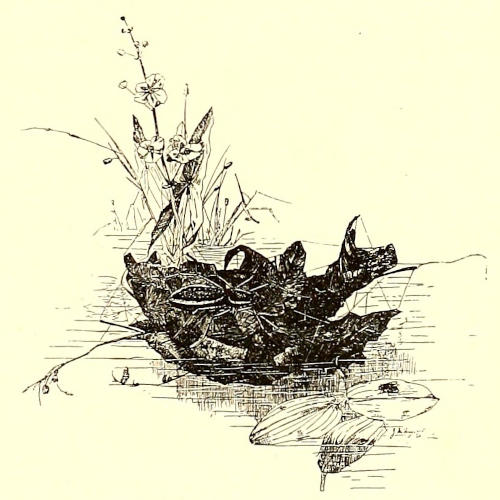
THE SPIDER AND HIS CRAFT.
The boys soon saw that this was indeed the fact, and, much interested, they started out next day, determined to become better acquainted with these nimble little boatmen. They were amply repaid for their trouble; for they had not gone far when Dick cried:
“Here is one, Ralph!” In a little bay, Dick had discovered a small bunch of leaves whirling around and around, and lying closely upon it a large and handsome spider that might easily have been the First Lord of the Admiralty of the Spider-Queen’s navy. Around its brown body was a band, or sash, of rich orange color barred in a curious manner; while a double row of white spots upon the under side, Ralph said, represented its rank. Its legs were a light red—and altogether its outward coloring made up a very fanciful and appropriate uniform.
But I grieve to say that the spider was really a pirate of the boldest and most cruel type. Finding that the circular motion was caused by the peculiar way in which the turned-up tip of a leaf caught the breeze, Ralph gave the craft a start, and away it went before the wind, the red-legged skipper lying low for plunder.
Near the head of the pond several members of the Dolomedes fimbriatus family (for this is their scientific name) were found, and the boys came upon one fellow in the very act of starting out on a voyage.
By lying upon the bank and keeping very still, the lads finally gained possession of many secrets of this cunning ship-builder. At first the spider seemed to be looking for something in the grass near the water’s edge; finally he seized upon a dead leaf, which he dragged down a slight decline, where the boys now saw several other leaves collected. By deft movements of his long legs, the leaf was lifted and tucked in between the others—the builder lashing them together by silken cords which he spun, and fastened them by a simple pressure of his body against the leaf. This leaf being satisfactorily placed, another was brought, and the same process repeated, the creature running rapidly about, passing silken cords over the entire mass, and now and then raising himself up and down, as if testing the strength of his craft. The vessel gradually grew in size until it was an inch and a half thick and four inches across, when it seemed to satisfy its owner.
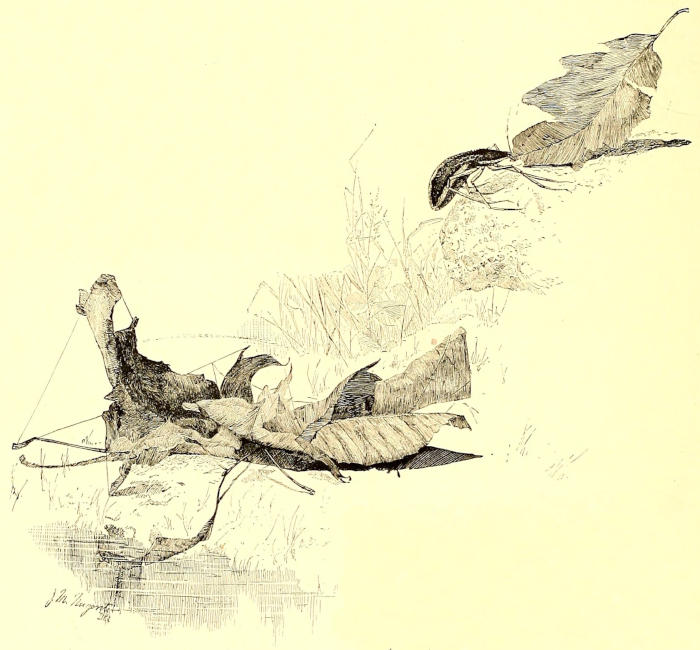
THE SPIDER BUILDING HIS BOAT.
The spider now ran down to the water several times, returning every time thoroughly to inspect the vessel; finally, taking the craft in his strong mandibles, or jaws, he drew it several inches toward the water. Then, resting for a moment, he took it a second time by the side and drew it fairly to the water’s edge. Once there, he took a last hold, the leafy ship glided clear of the shore, and the gay launcher, leaping aboard with surprising skill, sailed out into the stream.
But the launch was not even yet a success. A spear of grass growing from the water became entangled in the silken cables, and stopped the fairy craft. The spider rushed at the obstruction, seized it in his mandibles, and, to the astonishment of the watchers, walked down it into the water. Soon he re-appeared and again scrambled aboard. But as he now seemed to be greatly agitated and disturbed, the boys here interfered, and cast off the raft for him, whereupon the skipper settled down as if completely satisfied. If they touched him with a blade of grass, he darted into the water and clung to the under side, coming out when the danger was over. Soon an unfortunate fly alighted near the raft, when the pirate, instead of rowing his boat alongside, actually dashed into the water to secure his victim, swimming back to the raft to devour it at his leisure. The last the boys saw of the spider, he had jumped again at something that rippled the water; but he never returned. Possibly a self-satisfied young frog that soon hopped upon the bank could have explained the absence of the skipper of the now deserted craft.
Thoroughly interested, the boys repeatedly watched the spiders, and studied their manners and their labors. They found also another spider, which, although it did not make a raft, had no fear of the water, and frequently went fishing; while Dick’s father told them of still another that lived under water by carrying down bubbles of air with it. Its home, too, might be called a queer diving-bell, as may be seen from the illustration.
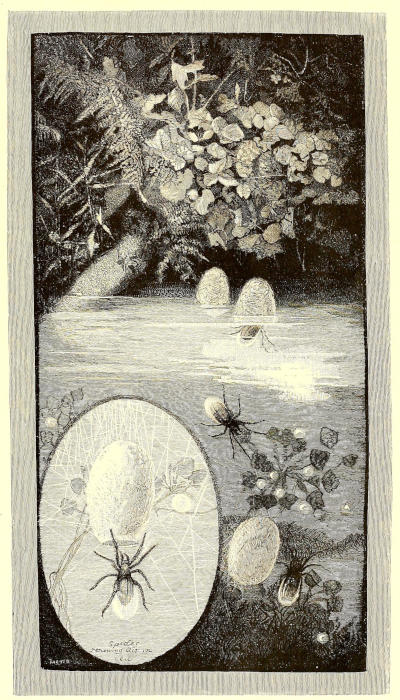
THE SPIDER THAT LIVES UNDER WATER.
There are certain ants that show quite as much intelligence as the spider, and the “driver ants” not only build boats, but launch them, too; only, these boats are formed of their own bodies. They are called “drivers,” because of their ferocity. Nothing can stand before the attacks of these little creatures. Large pythons have been killed by them in a single night, while chickens, lizards, and other animals in Western Africa flee from them in terror. To protect themselves from the heat they erect arches under which numerous armies of them pass in safety. Sometimes the arch is made of grass and earth gummed together by some secretion, and again it is formed by the bodies of the larger ants, which hold themselves together by their strong nippers, while the workers pass under them.
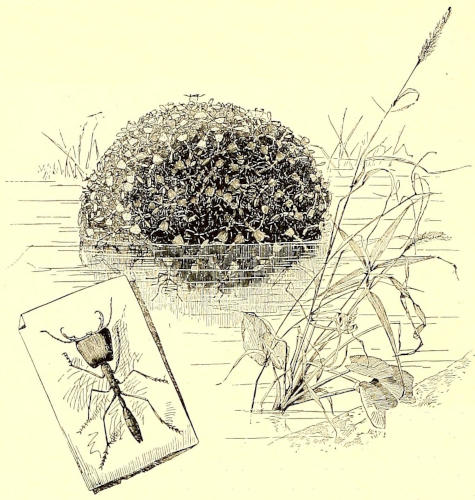
THE DRIVER ANTS FORMED INTO A FLOATING BALL.
At certain times of the year, freshets overflow the country inhabited by the “drivers,” and it is then that these ants go to sea. The rain comes suddenly, and the walls of their houses are broken in by the flood, but instead of coming to the surface in scattered hundreds and being swept off to destruction, out of the ruins rises a black ball that rides safely on the water and drifts away. At the first warning of danger, the little creatures rush together, and form a solid ball of ants, the weaker in the center; often this ball is larger than a common base-ball, and in this way they float about until they lodge against some tree, upon the branches of which they are soon safe and sound. And from this resting-place they escape by their curious bridges, a description of which was given in “Jack-in-the-Pulpit,” in St. Nicholas for July, 1881.
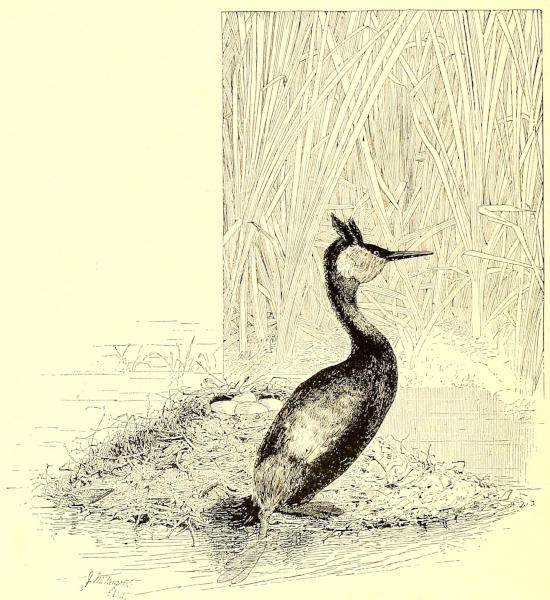
THE GREBE AND HER FLOATING NEST.
One would scarcely look for ship-builders among birds, so many of which are boats in themselves, going either upon or under the water; but in the curious family of grebes, one branch of which produces the beautiful feathers so coveted by ladies, there is one kind that forms a nest which is a veritable ark. Instinctively these birds seek the low boggy marshes to build their nests. But there they are in continual danger from the high tides that often cover the marshes, or from the drift-wood which washes in, or from many other accidents. So the ingenious grebe, looking like a clerk with feathery pens behind her ear, constructs a nest that will rise and fall with the tides, and can be moved from place to place. The boat is first built of rushes and grass; this is then packed with moss, and lined and relined until it is perfectly water-tight; and in this the eggs are laid. The home either is anchored to tufts of grass, or drifts, perhaps, here and there, though always guided by the mother-skipper, as she stands by the helm in all kinds of weather. We have seen that the spider is completely at the mercy of the wind, but the grebe propels her boat along. If the young are half grown, they readily take to the water; but if they are just hatched, the mother, at the approach of danger, steps upon one side of the boat, and uses one of her webbed feet as an oar to paddle away from the enemy into one of the innumerable inlets or lanes in the marsh, where she is almost sure to escape.
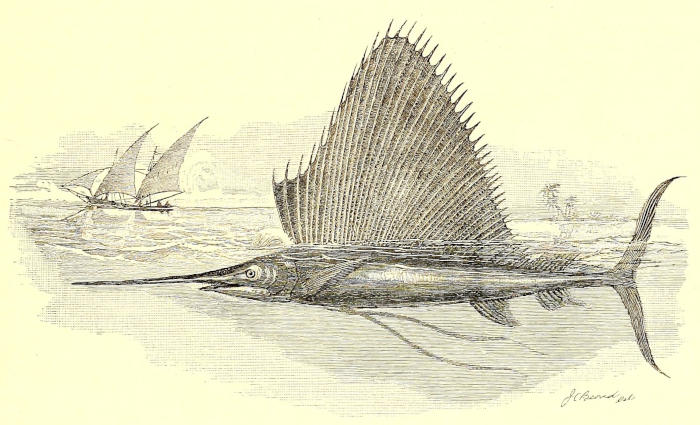
THE SAILOR-FISH OF THE INDIAN OCEAN.
In the warm waters of the Indian Ocean a strange mariner is found that has given rise to many curious tales among the natives of the coast thereabout. They tell of a wonderful sail often seen in the calm seasons preceding the terrible hurricanes that course over those waters. Not a breath then disturbs the water, the sea rises and falls like a vast sheet of glass; suddenly the sail appears, glistening with rich purple and golden hues, and seemingly driven along by a mighty wind. On it comes, quivering and sparkling, as if bedecked with gems, but only to disappear as if by magic. Many travelers had heard with unbelief this strange tale; but one day the phantom craft actually appeared to the crew of an Indian steamer, and as it passed by under the stern of the vessel, the queer “sail” was seen to belong to a gigantic sword-fish, now known as the sailor-fish. The sail was really an enormously developed dorsal fin that was over ten feet high, and was richly colored with blue and iridescent tints; and as the fish swam along on or near the surface of the water, this great fin naturally waved to and fro, so that, from a distance, it could easily be mistaken for a curious sail.
Some of these fishes attain a length of over twenty feet, and have large, crescent-shaped tails and long, sword-like snouts, capable of doing great damage.
In the Mediterranean Sea, a sword-fish is found that also has a high fin, but it does not equal the great sword-fish of the Indian Ocean.