OLD TIME ARMS AND ARMOR.
Reading edition
By E. S. Brooks.
Do you not think that the garments of iron, of steel, or of bronze in which the soldiers of five hundred years ago rode to the wars must have been very uncomfortable? Look at the “effigies,” as they are called, on the opposite page, representing four royal knights. These colossal statues, with those of twenty-four other noted warriors of history and romance, stand, a silent guard, around the magnificent tomb of the German Emperor Maximilian I., at Innspruck, in the Tyrol. These four mail-clad figures represent four of the bravest and most redoubtable of the knights of old—Arthur of Britain, Theodeobert of Burgundy, Ernest of Austria, and Theodoric, king of the Ostrogoths. The armor is rich in ornament and decoration, but I have not a doubt that King Arthur felt much more cool and comfortable when he was eating that famous “bag pudding,” which Mother Goose assures us the queen “did make” for him, than when he rode out from Camelot in the splendidly decorated iron war-clothes that are shown in the picture; and I am very sure, too, that the brave Theodoric was much happier and more at ease when as a boy he practiced Greek gymnastics at the Court of Constantinople, where he was held as hostage by the Emperor, than he did when, years after, he rode to the siege of Ravenna with that ridiculous iron kettle on his head and weighed down with the iron rosettes and jacket that we see in his picture before us.
But, while these metal clothes, uncomfortable, hot, and heavy though they were, have been a necessary style of wearing apparel ever since the forgotten ages when men began to quarrel and to strive, it was not until a comparatively recent date that warriors rode to battle wholly incased in armor. The Assyrians and Egyptians, the Greeks and Romans of the earlier days were satisfied with such partial protection as would shield the most vulnerable parts of their bodies—helmets, or head-coverings; greaves, or shin-protectors; and the short oval breastplates that guarded heart and ribs. The stout old Roman legionaries, bronzed and scarred with exposure and fighting, laughed rather contemptuously at the fresh levies which, when sent into the field, wished to shield their bodies as much as possible. Indeed, the first use of the word armor, as we understand it, is found in the works of a military writer of the latter part of the fourth century A. D., one T. Vegetius Renatus, who refers to armor as a defense worn only by the young troops; so you see that, after all, the boys were the first to incase themselves in armor and were the earliest of the knights.
But gradually, as men grew more careful of their bodies, they increased the safety-coverings; breastplate and greave and helmet grew into coat-of-mail, and suit of plate, until in the days of the knights—the thirteenth, fourteenth and fifteenth centuries—the men who couched lance or wielded sword and met in the terrific battle-shock seemed to be men of iron, whatever they really were beneath their clanging clothes.
Look at the picture (Fig. I, p. 938) of a knight in a splendid suit of armor, richly engraved. He lived and fought somewhere about the time of the heroic Edward of England, whom men, because of his sable armor, called the Black Prince. This warrior may have even followed the banner of Prince Edward; he may have fought with Bruce at Bannockburn, or against the cause of the people and Rienzi at Rome.
Certainly here is an instance in which “dress makes the man,” as the old proverb declares. Not one of us could recognize the gentleman by his countenance on a second meeting, for even his face is concealed behind a decorated visor, or beaver,—a sort of face-door that works up and down on well-oiled hinges. The short cloth sack, emblazoned with his crest and worn over his armor, is the tabard, and from his plumed helmet to his pointed sollerets, or shoes of iron, he is one mass of metal. The two knights, alongside, in Fig. 2, are incased in somewhat less elaborate iron suits, though they also belong to the age of splendid armor.
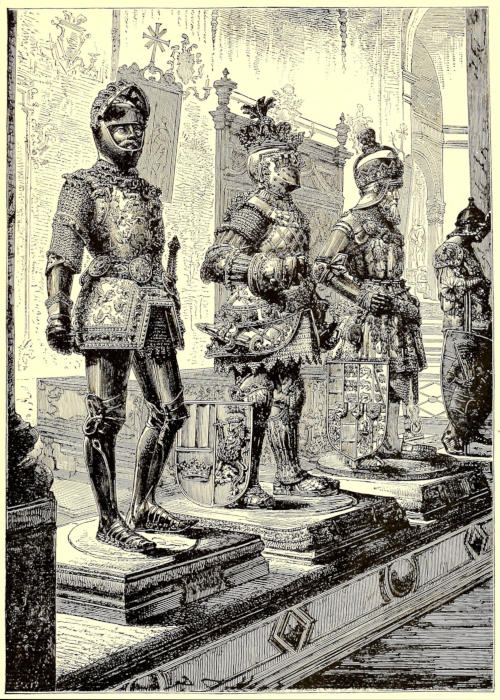
BRONZE STATUES AT THE TOMB OF MAXIMILIAN I., REPRESENTING ARTHUR OF BRITAIN, THEODEOBERT OF BURGUNDY, ERNEST OF AUSTRIA, AND THEODORIC, KING OF THE OSTROGOTHS.
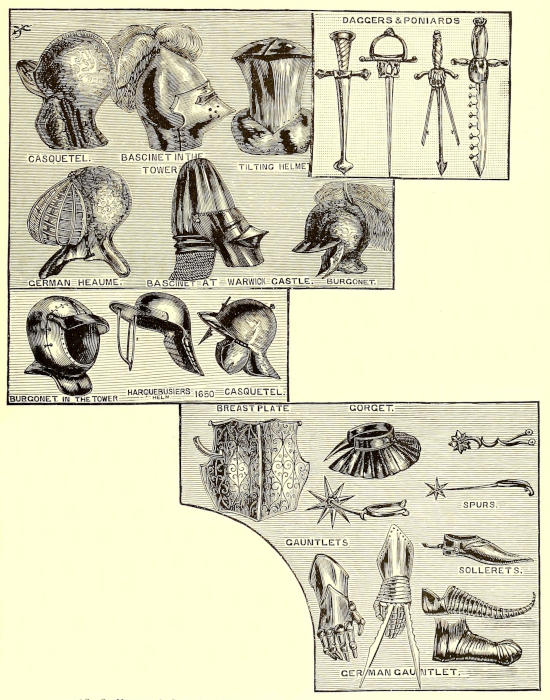
In those days of hard hitting with ax and lance, alike in tournament and in battle, the head and the breast generally received the stoutest blows and needed to be the most securely protected. The head-pieces grouped together on page 939 are what a merchant nowadays would call “an assorted lot”; the casquetel, or helmet with an iron cape for protecting the back of the neck; the bascinet, or helmet with a pointed visor, and another just beneath it that looks like three joints of stove-pipe; the tilting-helm, used in the tournament or in the “tilting-field,” looking very much like a “high hat” of to-day, in iron; the German heaume, or old Gallic helmet, with the basket-like cage to shield the face; the plumed burgonet, or old Burgundian helmet, and the rounded one, sometimes called a morion; and the last of the helmets, the helm and casquetel of the harquebusiers—those stout old fighters of the seventeenth century, who gave and took plenty of hard knocks in the Dutch wars, or in the ranks of Cromwell’s Ironsides.
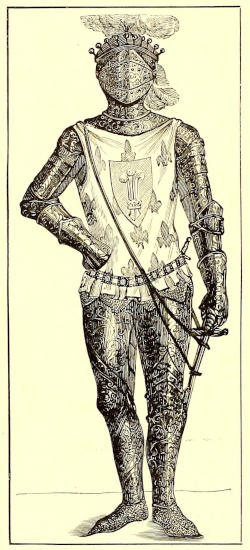
FIG. I.—A KNIGHT OF THE FOURTEENTH CENTURY IN A SUIT OF ENGRAVED ARMOR.
The breastplate, first worn in front only, was gradually added to until it became a cuirass, or iron jacket, laced at the sides. Around the neck was worn the metal collar, or gorget; the hands were incased in iron gloves, or gauntlets, sometimes armed with long, saw-like projections; and spurs of varying size and length were attached to the heels of the curious iron shoes that were known as sollerets.
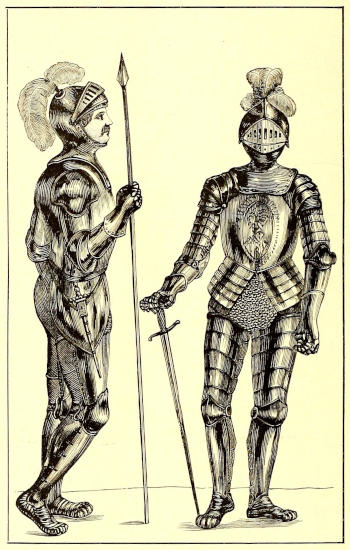
FIG. 2.—KNIGHTS OF THE FOURTEENTH AND FIFTEENTH CENTURIES.
Dagger and poniard, mace and lance, bill and battle-ax were the terrible weapons used by the gentlemen in the iron clothes to cut and carve, to pound and pummel, to hack and pierce one another,—and yet those were called the days of chivalry, of courtesy, and of courage!
War is always brutal, always terrible; but there seems something almost cowardly in the custom of those “knights of old” in thus crawling for safety into suits of steel and iron, while the poor people who followed their banners to the wars—vassals and serfs, archers and bill-men—had nothing but leather jerkins and iron head-pieces (often not even these) to protect them from the charge and thrust of the mail-clad knights. And the funny side of it all is that sometimes knights thus covered with plate, like modern ironclads, would fight all day without either being hurt. In one of the Italian battles of the sixteenth century, two armies of knights sheathed in the best Milan armor fought from nine in the morning until four in the afternoon without one valorous warrior being killed or even being wounded. Do you wonder that Cervantes made such sport of those men in kettles and stove-pipe, as he did in his marvelous story of “Don Quixote”?
But, as necessity is called the “mother of invention,” weapons, in time, were made that iron-cased warriors feared even more than mace or battle-ax. The archer’s “cloth-yard shaft” might not be able to pierce the Milan armor, but a steel-headed “bolt” or “quarrel,” sped with terrific force from the notch of a crossbow, has brought many a mail-clad knight to grief, as William, the Red King of England, and Richard, called the Lion-heart, found to their cost. For five centuries, the crossbow, or arbalist, was a favorite weapon in war and in the chase, as Mr. Maurice Thompson has already told you in his interesting “Story of the Arbalist.”[1] And many a boy of those olden days was taught either by the armorer of his father’s castle, or by that same knightly father, the baron and lord of the manor, how to string the bow and how to lay the bolt.
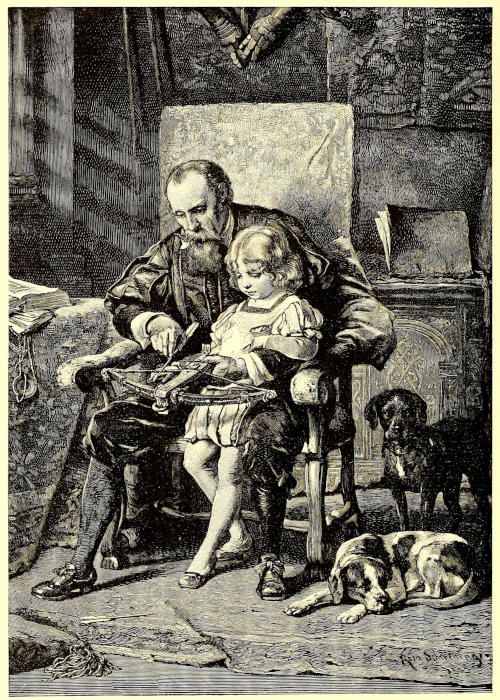
“MANY A BOY WAS TAUGHT HOW TO STRING THE BOW AND HOW TO LAY THE BOLT.”
The battle of Waterloo, in which the iron-sheathed cuirassiers of Napoleon went down in defeat before the soldiers of Wellington, was the death-blow to defensive armor.
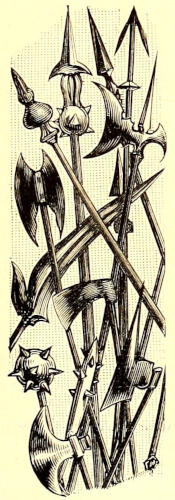
LANCES, MACES, AND BATTLE-AXES.
As gunpowder came into use in battle, and science improved the methods of warfare, the iron coats were found to be of little avail as a protection against shot and shell. Men grew braver as they dropped the heavy plates behind which they had hidden for centuries. And now they march unprotected by iron clothes, depending for victory upon their excellent drill and discipline and upon the deadly fire-arms which science has developed and perfected.
But, better yet, more helpful than casque or cuirass, lance or bill or battle-ax, more effective even than the ponderous Krupp cannon, the deadly Gatling gun, or the swift-loading Martini rifle, is the spirit of justice, of kindly courtesy, and of real courage, which now settles quarrels between men and nations. Argument, arbitration, and mutual concession are doing more to civilize the world than all the cruel war-weapons, and these kindlier methods render more and more useless the arms and armor of the long ago, which sprang, not from the friendships, but from the hatreds and passions of men.
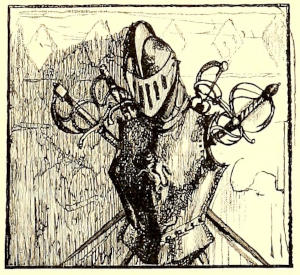
But breastplate, helm, and sword, and all the knightly accouterments have served their purpose in the world’s advancement, and as they look down at us from the walls of library or museum could tell us many a story of daring and of valor in “the brave days of old.”