JACK-IN-THE-PULPIT.
Reading edition
I’m told, my friends, that a beautiful red flower, known as “painter’s-brush,” abounds in Colorado. As it lies on the grass or leans against the stones and fences, it looks in shape and color precisely as if some painter had dipped the soft part of his brush in his brightest paint, and thrown it carelessly down. In midsummer these painter’s-brushes are to be seen by the thousand. Now, as we look about us here in my meadow to-day, it seems as if a million painter’s-brushes had been at work, high and low. Not only brushes dipped in red, but brushes rich with yellows, browns, grays, pinks, and deep dark crimsons. Ah, but it’s a fine piece of color, and the painting has been gloriously done! And though I’m only a Jack-in-the-Pulpit, great thoughts stir within me at the sight.
But now let us take up the subject of
A PERFECTLY QUIET DAY.
One afternoon, not long ago, the Little School-ma’am lay in a hammock, looking up at the leaves.
“How perfectly still they are!” she said to herself. “Not a leaf moves!”
She was lying under an oak tree, a sturdy, steady kind of a tree, as you all know.
“Look at that tree yonder!” said one of the prettiest girl-scholars, pointing to a Norway poplar, the leaves of which are hung on long slender stems.
Lo, and behold, it was all in a quiver!
“Oh, that shakes just for the fun of it!” replied the Little School-ma’am, “for there is hardly a breath of air stirring. It is perfectly quiet.”
The Deacon happened by just then, and overheard her last words. He stopped and asked her if she had any idea how difficult it was to get a perfectly quiet day? Whereupon, she owned that she thought it would be impossible.
“Well,” he replied, “there was once an Italian named Guiglielmini, who wanted to try an experiment in which it was necessary that some balls should fall through perfectly still air from a certain height. So in August, 1791, he went up on a tower in Bologna, and tied the balls to the top with long, silken threads. Then he waited for a perfectly still day. Sometimes the air was quiet, but the tower would slightly tremble, and at other times the tower was steady, but the air was in motion. At last, in February, 1792, there came a day when the air and the tower were both still, and he climbed up as softly as a cat, and gently set his threads on fire, and down dropped the balls!”
“And what was the experiment?” asked the Little School-ma’am.
“Oh, it had something to do with the motion of the earth!” said the Deacon, as he walked away, smiling.
HOW HE PROVED IT.
That reminds me, by the way, of a funny rhyme sent to the Little School-ma’am by a friend of hers, Miss E. L. Sylvester. Here it is:
A clever old man of Montrose Said: “I’ll balance my cane on my nose; For so shall I prove That the world doesn’t move As a great many people suppose.”
WALKING WITHOUT LEGS.
A little girl has sent you a question. She says she found three pretty brownish shells in the woods, one day, and she took them home to her little brother. They looked, she says, “very like similar shells that often are found on the sea-shore.” Well, she put them on the sunny piazza, and ran to find Bobby.—And now you shall have the rest of the story in her own words:
“Bobby was eating bread and molasses, and so he ran out of the kitchen all sticky. When we went together to look at the shells, lo, and behold! the shells were gone! They had walked around the corner of the piazza. And, oh Jack, what do you think? We watched them, and they kept on walking! And they hadn’t any legs!
“Now this is a true story, dear Jack, and I want you to tell it to little boys and girls younger than Bobby and me (or Bobby and I, whichever is right), and see if they know how those shells walked, and what kind of shells they were, and if any other little boys and girls ever found any of the same sort in their woods or gardens.
“Your little friend,
“Jamesetta C.
“I take up my pen again to say that we all know, of course, that snakes move along the ground without legs. But they do that motion entirely with their own insides, don’t they? Those shells couldn’t possibly move as snakes do.
“For fear you may think my name is strange, I will tell you that I am named after my grandfather, only James wouldn’t do for a girl.”
A QUEER SUNSHADE.
A wise bird of my acquaintance, who has traveled far and wide, told me, not long ago, of a queer sunshade that was invented for the benefit of the British soldiers in the Soudan. (I don’t know where that is, I’m sure, and my bird was in too great a hurry to explain. But who cares? I know I can trust you young geographers to clear up any mystery of that sort.)
Well, as to the sunshade, my bird-friend said that the upright parts are simply light bamboo sticks. They are fastened to the shoulders of the wearer, and they support at the top a curved awning made of paper and painted green inside.
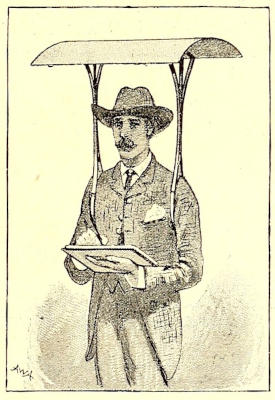
“But it would look so queer!” I said. “Would anybody have the courage to wear it?”—when from the grass near my pulpit up popped an old raven, whose specialties are ancient history, scarecrows, and eavesdropping.
“Don’t you know,” he croaked, “that the man who first carried an umbrella was ridiculed and hooted at?”
That raven, my dears, narrowly escaped a withering reply. But luckily I remembered something the Little School-ma’am read aloud, one sunny day, to a group of boys and girls, as they stopped to rest in my meadow. And what she read was the story of that very man—the original umbrella-carrier. And she was reading from St. Nicholas itself!
The old croaker was right! So I assumed my most dignified air, and gave in.
But did that satisfy him? Bless you, no! Before he left, I had to admit that this new sunshade was merely a parasol carried on the shoulders instead of in the hand; that it was lighter than the common sunshade; that it left both hands free for sketching, playing ball, or what not; and that the old raven might live to see every civilized boy or girl walking along on sunny days with a cupola of this sort over his or her unabashed head.—Between ourselves, my dears, you needn’t yet count upon this last as an up-and-down future certainty. I may take it back when I’ve had time to recover from the raven’s lecture.
By the way, there’s one good thing about that raven,—his memory.
A QUEER JUMBLE.
Talking of queer things, here comes a queer jumble from a young fellow who says he lives in Maine by the broad blue main; and that there’s nothing like using the rod and the “line-upon-line” method when you find a school of fish that won’t go to school; and——
Well, no Jack-in-the-Pulpit can make anything out of such stuff as that! But perhaps some of you clever youngsters can understand it. He sends these rhymes, too, which he calls
A LIQUID PRO QUO.
Oh, shun the ocean big with fate! Nor strive to make the free strait straight. Sauce, if thou wilt, the river’s source, And brook no babbling brook, of course; But keep the treacherous bay at bay. (It’s tide no man hath tied, they say.) And never see the midway sea, But waive the wave that waits for thee!
THAT DEAR LITTLE LORD.
Pittsfield, Ill.
Dear Mr. Jack-in-the-Pulpit: I think it sounds rather saucy to say just Jack, to the preacher. My Papa is a pulpit man, too, and people call him Mr. Rose, but they leave off “in the pulpit,” because he does not stay there all the time. He can tell me nearly everything I want to know; but there is one thing he is not sure about, and that is how to pronounce Fauntleroy. Should it be Faunt-Le-Roy? Or should the middle syllable be like the last syllable of the word little? I love the little lord so much, I want to know his name exactly.
Your friend,
Horace Rose.
Faunt-le-roy is correct. The vowel is sounded in the middle syllable.
I’m always in my pulpit, dear Horace, but I’m not always preaching. One eloquent sermon, however, I feel called upon to deliver at this present moment, for it concerns little Lord Fauntleroy.—[Haven’t I heard all about him from the Little School-ma’am and the scholars of the red school-house, and, for that matter, from every boy and girl I know?]—Well, the dear little lord is my text. In fact, he’s the sermon, too. So I need say no more except to publicly announce from my pulpit, with all due solemnity, that he is a boy after your Jack’s own heart. And to every youngster among you, dearly beloved, I say, “Earl or no earl,—go thou and be like him!”