Part II History of the Industry
Reading edition
EARLY HISTORY
India, the land that Kipling has called “the grim stepmother of mankind,” is, according to the best authorities, the original habitat of the sugar cane; and there is but little doubt that the properties of the plant were known to the Hindustani many centuries before the Christian era. Nothing concerning it is found in the Old Testament, the Talmud or in the oldest Hindu literature; and even in Buddha’s time (500 B. C.) it was little known.
The legend runs that sugar cane was created by the famous hermit Vishva Mitra to serve as heavenly food in the temporary paradise arranged by him for the sake of Raja Trishanku. It was the desire of this prince to be translated to heaven during his lifetime, but Indra, the ruler of the celestial realms, had refused to admit him. In order to gratify Trishanku’s wish, Vishva Mitra prepared a temporary paradise for him. When a reconciliation between Indra and Trishanku was brought about, the paradise was demolished and all its luxuries destroyed save a few, among which was sugar cane. This subsequently spread over the land of mortals as a lasting token of Vishva Mitra’s miraculous deeds.
Among the Chinese the first historical mention occurs in writings of the eighth century B. C., where the fact is recorded that their knowledge of sugar cane was derived from India. That it was considered of great value by the Chinese is shown by manuscripts of 200 B. C., wherein it is stated that the kingdom of Funan paid its tribute to China in sugar cane. From this it may be inferred that the secret of extracting crystals from the sugar-cane juice had not been discovered.
More than three centuries before Christ, the triumphant progress of Alexander the Great was halted upon the banks of the river Indus by the refusal of his troops to venture farther eastward. On their return journey, the Macedonian soldiers carried the “honey-bearing reed” to Europe.
A number of classical writers of the first century allude to the sweet sap of the Indian reed and to the granulated, salt-like product imported from India under the name of saccharum, or σάκχαρι, from the Sanskrit çarkarā, gravel, sugar. The names of sugar in modern European languages are derived through the Arabic from the Persian shakar.
The people dwelling in the valleys of the Ganges possessed a knowledge of boiling sugar juice, and this spread from there to China in the first half of the seventh century. Sugar refining, however, could not then have been known, for Marco Polo[5] states that the Chinese learned this from Egyptian travelers only during the Mongol period, some five hundred years later. Von Lippmann says that solid sugar began to be known in India somewhere between 300 and 600 A. D., probably nearer the latter date.[6] In the Middle Ages, the best sugar came from Egypt[7]; and in India today, coarse sugar is still called “Chinese” and fine sugar “Cairene” or “Egyptian.”
The Nestorians, a Christian religious sect in Gondisāpūr, India, planted sugar cane in Persia about 500 A.D. When Heraclius,[8] the Byzantine emperor, pillaged the palace of Dastargerd, Persia, in 627 A. D., solid sugar was taken among the other loot.[9] This is the first authentic evidence of crystallization. At the time of the Arabian conquest in the year 639, sugar was “prepared with art” in Gondisāpūr; and its manufacture on a large scale was carried on at Shuster, Sūs[10] and Askar-Makram[11] through the Middle Ages. Thaálibí, a writer of the eleventh century, says that Askar-Makram had no equal for the quality and quantity of its sugar, “notwithstanding the great production in Irāk, Jarjān and India.” It used to pay fifty thousand pounds of sugar to the Sultan in annual tribute.[12] Persian physicians of the time attributed extraordinary healing powers to sugar, and used it freely in the practice of their art.
Mohammed’s[13] religious wars carried the knowledge of sugar throughout the cities of the then civilized world. The Arabs first learned of it when they overran Persia. They took to it eagerly, and under their rule a great number of plantations were started. Artificial irrigation was employed in the growing of the cane, and the juice was expressed by means of millstones. At this period, however, sugar was looked upon as a rare and costly luxury, to be indulged in only by the wealthy, and sparingly even by them.
Arabian doctors who were well advanced in learning gave sugar an important place in their pharmacopœia. The Moslem armies took it westward with them; and when Amru[14] conquered Egypt (640-646 A. D.), it was introduced in that country. Careful methods of cultivation, coupled with the Egyptians’ intimate knowledge of chemistry, brought about excellent results. This cultured people had a simple process for purifying and recrystallizing saltpeter, and they soon found that sugar could be similarly treated.
The first crystals were remelted; and to the liquor so obtained albumen and lime were added. The precipitated impurities were removed by filtration, and the clear syrup boiled down to a grain once more. The syrup, or mother-liquor in which these grains remained after boiling, was eliminated by washing, leaving the white sugar crystals, which in point of quality far surpassed any product then known.
From this time forward, the traffic in sugar began to gain in importance and volume. Nasiri Khosrau, in his account of his travels in Egypt in the eleventh century, narrates that at the celebration of the great Ramazán feast, the Sultan’s table was decorated with sweetmeats consisting entirely of marzipan[15] modeled into shapes of orange trees and statues.
The continuation of the movement of the Arabs toward the west carried the cultivation of sugar over the entire northern coast of Africa and thence into Spain in the year of the conquest of Granada by the Moors (715 A. D.). It made its way to Sicily in 703; it was found growing at Assuan, on the Nile, in 766, and the Crusaders discovered important sugar plantations in Tripoli, Mesopotamia, Syria, Palestine, Antioch and other places in the Levant. Commercial relations between these points and the principal Italian cities were established during the Crusades, and a considerable trade in sugar followed.
Sugar-cane cultivation seems to have appealed to the Crusaders as a profitable venture—so much so that they actively interested themselves in it, making Tyre an important center of the traffic. King Baldwin and various orders of knighthood established large cane plantations in Antioch, Syria and Cyprus and did much to advance sugar production in those countries.
The Crusaders who had acquired a taste for sugar when in the Far east naturally wished to continue its use after their return home; thus, a trade sprung up between northern Europe and Venice, Genoa and Pisa.
After the fall of Acre in 1291, the Crusaders lost their foothold in Asia Minor; but Tyre, Beirut, Antioch and the valley of the Jordan continued to produce good crops of sugar, while Damascus and Tripoli became refining centers. Cyprus, still under Venetian rule, extended its trade in sugar, and sent considerable quantities annually to the mother city. All this time the production in Egypt went steadily forward.
This prosperity was rudely interrupted by the aggression of the Turks. Constantinople was captured in 1453 and Trebizond fell in 1461. The other commercial towns of Asia Minor and all of Genoa’s Black Sea colonies followed in quick succession. Trade between Europe and Asia Minor decreased as a matter of course and the manufacture of sugar languished under Turkish rule.
In 1517 Cairo was taken by the Turks, and Egypt became a province of the Ottoman empire, with disastrous results to the sugar industry there. In 1522 Rhodes, and in 1571 Cyprus, passed under the sway of the Turk; but by that time sugar cultivation in these islands had fallen off greatly, while in Sicily it had completely died out.
Other causes militated to bring about the decline of the sugar trade in these countries. The Portuguese took sugar cane to Madeira in 1419. In 1432 they captured and colonized the Azores; and between 1456 and 1462 they acquired the Cape Verde islands. São Thomé, Principe and Annobon were annexed in 1496; and in that same year the Spaniards colonized the Canaries. Sugar cane grew luxuriantly in the mild, moist climate of these islands, and the cost of production by slave labor was so low that neither Cyprus nor Sicily could compete; consequently, the once large and prosperous sugar trade of the Mediterranean became a thing of the past.
During the Middle Ages, Venice was the chief sugar-distributing center in Europe. One of the earliest references to sugar in Great Britain is that concerning one hundred thousand pounds shipped to London in 1319 by Tomasso Loredano, a Venetian merchant. Wool, which at that time constituted the most important staple of English products, was exchanged for sugar. In the same year, an entry appears in the accounts of the Chamberlain of Scotland, showing a payment for sugar at the rate of one shilling and nine pence halfpenny per pound. It is said that at the end of the fifteenth century a citizen of Venice received a reward of 100,000 crowns ($111,940) for having invented the process of making loaf sugar. Vasco da Gama’s exploit in finding the way to Calicut by sea in 1498 deprived Venice of her position as a dominant commercial center; and new routes for the world’s trade were opened up. The discovery of America exercised a still greater influence upon the production and distribution of sugar.
Christopher Columbus’ first attempt to establish sugar growing in Santo Domingo in 1493[16] was not a success; but when negro slaves were brought to the West Indies by the Portuguese and the Spaniards, the industry took a new lease of life, and with slave labor, ideal climate and fertile soil, it increased abundantly. As illustrative of the extensive development in Santo Domingo, it is interesting to note that Charles V of Spain obtained from import taxes on Santo Domingan sugar the vast sums of money expended in the building of the royal palaces at Madrid and Toledo.[17]
Brazil was discovered by Pinzon in 1499[18] and sugar cane was taken there from Madeira. About thirty-three years later plantations had been laid out and the first sugar factory built. The year 1590 saw one hundred and two mills in operation in the provinces of Bahia and Pernambuco; and in 1600 the quantity of sugar exported from Brazil was 15,000 tons. At that time Brazil belonged to Spain, which had annexed Portugal and her colonies in 1580. It was conquered by the Dutch in 1629, and a great many sugar plantations and factories were destroyed; but these were subsequently restored by the new rulers. The Dutch, in turn, were expelled in 1655; and in 1661 Brazil was acknowledged to be a Portuguese possession. The sugar trade suffered, however, on account of the banishment of twenty thousand Dutch in 1655, and also through the discovery of gold in 1725, which drew the laborers from the sugar fields and mills; and the production fell off to a large extent.
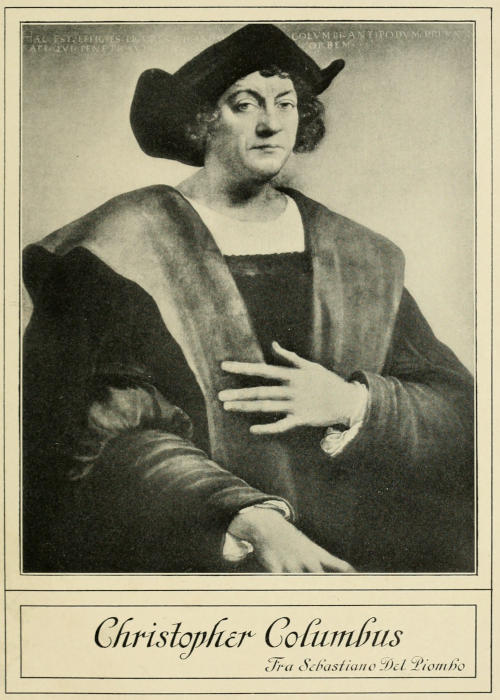
Christopher Columbus
Fra Sebastiano Del Piombo
Copyright, 1906. Braun, Clément et Cie., Braun et Cie., Successeurs
The island of St. Christopher (now St. Kitts) was occupied in 1625 by both the English and the French. Ten years later the French took Guadeloupe and Martinique; Barbados became a British possession in 1627, and Jamaica was annexed in 1656. Sugar cane was planted in all these colonies, but through lack of knowledge and experience the product obtained was of indifferent quality. A decided improvement was brought about when the Dutch, who were expelled from Brazil, came to the islands in 1655.
Santo Domingo was taken over permanently by the French in 1697 after it had previously been occupied and abandoned by them. From this date the industry throve there and for upward of one hundred years Santo Domingo ranked among the foremost of the sugar-producing islands of the West Indies. Tyranny and cruel treatment caused the slaves to revolt in 1791; the whites who failed to escape were exterminated and the sugar plantations and mills were destroyed.
Santo Domingo has never recovered the prestige in the sugar world that she lost in this way. Her misfortune gave a great opportunity to Jamaica, whose production increased so rapidly that at the close of the eighteenth century she outstripped all the other West Indian islands. The falling off in Santo Domingo stimulated the industry in Cuba as well. As a dependency of Spain, Cuba was hampered by a number of restrictions; these were repealed in 1772, after which the sugar tonnage grew apace.
St. Eustatius and Curaçao belonging to the Dutch, and St. Croix, St. John and St. Thomas to Denmark, also came in for their share of the benefit growing out of the impetus given to the sugar trade at this time. It must be borne in mind, however, that they were conveniently situated for sugar smuggling, of which there was not a little during the American Revolutionary war.
In the countries of South America, Brazil excepted, the sugar trade had become well established. French planters settled in Cayenne in 1634 and in Surinam six years later, but production was handicapped by the difficulty attendant upon securing labor, and this condition continued to exist even after the taking of Surinam, Essequibo, Demerara and Berbice by the Dutch. Finally the trouble was overcome by bringing in slaves, and with the end of the French war the sugar industry began to prosper, especially in Surinam. During subsequent hostilities these colonies were taken by France, afterwards by England, and later still they reverted to the Dutch. Today they are all British with the exception of Surinam and Cayenne.
Sugar cane was not known in Peru at the time of Pizarro’s first expedition to that country (1527), but it was brought there shortly afterward. In Chile and the Argentine its introduction was comparatively recent. The Jesuits took it from Santo Domingo to Louisiana in 1751, and in Mexico it dates back to the time of Cortés.
The rapidity of the increase in the production of the Americas threatened the plantations of Madeira, the Cape Verde islands and the Canaries with extinction and drove them from the world’s markets.
Sugar cane was planted by the French in the Ile de France (Mauritius) in 1747, and some years later in Bourbon (Réunion) and sugar made in these islands was sent to Europe about the end of the eighteenth century.
In Java sugar cane has been grown since a very remote period. It was probably brought there by Chinese traders and there is evidence that the Chinese introduced it in the Philippine islands, as the names of the implements and methods used there distinctly point to Chinese origin.
The cultivation of sugar cane in Australia was begun only fifty years ago; it was started in the Fiji islands in 1880, while Captain Cook found cane growing luxuriantly in the Hawaiian islands when he discovered them in 1778.
The wars between Great Britain and France during the latter part of the eighteenth century and the beginning of the nineteenth had a very bad effect on the cane-sugar trade and its development. There was constant fighting in West Indian waters and many merchant vessels were taken as prizes; a disastrous state of affairs for planters and merchants alike. After the battle of Trafalgar had definitely established British supremacy on the seas, Napoleon put into effect his “Continental System,” which dealt a severe blow to cane sugar. This opens up a new and interesting chapter in the history of the industry.
BEET SUGAR IN EUROPE
The destruction of the French fleet by Nelson in 1805 thwarted Napoleon’s long-cherished plans for the invasion of England. Nothing daunted, however, he immediately bent his efforts toward isolating Great Britain and cutting commercial communications between her and the continent of Europe. The Berlin edict of 1806 prohibited all trade relations with England and made her goods and those of her colonies subject to seizure. England’s reply was to forbid ships of all nationalities to enter French ports under penalty of confiscation. Napoleon followed this with the Milan decree which made any vessel that had submitted to English examination or paid dues in English ports subject to confiscation. The one government vied with the other in preying on commerce. The interference with the importation of sugar due to this condition drove prices upward to a point where only a few could afford its use.
Napoleon was fully cognizant of what a privation this was to his people, but he felt confident that means would be found to bring sugar from the Far east to western Europe by way of Constantinople and Vienna; besides, he had strong hopes that a substitute for cane sugar could be produced in Europe itself. He encouraged experimental and research work, keeping thoroughly informed as to progress made, and on March 25, 1811, he issued the famous decree that set in motion the beet industry of the world.
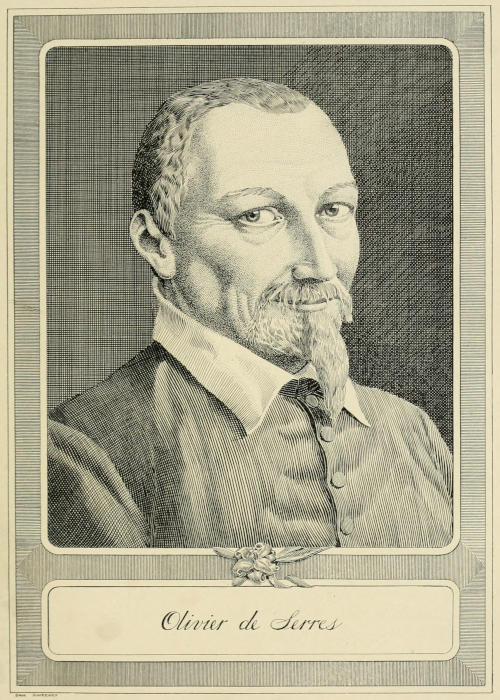
DAN SWEENEY
Olivier de Serres
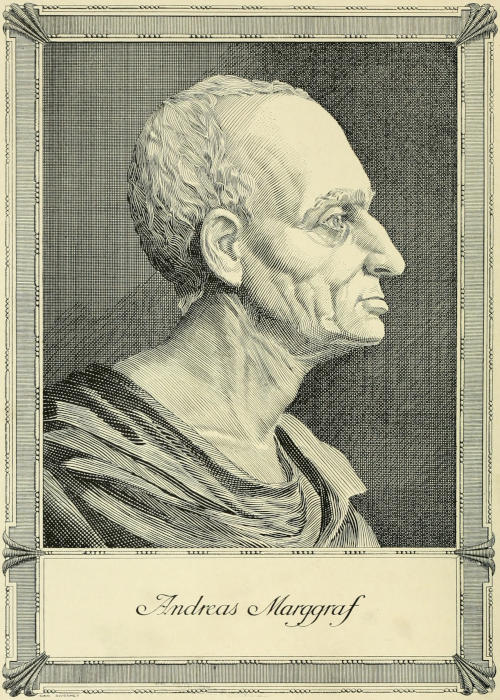
DAN SWEENEY
Andreas Marggraf
The original home of the sugar beet (Beta vulgaris) is not definitely known. The plant was found in a wild state in southern and middle Asia and it is said to have been cultivated in southern Europe and northern Africa in olden times. According to Professor Griffin,[19] Herodotus mentions the sugar beet as one of the plants that served to nourish the builders of the pyramids. Dr. von Lippmann cites the same instance and also quotes Voltz as authority for the statement that the Romans first brought the beet into Gaul.
When the beet was originally grown in southern latitudes it was an annual, but when it was taken north it became a biennial, storing sugar the first year and not developing its seed until the second.
Jules Hélot, an eminent French authority, in his “Histoire Centennale du Sucre de Betterave,” says:
“A great French agronomist, called the father of agriculture, Olivier de Serres (1539-1619), was able to find out that the beet-root contained sugar, long before Marggraf set about to extract sugar from this root. Olivier de Serres wrote: ‘The beet-root, when being boiled, yields a juice similar to syrup of sugar, which is beautiful to look at on account of its vermilion color’.”
Dr. von Lippmann, however, contends that Olivier de Serres never claimed in his writings that he discovered the sugar content in the beet, and that the statement “that the boiled juice of the red beet was similar in appearance to sugar syrup” cannot be construed as evidence that de Serres actually recognized the presence of sugar in the beet-root.
In the year 1747 Andreas Marggraf, a chemist and a member of the Royal Academy of Science and Literature of Berlin, demonstrated that various kinds of beet-root contained sugar and that the sugar could be extracted and crystallized. This discovery, however, was regarded for many years as being merely a laboratory determination and without practical value. In 1786 Franz Karl Achard, a pupil of Marggraf, attacked the problem of beet-root cultivation and succeeded in extracting sugar from beets on a scale hitherto unknown. He issued a report of the methods employed and the results obtained and stated that a good muscavado sugar should be made from beets for six cents per pound. His claims met with incredulity and no little ridicule, but the French Institute made a careful investigation of what he had done and found that the sugar content of the beets was over 6 per cent. From a number of tests of Achard’s process, they estimated that the cost of producing refined sugar from beet-roots on a commercial basis would be eighteen cents per pound.
Frederick William III, king of Prussia, took a keen interest in the making of sugar from beets, and, after having convinced himself that Achard was on the right track, he bought the crown land at Cunern, Silesia, for exploitation on a large scale. He provided Achard with funds for the erection of the first real sugar factory built in Germany, at which operations were begun in 1802. The king also supplied money for the construction of other factories in Brandenburg, Silesia, and Pomerania, and lent his support to the growers of beets as well as to the manufacturers of sugar. Despite the reverses in war suffered by the Prussians, the progress in sugar making was so manifest that in 1810 it was clear that the industry was bound to succeed under intelligent management.
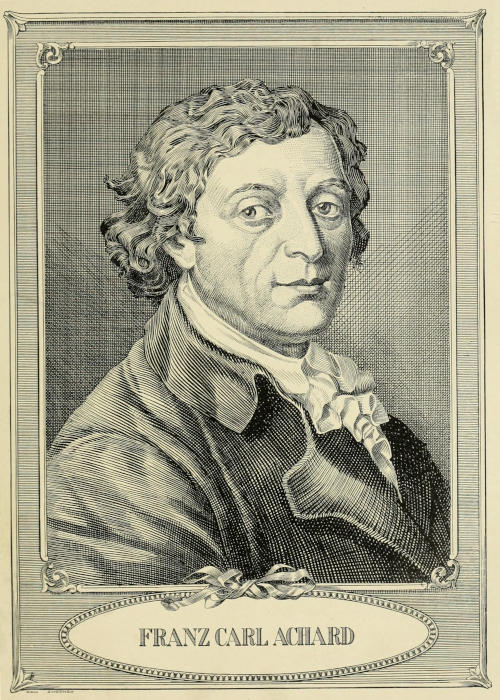
DAN SWEENEY
FRANZ CARL ACHARD
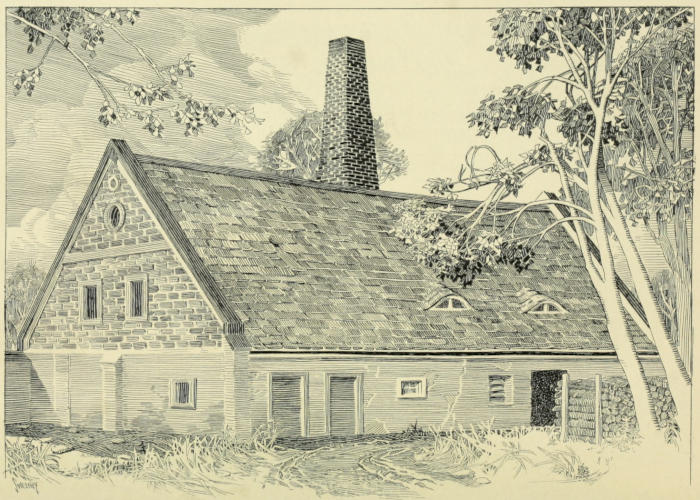
FIRST BEET-SUGAR FACTORY IN THE WORLD—BUILT AT CUNERN, SILESIA, 1802
Achard, who was of French extraction, had corresponded with a number of scientific men in France and through them reports of his work reached the French Institute. The verdict of this body was favorable and two sugar factories were built, one at St. Ouen and the other at Chelles. Both of these enterprises failed through lack of practical knowledge and the inferior quality of the beet-roots. Although this setback brought the manufacture of beet sugar to a standstill for a time, there is plenty of evidence to show that hope of ultimate success was never abandoned. The effect of the closing down of these two beet factories was to divert the attention of scientists to making sugar from grapes. Proust and Parmentier, both chemists of note, demonstrated that it could be obtained from this source and the French government issued instructions for the preparation of sugar and syrup from the vine. Parmentier published a bulletin advising against the attempt to make beet sugar in France as the soil of the country would not produce beet-roots containing sugar. In 1810 Napoleon ordered an appropriation of 200,000 francs to be divided as a premium among the factories recovering the highest percentage of sugar from grapes. Meanwhile the friends of the beet movement had not been idle, and early in March, 1811, the Society for the Encouragement of National Industry submitted to the emperor a report of what had been accomplished in the manipulation of beets, together with samples of the sugar obtained, and on the 25th of that month Napoleon issued the edict that established the manufacture of beet sugar in France. The decree provided that 79,000 acres of land in various parts of the empire should be devoted to the raising of beets and directed that all the acreage named should be under cultivation the first year, or at latest the second. It created six experimental stations for the instruction of the farmers and land owners in cultivation and also for the furtherance of the interests of the manufacturer.
Delessert had established a factory at Passy in 1801 and by dogged perseverance, despite many failures, obtained excellent results by a new method of clarification and the use of charcoal. Napoleon visited his plant in 1812 and ordered the construction of ten new factories at once. On January 1, 1813, all further imports of sugar from the East and West Indies were prohibited.
In 1812 and 1813 the output of sugar in France was 2200 tons and the factories of Germany and Austria gave promise of soon supplying the wants of their respective countries. During the following two years there were unusually heavy rains and the beet fields of France were occupied by hostile troops. The defeat of Napoleon at Waterloo and the consequent abolition of the blockade caused a decline in the price of sugar to a point where the new beet industry was unable to compete and only one factory succeeded in avoiding the general disaster.
From 1816 to 1821 the average yearly output of beet sugar was 1000 tons. The domestic product had a great advantage over the foreign article, as all sugars coming into France from abroad were subject to a heavy duty, while no tax was levied on home-grown sugar. In 1821, a duty of 49.5 francs was imposed upon every 100 kilograms (220.4622 lbs.) of raw sugar coming from French colonies and 70 francs on white sugar. The tax on sugar from foreign countries was 90 francs per 100 kilograms, and this was increased to 125 francs in 1829.
Shortly afterward the surtax[20] on foreign sugar was increased and an extra duty was exacted on sugar brought into France in foreign bottoms. Even with this protection the domestic producers were not satisfied. French colonial sugar, when exported, received the benefit of customs drawback of 120 francs per 100 kilograms, and the same privilege was accorded home-grown sugar upon which no duty whatever had been paid. This was tantamount to an export premium of 120 francs per 100 kilograms, and it may well be imagined that under this paternal arrangement old factories came back to life and new ones sprang into being. Under this régime by 1836 nearly one-third of the sugar refined in France was beet. The payment of this premium was so great a drain on the government treasury that in 1840 the authorities seriously considered the buying up of all the beet-root sugar factories then in operation for forty million francs and the equalizing of the tax on foreign and domestic sugar. The scheme was not carried out, but in 1843 beet-root sugar and cane sugar were placed on the same basis. This hurt the domestic industry severely, and if it had not been for the setback to the cane production by the abolition of slavery, the beet interests might have met with ruin. Nevertheless, in spite of many adverse turns of fortune, the general trend was forward.
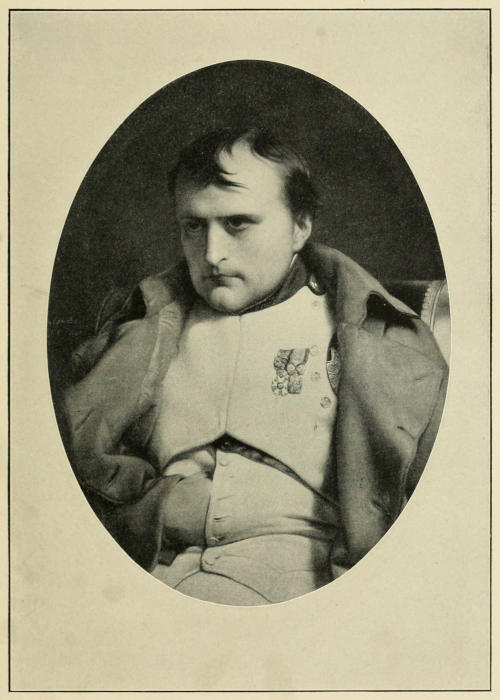
NAPOLEON I
Beginning with the year 1836, the beet-sugar industry in Germany, which had been paralyzed by the raising of the Continental blockade, went ahead rapidly. The German manufacturers gradually succeeded in obtaining a higher extraction of sugar from the beet and consequently their operations showed an increased profit. Krause of Austria and Schubarth of Prussia, both of whom had studied beet-sugar making in France, did much by their efforts to rehabilitate the industry in Germany, where it has steadily grown in importance ever since.
The manufacture of beet sugar was revived by Austria in 1831 and by 1840 there were many factories in operation. In 1854 the output of domestic sugar equaled the tonnage brought in from foreign countries and beet sugar had established itself throughout Europe as a strong competitor of the cane sugar of the colonies.
The European consumption, however, had grown at such a rate that the domestic beet-sugar production did not keep pace with it, hence the cane manufacturer was scarcely sensible of the competition for some years; in fact Europe took rather more than less cane from the tropics for a time.
During the nineteenth century Europe became less and less dependent upon the cane countries of the New world for its supplies. The abolition of slavery in most of the European possessions (1825-50), the development of the cultivation of cane in India and Java, and the expansion of the bounty-fed beet-sugar industry in Europe all contributed to bring this about and many colonial cane growers found themselves on the brink of ruin.
Slavery, upon which cane sugar raising so greatly depended, was entirely abolished in British possessions in 1834, in France in 1848 during the Second Republic, in the Dutch West Indies in 1863, in Porto Rico in 1873, in St. Thomas in 1876, and in Cuba in 1880. Great Britain appropriated the sum of £20,000,000 sterling as an indemnity, and of this £16,500,000 went to West Indian planters, the remainder going to Mauritius and the Cape, but indemnification, while most welcome, did not restore the supply of labor. Many of the freed slaves refused to work and great numbers of them left the plantations. British colonists were at a serious disadvantage, too, as after their slaves were liberated slavery still existed in other West Indian islands, and to offset this a special import tax was imposed on sugar produced by slave labor.
Strenuous efforts were made to secure an adequate labor supply. Chinese coolies, free negroes and Hindus were tried, but the cost was great and the number available was insufficient for the proper cultivation and upkeep of the plantations. This condition obtained in the British West Indies, Cuba, Louisiana, Peru, Brazil, the Guianas, Mauritius, Réunion and other places, and the cane growers had hard work to keep from going under during the adjustment period, when they were learning how to operate their plantations with a limited number of hands. Importation of labor, subdivision of cane lands into small tracts, to be rented or sold to farmers—many plans were tried—but naturally under such circumstances development was impossible, and beet sugar, which had been steadily increasing, finally outstripped cane in 1883-84, while in 1899-1900 cane only furnished 34.7 per cent of the world’s crop. In 1912-13 the cane tonnage exceeded that of beet by 211,082 tons of 2240 pounds. The great war in Europe has curtailed the production of beet sugar in that country to such an extent that of the world’s output for 1915-16 the proportion of cane to beet was roughly as two-thirds to one-third in favor of the former. The actual figures are:
Cane 10,533,039 tons
Beet 5,986,404 ”
Excess of cane over beet 4,546,635 tons
The following table giving the world’s production of cane and beet from 1852 to 1916 will be of interest, but it should be borne in mind that this comparison between beet and cane is not a fair one, because the figures are incomplete as far as cane is concerned.
In some instances in former years, only the quantity exported from a country was included in the world’s statistics and the amount consumed at home was left out of the calculations. This is particularly noticeable in the case of India, whose production of over two million tons of sugar annually was omitted from the older estimates as it all went into domestic consumption—while the beet figures were invariably given in full.
The world’s crop figures as furnished by Willett & Gray for the period from 1852 to 1916 include British India’s production for the last eleven years only:
YEAR BEET-ROOT SUGAR TONS CANE SUGAR TONS TOTAL TONS PER CENT CANE SUGAR
1852-53 202,810 1,260,404 1,463,214 86.0
1859-60 451,584 1,340,980 1,792,564 74.3
1864-65 529,793 1,446,934 1,996,727 73.5
1869-70 846,422 1,740,793 2,586,915 67.3
1874-75 1,302,999 1,903,222 3,206,221 59.4
1880-81 1,820,734 2,027,052 3,847,786 52.7
1883-84 2,485,300 2,210,000 4,695,300 47.0
1884-85 2,679,400 2,225,000 4,904,400 45.4
1885-86 2,172,200 2,300,000 4,472,200 51.4
1886-87 2,686,700 2,400,000 5,086,700 47.1
1887-88 2,367,200 2,541,000 4,908,200 51.7
1888-89 3,555,900 2,359,000 5,914,900 40.0
1889-90 3,536,700 2,138,000 5,674,700 37.7
1890-91 3,679,800 2,597,000 6,276,800 41.2
1891-92 3,480,800 3,501,900 6,982,700 51.6
1892-93 3,380,700 3,040,500 6,421,200 47.3
1893-94 3,833,000 3,561,000 7,394,000 48.2
1894-95 4,725,800 3,531,400 8,257,200 42.7
1895-96 4,220,500 2,839,500 7,160,000 39.6
1896-97 4,801,500 2,841,900 7,643,400 37.2
1897-98 4,695,300 2,868,900 7,564,200 38.0
1898-99 4,689,600 2,995,400 7,785,000 38.5
1899-00 5,410,900 2,880,900 8,291,800 34.7
1900-01 5,943,700 3,646,000 9,589,700 38.0
1901-02 6,800,500 4,079,000 10,880,500 37.5
1902-03 5,208,700 4,163,900 9,372,600 44.4
1903-04 6,089,468 4,244,206 10,333,674 41.0
1904-05 4,918,480 4,613,540 9,532,020 48.4
1905-06 7,217,366 6,733,626 13,950,992 48.2
1906-07 7,143,818 7,334,207 14,478,025 50.6
1907-08 7,002,474 6,912,520 13,914,994 49.6
1908-09 6,927,875 7,634,125 14,562,000 52.4
1909-10 6,587,506 8,339,888 13,927,394 59.8
1910-11 8,560,346 8,421,534 16,981,880 49.5
1911-12 6,820,266 9,066,964 15,887,230 57.0
1912-13 8,976,271 9,232,543 18,208,814 50.7
1913-14 8,908,470 9,879,275 18,787,745 54.3
1914-15 8,241,974 10,165,565 18,407,539 55.2
1915-16 5,986,404 10,533,039 16,519,443 63.7
France held the first place in output of beet sugar until 1880, when Germany took the lead and has maintained it ever since. The beet industry assumed important proportions in Austria-Hungary, Russia, Holland and Belgium shortly after 1850, but it was not established in Sweden, Spain and Italy until comparatively recent times.
The laws that were passed by the various European countries for the encouragement and protection of beet sugar were so beneficial in their effect that these countries not only were able to supply their own domestic demand, but found themselves able to export sugar. This stimulation finally led to abuses, as a result of which the Brussels convention was brought about and the bounties abolished.
Apart from certain details, the various regulations in European countries for the purpose of building up the manufacture of beet sugar and making it a revenue producer were very much alike. The essential features were a prohibitive import duty and a slightly lower excise tax. The latter provided revenue for the government, and the difference between the import duty and the excise shut out foreign competition and fixed the amount of profit the domestic beet-sugar producer could make. Still worse, it created pools or combinations for the control of both output and price.
With increased production, which was more than sufficient to supply the home demand, these countries were in a position to export sugar, and in order to enable their manufacturers to compete in outside markets, a drawback of the excise was allowed on all exported sugar. A peculiar condition of the law affecting this drawback was that it really, though not directly, provided for a bounty on export sugar, and while this was not the original intent of the law, the improvements that it encouraged accomplished the purpose.
In Germany the principle was that the excise was levied upon the quantity of beet-root sliced, while the export drawback was allowed on the actual sugar produced.[21] At the time of the passing of the law that was in operation from September, 1869, to July, 1886, the assumption was that the yield in sugar would be 8.51 per cent of the weight of the beets, allowing 11.75 tons of beets for one ton of sugar, and on all raw sugar exported the manufacturer was given $2.03 per hundredweight drawback, the exact equivalent of the excise tax, which was 17 cents per hundredweight of beets.
For some years after this law became effective it took twelve tons of beets to make a ton of sugar, consequently the drawback allowed the exporter did not represent all of the excise. Thus it became the aim of the manufacturers to raise the sugar content of the beets and to improve the extraction. By 1882 they had succeeded so well that a ton of sugar was produced from 10.46 tons of beet-roots instead of 11.75 tons, as predicated when the law was drawn up. The drawback, however, was still allowed at the rate of $2.03 per hundredweight, which netted the producer a clear gain of 22 cents.[22]
In France from 1864 to 1875 the calculations were made from the quantity and purity of the juice. In other words, a certain arbitrary rendement[23] of sugar from the beet-root was the basis of taxation, while any excess recovery was exempt. This was equivalent to an indirect bounty, but the French government saw to it that the estimates and the actual outturn did not get too far apart. No bounty whatever was paid on French sugar from 1875 to 1884.
About 1880 the sugar production of Germany exceeded that of France, so that in 1884 the French authorities revived the indirect bounty system to put new life into the industry, and the effect of this action was soon apparent.
Sugar legislation in other sugar-producing countries of Europe was similar in general principles and gave practically the same results. Amendments were made from time to time with a view to bringing the basis provided for in the law closer to what was actually attained in production, but the manufacturers by constantly improving their processes managed to keep the advantage and consequently to receive a secret indirect bounty or rebate.
The payment of these drawbacks taxed the treasuries of the different countries concerned and in the case of Austria-Hungary amounted to more than the entire revenue from sugar. This brought new regulations and the payment of direct bounties instead of hidden or indirect. Furthermore, a limit was set upon the total that could be paid in any one year.
Nevertheless, the producers in all the sugar-raising countries used their utmost efforts to send as much sugar as they possibly could to foreign markets in order to secure the drawback. It naturally followed that the production was stimulated to an abnormal degree, and toward the end of 1883 there was a slump in prices that affected all raisers of sugar, both beet and cane, throughout the world.
The governments of Europe came to find these bounties a serious burden, and when Lord Salisbury arranged for a convention to be held in London in 1886, the proposal to do away with all bounties met with a good deal of favor. France, however, opposed the idea, as she wished to discontinue the direct bounty only and to leave the indirect still in force, while the British themselves, who used prodigious quantities of sugar and who, under the bounty plan, got all they needed at a price below the actual cost of production, did not wish to forfeit this advantage. So the interests of the British colonists were sacrificed and the London conference accomplished nothing.
In 1890 Germany resolved to divest sugar of all its privileges in order that the treasury should receive the entire amount of the taxes. A measure was proposed in 1891 providing for direct export bounty. This was to be reduced in 1895 and entirely abolished by 1897.
Owing, however, to a severe agricultural crisis at this time, American cereals were brought into Europe at such low prices that the home grower could not compete. It therefore became necessary to find another crop for the land that had been sown to corn and the beet-root was the logical substitute. The increase in beet production from this cause was followed by a crash in sugar prices. With such a condition confronting it, the German government could not do away with, or even reduce, the bounty, especially as none of its neighbors seemed to have any intention of doing anything in this direction. In the interests of the beet growers, the output of beets in 1895, instead of being restricted as proposed, was doubled, and the export bounty on raw sugar was raised from 1.25[24] marks to 2.50 marks per 100 kilograms and on refined from 2 marks to 3.55 marks per 100 kilograms.
This legislation was meant to foster the export trade and bring the sugar business of foreign countries to German manufacturers, and the framers of the law were confident that other countries would not venture to follow suit. In this they were utterly mistaken. Germany’s competitors simply raised their bounties to her figures, thus nullifying her plans for expansion of her export sugar trade.
In 1897 the United States levied a countervailing duty on all bounty-nourished sugar, in addition to the regular protective tariff, so that the bounty paid by European countries on sugar exported to the United States simply went to enrich the United States treasury.
The manufacturers of Germany and Austria enjoyed a profit over and above the bounty by the adoption of what was termed a cartel, or pool, a plan borrowed from Russia.
In Russia the government fixes the amount of sugar required each year for domestic consumption and this quantity may be sold by the manufacturer. Then it determines what quantity shall be kept in reserve, to be sold when the price exceeds that named by the government commission (4.30 rubles[25] per pood[26] in winter, or 4.45 rubles in summer). Should the production exceed the amounts fixed for domestic consumption and reserve, exportation is permitted and the exporter gets back the excise, 1.75 rubles per pood, or if he elects to sell this excess at home, he may do so by paying double tax, or 3.50 rubles per pood. Of the alternatives, exporting the surplus is the more advantageous to the owner of the sugar, as the fixed price for domestic sugar is a profitable one. He therefore can afford to take a loss on the sugar he sells for export and still make money on the total operation. The stipulation that the contingent interest in the profitable home market shall keep pace with the growth of the output of the factory is also a substantial encouragement to manufacturers to increase their production. Regulations like these naturally have the effect of supplying foreign markets with cheap sugar. The manufacturer makes an excellent profit and the domestic consumer pays the entire bill.
Primarily, the intent may have been to keep the price of domestic sugar at one level and to enable the manufacturer to fill the home demand without having to go outside the country for his raw-sugar supply. But the plan in its actual working fosters exportation at the expense of the home consumer.
While in Russia the cartel was a government measure, the pooling of interests by German and Austrian manufacturers in their respective countries accomplished the same end. A cartel formed in Russia in 1890 came to grief after four years through the individual greed of its members. In 1898 a new combination of raw-sugar producers and refiners was formed, with the express proviso that the manufacturers of raws were to sell their product only to refiners who were members of the cartel. The domestic trade in white sugar was prorated among the refiners, in consideration of which they had to allow the producer a fixed price of 30 kronen ($6.08) per 100 kilograms (220.4622 lbs.) for raw sugar, the market price of which was paid by the buyer and the difference by the cartel, which got the money by notching up the price of domestic refined sugar.
With the cartel the only seller of refined, and sugar from foreign countries shut out by the high surtax (the difference between the impost on imported and domestic sugars), the consumer had to pay the price demanded by the cartel as long as the difference between the world’s price and that established by the cartel was less than the surtax.
The profit thus obtained constituted a working fund to be used in forcing into line such factory owners as remained outside the pool, either by reducing the price when a factory was about to begin to make white sugar, or by buying stock in the corporations that still held out. Out of the rest of the fund was paid the difference between the market price (with 22 kronen per 100 kilograms as a minimum) and the 30 kronen. Any amount remaining was the cartel’s profit. To illustrate and estimating that no kilograms of raw sugar produced 100 kilograms of refined:
Price of refined sugar for domestic use per 220.4 lbs. $17.25
Raw sugar 242.4 lbs. @ $4.46 per 220.4 lbs. $4.91
Refining cost and profit 1.53
Revenue tax 7.71 14.15
Net profit of cartel $3.10
With an open market price of $4.46 for raws, the difference between that and the arbitrary figure of $6.08 is $1.62 per 220.4 lbs. on 242.4 lbs. 1.78
Net profit from cartel for refiners $1.32
Reference has been made to the abortive results of the London conference of 1886, when a deaf ear was turned to the appeal of the planters of the British West Indies on account of the advantage to the British manufacturer and consumer of securing all the sugar they wanted at a figure lower than it cost to produce.
In 1895, Joseph Chamberlain, then Colonial Secretary of Great Britain, appointed a royal commission to investigate conditions in the West Indian colonies. The facts brought out in its report came as a surprise to the statesmen of the mother country and remedial measures were undertaken.
The anxiety of the Austrian and German governments to get rid of the bounty incubus led them to sound France as to her views, and in 1898 the Belgian government invited representatives of Great Britain, Germany, Austria, the Netherlands, France, Russia, Spain and Sweden to meet in conference in Brussels, but no definite agreement was arrived at, chiefly because of France’s unwillingness to discontinue the giving of indirect bounty. The meeting adjourned on June 1st with the understanding that it would again convene at the call of Belgium, when the preliminary negotiations through Belgium’s good offices had progressed sufficiently to make unanimity possible.
Meanwhile, public opinion in England with regard to the West Indies had undergone a change, partly on account of the report submitted by the Chamberlain commission and partly owing to the fact that Britain, needing the support of her colonies in her South African war, was anxious to shape her policy to please them.
A third conference was held in Brussels in December, 1901.
In the discussion concerning the German and Austrian cartels, it had developed that the heavy surtax permitted the Germans and Austrians to realize such high prices in their home markets that, even with the bounty repealed, their overproduction was very great and the large tonnage exported by them depressed values in foreign markets. Great Britain and Belgium, therefore, demanded that the surtax be reduced to a point where, while giving protection against foreign sugar, it would afford no inducement for the formation of cartels. Austria and Germany demurred to this and it looked as if a deadlock would again be reached, when Great Britain declared that if nothing came of the conference a measure would be introduced in Parliament excluding bounty-fed sugars entirely, or that some action equally drastic would be taken. It was further pointed out that an extra duty of an amount equal to the cartel profit had already been under consideration by the Indian government.
With a countervailing duty effective in the United States, the market of Great Britain was the only important outlet left for bountied export sugars from the Continent. Then again, the British colonies had to be reckoned with, for if preferential privileges were accorded to their sugars Continental beet would suffer. Great Britain’s ultimatum, therefore, carried the day, and on March 5, 1902, the convention was signed by the plenipotentiaries of Great Britain, France, Germany, Austria, Belgium, Spain, Italy, the Netherlands, Norway and Sweden.
The most important provisions of the convention were:
1. The suppression of all bounties, direct or indirect.
2. The limitation of the surtax, i. e., the excess of import duty over domestic revenue tax, to 53 cents per 100 pounds on refined and 48 cents per 100 pounds on raw sugar.[27]
3. Prohibition of importation of bounty-fed sugar from other countries, unless a countervailing duty is imposed.
4. Great Britain and the Netherlands pledge themselves that no preferential treatment will be given sugar from their colonies during the life of the agreement.
5. The agreement to come into force September 1, 1903, and to remain effective for five years from that date, and in case none of the signatory powers notifies the Belgian government of its intention to withdraw, it shall continue to remain in force for one year and so on from year to year.
6. The appointment of a permanent commission charged with supervising the execution of the provisions of the convention.
7. Spain, Italy and Sweden not to be bound by the principal restrictions, so long as they do not export sugar.
Russia declined to come into the pact, stating as her reason that she paid no bounty.
Great Britain’s action in joining the Brussels convention aroused a good deal of feeling at home. The contention was made that it worked an injury to the British consumer in causing an advance in prices; it was also argued that the plea put forth in behalf of the West Indies was really instigated by the selfishness of British investors in colonial sugar plantations. The rise in price that followed the convention was stimulated by the shortage in the European beet crop in 1904, and provoked much agitation and dissatisfaction in England, so that it was not certain that Great Britain would be a party to a renewal of the pact upon its expiration.
Subsequently Peru, Luxembourg and Switzerland joined the convention, and the contracting parties were so well satisfied with results obtained that they extended the agreement for five years beginning September 1, 1908. The conditions were to remain unchanged, except for an amendment that permitted Great Britain to disregard the article that prohibited the importation of bountied sugar, unless paying countervailing duty. This prohibition directly affected Russian sugars, of which England did not wish to be deprived.
Russia joined the convention in 1908, with the understanding that her existing fiscal laws and excise regulations should not be interfered with and that the method of fixing the price of sugar for home consumption should rest undisturbed. On her part, Russia undertook not to export more than one million tons during the next five years outside of Finland, Persia and neighboring Asiatic countries.
The convention with these modifications was thus extended to September, 1913, and on March 15, 1912, it was agreed to prolong it until August 31, 1918, on practically the same conditions as the 1908 convention. Because of the great drought in central Europe in the summer of 1911, there was a shortage of 2,000,000 tons in the beet-sugar crop of 1911-12, as compared with the former year, and, on account of the consequent rise in price, England demanded that the Russian exports be increased. The other signatory powers agreed to this and the amount that Russia was permitted to export in the seven years beginning September 1, 1911, was fixed at 1,650,000 tons.
In August, 1912, Sir Edward Grey gave notice of Great Britain’s intention to retire from the convention on September 1, 1913, and on that date she ceased to be a party to it. Nevertheless, after her withdrawal she undertook to observe all the obligations of the convention, and in return the signatory powers agreed not to discriminate against her manufactures of sugar.
The convention stopped exportation of beet sugar at abnormally low prices. It was instrumental in lowering the revenue tax, increasing the consumption and abolishing artificial conditions.
The outbreak of the war in Europe in August, 1914, interrupted the operations of the convention, and it remains to be seen whether or not, when hostilities come to an end, it will be renewed and its terms reaffirmed according to procedure customary when peace is concluded between warring nations.
As soon as the industry got on a sound basis, cane began to feel the benefit of the new order of things. Factories that had been closed were put in operation again and new enterprises were undertaken. Up to the year 1880 the manufacture of cane sugar had been conducted in a slipshod manner. The planters were lavishly extravagant and spent their incomes as they made them, giving no thought to putting aside funds for extensions and betterments. Hard times taught them a severe lesson, by which they profited, and with admirable courage they bent all their energies to the improvement of methods of cultivation and cutting down the cost of production. This was particularly true of Java; beginning with 1884, abundant new capital was brought in, experimental stations and laboratories were built and equipped and all that scientific knowledge, energy and sound business judgment could do was done. At the same time Hawaii, Mauritius, Porto Rico and Cuba made extraordinary progress, but each of these countries deserves an individual chapter.
BEET SUGAR IN THE UNITED STATES
While the manufacture of sugar from beet-roots is one of the foremost industries in the United States today, the early stages of its growth and development were marked by numerous failures and setbacks. The first beginning was made by a company headed by John Vaughn and James Ronaldson, which built a small factory in Philadelphia in 1830, where a few hundred pounds of sugar were produced. Owing to lack of knowledge of beet culture and extraction of sugar from the roots, the venture proved unsuccessful and no further attempt has been made in Pennsylvania.
Northampton, Massachusetts, was the scene of the next experiment in 1838 and 1839 by David Lee Child, who had studied the growth and manufacture of beet sugar in Europe for a year and a half. He succeeded in getting 6 per cent of sugar and 2½ per cent of molasses from the beets and his estimate of the cost of the sugar per pound was eleven cents. After producing 1300 pounds of sugar he abandoned the enterprise.
A report made in 1838 by the Committee on Agriculture, a government body, contains the following statement: “From all the information which the committee have been able to obtain, they are induced to believe that no country in the world is better adapted for the production of sugar beets than most parts of the United States, whether we consider the soil, the climate or the people.”[28]
In 1851 John Taylor, who afterward succeeded Brigham Young as president of the Mormon church, was carrying on missionary work in England, and in September of that year he met Elias Morris, whom he engaged to go to Utah to establish a plant for the manufacture of beet sugar.
Machinery for the purpose was purchased in France and sent to Liverpool, from where it was shipped to New Orleans in charge of Morris in March, 1852. From New Orleans it was taken up the Mississippi river to St. Louis, thence to Kanesville, Ohio, where it was loaded on wagons for transportation across the plains. The journey from the river was begun on July 4th, with oxen as the motive power. It proved long and arduous, but the members of the party reached Green river, Wyoming, four months later, having suffered much from hunger and cold. There they were met by a detachment sent out from Salt Lake city by Brigham Young and they finally arrived at their destination about the middle of November.
The original intention was to start operations at Provo, and the sugar machinery was taken there, but the company that John Taylor had organized was dissolved and the machinery turned over to the church, under whose direction it was installed in an adobe building still standing in Salt Lake city.
Once more lack of knowledge resulted in failure. Instead of sugar, the Mormons only succeeded in making a massecuite that was utterly inedible.[29]
In 1856, a coppersmith named Bepler erected a small beet-sugar factory at Ocean View, near San Francisco, California, but the enterprise was unsuccessful.[30]
The next noteworthy attempt was made at Chatsworth, Illinois, in 1863 by the brothers Gennert, who came from Braunschweig, Germany, and who were familiar with the methods of beet-sugar making. They formed the Germania Beet Sugar company, planted a thousand acres of land in beets and sent to Europe for machinery, but their highest extraction of sugar from the beet-roots was only 5.5 per cent. Weather conditions were unfavorable and the soil they selected was not suited to beet culture, so six years of effort ended in failure and the loss of more than a quarter of a million dollars. The plant was removed to Freeport, Illinois, where the final result was disaster.
Otto and Bonesteel, two Germans, established a factory at Fond-du-lac, Wisconsin, in 1866,[31] and during the two following years they achieved some measure of success. Subsequently, they moved to Alvarado, California, where they began operations in 1870. They managed to keep their factory running for a few years, but finally gave up the struggle in 1876.
In 1872 the state of New Jersey passed a law providing that all capital and property employed in the raising of sugar beets should be free from taxation for ten years. New ventures were undertaken in California, Delaware and Maine, and these states stimulated the industry by bounties, or tax exemption, or both. A factory was built at Hartford, Maryland, in 1879, but it was afterward abandoned, and the only going concerns engaged in the manufacture of beet sugar east of the Alleghanies during recent years were the small plants in New York at Rome and Lyons. Dismantled in 1905 and 1911, respectively, part of the machinery of the former was moved to Visalia, California, and the latter plant in its entirety to Anaheim, California.
All of these failures were traceable to the lack of practical knowledge of beet culture and the making of sugar from beet-roots. Then, too, the agricultural lands at first selected were unsuited to the purpose and the seed used up to the year 1890 gave beets of a low sugar content, from 6 per cent to 8 per cent. The development of the Western states gave the beet-sugar industry a permanent place in California, and a little later in Utah, Colorado, Idaho, Montana and Wyoming.
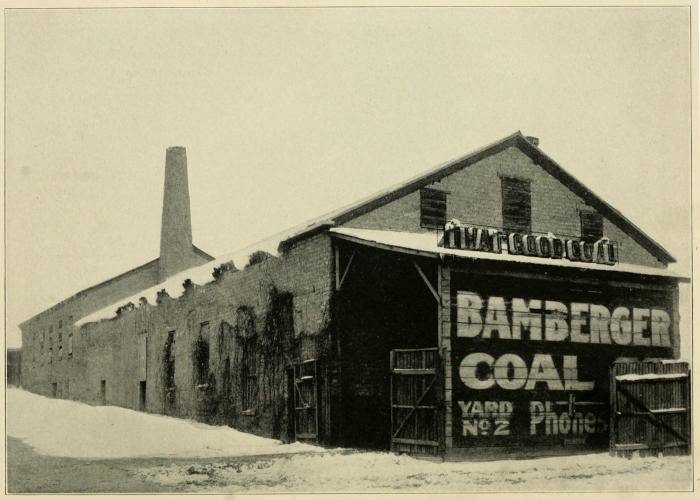
BUILDING IN SALT LAKE CITY, UTAH, IN WHICH THE FIRST BEET-SUGAR MACHINERY BROUGHT TO THE WEST WAS INSTALLED
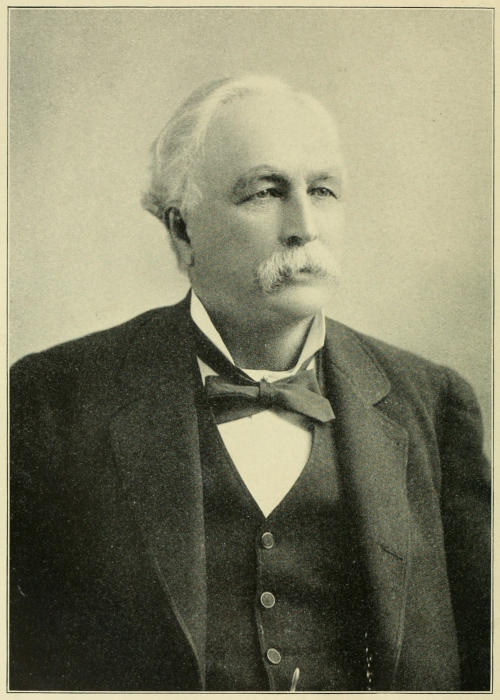
E. H. DYER. THE FATHER OF BEET SUGAR IN AMERICA
The California Beet Sugar Manufacturing company was organized by E. H. Dyer and C. S. Hutchinson in 1869 with $250,000 capital and a factory was erected at Alvarado on Mr. Dyer’s ranch. Otto and Bonesteel were induced to leave Fond-du-lac, Wisconsin, and come west to assume the management. Operations were begun in 1870 and on November 17th of that year the first beet sugar was made in California. The factory and equipment cost $125,000; the daily capacity was fifty tons of beets and one hundred and twenty-five men were employed. Between one thousand and fifteen hundred acres were planted in beets, the factory paying $3.50 per ton for them. The finished product cost about ten cents a pound, while the market price ranged from twelve to fifteen cents a pound. The first year’s output was 250 tons, the second 400 tons, the third 562 tons and the fourth 750 tons. Then financial troubles came and the plant was closed. The machinery was sold to a new concern, which built a factory at Soquel, Santa Cruz county. This enterprise failed in 1876, but the plant was put in operation again in 1880, when 150 tons of sugar were produced. That was the end of the Soquel venture.
In 1879 Mr. Dyer bought the buildings and land of the old California Beet Sugar Manufacturing company, and, with O. F. Giffin, formed the Standard Sugar Manufacturing company, with a capital of $100,000. Subsequently a reorganization was effected under the name of the Standard Sugar Refining company and the capital was increased to $200,000. The machinery and diffusion batteries of a plant built at Brighton by some Sacramento people about eight years previous were purchased and installed at Alvarado in buildings newly erected for the purpose. While it is true that in the operation of this company there was a constant struggle to overcome obstacles and difficulties, it is nevertheless a fact that it achieved success from the beginning. In 1884 the capacity of the mill was increased to 100 tons of beets per day, but disaster overtook the concern toward the end of 1886. Two of the boilers exploded, making it impossible to operate during the season of 1887-88.
Nothing daunted, Mr. Dyer grappled with the problem once more and succeeded in floating a new corporation, the Pacific Coast Sugar company, with $1,000,000 capital and headed by John L. Howard as president. In 1887 and 1888 this company built the middle part of the present factory at Alvarado, where it installed most of the machinery from the old plant, together with some new apparatus. The campaign of 1888 was barren of results and in March of the following year the Pacific Coast Sugar company sold its property to a new concern, the Alameda Sugar company, whose first president was M. H. Hecht. In 1890 two additions to the factory were built, one at each end.
From small beginnings, this Alvarado enterprise, the pioneer of American success in the production of sugar from beets, continued its yearly operations from 1879 until 1914, with the exception of the year following the boiler explosion. In 1889 the output was 872 tons, in 1911 it reached 9966 tons. At the beginning of 1914, sugar prices were low and tariff prospects very discouraging. Under such conditions, the owners of the plant did not believe that they could make sugar at a profit, and the factory remained closed during that season. The sharp advance in sugar values, due to the war in Europe, completely changed matters; beets were planted and 6363 tons of sugar were produced in 1915.
For a long time Mr. Dyer was looked upon as an enthusiast and a dreamer whose sincerity was unquestioned, but whose energies were misdirected. In the midst of the gloomy forebodings of those around him, he held tenaciously to his purpose and devoted his brains and his money to the solution of the problem confronting him. That the beet-sugar industry of the United States proved a success when it did is due to his unfailing courage and persistent effort.
A year before the Alvarado factory was built, a number of moneyed men of Sacramento, head by Julius Wetzlar, then president of the Capital savings bank, conceived the idea of starting a beet-sugar plant there. After some experimenting with local beets, the Sacramento Valley Sugar company was organized and machinery for a seventy-ton plant was ordered from Germany. Construction was delayed for a year, and thus the Sacramentans lost the honor of being the first in the field. In 1871 they built a factory at Brighton, six miles east of Sacramento, near the American river. An expert was brought out from Germany and work was begun on November 18th. The first diffusion battery used in the United States was employed in the extraction of sugar from the beets. The season of 1871 gave good results, but the following year the crop suffered greatly from the ravages of the army worm. The campaign of 1873 opened on August 5th, lasting until November 22nd. The yield of beets was ten tons per acre, the average sugar content 8 per cent and the total output 982,120 pounds of sugar, including all grades.
This enterprise struggled along until 1875, in spite of troubles from drought, army worm, grasshoppers and last, but not least, lack of experience. The plant was then closed and the equipment put up for sale. Briefly, it may be said that at the outset very poor sugar was turned out, and later, when the quality was improved, the cost of manufacture was found to be greater than what the sugar would bring. The final outcome was that the stockholders lost nearly all the money they had invested.
About 1874,[32] the California Sugar Manufacturing company was formed. Sixty-eight acres of land at Isleton were bought, a factory structure of brick was erected and machinery installed, the total expenditure being about $250,000. Sugar of good quality was made, but the financial result was disastrous. Isleton land was ill suited to beet culture, as when the Sacramento river was high the beet fields were covered with water. One authority states that the original idea was to manufacture sugar from watermelons, and when it was found that this was not practicable, attention was turned to beets.
In 1876 numerous mechanics’ liens were filed against the company. Later, the factory was leased to H. M. Ames of Oakland, who operated it during the campaign of 1880. Two years afterward the entire plant was sold at sheriff’s sale for $10,000. The land and building were purchased by P. H. Gardiner of Isleton and the machinery went to a San Francisco junk dealer. This venture is said to have caused financial distress to many of the farmers in the vicinity.
In 1888, Claus Spreckels, so long a prominent figure in the sugar world, established a beet factory at Watsonville, Santa Cruz county, in the rich Pajaro valley. At first its capacity was 300 tons of beets per day, and, the result of the operations being favorable, this was increased from time to time until it reached 1000 tons of beets per day. The Watsonville factory developed into the largest beet plant in America and remained so until 1898, in which year Mr. Spreckels erected a modern 3000-ton plant at Salinas, fifteen miles distant. Since then the new factory has sliced all of the beets grown in that territory and the old one has been dismantled. The capacity of the Salinas plant now is greater than that of any other beet factory in the United States, being 4000 tons per day.
The Oxnard brothers, Henry T., Benjamin, James G. and Robert, with J. G. Hamilton, W. Bayard Cutting and R. Fulton Cutting, organized the Oxnard Beet Sugar company in 1889, and in December of that year broke ground for a beet-sugar factory of 350 tons slicing capacity at Grand Island, Nebraska. In 1891 they built two more, one at Norfolk, Nebraska, and one at Chino, California, both of the same size as the Grand Island plant. The machinery for the first two factories was bought in France and that for the last one came from Germany. Toward the end of 1897, construction at Oxnard was begun, and in 1899 a consolidation of all these factories was effected under the corporate title of the American Beet Sugar company.
At the close of 1890, sixty years after the first experiment at Philadelphia, there were only three beet-sugar factories in operation in America; those at Alvarado, Watsonville and Grand Island. The total capacity of the three plants was eight hundred tons of beets a day, or ten thousand tons of sugar a year. France in the same period increased her production from 5000 to 770,000 tons a year through favorable legislation providing for the payment of bounties.
In the United States, whenever beet-sugar enterprises have been started, there has generally been some legal provision for payment by the state of bounty on the quantity of sugar produced. The story of how this responsibility was evaded is hardly a pleasant one. In Nebraska, for example, three different legislatures enacted laws providing for bounty on beet sugar, but in each case the following legislature either repealed the act or failed to make appropriations for the necessary funds. In the early nineties, Michigan passed a bounty law which resulted in several beet factories being established in that state, but when the claims for bounty were presented for payment, the state auditor refused to honor them, and his action was upheld by the state supreme court on the ground of unconstitutionality. A similar condition arose in Idaho. Minnesota paid bounties in 1890 and 1899, after which the law was declared unconstitutional.
The McKinley bill of April, 1891, was the first national legislation to encourage the beet industry. It called for a bounty of two cents on each pound of domestic sugar produced testing over 90 degrees, and admitted beet seed and sugar machinery free of duty. This encouraged the Oxnards to build the factories at Norfolk, Nebraska, and Chino, California, of which mention has already been made. At the same time Thomas R. Cutler and his associates put up a beet factory at Lehi, Utah, which state offered a bounty in addition to that granted by the Federal government.
The tariff act of August 28, 1894, abolished the bounty on sugar and fixed an ad valorem duty of 40 per cent. As a result of the loss of the bounty and the financial stress that reigned at that time, no beet factories were started except that at Menominee Falls, Wisconsin, which was a flat failure.
The following résumé of the United States tariffs on sugar since the year 1846 may be found useful for purposes of reference:
Tariff act July 30, 1846: All sugars 30 per cent ad valorem.
Tariff act March 3, 1857, to be effective from and after July 1, 1857: All sugars 24 per cent ad valorem.
Tariff act March 2, 1861, effective April 1, 1861: ¾c per pound on raw, 2c per pound on refined.
Tariff act August 5, 1861: 2c per pound on raw. Sugars above 12 D. S. and not yet refined, 2½c per pound. 4c per pound on refined.
Tariff act July 14, 1862, effective August 1, 1862: Sugars not above 12 D. S., 2½c per pound. Sugars above 12 D. S., not above 15 D. S., 3c per pound. Above 15 D. S., not above 20 D. S., and not stove dried, 3½c per pound. Refined and above 20 D. S., 4c.
Joint resolution of April 29, 1864, in effect for sixty days: Sugars not above 12 D. S., 2½c per pound plus 50 per cent equals 3¾c per pound. Sugars above 12 D. S. and not above 15 D. S., 3c plus 50 per cent equals 4½c per pound. Sugars above 15 D. S. and not above 20 D. S., 3½c per pound plus 50 per cent equals 5¼c per pound. All refined sugars 4c per pound plus 50 per cent equals 6c per pound.
Tariff act June 30, 1864, effective July 1, 1864: Sugars not above 12 D. S., 3c per pound. Sugars above 12 D. S., not above 15 D. S., 3½c per pound. Sugars above 15 D. S., not above 20 D. S., and not stove dried, 4c per pound. All refined sugars and all sugars over 20 D. S., 5c per pound.
Tariff act July 14, 1870, to be effective on and after December 31, 1870, which means January 1, 1871. Later amended by tariff act of December 22, 1870, to be effective immediately: Sugars not above 7 D. S., 1¾c per pound. Sugars above 7 D. S., not above 10 D. S., 2c per pound. Sugars above 10 D. S., not above 13 D. S., 2¼c per pound. Sugars above 13 D. S., not above 16 D. S., 2¾c per pound. Sugars above 16 D. S. and not above 20 D. S., 3¼c per pound. All sugars above 20 D. S. and all refined, 4c per pound.
Tariff act March 3, 1875: Sugars not above 7 D. S., 1¾c per pound plus 25 per cent equals 2.19c per pound. Sugars above 7 D. S., not above 10 D. S., 2c per pound plus 25 per cent equals 2.50c. Sugars above 10 D. S., not above 13 D. S., 2¼c plus 25 per cent equals 2.81c per pound. Sugars above 13 D. S., not above 16 D. S., 2¾c plus 25 per cent equals 3.44c per pound. Sugars above 16 D. S., not above 20 D. S., 3¼c plus 25 per cent equals 4.06c per pound. All sugars above 20 D. S. and all refined sugars, 4c per pound plus 25 per cent equals 5c per pound.
Tariff act March 3, 1883, effective June 1, 1883: Sugars not above 13 D. S. and not above 75-degree polarization, 1.40c per pound and .04c additional per degree or fraction thereof. Sugars above 13 D. S., not above 16 D. S., 2.75c per pound. Sugars above 16 D. S., not above 20 D. S., 3c per pound. Sugars above 20 D. S., 3½c per pound.
Tariff act October 1, 1890, effective April 1, 1891 (McKinley bill): Bounties effective July 1, 1891. Bounties declared unconstitutional by the United States supreme court: Bounty on domestic productions, sugars testing 80 degrees to 90 degrees, 1¾c per pound. Bounty on domestic productions, sugars testing at least 90 degrees, 2c per pound. All sugar not above 16 D. S., free. All sugar above 16 D. S., duty ½c per pound. All sugar above 16 D. S. from bounty-paying countries, duty ⁶⁄₁₀c per pound.
Tariff act August 27, 1894, effective August 28, 1894 (Wilson bill): Bounty on domestic production repealed. All sugars 40 per cent ad valorem. All sugars above 16 D. S. and all sugars discolored, 40 per cent and ⅛c per pound. All sugars from bounty-paying countries, ¹⁄₁₀c per pound additional.
Tariff act July 24, 1897 (Dingley bill): Raws not above 16 D. S. and not above 75-degree polarization, .95c per pound. Each additional degree or fraction thereof, .035c per pound additional. Sugar above 16 D. S. and all refined, 1.95c. All sugars from bounty-paying countries, countervailing duties equal to bounties additional.
Tariff act August 5, 1909 (Payne-Aldrich bill): Raws not above 16 D. S. and not above 75-degree polarization, .95c per pound. Each additional degree or fraction thereof, .035c per pound additional. Sugar above 16 D. S., and all refined, 1.90c per pound. All sugars from bounty-paying countries countervailing duties equal to bounties additional.
Tariff act October 3, 1913, effective March 1, 1914 (Underwood bill): Raws testing not above 75-degree polarization, .71c per pound. Each additional degree or fraction thereof, .026c per pound additional. No. 16 D. S. clause repealed. All Philippine sugars to be admitted free. After May 1, 1916, all sugars to be admitted free of duty.
In April, 1916, a bill was passed by Congress repealing the free-sugar clause of the tariff act of October 3, 1913. The President signed the bill on April 27, 1916.
The Democratic party was defeated in 1896 and the following year saw the passage of the Dingley bill, which levied a duty of 1.685 on 96-degree raw centrifugals under 16 D. S. in color and 1.95 on raws over 16 D. S. and on refined sugars. Under the beneficial influence of this law the industry revived and within a period of about two years from the enactment of the bill twenty-four beet factories sprang into being. One-half of the number were unsuccessful[33] because the stimulating provisions of the new tariff caused ventures to be made hastily and without regard to actual conditions. Of the twelve factories that survived, nearly all were situated in California and Michigan.
From 1900 to 1902 the building of beet plants was not so rapid, for the reason that the failures just mentioned and the popular demand for preferential terms for Philippine and Cuban sugars were not exactly encouraging. A 25 per cent preferential was given to Philippine sugars March 8, 1902, and a concession of 20 per cent of the duty was allowed Cuba December 27, 1903; still, notwithstanding the failures and the political agitation, five or six beet factories were erected each year during this period. The number of beet factories operating in the United States in 1915 was sixty-seven and the total daily slicing capacity was 73,320 tons. The acreage harvested was 611,301 acres, ninety-three per cent of which was worked by independent farmers and seven per cent by the factories. The total amount of beets sliced during that season was 6,150,293 short tons, which produced 874,220 short tons of sugar.
The following is a list of the factories themselves:
DATE BUILT SLICING CAPACITY
ARIZONA
Southwestern Sugar & Land Co.[34] Glendale 1903 600 tons
CALIFORNIA
Alameda Sugar Co. Alvarado 1870 750 ”
American Beet Sugar Co. Chino 1891 900 ”
American Beet Sugar Co. Oxnard 1898 3000 ”
Anaheim Sugar Co. Anaheim 1911 800 ”
Holly Sugar Co. Huntington Beach 1911 1200 ”
Los Alamitos Sugar Co. Los Alamitos 1897 800 ”
Santa Ana Co-op. Sugar Co. Dyer 1912 1000 ”
Southern California Sugar Co. Santa Ana 1909 600 ”
Spreckels Sugar Co. Spreckels 1899 4000 ”
Union Sugar Co. Betteravia 1898 900 ”
Sacramento Valley Sugar Co.[34] Hamilton City 1906 700 ”
San Joaquin Valley Sugar Co. Visalia 1906 450 ”
Pacific Sugar Co.[34] Corcoran 1908 600 ”
COLORADO
American Beet Sugar Co.[34] Lamar 1905 400 ”
American Beet Sugar Co. Las Animas 1907 800 ”
American Beet Sugar Co. Rocky Ford 1900 1600 ”
Great Western Sugar Co. Brush 1906 1100 ”
Great Western Sugar Co. Eaton 1902 1000 ”
Great Western Sugar Co. Fort Collins 1903 2000 ”
Great Western Sugar Co. Fort Morgan 1906 1150 ”
Great Western Sugar Co. Greeley 1902 1000 ”
Great Western Sugar Co. Longmont 1903 2000 ”
Great Western Sugar Co. Loveland 1901 1800 ”
Great Western Sugar Co. Sterling 1905 1000 ”
Great Western Sugar Co. Windsor 1903 1100 ”
Holly Sugar Co. Swink 1906 1200 ”
National Sugar Mfg. Co. Sugar City 1900 500 ”
Western Sugar & Land Co. Grand Junction 1899 600 ”
IDAHO
Amalgamated Sugar Co. Burley 1912 725 ”
Utah Idaho Sugar Co. Blackfoot 1904 860 ”
Utah Idaho Sugar Co. Idaho Falls 1903 950 ”
Utah Idaho Sugar Co. Sugar 1904 900 ”
ILLINOIS
Charles Pope Riverdale 1905 450 ”
INDIANA
Holland St. Louis Sugar Co. Decatur 1912 800 ”
IOWA
Iowa Sugar Co.[34] Waverly 1907 500 ”
KANSAS
Garden City Sugar & Land Co. Garden City 1906 900 ”
MICHIGAN
Continental Sugar Co. Blissfield 1905 900 ”
German American Sugar Co. Bay City 1901 1500 ”
Holland St. Louis Sugar Co. Holland 1899 400 ”
Holland St. Louis Sugar Co. St. Louis 1903 600 ”
Menominee River Sugar Co. Menominee 1903 1150 ”
Michigan Sugar Co. Alma 1899 1400 ”
Michigan Sugar Co. Bay City 1899 1400 ”
Michigan Sugar Co. Caro 1899 1200 ”
Michigan Sugar Co. Crosswell 1902 700 ”
Michigan Sugar Co. Carrollton 1902 900 ”
Michigan Sugar Co. Sebewaing 1902 850 ”
Owosso Sugar Co. Lansing 1901 600 ”
Owosso Sugar Co. Owosso 1903 1200 ”
Mt. Clemens Sugar Co. Mt. Clemens 1902 600 ”
Western Sugar Refining Co.[34] Marine City 1900 600 ”
West Bay City Sugar Co. West Bay City 1899 900 ”
MINNESOTA
Minnesota Sugar Co. Chaska 1906 700 ”
MONTANA
Billings Sugar Co. Billings 1906 2000 ”
NEBRASKA
Scottsbluff Sugar Co. Scottsbluff 1910 1850 ”
American Beet Sugar Co. Grand Island 1890 400 ”
NEVADA
Nevada Sugar Co.[34] Fallon 1911 600 ”
OHIO
Continental Sugar Co. Fremont 1900 500 ”
Continental Sugar Co. Findlay 1911 800 ”
German American Sugar Co. Paulding 1910 900 ”
Ottowa Sugar Co. Ottowa 1912 600 ”
Toledo Sugar Co.[34] Toledo 1912 1100 ”
UTAH
Amalgamated Sugar Co. Lewiston 1905 900 ”
Amalgamated Sugar Co. Logan 1901 750 ”
Amalgamated Sugar Co. Ogden 1898 750 ”
Utah Idaho Sugar Co. Elsinore 1911 620 ”
Utah Idaho Sugar Co. Garland 1903 950 ”
Utah Idaho Sugar Co. Lehi 1891 1165 ”
Utah Idaho Sugar Co. Payson 1913 700 ”
Layton Sugar Co. Layton 1915 450 ”
WISCONSIN
Chippewa Sugar Refining Co. Chippewa Falls 1904 500 ”
Rock County Sugar Co.[34] Janesville 1904 600 ”
U. S. Sugar Co. Madison 1906 600 ”
Wisconsin Sugar Co. Menominee Falls 1901 600 ”
WYOMING
Sheridan Sugar Co. Sheridan 1915 750 ”
Total capacity (76) U. S. factories 73,320 tons
TERRITORY OF HAWAII
The Hawaiian islands lie in the north Pacific ocean, between 18 degrees 54 minutes and 22 degrees 15 minutes north latitude and 154 degrees 50 minutes and 160 degrees 30 minutes west longitude. The group consists of eight inhabited islands and a number of small barren islets extending several hundred miles in a west-northwesterly direction.
The area of the various inhabited islands in square miles is as follows:
Hawaii 4210
Maui 728
Oahu 600
Kauai 547
Molokai 261
Lanai 139
Niihau 97
Kahoolawe 69
Total 6651
All of them are of volcanic and comparatively recent origin, and their age, or at least the time since the last eruptions on them, decreases from west to east. On Hawaii, the largest and most easterly of the group, the volcanic forces are still active and its surface is covered with lava thrown up at no very remote period. The principal port is Hilo and the highest mountain peaks are Mauna Kea (White mountain), 13,823 feet, and Mauna Loa (Great mountain), 13,675 feet.
Maui is formed by two mountains connected by an isthmus. Mauna Haleakala, the higher of the two, rises to a height of 10,032 feet.[35] Kahului is the most important town and seaport.
Oahu is of irregular quadrangular shape. Two nearly parallel mountain ranges traverse it from southeast to northwest and between them is a plateau that slopes down to the sea both in a northerly and southerly direction. The principal port is Honolulu, the “cross-roads of the Pacific,” a flourishing city of about 60,000 inhabitants and the capital of the group. It is admirably situated on a fine harbor and, in addition to its commercial importance, is one of the most attractive spots in the world on account of its balmy climate and wondrously beautiful surroundings. It is strongly fortified and a considerable military force is maintained there.
Pearl Harbor lies about seven miles from Honolulu in a westerly direction. Here the United States government has established a great naval station, one of the finest in existence. It has the most improved apparatus for supplying coal or fuel oil to vessels; there are machine shops, storehouses and barracks; and the huge dry-dock when completed will accommodate the largest dreadnaughts. The entrance from the sea has been dredged to make it navigable for ships of the greatest draft and the station is protected by powerful long-range guns of the most modern type.
Kauai, the oldest island of the group, is irregularly circular in shape, with a maximum diameter of about 25 miles. On the northwest a precipice rises to a height of 2000 feet and beyond that is a mountain plain, but the other portion of the island consists of shore plains with the mountain peak, Waialeale, 5250 feet high, in their midst. The shore plains are broken by ridges and broad, deep valleys and the island is well watered on all sides by mountain streams. There are a number of ports, but no large towns.
The climate of the Hawaiian islands near sea-level does not vary greatly from one year’s end to the other. It is cooler than other regions in the same latitude and extremely healthful. The northeast trade winds blow with periodic variations from March to December, or, as one writer says, 264 days out of 365 every year.[36] The leeward coast, protected by high mountains, is refreshed by regular land and sea breezes. The heaviest rainfall is from January to May, and naturally the greatest precipitation takes place on the windward side of the principal islands. The extremes of local rainfall in the larger islands have been known to range from 12 inches to 300 inches for the year. In Honolulu the average temperature runs from 72 degrees to 74 degrees, the maximum about 88 degrees and the minimum 52 degrees Fahrenheit. In ascending the mountains a lower temperature will be encountered as a matter of course and some of the highest mountain peaks are covered with snow nearly all the year round. Winds seldom blow with extreme violence and hurricanes are unknown.
Singular it is that so little should have been written upon a subject so important as the history of the growth of the sugar industry of the Hawaiian islands. Jarves and Thrum bring the narrative down to 1875 and Mr. H. P. Baldwin, in his book entitled “The Sugar Industry in Hawaii” (1895), contributes a fund of valuable information which is freely drawn upon in this chapter.
Tradition has it that a Japanese junk touched at the island of Maui during the thirteenth century and a Spanish vessel is said to have put in on the south coast of Hawaii during a voyage from Mexico to the Philippines in 1550. Be this as it may, our knowledge of these islands dates only from the time of their discovery by Captain Cook in 1778. He found sugar cane growing there when he landed and speaks of it in his description of his first visit as being “of large size and good quality.” According to the old natives, it grew wild and luxuriant in the valleys and lowlands. As far back as 1837 Mr. D. D. Baldwin recalls having seen fields of white cane on the edge of the woods at Hana, Maui, at an elevation of 2000 to 3000 feet. The natives made no attempt to use sugar cane except as an article of food, although it is said that in ancient days it served as an offering to their gods, particularly the god “Mano” (shark).
Cleveland[37] says that upon his first visit to the Sandwich group in 1799 the natives came alongside the ship in canoes bringing many fruits and vegetables, among which was sugar cane.
L. L. Torbert, one of the early planters, in a paper read before the Royal Agricultural Society in January, 1852, claims that the earliest sugar factory was put up on the island of Lanai in 1802 by a Chinaman who came to the islands in one of the vessels trading for sandalwood. He brought with him a stone mill and boilers, and after grinding one small crop and making it into sugar, went away the next year taking his apparatus with him.
Anderson[38] makes a statement that 257 tons of sugar were exported from the islands in 1814, but cites no authority upon which to base his assertion.
According to Jarves[39] the first instance of the manufacture of sugar goes back beyond 1820, but the name of the pioneer planter is unknown. It is certain that at first molasses was manufactured and then sugar some time before 1820.
Don Francisco de Paula Marin made sugar in Honolulu in 1819, the year before the arrival of the first missionaries. Lavinia, an Italian, did the same thing in 1823. His method was to pound the cane with stone pestles on huge wooden trays (poi boards) by native labor, collecting the juice and boiling it in a small copper kettle.
Accounts from various sources agree that the making of sugar and molasses was general in 1823-24. This undoubtedly had direct connection with the manufacture of rum, which was extensively carried on at that time.
In 1828 a considerable amount of cane was raised in the neighborhood of Honolulu and mills were built in the Nuuanu valley and Waikapu, Maui. A pioneer cane grower, Antonio Silva by name, lived at the latter place, and some Chinamen had a sugar mill near Hilo. In those days mills were made of wood, very crudely put together and worked by oxen.
The first attempt at sugar cultivation on a large scale was made at Koloa, Kauai, by Ladd & company, a Honolulu merchant firm, in 1835. This was the beginning of what is now known as the Koloa plantation, and the first breaking of the soil for planting cane was done with a plough drawn by natives. A mill was established here at the same time, and the enterprise was managed by a Mr. Hooper.
As has been said, the general character of the mills was rude and primitive and it continued to be so up to 1850. The rollers were generally of wood and the kettles in which the juice was boiled were whalers’ trypots. The buildings were adobe or simple grass huts. Only one grade of sugar was made. The juice was boiled to a thick syrup and put into coolers to grain, after which the granulated mass was packed in mats, bags, boxes or barrels with perforated bottoms for the molasses to drain off. The mills were run by bullocks, horses and in some cases by water power, and were fed by hand, one stalk at a time. The whole process, both in the field and in the mill, was very crude and imperfect.
The value of the sugar exported from the islands from 1836 to 1841 was $36,000 and that of the molasses for the same period $17,130.
An article by the late William Ladd on the “Resources of the Sandwich Islands,” published in the “Hawaiian Spectator” for April, 1838, speaks thus prophetically of the manufacture of sugar, then in its infancy:
“It is a very common opinion that sugar will become a leading article of export. That this will become a sugar country is quite evident, if we may judge from the varieties of sugar cane now existing here, its adaptation to the soil, price of labor and a ready market. From experiments hitherto made, it is believed that sugar of a superior quality may be produced here. It may not be amiss to state that there are now in operation, or soon to be erected, twenty mills for crushing cane propelled by animal power, and two by water power.”
Just here it may be remarked that at that time the price of labor was a potent argument in favor of making the islands a sugar-producing country, for native labor was available in abundance and the current rate of wages was from 12½ cents to 37½ cents per day, or $2.00 to $5.00 per month.
In an article on commercial development,[40] Thrum says:
“Hawaiian produce in the early days had to seek distant markets, for we find shipments of sugar, hides, goat skins and the first shipment of raw silk moving to New York per the bark Flora in 1840. A trial shipment of sugar was sent to France, but it did not offer sufficient encouragement for any renewals. The Sydney market was also exploited with sugar, where it obtained better figures than similar grades of Mauritius.”
Between the years 1840 and 1850 a cane field and rude mill in Lahaina, Maui, were owned by David Malo, a well-known Hawaiian, who made molasses and sold it for home consumption. His apparatus consisted of three whaling-ship trypots set up on adobe and stone mason work. The crushing was done with wooden rollers, strengthened by iron bands.
In 1841, Kaukini, governor of Hawaii, planted about one hundred acres of cane in Kohala and the crop when harvested was ground under contract by a Chinese named Aiko.
In Wyllie’s “Notes” on the islands, published in the “Friend,” December, 1844, the quantity of sugar exported from the island of Kauai is estimated at about 200 tons, and the molasses at 20,000 gallons. Hilo, in the same year, exported 42 tons of sugar. Maui had, at that time, two mills, but the amount of sugar produced is not reported.
In 1851, D. M. Weston, then manager of what is now the Honolulu Iron Works, invented the first centrifugal machine for drying sugar, and this machine was installed on the East Maui plantation in the same year. This, it is claimed, was the first centrifugal to be used for the purpose anywhere.
Prominent among the early planters are the names of Stephen Reynolds, William French, Ladd & company, Dr. R. W. Wood, L. L. Torbert, W. H. Rice, and later on S. L. Austin, A. H. Spencer and Captain Makee.
In the year 1854 or 1855, Captain Edwards of the American whaler George Washington brought from Tahiti two varieties of cane, one known as Cuban and the other as Lahaina. The latter proved to be profitable to raise and fifteen or sixteen years later began to displace other species throughout the islands. Since then its popularity continued to increase and up to twenty years ago it was the variety most in favor on all Hawaiian plantations.
Twelve varieties of cane were imported from Queensland, Australia, in 1880, but of these only one—the Rose Bamboo—compared with the Lahaina in productiveness, and that only in high altitudes.
In 1898 Lahaina and Rose Bamboo seemed to have outlived their usefulness on the Hamakua coast of the island of Hawaii, and while they continued to give excellent results in the low, sheltered valleys, it became evident that they could not be profitably grown on the uplands. The yields in the Hamakua region were becoming smaller each year and the plantation owners had to seek a new variety. A cane known as Yellow Caledonia[41] solved the difficulty and wonderful crops of it have been raised uninterruptedly in that section ever since.
In 1856 no fertilizers were used and practically nothing was known of irrigation. The average yield of sugar at that time was one ton per acre. The extraction of sugar from the cane was less than 50 per cent, while today in the best mills it exceeds 98 per cent and the average result from all Hawaiian factories shows over 90 per cent.
The industry struggled along under severe handicaps and discouraging circumstances until 1857, when the number of plantations on the islands had dwindled down to five: Koloa and Lihue on Kauai, the East Maui and the Brewer on Maui and a Chinese outfit near Hilo, Hawaii.
In 1858-59 steam was adopted as the motive power in the mills; wooden mills were superseded by those built of iron and in 1861 the first vacuum pans were introduced. The same year saw the number of plantations increase to twenty-two, nine of which employed steam for the grinding of the cane.
The outbreak of the Civil war in the United States cut off the supply of sugar drawn from the Southern states and caused the price of Hawaiian sugar in kegs to advance to ten cents a pound. This gave the Hawaiian producers their first real start. In 1863 the export tonnage was 2600, and this increased until in 1860 it reached 8869 tons.
A small plantation was started at Paia, Maui, by a Captain Bush in 1868 and in the following year he disposed of it to S. T. Alexander and H. P. Baldwin. The former gentleman was then manager of the Haiku plantation and the acquisition of his interest in the Paia venture necessitated his going to Honolulu to borrow the sum of $9000, which he managed to do, but not without difficulty. Mr. Alexander was the father of irrigation in Hawaii. He promoted and built the Haiku ditch, which was the forerunner of the present magnificent water-distributing system of the islands.
The period from 1869 to 1876 was one of arduous struggle for the planters. Their very existence was at stake. The duty levied on imports by the United States cut their margins down to nothing, labor was scarce and the cost of obtaining it great, the rate of interest was from ten to twelve per cent, agents’ commissions for buying and selling ran from five to ten per cent; in short, many plantations were threatened with utter ruin, and so seriously discouraged did the business men become that the only gleam of hope for the salvation of the sugar industry seemed to be annexation.
Repeated efforts were made to negotiate a reciprocity treaty with the United States. Finally this was accomplished; the treaty was consummated in 1876 and a new Hawaii was born.
The expansion that followed was more rapid than the finances of the country could stand. Depression ensued, and as a result the resources of the islands were taxed to the utmost.
The demand for labor during this period of expansion was so great that the pay of the laborers in the fields was raised to one dollar a day, with free rent, fuel and medical attendance. Laborers were sought for in the far corners of the earth, and in consequence the islands have a race mixture rarely found anywhere else in the world.
In 1876 the annual crop of the islands could have been put in one vessel of the capacity of those that are now engaged in freighting Hawaiian raw sugars to the United States, the total being in the neighborhood of 13,000 short tons. At that time, however, this seemed an enormous amount to the planters with their small acreage and mills. It is well known that one planter was very much exercised as to how he was possibly going to handle the extraordinary production of 1100 tons from his plantation, which was then the largest in the islands.
The crop came on the market in such small quantities that it was of no value to refiners, as they could not depend upon definite deliveries. It was therefore put up in special containers, known as “island kegs,” and sold directly to the wholesale grocers on the Pacific coast.
Some plantations turned out sugars that found especial favor with the trade, and these grades brought as high as 14 cents per pound.
Under the benefits of reciprocity the crop increased by leaps and bounds and in a short time the planters ceased selling these raw grocery sugars and turned their attention to supplying the wants of refiners. The “island keg” became a thing of the past and the small sailing vessels which had heretofore carried all the island products to the mainland gave way to steamers. At the present day there is only one sailing vessel plying regularly between San Francisco and the islands, and she usually loads at a port where the large freighting steamers do not care to venture.