Part I Growth, Manufacture and Distribution (continued 3)
Reading edition
Like sugar cane, beets are subject to plant diseases of various kinds, as well as to injury by insect pests, and great care has to be exercised to ward off these dangers.
Probably no other crop exhausts the soil so rapidly as beets, and, if they are planted for many years in succession, they deteriorate year by year. On the other hand, if crops are rotated so that beets are grown in the same ground every third year, peas, beans or grain being raised the other two years, it is a remarkable fact that all of these crops will improve each year. This is due to the intensive cultivation of the beets and to the humus left in the ground in the form of rootlets. Experience has taught the farmer that no other crop is so beneficial to the soil as beets grown in the right rotation and with proper care.
THINNING
As soon as the beets are up and the rows clearly defined, thinning becomes necessary. This is one of the most important features of beet culture and is a tedious and expensive operation. It consists of cutting out the plants so that individual roots remain, spaced about eight inches apart. The work is done by hand, a hoe being used to block out the spaces, and the roots surrounding the one which it is desired to retain are pulled up. Due partly to faulty germination, but principally to defective thinning of the beets, in which operation a great many of the small, tender beet plants are injured or killed, very much less than the theoretical number of mature beets are secured per acre. With rows eighteen inches apart and a plant every eight inches in the row, 43,000 beets per acre should be obtained, which, at an average weight of one and one-half pounds per beet, would mean 32.25 tons. Owing, however, to the facts just mentioned and to other causes, the actual yield is always much less. The average in California for a number of years past has been only 10.68 tons per acre.
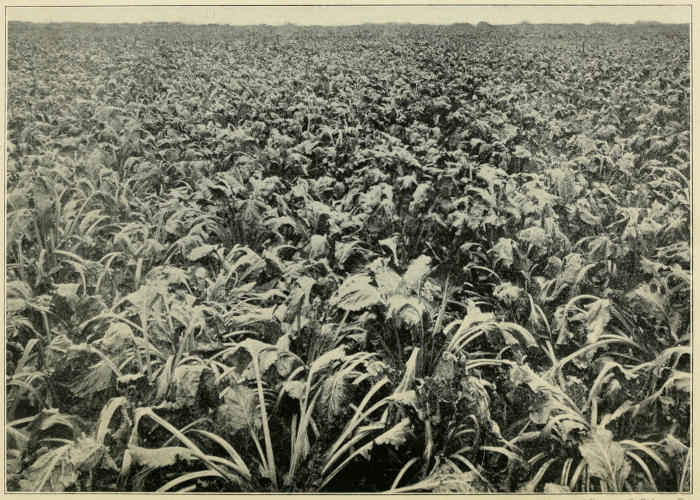
By permission of Truman G. Palmer, Esq.
FIELD OF RIPE BEETS
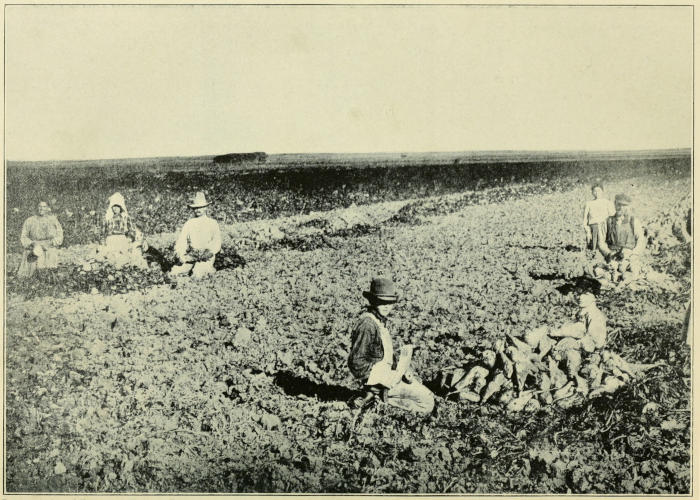
By permission of Truman G. Palmer, Esq.
TOPPING BEETS
CULTIVATION
The purpose of cultivation is two-fold; first, to retain the moisture in the soil, and, second, to destroy the weeds and grass, as in the early stages of the growth of the beets weeds might spoil the stand by choking the plants.
Cultivation should be continued until the plants have attained such a size that the leaves cover the ground. It increases the fertility of the soil by opening the land to the atmosphere, thus facilitating the penetration of oxygen and absorption of air moisture and the resulting decomposition and assimilation of nutritious elements.
HARVESTING AND TOPPING
The time when harvesting takes place depends on the many factors that influence the growth and maturing of the beet. In the colder countries the harvesting lasts from September until the ground becomes frozen, while in warmer climates like that of California, where the seed is planted early, harvesting begins about July first and lasts for a period of from seventy-five to ninety days.
The beets are first loosened by means of a specially shaped plough, called the “puller,” which lifts them from the ground. They are then picked up by hand and the crown of each beet, together with the leaves, is cut off with a large knife. The leaves contain no sugar, and are, therefore, not taken into the factory, but are utilized for stock feeding, being quite valuable for this purpose. The sugar contained in the crown is accompanied by so many organic salts that it does not pay to extract it.
The topped beets are then loaded into wagons or railroad cars and transported to the factory, at which point they are carefully weighed. In this country most of the beets are raised by farmers and sold under contract to the factories, at so much per ton, so that the determination of the exact weight and sucrose content is important. For the season of 1915 the average price paid to the farmers for beets was $5.67 per ton.
On arrival at the factory a certain number of beets are taken from every wagon- or car-load, and these represent a fair average of all the beets of that particular delivery. They are sent to the laboratory and their exact weight ascertained, after which they are trimmed of all adhering roots, leaves and parts of the crown, if not properly topped in the field. Any remaining soil is carefully brushed off and the beets thoroughly cleaned. They are then reweighed and the difference between this and the first weight is the tare. This difference represents a certain percentage of the total of the sample beets weighed, and that small percentage is deducted from the gross weight of the total load. In this way the exact net weight of beets delivered by the farmer is determined and he is paid according to this net weight.
The sugar content of the beet and the purity of the juice must now be ascertained, for the price paid the farmer varies according to the amount of sugar the beet contains. As in the case of weighing, sampling and polarizing raw cane sugar, representatives of both parties—the farmer and the factory—are present when all weights are taken and tests made. There are several different methods for determining the percentage of sugar in the beet and the purity of the juice, but the following gives a fair idea of the general practice.
The sample beets having been cleaned, are cut into quarters, one-quarter of each beet being taken for the general sample. This general sample is placed in a grinding or shredding machine, the beets are disintegrated to a fine pulp and thoroughly mixed. A specific amount of this fine pulp is then accurately weighed and placed in a copper pan or dish called a capsule. A small quantity of dilute lead solution is introduced to assist in clarifying, and sufficient water added to bring the volume up to 200 cubic centimeters. It is then heated for about twenty minutes and vigorously agitated, so that the sugar-bearing juice of the beet will mix evenly with the water that was added. The mixture, after being allowed to stand for several minutes, is filtered through paper and a certain amount placed in the observation tube of a polariscope. The instrument will show the amount of sugar in the solution, and by multiplying the reading by two the per cent of sugar in the beets will be found. If in preparing the sample only sufficient water had been added to bring it to a volume of 100 cubic centimeters, the polariscope would give a direct reading of the percentage of sugar in the beets. Practice has demonstrated, however, that the method described is the more accurate.
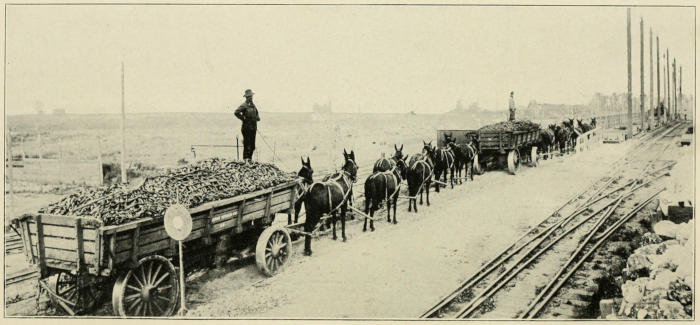
By permission of Truman G. Palmer, Esq.
HAULING BEETS
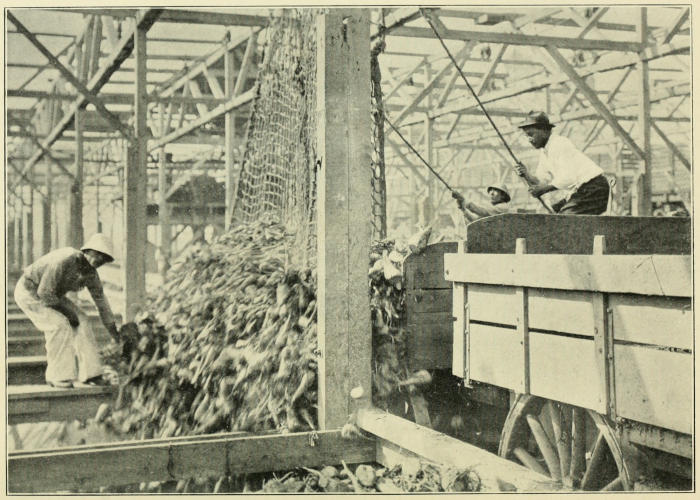
By permission of Truman G. Palmer, Esq.
DELIVERING BEETS TO THE FACTORY BY WAGON
To ascertain the purity of the juice, the procedure is as follows: A part of the shredded sample is taken and the juice is squeezed out of it. The amount of sugar in this juice is determined by aid of the polariscope, and a Brix spindle shows the amount of solids it contains. By dividing the polarization by the Brix and multiplying by 100 the purity is obtained, which means the percentage of pure sugar in the total amount of solids contained in the solution.
The purity of the juice has an important bearing on the subsequent manufacture of the sugar. It is difficult and costly to extract sugar from low-purity juices, and the loss of sugar in the process is very high. The reverse is naturally true if the juices have a high purity. The purity of the juice in the beet is materially affected during the growing period by climatic conditions, rainfall, irrigation, fertilization, state of soil and cultivation. Great care and attention must be given the beet to insure high purity and heavy content of sugar.
From the above it will be seen how the net weight and the percentage of sugar in any particular wagon- or car-load of beets are ascertained, as well as the purity of all the beets that enter a factory. The efficiency of the work in a factory is based on the figures thus obtained.
MANUFACTURE OF BEET SUGAR
The process of making sugar from the beet is highly technical in its details and cannot be fully discussed within the scope of this work. A brief description, however, will give an idea of the general methods followed.
The process of manufacture may be classified under seven headings:
1. Transportation and cleaning of beets.
2. Extraction of juice, slicing and diffusion.
3. Purification, carbonation, filtration, concentration and sulfitation.
4. Formation of grain.
5. Partial drying, purging crystals from syrup in centrifugals.
6. Final drying.
7. Packing.
TRANSPORTATION AND CLEANING
The beets, after delivery to the factory, are stored in V-shaped bins, in the bottom of which is a flume covered by removable boards. By removing the boards, one at a time, the beets are fed into the flume, where a swift current of water floats them into the factory. From this flume the beets are lifted by means of a large wheel, a helical screw or any other suitable device, and discharged into a washer.
The common form of washer consists of a horizontal, semi-cylindrical tank provided with rotating, kicking or stirring arms for keeping the beets in motion. In this tank the beet is completely cleaned and separated from adhering earth, weeds and pebbles.
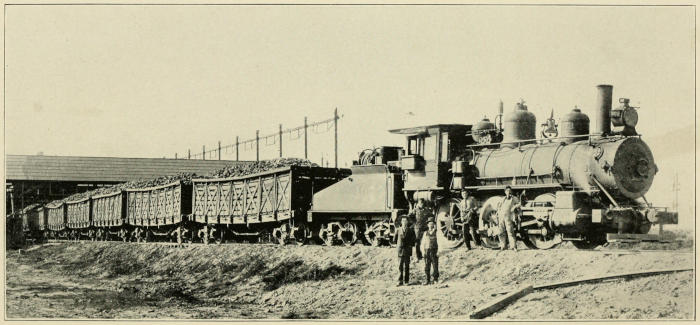
By permission of Truman G. Palmer, Esq.
DELIVERING BEETS TO THE FACTORY BY TRAIN
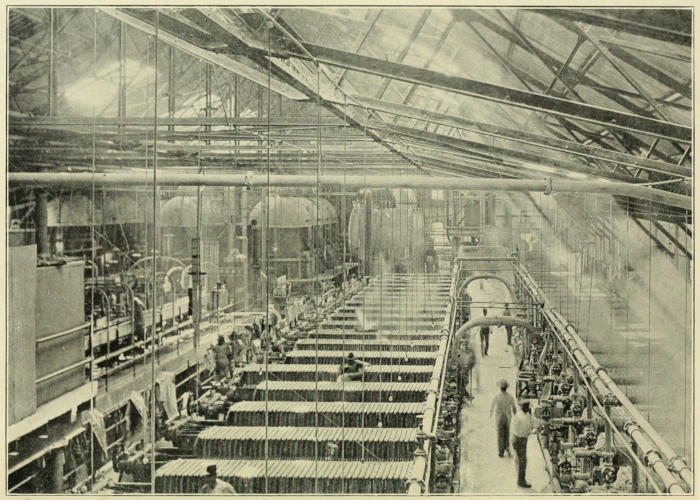
By permission of Truman G. Palmer, Esq.
GENERAL INTERIOR VIEW OF BEET-SUGAR FACTORY—SHOWING FILTER PRESSES IN FOREGROUND; PANS AND EVAPORATORS IN REAR
The beets are delivered from the washer into an elevator, which takes them to a point near the top of the factory and discharges them into automatic weighing and recording scales. From the scales the beets fall by gravity into the slicing machines.
EXTRACTION OF JUICE, SLICING AND DIFFUSION
The slices are made in various shapes and forms. The slicing machines consist of revolving, corrugated knives which cut the beets into long, thin slices or “cossettes.” The object is to produce slices which expose the greatest amount of surface, and yet sufficiently firm to lie not too closely together when placed in the diffusion battery, thereby preventing the circulation of the diffusion liquors. The cossettes are conveyed on an endless belt, or through a hopper, to the cells of the diffusion battery.
As the term implies, the juice in the beet is extracted by diffusion, and not by crushing, as in the case of cane. When two liquids, separated by a membrane, are brought in direct contact with each other and allowed to stand for a time, they mix uniformly without the assistance of mechanical or other force.
Beets are made up of a great number of plant cells, the walls of which are porous membranes. These cells are placed in contact with water or juice of lesser sugar content than the juice in the plant cell, in consequence of which the juice is gradually diffused from the beet and carried away in the circulating water which is added. When this water, or rather juice, has reached a certain stage of concentration, it is drawn out of the cells and sent to the next stage in the process of manufacture.
A diffusion battery, or the apparatus in which the process of diffusion is carried on, consists of a number of tanks or cells, usually from ten to fourteen, cylindrical in shape and terminating in truncated cones provided with covers. There are two ways of arranging the cells of a diffusion battery; in the one case the cells are placed in a straight line; in the other they are grouped in a circle. These cells are filled with cossettes in rotation, and water is introduced into the one in which the cossettes were first placed.
Thus the water enters the tank in which the cossettes are nearly exhausted of their sugar, and it flows successively through the other cells that contain cossettes of greater sugar content until the last cell, or the one containing fresh cossettes, is reached. The juice passing through this cell is alternately sent to the measuring tank or to the next cell, which has just been filled with fresh cossettes. The process is continuous, one cell being emptied of exhausted cossettes while another is being filled with fresh ones, and the juice flowing either to the measuring tank or to the freshly filled cell.
The exhausted cossettes, now called pulp, are dropped from the bottom of the diffusion tanks into a large bin, from which they are conveyed or pumped to pulp separators and presses for the separation of the surplus water. This pressed pulp is usually stored in large bins or silos, where it is allowed to ferment before being fed to cattle.
Recently the practice of drying the pulp has been carried on to a large extent. In this process the moisture in the pulp is reduced to ten per cent, the same proportion as in cured hay. Dried to this point, it is packed in bags and may be stored for an indefinite period without deteriorating. After being treated thus it forms an excellent stock food, particularly if waste molasses is sprayed on it before drying.
PURIFICATION OF JUICE, CARBONATION AND FILTRATION
The diffusion juice obtained as above described is quite dark in color, and after passing through the measuring tanks it is conveyed to carbonation tanks where it is treated with from three to four per cent of caustic lime in the form of a thick milk.
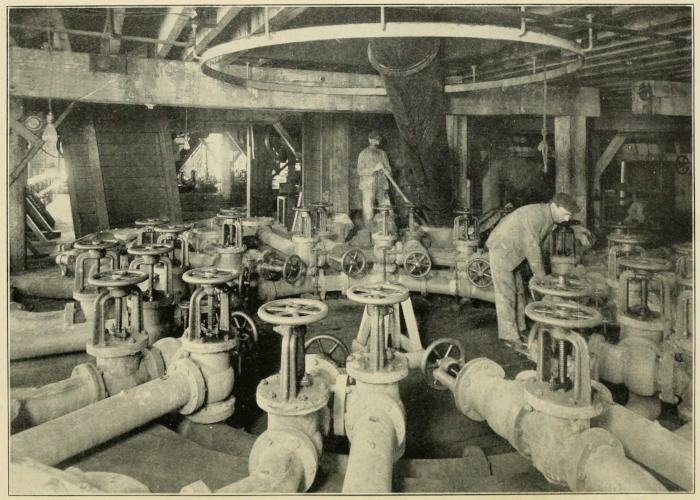
By permission of Truman G. Palmer, Esq.
DIFFUSION BATTERY—SHOWING DIFFUSION CELLS IN CIRCULAR ARRANGEMENT
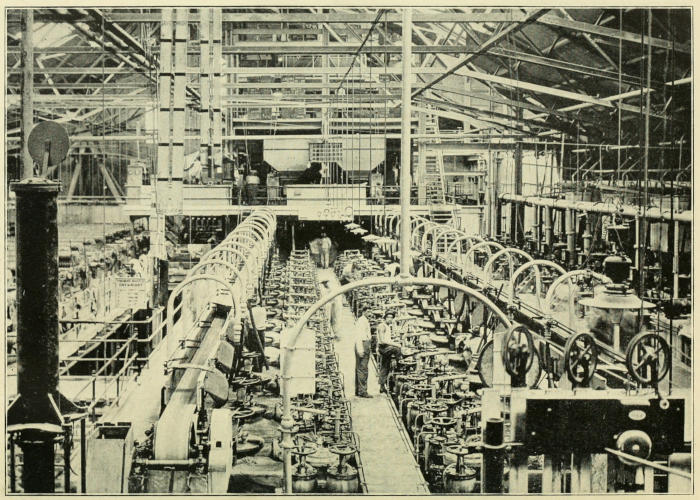
By permission of Truman G. Palmer, Esq.
DIFFUSION BATTERY—SHOWING DIFFUSION CELLS IN STRAIGHT LINES
After being thoroughly agitated, the mixture is treated with carbonic acid gas obtained from the lime-kilns, as the result of the decomposition of limestone and the combustion of the fuel used for burning it.
By this process some of the impurities in the juice are removed and the color reduced to a brilliant amber. As is the case in the cane mills and refineries, it is essential to keep the juice hot throughout the process. The carbonation is continued until the juice is only slightly alkaline, when it is passed through filter presses for the removal of the precipitated lime carbonate and other solid matter. The solid matter in suspension is retained in the frame of the press, and, as soon as the frame is full, the cake is washed by passing water through it. When the sugar content of the cake has been sufficiently reduced, the press is opened and the cake discharged and sent to the fields to be used as a fertilizer.
As a rule, the filtration is repeated for the elimination of any solids that may have passed through the first filtration. This double filtration is usually practiced in all the filtrations in the course of the juice through the factory.
The juice after being filtered a second time is again treated with carbonic acid gas for the further reduction of the caustic lime and then undergoes a third filtration, following which it is sent to the evaporators for concentration.
CONCENTRATION OF JUICE
When the juice reaches the evaporators it contains about eighty-two per cent of water, which, by concentration, must be reduced to about forty per cent. As already explained, the removal of water is generally accomplished in multiple-effects. The apparatus consists of a number of boiling bodies connected in such a manner as to secure a progressive decrease in atmospheric pressure.
The thin juice enters the first body where evaporation takes place under a slight pressure. The steam for this evaporation is usually the waste or exhaust from the engines and pumps. The vapors generated by the evaporation of water from the juice in the first body enter the heating tubes of the second body and are used in further concentrating the somewhat concentrated juice from the first body. The evaporation in this second body is conducted at a higher vacuum and corresponding lower temperature than in the first body. This proceeding is continued until five or even six bodies are used in the series. The last body is usually under a vacuum of about twenty-six inches of mercury.
It is obvious that by this arrangement the concentration of the thin juice is effected with the maximum of economy, direct steam being admitted into the first body only and the rest of the operation accomplished by the steam generated in the boiling of the juice.
SULFITATION
The thickened liquor leaving the last body of the evaporators is sent to the sulphur station and treated with sulphur fumes, in order to further precipitate the soluble impurities and reduce the color of the liquor. It is then heated to boiling point in closed tanks and passed through a double set of cloth filters. This is the final process in the purification of the beet juice, and it is then ready for graining.
In a cane-sugar refinery no sulfitation of the liquor takes place, and in a beet factory there is no char filtration for removal of color and impurities in the liquor. These two points constitute the main difference in the methods of making white sugar from the cane and the beet in the United States. In Europe, however, many factories make a raw beet sugar, which is subsequently refined with the aid of bone-char.
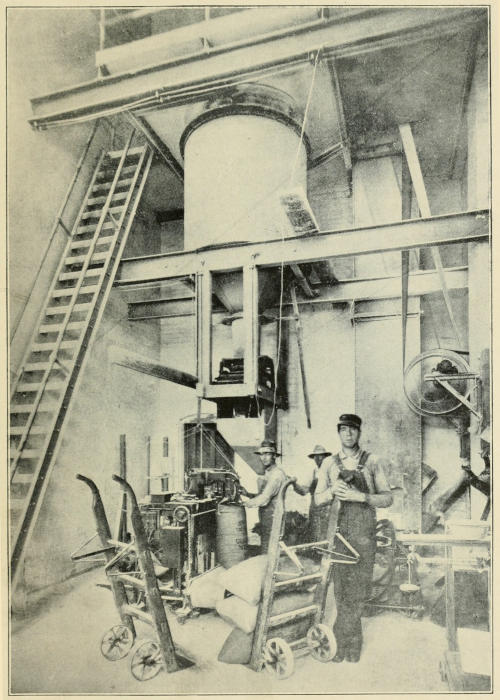
By permission of Truman G. Palmer, Esq.
WEIGHING, FILLING AND SEWING BAGS IN A BEET FACTORY
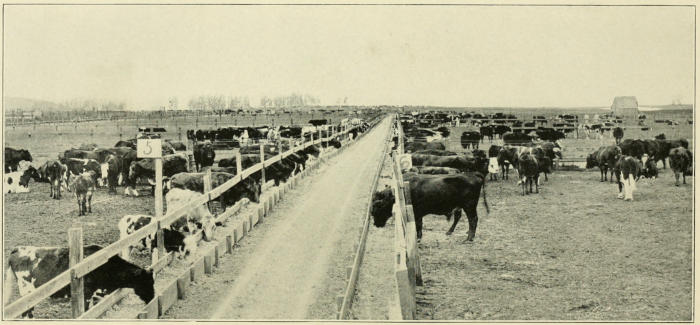
By permission of Truman G. Palmer, Esq.
CATTLE FEEDING ON BEET PULP
FORMATION OF GRAIN
The formation of the crystallized grain and its progress through the vacuum pans, centrifugals, driers, granulators and screens, and into the bags in the packing room, is identical with the process in a cane refinery, which has already been described.
STEFFEN PROCESS
In some of the beet factories the sugar left in the final molasses is extracted by what is known as the Steffen process. The final low-purity molasses is diluted with water and cooled to a very low temperature, after which finely powdered lime is constantly added to the solution at a uniform and slow rate. The sugar combines with the lime and a saccharate of lime is formed which is insoluble in the liquid. The suspended matter or saccharate is then separated and washed in filter presses.
The cake from these filter presses, which is the saccharate of lime, is mixed with sweet water to a consistency of cream and takes the place of milk of lime in the carbonation process. When the Steffen process is employed, about ninety per cent of the sugar originally in the beet is extracted. The loss of sugar that does take place is accounted for in the exhausted cossettes or pulp, in the pulp water which surrounds them when they are dumped from the diffusion cells, in the cake and wash waters from the carbonation presses and in the waste and wash waters from the Steffen process. As the water used in washing the saccharate press cake is rich in fertilizing qualities, it is used for irrigating the lands adjoining the factory.
The 6,511,274 tons of beets harvested in the United States during the season of 1915 contained an average of 16.49 per cent of sucrose, of which 14.21 per cent found its way into the sacks as white sugar. The difference, 2.28 per cent, represented the loss in working up the beets. As only a few factories, however, were using the Steffen process, a considerable amount of sugar was left in the waste molasses. For the same period, the beets produced in California contained 17.82 per cent of sugar, of which 15.64 per cent found its way into the sacks, showing a loss of only 2.18 per cent. This may be accounted for by the fact that probably more of the California factories were equipped with the Steffen process than the average for the United States, and that the purity of the juices of California beets was higher than the average for the United States.
A factory equipped with the Steffen process and running on beets containing 17.82 per cent sugar, with a purity of 82, should lose not over 1.9 per cent of the sugar in the beet. The same factory without the Steffen process would probably lose 5.04 per cent of the sugar.
It is interesting to know that, according to the testimony given before the Hardwick committee, the average cost of producing and selling one hundred pounds of white beet sugar in the United States today is about three dollars and fifty cents. The selling price, which is from ten to twenty cents per one hundred pounds less than the selling price of refined cane sugar, fluctuates with the value of raw cane sugar. For instance, if raw cane sugar is selling in New York at four dollars per one hundred pounds, the selling price of refined cane will probably be four dollars and eighty cents. Beet sugar, therefore, would be four dollars and seventy cents or four dollars and sixty cents. On the other hand, if raw cane were selling for three dollars per one hundred pounds, refined would probably be three dollars and eighty cents and beet sugar three dollars and seventy or three dollars and sixty cents. In the one case the beet factory makes a large profit; in the other a very small profit.
As the value of raw sugar is determined absolutely by the law of supply and demand in the world’s markets, it is clear that the fortune or misfortune of the beet-sugar producer is beyond his control.
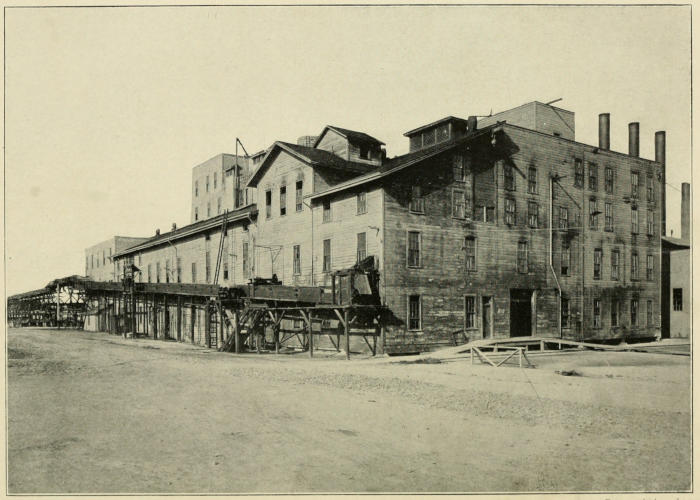
By permission of Truman G. Palmer, Esq.
THE FIRST SUCCESSFUL BEET-SUGAR FACTORY IN AMERICA—ALVARADO, CALIFORNIA
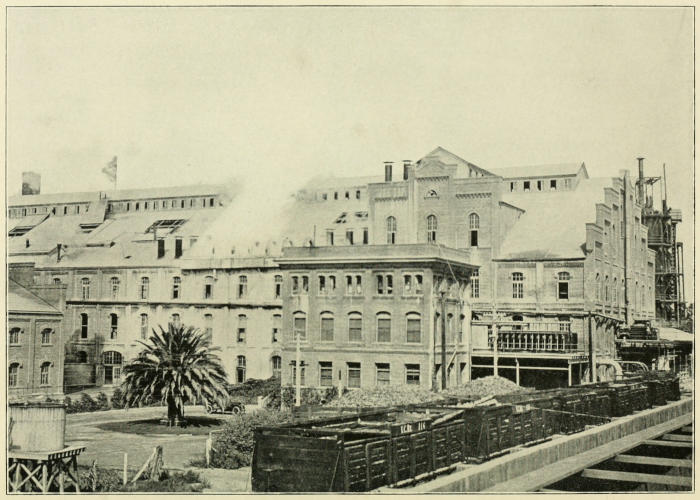
By permission of Truman G. Palmer, Esq.
A MODERN BEET-SUGAR FACTORY