Part II History of the Industry (continued 4)
Reading edition
It also parceled out land to Chinese sugar growers and granted them special concessions in consideration of the entire product of the land being sold to the company at an agreed figure. Prices and terms changed from year to year, however, and much confusion and dissatisfaction resulted. War, cane pests, cattle diseases and labor troubles still further complicated the situation. In 1648 the company’s plantations produced 124 tons and in 1652 the outturn was 723 tons. The increase in West Indian production hurt the Javan factories and the war in Bantam in 1660 stopped development. In 1652, twenty mills were running, but in 1660 half of the number had closed. Peace with Bantam was concluded in 1684 and matters then began to improve. By 1710, one hundred and thirty mills were in operation and the industry was extended to Bantam, Cheribon and Japara. The policy of the company, however, was to restrict production so as to keep up prices, and to this end it prohibited the erection of any new mills and limited the output of those that were running to eighteen tons per annum each, thus fixing a maximum total of 2340 tons. This amount was not realized, however, as the number of factories decreased until in 1745 only sixty-five were in operation in the territory near Batavia. The company then decided to raise the number to seventy, and five years later it added ten more. As years went on the number of factories diminished, but their capacity increased, and in 1779 fifty-five mills furnished 6176 tons of sugar to the company.
The Dutch East India company was dissolved in 1795 and the Dutch interests in Java passed under the control of the Batavian republic,[86] afterward the kingdom of Holland, which was brought under French rule when Holland fell into the hands of Napoleon. In 1811 it was seized by England and was finally restored to Holland in 1816.
All this time the regulations governing the sugar industry were being constantly changed. The producers had always been at loggerheads with the company, for while they were bound to deliver their entire output to the company, it did not consider itself obligated to take delivery of any definite amount. This left the planters in a very unsatisfactory position, as they could never look ahead with any degree of certainty. At length a law was passed in 1797 calling upon the factories near Batavia to produce 2810 short tons yearly for the government, with the privilege to them to dispose of any sugars made in excess of this amount for their own account. A similar law affecting the factories on the north and east coasts was proposed. In this territory there were thirty-one factories in 1794 with a capacity of 1000 tons, which quantity it was proposed to increase to 2000 tons for delivery to the government and 500 tons for sales for account of the producers. In furtherance of this plan, the mill owners were to be granted tracts of new cane land and the government was to make cash advances up to 50 per cent of the estimated value of the growing crop. These propositions were never carried into effect, and a production of 1000 tons per annum remained the maximum for that section of the country.
In the vicinity of Batavia, however, the measure was a success, especially as the government encouraged the manufacturers by increased advances and by supporting prices. The result was that during the early years of the nineteenth century the production grew, but a sharp decline came in 1811-13, and in the latter year the total production of Java fell to about 600 tons.
The causes were not hard to find. Holland was dominated by France and sea traffic was blocked by the British, so that Java had to keep her sugar in storage at home. Nevertheless, the government continued to encourage the production in the hope of an early peace and so that the industry might not die out. Each year, therefore, added to the government’s stocks of sugar until the amount became burdensome for financial reasons, and the traditional policy of the government was abandoned. Manufacturers were allowed to dispose of their sugars freely and without restriction, but unfortunately the privilege was granted at a time when it was impossible to sell and the British occupation of Java did not mend matters.
When Java was restored to Holland in 1816, the new government continued the freedom of the industry, but it had received so severe a check that to revive it was a difficult matter. In 1826 the output was 1220 tons, and in this year the authorities renewed the system of making advances and stimulated growth and manufacture, so that in 1830 the production had increased to 6700 tons.
That same year a new governor-general, van den Bosch, was appointed. He was entrusted with the task of making the island a producer of the commodities required by the mother country and was given a free hand as to the means to be employed in accomplishing his purpose. The plan he put into effect was known as the “Cultural System” and its principal features were as follows:
In the districts adapted to sugar cultivation, the natives were to contribute one-third of their arable land to be planted in cane as required. The natives were to till the fields, supply fuel and cattle for ploughing and transportation, and in consideration of this they were exempted from the free service due from them by law to the state. Payment for labor was to be made out of the proceeds of the crops after deducting the land tax.
The crushing of the cane and its manufacture into sugar was done under contract by private individuals who were assisted by government money in the building of factories. The contractors turned over the sugar to the government at a fixed rate, at the same time repaying the money advanced to them.
At the outset there was next to no profit for either the government or the producers, in fact the first few years showed an actual loss, so that it became a hard matter to induce anyone to undertake the manufacture of sugar on a contract basis. This led to a modification of the regulations and the manufacturers were permitted to sell a part of their output on their own account. In this way their interest was stimulated and there was a change for the better, attended by a profit both for the producer and the state. By 1870 the government, recognizing that the sugar industry was established on a sound footing, decided to withdraw from any participation in the manufacture and a new set of rules was formulated, under which the government’s direct connection with the industry was confined to the growing of the cane. The government then had to dispose of a portion of the land and the native labor at a just figure, and when once the cane crop was turned over to the contractor he had to take care of any further field work, together with the harvesting and transportation of the cane, out of his own funds without government help. Commencing with the year 1879, the government was to reduce its interest in the original contract plantations one-thirteenth annually, so that government participation in both cultivation and manufacture of sugar should terminate by 1891. It was stipulated that the manufacturers could make whatever disposition of their output they wished, and in lieu of rent for the land they planted to cane, they were to pay a fixed price for the cane, and in addition a premium based on the yield of the years 1864-69. On privately owned plantations the government exacted a tax of $10.00 for every 1.74 acres. This tax on privately grown cane was abolished in 1886 in order to stimulate the then languishing industry, and the premium on state plantations was cut down one-half between 1887 and 1891, with the proviso that the payment of the other half should be deferred until 1892-96.
Unfortunately for the producers in Java, there was a disastrous slump in sugar prices just about the time these new measures were formulated. The tremendous output of beet sugar sent the price below cost in 1882-84, and besides this a strange disease, called sereh, worked havoc with the cane in the fields and caused serious loss. This disease made its appearance in western Java in 1884 and spread rapidly, affecting the production everywhere. After carrying on a hard but losing fight for some years, the sugar men summoned science to their aid in this difficulty. H. C. Prinsen Geerligs was called to Java in 1891 and three experimental stations were established to fight the sereh. Through the efforts of the officials in charge of the experiment stations, specimens of cane were brought from all parts of the cane-producing world, the object being to find a cane that would be as rich in sugar as the Black Cheribon (the most popular variety then grown in Java) and yet able to withstand the sereh. Fresh healthy cane was planted for seed purposes in the mountains, far from the disease-infected region, and much care was taken in the way of disinfection and quarantine precaution to prevent the sereh from spreading into the sections that were free from it. These measures were accompanied by exhaustive scientific experiment work to find out the cause and the nature of the disease and how it could be overcome.
These stations not only accomplished the purpose for which they were built, but they were of great benefit to the industry in all of its branches. As a result, planting, growing and manufacturing methods have been vastly improved, chemical control of factories has been introduced and economic scientific methods govern every department of the work. By these means, supported by the addition of fresh capital, the sugar industry of Java was not only saved from extinction, but was lifted into a very prominent world’s place, and for years past Java has furnished an example of remarkable efficiency and low cost of production.
Java’s sugar plantations are situated in the eastern and central part of the island. The surface of much of the western end is broken and mountainous, lacking uninterrupted stretches of level land suitable for agriculture, and presenting obstacles to transportation. The great drawback, however, even in the vast plain of Krawang, is climatic. As has been said, the ideal climate for sugar cane is one that combines abundant rain during the period of growth with an uninterrupted dry season to ripen the cane and admit of its being readily harvested and transported to the mill. In west Java these conditions do not obtain, as the wet and dry seasons are not sharply defined.
The plains along the north central coast, east of the river Tjimanoek, between the sea and the foothills are, with the exception of a few open stretches, devoted to cane growing. There is also a considerable area in cane south of the central chain of mountains.
In east Java the sugar estates are found in the wide valley of the river Brantas, on the plateaus of the provinces of Madioen and Kediri, in the fertile plains along the north coast and in the lowlands bordering upon the Bali strait.
In 1912 Java had 184 sugar factories in operation, divided among the various residencies as follows:
RESIDENCY FACTORIES ACREAGE IN CANE SUGAR PRODUCED TONS OF 2240 LBS.
Cheribon 12 22,346 85,728
Pekalongan 15 29,847 124,322
Samarang 12 22,490 97,462
Banjoemas 5 } 18,640 82,142
Kedoe 2 }
Djokjakarta 18 27,785 120,384
Soerakarta 16 24,122 97,706
Madioen 6 13,376 47,463
Kediri 20 48,005 195,232
Sourabaya 38 65,633 275,920
Pasoeroean 29 57,684 199,390
Bezoeki 11 16,763 58,493
Total 184 346,691 1,384,242
While these figures show the acreage actually under cane, the total amount of land used in the production of the crop is much greater. It takes over twelve months for the cane to mature, and as some fields are being cut others are being planted. The ground required for factory buildings, dwellings, roads and other purposes connected with the industry must also be taken into account, and it has been estimated that altogether 1,200,000 acres are tributary to cane culture. The annual plantings cover about 350,000 acres and the portion of the remainder that is not devoted to roads, buildings and so forth is sown with other crops or allowed to lie fallow for a time.
The general plan of crop rotation on an average is:
First year May-October, sugar-cane crop is cut.
” October-November, soya beans, maize, etc.
” November-April, rice.
Second year April-November, indigo, tobacco, beans, fallow.
” November-April, rice.
Third year April until May-October of the fourth year, sugar-cane crop.
Sometimes tapioca is planted instead of rice immediately after the cane crop is harvested, but cane invariably follows a rice crop. The European planter confines his operations to sugar cane, and the other products are raised by the native farmer exclusively by his own efforts and on his own account.
The terms under which plantation land is held in Java differ widely from those that govern in other cane-growing countries. Between 1830 and 1879, when the compulsory cultural plan was in effect, the government determined what lands were to be planted in cane. It compelled the natives to cultivate and harvest the crop, but allowed them compensation for their labor and the use of their fields. The wages thus paid were ultimately accounted for when the sugar was sold by the government. Each district, or group of districts, delivered the cane product to the mill agreed upon and the grinding was done under a contract with the government.
When, at a later period, the sugar estates had to produce their own cane, they gradually took over the land on a rental basis and grew cane upon it by paid native labor. In 1879, when cultivation was free, the government factories had 7531 acres leased from the natives, in addition to 64,470 acres of cane that they ground under contract with the government. At this time the independent factories had 16,824 acres rented and were growing cane upon it under their own management and for their own account.
During the gradual abolition of the cultural system, the fields first given up by the government were those situated at a considerable distance from the factories and those to which it was difficult to bring water for irrigation. It came about naturally that when the factories had the selecting of the lands they were to rent, they picked out the best in their neighborhood for their purposes. In this way an exchange of the tilled fields was effected. Subsequently, estates were extended and new tracts of land occupied, but in increasing the acreage, each factory was careful to confine its operations to its own district and thus avoid competing with other factories in renting new ground. The old-established factories already had their acreage, and when the compulsory cultivation plan was abandoned, they mutually agreed upon the territory in which each factory should rent land without interference on the part of any of the others. Whenever a new plantation was established, its district was clearly defined, so it will be seen that under this plan there could be no competitive bidding on land rents. There have been instances of newcomers having disregarded this convention, but in every case they have sooner or later acknowledged their error, and today there is perfect harmony among the factors as to the territory in which each interest rents its land.
In Java, cane is almost always grown on lands irrigated by the same means that are employed in irrigating rice, the privilege of using these works being included in the rent of the land. Under the compulsory régime it was the rule that in the dry season irrigation water should be utilized for the cane fields during the day and for native agriculture during the night, and this regulation remained effective after the withdrawal of the government from the industry.
As the water supply was controlled by private enterprises, it frequently happened that in a time of scarcity it was not impartially distributed. After 1890, when the acreage of the cane plantations was being constantly extended, the authorities found themselves obliged to prevent encroachment by the cane growers on the land required to produce the necessities of life for the natives, and also to see to it that the new extensions of cane land should not be allowed to appropriate an undue proportion of the available water to the detriment of both the established plantations and the native agriculture. Accordingly, in 1894, legislation touching the renting of land and the use of water was begun, the principal features being as follows:
All new sugar enterprises, or any addition to an existing enterprise, to apply to the director of the civil service for his sanction of the undertaking, and the applicant to declare the maximum area of land to be planted with cane each year, as well as the names of the districts in which it is desired to rent cane lands.
The authorities investigate conditions in order to determine whether or not the proposed increase will conform to the rules governing the “Lease under contract with the native population.” They are also careful to satisfy themselves that the granting of the request will not produce unfair disparity between the amount of land and water used for cane cultivation and that devoted to the raising of foods for the natives.
The permit to rent the necessary amount of ground provides that, while the length of the lease may vary according to conditions, the land cannot be held by the sugar factory any longer than is necessary to grow and harvest one crop of cane. This takes between fifteen and seventeen months, and the land must be in the hands of the native farmer directly before and after that period. Leases to be valid must be drawn up before a civil-service official and have his approval.
No permits for the establishment of new factories or the extension of existing enterprises will be issued for the time being in districts where important changes in the irrigating system, either new construction or additions, are contemplated. As a rule, the period during which the natives are prohibited from renting lands that have been opened up to irrigation for the first time is fixed at five years. This is done in order to afford the natives an opportunity to realize what the land is worth before leasing it. The amount of water to be used in the growing of rice and other crops as well as cane has also been clearly agreed upon and great care is taken to see that full justice is done to all concerned.
As the water brought by canal is not sufficient to irrigate the entire cane acreage, the government has allowed the factories to install a number of large pumping plants by which water is raised from rivers. In such cases, whenever the factories have pumped water enough for their own requirements, they are generally willing to operate the pump free of cost to supply water to the native farmer.
In the principalities or semi-independent states of Java, where the native princes have made grants of land to their nobles as appanage, another rental system prevails. Both princes and nobles lease large tracts of land for long periods to European agriculturists, and such leases include not only the fertile portion with the irrigation facilities and the water, but the rocky, barren spaces as well. Here the tenant has to make the most of the possibilities of the property and determine what part of it is best suited for cane culture and what part for other purposes.
Besides the two plans of tenure just described, certain lands are held under absolute title or perpetual lease. Over a hundred years ago large tracts were sold outright at times, the title carrying all the seignioral rights, and consequently the owners are free to plant and irrigate without restriction. In later years European farmers were no longer permitted to purchase, but much jungle land was leased for seventy-five-year periods. Such leases were made for the most part in mountainous or sparsely settled territory, and as sugar culture thrives best in the low plains where labor is plentiful, sugar has not been benefited as much by the long-term leases as have tea and cinchona bark. Still there are sugar plantations that hold land under perpetual lease with unrestricted rights and water for irrigation.
Plantations situated in the thickly populated lowlands have no trouble in securing labor, but it is another matter in districts that have been newly opened up or on perpetual-lease holdings where the population is small. In the last two cases labor must be brought in from other districts, and sometimes there is difficulty in doing this, especially during the rice harvest or when large public works are under construction.
However, such conditions are unusual, and, as compared with other sugar-producing countries, Java is in a peculiarly fortunate position with respect to a steady supply of good labor at low cost. All of the arduous work is done by men, but women cut cane tops, plant seed and do watering and weeding, while children are employed in destroying insects and other light work.
In April or May, as soon as the rice crop has been cut, the field is prepared for planting sugar cane. The soil is first drained of its superfluous moisture, and, if the ground be loose, it is generally ploughed several times. Heavy soils, instead of being ploughed, are treated by the Reynoso method. This consists of digging deep ditches to carry off the subsoil water and to supply irrigation water later on. The plot is then divided by cross ditches into pieces about one-sixth of an acre in size and finally the furrows for the seed are dug. These furrows are generally thirty feet long, from twelve to eighteen inches wide, twelve or fifteen inches deep and four or five feet apart. The earth displaced in digging is piled up between the furrows. Thus prepared, the field is left exposed to wind and sun for about six weeks and at the end of this period the heavy wet clods have crumbled into a gray or light-brown powder. During the drying-out process the grass has to be removed repeatedly, and in case of rain, the soil that is washed down into the furrows is thrown back upon the ridges to prevent the furrows from silting up. The hard bottom of the furrow is loosened or square holes are dug in it and filled with loose soil. Part of the earth on the ridges is thrown into the furrow and the field is then ready for planting.
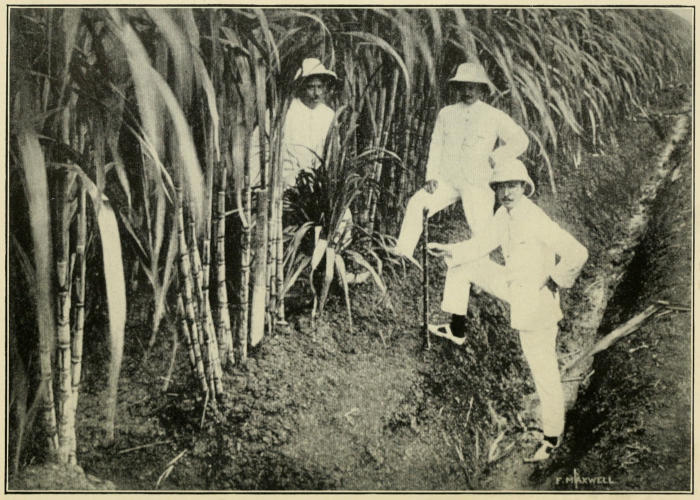
SUGAR CANE AFFECTED BY THE SEREH, JAVA
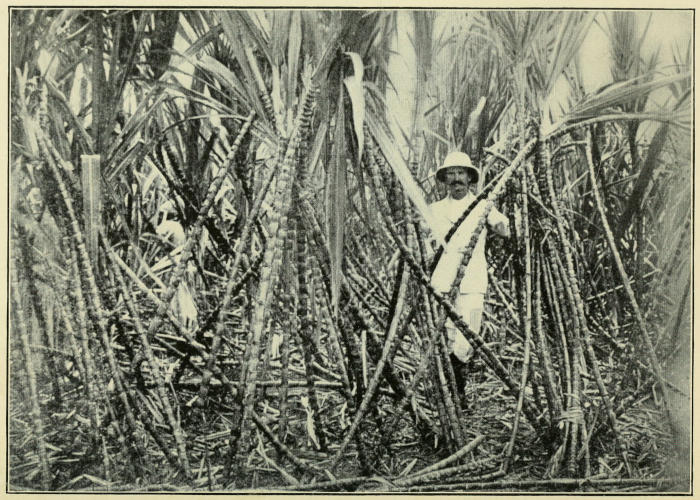
SEEDLING CANES, JAVA
Before the outbreak of the sereh, seed for new plantations was obtained exclusively from tops of ripe cane, but when the disease became prevalent, it was found that cuttings taken from sereh-infected cane gave diseased yields, while cuttings from cane grown in districts not affected by the sereh produced cane that did not suffer so greatly from the disease. At the beginning of the trouble, cuttings from outside healthy districts were used, but as the disease spread, the demand for sound cuttings increased while the sources of supply became fewer. Finally, plantations were established in remote districts free from disease and they were carefully quarantined. Here seedlings were grown from young cane cut at full length, and in this way sound seed was obtainable at all times. Formerly, seed was only to be had in the grinding season, which frequently occasioned delays in planting. The new plan not only enabled the cane growers to stamp out the sereh, but even after the disease had been practically eradicated it was continued because of its manifest advantages.
Seedlings used for planting are cut into lengths, each having three eyes. Unhealthy stalks and any showing the presence of insect pests or fungi are culled, while the sound pieces are carefully disinfected. The seed thus prepared is placed horizontally in the furrows end-to-end and covered with earth. At first water is applied at four- or five-day intervals, afterward less frequently, until the cane has attained a considerable height. About this time the rainy monsoon sets in and further irrigation is not needed. The stalks are banked several times during the early period of growth and fertilizing accompanies the second and third banking. Until comparatively recently the fertilizer consisted of nitrogenous substances, while potash and phosphoric acid were considered of no value. The first investigations concerning fertilizers were made on rich lands that had been irrigated with river water when the wet rice crop was being grown, and the water brought with it sufficient potash and phosphates for the needs of the cane. In such cases it was shown that adding these substances to the soil was unnecessary and that nitrogen was the only element that could increase the yield of cane. Hence groundnut cakes and sulphate of ammonia were used almost entirely. It has been proved, however, by more thorough study that much ground is low in phosphates, and this fertilizer has been added with excellent results. As regards potash, the soil of Java seems to contain sufficient for cane cultivation.
When the cane leaves become sufficiently thick to shade the ground the weeds die. Borers, beetle larvae and termites are caught during the early growing period, but all labor stops with the last banking and the advent of the wet monsoon. When the wet season is over, the cane is trashed and samples of the growing cane are taken from the fields and tested in the laboratory of the factory to determine the degree of ripeness. As soon as the roads become dry enough to admit of cane-laden carts passing over them, the harvesting of the ripest cane begins. The cane is dug up by the roots, care being taken to leave as little as possible of the roots in the ground. The roots and the earth adhering to them are removed, together with the leaves and tops, and the clean cane is loaded on cars to be taken to the mill.
Formerly carts drawn by oxen and buffaloes were used to transport the cane to the factory, but the crop has grown to such proportions that cattle-drawn carts have had to give way to the rail. Today nearly every plantation has its own railroad with permanent and portable tracks, over which the cane moves in cars hauled by cattle or locomotives.
Having been unloaded at the mill, the cane is taken to the crushers on carriers. Three sets of rolls are generally used and water is sprayed on the cane before the last crushing, after which the bagasse is fed to the furnaces as fuel. The juice is strained to free it from fragments of cane and leaves, then milk of lime is added and heat applied. The heavy impurities settle at the bottom, the clear juice is drawn off and the remaining juice is separated from the foreign matter in the filter presses. Another method is to treat the juice at a low temperature with a large admixture of milk of lime, and afterward with carbonic acid or sulphurous acid until all the lime is neutralized. Then all the juice is clarified by filtration without the settling operation. Next follow evaporation, refiltering, boiling to grain and separation of the crystals from the mother liquor in centrifugal machines.
In 1903 the Java manufacturers began to make a bid for the British Indian trade. After some experimenting they succeeded in producing an almost-white raw sugar, which at once found favor in India, where sugar refined by the bone-char process was objected to for religious reasons. Statistics compiled for the year 1912 show that this so-called “Java white” represented 39.2 per cent of the entire output; 26.2 per cent was muscavado, 29.9 per cent European assortment and 4.7 per cent second sugars.
Java, with her population of more than thirty millions, presents altogether different conditions to the sugar grower than other cane-producing countries. A large proportion of the agricultural area is needed for crops of food to nourish the inhabitants. The land available for sugar cane is rented at an equitable figure and, as has been said, there is always an ample supply of cheap and readily obtainable labor. The aim of the Javan planter is to produce cane carrying a high sugar content and to get as great a yield as possible. To this end, unceasing attention is paid to cultivation, fertilizing and the general well-being of the crop; in other words, the soil is worked for all there is in it.
While the scientists of the country are absorbed in the task of producing through cross-culture new species of cane that will give a heavier yield per acre with a higher sugar content and greater purity, the agriculturists are opening up extensive fresh tracts of rice and cane land. New irrigation projects play an important part in this development and everything points to a steady growth of the industry.
The following table shows the annual output since 1840 in tons of 2240 pounds:
1840 46,296
1841 45,176
1842 50,320
1843 55,544
1844 62,419
1845 89,526
1846 86,263
1847 81,431
1848 88,512
1849 103,445
1850 85,153
1851 118,443
1852 74,806
1853 109,961
1854 110,323
1855 102,321
1856 123,124
1857 104,479
1858 130,725
1859 131,571
1860 134,001
1861 134,726
1862 142,755
1863 129,716
1864 138,009
1865 135,714
1866 140,042
1867 130,947
1868 175,960
1869 179,579
1870 150,184
1871 187,851
1872 205,992
1873 195,924
1874 198,318
1875 190,576
1876 234,111
1877 241,930
1878 221,140
1879 229,616
1880 212,763
1881 274,796
1882 287,392
1883 319,574
1884 388,019
1885 374,041
1886 350,397
1887 369,847
1888 349,719
1889 327,735
1890 393,680
1891 400,372
1892 415,332
1893 472,082
1894 522,574
1895 572,381
1896 525,947
1897 577,036
1898 713,575
1899 750,400
1900 732,498
1901 791,046
1902 882,966
1903 929,880
1904 1,038,373
1905 1,022,759
1906 1,050,926
1907 1,191,007
1908 1,222,262
1909 1,227,553
1910 1,258,222
1911 1,443,397
1912 1,331,180
1913 1,345,230
1914 1,303,045
1915 1,264,000
1916 1,500,000 [87]
AUSTRALIA
The island-continent of Australia lies south of Asia, between the Indian and Pacific oceans, and it extends from 10 degrees 41 minutes to 39 degrees 8 minutes south latitude and from 113 degrees to 153 degrees 30 minutes east longitude. Its area is 2,974,581 square miles and the population, not including aborigines, is 4,455,005, mainly of British origin.
Dutch and Spanish explorers visited Australia in 1606. On April 19, 1770, its eastern coast was first sighted by Cook, who, nine days later, dropped anchor in Botany bay. Sailing north, he touched at several points, and after having completed a survey of the east coast, he took possession of the territory between 38 degrees south and 10 degrees 30 minutes south. He reached Australia again in 1772 and in 1777 he landed on the coasts of Tasmania and New Zealand. The first settlement was established at Port Jackson in 1788 and gold was discovered in 1851. The commonwealth of Australia comprises the following political divisions: Victoria, New South Wales, Queensland, South Australia, Northern Territory, Western Australia and Tasmania.
As over 90 per cent of Australia’s sugar crop comes from Queensland, this article will deal with the growth and condition of the industry in that state only. Queensland has an area of 668,497 square miles, of which 920,010 acres were under cultivation in 1913; of this, 147,743 acres were planted with sugar cane.
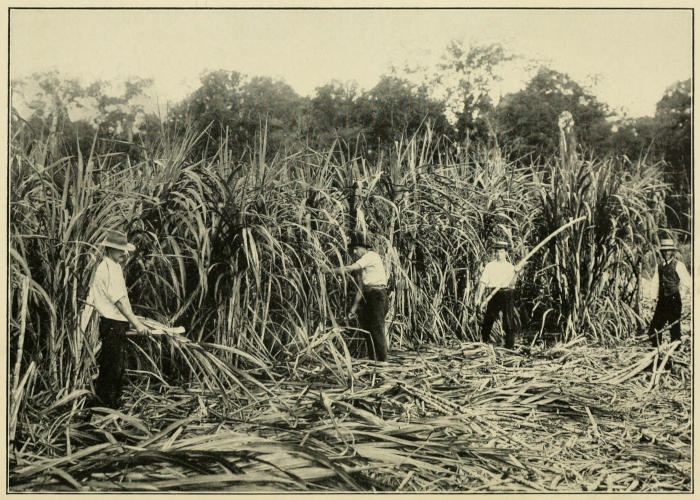
CUTTING CANE, MAROOCHY RIVER, SOUTH QUEENSLAND
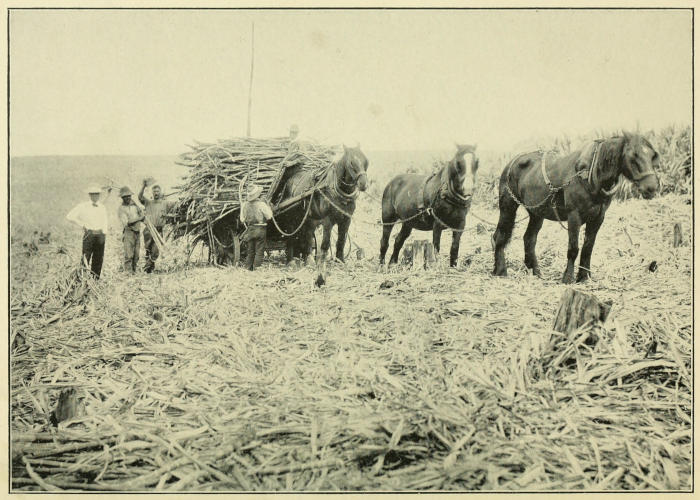
CARTING CANE TO MILL, INGHAM DISTRICT, NORTH QUEENSLAND
About one-half of Queensland lies in the tropics and the remaining area stretches southward to the twenty-ninth parallel. The temperature is affected in a marked degree by the breezes that blow steadily from the sea and moderate what otherwise would be excessive heat. It is warmer along the coast than in the uplands of the interior, and in the northern part the heat is very trying to people who have come from temperate climes. At Rockhampton the winter temperature averages 65 degrees Fahrenheit, and in summer the mean is nearly 85 degrees. The annual rainfall on the seacoast is large, particularly in the north, where it ranges between 60 and 70 inches. At Brisbane it is about 47 inches, while a large part of the interior receives from 20 to 30 inches, but it falls below 20 inches in the west and south. There are no active volcanoes in Australia and no violent earthquakes have occurred in recent years.
The sugar plantations of Queensland are found in a strip of territory running along the eastern coast between the sixteenth parallel and the southern border. This stretch of land has been divided into three districts, the southern, the central and the northern, the last being the most important, as it furnishes over 60 per cent of the total sugar production of the state.
The cane lands are of two kinds—scrub land and forest land. The scrub lands may be divided into two classes, true scrub and bastard scrub, the former being characterized by a dense, almost impenetrable vine growth and timber of soft wood. In the bastard scrub there are both hard and soft woods, the former predominating, and very little vine growth is met with. The soil of true scrub lands is of two kinds, alluvial and volcanic. The alluvial soil is composed of clay, fine sand, gravel and vegetable and mineral matter brought from the high levels by water action. The soil of forest lands is diversified and, for sugar-cane culture, “blady grassed” bloodwood country with a porous subsoil is selected. Here the yield of cane per acre is not so heavy as on scrub lands, but the sugar content of the juice is greater.
The growth of sugar cane and the manufacture of sugar in Australia date back to 1823, but no substantial progress was made for a number of years. The first cane to be raised in Queensland was grown in the botanic gardens in Brisbane in 1847 and sugar was first manufactured in that state in 1862. The following year Captain Louis Hope had twenty acres in cane on a plantation near Brisbane and to him is due the credit of establishing the sugar industry in Queensland. In 1867 there were nearly 2000 acres in cane and six mills in operation, while the next year saw 5000 acres planted, with twenty-eight mills at work. The industry grew and throve until 1875, when the cane crop was almost completely destroyed by a disease known as “rust,” which was really due to imperfect cultivation, lack of proper drainage and the soft variety of the cane. As over 60 per cent of the estates were being operated with borrowed capital, the planters found themselves in serious financial trouble and many mortgages were foreclosed. Up to this time Bourbon cane was the variety generally grown, and when the disease wrought such havoc with the crop, it was noticed that the Rappoe cane did not suffer from rust. The hardiness of this variety encouraged the growers to substitute it and other sturdy species of cane for the Bourbon. The change proved entirely successful and the planters enjoyed good times once more.
The sugar industry of Queensland was carried on at the outset under the plantation system, that is to say, the planter, besides growing the cane, owned the mill and manufactured the sugar. This method worked very well until 1884, when a period of extreme depression came in the wake of the great boom that began in 1879. In 1885 the industry appeared to be in danger of extinction, and, as a remedial measure, the legislative assembly voted £50,000 for the establishing of central factories. Two mills were operated on the new plan as an experiment with such marked success that an act was passed in 1893 to foster the development of the central-factory system. The act enabled a number of planters to form a co-operative company for the purpose of building and equipping a central mill. The necessary funds were obtained from the government, the cane lands being pledged as security for the loan, and the mills erected by this means became the property of the companies upon the payment of the loan. The large estates were gradually cut up into tracts of from fifty to one hundred acres each and were leased or sold on reasonable terms; in this way the land was settled by a large number of farmers.
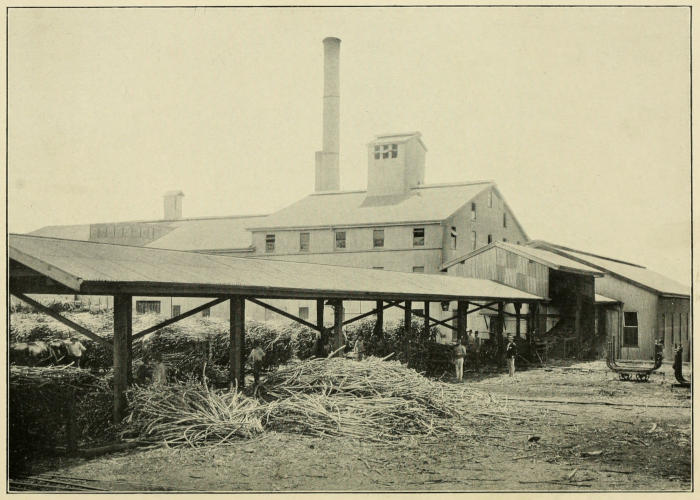
ISIS CENTRAL MILL, CHILDERS, SOUTH QUEENSLAND
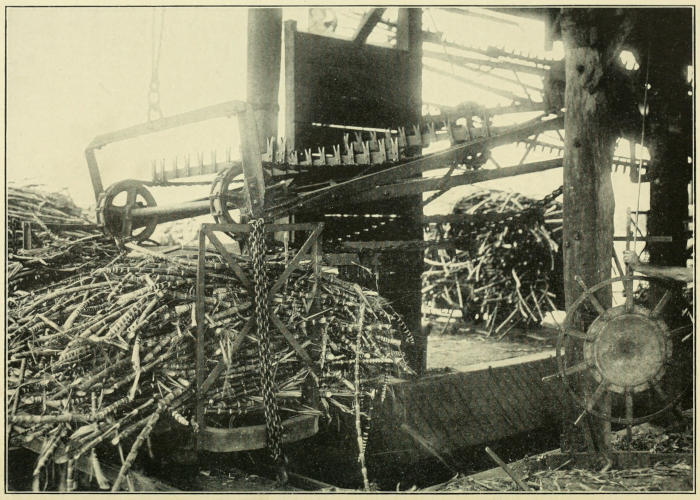
CANE UNLOADER, MULGRAVE CENTRAL SUGAR MILL, CAIRNS DISTRICT, NORTH QUEENSLAND
Nevertheless, there was grave danger that the benefit accomplished by this new law would be more than offset by the “white labor” agitation. As is well known, the labor party is very strong in Australia, and probably no other branch of agriculture in that country has been so beset with labor troubles as the sugar industry. For nearly thirty years the supply of laborers for the cane fields was drawn from the South Sea islands and India, principally the former. The white laborers were loud and insistent in their protests against the employment of Kanakas, as the islanders were called, and finally, after the formation of the commonwealth in 1900, an act excluding colored labor entirely and providing for the deportation of the Kanakas to their homes was passed by the federal government. To afford the planter relief for the hardship worked upon him by this measure by reason of the high wages they had to pay in order to secure white laborers, a duty was placed upon foreign sugar. A bounty upon sugar produced by white labor was also provided for, but this, together with the excise tax on sugar, was abolished in 1913. Today the industry is protected by a customs tariff of one and three-tenth cents per pound.
When cane is to be planted in new ground, the scrub, stumps and logs are first cleared away and the field is then ready for the seed. Holes are made with a mattock at regular intervals, the seed cane is placed therein, covered with earth and left to grow. The ground is hoed from time to time to keep the weeds under control, but the young cane does not require much attention after the first five or six months. On cleared land, ploughing is done two, three or four times, after which the surface is harrowed, rolled and planted. Three or four weedings are necessary during the growth of the crop.
From Mackay northward planting is done between February and October, but in certain low-lying districts in the north May, June and July are not considered good months for planting on account of the possibility of frosts. The cane ripens in from twelve to eighteen months. In the region south of the tropic line, planting is done early, although much cane is set out in August and September. The cane when cut is transported to the mills by narrow-gauge railroads, some of these lines being portable. In the north crushing begins in June and ends in December, while in the south the greater part of it is done from August to December. From two to four crops of ratoons are raised, but usually not more than three, the land lying fallow for one season. Fertilizing is not generally practiced, although some growers make use of legumes or dry manures as enrichers. The former consist of the Mauritius bean, the cow-pea and vetches, which are ploughed into the land after they have attained a certain growth.
Under ordinary conditions the rainfall is so evenly distributed in the sugar-growing districts that irrigation is not needed. Still, there are places where it has been found necessary to irrigate freely, owing to the amount of rain being insufficient for the crop needs. In such cases, wherever practicable, water is obtained by damming rivers and streams and is distributed over the cane fields through ditches by gravity. Where, however, the topography of the country does not admit of this being done, pumping is resorted to and large stations have been established for this purpose. The yield of sugar per acre since 1894 has been 1.688 tons and the amount of sugar extracted since 1904 averaged 10.95 per cent of the weight of the cane.
The federal government maintains an experiment station at Mackay and experiment farms have been laid out in the important sugar centers. The value of the work done at this station cannot be too highly estimated. The scientists in charge are constantly on the lookout for new varieties of cane and are on the alert to fight diseases and pests. The chief enemies of the cane in Queensland are cane grub, fungus pest, frosts and floods.
Today Queensland has forty-eight sugar mills and two refineries. Thirteen of the mills are centrals and four of these are under state control. Additional factories are under construction.
Most of these plants are equipped with three sets of rollers and modern machinery, the capacity ranging from 70 to 960 tons of cane per day.
The annual production of sugar in Queensland since 1894 in long tons has been as follows:
1894-95 91,712
1895-96 86,255
1896-97 109,774
1897-98 97,916
1898-99 163,734
1899-00 123,289
1900-01 92,554
1901-02 120,858
1902-03 77,835
1903-04 89,862
1904-05 145,020
1905-06 152,259
1906-07 182,188
1907-08 185,063
1908-09 150,400
1909-10 132,816
1910-11 207,340
1911-12 176,076
1912-13 113,060
1913-14 255,000
1914-15 246,408
1915-16 150,000
1916-17 200,000 [88]
MAURITIUS
Great Britain’s island colony, Mauritius, lies in the Indian ocean between 57 degrees 18 minutes east and 57 degrees 49 minutes east, and 19 degrees 58 minutes and 20 degrees 32 minutes south, 550 miles from Madagascar. Irregular in shape, it extends 36 miles from north-northeast to south-southwest, and its greatest width is 23 miles. Its area is 710 square miles.
Mauritius is of volcanic origin, although signs of volcanic activity no longer exist. It is encircled by a coral reef which is submerged at high tide. The central part of the island is a tableland that rises from 500 to 2700 feet above sea-level and occupies more than half of the total surface. In the north and northeastern coast regions there are extensive low plains, but the rest of the coast territory is more or less broken by hills. The registrar-general’s report for 1908 gives the population as 374,450.
The climate is agreeable during the cool season, but oppressively hot in summer, which begins in December and ends in March. The temperature falls from April to June and rises again from June to December. In the elevated inland plains of the interior the thermometer ranges from 70 to 80 degrees Fahrenheit in summer, and in Port Louis and the coast region it runs from 90 to 96 degrees during that season. The average temperature at Port Louis is 78.6 degrees Fahrenheit throughout the year.
The rainfall varies greatly in different parts, but an average of ten years (1893-1902) gave 79 inches for the entire island. Cyclones are frequent and generally occur between December and April.
The soil consists chiefly of a very light clay formation, easily penetrated by water. In some localities the clay is deep and evenly deposited, while in others many large pieces of lava are found in it, so that ploughing is impossible.
Mauritius was discovered by the Portuguese in 1505. From 1598 to 1710 it was in the hands of the Dutch, and in 1715 it was taken by France, from whom it was wrested by the British in 1810.
The Dutch brought sugar cane from Java to Mauritius in 1650, but their efforts at cultivation were not successful.
When in 1741 de la Bourdonnais was appointed administrator of Mauritius, or, as it was then called, l’Ile de France, it was a crown colony under the control of the French East India company. The island was without agriculture or commerce and the inhabitants were sunk in indolence. The genius of the new executive brought order out of chaos, and his example and assistance aroused the people from their lethargy. Sugar cane was again imported in 1747 and in 1750 a sugar estate was established at Pamplemousses in the northern part of the island by de la Villebague, the governor’s brother. The industry expanded and was carried on with profit.
In 1769 an experiment station was established with a view to furnishing planters with the knowledge of which they were so sorely in need. Agricultural development, however, was not carried forward to any great extent while Mauritius remained under French rule. State interference with the planters had an unfortunate effect, and besides this the greater number of the inhabitants looked upon the colony not as a permanent home, but as a means to acquire sufficient money to enable them to return to France and live there in comfort. The authorities deemed it essential that the colony should produce the greater part of its foodstuffs, while the planter on his side was anxious to grow crops that he believed would give him the best results in money; for example, sugar, cotton, coffee, indigo and spices.
In 1776 there were three small sugar factories on the island, and in 1789 the production of sugar was 300 tons. Disaster overtook the industry, owing to conditions that made the cost of the mills abnormally great and the extravagance with which they were operated. In consequence many of those who built factories were ruined.
Shortly after the British occupation there was a change for the better. In 1816 the production of sugar was 4430 tons, and from that time forward the industry made continuous and steady progress. The planters were encouraged and, as far as could be, helped in their operations, while the policy of the government developed the colony’s resources and established for it trade relations on a firm basis with other countries.
The method of extraction of sugar from the cane employed at the beginning of the last century was primitive indeed. The apparatus consisted of a solid, heavy table made of thick planks carefully finished and having a perfectly smooth top. It was made in the shape of a parallelogram, with a groove or gutter on each of its four sides and an opening in the middle of each end gutter. Upon this table was a huge, heavy cylinder of hard wood, slightly longer than the width of the table. Three, four, or five stalks of cane were placed lengthwise on the table and submitted to pressure by rolling the cylinder over them from one end to the other and back again. The juice thus expressed from the cane ran into the gutters at the sides and ends and through the holes into two tubs placed to receive it. The cane stalks were then removed, put in the sun to dry and afterward used as fuel in the boiling of the sugar juice. This operation was repeated until a sufficient quantity of juice was obtained.
From the tubs, or “bacs,” the juice was run through a series of kettles, or open-fire caldrons, for concentration. The kettle next in position to the bac into which the juice from the table fell was called la grande, because it was really the largest of the set. It was farthest from the fire and served as a defecator. As soon as the juice contained in it became heated, a thick, creamy substance formed on the surface and was immediately skimmed off. The liquor was then ladled into the second kettle, where the boiling became more lively on account of closer proximity to the furnace. The juice bubbled up in foam and at this point the cleansing process began. A long, flat piece of wood was passed slowly over the surface of the liquor, thus removing certain impurities. Here the mixture of lime begun in la grande was continued until the liquor was found to be perfectly clear.
Passing to the third kettle, the liquor was reduced to syrup by the increased heat. It was concentrated in the fourth and boiled to grain in the fifth. Directly under the fifth and last kettle of the set was the furnace, which was fed by bagasse and cane trash.
The boiling process finished, the sugar was removed from kettle number five and placed on tables, where it remained until it had to be taken to larger tables farther on to make room for a fresh batch. There it stood with other boilings until the following morning. Then the crystallized mass was shoveled into pots and carried to large bins constructed so that the liquor, or syrup, could drain off. This usually took from fifteen to twenty days, after which time the sugar was dug out by pick and shovel, put into baskets and taken to be spread out in the sun to dry. After two to three hours of this drying, according to the intensity of the sun’s rays, the sugar was packed in a double sack containing about 135 pounds.
By such means little more than one-third of the sugar in the cane could have been recovered, and the product obtained was heavy and dark in color.
From 1816 to 1845 a change was gradually made from the clumsy apparatus just described to three-roller vertical mills, and from wind- and water-driven mills to steam power, thus increasing the extraction. No perceptible improvement was effected in field methods during this period.
In 1852 a number of vacuum pans and centrifugal machines were in use. Some eight or ten years later the efforts made to combat the diseases of the cane began to bear fruit and the planters of the coast and inland estates started to exchange cane tops.
During the period of 1866 to 1875 single crushing was almost universal. A few factories used double crushing with maceration, but the mills were not powerful. Marked progress was made in the chemical treatment of the juice. Shortly afterward the planters began to appreciate the vital importance of chemical control in their factories and scientific principles were applied to the culture of the cane.
Up to 1835 the labor in the fields had been done by African negro slaves. The emancipation of these slaves was declared on February 1st of that year, and their final liberation took place in March, 1839. In anticipation of this, the authorities had arranged five years previously for the bringing in of a number of immigrants from India, and from that time down to the present virtually all the labor required in the cane fields has been drawn from India. In 1834 the immigrants from India numbered 75 and in 1908 the Hindu population was 263,419.
One of the most important events in connection with the growth of the sugar industry of Mauritius was the formation of the Chamber of Agriculture in 1853. This body fostered mutual co-operation and interchange of ideas among the planters. It exercised its influence in bringing about legislation affecting agricultural and industrial questions and the development of the resources of the colony. The Station Agronomique, instituted in 1893, and the Bacteriological Station in 1908, came into being as a result of the efforts of the Chamber of Agriculture, to which credit is also due for the extension of the cane-raising area to its present proportions.
During the last hundred years the island of Mauritius has suffered from a series of disasters—epidemics of cholera, smallpox and bubonic plague, hurricanes and droughts.
In 1892 a hurricane of extraordinary violence sowed frightful devastation, destroying cane, wrecking houses and killing numbers of people. Ten years later nearly all the draft animals were carried off by surra, a deadly cattle disease, which made its appearance just as the largest crop on record was about to be harvested. In addition to the direct loss of horses, mules and cattle, the difficulties of transportation delayed the work of gathering and crushing the cane long after its maximum richness had been reached. The yield for the 1903 crop was thus appreciably reduced, and the growing period for the crop of the following year greatly curtailed. The shortage in 1903 has been placed at 11,000 tons, while that for 1904 amounted to 23,000 tons. These losses caused such distress that it became necessary to invoke state aid, which was provided by the Mechanical Transport loan of 1903.
All agricultural centers are subject to crises more or less serious in character, and, as has just been shown, Mauritius is no exception to the rule. Depressions resulting from crop shortages, however, should not be confounded with the general troubles that have seriously menaced the cane-sugar industry during the last half century, almost all of which are attributable to the competition of the beet. Over sixty years ago the Mauritian planters began to feel apprehensive concerning the future of their sugar trade, owing to the rivalry of beet-root sugars in the markets of Europe, and between 1870 and 1880 the prospects were indeed gloomy. What chance had the cane-sugar-growing dependencies of Great Britain against bounty-fed beet sugars raised on the continent? If the increased production had taken place in the cane industry, the disturbance in trade conditions would have been gradually overcome by a process of natural adjustment. But unfortunately for the cane planters, the enormous extension of sugar-raising possibilities by new means in territory not hitherto available found them totally unprepared to cope successfully with this new competition.
In 1885 the Chamber of Agriculture instituted an inquiry into the causes that had brought the cane trade to such a critical state. The attention of the planters was called to the improved methods employed by the beet-sugar manufacturers and to the rapidity with which their trade was expanding. The cane growers were earnestly urged to take steps to meet the conditions that confronted them. Manifestly the cost in field and factory was too high. The task of working out the problem took considerable time and involved the outlay of vast sums of money. It was all the more difficult because of the necessity for finding new capital in the face of decreasing revenue, but it was undertaken with courage and perseverance, and the results have justified the efforts put forth and the sacrifices made.
The growers of sugar cane in Mauritius have adjusted themselves to the new conditions. They have reduced plantation and manufacturing costs, and scientific methods have enabled them to grow cane profitably on land which could not possibly have been cultivated in the old way without severe loss. Crude processes have given way to the modern sugar factory with its up-to-date roller mills, clarifiers, triple effects, vacuum pans and centrifugal machines, and the chemical engineer has changed the dark mixture of crystals and molasses into an almost pure white granulated sugar.
The crop for the season of 1915-16 amounted to 215,528 tons.
A great deal in the way of improvement in cultivation still remains to be done, but it may be truly said that the island has fought its way into the front ranks of sugar-producing countries. With its natural advantages of climate and soil, the enormous possibilities of irrigation and development of water power, the accessibility of an unlimited supply of Asiatic labor, and the markets of India, Africa and Australia at its doors, there is ample justification of high hopes for the future.
Yearly output of sugar, exclusive of local consumption, since 1895:
1895 143,000 tons
1896 153,000 ”
1897 124,000 ”
1898 183,000 ”
1899 161,000 ”
1900 190,000 ”
1901 155,000 ”
1902 142,000 ”
1903 218,000 ”
1904 142,101 ”
1905 188,364 ”
1906 220,000 ”
1907 170,000 ”
1908 205,758 ”
1909 244,597 ”
1910 226,099 ”
1911 164,260 ”
1912 206,497 ”
1913 249,800 ”
1914 277,164 ”
1915 215,528 ”
1916 220,000 ” [89]
NATAL
On Christmas day, 1497, Vasco da Gama, then on a voyage to India, sighted the entrance to what is now Durban harbor, and named the country Terra Natalis.
This maritime province of the British Union of South Africa lies approximately between 27 degrees and 31 degrees south latitude and 29 degrees and 33 degrees east longitude. On the southeast it is bounded by the Indian ocean, on the southwest by the Cape province and Basutoland, on the northwest by the Orange Free State and on the north and northeast by the Transvaal and Portuguese East Africa. Its coast line is 376 miles long and its area is 35,371 square miles. It is divided into two parts, Natal proper and Zululand, the former comprising 24,910 square miles and the latter 10,461 square miles. In 1908 the population, including that of Zululand, was 1,206,386, of whom 91,443 were European, 998,264 natives and 116,679 Asiatics.
The surface of the country is of terrace formation. The coast strip south of Durban is quite narrow, but north of that point it becomes wider and more level. Ranges of hills roll back to the first plateau, which is about 2000 feet above the sea. The second plateau rises sharply between 4000 and 5000 feet and extends to the Drakensberg mountains, whose base is from 6000 to 7000 feet in elevation, and in which all the rivers of Natal, except the coast streams, have their source.
Natal’s sugar plantations are situated in the low, moist regions of the coast zone, between 28 degrees and 30 degrees south latitude, i. e., quite a distance below the tropic of Capricorn. The industry had its beginning in 1850, when the first cane was brought from Mauritius. Operations did not amount to much at the outset; a limited amount of cane was ground in small mills and the juice was boiled into sugar. In 1878, however, a factory with the newest equipment of that time was erected at Mount Edgecombe by Mauritius people. Henceforward, the production of sugar in the colony has shown a steady growth, and today there are thirty-four factories in active operation with an output of about 100,000 tons of sugar per annum.
The climate of the valleys and the coast belt is hot and humid. Summer, beginning in October and ending in March, is the wet season, while May, June and July are the driest months. At Durban the temperature ranges from 42 degrees Fahrenheit in winter to 98 degrees Fahrenheit in summer, the mean being 70 degrees, and both the temperature and the humidity are affected by the Mozambique current that flows southward from the equator. The annual rainfall at Durban is about 40 inches and the average for the province is placed at 30 inches.
The kind of cane most generally grown in Natal at the present time is the Uba, a hard, yellow variety that was brought from Hindustan. For fertilization, stable manure, cane ash and phosphates are employed. Owing to the geographical position of the country, it takes longer than usual for the cane to ripen. Plant cane matures in two years and first and second ratoons in eighteen months for each crop. So five years’ time is necessary to produce three crops, and at the end of this period replanting is done. After the cane is cut, it is loaded on railway cars for transportation to the mill. All of the raw sugar produced in Natal is refined there, except what is consumed in a raw state. In addition to the sugar made in the province, quite a little is imported from foreign countries, as Natal distributes a good deal of the commodity in adjoining states. The home industry is protected by a duty of $1.215 per 112 pounds on foreign sugar, while no duty is assessed on sugar going from one province to another throughout the British Union of South Africa.
Formerly the most desirable laborers came from India, but recently the Indian government has stopped the exportation of natives of that country as plantation laborers, so Natal, like many other sugar-growing sections, has its labor problems.
The production in long tons since 1894 has been as follows:
1894 19,369
1895 20,508
1896 20,651
1897 20,245
1898 29,186
1899 Boer war
1900 16,689
1901 36,662
1902 21,095
1903 33,944
1904 19,238
1905 26,158
1906 21,479
1907 24,223
1908 31,999
1909 77,491
1910 84,437
1911 92,000
1912 82,589
1913 85,714
1914 91,619
1915 100,000
1916 125,000 [90]
EGYPT
Egypt, the northeastern corner of the African continent, is bounded on the north by the Mediterranean sea, on the northeast by Palestine, on the east by the Red sea and on the west by Tripoli and the Sahara. The 22nd parallel of north latitude is the dividing line between it and the Sudan on the south. Its area is about 400,000 square miles, of which by far the greater part is desert; it has been truly said that the principal features of Egypt are the desert and the Nile.
In 1907 the entire population was 11,189,978, exclusive of nomadic Bedouin tribes, who numbered about 97,000. Of these 10,366,046 were Egyptians, 735,012 settled Bedouins, 65,162 Nubians and 221,139 foreigners—British, Italians, Turks and Greeks.
The wonderful fertility of the soil of the valley of the Nile is due to the annual inundation caused by the melting of the snows and the spring rains in the region in which the Blue Nile has its source. The turbulent waters of the swollen stream rush down the Nubian valley laden with rich loam from the mountains of Abyssinia, and this is deposited upon the flat plains on either side when the river overflows its banks. The period of high water begins in June and lasts until the end of September.
The rainfall is slight and there are years when there is none whatever. Crops, therefore, depend upon irrigation, and powerful pumping plants supply the needs of the large estates, while the small native holdings depend upon water-wheels worked by buffaloes or by the natives themselves. The irrigation possibilities of the country were greatly extended by the huge dam constructed by the government at Assuan in 1902. In the cane-raising country, the average temperature in summer ranges between 82 degrees and 110 degrees Fahrenheit, and between 50 degrees and 86 degrees in winter. Cool nights are the rule and occasionally there is a killing frost.
Sugar was introduced in Egypt by the Moslems when they conquered the country, 640-646 A. D., and the Egyptians were quick to apply their knowledge of chemistry to its preparation. By remelting the first crystals, then treating the liquor with lime and albumen, removing the suspended impurities by filtration, boiling to grain once more and purging the crystals of their syrup by washing, they succeeded in making a sugar far superior to that produced elsewhere. The cultivation of cane prospered and the excellence of the sugar manufactured in Egypt was maintained throughout the Middle Ages, until the conquest by the Turks in 1517. Ottoman dominion ruined Egypt industrially. A little sugar cane continued to be raised and some sugar was made, but on so unimportant a scale as to be hardly deserving of mention. This state of affairs lasted until 1850, when Ismail Pasha (afterward khedive, 1863-79,) caused sugar cane to be brought from Jamaica and five years later the government took steps to foster sugar manufacture. In 1877 a change came about, through which the control of the factories passed from the hands of the khedive to a government committee, under whose auspices several new mills were constructed. In 1896 the output of sugar reached 75,000 tons. The factories operated by the government body were sold in 1903 to a French corporation, known as the “Société Générale des Sucreries d’Egypte,” which some years previous had built three factories of its own. By this purchase the French company practically obtained a monopoly of the sugar business of the country. The financial crisis of 1905 proved a setback, but after the trouble arising from this had passed, the company formulated plans for enlarging its plantations and grinding an increased amount of cane.
Sugar cane is grown along the Nile banks from a short distance above Cairo up to Assuan, or between 24 degrees and 30 degrees north latitude, a stretch of more than four hundred miles. In width, however, this territory is confined to the valley of the Nile, which is only twelve miles wide at the extreme and narrowing to very much less. The agricultural possibilities of the eastern or right bank are not so great as those of the left, owing to the fact that it is mountainous in many places. Consequently most of the cane and all of the sugar factories are to be found on the left (western) bank.
Ploughing is done in autumn and the ground is further prepared during the following February; the furrows are then made; shortly afterward the cane is planted, covered with earth and the water is turned in. Irrigation is kept up until the end of October, when it is discontinued for two or three weeks to allow the cane to ripen. Harvesting begins in December and lasts until April. The cane when cut is transported by camels to the railway and thence to the mill. The customary procedure is to raise one crop of plant cane, one crop of ratoons and one crop of cotton or beans in succession, allowing the land to lie fallow the fourth year, and so on every four years.
The yield of cane per acre depends upon the soil, the adequacy of the water supply and the temperature ruling during the period of growth; the average from plant cane is twenty-four tons and from ratoons sixteen tons.
The factories depend upon cane furnished by the growers, either large plantation owners or small farmers who cultivate a few acres of rented land, and one of the serious problems which they have to face is the difficulty of obtaining an adequate supply. The capacity of the factories is large, the machinery is modern and they could easily take care of a much larger cane tonnage than they have been able to secure. An improvement is looked for as a result of more liberal terms recently offered to growers. The bulk of the output is raw centrifugal sugar, famous under the name of “Egyptian crystals,” and much sought after for flavoring chewing tobacco. The vineyardists of the Champagne district in France get from Egypt the sugar used in making their sparkling wines, as they hold that cane sugar is the only kind that will not hurt the flavor of the champagne.
According to Willett & Gray the yearly crops in long tons since 1903 were:
1903-04 60,000
1904-05 60,000
1905-06 65,000
1906-07 42,195
1907-08 55,648
1908-09 34,835
1909-10 52,525
1910-11 49,394
1911-12 57,879
1912-13 75,420
1913-14 69,368
1914-15 75,738
1915-16 110,000 [91]
SPAIN
Spain lies in the extreme southwest of Europe and it embraces about eleven-thirteenths of the Iberian peninsula. Its total area is 194,700 square miles, and in 1914 the population numbered 19,712,585.
It is said that Phoenician traders reached there as early as the eleventh century before the Christian era. In 238 B. C., or three years after the close of the first Punic war, Hamilcar Barca, the famous Carthaginian general, crossed from Africa into Spain, taking with him his son-in-law, Hasdrubal, and his son Hannibal, both of whom were destined to play great parts in the coming struggle between Carthage and Rome. From a few trading posts, Hamilcar extended the Carthaginian dominion in Spain to that of a great province, that not only proved a source of immense revenue, but that also furnished a never-failing supply of warlike troops for the armies of Carthage. The second Punic war ended the sway of the Carthaginians in Spain, and from 201 B. C. until 406 A. D. the country was under Roman rule. Then came the barbarian invasion and the Visigothic kings, whose power was shattered in turn when the Berber Tarik defeated King Roderic in 711. For centuries afterward the struggle of reconquest went on until Granada, the only remaining Mohammedan stronghold, surrendered to Ferdinand and Isabella on January 2, 1492. That same year, under the auspices of these sovereigns, Columbus set out on his first journey westward, and with his discovery of America came a revolution in the sugar industry of the world.
Spain is the only cane-sugar-producing country in Europe. Sugar cane was brought there by the Arabs when they conquered Granada, and its cultivation had assumed important proportions in that kingdom at the time of the expulsion of the Moors. The introduction of the plant in America had a serious effect upon sugar production in Spain and other countries of the Old world, and over three hundred years later the Spanish growers of cane had to meet the competition of the beet sugar of central Europe. Finally the loss of her colonies in 1898 stimulated the industry in the mother country by relieving the Spanish planter from protected competition in his home market. In 1903 Spain had fifty beet-sugar factories, thirty-two cane-sugar mills, fifteen syrup mills, eleven refineries and two factories that turned out sorghum sugar and glucose. Shortly afterward, however, prices in Spain dropped below the cost of production, so that a period of profit was followed by a period of heavy loss. As a result of this state of affairs, the Sociedad General Azucarera de España was formed. This organization comprised forty-three beet factories, thirteen cane factories and thirteen other mills, and its object was to limit the number of mills in operation and to introduce greater efficiency into cultivation methods. The plan did not prove successful, and finally, after lengthy discussions between the Sociedad General, the independent producers and the government, it was decided to fix the excise tax on sugar at thirty-five pesetas per 220.4 pounds, and it was agreed that no new factory should be built within a fifty-mile radius of any factory in operation. The output of each mill was fixed every year between the owner and the government, and if this amount should be exceeded the surplus was debited to the factory for the following year.
Early in 1916 a royal decree authorized a reduction in the import duty on sugar from 60 to 25 pesetas per 100 kilograms. Since then there has been a heavy increase in imports, and the government is now being importuned to restore the tariff protection, lest the home industry be destroyed altogether.
The cultivation of sugar cane in Spain is decreasing year by year on account of competition from the beet. The area devoted to cane culture in 1913 was 9900 acres, while in 1915 it had dwindled to 4069 acres. The plantations are situated in the provinces that border on the Mediterranean coast between Gibraltar and Almeria, or, roughly speaking, between 36 and 38 degrees north latitude, a long way outside of the tropics, but where the climate is warm and free from frost nevertheless.
Three varieties of cane are grown: the white, the red and the striped, and the kind selected is determined by the nature of the soil. White cane requires a good soil with plenty of fertilization; red cane needs a deep soil carrying a large amount of moisture and also well manured. The striped cane calls for the same conditions as the red and gives about the same weight of cane per acre. The method of planting is similar with all three. A cane crop is raised every fourth year on land that has previously been planted in wheat, maize, barley or sweet potatoes. The fields are ploughed deeply in January and February and the ground is well fertilized. During March the furrows are made three and one-half feet apart, one foot deep and eight inches wide, and more manure is added when it is thought to be necessary. Sulphate of ammonia, nitrates, basic slag, fish guano and phosphates, as well as stable manure, are used for fertilizing.
Two rows of seed cane are placed in each furrow, so that the amount of seed required is large, being about 9800 pounds to the acre. The reason for this is that in the moderate climate of Malaga, Granada and Almeria the formation of secondary stalks is not certain, consequently there must be ample provision for a sufficient number of primary stalks. As soon as the seed is planted it is covered with a layer of earth and enough water to moisten the ground effectually is turned into the furrows. These waterings are continued as often as necessary while the crop is growing, and the cane is banked from time to time. Finally the land is leveled and the last banking done. The furrows now appear raised above the surface instead of being below it as at first. Water is turned on at the proper point and allowed to run over the entire field, and this operation is repeated every ten or fifteen days during the summer.
The crop is ready to be cut one year after planting, so that harvesting and grinding begin in March and are finished in May. As soon as the cane is cut it is stripped of its leaves and taken to the mill. Part of the leaves is utilized as straw for the cattle and the remainder is burnt. If it should be decided to follow this crop by one of ratoon cane, the spaces between the rows are then ploughed, fertilizer is added and the process of irrigation and banking is kept up until the ratoons reach maturity.
In 1910 there were thirty-four cane mills in Spain, divided into two classes: first, the trapiche, a small affair where the juice obtained from the little cane that is ground is made into table syrup, and, second, the fabrica, where white and yellow sugars and molasses are manufactured. The average fabrica is well equipped and managed. The diffusion method of extracting the juice from the cane is employed to a large extent. At the beginning of the refining process the juice is treated with sulphur and lime, after which it is clarified in the usual way. The heavy impurities are removed by bag filters and the clear juice is decolorized by filtration through bone-char. The first liquor is boiled to a fine-grained massecuite, which is purged of its mother liquor in centrifugal machines and dried in large cones[92] of white sugar, which are broken up into small pieces and used in that form. A fine white granulated sugar is boiled from the second liquor, while from the third and fourth liquors soft yellow sugars are made. The final molasses is distilled into alcohol.
That the outlook for the cane-sugar industry is far from promising is evidenced by the fact that the output has fallen off from 34,548 tons in 1900 to 6,359 tons in 1915. The area available for cane culture is limited and too far from the tropics to give satisfactory crop results. Then again, a high surtax has had the effect of restricting the consumption, which at the present time is somewhere in the neighborhood of 150,000 tons per annum, all told.
As the foregoing figures show, nearly all the country’s requirements are served by beet sugar, concerning which a word or two may be timely at this point.
In 1899, the year following the conclusion of the Spanish-American war, which cost Spain her colonies, the duty upon foreign sugar brought into that country was increased from fifty pesetas to eighty-five pesetas per 220.4 pounds, and the excise tax was fixed at twenty-five pesetas. This legislation effectually barred out the foreign article and at the same time stimulated the home industry. Much capital that was withdrawn from the lost colonies was invested in the culture of sugar beets and the manufacture of beet sugar. The profits realized from these operations were very large at first, which naturally led to expansion and finally overproduction.
During the year ending July 1, 1913, the total amount of beet sugar turned out was 156,892 tons. In 1914 the production amounted to 140,394 tons, representing the output of thirty-three factories. The latest information obtainable gives the number of factories as thirty-eight, and two-thirds of these are said to be controlled by the so-called “Sugar Trust of Spain.”
PRODUCTION OF CANE SUGAR[93] CONSUMPTION
1904 22,175 tons 98,043 tons
1905 28,819 ” 107,191 ”
1906 15,722 ” 117,749 ”
1907 16,092 ” 113,968 ”
1908 14,057 ” 117,190 ”
1909 21,669 ” 104,740 ”
1910 20,301 ” 133,608 ”
1911 20,295 ” 130,769 ”
1912 16,176 ” 143,664 ”
1913 13,231 ” 143,826 ”
1914 7,376 ” 126,425 ”
1915 6,359 ” 156,618 ”
INDIA
To all intents and purposes, India is a continent rather than a country. It is triangular in shape, with its base resting upon the Himalayas and its apex running far out into the ocean. To the east is the bay of Bengal and to the west the Arabian sea. Its length from north to south and its greatest width from east to west are both about 1900 miles. The Indian empire, including Burma, comprises 1,766,000 square miles, with 294,000,000 inhabitants. It extends from 8 degrees to 37 degrees north latitude, which means from the hottest tropical regions to a point well within the temperate zone, so that it would be idle to attempt to describe here the variety of formation and climate.
In this, the birthplace of sugar cane, accurate information regarding the state of the industry is extremely hard to obtain, for various reasons, among which may be mentioned—
First: In certain portions of the empire very indifferent attention is paid to the compilation of reliable statistics concerning production.
Second: The raising of sugar cane is not carried on by large interests, but is divided among a vast number of small farmers, so that it is doubly difficult to secure dependable data concerning the yield and manufacture.
Third: By no means all of the cane that is grown goes to the sugar mills to be ground. Much of it is chewed or eaten in the stalk, and the manufacturing process itself is, in most instances, very primitive. So it is clear that even where the acreage planted to cane is accurately known, it would be a difficult matter to determine the result in sugar.

SUGAR MILL, NAHAN FACTORY, INDIA
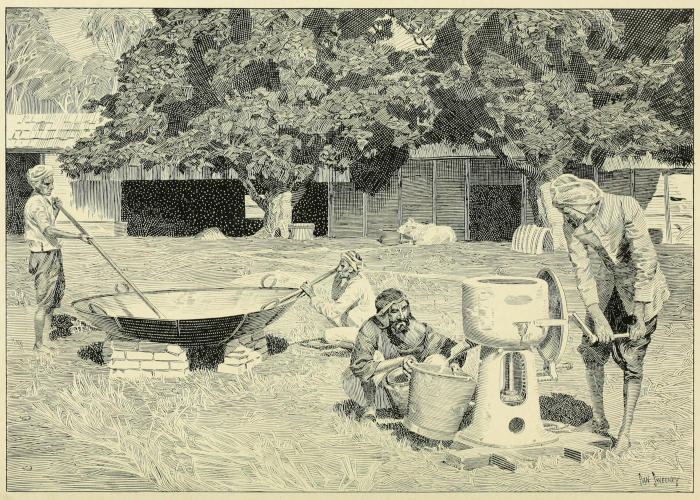
CENTRIFUGAL WORKED BY HAND, INDIA
The area devoted to cane varies year by year and runs between 2,500,000 and 3,000,000 acres, chiefly in the United Provinces, Bengal and the Punjab, although the northwest provinces, Madras, Bombay, central provinces, the Rajput states, and Burma contribute. As the cane-sugar crop of India is estimated to be between 2,225,000 and 2,500,000 tons, it would appear that the sugar realized per acre is something near one ton on an average, as against five and one-half tons in Hawaii. However, there is a good deal of uncertainty regarding the figures, and some authorities consider the total crop very much larger than the amount just mentioned.
The general practice in India is to plant the cane each year, and ratooning is seldom met with outside of the Poonah district. For fertilization, stable manure, town refuse and crushed oil cake are used. The cane is planted from February to April and harvested from the middle of January to the middle of March of the year following. Water for irrigation purposes is taken from rivers and wells. Climatic conditions are frequently unfavorable. There are long dry spells, the low-lying lands are subject to floods in the rainy season, and in certain sections frost plays havoc with the cane.
Not only was India the original home of sugar cane, but, according to recognized authorities, the secret of preparing sugar from cane juice, which dates from the seventh century, also came from there. Today modern methods are employed to a certain extent, but the original processes predominate, and a word or two concerning the latter will no doubt prove interesting.
The cane is cut into short lengths, placed in a kind of mortar and crushed with a large pestle, worked by oxen. The juice runs through a hole in the side of the mortar into a vessel placed to receive it. The practice in former days was to saw off a good-sized tamarind tree about three feet above the ground and then scoop out the stump. Later, logs were sunk deep in the ground and hollowed out in the same manner. Stone mortars followed, meeting with great favor, so that the advent of iron roller mills was delayed for many years.
In the mortar-and-pestle operation of cane grinding, the pestle consists of a lever with two arms. The crushing end of the principal arm rests on the side of the mortar and the cane is ground between the pestle and the mortar wall. The apparatus is driven by oxen.
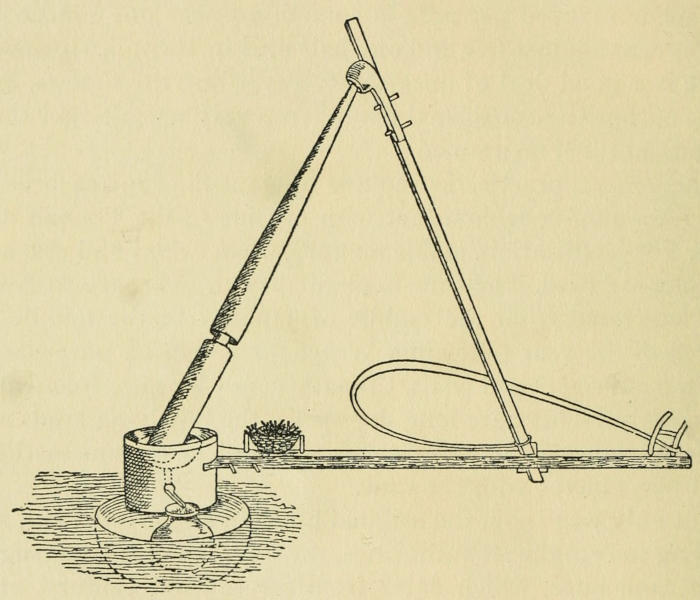
WOODEN MILL FROM GORAKHPUR, INDIA
This method was improved upon by the introduction of the mill with two-geared wooden rolls set vertically, the core of the taller one projecting upward through a frame and attached to a horizontal lever to which the oxen are harnessed. When the mill is started the cane is fed between the wooden gears and the juice expressed in this manner. A further development brought in geared iron cylinders or drums, in sets of two and three. The extraction by these means is extremely poor, ranging from 50 per cent to 62 per cent.
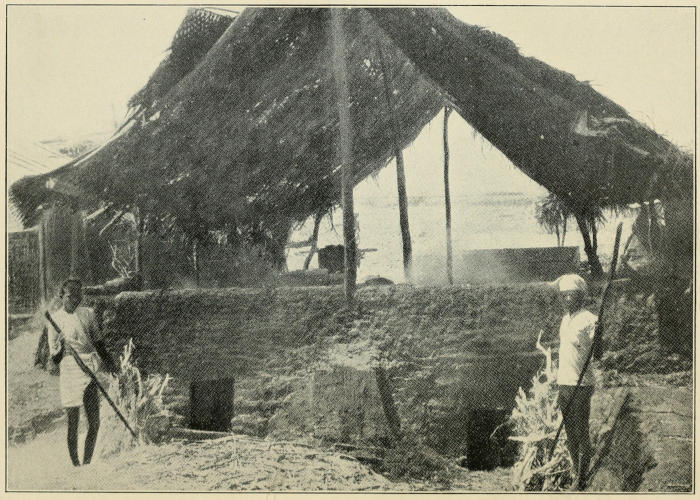
BOILING BY OLD METHOD, INDIA
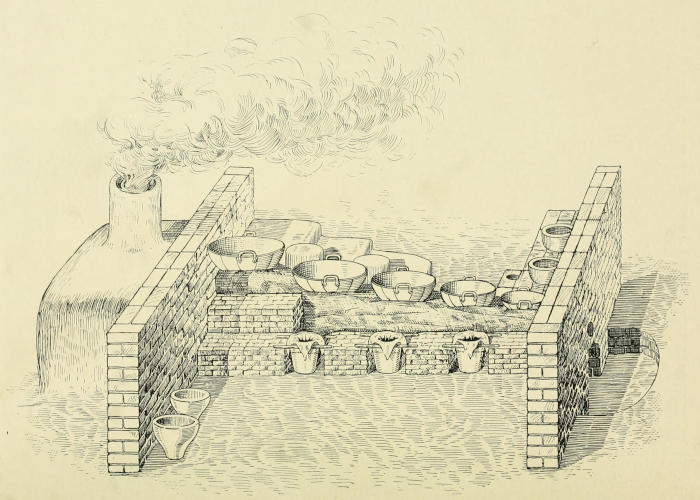
FURNACE AND PANS FOR MAKING RAB, INDIA
Indian sugar makers treat the cane juice in many ways, but all the various grades or kinds produced come under one of two general heads, gur or rab.
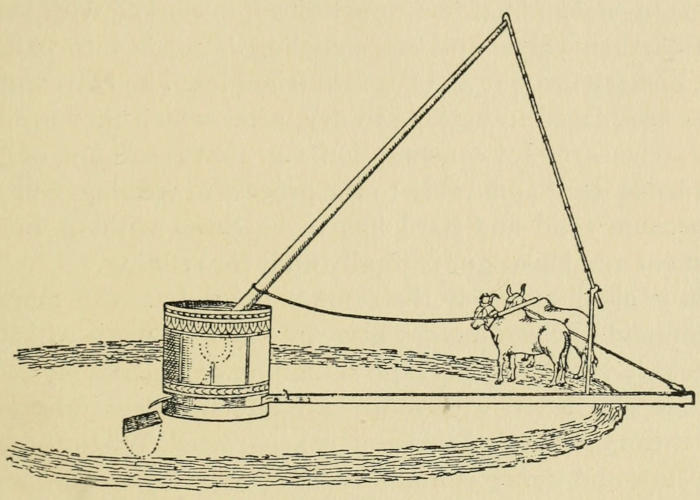
STONE MILL, AGRA, INDIA
When making gur the juice is first freed from floating particles of cane by straining. It is then run into a large earthen vessel sunk in the ground. From there it is ladled into smaller pans placed above a furnace, which is a very primitive affair, generally with three pans and having side walls of tiles or brick. Cane trash and bagasse are used as fuel. When the juice in the first pan begins to boil, a thick scum forms on the top and is skimmed off, and this operation is kept up until the liquor becomes clear. It is then taken to the third pan for further boiling and finally concentrated in the second. In many instances purification is limited to skimming, but sometimes this is supplemented by adding milk of lime or crude soda ash to the liquor. The scum is set aside to be fed to cattle or very poor people.
When the yellowish-brown mass is boiled to a certain density it is constantly kept in motion by stirring and its consistency is tested at frequent intervals. As soon as it is found that it can be rolled into a ball that upon cooling will remain fairly soft, it is considered sufficiently cooked and the boiling operation comes to an end. Sometimes the hot gur is put into earthen moulds to cool and harden, sometimes it is worked with batons in an earthen vessel and after cooling is made into balls by hand, or flattened out and cut into triangles. The balls and triangles are placed in baskets to dry, after which they are supposed to be ready for consumption. Gur that is soft and of good grain lends itself admirably to the process of refining. Gur that has become solid and hard has to be eaten without further treatment and burnt gur is totally unfit for refining.
Rab is made in nearly the same manner, but with more attention paid to cleanliness. There are five iron pans, which are thoroughly cleansed daily; the skimming and clarifying operations are conducted with more care and the clear juice is filtered through cloth before being concentrated. When the mass of crystals and liquor is found to be of the proper consistency, it is poured into earthen pots to cool and well stirred to help crystallization. This process being finally complete, the moist and somewhat soft sugar can only be removed by breaking the pots containing it. Owing to its almost liquid condition, rab cannot conveniently be transported any distance, so that it is generally used near the place where it is made, chiefly for refining purposes. Gur, on the other hand, being harder, can readily be carried any distance.
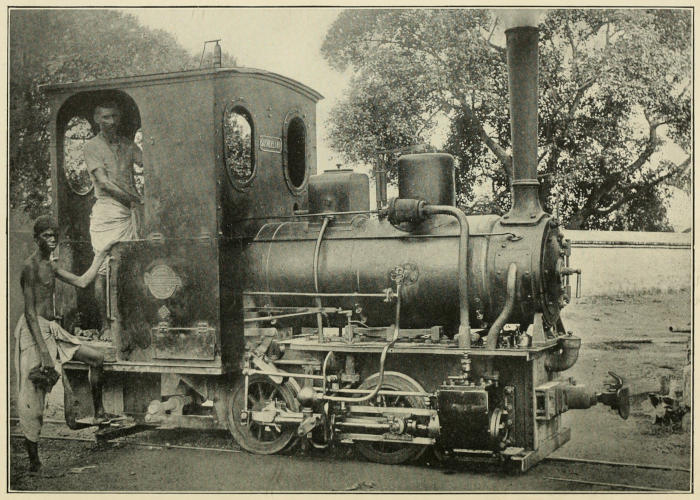
SMALL LOCOMOTIVE USED TO DRAW CANE CARS, 2-FOOT GAUGE, INDIA
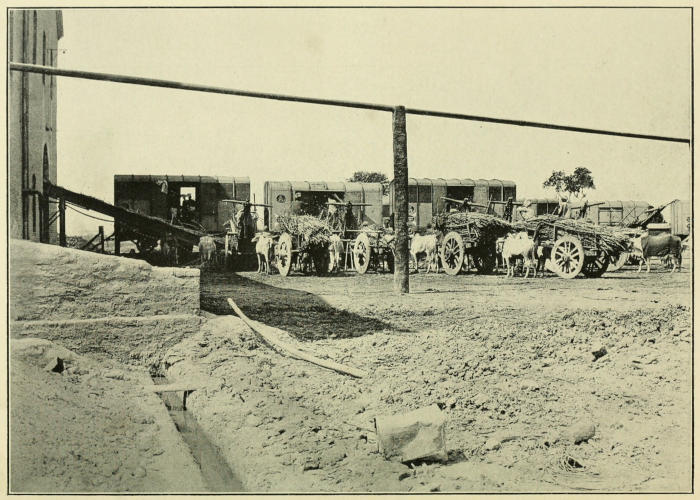
LOADING CANE CARRIER, MARHOURAH FACTORY, INDIA
Men are sometimes set to work tramping upon sacks filled with rab, in order to separate the syrup from the sugar; again sacks of rab are piled upon a floor with holes for drainage and a well for the syrup that runs off. Weights are often placed upon the bags in order to hasten the process. After the drainage is fairly complete, the rab is dumped into vessels having openings at the bottom and covered at the top by a layer of wet water plants. The water as it passes through the mass of sugar washes the syrup from the crystals and the liquor runs off through the apertures in the bottom. Several days afterward the operation is repeated, and so on until all the syrup has been removed by washing. The resulting sugar is either used in that form, or dried in the sun and worked by human feet in order to lighten its color.
Saiyid Muhammad Hadi, assistant director of the Land Records and Agriculture at Allahabad, has worked out an improved method for making rab which is now widely adopted. Under his plan the furnace heat can be readily controlled, so that the danger of burning the juices during boiling is considerably lessened; neither is there so much risk of decomposition (souring). Besides, the cooled rab is purged of its syrup in a centrifugal machine worked by hand instead of by drainage from wet vegetation. At best, however, the production of sugar by the natives of Hindustan is still at a very elementary stage, and in that country new ideas gain ground very slowly, so that it will be some time before modern machinery and equipment are generally in use.
It would seem that in view of the small production of sugar per acre and the enormous losses in manufacture, a modern plant, with machinery of the latest and best type and large financial resources, should be remarkably successful, but such is not the case. It appears to be impossible to get a steady supply of cane. In India, plantations like those found in other countries do not exist. Instead, there are a great number of extremely small pieces of land all under different ownership. The cane has to be brought to the mill from considerable distances in small quantities, and owing to lack of intelligence or initiative on the part of the farmer it is of indifferent quality. Transportation facilities are far from good and the manufacturers have to make up the shortage in the supply of cane by using rab and gur. If the latter should contain an excessive amount of glucose or be caramelized, it does not lose its value as an article for direct consumption; on the other hand, either of these conditions unfit it for the purposes of refining, and as there is but a slight difference in price between gur and the white sugar into which it is made, the disadvantage to the refiner is readily apparent. Another drawback is that the Hindus do not take kindly to sugar manufactured by the European process, consequently chini, or sugar made from rab by the native method, commands a better price than, sugar made in a modern refinery. Religious and caste prejudices exert a strong influence also. In modern sugar refining, animal charcoal is the principal purifying and decolorizing agent, and this, together with the fact that ox-blood has been used for clarification, causes the Hindus to reject sugar prepared by such means. Finally, there is the apprehension on the part of the high-caste natives that the sugar may have been produced by low-caste labor and that to eat it would bring defilement.
The refiners of India have begun to recognize the advantage to them in using raw European beet-root sugars and raw cane from Java and Mauritius instead of the more costly preparations of rab and gur. As a result, there is a considerable quantity of foreign sugar imported into India which is consumed ultimately by the high-caste native without his being aware of its origin.
The imports during the period from 1908 to 1916 were as follows:
1908-09 535,664 tons of 2240 lbs.
1909-10 556,840 ” ” ”
1910-11 608,785 ” ” ”
1911-12 508,591 ” ” ”
1912-13 675,017 ” ” ”
1913-14 802,978 ” ” ”
1914-15 428,595 ” ” ”
1915-16 515,909 ” ” ”
Of this tonnage, Austria supplied the greater amount of the beet, Germany the remainder, while the cane came from Java and Mauritius. In 1913 and 1914 the raw beet from Austria and Germany was almost entirely displaced by washed Java raws, the trade name for which is “Java white.” Some sugar is exported, but the quantity is insignificant.
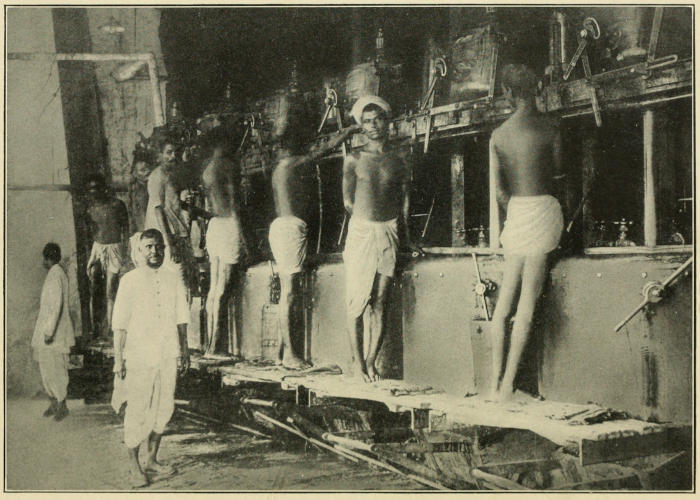
WATER-DRIVEN CENTRIFUGALS, MARHOURAH FACTORY, INDIA
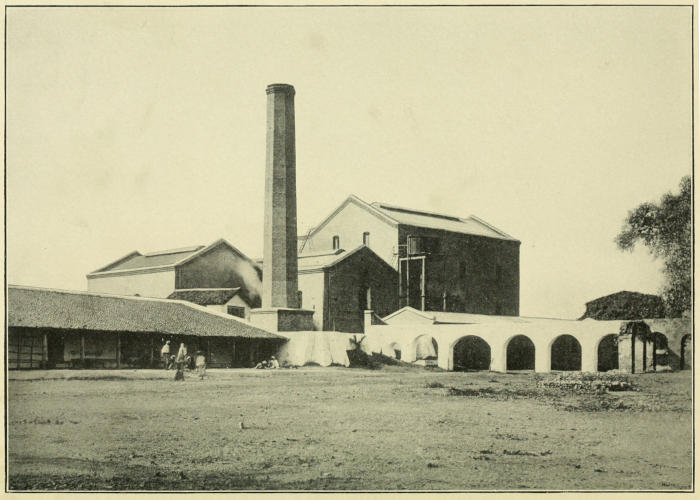
CHAMPARAN SUGAR COMPANY, LTD., BARRAH CHAKIA, CHAMPARAN, INDIA
As to the future of the industry in India, the theory is held by many that with modern scientific methods governing cultivation and manufacture, that country would be able not only to provide for its own requirements, but would be a competitor for export trade in the markets of the world. If such a condition is to be brought about, it will not be by improvement in the cane fields and the manufacturing plants alone. There are other problems to be overcome before there can be any great change for the better,—the stubborn opposition of the natives to innovations, the extreme smallness of individual holdings, poverty, lack of initiative and co-operation,—these are the main obstacles in the way of a material increase in the present enormous production, and they will not be easily surmounted.
CONCLUSION
The sugar crops of the world for the year 1915-16 aggregated 16,558,863 long tons, of which 10,571,079 tons were cane. The following table shows the production of the various countries:
TONS
NORTH AMERICA
United States
Hawaii 545,000
Louisiana 122,768
Texas 1,000
Porto Rico 400,000
Cuba 3,000,000
British West Indies
Trinidad 55,000
Barbados 50,000
Jamaica 15,000
Other British West Indies 30,000
French West Indies
Martinique 40,000
Guadeloupe 40,000
Danish West Indies
St. Croix 11,000
Santo Domingo 120,000
Mexico 75,000
Central America 30,000
SOUTH AMERICA
British Guiana 110,000
Surinam 13,000
Venezuela 10,000
Peru 200,000
Argentina 155,000
Brazil 194,000
Total in America 5,216,768
ASIA
British India 2,636,875
Java 1,264,000
Formosa 391,549
Philippine islands 300,000
Total in Asia 4,592,424
AUSTRALIA AND POLYNESIA
Queensland } 150,000
New South Wales }
Fiji 90,000
Total in Australia and Polynesia 240,000
AFRICA
Egypt 110,000
Mauritius 215,528
Réunion 40,000
Natal 100,000
Mozambique 50,000
Total in Africa 515,528
EUROPE
Spain 6,359
Total Cane Sugar 10,571,079
BEET SUGAR
Europe 5,190,387
United States 779,756
Canada 17,641
Total Beet Sugar 5,987,784
Grand Total Cane and Beet Sugar 16,558,863
From the time when the soldiers of Alexander of Macedon found sugar cane in India, over three hundred years before the Christian era, knowledge of sugar and its cultivation has accompanied great political movements.
In the sweep of the Saracen conquest from Persia to Egypt and on through northern Africa into Spain, sugar followed the footsteps of the invading armies. The Crusaders brought it with them when they returned home from Palestine. Daring Portuguese adventurers carried it to the Madeiras, the Azores, the Cape Verde and other islands of the east Atlantic ocean when they captured and colonized them in the fifteenth century. The New world received sugar cane at the hands of Christopher Columbus, who planted it in Santo Domingo in 1493. Shortly after Pizarro’s first landing it was brought to Peru by the Spanish conquerors. Cortés himself introduced it in Mexico, erecting the first mill there in 1520; and when, during the struggle between Great Britain and France, sugar was excluded from Europe by the blockading British fleet, it was Napoleon Bonaparte who called beet-sugar manufacture into being.
Before the outbreak of the great war in 1914, the world’s crops of sugar were pretty evenly divided between cane and beet, with a preponderance in favor of the former. How this titanic conflict has affected the European production is clearly seen by the returns for 1915-16. During that season the world’s output was 16,558,863 long tons, made up of 10,571,079 tons of cane and 5,987,784 tons of beet, and Europe was short 2,392,828 tons as compared with the previous year. The conclusion is inevitable that after the war shall be brought to an end a period of poverty and distress will ensue and restriction of sugar consumption in Europe will be one of the results of this condition.
Apart from countries where sugar production is fostered by protecting tariffs, it seems certain that future development and progress will take place in lands where favorable climate, rich soil and adequate, cheap labor are found together. The natural economic law will cause the industry to thrive best where such conditions obtain in the fullest degree, and to fall off correspondingly as they diminish.