Part I Growth, Manufacture and Distribution (continued 2)
Reading edition
MELTING
CHANGING THE SOLID RAW SUGAR INTO LIQUID FORM
From the centrifugals the washed sugar drops to the melter pan on the floor below. This is a cylindrical tank in the center of which is a revolving vertical shaft, to which are attached horizontal paddles that serve to facilitate the dissolving of the sugar with the hot water that is now added. Only enough water is added to bring the resultant liquor to a density of 58.6 per cent of solid matter.
The raw sugar having been washed and, to use a technical term, melted, leaves the melt house at this point.
DEFECATION
PRECIPITATION OF SUSPENDED AND INSOLUBLE IMPURITIES
From the “melt” the liquor is pumped to the top floor of the char house, which is usually a structure of from twelve to fourteen stories high. The reason for building to such a height is the advantage gained by utilizing the force of gravity and by this means handling the liquors and bone-char from floor to floor without mechanical aid.
The liquor is delivered into a number of cylindrical tanks equipped with a coil of pipe through which steam is passed for heating the liquor, each tank being capable of holding 25,000 pounds of liquor. Around the bottoms of the tanks are perforated pipes through which compressed air is forced to agitate and thoroughly mix the solution. On account of this air being blown in, these tanks are called blow-ups. By means of the steam coil the temperature of the liquor is kept at 190 degrees, which makes it less viscous than cold liquor, thus facilitating subsequent filtration and hastening the reaction of the lime and acid added at this point.
As the liquor comes into the blow-ups it varies in color from a straw yellow to a dark brown, and contains a considerable amount of suspended and insoluble impurities which must be removed. Some of these impurities are present in the raw sugar, and others, such as pieces of twine, lint from the bags, fine particles of leaves from the Java baskets and Philippine mats, are traceable to the opening of the containers in the melt house.
The process of removal is called defecation. In former years this was accomplished by adding bullocks’ blood to the raw-sugar liquor in the blow-ups and heating the mixture until the scum which rose to the surface cracked, when the solution below was found perfectly clear, or, in the language of the refinery man, bright. Today, however, chemicals are the defecating agents, those most commonly used being phosphoric acid and lime. Phosphoric acid, neutralized with lime, throws down a heavy, flocculent precipitate which, as it settles, sweeps the solution and drags down all the suspended matter, gums, etc., leaving the liquor above clear and transparent.
The precipitate must now be removed, and this is accomplished by running the liquor through the bag filters on the floor below. These filters are tight iron boxes, about sixteen feet long, six feet wide and seven feet high. The top of the box is depressed about eight inches below the sides and ends, thus forming a tank. This top is perforated with five hundred holes, one and one-half inches in diameter. From the bottom of the iron box is an outlet pipe leading into tanks below.
In each of the holes on the inside top of the box is screwed a so-called “brass bottle,” conical in shape, to which is securely attached a closely-woven cotton filter bag, about twenty-four inches wide and seventy inches long. This filter bag is encased in a heavier and stronger cotton sheath, or sleeve, about eight inches wide, which adds strength and keeps the twenty-four-inch bag in folds so as to give an effect similar to that of a folded paper filter, frequently seen in drug stores. Each bag filter contains five hundred of these bags, suspended vertically from the top.
Before any liquor is run on the filters, the bags and the iron box are heated by means of steam to bring the apparatus to a temperature of about 190 degrees Fahrenheit. This prevents the chilling of the sugar liquor by cold bags, which would cause the bags to become “blocked,” as it is technically called. The liquor from the blow-ups, at 190 degrees temperature, is now turned into the depressed tank on the top of the filter and flows through the perforations into the bags attached on the inside, down through the bags, and finds an exit through the bottom of the filter into the tanks below.
As the first liquor comes through the bags, it is a little cloudy, but in a few minutes, as the pores of the bags fill with the insoluble substances, it becomes perfectly bright, all the suspended and insoluble impurities remaining in the bags, together with the precipitates drawn over from the blow-ups. The cloudy liquor is pumped to the top of the filter and clarified by being run through a second time. It is interesting to know that it is not really the bag that does the filtering, but the thin layer of sediment that is deposited from the liquor itself on the inner surface of the bag. The cotton bags are made in a particular manner, and from a fabric especially adapted to catch the sediment and to form, in conjunction with it, an excellent filtering medium.
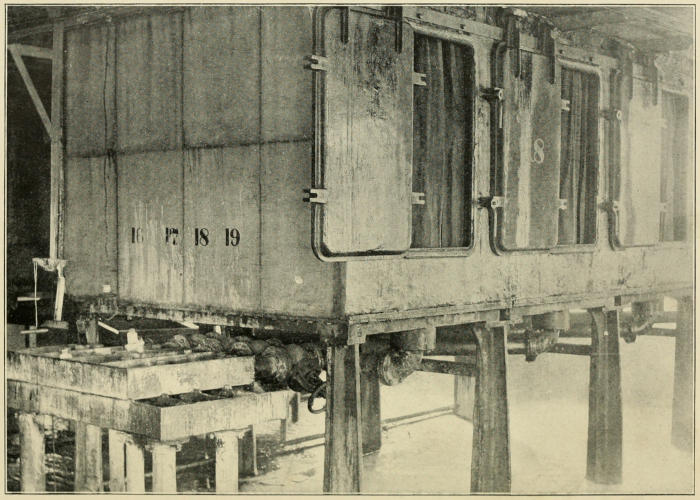
BAG FILTERS—SHOWING BAGS IN PLACE
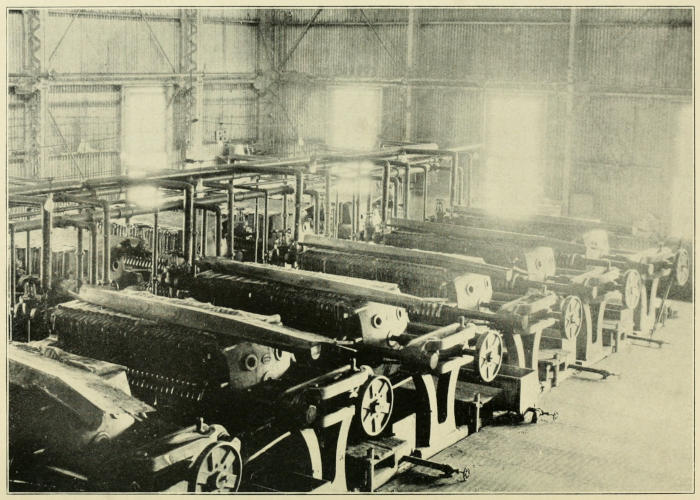
FILTER PRESSES
The liquor, as it runs into the tanks, must be carefully watched, for sometimes a bag inside the filter breaks, which causes cloudy liquor by allowing the precipitates to gain entrance into the clear liquor. As soon as this is noticed, samples are taken from the outlet of each filter and the defective one found and investigated.
When a bag is torn, or develops a hole, the liquor runs through the opening on the top of the filter so fast that it forms a little whirlpool, which shows the bag that is broken. A wooden plug is immediately driven into the opening and that particular bag cut out. The men on the bag filters soon become so expert that they detect broken bags and plug them before the cloudy liquor gets to the inspection station. It is essential that the liquor be freed from all suspended impurities at this station before the next step is taken, hence great care and watchfulness must be exercised.
In time the coating of sediment, gums and precipitates on the inside of the bag becomes so thick that the liquor runs very slowly and finally stops. The refinery term for this condition is “stuck-up.” Depending on the impurities in the original liquor, the bag filters will continue to filter the liquor for from twelve to twenty hours and sometimes longer.
After the bags are “stuck-up,” the liquor remaining in them is sucked out by means of vacuum through a small pipe attached to a long rubber hose and inserted in the bags through the holes in the top of the filter. The liquor thus sucked out of the “stuck-up” bags is sent to the blow-ups and reprocessed with new liquor, thus beginning its journey anew.
As soon as the liquor is sucked out, hot water is run through to reduce the sugar contents of the filter. This water is saved and the sugar it takes up is subsequently recovered. The filter is then opened by means of an electric hoist traveling on an overhead track immediately above the filters. Chains are attached to the top of the filter and the hoist elevates top, bags and all, to a point sufficiently high for the bags attached to the top to clear the adjoining filters. The top and bags are then moved along the track to the washing station. Meanwhile another hoist has delivered a duplicate top, with fresh bags attached, to the filter, where it is lowered into place. In this way the filter is again in operation within five minutes. At the washing station the bags just taken from the filter are detached from the top for washing, and the top is sent to a point where clean bags are again attached. It is then ready to go into another filter.
At the washing station the dirty bags are pulled out of the sheaths and turned inside out in tanks containing water, thus releasing a large quantity of the impurities. The bags and sheaths are then thrown into washing machines, where all the remaining impurities and sugar are washed out of them. From the washers the bags are put into centrifugal machines, or through powerful wringers, and dried sufficiently to permit being rehandled. They are then resheathed and made ready to be attached to another top.
The water from the washers contains a large amount of sugar and is conducted to a tank similar to one of the blow-ups, where it is treated with lime and diluted with water at 190 degrees Fahrenheit until it contains only from ten to twelve per cent of solid matter. This liquid is then pumped through filter presses and the impurities removed. The “sweet water,” as it is termed, which now contains practically all the sugar, is collected in tanks and the sugar is ultimately extracted by evaporation, filtration and boiling to grain.
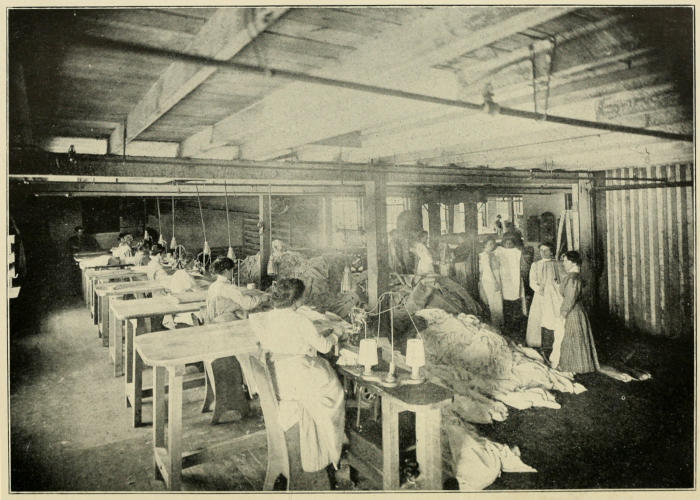
MAKING NEW BAGS AND LINING THE WASHED BAGS
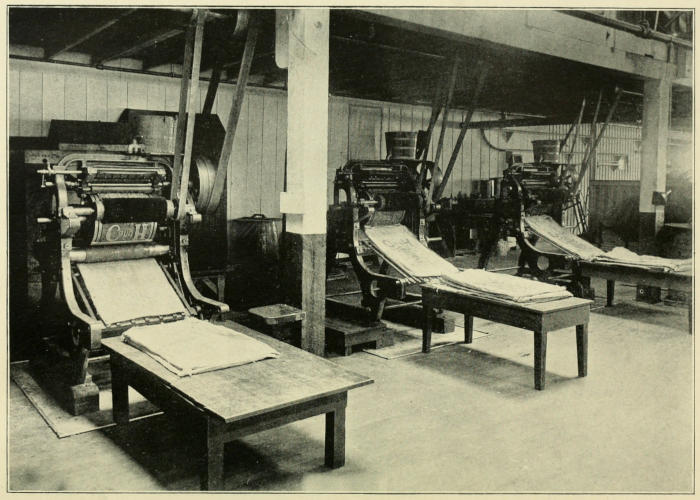
PRINTING THE EMPTY RAW-SUGAR BAGS
The impurities removed by the filter presses consist of sand, portions of bags and baskets, phosphates, hair, lime, salts and gums, in fact every kind of foreign matter that finds its way into raw sugar either in the process of manufacture or in transportation. A small amount of sugar accompanies this refuse, but as its recovery would cost more than it is worth, it is allowed to run to waste. The filter-press cake, as it is called, contains valuable fertilizing agents, and when conditions permit it is used for fertilizing purposes, otherwise it is run to waste.
BONE-CHAR FILTRATION
REMOVAL OF COLOR
To resume the course of the bag-filtered liquor, from which the superficial, the suspended and insoluble impurities have been removed and which is now the color of clear amber, the next step is bone-char filtration.
Bone-char, bone-coal or bone-black, as it is variously called, is made from the bones of animals. After the fat and glue are removed, the bones are subjected to a dry distillation which carbonizes them. These charred bones are then broken into very small pieces, or until they will pass through a ten-mesh screen and remain on a thirty-mesh screen; in other words, the size of the grains used in a sugar refinery vary from one-tenth to one-thirtieth of an inch. If properly manufactured, the grains are hard, porous, and have a great affinity for moisture.
Bone-char has the peculiar property of removing from the sugar liquor, in some unknown mechanical way, not only the soluble salts but the coloring matter as well. The elimination of the salts and coloring matter facilitates the subsequent crystallization.
The char house is, therefore, by far the most important station in a refinery, for failure in the char house means failure throughout.
Contrary to the general practice in Europe, beet-sugar factories in the United States do not use bone-char, and consequently do not take all the coloring matter and salts out of the liquor. They secure a white sugar by other methods, which will be explained later on. In a cane-sugar refinery, however, the coloring matter and impurities are entirely eliminated, and the product is invariably pure and white.
The char filters are cast-iron cylinders, usually ten feet in diameter and twenty feet high, with doors at the top for entrance of the char and openings at the bottom through which it is removed. There are also many pipe connections for the introduction and outlet of liquors, steam, hot water and compressed air. The filters are insulated on the outside with asbestos or some other non-conductor of heat to prevent the temperature of the liquor from being lowered as it passes through. Each filter has a capacity of from sixty thousand to eighty thousand pounds of bone-char.
At the bottom of the filter is a perforated iron plate. Over this is placed a coarsely woven cotton blanket, through which the liquor will pass, but which prevents the char from escaping from the filter with the liquor or wash water. After the blanket is set in place, the char is delivered by gravity through an overhead pipe into the filter, until it is entirely full. The char, as it goes in, has a temperature of from 170 to 180 degrees Fahrenheit, and the bag-filtered liquor which is then run on has a slightly higher temperature.
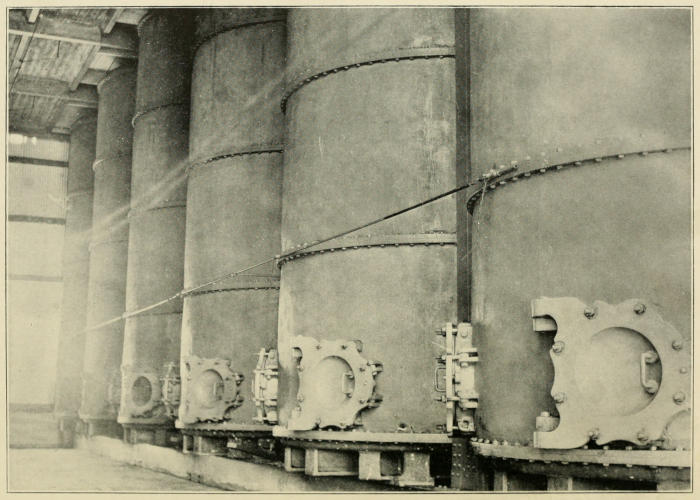
CHAR FILTERS
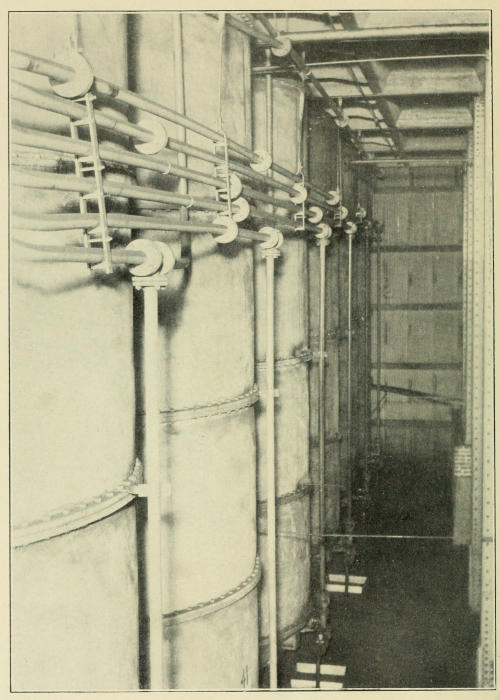
CHAR FILTERS—SHOWING OUTLET PIPES
When the liquor in the filter reaches the top and the char has settled in a compact mass, the cover is put on and fastened securely to prevent leakage. The liquor is again allowed to run into the filter by gravity, from the tanks about fifteen feet overhead. The valve on the bottom of the filter is then opened and the liquor, as it filters slowly through the char, is led through a copper pipe to the liquor gallery, to which station all the char-filtered liquor is delivered. This pipe, instead of leading downward from the filter, leads upward and nearly to the top, so that the flow of liquor through the char will be slow and uniform and the filter will always remain full of liquor. The diameter of the filter is ten feet, while that of the outlet pipe is two inches, so that the flow of liquor through the char is necessarily very slow. The reason for this is that the liquor must remain in contact with char a certain time to enable the char to absorb the coloring matter and soluble salts.
The first liquor from the filter appears cloudy and is sent back for refiltration, but it soon becomes bright, perfectly colorless and transparent as plate glass. This white liquor is pumped from the liquor gallery into the tanks on the top floor in the pan house, ready for the next process, which will be dealt with presently.
After a filter has been running for from twenty-four to thirty-six hours, depending on the character of the sugar in the liquor, the char becomes “tired” or spent. In other words, it has absorbed so much of the impurities and coloring matter from the liquor passing through it that its capacity to absorb more is gone and the liquor begins to show a slight straw or canary color. The inspector in the liquor gallery immediately notices this and orders the liquor stopped. Immediately afterwards a lower-grade liquor is turned into the filter, which forces the first liquor out before it. In due time the man at the liquor gallery notices the number two liquor coming from the filter and turns it into separate tanks. In time a still lower grade of liquor is turned on and the filter run until the bone-char is absolutely exhausted, when it is ordered “sweetened off.”
Hot water is then turned in at the top of the filter to wash out the remaining sugar liquor which gradually becomes more and more dilute. When its density has been lowered to about thirty-five per cent of solid matter, it is diverted to other tanks, and this is continued until only three-tenths of one per cent of sugar remains in the sweet water, as it is now called. The washing of the char in the filter in this manner, by hot water, is kept up for twelve hours, but as soon as the sugar content falls below three-tenths of one per cent the solution is allowed to run to waste, as the recovery of this small percentage of sugar would cost more than its value.
The sweet water is sent to the evaporators, concentrated to 58.6 per cent of solid matter, and it then begins its refining journey over again.
This long and continued washing of the filters is for the purpose of removing as much as possible of the organic and mineral impurities absorbed by the char.
The washing completed, compressed air is applied to the filter to force out the remaining water. The bottom doors of the filter are then opened and the char, containing about twenty per cent of water, drops to the floor below. Here it passes through mechanical driers and is delivered comparatively free from moisture to the kilns. There it is revivified, that is, the organic matter in the char which could not be removed by washing is converted into carbon by being heated to a cherry red in the absence of air. This is accomplished by allowing the char to pass by gravity through the red-hot retorts of the kilns.
As the wet char leaves the filter, it drops on a moving belt which carries it to large cast-iron hoppers leading to the driers immediately beneath, where the greater part of the moisture is expelled from the char prior to its being treated in the revivifying kilns. The driers are made up of a number of thin, hollow, cast-iron, triangular pipes, enclosed in a large, rectangular, outside casing. The wet bone-char passes over these hollow pipes as it falls slowly through the drier. The hot gases from the furnaces of the kilns below pass through these cast-iron pipes, giving off heat as they ascend, thus driving off the moisture in the char as it falls down over the outer surface of the pipes. At the same time, hot air obtained from cooling the char in the cooling pipes below the retorts is drawn through the drier, coming in direct contact with the char. The moisture given off by the char is absorbed by this hot air and carried out of the drier and building by fans or smokestacks. By this means the water in the char is reduced to ten per cent, and in this comparatively dry, hot state it runs freely by gravity from the bottom of the drier into a second set of hoppers, through which it drops into the retorts of the kiln. The hot gases, after drying the char, pass out at the top of the drier through a flue leading to a stack outside the building.
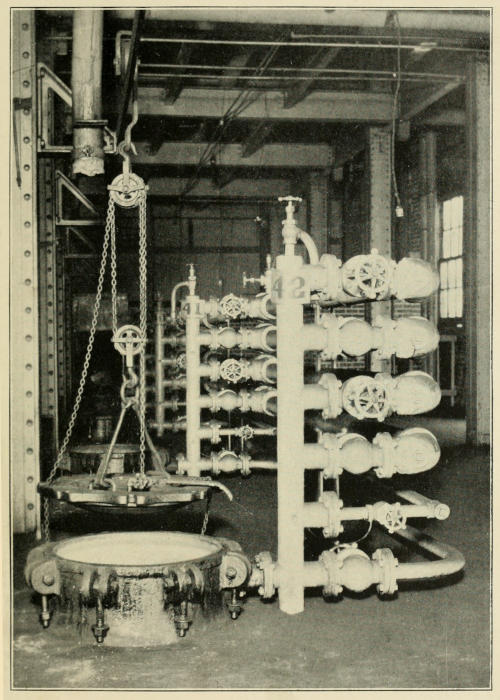
TOP OF CHAR FILTERS—SHOWING PIPE CONNECTIONS
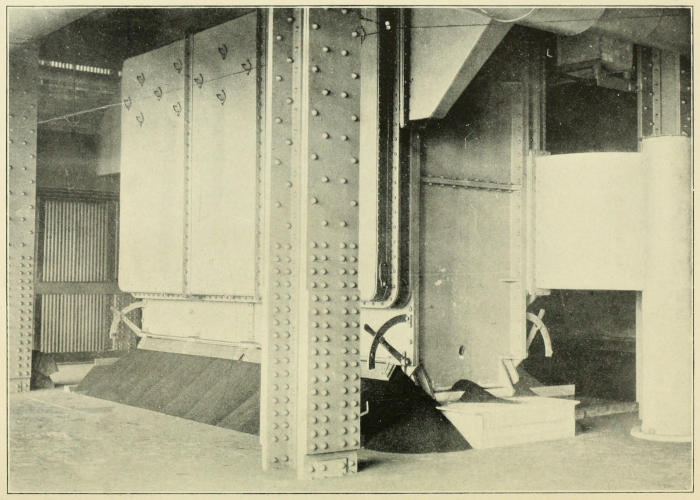
EXTERIOR VIEW OF CHAR DRIER
The kilns are large square boxes of brick, built around a strong supporting iron structure. On each side of these boxes are a number of large flat pipes of cast iron, nine feet long and twelve inches by three inches in section, the iron being three-quarters of an inch thick. These pipes are called retorts and are arranged vertically in the kilns, forty on each side. The space in the center between the retorts is known as the furnace and extends the entire length of the kiln, a distance of about sixteen feet. Intense fires are maintained in this central space and the flames playing around the retorts keep them red-hot. The upper ends of the retorts lead into the hoppers above and the lower ends to the cooling pipes below. As the char passes gradually through the red-hot retorts, it becomes heated to 900 degrees Fahrenheit and the organic matter it absorbed from the sugar liquor is changed into carbon. In this way the char becomes almost as good as new, or, as the term goes, revivified. Each kiln has a capacity of revivifying sixty thousand pounds of bone-char per day.
If the char in this red-hot state were suddenly exposed to the air, the contact with oxygen would bring about combustion and the char would be quickly reduced to ashes, so a cooling process is necessary. It is, therefore, drawn from the cast-iron retorts into cooling pipes located directly beneath. These pipes are of thin sheet-iron and are about three by four and a half inches in section. There are three under each retort, and a mechanical device at the bottom allows only a small amount of char to escape at a time. This amount can be regulated at will by the operator, and in this way the char is held in the retorts the exact time necessary for its revivification.
A current of cold air circulates continually around the cooling pipes, taking up the heat from the char and delivering it through pipes to the drier overhead, so that when the char leaves the bottom of the pipes its temperature is about 180 degrees Fahrenheit. From the cooling pipes, it drops on a belt conveyor from which it is carried by endless belt or chain bucket elevators to the top of the char filters to be used again.
The manipulation of the char filters varies in different refineries, some running the liquor over the char for a longer period than others, but a fair average of the time required for filling, settling running liquors and syrups, sweetening off, washing, applying air and emptying, is eighty-six hours, the shortest time being seventy-two hours. Taking eighty-six hours as a basis, it will be seen that the char is handled and revivified eighty-one times each year after making due allowance for Sundays, holidays and annual clean-up periods.
Each time the char is handled, a certain amount of it is broken into dust, and this is taken out by passing it over fine screens, and also by exhaust fans. Obviously, the amount of dust taken out each day must be replaced by its equivalent in new char. It is estimated that the original char put into the filters will last from five to six years before it finally becomes disintegrated and is taken out as dust.
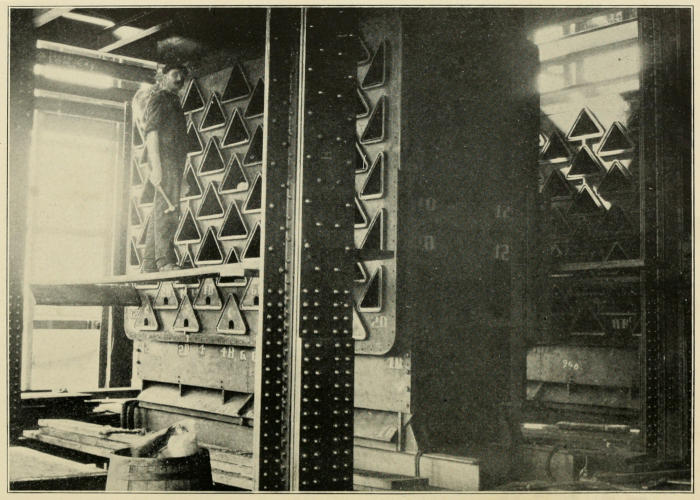
INTERIOR ARRANGEMENT OF CHAR DRIER
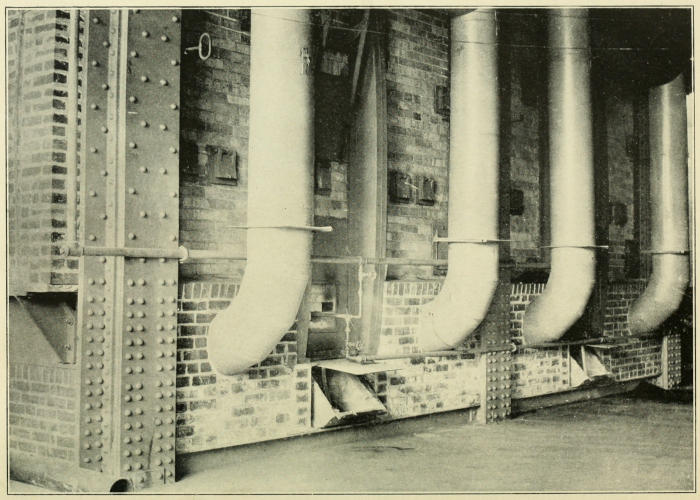
EXTERIOR VIEW OF CHAR KILNS—SHOWING OIL-BURNING APPARATUS
As approximately one pound of char is required for every pound of sugar melted, it will be seen that as the liquor is in contact with the char for only twenty-four hours out of seventy-two, a refinery turning out two million pounds of sugar per day should have filter capacity for six million pounds of char. The amount of the latter that is handled each year is, therefore, very great and requires a large and costly plant to take care of it properly.
CRYSTALLIZATION
PRODUCTION OF CRYSTALS BY CONCENTRATION
The refining process has been described up to and including the purification and decolorizing of the sugar liquor, the last step being the delivery of the pure white liquor into the receiving tanks in the pan house.
After the white liquor leaves the char filters, the greatest care must be exercised to keep all the machinery, piping and apparatus scrupulously clean, for if any foreign matter becomes mixed with the liquor or sugar it can only be removed by refiltering or remelting.
By means of vacuum, the liquor is drawn from the tanks into the vacuum pans, this being the last operation in which the sugar is handled in a liquid state. From this point on it drops by gravity from floor to floor in a solid or semi-solid form, until it reaches the packing room as a finished product. In a first-class refinery, the vacuum pans, as well as all the piping through which the liquor passes, are made of copper instead of iron and steel, which eliminates the possibility of rust or scale getting into the sugar.
Refinery vacuum pans are usually from fourteen to sixteen feet in diameter and from sixteen to seventeen feet high, while in shape they appear almost spherical. The boiling takes from one hour and twenty-five minutes to one hour and forty-five minutes, and about forty-five tons of granulated sugar can be made at each boiling in a fourteen-foot pan. Before the liquor is drawn in, the pan is thoroughly cleansed with hot water and steam. All openings are then closed and the vacuum pump started. The air is quickly exhausted, a valve in the pipe line leading from the receiving tank is opened and the pan is given a charge of liquor. Steam is turned into the coils of the pan and the boiling process begins. Soon sufficient moisture is driven off to cause the sugar to “grain.” Shortly after the grain forms, another charge of liquor is drawn into the pan and the operation is repeated until the pan is full of a thick, white, mushy substance called massecuite, that looks very much like half-formed ice. The vapor driven off in the boiling passes out through a large pipe at the top of the pan and is condensed by being sprayed with cold water. On account of the high vacuum, the liquor boils violently at temperatures ranging from 140 degrees to 195 degrees Fahrenheit; thus the risk of scorching, discoloration or caramelization of the sugar is minimized.
On the front of the pan is a vertical row of windows made of heavy plate-glass, and through these the liquor is watched during the boiling. The massecuite in the pan is sampled at intervals by the sugar boiler, by means of a “proof stick,” a brass rod about three feet long and one and one-quarter inches in diameter, in the pan end of which there is a hollow space. This stick is pushed through an opening in the side of the pan into which it fits tightly, and then partly withdrawn. A small quantity of the contents of the pan remains in the hollow space, and this the sugar boiler removes and places on a piece of clear glass. On holding it up to the light, he sees exactly how the crystallization of the sugar is progressing, and by observing and feeling the crystals, he is enabled to control the boiling perfectly. When he concludes that the evaporation is complete and the massecuite of the proper consistency, the pump is stopped and the vacuum broken by opening a valve near the top of the pan, admitting the outside air. The foot valve is then opened and the massecuite drops from the pan into a mixer directly underneath. There it is kept constantly in motion by a revolving shaft with paddles, to prevent the crystals from sinking to the bottom. From the mixer it is drawn into the centrifugals and purged of the mother liquor, the pure crystals being left in the machine. The liquor thus drawn off contains whatever impurities may have remained in the original liquor. It is now pumped back and run through the char filters again, after which it is boiled in the vacuum pan and the granulated sugar taken out in the centrifugals. This completes the process of producing crystallized sugar by concentration.
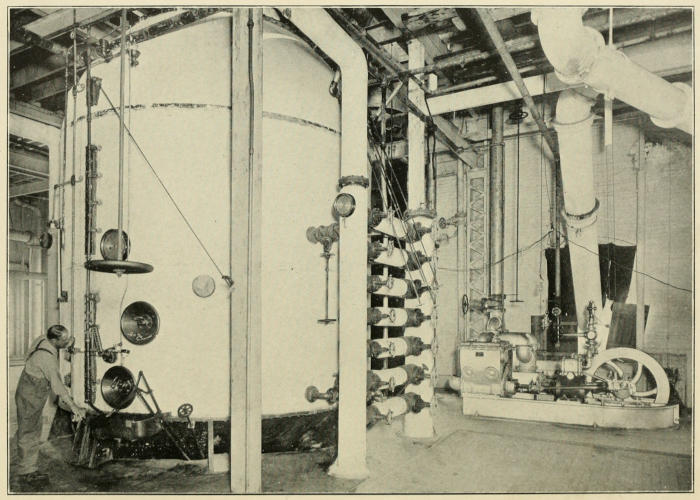
A REFINERY VACUUM PAN AND PUMP
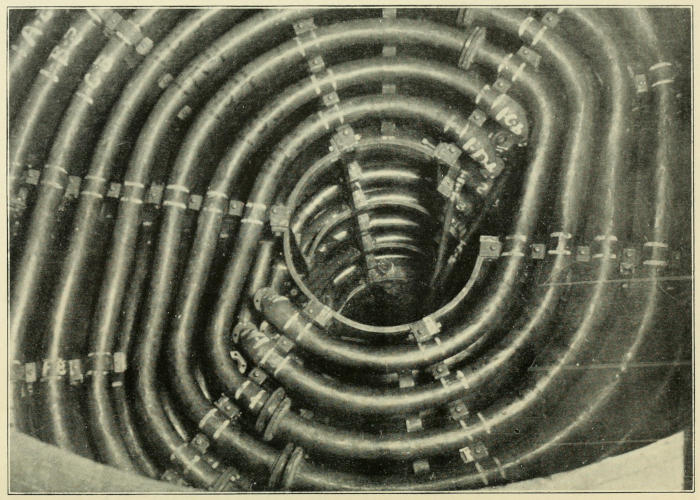
ARRANGEMENT OF STEAM COILS IN A VACUUM PAN
There are many interesting and intricate problems in connection with the extraction of the sugar from the wash waters, sweet waters and low-grade syrups that are constantly accumulating in a sugar refinery, but space will not admit of their being dealt with here. Suffice it to say that the process of extraction is carried to a point where the sugar recovered barely pays for the labor and fuel expended in the operation. The ultimate result is white sugar, table syrup and molasses.
This molasses is used largely in the manufacture of vinegar and alcohol. Mixed with grain and alfalfa meal, it makes an excellent stock food that cattle take to readily and that possesses high value as a fattening agent. The sucrose and glucose content of molasses as it leaves the refinery is about fifty per cent.
Naturally, in a process involving so much handling, filtering and boiling, there must be some loss, and the efficiency of a refinery is based upon the percentage of granulated sugar recovered from the raw article delivered to the melt. It may be stated for general guidance that, taking an average of the refineries of the United States, one hundred pounds of refined white sugar is made from each one hundred and seven pounds of ninety-six-degree raw sugar melted. Some of the sugar lost is accounted for in the molasses, in the sediment from the filter presses, and in the wash waters from the char filters. The remainder is the undetermined loss in handling, in sugar destroyed by heating, and in sugar dust escaping during the manufacturing operation. As has been said, the component parts of raw sugars vary more or less, and the recovery in white sugar from two lots of raws, each polarizing ninety-six degrees, might differ considerably according to the refractory matter in the original raw sugar.
The following figures give a fairly accurate idea of the disposition of one hundred pounds of ninety-six-degree raw sugar in refining:
Water, which is eliminated .70 per cent
Non-sugar, which is eliminated 3.30 ”
Sucrose loss, undetermined .75 ”
Sucrose left in molasses 1.75 ”
Sucrose extracted in granulated form 93.50 ”
Raw sugar melted 100.00 ”
The undetermined loss includes every loss from the time the raw sugar is weighed into the warehouse until the granulated article is sold to the buyer. It is evident, therefore, that one of the principal items of refining cost is the actual loss of weight in converting raw into refined sugar. Assuming that the raw sugar costs four cents per pound, the refiner has lost on each one hundred pounds melted, four cents × 6½ pounds, or twenty-six cents, less the small value of the resulting molasses. If the raw sugar cost six cents, the loss would be thirty-nine cents. At four cents, the loss is equivalent to $5.20 per ton, or, in the case of a refinery melting two million pounds of raw sugar daily, $5,200.00 for each working day. This does not include any of the operating expenses, such as labor, fuel, bone-char, containers, selling expense or administration—just the actual value of the raw sugar lost in the process of refining.
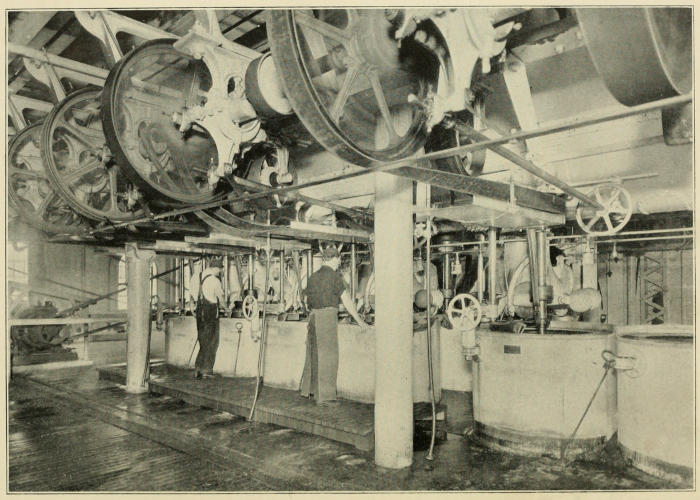
REFINERY CENTRIFUGAL MACHINES
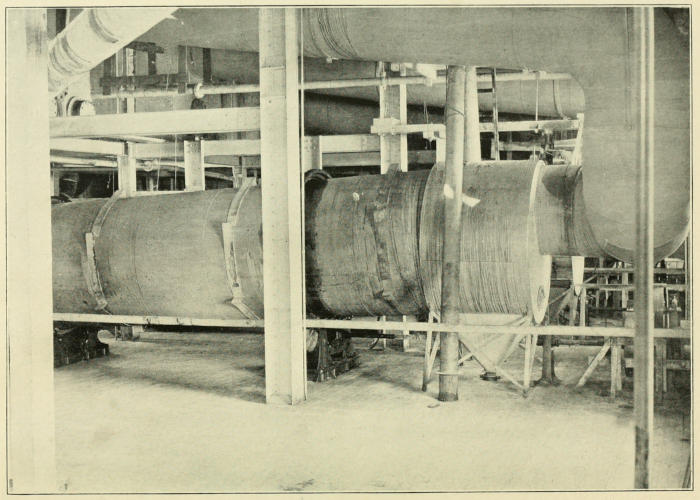
EXTERIOR VIEW OF SWEATER
PARTIAL DRYING
PURGING CRYSTALS FROM THE SYRUP
Returning to the sugar left in the centrifugals, the force developed in a machine forty inches in diameter, spinning at the rate of eleven hundred revolutions per minute, is so great that it quickly dispels all the liquor surrounding the crystals, leaving them nearly dry, in a solid, vertical wall. Water, filtered to insure its purity and cleanliness, is then sprayed on this spinning wall of sugar, only to be immediately thrown off through the sugar by the centrifugal motion. In passing through the sugar it washes the last of the syrup from the grains and leaves them perfectly white. Cold water, rather than hot, is used for this purpose, as it dissolves less sugar.
In former years a small quantity of bluing was added to the spraying water in order to enhance the whiteness of the sugar, just as bluing is employed in washing fine linen fabrics. Since the pure-food laws became effective, however, the practice has been discontinued in all cane-sugar refineries.
After the sugar is thoroughly washed, the centrifugal machine is stopped, a large valve in the bottom opened and the mechanical discharger rapidly ejects the sugar (now containing only about 1.2 per cent moisture) from the machine into a storage bin beneath.
FINAL DRYING OF CRYSTALS
For some reason not well understood, the next step in refining is called “granulation.” Actual granulation, or crystallization, takes place in the pans, and the process about to be described should properly be called drying. The manufacturing term, however, is as given.
Drying is effected in an apparatus consisting of two large cylindrical drums of wrought iron. These drums are about six feet in diameter, thirty feet long and have a slight downward pitch from the receiving to the discharging end. The first drum rests on the floor, directly below the storage bin, and is called the sweater. It turns slowly on revolving wheels, by means of circular tracks bolted to it. The power that moves it is delivered from an electric motor, through a pulley, shaft and pinion, the latter working in a gear bolted to the outside circumference of the drum. Fastened to the inner surface of this drum is a series of short, narrow shelves with saw-tooth edges that serve to carry the sugar to the top of the revolving cylinder, whence it falls to the lower side, causing a continual shower of sugar throughout the entire length and breadth of the drum. The sugar is delivered through a pipe at the upper end of the sweater, and the revolving motion together with the incline of the cylinder gradually works it down to the lower end. Here it drops through a chute to the granulator on the floor below, where the process of drying is completed.
A strong current of hot air is drawn through the sweater by a powerful fan connected to the upper end by a very large pipe. The air introduced in this way is brought to a high temperature by passing around a number of coils of pipe charged with steam, which are placed directly in front of the sweater. The hot air sweeping through the drum absorbs nearly all of the moisture in the sugar, which carries 1.2 per cent of water when it enters the drum and about 0.1 per cent as it leaves it.
The granulator, or lower drum, is the same size as the sweater and is constructed in very much the same manner, having shelves for carrying the sugar to the top and dropping it at the proper point, and being equipped with a large fan to draw off the hot, moist air. Instead of having steam coils in front, however, it has in its center a steam-heated drum about twenty-four inches in diameter that revolves with it. The sugar crystals, as they fall in a shower from the shelves, come in contact with the hot inner drum on their way through the granulator, and in this manner become thoroughly dried. The moisture in the sugar, as it emerges from the granulator, is less than four-hundredths of one per cent, an amount too slight to determine except with the most delicate apparatus.
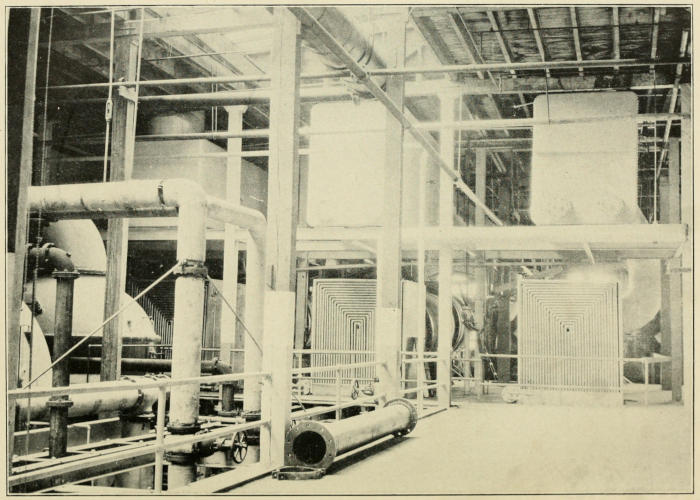
FRONT VIEW OF SWEATER—SHOWING STEAM COILS FOR HEATING THE AIR
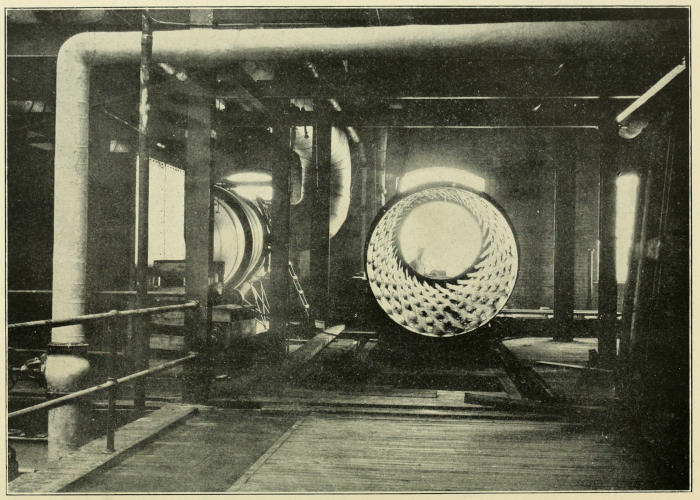
INTERIOR VIEW OF SWEATER
To insure perfect drying, the damp sugar must be fed to the upper drum or sweater with unfailing regularity. This is accomplished by the use of revolving screws located under the storage bins. By turning a certain number of revolutions per minute, they deliver an even and steady supply of sugar.
From the granulators the sugar is dropped on thin cotton belts that, passing around highly magnetized pulleys, carry it to the dry storage bins. The sugar is cooled to normal temperature before being packed in containers, thus preventing subsequent absorption of moisture and consequent caking.
Magnetic pulleys are used to extract any particles of iron scale or rust that may drop into the sugar after the liquor leaves the char filters. Rust sometimes forms in the pans, mixers, conveyors, elevators, sweaters or granulators, and should it get into the sugar the magnetic pulleys will surely remove it.
Storage bins and storage tanks are prominent accessories of all sugar refineries, for if a breakdown should occur at any point, there must always be a supply of material on hand to keep the refining operations going while the trouble is being remedied.
SCREENING
SEPARATING CRYSTALS INTO VARIOUS SIZES
The now thoroughly cold, dry and free-running granulated sugar is drawn from the storage bins through galvanized metal pipes and taken to the separators by screw conveyors, which deliver it at an even, steady feed—a most essential feature. The sugar as it comes from the pans is made up of crystals of various sizes. It also contains a number of small lumps formed in the centrifugal machines, or in some part of the process after it leaves the pans. It is necessary to separate the crystals according to size and to screen out the lumps, for the following reason:
In some parts of the country, people have been educated to use a coarse-grained sugar; in other sections, they are accustomed to sugar of a fine grain. For example, on the Pacific coast, the demand is for the fine-grained article; the consumers of the Mississippi river valley like a fairly large grain; while the Atlantic coast trade calls for a still coarser product. There is a difference, too, as to containers. In the East the preference is for the barrel package, while the Western buyer wants his sugar put up in bags.
There are many different types of separators commonly in use, but in all of them the governing principle is the same. It is the elimination of lumps and dust from the final product and the separation of the sugar crystals according to size. The separator here specifically referred to will explain the principle as well as any other type, and a glance at the accompanying illustration will give the reader a good idea of its construction. It is made up of a number of wire screens of various sizes, fixed at a sharp incline, one above the other, and all enclosed in a tight, dust-proof steel case. At the top of the case is a steel screw conveyor by which the sugar is fed evenly and steadily across the entire width of the top screen.
On the outside face of the case are a number of shafts to which hammers are attached. As the shafts revolve, the hammers tap the various screens below, lightly and at rapid intervals, thus causing them to vibrate.
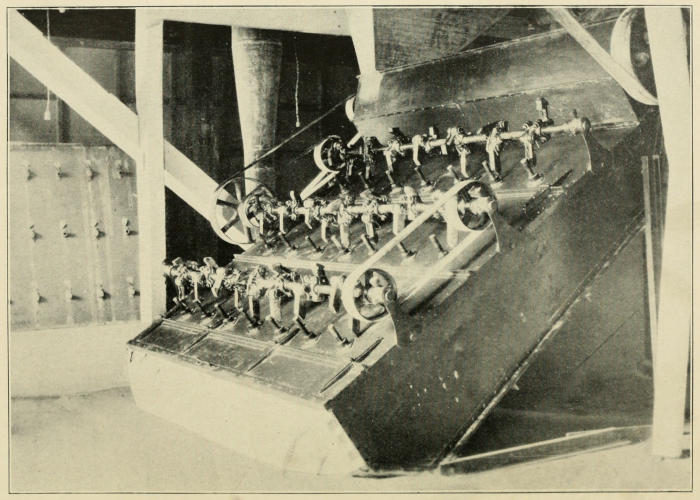
SEPARATOR—CLOSED, READY FOR OPERATION
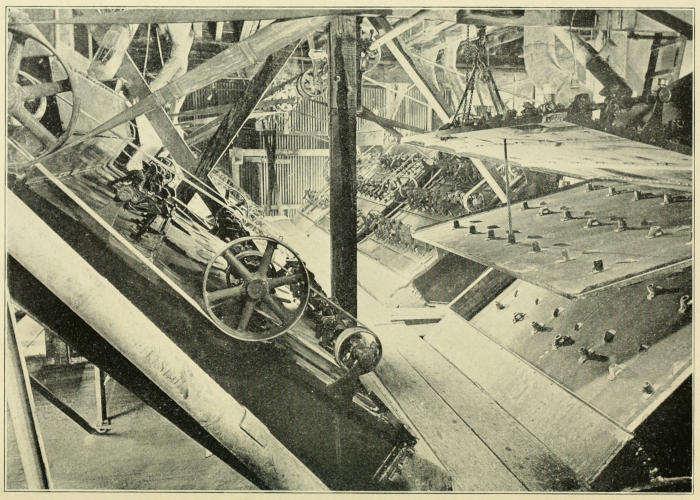
SEPARATORS, ONE OF WHICH IS OPEN—SHOWING THREE SCREENS FOR SEPARATING THE SUGAR GRAINS
The upper screen, called the scalper, is quite coarse and allows all the sugar to fall through except the lumps, which run down the face of the screen into a pipe that carries them to the melt, where they begin the refining process over again. These lumps, however, represent a very small proportion of the whole.
The second screen is finer than the scalper. It permits part of the sugar to pass through, but retains a certain amount which falls down on the face of the screen, whence it is led through a pipe to a special bin. Sugar of this size is known as coarse granulated.
The next screen lets the finer grains drop through, but catches the standard granulated, which in turn is drawn off to its special bin. The last screen, an extremely fine one, retains the extra fine granulated, and this in turn is delivered to its appointed bin. The sugar passing through the last screen is so fine as to be classed as “dust,” which, not being marketable, is usually remelted.
The amount of any one grade of sugar obtained from the separator may be changed, within certain limits, by the boiling in the vacuum pans. If a large proportion of fine-grained sugar is required, the sugar boilers are instructed accordingly. It is impossible, however, to boil all the grains in each strike a uniform size, or to boil any two strikes exactly alike, so the separators are necessary, especially for removing the lumps and dust. The dust is caused by the constant falling of the dry sugar crystals against each other in the driers and granulators, and by the grinding action upon the sugar crystals in the screw conveyors.
PACKING
FILLING VARIOUS KINDS AND SIZES OF CONTAINERS
When putting up his goods, a sugar refiner—like every other manufacturer—must needs cater to the wishes and tastes of the consuming buyer. The modern tendency in containers is in favor of sealed air-tight and dust-proof packages. Some refiners spend great sums of money every year in advertising the merits of special sugars packed in dust-proof cartons. Their rivals generally follow suit, as competition in the marketing of sugar is probably far keener than in any other line of business.
The plain truth is that all refined granulated cane sugar offered for sale in the markets of this country today is almost identical, irrespective of the manner in which it may be packed. The poorest quality of refined sugar made has, in all likelihood, a purity not lower than 99.5 per cent, while the highest grade cannot possibly exceed 99.9 per cent, a difference of only four-tenths of one per cent, hence it is evident that all refined sugars are practically pure, the fancy package simply meaning a fancy price.
The methods of transporting and handling the sugar after it leaves the refinery may justify the additional expense, but this is subject to argument. However, it makes but little difference to the manufacturer, as the cost of the package as well as the extra handling is always included in the selling price.
A few years ago all sugar went out in barrels or bags, while today a modern refinery turns out about twenty different styles of container, and twenty-four kinds of sugar. It is obvious, therefore, that the packing room of a refinery is an interesting place, covering as it does a large area and including a great amount of special, intricate machinery for filling, weighing and sewing or sealing packages.
In the bottom of the bins into which the sugar is delivered from the separators is a series of galvanized iron pipes, through which the sugar runs to the various filling devices, the latter being usually arranged in long rows. Under the end of each pipe is an automatic weighing machine. In packing bags, a workman hangs a bag on the weighing machine and presses a lever, thus allowing the sugar to run into the bag. As soon as the exact amount required is reached, the flow is automatically cut off. These weighing machines are so accurate that they gauge the amount to within a fraction of an ounce. The operative removes the full bag, places it on a conveyor that runs in and level with the floor and quickly adjusts an empty one on the weighing machine. These men become so expert that a single operative will fill two hundred and fifty one-hundred-pound bags per hour. The weighing machines are designed to fill and weigh four hundred and eighty one-hundred-pound bags per hour, but the operative cannot handle them at this rate.
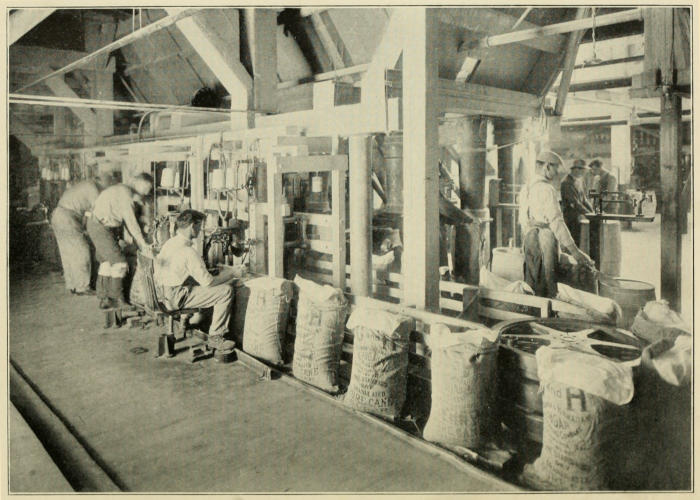
FILLING, WEIGHING AND SEWING 100-POUND SACKS
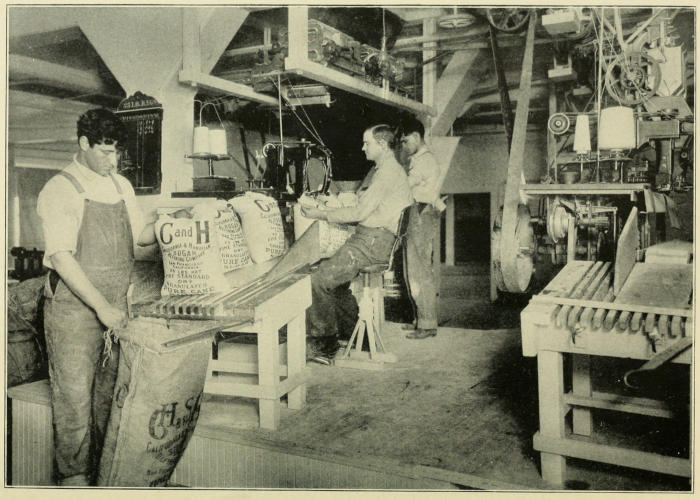
FILLING, WEIGHING AND SEWING 25-POUND SACKS
Four sewing machines, specially designed for sewing the filled bags, are located immediately over the conveyor and in direct line with it. As the bag passes along on the conveyor, the operative at the first machine picks up the end of the inner cotton sack and passes it through his machine, stitching it securely. The bag then passes along to the third machine, where the operative takes hold of the outer burlap bag and sews it in the same manner. Each operative has a spare machine ready for instant use in case the one he is running gets out of order. Continuing its journey to the end of the conveyor, the bag is deposited on the main belt conveyor, which takes it without manual aid to the shipping floor or the storage warehouse. A sewing-machine operative will sew as many as seventeen bags per minute, but it is trying work and the men relieve each other at intervals during the day. Both the one-hundred- and the forty-eight-pound sacks are handled in this manner. Formerly the half sacks weighed fifty pounds, but since the Parcel Post law went into effect they have been changed to forty-eight pounds to permit of their shipment by mail. Those containing twenty-five, ten, five and two pounds are weighed and sewed in much the same way, by the aid of specially designed, rapid-handling machinery. The small package machines will accurately weigh and fill five-pound bags at the rate of twenty-five packages per minute, the others in proportion.
The paper boxes, or cartons as they are called, are weighed and filled by special machinery. This machinery seems to possess an intelligence almost human. One girl feeds the cartons (the tops and bottoms of which are open) into the machine at the rate of thirty-two per minute. The machine glues the bottom, weighs the sugar to within one thirty-second of an ounce, fills the carton, glues the top, seals it and passes it on to a conveyor which delivers the finished package to a table, from which it is packed into a box for shipment. Women are usually employed in putting up the lighter packages.
A short distance from the bag-weighing machines, and running parallel with them, is a line of pipes or spouts for filling barrels. On the floor under each spout is a barrel shaker. This is a heavy cast-iron plate that is lifted about one inch, first on one side, then on the other, by the action of two cams or arms attached to a revolving shaft underneath. The shaker drops back violently on the supporting frame after each lift, causing the sugar to settle compactly in the barrel as it is filled to an average weight of three hundred and fifty pounds. Naturally, the greater the amount of sugar packed in a barrel, the less the container costs per unit of output, and as the average cost of a sugar barrel in the United States is fifty cents, the container cost per one hundred pounds of sugar is 14.3 cents.
Without the shaker, not more than three hundred and thirty pounds of sugar could be put in a barrel, which would increase the cost per one hundred pounds to 15.1 cents. This difference on a single day’s output of two million pounds represents one hundred and sixty dollars, an eloquent argument in favor of the shaker.
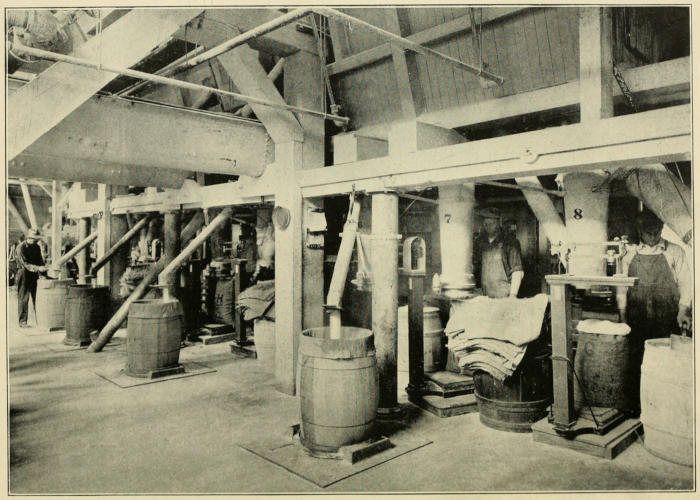
FILLING BARRELS
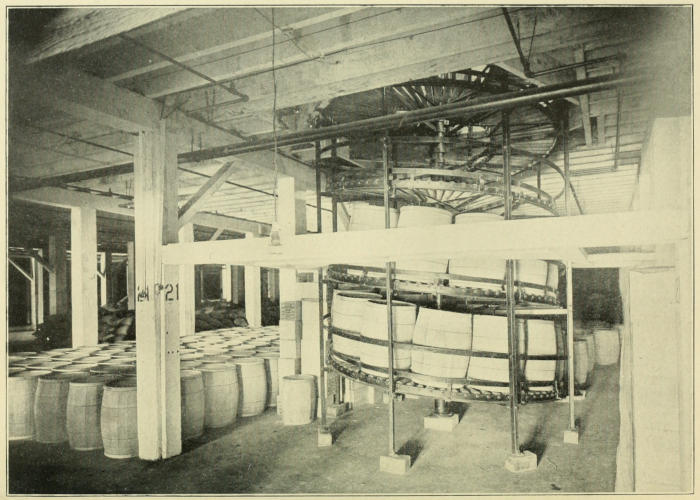
METHOD OF HANDLING BARRELS
In packing barrels, the operative first lines the barrel with heavy paper to prevent the sugar from coming in contact with the rough wooden sides and to keep it from sifting out between the staves. The barrel, thus lined, is placed on the shaker, a valve on the spout opened and the shaking barrel filled to the top. The barrel is then removed and turned over to the cooper, who heads it up and rolls it on the scale for weighing.
Before an empty barrel reaches the packing room, it is weighed and the weight (generally from nineteen to twenty-five pounds) is stamped on its side. The gross weight of the filled barrel is determined by the packing-room scales. The weight of the empty barrel is deducted and the net weight of the sugar stenciled on the head. The full barrel is then sent down a chute to the waiting freight car or to the dock for steamer shipment, or to a conveyor that automatically delivers it to the storage warehouse.
In addition to the bags, barrels, half barrels, cartons and boxes, tins of various sizes are used for the different sugars. All of these are filled and weighed automatically, and taken from the packing room by conveyors. Some of the boxes are lined with paper and some with cotton cloth; some are nailed up in the ordinary way, and others are strapped with iron at each end. As a rule, the individual tins are cased with wood, but sometimes there are a number of tins in a case. Cartons contain two pounds, three pounds or five pounds of sugar. They are packed in fiber cases holding thirty twos, twenty threes or twelve fives and also in wooden cases which hold sixty twos, forty threes or twenty-four fives each. The style of package depends upon the demand of the trade catered to.
At this point a word or two about some of the specialties, such as cube, powdered and bar sugars, as well as yellow or soft sugars, may be of interest.
CUBE SUGAR
The sugar from which the cubes are made is of a rather fine grain, boiled in special pans from liquor that has been filtered over the char at least twice. From the centrifugals under the pan it falls into a hopper in which there is a revolving screw. Directly over the screw is a tank containing a warm, white sugar liquor, very sticky and viscous by reason of its density. A pipe leads from the bottom of this tank to a point over the screw, and the liquor, which is controlled by a valve, is allowed to drip upon the sugar. The action of the screw causes the sugar and the liquor to become thoroughly mixed and feeds the damp mass thus formed into a spout leading to the cube press, the machine in which cube sugar is made.
At the top of this machine is another hopper, into which the damp sugar drops from the spout overhead, and revolving in the last-mentioned hopper are a number of small shafts with brass pegs inserted at certain intervals along the length of the shafts, like spokes in the hub of a wheel. These pegs are like human fingers in their action and they press the sugar down into the pockets of a large revolving drum placed directly under the hopper. Each pocket is the size of a cube or half cube. Working in these pockets are plungers, which fall back as the revolving drum reaches the highest point directly under the mechanical fingers in the hopper. The fingers fill the open pockets and, as the drum turns, the plungers, at a certain point in its circumference where a heavy bronze bar is placed across its face, slowly enter the pockets and in so doing compress the sugar into cube form.
Two belts run through the machine under the cylinder, carrying galvanized iron plates about twenty-four inches wide, or the same width as the cylinder, and thirty inches long. As the line of pockets into which the sugar has been pressed reaches the lowest point on the circumference of the drum, the plungers drop down, forcing the pressed cubes out of the pockets onto the galvanized iron plates which the moving belt carries along out of the way of the next lot coming from the cylinder. Each plate, as it leaves the cube press, contains five hundred and four cubes and one hundred and sixty-eight half cubes, and the time required to fill a plate is between six and seven seconds.
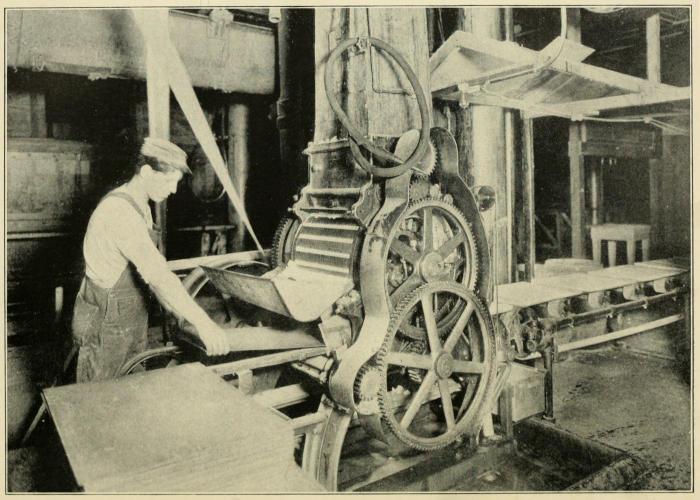
CUBE-SUGAR MACHINE
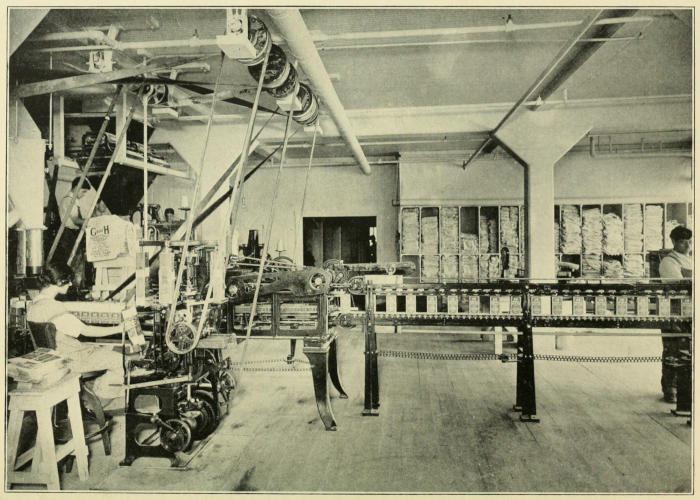
CARTON MACHINE
The belts carry the plates to a series of ovens, or driers, so placed that a large number of plates with their contents may be inserted through a door on the belt side. When the ovens are filled with plates holding the soft, moist cubes, a current of hot air is turned on at the top of the ovens, passing out at the bottom. The hot air circulating in this manner dries the cubes and carries off the moisture. Eight hours in the ovens suffice to render the cubes thoroughly dry and hard. They are then removed through doors opposite to those through which they were put in. This arrangement prevents the men who are putting the cubes into the ovens from interfering with those taking them out, for the process is a continuous one and cubes are placed in and removed from the ovens at the same time. As the cubes are taken out of the ovens, they are deposited on a belt conveyor which delivers them into bins in the packing room, ready to be put into boxes, bags, barrels and other containers.
POWDERED AND BAR SUGAR
Powdered and bar sugars are made by grinding coarse granulated sugar into fine particles and then separating these particles by screening them through fine silk cloth. The bolting of flour is a similar process. Powdered sugar has a decided tendency to cake and become hard, and the coarse sugar from which it is ground should be particularly free from moisture. After being crushed or ground between corrugated rolls turning at high speed, the ground sugar passes into a screening or sifting device, of which there are many kinds in use, the most common being the horizontal, revolving centrifugal screen. The crushed sugar goes in at the head end, and, as it enters, a number of revolving arms throw it against a silk screen on a circular frame, revolving in an opposite direction, that permits the finest, or powdered, sugar to pass through a silk cloth having over sixteen thousand openings per square inch.
The powdered sugar extracted, the remainder drops into another screen where a similar sifting action takes place, the silk of the second screen being coarser than that of the first, and bar sugar is the result. Such grains as are too large to pass through the bar screen are carried back to the rolls and reground. The bar screen has about five thousand openings per square inch.
Bar sugar, as the name implies, is generally used in preparing beverages. It dissolves almost instantly when dropped in water. Singularly enough, the average housewife is not aware of the advantages attending the use of this grade of sugar. It does not become caked as readily as powdered sugar does, and is the ideal sweetening for berries and cereals served at the breakfast meal. It is far more desirable than powdered sugar for most of the purposes for which the latter is commonly used.
It is believed by many that all powdered sugar is adulterated with chalk, starch, white corn meal or similar substances. Such is not the case, and it is safe to assume that no mixing whatever is done by any refiner in America. Powdered sugar has a strong tendency to cake or become hard, and some manufacturers who buy coarse granulated sugar from the refiners for grinding purposes use starch to the extent of from two to three per cent. Chalk is never used, nor are other non-edible or deleterious substances. Starch is not introduced for the purpose of making a greater profit, but to prevent the powdered sugar from caking. The adding of starch, in all probability, increases the cost of making powdered sugar, as starch costs almost as much as sugar, and the expense of handling it and feeding it into the grinding machinery is quite an item.
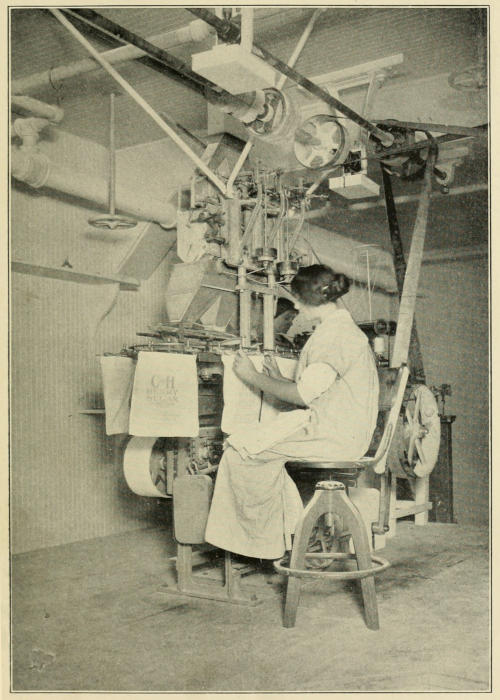
FILLING, WEIGHING AND SEWING 2-POUND, 5-POUND AND 10-POUND BAGS
YELLOW SUGARS
Yellow sugars, or “softs” as they are usually called, comprise fifteen grades, ranging in color from a creamy white to a dark brown. These sugars are used chiefly by bakers in making gingerbread, pies and cakes, although a small quantity finds its way directly into households for ordinary domestic consumption.
The characteristics of yellow sugars are that they have a small grain and contain a sufficient amount of molasses to make them moist to the touch, properties brought about by a radically different method of boiling from that applied to white sugars. They also contain a certain amount of invert sugar which preserves the softness of grain and prevents subsequent caking or hardening.
To properly explain how yellow sugars are boiled, reference must be made to the method of boiling white sugars, which may be briefly summarized as follows:
The object to be attained in boiling white sugars is the separation of the crystallizable sucrose contained in a given solution from the impurities, moisture and non-crystallizable content of that solution. The formation of sugar crystals is a natural result of the evaporation of the moisture from the liquor or solution. In order to obtain pure white crystals, it is vitally essential that, as far as possible, all impurities and non-sugars, except water, be removed from the liquor before the boiling takes place, for if the coloring matter is not thoroughly taken out, obviously the crystals will be colored. The purifying and decolorizing operation is accomplished in the char filters. After the grain is once formed in definite crystals, these crystals attract and appropriate the sucrose in solution in the process of building up their structure, while repelling or excluding the impurities, so that in consequence the latter remain in solution. Irrespective, however, of whether crystallization of sucrose takes place in solutions of high or low purity, it will only partially remove the sucrose from the solution in one operation, the limit being fixed by the amount and nature of impurities present. In order to bring about further crystallization of sucrose the solution or mother liquor surrounding the crystals must be separated from them and be again diluted, filtered and concentrated.
Briefly, the procedure in boiling white sugar in a vacuum pan is to take liquors of the highest purity for the first boiling. After the first crystals have been removed from the mother liquor in the centrifugal machines, the liquor is again diluted, decolorized by bone-char and boiled to grain. This operation is continued a number of times, the purity of the liquor decreasing each time. Finally, when the purity of the liquor falls to a certain point, the boiling is discontinued, for at this point conditions do not admit of further formation of pure sucrose crystals, and, if the process were pursued further, the resulting sugar would not be white. Therefore, when this state is reached, these low-grade liquors are boiled into a semi-refined sugar, commonly called “refinery raw,” which corresponds fairly closely in test with the original raw sugar, or they are used for making soft yellow sugars as explained later on. This refinery raw is then washed, melted and put through the whole process all over again. The liquor, from which the crystals formed in repeated boilings have been removed as made, at length becomes so charged with impurities that further crystallization of sucrose is impossible and this residue, or final waste, is known as blackstrap molasses.
This manner of boiling white sugar has been called the “out and out” method, in contradistinction to the “in and in” method employed in boiling soft yellow sugars, of which a few words of explanation now follow.
In boiling soft yellow sugars, the aim is to produce a large number of small sucrose crystals having the property of attracting and combining with the molasses content of the liquor and that will retain some of the molasses after they are purged of mother liquor in the centrifugal machines. This process gives a sugar that may be described as a mechanical mixture of sucrose, invert sugar and the non-sugars in the molasses.
In the case of yellow sugars, the lighter the color the better price they bring. The greatest profit, therefore, is derived from the manufacture of sugars of the lightest color and carrying a reduced percentage of sucrose. In boiling such sugars, low-purity liquors from which the coloring matter has been removed as far as practicable by bone-char filtration are required. For the purpose, it is generally found most advantageous to use the liquors taken from white sugar massecuite at the point when, owing to repeated boilings, its purity has fallen so low that further extraction of pure white sucrose crystals is impossible.
As a result of the numerous filtrations through bone-char preparatory to reboiling in the manufacture of white sugar, these liquors are usually lighter in color than any of corresponding purity obtained in the refining process. Nevertheless, they are not necessarily the only liquors suitable for the purpose, and this particularly applies to the making of the lower grades of yellow sugars. It is, however, beyond the scope of this book to elaborate upon that phase of sugar refining. The object sought here is to give a general idea of how yellow sugars are boiled, without going into all the details.
As is the case with white sugars, yellow sugars are made by a succession of boilings in vacuum pans, the liquor used for each boiling or strike being that obtained from the massecuite of the previous strike. The operation is continued until the liquor becomes too low in purity and dark in color. Each successive strike boiled is lower in test than the preceding one, due to the fact that the sucrose crystals represent the purest part of the massecuite, and, consequently, each time they are removed the quality of the liquor is lowered. This accounts for the various grades of yellow sugar that are made, fifteen in all, starting with a creamy white and ending with a dark brown. The sucrose content of the best is about 92 per cent and that of the poorest about 80 per cent.
In making white sugars, the aim is to produce from liquors of high purity sucrose crystals that are pure white, hard and absolutely free from molasses.
In making yellow sugars, the object is to boil from low-purity liquors soft sucrose crystals that possess the property of attracting and retaining the molasses and to make this combination of crystals and molasses as complete as possible.
The essential difference between the two methods, as well as the appropriateness of the descriptive terms “out and out” and “in and in,” will be readily apparent.
The impurities in yellow sugars are natural and consist of invert sugar, glucose, organic non-sugars and salts, all of which were originally present in the raws or were formed in the process of refining.
It is not unusual to hear it said that yellow sugars are sweeter than granulated. To the average palate this is apparently so, but, as has been shown, granulated sugar contains 99.8 per cent of sucrose or sweetening matter, while the highest grade of yellow carries only 92 per cent. Soft sugars dissolve more readily on the tongue than granulated, and the syrup or molasses in them accentuates their sweet taste.
There are several other grades of sugar prepared for the consuming market, but lack of space precludes a description of them or the methods by which they are produced.
MECHANICAL DEPARTMENT
It is needless to say that the conveying, melting, filtering, boiling, drying, screening, weighing and packing of one thousand tons of sugar in twenty-four hours necessitates a great amount of steam and a multiplicity of machinery.
The boilers generate steam to drive huge pumps that deliver cold salt water to the condensers throughout the refinery, to drive vacuum pumps that make boiling and evaporation in vacuo possible, and to drive large turbine or reciprocating engines that supply the electric power. The exhaust steam as it leaves the cylinders has a pressure of about fifteen pounds per square inch. It is conducted through pipes to the evaporators, pans, driers and tanks, where it is again used for concentrating the liquors, boiling in the pans, drying the sugar and keeping the liquors hot throughout the process. It leaves the various heating coils and tubes as hot water and is returned to the boilers for the generation of more steam.
Live steam, that is to say, steam just as it comes from the boilers, is used extensively in the vacuum pans for boiling the liquor to grain.
A refinery melting one thousand tons of raw sugar each day requires about 5500 boiler horse power. On the Atlantic coast coal is the fuel used, while on the Pacific coast oil is burned. The amount of fuel consumed in different refineries varies to some extent, but a fair average per ton of raw sugar melted is one and one-third barrels of oil, or one-third of a ton of coal.
In modern plants all the moving machinery, except the pumps and main engines, is usually driven by electric motors. This does away with many dangerous belts, as well as expensive transmission machinery. The motor drive is simple and efficient and therefore used extensively.
The mechanical department is under the general supervision of the superintendent, but in direct charge of a mechanical-electrical engineer. This man is known as the chief engineer, and he is directly responsible, not only for the operation of all the machinery in the plant together with its upkeep and repair, but he has also to cope with engineering problems that are constantly arising. Under his direction, a corps of draughtsmen is always busily engaged in planning and designing improvements and additions. He also maintains a force of mechanics, watching, operating and repairing the machinery. These men represent almost every trade, including machinists, blacksmiths, coppersmiths, tinsmiths, millwrights, boilermakers, riggers, masons, painters and many others.
The diversity of the mechanical work around a refinery is remarkable, and the engineer in charge must be a man of exceptional mechanical ability, as his duties include not only steam, electrical and civil engineering, but construction engineering of an advanced character. As refineries are always built on sites bordering on deep water, harbor engineering problems are also constantly before him.
In connection with every refinery there are many shops, where mechanical work incidental to repairs and construction is carried on. These shops are equipped with the necessary tools and implements for quick repairs and are under the supervision of the chief engineer. In addition, there is the cooper shop where many thousands of barrels are turned out daily, and the bag factory where twenty cotton bags and twenty burlap bags must be made for each and every ton of output packed in that manner.
The mechanical department of a modern refinery is as important as it is extensive, for failure in any one of its branches means costly delays. The machinery is run twenty-four hours each day, except Sundays, during about eleven months in the year. The plant is closed down the remaining thirty days for annual cleaning and repairs.
Intelligence and ability, tempered with good judgment, bring about the esprit de corps that gives the necessary results. The mechanical is almost as important as the chemical department and, as before stated, it is subject to the general supervision of the chemical engineer.
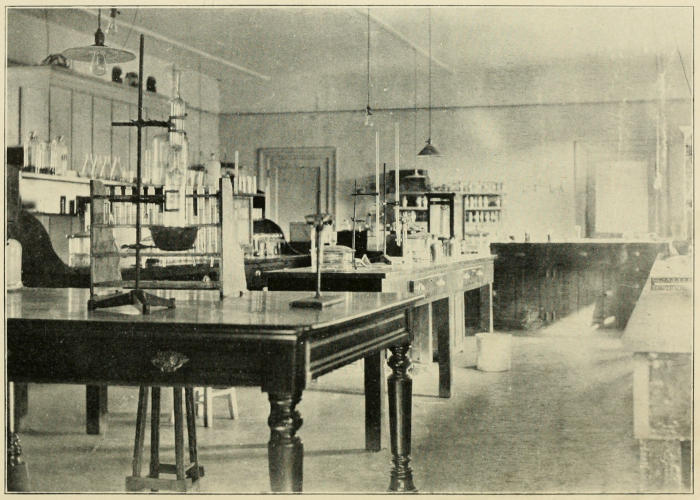
LABORATORY
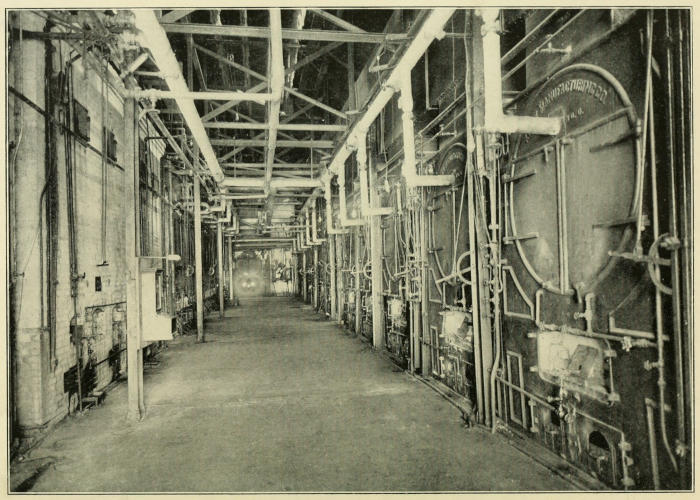
OIL-BURNING BOILER PLANT
LABORATORY
The chemical laboratory is really the heart of the institution, for upon it depends the success of every manufacturing operation. The superintendent of a refinery must possess a thorough knowledge of chemical engineering, for the process of sugar refining is largely chemical from beginning to end.
Competent chemical engineers, as distinguished from chemists, are rare, and yet their calling offers more promising prospects to young men than most other professions do today. It is clear to the intelligent observer that in these times of intensely keen competition, the manufacturer will, sooner or later, inevitably be driven to seek a considerable percentage of his profits in the utilization of by-products that now go to waste or bring but little return. The men to solve the manufacturing problems of the future will be chemical engineers. Broadly speaking, comparatively little has been done in this field in the United States, and its possibilities are incalculable.
In the laboratory, day and night, a corps of chemists is constantly engaged in the study of questions that arise in connection with the operation of the various departments. Polarizations for account of buyers and sellers of all raw sugars purchased, are made and checked there; hundreds of samples of liquors and syrups are tested daily for control work, as the purity of both must be known at all times and a record kept of their temperatures and densities. Samples of all the sugars entering the refining process, as well as of the finished product, are carefully analyzed, and upon these analyses are based elaborate calculations regarding yield and efficiency. The wash waters from the char filters are examined and tested frequently, the bone-char is tested every twenty-four hours as a check upon the process of revivification in the kilns, and once a month the bone-char is completely analyzed to determine the deterioration that has taken place in it.
Tests are made of materials used in the refining process, such as lime, soda, acids and lubricating oils; of the feed water for the steam boilers; of the fresh water used throughout the plant; and of the fuel, whether coal or oil. Even the gases from the fires under the boilers are tested as they pass through the smokestack, in order to determine whether or not the firemen perform their duties properly.
Taking all this in conjunction with frequent tests and experimental work on driers, condensers, evaporators and other apparatus, it will be seen that there is plenty to keep a large staff of chemists fully occupied.
In refinery work, what is to be feared more than anything is the house becoming “sour.” Raw sugars and sugar liquors, and particularly the sweet waters, have a tendency to ferment, and fermentation, like fire, if not checked and brought under control before it gains much headway, soon pervades the entire establishment, affecting all the liquors and syrups, thus turning the sucrose or sugar into glucose, which cannot be recrystallized. In a refinery of two million pounds daily capacity, there is double this quantity of sugar in the house in the form of liquors, syrups, sweet water, massecuite and raws. If all of this four million pounds turned “sour,” the money loss, with raw sugar worth four cents a pound, would be about one hundred and sixty thousand dollars. Such a contingency, while remote, clearly demonstrates that chemical control is an absolute necessity.
COST OF REFINING
In concluding that part of the story that deals with refining, some reference may be made to the refining cost and to the price at which refined sugar is sold.
The cost of refining sugar varies in different parts of the United States on account of the difference in the cost of commodities entering into the refining process, such as labor, fuel, cotton, burlap, containers, bone-char, etc. On the Pacific coast nearly all these items are higher than in New York, and consequently the cost of refining is probably greater.
In 1911 nearly all the sugar refiners of the United States appeared before the Hardwick Congressional committee at Washington and the testimony given by them before that body showed that the cost of refining ranged from 60 cents to 65 cents per 100 pounds.
On the day the Congressional committee began its investigation, raw sugar was selling in New York for 3.86 cents per pound, and the testimony regarding the cost of refining was no doubt based on this price for the raw sugar entering the refining operations.
It is therefore fair to assume that under normal conditions, with raw sugar at about 3¾ cents, the average cost of refining in the United States is 62½ cents per 100 pounds. This includes every item from the time the raw sugar is landed on the dock until the refined is loaded on the cars or boats for shipment. It includes the selling and overhead expenses, but not the transportation charges after the sugar leaves the refinery.
During the last six years (1909-14 inclusive) the actual differential in the United States between the purchase price of raw sugar and the selling price of refined has been 82½ cents per 100 pounds. The difference between this figure and the cost of refining represents the refiner’s gross profit; in other words, about 20 cents per 100 pounds, out of which he must pay for all additions and improvements to his plant. The remainder is available for returns on capital invested. This difference varies with the time of year and in different localities, but the average will probably hold good.
A refiner of cane sugar buys his raw product in the open market and must pay for all his operating and administration expenses and obtain his profit from the margin between the buying price of raw and the selling price of refined sugar. The cost of refining is not constant, as it varies with the fluctuating values of fuel, containers, labor, and particularly the cost of raw sugar. If it costs 62½ cents per 100 pounds to refine sugar with raws at 3.86 cents per pound, it will cost about 82½ cents per 100 pounds with raw sugars at 6 cents, assuming that such items as fuel, containers, labor, etc., remain constant. This is due to the greater value of the raw sugar lost in refining, to the heavier insurance premiums and higher interest charges. With high-priced raws, the margin between raws and refined must be proportionately greater to offset the increased cost of refining.
The refiner, like the consumer, would prefer to see sugar selling on a low basis, while the producer always hopes for the opposite.
SHIPPING DEPARTMENT
Here will be found every modern convenience for the rapid loading of cars and steamers. Adequate railway trackage is provided for the handling of shipments moving by rail, and on the waterfront side of the warehouses there is ample berth room for steamers that carry the sugar to cities and towns on the inland waterways and the seacoast, together with points tributary thereto. Facilities are also at hand for local delivery by drays.
Railroad cars are sometimes sent to refineries by water, on car barges, to be loaded with sugar and then towed to what are known as railroad terminals, where the cars are taken from the barges and started on their journey to destination. The capacity of a car varies from twenty-four thousand to one hundred thousand pounds. If an amount of sugar equal to that consumed in the United States in 1915 were loaded into cars containing 1000 sacks of 100 pounds each, it would require 81,087 cars, which would make up a train 768 miles long.
A large part of the product is delivered direct from the packing-room conveyors into the waiting cars and steamers, thus avoiding unnecessary handling. A single shipment frequently includes a number of different styles of package, and great care must be exercised to insure accuracy in count and description.
As dry granulated sugar readily absorbs moisture, every precaution must be taken to make the storage rooms thoroughly damp-proof, so that the sugar may always be in good condition when shipped from the refinery.
Shipments are made only on written orders from the sales department to the head of the shipping department. These orders set forth the name of the buyer, the kinds and quantity of sugar desired, the point to which the sugar is to go, the route by which it is to travel, the date on which it is to be shipped, and the terms of sale. At the proper time the sugar is loaded, shipped, and in due course delivered to the buyer.
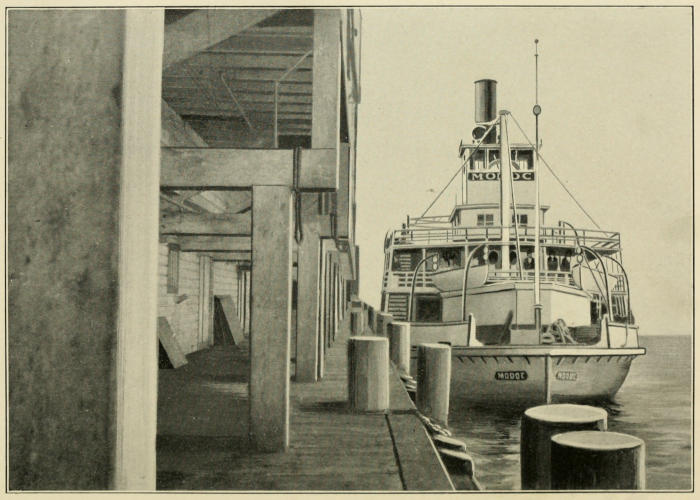
INLAND-WATERWAY STEAMER LOADING SUGAR AT REFINERY DOCK
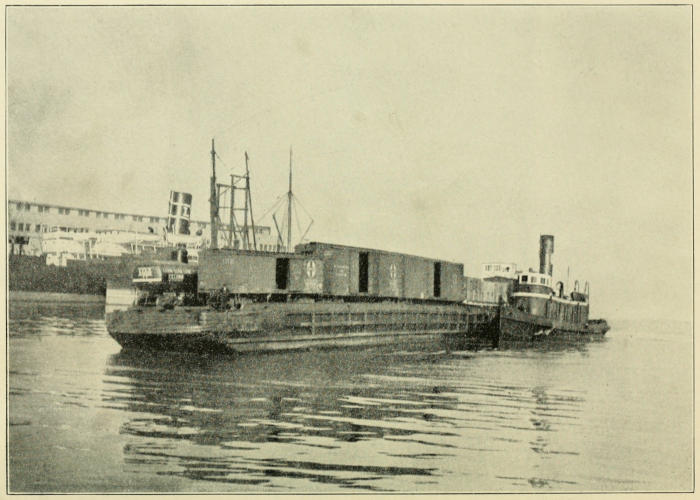
CAR-FLOAT ARRIVING AT REFINERY DOCK
MARKETING
The amount of sugar used in the United States in 1915 was 4,257,714 short tons. Of this, 3,389,175 tons were raw cane, the remainder consisting of 861,568 tons of domestic beet and 6,971 tons of foreign refined cane and beet. Of the 3,389,175 tons of raw cane, 150,000 tons were consumed in the raw state, and from the remainder, 3,239,175 tons, about 3,044,825 tons of refined sugar were produced. The per capita consumption was 83.83 pounds, and was made up of:
SHORT TONS PER CENT
Refined made from raw cane 3,044,825 74.94
Domestic and foreign beet 862,694 21.23
Foreign refined cane 5,845 .14
Consumed in the raw state 150,000 3.69
4,063,364 100.00
Among articles of food that contain a large percentage of sugar are jams, jellies, chocolate, canned fruits, condensed milk, confectionery, chewing gum and cordials. It is estimated by Willett & Gray that in 1915 the direct per capita consumption was 31.43 pounds, and that the remaining 52.40 pounds were used in various prepared or manufactured foodstuffs. Over ninety-nine per cent of all the cane sugar consumed in the United States is refined in New York, Boston, Philadelphia, New Orleans and San Francisco. The beet comes chiefly from California, Colorado, Michigan, Utah and Idaho; the maple from the New England states, Ohio and Canada; and the small amount of full duty-paying foreign cane from Java, Peru, Mexico, Central America and Santo Domingo.
During the past eleven years the consumption in the United States has grown at an average rate of 3.57 per cent per annum. In 1911, on account of the abnormally high prices, the increase was practically nil.
The annual per capita consumption of sugar in some of the other countries of the world is as follows:
1914
Servia 4.60 lbs.
Greece 8.99 ”
Bulgaria 9.94 ”
Italy 10.45 ”
Portugal 13.60 ”
Spain 15.91 ”
Roumania 17.12 ”
Turkey 20.33 ”
Russia 29.26 ”
Finland 32.54 ”
Austria-Hungary 37.38 ”
France 39.01 ”
Belgium 42.79 ”
Holland 53.44 ”
Norway 60.37 ”
Sweden 60.48 ”
Switzerland 74.87 ”
Germany 74.95 ”
England 89.69 ”
Denmark 93.48 ”
The sale and distribution of large quantities of refined sugar is a serious problem and just as important as the production and the refining of the raw product. Competition is so keen, and the questions involved so complex, that the sale of the product really results in commercial warfare.
To dispose of the output of a large plant successfully requires great intelligence, a broad grasp of business principles, strict honor and integrity, and prompt, decisive action in times of fluctuating markets.
Sales managers of the sugar-refining companies of the United States command high salaries, for the success of the business depends to no small extent upon their ability and judgment. Their knowledge of human nature must be broad and sound and it is tested to the utmost in their selection of assistants and brokers, for representatives always reflect the ideals, principles and methods of the parent authority.
The selling of sugar by the refiner direct to the consumer has not been found practicable, as an organization complete enough to keep in touch with consumers in every city, town and village of the country would be so top-heavy and costly to maintain that the price of the commodity to the consumer would be needlessly increased.
As matters stand, people living in the frozen valleys of Alaska, in the scarcely accessible regions of the Rocky mountains and in the lumber and mining settlements of the West, many miles from railroads, can obtain their supply of sugar with almost the same facility as the residents of New York or San Francisco. A system of distribution that makes this possible leaves little to be desired, and a word or two concerning it will be timely at this point.
Sugar is sold by the refiner to the wholesale grocer through the medium of the refinery’s broker. From the wholesaler it goes to the retailer, who in turn delivers it to the consumer.
Brokers are important factors in distribution. In every large city and consuming center, each refinery is represented by its own brokers, who keep in constant touch with all the wholesale grocers and manufacturers of their district.
A thorough knowledge of men and methods, sound business principles, diplomatic talents of no mean order and the capacity to act rapidly, but coolly, in business crises are found combined in the successful broker. He occupies a position between the seller and buyer, and it is just as much his prime duty to see that in all transactions full justice is accorded to both as it is to sell the sugar.
Every refinery having its own broker in each consuming center, it follows that the competition for business among the brokers is very keen. When a broker obtains an order from a jobber or manufacturer, he telegraphs it to his principal. The order is usually confirmed and the goods shipped promptly. For his services the broker receives three cents for every one hundred pounds of sugar sold. This compensates him for the services of his salesmen and himself, his office expenses and cost of telegrams, which is heavy.
Manufacturers of foodstuffs of which sugar is an ingredient, buy their supplies through brokers. They do not resell the sugar as such, but use it only in the manufacture of their own special products.
Wholesale grocery jobbers, of whom there are about twenty-five hundred in the United States, are also very important factors in the distribution of sugar. As a rule, they are located in the large centers of population, and have efficient organizations for the purchase and resale of all kinds of foodstuffs. They deal in as many as three thousand different commodities, and their expense of doing business is apportioned over all of these items, thus reducing to a minimum the expense of handling any one of them. Generally speaking, they have large establishments where stocks of all kinds of goods are carried ready for immediate distribution. The aggregate capital tied up in these stocks throughout the country is enormous, but necessary, as the jobber must at all times be ready to deliver to the retailer whatever is wanted in any of his lines. Wholesale jobbers occupy a unique position in the scheme of things. They are to the commerce of the country what the bankers are to its finances. In other words, they are the bankers of commodities. Their operating staff consists, first, of the buyers, and, second, of the salesmen.
The buyers are men possessing special knowledge concerning the various articles handled by the house. For instance, in the grocery line one will buy nothing but teas and coffees, another canned goods, another sugar, and so on. These men as a rule have devoted years of study to the particular commodity which they are delegated to buy. They are shrewd, keenly alert and always ready to take advantage of market fluctuations in their favor. The margin of profit between the buying and selling price of any commodity is usually so small that the acumen of the buyer is an important factor in the final results.
The salesmen are trained, tactful, tireless and efficient. They travel from town to town and place to place, visiting every nook and corner where human beings congregate, in order to sell the goods carried by the firm. While his calling is a most useful one, the life of a “knight of the grip” is not always pleasant, as he meets with many deprivations and discomforts.
To compensate him for capital invested, for the expense of doing business and for the losses he incurs in bad debts and declining markets, the jobber probably obtains a gross return of fifteen cents on each one hundred pounds of sugar he sells.
The next important link in the chain is the retailer. It is roughly estimated that there are three hundred thousand retail grocers in the United States, many of whom handle and distribute almost as many articles as the jobber. Their lot on the whole is not cast in pleasant places, because of the severe competition they meet in selling their goods.
Competition is a word regarded almost with affection by the buyer, but for the seller of goods it is probably the most unpleasant one in the English language. There is an old axiom which reads: “Competition is the life of trade.” It may be so, but the expression was no doubt coined by a buyer.
Among sellers, competition is in direct proportion to the number engaged in any particular business. It therefore follows that as there are three hundred thousand retailers in the United States, and hundreds in each of all the large cities, the struggle to keep on their feet and continue their various enterprises must be severe. The number of failures occurring every year amply substantiates this assertion. Reckless and unscrupulous men engage in every business, and the competition thus forced on all others in their line is not only unfair, but positively dishonest. Any individual can break a price or introduce new and expensive experiments in selling terms, which must be followed with equally attractive terms by the other sellers, thus resulting in great loss to all. It is no satisfaction that such men finally fail and go out of business, for the losses sustained in the interim can never be recovered.
Another grave difficulty with which the retailer has to contend is the fact that the average individual to whom he delivers his wares is apt to be rather callous when pay-day comes around. It is sad, but true, that those best able to pay are sometimes the most unsatisfactory customers of the retail grocer.
A retailer’s expense of doing business is proportionately much greater than that of the wholesaler, and his losses, due to bad or uncollectible accounts, are much heavier. The cost of delivering goods to the consumer’s door is high, and a fact that should be remembered, but which is frequently overlooked, is that it costs the grocer just as much to deliver a five-pound package of sugar as a wagon-load. Householders are proverbially careless, and telephone calls for late and urgent deliveries are a source of great annoyance and expense.
To create a pleasing impression, the grocer must keep a clean, sanitary store, and the expense incident to attractive window and shelf displays to invite attention is an important item. Department and other stores in his town or neighborhood often advertise “leaders” to attract the buying public, in the hope of selling with these leaders other goods at a profit, or because they are overstocked with a particular commodity. Every retailer must, as a rule, meet this unfair competition or lose his trade.
Sugar more than any other staple article is used as a leader, and, as a result, the retail grocer’s profit on it is very small. What remains to him out of the selling price of one hundred pounds of sugar does not exceed thirty-five cents, and more than likely it has cost him twenty-five cents to sell it. It is the retail grocer’s employé who delivers sugar in the quantity desired to the housewife at her door, and through her hands the pure, glistening crystals reach the family table.
BEET SUGAR
SHORT REVIEW OF THE HISTORY OF BEET SUGAR
The extraction of sugar from beets dates back to 1747, when Andreas Marggraf, professor of physics in the Academy of Science of Berlin, discovered the existence of a sugar in beets similar in its properties to that obtained from cane.
The discovery was little utilized at first, however, and the manufacture of sugar from beets did not attain commercial importance for over half a century, when Franz Karl Achard, a pupil of Marggraf, made discoveries which led to the construction of the first beet-sugar factory in the world, in Silesia, in the year 1799.
The work of Achard soon attracted the attention of Napoleon Bonaparte, who appointed a commission of scientists to go to Silesia to investigate Achard’s factory. Upon their return, two small factories were constructed near Paris. Although these two factories were not altogether a success, the results attained greatly interested Napoleon, and in 1811 he issued a decree appropriating one million francs ($200,000) for the establishment of sugar schools, and compelling the farmers to plant a large acreage to sugar beets the following year. He also prohibited the further importation of sugar from the Indies after January 1, 1813.
As a result of these and other drastic decrees, three hundred and thirty-four factories were erected in France during the years 1812 and 1813, and their production was seven million seven hundred thousand pounds of sugar, or an average of eleven and one-half tons to the factory.
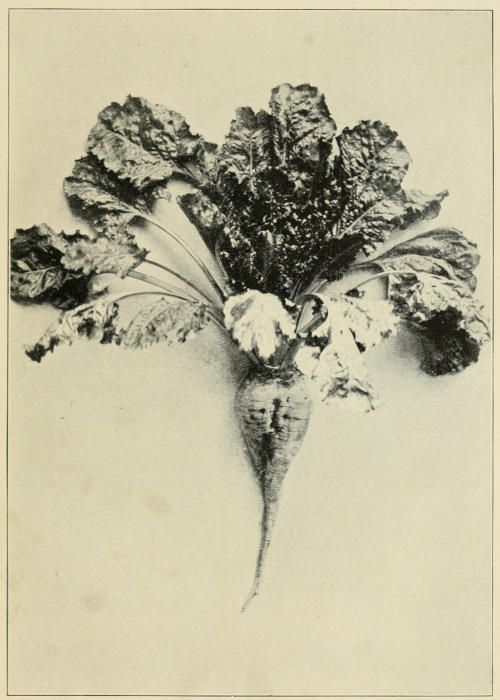
By permission of Truman G. Palmer, Esq.
SUGAR BEET
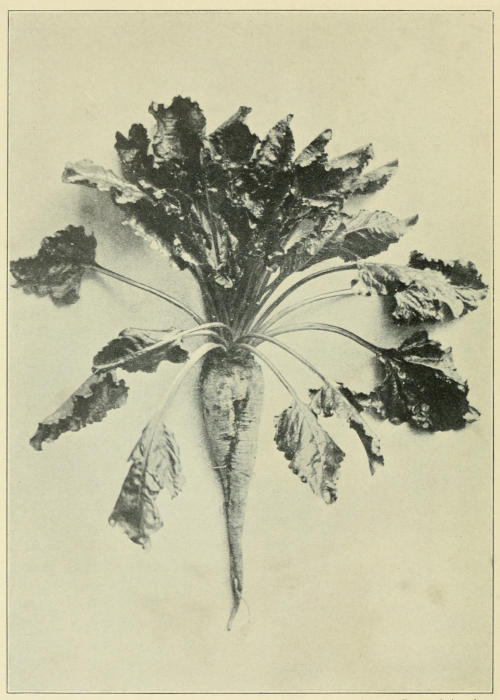
By permission of Truman G. Palmer, Esq.
ANOTHER TYPE OF SUGAR BEET
With the fall of Napoleon Bonaparte, disaster came upon this, one of his greatest achievements, and but one factory survived. The industry was destined to flourish again, however, under the reign of Louis Philippe. In 1836-37 there were five hundred and forty-two factories in France, producing thirty-five thousand tons of sugar, as compared with fourteen hundred and eight tons in Germany, which country had only recently begun the culture of beets.
When Napoleon III became emperor, he so stimulated the industry that in 1853 the French output had doubled. Meanwhile the Germans were making rapid strides, and in 1880 the German output of sugar exceeded that of France. As a result of legislative encouragement, Germany today is the largest beet-sugar producer in the world.
The first successful beet-sugar factory in the United States was constructed by E. H. Dyer, at Alvarado, California, in 1879. The next successful factory was erected at Watsonville, California, in 1888, by Claus Spreckels. The Oxnard brothers followed with the construction in 1890 of a factory at Grand Island, Nebraska, one at Norfolk, Nebraska, and a third at Chino, California, the last built in 1891.
From this it will be seen that the commercial production of beet sugar in the United States really dates back to about 1890, since only three factories of small capacity had been established prior to that date. The development of the industry since the year 1892 has been rapid, and the general results of the beet industry in the United States in 1915 showed the following:
Factories in operation 67
Acres of beets harvested 611,301
Average yield of beets per acre 10.10 short tons
Beets worked 6,150,293 ”
Sugar manufactured 874,220 ”
The season of 1916 promises a notable increase in tonnage.
THE SUGAR BEET
The botanical name of the sugar beet is Beta vulgaris. It grows exclusively in the temperate zone, and with satisfactory soil and climatic conditions a yield of thirty tons per acre has resulted. The average yield in the United States, however, is slightly over ten tons per acre. There are many varieties of beets, some of which do better in one locality than another, so that great care must be used in the selection of the seed.
The beet, unlike sugar cane, grows below the ground, is white in color and shaped like the ordinary carrot, but larger. The beets vary greatly in size, depending upon variety, soil and climatic conditions, the average weight ranging between one and two pounds.
The foliage has a rich, brilliant green color and grows to a height of about fourteen inches. The leaves are numerous and broad and grow in a tuft from the center or crown of the beet, which is usually level with or just above the ground surface.
The average composition of a sugar beet is about as follows:
Sugar 17.3 per cent
Marc or pulp 4.4 ”
Ash and organic non-sugar .7 ”
Water 77.6 ”
The value of the beet to a factory depends on the amount and purity of the sugar content. Factories as a rule decline to purchase beets containing less than twelve per cent of sucrose, as it is unprofitable to handle them. In order to induce the farmer to devote particular care and attention to the culture of his fields and thus increase the sugar content, the factories pay a premium for beets containing over fifteen per cent of sugar. The premium is usually twenty-five cents per ton of beets for each additional one per cent of sugar. Encouraged by this bonus, the California grower has improved the quality of his beets, until today they contain on an average about eighteen per cent of sugar of a purity from eighty to eighty-four.
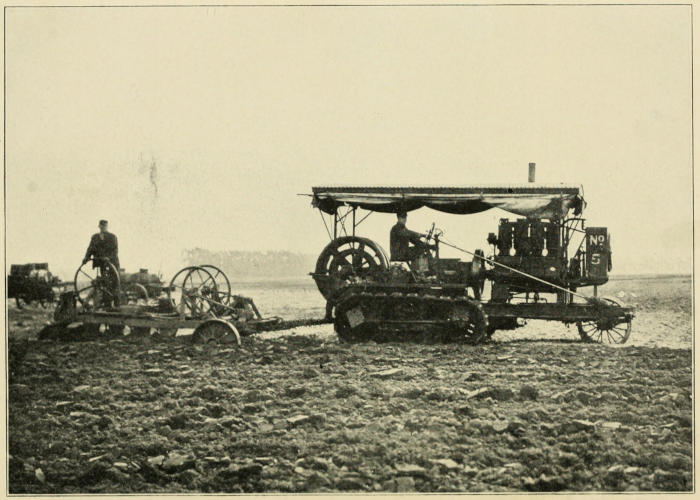
By permission of Truman G. Palmer, Esq.
PLOUGHING WITH CATERPILLAR ENGINE
By permission of Truman G. Palmer, Esq.
PLANTING BEET SEED
SELECTION OF THE SOIL
The sugar beet, like sugar cane, needs a peculiar soil and climate for its successful cultivation. The most important requirement is that the soil shall contain a large supply of plant food, be rich in humus and have the property of retaining a great deal of moisture. A certain amount of alkali is not necessarily detrimental, as sugar beets are not especially susceptible to injury from this salt. The ground should be fairly level and well drained, especially where irrigation is practiced.
While the physical character is of secondary importance, as generous crops are grown in sandy soil as well as in heavy loams, still the ideal soil is a sandy loam, i. e., a mixture of organic matter, clay and sand. A subsoil of gravel, or the presence of hard-pan, is not desirable, as cultivation to a depth of from twelve to fifteen inches is necessary to produce the best results.
Climatic conditions, temperature, sunshine, rainfall and winds have an important bearing upon the success of beet culture. A temperature ranging from 60 degrees to 70 degrees Fahrenheit during the growing months is most favorable. Sixteen inches of rainfall are necessary to raise an average crop of beets without irrigation. High winds are very harmful, as they generally crust the land and prevent the young beets from coming through the ground. The best results are obtained along the coast of southern California, where warm, sunny days succeeded by cool, foggy nights seem to meet every requirement. Sunshine of long duration but not of great intensity is the most important factor in the successful cultivation of sugar beets. The nearer the equator is approached, the poorer the beets become in sucrose because of the shorter days and the greater heat of the sun. Beets have never been raised with success in the hot interior valleys, as the hot days followed by warm, dry nights sap the vitality of the plant. In the elevated Rocky mountain region of Colorado and Utah, where the temperature is high during the daytime but where the nights are cool, the quality of the beet is excellent.
In Michigan the long summer days and the influence of the great lakes result in satisfactory climatic conditions for sugar-beet culture, and the crops raised in that state are large.
In order to cultivate beets successfully the land must be properly prepared. Deep ploughing is the first principle of beet culture. It allows the roots to penetrate the subsoil without much obstruction, thereby preventing the beet from growing out of the ground, besides enabling it to extract considerable nourishment and moisture from the lower soil. If the latter is too hard, the roots will not penetrate it readily and, as a result, the plant will be pushed up and out of the earth during the process of growth. A hard subsoil is impervious to water and prevents proper drainage. It should not be too loose, however, as this allows the water to pass through more freely than is desirable.
The character of the surface soil is equally important. Careful preparation by harrowing should be done to afford a finely pulverized and clean bed for the seed.
To sum up, the soil should be deep, fairly fine and easily penetrable by the roots. It should also be capable of retaining moisture and at the same time admit of a free circulation of air and good drainage.
PLANTING
The preliminary preparation of the ground finished, the seed should be put in as soon as the soil is firm enough to allow it to germinate readily and the young plants to grow normally. The time of planting varies according to climatic conditions. In California planting begins as a rule in December and ends in March, while in Utah, Colorado and Michigan it ranges from March until May.
By permission of Truman G. Palmer, Esq.
THINNING
By permission of Truman G. Palmer, Esq.
CULTIVATING
About twenty pounds of seed to the acre are required to produce a satisfactory stand. The seed is planted in rows, about eighteen inches apart, and is drilled in solidly to a depth of from three-quarters to one and a half inches. The latter is the maximum, as any greater depth than this weakens the plant and should, therefore, be avoided. The soil around the seed is well packed by the planter in order to draw the moisture necessary for germination.
The production of beet seed presents many problems; the chief one is to obtain the particular kind of seed that will bring forth a hardy beet containing a large percentage of sugar of a high purity. The beets from which the seed is produced are selected with the greatest care, and for nearly a century the Luther Burbanks of Europe have devoted their time and skill to improving the quality. Until recently, practically all of the beet seed used in the United States was imported from Europe. Since the outbreak of the great war in 1914, however, the difficulties attendant upon securing a supply have caused the beet growers to turn their attention to raising seed in this country. Their efforts have been rewarded with a fair measure of success, and while the cost is greater than that of European seed, the germinating properties have proven to be excellent. The best results have been obtained in Idaho. Owing to the fact that the culture of the beets and the picking and sorting of the seed are done chiefly by hand, labor enters largely into the cost of production, and consequently, under normal conditions, the growers in the densely populated countries of Europe have a great advantage over those in the United States, where the main difficulty is securing labor for the field work.