Chapter IV · HUTS AND HOUSES. (continued 2)
Reading edition
If a single apartment is required the hut is now complete, but if several families are to reside together the passage is made common to all, the first hut becoming a kind of antechamber, and is commonly a little smaller than the rest, which are entered by arched doors 5ft. high. Sometimes the ground plan assumes the form of a cross, as in the instance we now illustrate. A hole is cut into the side of each compartment, and a circular plate of ice 3in. or 4in. thick, and 2ft. in diameter, let into it. The light is like that transmitted through ground glass, and is quite sufficient.
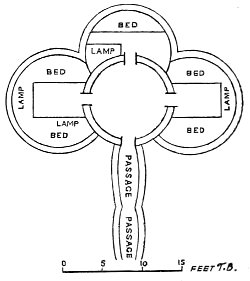
GROUND PLAN OF SNOW HUT.
A bank of snow, 2½ft. high, round the interior of each room, except near the door, forms the bed and fireplace, the former occupying the sides and the latter the end opposite the door. The beds are made by covering the snow with a layer of stones, on which are spare paddles, tent poles, whalebone, pieces of network, and a quantity of birch twigs, reindeer skins in profusion are heaped on these, creating not only a comfortable but a luxurious resting place.
The fireplace is a shallow vessel of stone, the wick is of moss rubbed dry between the hands, disposed along the straight edge for about 18in., it supplies itself from a long strip of blubber hung near enough to be melted gradually, and drop slowly into the hollow of the stone; over the lamp is a network, on which wet boots or mittens are usually laid. Frequently there are two other lamps in the corners next the door, for no married woman or widow can be without her separate fire.
With all the lamps lighted, and the room full of people and dogs, the thermometer on the net over the fire stands at 58°; 2ft. or 3ft. away it falls to 32°, close to the wall it is 23°, the temperature of the open air being at the same time 25° below zero. If the temperature is raised higher than this, the melting of the roof causes great inconvenience; but when an inclination to drip is observed, a patch of cold snow is plastered on to absorb the superfluous heat. In the time between the extreme cold of winter, and the season when it is possible to live in tents, the natives suffer much from this melting of their walls.
The cooking is done in pots of hollowed stone (lapis ollaris), slung over the lamps. Many of these are cracked, but are joined by lacings of sinew, or rivets of copper, iron, or lead, which, with a sufficient coating of dirt, makes them again watertight. Their knives are sometimes of ivory, but the best are of iron, obtained from the Hudson’s Bay Company.
They procure fire by striking two pieces of iron pyrites over a leather case with dried moss in it, and a little floss from the seed of the ground willow helps to convey the flame to a bit of oiled wick—sometimes the wick for the lamp is made of asbestos.
At times, especially in the commencement of the winter, the huts are built of ice instead of snow. They approximate to a circular form, but from the flatness of the material necessarily present a number of flat sides and obtuse angles. They are cemented entirely with snow and water, and roofed with skins, which are replaced by snow as winter advances. The entering tunnels are also of slabs of ice, as are the kennels for bitches and puppies. The skin canoes are propped up on slabs of ice high enough to be out of the reach of the dogs. The semi-transparency of the walls give these huts a strange effect, and some of our later voyagers have called them crystal palaces; but all the purity, either of ice or snow, disappears, and whatever cleanliness the Esquimaux possess is forced upon them by the annual thawing of their houses.
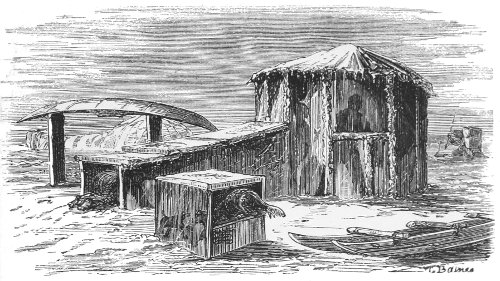
ESQUIMAUX HUT OF ICE SLABS.
The summer tents are made of several seal or walrus skins, the former without the hair, and the latter with the thick outer coat taken off, and the rest shaved down so thin as to admit light through them. They are irregularly sewn together, forming a kind of oval bag, supported in the middle by a pole of several deers’ horns or bones of other animals lashed together. On the top of this is a cross or T-piece, which serves to extend the top of the tent, 6ft. or 7ft. from the ground the lower part of the tent pole rests loosely on a large stone, from which any accident will knock it off. The borders of the skins are kept down by stones laid on them, and the top is stayed by a thong on the outer side, stretching to a heavy stone at some distance. The door is merely two flaps, one of which overlaps the other, secured by another stone.
Sometimes a little shelter from the wind is given by an outer wall of stone.
If a larger tent is required, two of these bags are made to overlap at the edges, and are set up with a couple of poles.
The accumulation of seal and walrus flesh and blubber during the summer months makes these habitations disgustingly filthy; but it is to be remembered that the great necessity of the Esquimaux is to keep himself warm, and he cannot afford to lower the temperature of his skin by washing off the grease and dirt which encrust it.
On one experimental trip Captain Parry was compelled by a sudden decrease of temperature to shelter his party in a small tent. They attempted to warm themselves by smoking, and found the temperature at their feet to be 1° below zero, while overhead the smoke had raised it to +7°, the outer air being -5°, soon falling to -15°. It was then found possible to dig a kind of cavern in the snow, the spade being lent as a favour to the men who most required to warm themselves, a small fire and a pot of soup were made, and by confining the smoke and hot air the temperature was raised to +20°, while outside it was -25°.