Chapter II · BOATS, RAFTS, AND MAKE-SHIFT FLOATS. (continued 3)
Reading edition
Our illustration shows one expedient for the remedy of the misfortunes we have named. A warp or cable is faked down upon the deck in lengths equal to that of the required rudder, all the parts are then so closely pressed together that it resembles a board of the required breadth; it is then stiffened by longitudinal and cross bars, a weight is attached to the bottom, and a tiller projects aft, from the extremity of which the steering tackles (A) lead in over each quarter. When lowered into its place, the heel is confined to the stern-post by chains or hawsers leading to the gangway on either side, and in the present instance ropes are reeved through the gudgeons on the stern-post. Sometimes two parts of the cable are left longer than the rest to come up the rudder trunk and form the neck of the rudder, a short spar passed through the bight on deck serves to suspend the whole. Very frequently, however, when the rudder goes, the gudgeons, and perhaps also part of the stern-post, are carried away, and it then becomes necessary to devise some plan which shall supply their loss.
Several expedients are given in the Nautical Magazine for 1836, and from these we extract two or three examples. A spar, such as the spanker-boom or jibboom, is first passed over the stern, secured to the centre of the taffrail by temporary “partners,” and to the heel of the stern-post by stout guys leading forward to the gangways on either side; the gaff is then fitted on this, just as it would be on a mast, and one of the smallest and stoutest storm staysails is laced, with the head downwards, to the upright spar, and also to the gaff, the foot of the sail being cut off, if it be too large. It is then hauled down to the lower end by a halyard previously reeved, and the gaff, which should go a little below the surface of the water, is hoisted until the sail sits “as flat” as a board. If greater power is thought necessary, the outer end of the gaff can be sawn vertically down the centre, and boards clinched in, as shown in the sketch (Fig. 3); or either the sail or boards might be used separately. The ship is steered by guys leading from near the end of the gaff over each quarter. Sometimes the principle of the steering oar is adopted: a spar, with planks fastened on its outer end, is got over, and the foremost end is fitted to the stern by ring-bolts or lashings, so as to allow it to work freely without too much play. The outer end is kept down either by a lower guy or by a piece of pig ballast or other weight; and if a topping-lift be attached, leading to a boom over the stern and thence to the mizen topmast-head, the oar may be lifted out of the water when one stroke has been completed, carried back again to the other side, and thus bring the ship’s head round by a succession of sweeps.
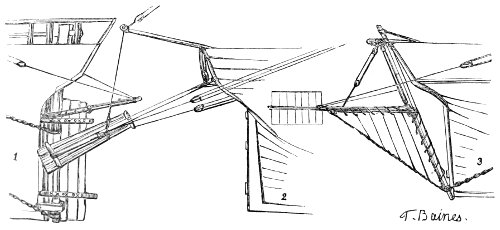
Sometimes it is necessary to make a temporary stern-post, and the spare lower cap (which, however, we may remark, is generally stowed away where it is least likely to be found on an emergency) can be fitted on this by enlarging the masthead hole and securing it, as before, by lower guys. A topmast, with its heel upwards, may be passed down through it, and such additional spars or planking bolted on as will give the needful increase of breadth. The surface should be as smooth as circumstances permit, so that the water may glance off readily; the fid-hole will then receive the tiller, but the spar must be well banded or lashed round to prevent its splitting with the strain, or perhaps breaking off where the sheave-hole weakens it.
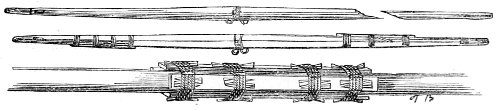
Scarfing or fishing of broken spars.
The captain of our battered little vessel had always some rough and ready expedient at his finger-ends. When one of the iron davits of the quarter boat was bent by a collision, he extemporised a forge with some pig ballast, on deck, and, though the planks beneath were somewhat scorched, he rendered the davit again effective. Once, when running before the wind, the mainsail jibed in consequence of careless steering, and the boom, being fastened by a “lazy guy,” a slovenly shift a little too common among us, broke short off; however, a good stout plank was found, cut into four pieces, which were laid round the fractured part so as to inclose it in a kind of packing-case, of which the four sides did not meet at their edges; wooldings of rope were passed round at intervals and tightened by driving in wedges, and the boom, though somewhat clumsy, was again fit for duty. (See illustration.)
If a spar, with both ends alike, breaks at either end, a very neat and effective scarf may be made by sawing it down the centre and reversing the two parts, end for end, so that the fracture in one half may come against the unbroken part of the other, as in our sketch (p. 181). If the fracture is long, there may be no need for that unsightly appendage called a fish, and, even if it is short, a very small one will serve the purpose.
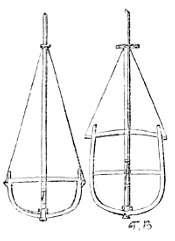
If a mast breaks, much above the deck, it may be again used, with little or no diminution of its strength, by reversing it, and stepping what used to be the masthead upon the keelson, so that the fractured part may come below the deck, while that which was the heel is shaped and fitted to become the head. It will be evident from the sketches we give that in a ship with a very deep hold, where very nearly half the mast is below the deck, this plan is more likely to be of service than in a shallow one, where the part below bears but a small proportion to that above.
Kites.
As a substitute or as an auxiliary to the common sails, or as a means of sending up a signal or effecting communication between a ship and a lee shore, a kite of sufficient power would frequently be useful.
Every voyager knows how frequently all the lower and larger sails of a vessel are becalmed, the uppermost and smallest catching only a gentle air, while at a little height above them the wind, as indicated by the fleecy clouds, may be blowing much more briskly.
In this case, when even the flying kites, as the upper sails are figuratively called, have become useless, real kites flying at a sufficient elevation would do good service; and even though the wind might not be fair, still so long as it was a little abaft the beam the vessel might be steered to her course. One thing must be kept in mind, and that is, that when it has once fallen calm below the kites cannot be raised to the breeze that is blowing above, therefore it would be well either to send them up before the breeze fails, or at least to send up in preparation a small one, to the line of which the larger could be hitched, and jerked clear when it had been carried to a sufficient altitude.
A kite of 12ft. in height spreads about 50ft. square of canvas, and will pull, in a fresh breeze, with a strength of about 200lb., if the height were doubled the strength would, of course, be fourfold; and as it would act as a lifting or buoyant instead of a depressing sail, the only risk in “carrying on” would be the parting of the line connecting it with the vessel; on this account it would be the best possible form of sail to rig in an open and over-crowded boat when leaving a wreck, for its tendency would be to lift the bows over the seas instead of depressing them. And even if a man about to risk the passage by swimming from a stranded ship to a lee shore could send up a small kite, such as he could make with a cotton shirt, a couple of sticks, and a few fathoms of fishing line, it would most likely buoy him over the crests of the breakers in which he would otherwise be overwhelmed. But the greatest objection to the general use of the kite is, that in the usual mode of flying we have no command of it except that of letting it go higher or hauling it in at the risk of breaking the line; this has been met by a very ingenious invention, and although it is patented, we think that we may do the public some service, and Mr. Pocock, the patentee, no harm, by describing it.
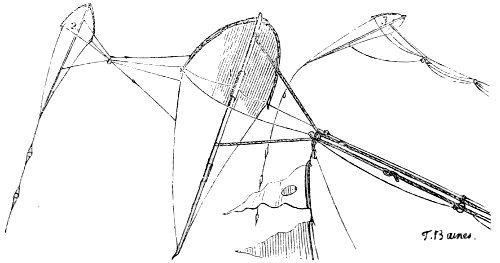
POCOCK’S KITE.
The common form of kite is best. The standard is made into two or three equal lengths, connected either by fishing-rod, by tent-pole, or by parasol joints; the wings have hinges at the head of the standard, and, if large, joints in each pinion. The flight band consists of two lines, the uppermost of which has an eye upon it through which the lower, called the brace line, reeves, and both come down to the hand of the conductor, and by these the deviation of the standard from the perpendicular is controlled. By hauling on the brace line the surface is opposed fairly to the full strength of the wind (Fig. 1); by slackening it the kite floats more horizontally, allowing the wind to pass gently beneath it, so that even in the strongest gale the power may be regulated at pleasure (Fig. 3). The power may be increased by backing the first with a second kite as in Fig. 2, all the lines of the second kite being made fast to their corresponding places on the first, so that both assume the same relative position in all cases. Two smaller lines from the wings, also passing through eyes on the upper line, act as braces by which to trim the kite upon a wind; and it appears from a diagram given by the inventor that a vessel braced sharp up will lie within about five and a half points of the wind, or as close as most vessels can with their usual sails, and, therefore, may turn to windward. With a kite the operation of tacking would be very easy. Even should the boat not answer her helm, the kite line taken aft would bring her head up to the wind, and, being carried round on the other quarter, and again forward to its proper place, would help her to her proper course; and in manœuvring the absence of masts would be an advantage rather than not. A carriage with the fore wheels capable of being turned by a tiller would also turn to windward, and the draught power might be increased at pleasure by backing one kite with another, the connecting lines all being fastened in their proper places, as in the illustration (p. 183), so that whatever change of position was imparted to the lowermost kite might be also assumed by all that were harnessed to it.
Signals by day or night might be sent up with great facility by hitching the halyard block upon any part of the kite line, when the flags or lanterns might be sent far above any spars or sails that could obstruct the view of them. In case of shipwreck, even a common kite extemporised with the roughest materials would very generally be useful.
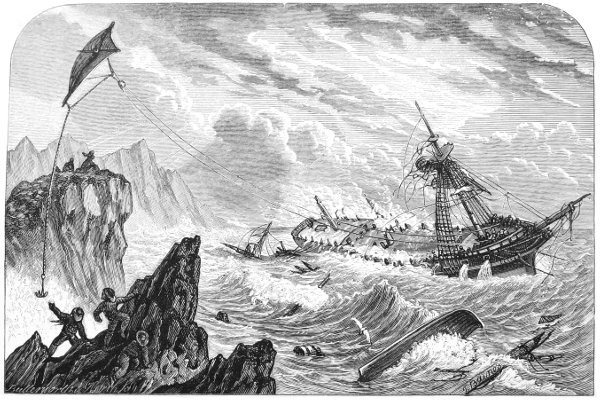
SENDING LINE FROM WRECK TO LEE SHORE BY MEANS OF A KITE.
When the ship is on a lee shore, a common kite, flown from on board, could not fail to bring a line to land, and, with this communication once established, all hands could probably be saved. Their own boat might be veered ashore, or the men sling themselves with grummets and warp themselves hand over hand; or if passengers are on board, a cot or hammock, slung to notched blocks running on a hawser with a line to haul it back to the vessel, and one to bring it again towards the shore, might be employed.
But with kites rigged as we have described, there would have been a greater chance of safety, for they may be braced to fly three and a half points either way from the direction of the wind, and if they are employed to carry a grapnel or small kedge, they may be braced and veered within a limit of seven points of the compass towards a suitable spot; may be lowered gradually by the slacking of the brace line, and, if the hold is not good, again elevated by hauling it in, to drop the anchor in a more suitable spot.
In our full-page illustration the extemporised kite is not so completely rigged, but the flight line is led through a block, so that the wrecked crew could make fast to one end a stronger line; and, having hauled that through, could next bend on a sufficiently stout hawser.
The inventor states that he has travelled in a carriage, at twenty miles per hour; that a boat so drawn outsailed the speediest vessels of the usual rig; that a lady ascended to a height of a hundred yards; and that his son, with a 30ft. kite, scaled a cliff 200ft. high. Tho main and brace line of a kite of this size were ½in. in diameter, the braces (proper) were somewhat smaller. The discovery that a statue once stood on Pompey’s Pillar was made by some merchant captains who ascended it by means of a line carried over by a kite.
Weather signs.
The canoe or boat voyager should at all times pay particular attention to the instructions which foretell the approach of storms; these are not at all times so unmistakable as to enable him to surely count on the kind of day or night which he has to pass through; still, the remarks of the late Admiral Fitzroy, published by the Board of Trade, are of much practical value:
“Whether clear or cloudy, a rosy sky at sunset presages fine weather; a red sky in the morning, bad weather, or much wind (perhaps rain); a grey sky in the morning, fine weather; a high dawn, wind; a low dawn, fair weather. Soft-looking or delicate clouds foretell fine weather, with moderate or light breezes; hard-edged oily-looking clouds, wind. A dark, gloomy blue sky is windy; but a light, bright blue sky indicates fine weather. Generally, the softer the clouds look, the less wind (but, perhaps, more rain) may be expected; and the harder, more ‘greasy,’ rolled, tufted, or ragged, the stronger the coming wind will prove. Also, a bright yellow sky at sunset presages wind; a pale yellow, wet; and thus, by the prevalence of red, yellow, or grey tints, the coming weather may be foretold very nearly, indeed, if aided by instruments, almost exactly. Small inky-looking clouds foretell rain; light scud-clouds driving across heavy masses show wind and rain; but, if alone, may indicate wind only. High upper clouds crossing the sun, moon, or stars, in a direction different from that of the lower clouds, or the wind then felt below, foretell a change of wind. When sea-birds fly out early, and far to seaward, moderate wind and fair weather may be expected; when they hang about the land, or over it, sometimes flying inland, expect a strong wind with stormy weather. There are other signs of a coming change in the weather known less generally than may be desirable, and, therefore, worth notice; such as when birds of long flight, rooks, swallows, or others, hang about home, or fly up and down or low—rain or wind may be expected. Also, when animals seek sheltered places, instead of spreading over their usual range; when pigs carry straw to their sties; when smoke from chimneys does not ascend readily (or straight upwards during calm), an unfavourable change is probable. Dew is an indication of fine weather: so is fog. Neither of these two formations occur under an overcast sky, or when there is much wind. One sees fog occasionally rolled away, as it were, by wind, but seldom or never formed while it is blowing.”
Waterproofing.
The traveller will not unfrequently wish to render sailcloth, duck, calico, and other materials water-proof; few handy methods surpass that of the Chinese. They proceed as follows: to every ounce of melted white wax is added one quart of spirits of turpentine. The mixture must be stirred with a stick until quite cold, when the material to be treated is thoroughly dipped, allowed to drain out, and then finally hung by the corners in a current of air to dry. In making common tarpaulins it is well to soak the canvas thoroughly in sea-water before laying on the dressing, and as the water evaporates the tar penetrates the fabric. In Africa we used the acrid milky juice of the Euphorbium, mixed with a little boiled oil, on calico. It was very flexible, and perfectly protected a common open packing-case, with books and papers, on the deck of the vessel from the Cape to London. Boiled linseed oil, when allowed to soak into linen or cotton cloth, much increases its power of resisting the action of water.
The deep-water glass.
To those who are engaged in boat expeditions, researches along the sea-coast, or lake investigations, it is of the greatest importance to be able to see far down into the depths below; as, for example, for the recovery of sunken seals, which often go to the bottom like lead when struck dead by a shot, the examination of rocks, and the detection of lost objects. The late Mr. Wheelwright gives such a thoroughly practical account of his deep-water glass that we insert it in his own words: “I have had a little experience myself in seal-shooting off our north-west coast, and when I first began I had the mortification of seeing many a seal which I had shot stone dead go down like a plummet, and we lost him. But afterwards we used a seal-glass, a kind of machine very similar to a small hand-churn, like a bucket, about one yard high, tapering towards the top, about 9in. wide at the top and 18in. at the bottom. Of course the top was open, and in the middle of the bottom was fitted a square piece of glass (I believe common window glass). As soon as a seal sunk dead, we cast over a small buoy, kept in its place by a grapnel, as near the spot where the seal sank as possible, and then we examined the bottom after this fashion: We sunk the glass over the boat’s side (just where we fancied the dead seal lay) into the water, within about two inches of the top (glass downwards), and by steadily looking down through the little glass window we could distinctly see the bottom of the sea and what lay on it. As soon as we saw the dead seal we hooked him up with a line and a drag. I don’t know what is the greatest depth of water in which such a glass is available, and it is now some time since I used one; but I am sure I have often seen a dead seal lying in eight or ten fathoms; and just round the rocks where we shot the seals the water was never very deep, but still we rarely could see the bottom with the naked eye. I do not believe the glass at all has any magnifying properties, but I suppose the focus of vision is better concentrated below the surface of the waves in the comparatively still water. I was at this time living with one of the Customs’ officers on the coast, who often used such a glass with great success in finding kegs that were sunk by smugglers off this coast.”
Treatment of the apparently drowned.
Our remarks and directions concerning the various means which may be had recourse to for traversing rivers, lakes, and the sea would be incomplete without instructions for the restoration of the apparently drowned. None that can be drawn up are more perfect than those given by the authority of the Royal Lifeboat Institution, which were published, with some of the following remarks, in the Field newspaper some short time since:—“Hanging the body up by the heels to drain out the water which is supposed to have been swallowed, is not one of the least injurious of the popular expedients in cases of suspended animation, and it is, in itself, sufficient to keep up the engorgement of the brain, which is one of the chief dangers to be apprehended. So, also, warm baths, tobacco smoke, and other depressing influences, should be strictly prohibited; and also that horrible practice of rolling the body over and over, which is so frequently adopted by those who are ignorant of its effects. The Royal National Lifeboat Institution and Humane Society constantly circulate printed papers containing cautions against the adoption of these expedients; but, unfortunately, they are seldom to be met with when they are wanted, and, on that account, we venture to impress upon our readers the importance of making themselves intimately acquainted not only with the objectionable practices to which we have alluded, but also with the methods which scientific men are agreed upon as those most likely to restore the circulation and respiration.
“In the first place, it may be observed that for several hours after the submersion all hope of recovery should not be given up, unless it is declared by a medical man of experience that life is extinct. The signs by which this opinion may be formed are pretty clear to him, but by an ordinary spectator they are liable to be mistaken, since they are all more or less comparative in their nature. When, however, for half an hour there is not the slightest evidence of breathing, or of the action of the heart—when the eyelids are half closed, with the pupils turned upwards and dilated, the jaws clenched, and the fingers semi-contracted—there is little doubt about the result, especially if the tongue is partially protruded, and the lips and nostrils are covered with frothy mucus. The temperature of the body is often not a reliable sign, because that is kept up by artificial means; but if, in spite of these, and in addition to the existence of the above symptoms, the coldness of the surface is very manifest, even if there is no medical authority for the relaxation of all efforts at restoration, it can serve little purpose to persevere. Still it is better to err on the safe side, and in this country there is seldom a long interval of doubt.
“But supposing a body to be brought out of the water, it becomes a question, What shall be done? Shall it be taken to the nearest house, or at once be treated on the spot? The answer is, proceed at once in the open air, whether on shore or afloat, and lose not a moment in the attempt to restore breathing, and keep up the temperature of the body by the application of dry heat. The first of these is the main object, and the second must be for a short time sacrificed to it, but only for a few minutes, after which the two objects must be jointly pursued. These efforts must be continued energetically till they are either found to be successful, or declared to be useless. Should the breathing be restored, the circulation should next be encouraged by rubbing the limbs in the direction of the heart, with firm and steady pressure, and with the aid, if possible, of warm flannels or silk handkerchiefs, protected by a blanket over all. Beyond these general directions, however, it is necessary to give others more minute, and this will be best done in the words used in the printed directions of the Royal National Lifeboat Institution, which are given in a succinct tabular form, and should be hung up in every public place near which accidental drowning is at all likely to occur.” These directions are as follow:
TO RESTORE BREATHING. To clear the Throat. 1. Place the patient on the floor or ground with his face downwards, and one of his arms under the forehead, in which position all fluids will escape by the mouth, and the tongue itself will fall forward, leaving the entrance into the windpipe free. Assist this operation by wiping and cleansing the mouth. 2. If satisfactory breathing commences, adopt the treatment described below to promote warmth and natural breathing. If there be only slight breathing, or no breathing, or if it fail, then— To excite Breathing 3. Turn the patient well and instantly on the side, and— 4. Excite the nostrils with snuff, harts-horn, smelling salts, or tickle the throat with a feather, &c., if they are at hand. Rub the chest and face warm, and dash cold water on it. 5. If there be no success, lose not a moment, but instantly To imitate Breathing— 6. Replace the patient on the face, raising and supporting the chest well on a folded coat or other article of dress. 7. Turn the body very gently on the side and a little beyond, and then briskly on the face, back again; repeating these measures deliberately, efficiently, and perseveringly about fifteen times in the minute, or once every four seconds, occasionally varying the side: [by placing the patient on the chest, the weight of the body forces the air out; when turned on the side, this pressure is removed, and air enters the chest.] 8. On each occasion that the body is replaced on the face, make uniform but efficient pressure with brisk movement, on the back between and below the shoulder-blades or bones on each side, removing the pressure immediately before turning the body on the side: [the first measure increases the expiration, the second commences inspiration.] ⁂ The result is—Respiration or Natural Breathing; and, if not too late, Life. Cautions. 1. Be particularly careful to prevent persons crowding round the body. 2. Avoid all rough usage and turning the body on the back. 3. Under no circumstances hold the body up by the feet. TO PREVENT ANY FURTHER DIMINUTION OF WARMTH. N.B.—These efforts must be made very cautiously, and must not be such as to promote Warmth and circulation rapidly; for if circulation is induced before breathing has been restored, the life of the patient will be endangered. No other effect, therefore, should be sought from them, than the prevention of evaporation, and its result, the diminution of the warmth of the body. 1. Expose the face, neck, and chest, except in severe weather (such as heavy rain, frost, or snow). 2. Dry the face, neck, and chest, as soon as possible with handkerchiefs or anything at hand; and then dry the hands and feet. 3. As soon as a blanket or other covering can be obtained, strip the body; but if no covering can be immediately procured, take dry clothing from the bystanders, dry and re-clothe the body, taking care not to interfere with the efforts to restore breathing.
N.B. The directions are printed in parallel columns to avoid confusion, and to insure that the efforts to obtain both objects shall be carried on at the same time.