Chapter III · WORKING IN METALS.
Reading edition
It would be of great advantage to every traveller if before starting on an expedition he were to spend a few hours in learning from a blacksmith how to weld together two pieces of iron, and from a tinman how to solder tin or copper. In the absence of this experience, a man who is determined to help himself need not despair of success if he will bear in mind that the chief essentials in both cases are proper heat, strict cleanliness, and sufficient quickness of manipulation without hurry. If the traveller possesses a portable forge, it is most likely he will have learned how to use it before starting; if not, he may in many countries, South Africa especially, find almost in every tribe some native who could make one; or if not, he might adopt some of the expedients described under that head. His first care should be to see that his fire burns clearly and with sufficient intensity, and this he may aid by occasionally dashing in a little water, which, by the decomposition of the gases, will increase the heat under the direct blast, while the surplus, falling on the surrounding coal, will prevent the fire spreading farther than is requisite. The broken ends of the iron to be rejoined should then be placed in the fire, one of them in the centre of the heat, and the other near enough to acquire a preparatory warmth; the first, heated to a bright orange red, should be taken out and thickened by stamping the broken point upon the anvil till it is considerably shorter than before; if the heat is sufficient, the scarf, or smooth diagonal surface which is to form one part of the welded joint, may be worked upon it; if not, it must be returned to the fire while the other part is taken out and driven up in the same manner. In using the hammer, some care is needful to proportion the force of the blow to the size and comparative heat of the metal you are working, and also to turn the iron under the hammer so that each stroke shall help to consolidate the mass instead of splitting it into fibres. When the surfaces of the scarf are worked smooth, fair, and perfectly free from scales or dirt of any kind, place them side by side in the fire and bring them to an intense white heat, so that when drawn forth they may almost spontaneously give off small white sparks. We would add a caution against burning the iron, or partially fusing it, by too much heat, but we do not think a traveller with an extempore forge is in much danger of doing this. The anvil should now be perfectly clean; the “smith,” with his hammer ready in his right hand, should grasp with his left one of the pieces while his attendant draws out the other and lays it with the scarfed side uppermost on the anvil; prompt action without hurry is now the one thing needful: the smith withdraws his piece, lays it with its scarf turned downwards on that of the assistant’s, and with one decisive stroke of the hand-hammer unites them; a few more smart and rapid strokes while the iron is slightly turned to and fro to receive them properly, complete the union; and when the first heat is lost the iron is again put into the fire, and the joint which, owing to the thickening and shortening previously described, should present a clumsy appearance, may be trimmed and hammered down to its proper dimensions, the iron, if this is neatly done, having lost but little of its original length; and it is now for the operator to judge whether he will restore this by beating the metal a little thinner or sacrifice a little of it for the sake of retaining the original thickness. Among the Kafirs a rock is most frequently used for an anvil, and a smaller stone for a hammer. The West Africans use a conical block of iron, about the size and shape of the link extinguishers, some of which may yet be seen before old houses in London. The work has, in consequence, a slightly indented appearance, which distinguishes it from the smooth-faced hammer-work of England; but their weapons are of excellent metal, and so flexible, that they will almost tie in a knot rather than break. The Abyssinians also use weapons of this temper; for they say if a steel sword breaks, who can mend it, but if it bends we can sit on it and straighten it.
Scrap and hoop iron.
We have often made very good knives for skinning or cutting up animals from the handles of broken gridirons, frying-pans, stout hoop, or other bits of iron. Broken sheep-shears are also excellent substitutes. The hoop iron used to bind the bundles of compressed hay issued to troop horses can be made use of for an immense number of useful purposes. The walls of many of the stables we erected in the Crimea were composed entirely of this material, closely interwoven, like basketwork. Excellent gabions can be made from it, as can the framework of hut roofs. A piece a couple of yards long, doubled forward and back in zigzag form, makes an excellent gridiron. Short pieces, straightened out by hammering, form useful make-shift knife blades for the use of native servants. Tent poles are greatly strengthened by having a spiral strapping of this iron nailed to them. Saws for cutting or rather fretting blocks of stone can be made by stretching a strip of this material edgewise in a wooden frame, aided by water, sharp sand, and a suitable balance weight, such as marble masons use. Excellent eel traps are made by arranging long strips of hoop for a body, and then securing them by small nails, as rivets, to hoops made from the same material. Eel traps will be fully described under the head of “Fishing.” We once made a complete set of bars for the bottom and front of a camp stove entirely of forage hoop iron, made a scraper for the door, a set of hooks for a gun rack, and a set of cross hooks to hang meat on. Never heedlessly throw away forage iron.
Trimming and filing up are matters which may be left very much to the taste and opportunities of the traveller, but it should be remembered that, cæteris paribus, a neatly finished piece of work, besides being more satisfactory to the eye, is in itself stronger, as the inequalities, flakes, flaws, or roughnesses of the surface, which, under any strain, might form the commencement of a fracture, are removed; and besides this, especially in wet climates, a well smoothed piece of work is less liable to rust in patches than one of unequal surface. If you intend to file-finish your work, remember to let it cool slowly, and do not harden it by immersion in water.
The use of cold or of joiners’ chisels.
In some cases incisions may be required, too sharp or clean to be cut with a file, and, if proper care be taken, a fine, sharp, joiner’s chisel may be used without more injury than may be set right by fresh grinding it; it is advisable, however, first to render the angle at which the edge is set a little more obtuse, so as to lessen the danger of flawing it, taking care at the same time to keep it as keen as possible.
Tires and wheels.
In all expeditions in which wheeled vehicles are used, nothing causes more trouble than the loosening of the tires, owing to the shrinking of the woodwork, and possibly some slight expansion of the metal, from the heavy pressure on the rough roads, as well as from the intense heat of a tropical climate. If sufficient skill be available, the proper course is to cut and shorten the tire, for all other make-shifts have the disadvantage either of being insecure, or positively injurious to the fabric of the wheel. Supposing the shortening to be determined on, the tire must be taken off, and if, as is frequently the case, it be fastened with rivets through the felloes, the clinch on the inner ends of the bolts must be first cut or filed away, the “washers” or iron rings taken off, and the rivets themselves driven back with a long punch or drift pin; the “band” or tire will then either fall off or require but a few blows to detach it. The streaks used to protect the wheels of field artillery guns and waggons are removed and replaced separately.
It is impossible to measure the relative circumference of the felloes and the inner side of the band without an instrument similar to the perambulator; i. e. a wheel or disc of wood or metal, mounted on a handle. A chalk mark is made on the felloe and a corresponding one on the edge of the disc; the two are set together, and the disc—say 1ft. 6in. in circumference—will then revolve perhaps ten and a half times in going round the hinder wheel of a Cape waggon of about 5ft. diameter. As soon as the disc has again reached the starting point another chalk mark is to be made upon it, and the distance between the two marks on the disc, say 9in., is to be added to the number of revolutions counted; it is then to be applied to the inner side of the band, the ten revolutions counted off, the additional 9in. to be run, and the distance between the starting point and the finish of its course is the amount by which the band is too long. Some judgment is required to decide whether more or less than this piece shall be taken out. If the wheel looks very firm and close in its joints, perhaps a little less should be cut, as the overlapping of the weld will take up a trifle—especially if it be not very skilfully and neatly done; if the wheel is loose and the spokes not firmly shouldered up to the nave, a little more may be taken away; and in this case it is proper to estimate whether the felloes will close up sufficiently to force the spokes home upon the nave; if not, the ends of four or more felloes opposite each other should be cut a trifle shorter with a fine tenon saw, great care being taken not to cut the dowels by which the ends of the felloes are kept true to each other. A smooth, hard place must now be sought out, on which the wheel can be laid flat, the front downwards, a hole being dug, if necessary, for the reception of the nave; flat stones, plates of iron, or slabs of hard wood, laid evenly under the circumference, would be of advantage when the shortened band is to be driven on. The next essentials are plenty of water and abundance of heating power. The ends of the band must now be heated, and the smith will bevel off each of them, one from the inside and the other from the out, so as to form the scarf; an attendant or two holding the band, as he directs, upon the anvil. The tire should now be reversed, and the curvature increased by resting it on two points of support and striking heavily between them on its inner surface till the scarfed ends close upon and begin to overlap each other. It is again placed in the fire with the ends equally exposed to the intense heat, and at the proper moment is lifted out by two attendants and promptly, but carefully, placed upon the anvil; a few smart decisive blows are given, and the joint is made. The hammer man now comes to the assistance of the smith and consolidates it by striking alternate blows with the “sledge,” under his direction. The circumference is again tried with the revolving disc, and if it be too short, as it ought rather to be, it is again heated and hammered out, the weld, if this be rightly done, gaining solidity in the process. The band is then laid upon the ground and a fire of wood, dry cow dung, or other material made, so as to heat it to redness through its whole circumference. It is then lifted by tongs or other means (if hooks are used they must be applied from the outside), and placed upon the wheel, and, as quickly as possible, hammered down nearly into its true position. The workmen will soon find what “smoke to the eyes” is like, but they must disregard this, and, before the wood is too much burned away, quantities of cold water must be dashed on, the hammer men all the while beating down the shrinking band to a level with the felloes; before it is quite cold the wheel should be caught up and brought to the anvil, or a smooth rock, where the tire is faced up true to the felloe front by heavy blows, and finally cooled off and tightened by another deluge of cold water.
Everything depends upon prompt action; and the tiring of a set of waggon wheels at some out station is really an exciting event, at which all hands are required to work with a will.
Repair of perch-bolts.
Not unfrequently the “schammel-bolt” or perch-bolt will give way in the grip, and if this flaw be detected in time, and the bolt be long enough, the evil day may be staved off by removing it, boring a hole through the “buik” plank or floor of the waggon, right above, and dropping the bolt down through it so that its head remains 3in. or 4in. higher than before, and the nip is brought upon a fresh place, as shown by the dotted line above H (p. 216).
Extempore anvils and vices.
For small work, the “reim schoen,” or drag, turned up upon a block of wood, will form a very decent anvil; and the next essential is a vice, which ought to be as large and powerful as can be carried. A weak inefficient vice is worse than useless. The means of attaching it ought also to be good, for if it is not firmly fixed no work can be properly finished in it. No part of the waggon ought to be used as a holdfast for the vice, unless indeed it were properly fitted with iron guards for that purpose before starting, for the claws and screw-bolts would speedily tear and split the wood, and only damage the vehicle to no purpose. It would generally be better to cut down a convenient tree, leaving a stump about 3½ft. high, and in this to cut a niche, partly to let the vice in: it might then be secured by hoops of iron, if available, such as the nave bands, or anything similar, tightened with wedges, and lashed in its place by thongs of raw hide, which, when they dry, acquire almost the rigidity of iron.
If the vice cannot be fixed firmly, it is better to cut with the saw a deep groove down into the solid stump, and, having inserted the iron you wish to file, to tighten it with wedges, screws, lashings, or such other appliances as you may have at hand (p. 166).
The tapping of screws on bolts or nuts, especially if of any size, requires that the work be firmly held; but we should rather advise that duplicate bolts and nuts of the principal sizes used in waggon work—½in., ¾in., ⅞in., and 1in.—be carried, as a set of taps and dies could not be had even in Cape Town for much less than £5, and an unskilled hand would be more likely to break the instruments than use them to advantage. For the smaller sizes, suitable for gun-locks, &c., a plate and set of taps might advantageously be carried.
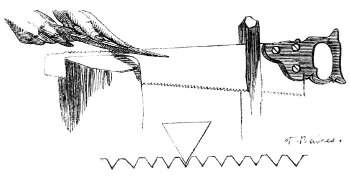
Cutting bolts and gun-barrels.
Sometimes a bolt, rod of iron, or a gun-barrel, has to be cut off to a given length, and the most convenient way of doing this is to file a row of small teeth upon the back of a handsaw, and with it to saw off the superfluous iron: the first illustration shows the manner of cutting the teeth, and their exact size and shape. Always put in a bit of copper, lead, or leather to protect the gun-barrels from the grip of the vice. It may, perhaps, be well to remark here, that nearly all Russian saws are made to cut backwards, and all the gun breech-screws made in that country are cut the reverse way to ours.
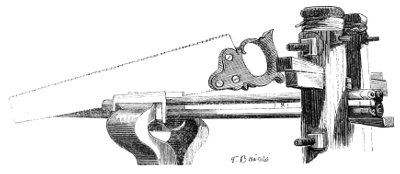
For repairs of guns, it is well to have sufficient wire of different thicknesses; but when a hardened pivot is required, a broken gimlet or a bradawl will often supply the material; and we have before now earned a goat or sheep for dinner by supplying in this manner some deficiency in the arms brought to the white man to be repaired. It is convenient to buy a musket-lock or two before starting, and to save all sorts of screws, tumblers, springs, &c., out of old locks.
We were once asked, far away in Namaqualand, to perform no less a service for a friend than to put a new hammer on his gun. Modest disclaimers of ability were not received, and there was nothing left but to do our best. We found a bit of flat iron, which, fortunately, had a hole in it: this we first squared up with a small “three-square” file, and then fitting it to the tumbler, and making sure that the flat surface of the hammer should strike upon the nipple, laboriously cut and filed away the intermediate parts, and before morning the hammer was fixed. Mr. Rae, the engineer of the Zambesi expedition, proceeded more scientifically; he employed a native to weld up a quantity of iron hooping into a plate quite thick and large enough to make the hammer, then, drawing the outline, he bored small holes close together all round it, broke off the superfluous iron, and finished with the file.
On one occasion we were unfortunate enough to break the little S-shaped bridle which connects the claw of the mainspring with the arm of the tumbler. Most of our readers will remember that this portion of a gun-lock is of a most peculiar form, being not only S-shaped, but flat-cheeked and T-ended. Notwithstanding the apparently complicated nature of the undertaking, a new one had to be made; so we proceeded as follows:—One of our small mining picks chanced to have an iron wedge (which had originally been cut from an old patten iron) in the handle. This we softened in the fire, worked into form on the head of an upturned hammer with one of smaller size, and then roughly finished it up with a handsaw file. The screw hole had then to be made, and, as we had no drill, we took the scissors from our fishing-book, ground down the point on our bit of Turkey hone, tempered it in the candle, and then, by dint of hard labour and persistent boring, made a hole through the end of the bridle. We then gave our work a few finishing touches, tied it up in a bit of old leather, heated it in the fire, plunged it in water to case-harden, and then secured it in the lock, where it performed its work well until we parted with the gun so repaired.
Sighting guns.
Most of the hunters in South Africa find that ivory, from its agreeable creamy white, is better adapted for the “korel,” or front sight of a gun, than the polished metal used for that purpose by the maker. Sometimes the sight is accidentally lost, and has to be replaced; but more frequently the dazzling bit of metal is purposely knocked off.
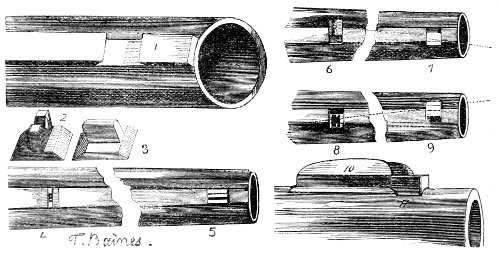
A broad flat groove, say ½in. broad, or as wide as a handsaw file, and 1⁄16in. deep, is cut across the midrib of the gun (Fig. 1), and the edges of this are under cut, either with a sharp-edged file, or, if the operator is expert in the use of tools, with a chisel and mallet. A piece of ivory (Fig. 3), cut so that the grain runs with the length of the barrel, and with an elevated ridge left in the centre, is then fitted tightly in, adjusted as nearly as possible, and the metal clinched down upon it; then the central ridge is filed on either side until, by occasionally firing at a mark, the gun is found to shoot without lateral deviation. It should, in the beginning, be considerably too high, and should then be filed down so as to carry the bullet point blank to its mark at a hundred yards.
If the back sight is lost, cut a notch across the midrib as before, and fashion a piece of iron (Fig. 2) to the same shape as you did your ivory, only let the elevated ridge in this case be across the barrel. File a notch in the centre, and leave the iron a little wider than the rib, so that it may admit of being driven a little to either side, and the superfluous metal filed off when the adjustment is nearly perfected. Mark it, and take it out to do this; then put it in again, clinch it, and test it by firing at a mark.
Figs. 4 and 5 represent the position of the two sights. If the gun shoots to the right, shift the back sight (Fig. 6) to the left and the front sight (Fig. 7) to the right; if to the left, shift the back sight (Fig. 8) to the right, and the front one (Fig. 9) to the left. If the gun shoots too low, file down the front sight; if too high, file down the notch of the back sight.
In one of our own rifles the front sight was, as usual in military patterns, based on the block of iron which forms the check for the bayonet (Fig. 11). We did not remove this, but cut behind it a very shallow groove an inch broad, and in this fixed and soldered a piece of iron with a longitudinal groove, to carry a knife-edged sight of ivory, as seen in Fig. 10.
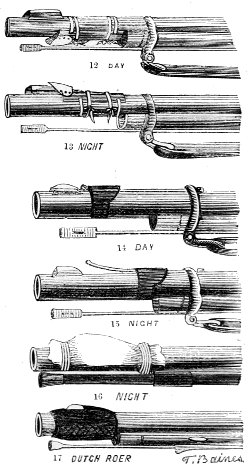
For night shooting, we used the only sixpence to be found amongst our party; bending and polishing it and clinching it on to a saddle of zinc painted black. Holes were punched in this for leather thongs, and in front was a notch cut to fit the actual sight, and so insure the central position of the silver one when in use (Fig. 13). By day the saddle was turned beneath the barrel (Fig. 12), and the little flat thongs of antelope hide were not at all in the way. With guns not of military pattern the sight could not so conveniently be turned under, but would have to be removed by day; but we should think a broad silver sight might be fixed on a steel spring on the rib behind the sight, with a broad ring to slip over and keep it down by day, as in Fig. 15, or to draw back and let it rise into view by night as in Fig. 14 (p. 201). For the same purpose our late friend, C. J. Andersson, used to wrap a bit of white paper round the muzzle of his gun, pinching it up in the centre, or laying a cord under it to give it a little elevation (Fig. 16).
As a protection, and also for the contrast of the colours, the Dutch, and many of the English colonists, stitch very tightly over all a bit of skin from the inside of the elephant’s ear (Fig. 17). This is very fine, exceedingly strong, and, when rubbed with a little grease, intensely black; it is then very carefully cut, to allow the front sight to appear through, and left to dry. Another advantage of this plan is, that it corrects the errors often caused by the mirage or refraction of the sun’s rays from the polished barrel, which, especially in the tropics, causes the object aimed at to become indistinct, to assume the appearance of motion, and to be seen sometimes considerably above its true position, thereby causing the marksman to miss by shooting over it.
Sheath knives or bayonets.
No wise traveller ever encumbers himself with a long sword or bayonet of ordinary pattern; but every one carries a sheath knife, of from 6in. to 12in. in the blade; and the handle of this ought to be made so that it may fix as a bayonet on his gun. We have seen natives considerably astonished by this sudden conversion of our gun into a spear to kill a wounded animal.
If the knife handle were simply made round, so as to stick into the barrel, like the bayonet of old times, it would be better than nothing; but if the side-springs were generally adopted, it might be well to arm our troops, intended for service in wild countries, with a good serviceable sheath knife, of 8in. or 10in. in the blade, to be used for general purposes, and fixed as a bayonet when wanted, rather than with the orthodox triangular needle, that is only of use in opportunities that occur but rarely. We remember a party of a certain line regiment coming upon a number of Hottentots, when their officer ordered them to fix bayonets, forgetting for the moment that as usual they had been left at home—just as were the swords and steel scabbards of the Cape Corps—lest their rattling should give warning to the crafty foe. It is a common custom in India, when real work has to be done, to throw aside the steel scabbards and replace them with wooden ones, which have the double advantage of being noiseless and a preservative to the edge of the sword. We have heard a man of the Rifle Brigade say, he should not fear even though lost in the bush. “Shoot the first Kafir that attacks you,” said he, “and arm yourself with his assegai, and no other will come near you.”
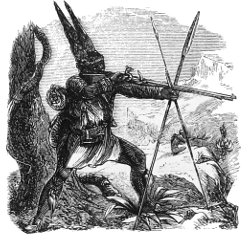
THE ASSEGAI GUN REST.
Our allies, the Fingoes, in the war of 1850–53, generally carried one or more assegais, using the shaft as a ramrod, or holding two of them crosswise in the left hand as a rest for the musket. The Kafirs, when hard pressed, retain the largest assegai, and, breaking off the shaft, use it as a sword or dagger. The contest is often prolonged by picking up the assegais thrown by the other party, and sending them back again. To prevent this, sometimes a tribe, bent on a sharp decisive conflict, will cut the shaft half through, so that it may break when it strikes, and become useless to the enemy.
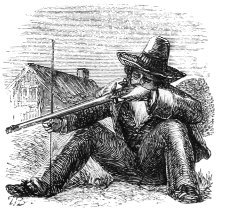
RAMROD GUN REST.
The Dutch Boer sits down, rests his elbows on his knees, and extending his left arm, with the ramrod grasped firmly and planted on the ground, obtains an almost immovable rest for his heavy roer. Many of them shoot from the left shoulder, and some few can shoot from either shoulder equally well—an immense advantage if a man on horseback is surrounded by enemies.
Watch-key, to make.
In an out-of-the way corner of Central India we were so unfortunate as to lose our watch-key—the last of three. This we replaced as follows: We first routed out a piece of soft steel about the size of a small black-lead pencil. After filing off one end perfectly flush, we placed it in the fire, whilst we prepared the square end of a saddler’s awl by grinding it to the exact size of the key-square of the fusee of the watch. When the steel was heated to a cherry red, we fixed it upright in the vice, and then supporting the bit of awl with a pair of pliers we, with a light hammer, drove it a fair distance into the steel bar. When it cooled, it was reheated, and the bit of awl driven deeper, until a square hole of sufficient depth was formed. The bar was then filed down to the size of the key-hole of the watch. The requisite length was then cut off; the end flattened out for a thumb-piece; and a hole drilled in it to pass a thin strip of tendon through. A few finishing touches were given with a fine file; the work was heated to a blue heat on a bit of red-hot iron, and was then dropped into a cup of water. So we made our watch-key, which did its work well through about 4000 miles of travelling, and was as good as new when we returned to England with it hanging at our whip-cord watch-guard.
Tools, to temper.
In all cases in which heat is required for iron work care should be taken that the fire is perfectly clear, especially if it has been previously used for melting lead, when any dross or other extraneous matter should be scrupulously cleared out. Sulphur in any form is most destructive. It would be well that the operator should learn before starting how to work up and fresh temper a cold chisel, or punch, or even to make one if needful out of a broken file or rasp; of course, the punch is round, square, or octagonal, according to circumstances, and generally flat at the end to drive back the nail or bolt that is to be withdrawn. Sometimes a tapered point on a triangular instrument, such as a handsaw file, with the edges sharpened, is useful for driving into a broken nipple, and by turning it against the sun to extract it when sufficient hold has not been left for the usual nipple key. The cold chisel is first forged to a chisel edge, more or less finely tapering according to the strength required, the two sides forming an angle of about 15° to 20° with each other; the cantle is then filed or ground till its sides form an angle of from 45° to 90°; it is then heated to a cherry red, and dipped in water cautiously at first, being frequently taken out and watched during the process till it assumes a pale straw colour, a deeper tint or even a deep blue or purple, according to the degree of hardness required, and is finally ground sharp upon a stone with plenty of cold water. Small tools may be tempered by laying them on a piece of red-hot iron, such as a bit of waggon-wheel tire; the changing colours should be watched, and when the desired tint appears the tool may be plunged into water. Should it be too hard the temper may be reduced by dry grinding; when a temper not quite so hard and less liable to fly is required, it may be given by cooling the steel in grease or oil. The tools carried for this purpose must vary according to the means of conveyance. On the North Australian Expedition we had a portable forge, which remained at the main camp, but on our inland journeys with packed horses we took as many horse-shoes as were thought requisite, a small hand hammer, a pair of tongs, a few files, rasps and punches, and a supply of nails.
Case-hardening.
It not unfrequently happens that some object, such as a fish-hook, key, portion of a gun-lock, or gun furniture, will require being so treated as to harden the surface whilst toughness of texture is retained. This process is known as case-hardening, which is, as its name implies, one by which a hard case or crust is formed over the surfaces of the articles operated on. There are numerous instruments and contrivances in constant use in the construction of which the toughness of iron combined with the hardness of steel, communicated by the process about to be described, is taken advantage of. Gun furniture, fish-hooks, and handcuffs are examples, the latter most remarkedly so, as, were they composed of ordinary iron, nothing would be more easy than to file or saw them through; if of steel, a blow with a stone, or any other heavy substance, would break them as though made of earthenware. When case-hardened neither of these devices is available. Too hard to cut, too tough to break, the metal is all that can be desired. Having fashioned, filed up, and finished the article or articles in hand, procure a fair quantity of leather cuttings, or horsehoof parings. These should be roasted crisp, and pounded up until a sufficient quantity of coarse powder is obtained to bury the “work” when laid in a little iron box, which can be conveniently made by doubling up the edges and ends of a bit of sheet iron. In the absence of iron, clay may be used to form the box. This, when filled and gently pressed down, must be placed, when dry, in a clear bright fire, and heated up to a blood red heat, at which temperature it should be allowed to remain for a short time, taking care not to increase it. The box and its contents may then be withdrawn with the tongs, and thrown into a pail of cold water. The work may, when cold, be washed and brushed clean, made thoroughly dry, oiled, and put aside for use. Ferrocyanide of potassium is also extensively used for case-hardening, being either sprinkled over the work when hot, or mixed with some convenient substance, such as dried cow dung, and placed in the box; but, unless in the hands of those accustomed to use it, the surfaces of the work at times become “pitted” from the contact of stray particles of the salt.
To platinise iron, &c.
Professor Church gives the following directions for covering the surfaces of metallic objects with a film of platinum: “Dissolve in 1oz. of distilled water 60grs. of bichloride of platinum and 60grs. of pure honey. Add to the above solution ¾oz. of spirits of wine, and 1/4oz. of ether. The mixed liquids, if not quite clear, must be filtered through a piece of white blotting-paper. The objects to be platinised, which may be of iron, steel, copper, bronze, or brass, are to be thoroughly cleaned by washing them in soda, then in water. When they have been dried they require heating over a lamp to a heat below redness. For this purpose they may be suspended, by means of a fine wire, over a spirit or an oil lamp, in such a way as not to touch the flame. Suddenly, before they have had time to cool, the objects are to be completely plunged beneath the surface of the platinising liquid. One immersion for a single minute generally suffices, but the process may be repeated if necessary, care being taken to wash and dry the pieces operated upon before re-heating them. The composition of the solution may vary considerably, and yet good results be obtained. Sometimes the addition of more honey improves it; sometimes the proportion of bichloride of platinum may be increased or diminished with advantage. Indeed, it will be found that the appearance of the platinum film deposited upon the objects may be altered by changing the proportion of the bichloride present. The solution may be used several times; gradually, however, it loses all its platinum, the place of this element being taken by the iron or copper dissolved off the immersed objects.”
If the film of platinum deposited by this method is found to be permanently adherent, the plan promises to be very valuable. It would be a great boon to travellers in warm, damp countries to be able to protect iron and steel articles by so simple a process. In the same article Professor Church describes a new and very simple plan of inlaying iron with silver, and also for enamelling metals with different colours. Both these processes really come within the scope of amateurs, and we can strongly recommend the entire paper to those interested in the chemical arts.
We may now appropriately mention a few examples where this platinising process seems to furnish desirable results. Articles made of iron or steel—watch-chains, seals, sword-handles, keys, and similar useful or ornamental objects—are greatly improved in appearance, and, moreover, preserved from all chance of rusting, by this treatment. The colour of the platinum film is of a neutral greyish black, and it often shows at the same time a faint iridescence. Iron or steel which has been inlaid with gold or silver, forming what is known as damascene work, is greatly improved by platinising. Neither the gold nor the silver are in the least degree affected, and they will be found to afford a better contrast with the colour of the platinised than with that of the original iron.
To preserve iron from rusting.
Iron which has become deeply rusted cannot be platinised by our process. In order, however, to preserve from further destruction objects of steel or iron having an archæological or artistic interest, a very excellent plan may be used as a substitute. The purest white paraffine is to be melted in a clean pan, and maintained at about the temperature of boiling water. The rusted and corroded specimens are to be immersed in this paraffine bath till they cease to froth from escape of moisture. They are then withdrawn, wrapped in blotting-paper, and kept in a warm place till the excess of paraffine has been absorbed. The objects thus treated, while preserved from further decay, do not acquire that disagreeable greasy aspect which the varnish ordinarily used imparts. We have been obliged to tar our saw blades, which was very inconvenient in working, but this was better than having them spoiled by rust.
Smith’s tools.
If the traveller has a waggon, as in South Africa, he may either carry a portable forge or trust to finding natives capable of building one and supplying bellows of their own manufacture. If he thinks the weight of a small anvil too great, he should carry a heavy sledge hammer, which will serve as an anvil for ordinary purposes; two hand hammers of different weights; half-a-dozen pair of tongs, of such form and size as will enable him conveniently to hold the different sizes of work he may find necessary to do; at least a dozen files or more—square, flat, half-round, or rat-tail; and of these the temper should never be destroyed by working with them on iron that has not yet become cool, though occasionally time may be saved by using a worn-out file to work on iron while it is yet hot and comparatively soft; cold chisels of different sizes, from small ones of 1/4in. or ½in. wide, to be tapped with a small hand hammer, to others of 1½in., to be held by pieces of rod iron coiled round them, or still better by rods of osier, and to be struck with the sledge hammer; if there is an anvil, of course a chisel to fix upright in the hole provided will be taken with it; punches of various sizes, and a stock and set of drills for boring holes up to ½in. in diameter, with rymers, or tapering four-edged tools for gradually enlarging them, and countersinks for letting in the heads of screws, &c., to the surface level. For small work, such as gun-locks, &c., an Archimedean drill and set of bits are very convenient, a hand-vice and set of gunsmith’s small files—triangular, square, flat, half-round, round, and knife-edged—should accompany them.
Muskets, to repair.
A traveller will frequently have occasion either for his own servants or for the natives of the country to put “fresh fire” into the pan cover of a musket; for this purpose nothing is better than the blade of an old saw, the thinner the better; a piece is broken off, softened and filed down to the exact size; it is then bent so as to fit the face of the pan-cover, and is bound on to it by several turns of iron wire, not drawn so tightly but that bits of copper wire may be thrust beneath them all round the edges that are to be joined; borax, dissolved in water, is now laid on with an old brush, and, if necessary, small lumps are also added, and the whole is placed in the fire and heated till the copper melts and brazes the two parts firmly together; let it cool slowly, finish it carefully with the file, heat it to a dull red, and temper by cooling it in water. Half-civilised Hottentots frequently do this.
Fish-hooks, to make.
The snoek-hook used in Table Bay is a bit of brass wire as thick as a quill and 7in. long; the point is filed sharp, and the barb is merely such a triangular notch as might be made with a handsaw file. It is not bent in a true sweeping curve, like our fish-hooks, but turned sharply up at about 2in. from the point, so that when the lip is pierced, it slips at once into the sharp bend of the hook, and the struggles of the fish are less likely to break it than they would be if it afforded the leverage that the usual form of fish-hook gives. (See Fig. 20, p. 211.) Fish-hooks can be made by taking a wire or rod of the required size and softening it by heating it to a bright red and letting it cool very slowly in sawdust or leaving it till the fire dies out; let the soft end abut against something solid, and, with a sharp chisel and mallet, make a deep cut at such an angle as to form the barb; file up the point, heat it again, and bend it round a stick of the proper size so that the curve may be true. We have, before now, broken up a gridiron at the galley fire, and with a hook thus formed from one of the bars caught a young shark, whose flesh formed a very desirable addition to our fare. On another occasion, while exploring a branch of the Victoria River, in North Australia, we halted, as usual, at noon, with scanty rations, which Mr. Gregory improved by taking from his hat a stout sewing needle, softening it in the fire, and bending it into a fish-hook, baited with grasshoppers; a few strands of thread made a sufficiently strong line, a small sapling formed a rod, and, in a few minutes, he had caught three fish, resembling mullet, nearly 18in. long. The needle had done good service, but was too precious to be thrown away, so Mr. Gregory carefully restored it to its pristine straightness, tempered it, and again stuck it in his hat, to be used, when required, for its legitimate purpose.
Brass, and its treatment.
It is rather curious that with brass the softening process is the very reverse of that we use with iron. Heat a bit of brass and plunge it into cold water, and, with a sharp knife or chisel, you may carve it almost like pewter; heat it again when finished, let it cool slowly, and it becomes as hard as before.
A traveller in Africa should be well provided with brass, the best form being that of stout wire as thick as stair carpet rods; this will serve for many useful purposes: hooks, rings, ramrods for guns, or almost anything can be made of it. While, in lengths sufficient to make armlets, it is always a convenient medium of barter, or payment for the services of the natives, who, though they will give nothing for hollow lacquered curtain rings, will always appreciate solid metal, that may be cut, worn away, or broken, and remains the same throughout.
Tinning Copper.
To tin copper: first clean the surface carefully by rubbing it with sandpaper or stone, or washing it with diluted nitric acid or aquafortis; heat it till it is rather too warm to handle, by placing a hot iron or pan of fire under the part to be tinned; rub on, with a feather, a little hydrochloric acid (commonly called spirits of salt) with zinc dissolved in it; then, with a soldering bolt previously rubbed on sal-ammoniac, touch the bit of tin you hold upon the copper, and, as you melt it, spread it evenly with a bit of rag over the surface you wish to tin; this ought to be done with the insides of all copper vessels that are to be used for containing liquids or for cooking, and also for the edges of sheets that are afterwards to be soldered together. Even if the edges were to be riveted, it would still be advisable to tin them, as they might then also be soldered by slightly heating them and running a little tin into the joint, by means of the heated bolt rubbed on sal-ammoniac, as before.
Small iron nails, tacks, fish-hooks, &c., are protected from the effects of rust by tinning. The process is carried out as follows:—First cleanse the objects to be operated on in diluted sulphuric acid, then place them with broken fragments of tin and sal-ammoniac in an earthenware bottle over a strong charcoal fire. When the coating of tin is found to be complete, they are first washed in clean water, and then dried in hot bran or sawdust.
Sheet metal, to join.
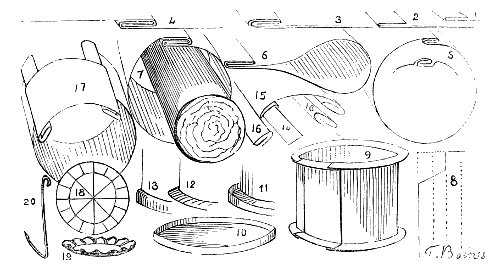
A very strong joint may be made by turning up, say ½in., more or less, of the edge of one sheet (Fig. 1), then laying in it the edge of the other (Fig. 2), and turning up the edges of both (Fig. 3); then, keeping the joint pressed down, lift up the second sheet as you would open a book, and press it out flat and open (Fig. 4). You cannot make this joint in the two edges of the same sheet, turned round upon each other (Fig. 5), unless you first nearly flatten the two parts (Fig. 6), when they may be doubled upon each other, and the sheet restored to its cylindrical form by the insertion of any pointed cylinder, such as, for instance, the horn of the anvil or a block of wood rounded and tapered at the end (Fig. 7). Suppose it is required to make a pannikin, this joint, whether previously tinned so that it may be soldered or not, is the only proper one, but the corners should previously have been cut away, so that only a single or, at most, a slightly overlapping double thickness may be left at top and bottom (Fig. 8). The bottom edge is now turned outwards by gently tapping it on the block or anvil edge with a hammer till it resembles a narrow flange (Fig. 9). A circular piece is now cut for the bottom so much larger as to allow a rim to be turned up all round (Fig. 10), and to admit the flange within it (Fig. 11); then setting it flat upon the anvil, and forcing into it a block of wood that has been cut perfectly to fit it, clinch down the rim of the bottom upon the flange (Fig. 12), and turn them both up against the side together (Fig. 13). The top edge may now be rolled over in the same manner, and it will give additional strength if the rim is strengthened by the insertion of a piece of wire. If the foregoing joints have been carefully made you will have a water-tight and, what is more, a fireproof pannikin with or without the aid of solder, and a handle can be riveted on or not just as suits your convenience. One great advantage of the folded joint is, that if it is not too tightly hammered down, the parts will slide freely on each other, and advantage may be taken of this for making an opening in one side of a cannister to be closed by a sliding lid; or, if you are making a pannikin or other vessel, and your metal is not large enough to make the whole circumference in one piece, cut a small strip (Fig. 14) of the breadth you wish the joint, say 3⁄16in. or ¼in., and fold the edge of the metal twice over it (Fig. 15), then draw it out; do the same with the other edge, and also with the edges of the piece you intend to insert (Fig. 16), and you may then, with a little care, slip the parts together, and clinch down the joints as closely as you wish (Fig. 17). If the corners have previously been snipped off, or smoothed with a file, it will considerably increase the facility of doing this.
Utilisation of meat tin cases.
During the North Australian Expedition, when Mr. Gregory was preparing for the journey from the Victoria River to the Albert, in the Gulf of Carpentaria, he collected all the emptied preserved meat tins, and burning off the old paint by placing them above the forge fire, smoothed down the tin upon the surface with a piece of greasy rag, trimmed up the ragged edges, and, in most cases, obtained sheets of tinned iron nearly equal to new; from these he made pannikins of graduated sizes, in fact a nest of them, one fitting into the other from the largest to the least, thus securing comfort and convenience to his party, and utilising material which many persons would have thrown away as useless.
In opening a packing case lined with tin, care should be taken to cut the edges as clean as possible, for not only are ragged points liable to tear the hands very disagreeably, but if you wish to make use of the tin in any other manner, it is of great importance that it should be kept quite clean, flat, and free from unsightly wrinkles; a smooth sheet of tin may be cut, turned, or bent almost at will, but if it has previously been wrinkled, it is absolutely impossible to restore it to flatness, and to make a true joint in it is as much out of the question as to write freely on note paper fall of unsightly folds or creases. For cutting tin or other sheet metal, a pair of small tin snips, say 8in. or 9in. in total length, will be found exceedingly useful: stout copper or sheet-iron may be cut with them.
Dishes and plates, to make.
To make plates or dishes of sheet iron or other metal, cut out a disc or oval, of the size you wish, and then draw a line parallel to the edge all round it (Fig. 18); then draw lines radiating from the centre, like points on a compass card, as many as you please, say twelve, which will divide each quarter into three parts, answering to the hours on a clock face.
Make a small hollow across the end of a block of wood, the stem of the nearest small tree cut off at a convenient length for instance, lay the edge of your plate on it with one of the radiating lines corresponding with the hollow; strike it with the edge of your hammer till you have slightly indented it, do the same on the opposite side, and then with the other two quarters; repeat this all round, and you will have a very neat and useful plate, with scolloped edges like the patty pans usually sold by tinmen (Fig. 19).
Rivets.
A few rivets of various sizes, of iron, tin, and copper, should be taken; but, if the work is to be exposed to the action of the water, care should be taken not to fasten iron sheets with copper rivets, as the action of the metals on each other will be most destructive.
Tin rivets may be used to fasten any other metal where great strength is not required, and they are very advantageous for many purposes, as handles of tin or copper pannikins. By these we mean rivets of tin, not of iron tinned over, which also are useful, but not so easily worked.
Make-shift forge and bellows.
To extemporise a forge and bellows, the natives of Africa and India, who invariably squat down to their work, simply make their fire on the ground, which is previously smoothed and clayed over; behind this is raised a bank or fence of clay, perforated for the admission of a tube, either of wood of the bark of a small tree, or of the horn of an ox, or other large animal.
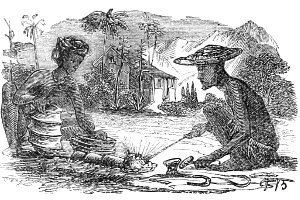
NATIVE INDIAN BLACKSMITH.
Their bellows are variously formed, but in every instance a pair are used, being worked alternately, one with the right hand and the other with the left, so as to keep up a continuous blast. They are generally formed of goat or antelope skins of about the same size, which are skinned off as “sacks,” and braiied or softened in the usual manner.
The sack is made by cutting the skin of the animal along the inside of the thighs, and then, without making any other incision, stripping it over the fore part of the body, the head being previously cut off, the skin of the legs is sewn or knotted up to prevent the escape of air. In one of the hinder legs of each bag is fitted a smaller tube, frequently of gemsbok horn, and to the sides of the aperture of the neck are sewn two pieces of stick with loops upon them for the insertion in one of the thumbs, and in the other of the fingers, so that by expanding the hand the neck can be opened while it is raised to inflate the bag, and closed up by grasping it tightly when it is pressed down to force the stream of air upon the fire; then by inflating and compressing the bags alternately, the primary object of a continuous and sufficient supply of air is obtained.
There are various modifications of form, in some of which more or less wood is very ingeniously used; but as the power of the whole depends entirely on the amount of air that can be inclosed in and forcibly expelled from the skin bags, we think the foregoing description will sufficiently answer the purpose.
If the traveller wishes—as an Englishman generally does—to stand up to his work, he can build up for his forge a square of rough stones, and then smooth over the top with a mixture of cattle dung and clay, of which last anthills broken up afford the finest quality; or if the hills are sufficiently large, he may at once smooth off the top of one and shape the embankment in the rear. But in this case he will also have to raise another platform, not only to carry his bellows, but for the blower to sit upon; for we doubt whether a native in the wilderness could be prevailed upon to blow them in any other position.
One of the most important portions of a waggon, and at the same time one most liable to damage, is the axle, and it is therefore of vital consequence that the traveller should understand properly how to set about repairing it.
New axles.
Suppose it be necessary to condemn the broken axle and make a new one; the first care is to seek out a tree of good hard wood—“kameel doorn” (Acacia giraffæ) is about the best a traveller is generally likely to find, though many other varieties may be used—and in thinly wooded countries this may imply a day or more spent in searching for miles around, for the trunk should be of tolerably straight grain, solid, and capable of affording a log 6ft. or 7ft. in length, 10in. in depth, and 4in. in thickness. A yoke of oxen may be sent to draw it home, and it should then be truly, however roughly, squared up to the above dimensions.
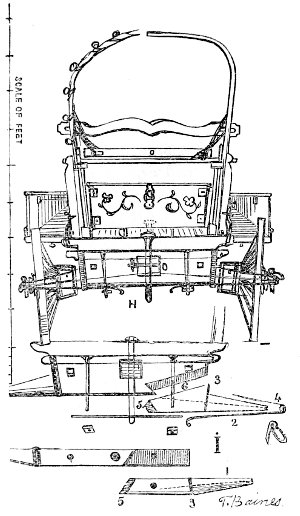
The size of the aperture in the nave, both at the back and front of the wheel, should then be taken, they will generally be about 4in., tapering to 3in. or 2½in.; the length of the arm will probably be from 14in. to 16in. In cutting the arm nothing is to be tapered off from the front (Fig. 1) or from the lower part (Fig. 2), all the taper being cut from above and from behind, so that the wheels may incline a little inward in front and below, and if the axle arms should bend a little with the weight of cargo and with the forward draught, they may only have a tendency to resume a true position.
The arms should be carefully lined off in accordance with these rules, and in cutting the shoulder (Fig. 3) it should be squared, not from the edge of the axle, but from a line (dotted in the illustration) drawn along the centre of the arm, so that the back of the nave may bear truly against it. In cutting the shoulder be sure not to weaken the arm by letting the saw go, however little, beyond the proper depth, for where so great a pressure has to be borne the slightest cut would become the beginning of a fracture. When the arms have been cut and roughly rounded by saw and adze or axe, trim them with the spoke-shave, and occasionally try on the wheel, whirling it round to test the truthfulness of the work—there is almost sure to be sufficient grease or tar left in it to mark all the undue projections, and to leave clean the hollows on the arm, and the marks should be carefully examined that you may know what parts require to be trimmed away. It is now time to take off the iron work from the condemned axle; and sufficient notice should be taken of every piece, to know exactly to what portion of the woodwork it is to be restored, for much extra difficulty is occasioned by any uncertainty on this point. Bolts, though of the same apparent size, should not be transferred at random from one side to the other, and every nut, when once removed, should be scrupulously restored to the individual bolt it belongs to. These injunctions may seem needlessly strict; but we speak from experience, and if the reader has to attempt the work now under consideration he will do well to attend as strictly to them.
The iron skeins, or friction guards (Fig. 4), should be removed from the arms of the old axle and carefully let into the corresponding ones of the new; and when nearly fitted they may be slightly heated so as to char and smooth the bed for themselves, as well as to grip more tightly, in cooling, the wood they are meant to protect. Before fastening them with their proper bolts the wheels should be tried on to ascertain that they have been truly fitted.
Note.—The sketch above shows, on one side, the kap tent, or properly-built roof, and on the other, the wattled substitute. O is the front of the “kadel,” or swinging bed frame, L, 8, M, on the next page, are the yokes, skeis, and trek gear, drawn to the scale given at the side.
If, as is most frequently the case, the new axle is a front one, it must now be fitted under the rest of the fore “stell” or “carriage” (H), the holes for the connecting bolts and perch-bolt marked and truly bored, and the clamps which bind it to the upper portion heated, driven into their place, and tightened by being suddenly cooled with water.
Sometimes, when it is not necessary, or wood sufficiently large cannot be procured, to make a new axle, a new arm (I) may be let in, and this should be scarfed and checked in, and the inner end (Fig. 5), which reaches nearly to the centre of the axle, cut, not square, but diagonally across, so that the after side is somewhat longer than the front, and this, preventing the inner end from coming forward, will also counteract the natural tendency of the draught to force the arm backward.
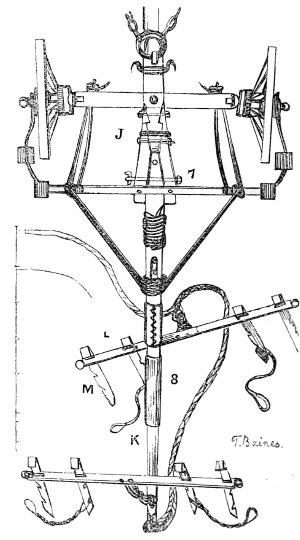
If the longitudinal cut (Fig. 6) for the scarf is also made not square across, but a little inclined upwards in front, it will also help to resist the backward pressure of the wheel. No fastening beyond the bolt which passes through the quarter of the axle and the band at the shoulder is absolutely necessary for the fixing of a new arm. We have, upon one occasion, not only made a new axle, but when, from unsoundness of timber, a new arm was necessary, have put in one on which the heavily-loaded waggon ran nearly 1000 miles; and besides this, the fore “tong” (J), or socket in which the dissel-boom or pole (K) works being much broken, we cut off the jaws on either side, and fitted new ones in a manner that will be much better understood by the above sketch than by description; and these, after running from the Zambesi to Otjimbengue, were still so firm that the professional waggon-wright, deemed it necessary only to secure them by the addition of a couple of bands put on hot, and shrunk down on them with water.
Repairing poles.
Frequently the “dissel-boom” or pole will break, but the cutting and fitting of a new one is too simple a matter to need much more instruction than a careful inspection of the old one will afford; it was our practice, however, to bore a hole perpendicularly downward behind the dissel-bolt (Fig. 7), and by means of a ½in. bolt and nut, tightly screwed, preserve the pole from splitting when subjected to a heavy strain.
Mr. Reeder, whom we met near the Zambesi, showed us a very ingenious plan of staying the dissel-boom when the fore tong was weakened. Chapman went out and shot a rhinoceros, and Reeder first nailed a chock upon the dissel-boom, and fixed on it a grummet of rhinoceros hide as tight as possible, then, taking a long, stout strip of the same, he hitched the middle of it on in front of the grummet, leading the parts to each side of the splinter bar, and thence under the axle to the bolts behind it, where the ends were thinned off sufficiently to admit of their being easily made fast. These stays did not come forward enough to gall the after oxen. The great virtue of raw hide is that, instead of slackening like rope when it dries, it shrinks, and becomes as hard as iron. Suppose a dissel-boom sprung where another could not be procured, the skin from the leg of an ox, or a wild animal of corresponding size—say a buffalo or quagga—drawn on while wet and allowed to dry, would make the joint firmer even than the unfractured part (Fig. 8). The skin from the tail of an ox will, in the same manner, mend a broken waggon whip; and that of a calf’s tail is in like manner used by the Kafirs to bind the part where the iron of their assegais or light javelins is inserted into the shaft. Quagga skin, indeed, is especially used for this purpose, and hardly for any other, as it is so rigid that the ordinary means for softening leather are of no avail. Sometimes the Dutch farmers use the skin, just as it is stripped off, as a jar or barrel to hold corn or other produce.
The repair of wheels.
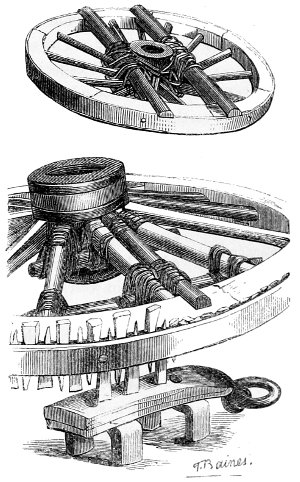
A long journey over rough roads and in an intensely hot country, like Africa in the dry season, will tell upon the best-made wheels, and the spokes and tires will become loose most frequently where it is impossible properly to rectify the defect. In such cases a number of wedges of dry, straight-grained wood must be prepared, and for this purpose some box or packing-case, made of deal, must be sacrificed, as it will be almost impossible to procure anything so suitable in the bush; the plank must be cut into pieces between 3in. and 4in. long, and, if these are again sawn diagonally along their length, material will be saved by the production of two wedges, where only one could have been made by the whittling process. These must be driven tightly in from back and front, between the felloe and the tire, and as equally as possible all round the wheel; if they are then wetted with, and allowed to absorb, a strong solution of salt in water, they will swell, and will not again shrink as they would if wetted with water only. We knew one very practical Englishman who used to soak his wedges in salt and water before driving them in, but what he gained by thus previously swelling them we never were able to learn. If the spokes become loose in the nave the temporary remedy is to cut two stout bars, in length just equal to the diameter of the wheel; half check them so as to give them a better hold on the felloe; lay them parallel to each other on the front of the wheel, one on each side the nave, and bind every spoke as firmly as possible to them with thongs of raw hide, taking care to keep the lashings quite close to the centre of the wheel; the drying up of the thongs will shrink them so much that the fabric of the wheel will be as firmly bound together as if clamped with iron.
If a spoke be broken, cut a new one much thicker than the rest, half check it on to the back of the felloe, and let the other end abut upon the nave, filling up nearly the space between the sound spokes on either side; it should need to be driven in tightly, and, when in position, should be secured by thongs of raw hide, both at the nave and at the felloe, to sticks laid across the front of the spokes on either side, and securely lashed to them.
Lead, and its uses.
Lead is useful for a multitude of purposes; its great specific gravity, and the ease with which it can be melted, cut, hammered, moulded, and bent, render it especially valuable as a handy metal. Our space will not admit of our giving more than a few of the most noteworthy purposes to which it can be applied by the hunter and explorer. Projectiles of all sizes can be made from it, from the ponderous cannon shot to the small sizes used by the hunter naturalist.
Cannon shot.
Round shot for artillery, of excellent quality, can be manufactured from lead; and there is no doubt that for certain purposes it is far superior to the iron missiles in general use, the cheapness of the latter material being its great recommendation. It will sometimes happen in wild countries that although regular cannon balls are not obtainable lead is, and to make round shot from it two or three methods may be adopted. The first is to form a ball from well-mixed clay, or carve one from wood, of size to fit the bore of the piece easily, but not too loosely. The clay ball will require thorough drying in the sun or before a slow fire before use. The wooden one will merely require sprinkling over with fine ashes from the camp fire to fit it for use. Two large calabashes, wooden boxes, bowls, or cooking pots, are now to be rather more than filled with well-kneaded clay, which has been carefully freed from stones or grit, pressing it well down with a flat board until it is quite even at the surface and is perfectly compact. The clay round the edges of the two clay holders must now be trimmed off with a knife even with the sides of the holders, but projecting about an inch beyond the brim. The surface of each is now to be sprinkled with very fine ashes, and the ball pressed into the centre of the clay until it is half imbedded. It is then to be carefully removed, and pressed in like manner on the other holder. The ball is then taken out and laid aside, the two holders being allowed to dry slowly, care being taken that the clay is not cracked by the too sudden application of heat. When thoroughly dry, the vessels or holders are to be placed mouth to mouth, and so fitted, by scraping the clay, that the two indentations formed by the ball fit exactly facing each other; when this has been done, a funnel-shaped inlet must be cut for the admission of the molten lead. The two holders may now be put together, secured with a lashing of cord or strips of hide, and the metal run in at the inlet. Some time must be allowed to elapse before the mould is disturbed, or the lead will not have sufficiently settled to admit of the shot being removed without injury to the apparatus. The tail of lead formed by the inlet serves to lift the shot out by, and is then cut off flush with the surface. A number of balls may with care be made with the same pair of holders, only the greatest caution is needed in this, as with all other operations in which molten lead is used, to guard against the presence of moisture in the mould, or most serious accidents will happen.
We were busily engaged one night over the camp fire casting heavy bullets for our large smooth bore, making use of an iron ladle for the lead, and a large pair of iron moulds for the balls. These had become rather hot and were laid aside to cool; and whilst this was doing, as the lead was beginning to run rather short, we started for the tent to get more, desiring one of the Indians, who was keeping up the fire and generally aiding in the operations, to go on casting so soon as the moulds were cool. That no time might be lost, our dusky assistant plunged the hot mould in a pot of water, closed it up, and proceeded to pour in the charge of heated metal, when a violent explosion instantly took place, scattering the boiling lead broadcast over the naked legs and bodies of the unfortunate natives, sending the ladle one way, the mould another, and causing a perfect panic and dire dismay throughout the party.
Soft stones of many kinds can be conveniently made use of for casting in, taking two of equal size, scooping out the cavity in each stone of the form intended to be given to the casting, and then cutting an inlet. Common Bath scouring bricks answer this purpose admirably. We constantly use them for casting fishing leads, plummets, bodies for artificial baits, &c. &c. Two bricks, or portions of brick, are made use of. The surfaces are rendered smooth by rubbing them together. The intended cavity is then marked with a sharp point on each half, and scooped neatly out with a knife, chisel, or other convenient instrument; when finished, notched, and the inlet cut, the two halves are tied together with tape and the lead poured in. Objects of six or seven pounds weight can be made by the use of two common scouring bricks. Balls of large size are often made in the East by hammering square masses of lead, or iron, on an anvil until sufficiently round for use. Great labour and no little skill are required to perform the operation, which after all leads to very unsatisfactory results, the balls being rough and untrue, corresponding with the interiors of the barrels they are intended to be fired from. We have seen heavy stones and bits of iron covered with lead fired from the most unpromising looking matchlocks, which, somehow or another, deliver their charge with greater force and accuracy than would be anticipated on a first examination. The best moulds for casting bullets of all sizes and forms are those made from gun-metal, bronze, or brass.
Buck-shot mould.
A buck-shot mould of either of these materials will be found of great value. We have one which has proved on many occasions of the greatest service; it is constructed to contain two rows of cavities for the shot, seven in each row, one above the other; so that when the groove leading to the inlets is filled with lead, and all the cavities are charged, the second row is turned upwards and treated in the same manner. The shot, when cold, are cut from their necks with a knife or strong pair of scissors, and are then fit for use. They should be about the size of common peas, and a charge of them from a large powerful gun is tremendously effective; they are extremely useful for deer jumping, antelope shooting, wild goose or bustard stalking. At very short distances, and in close encounter with a large animal, they may be used with destructive effect, but must be only considered in the light of a makeshift when the true large game of the forest has to be dealt with. Against attacking hordes of savages, in a bush fight, or canoe encounter, they are invaluable. The charge must be proportioned to the size of the guns; those of heavy metal and large bore generally deliver them best.
Slugs, to make.
Slugs are to be made by filling a box or large pot with fine clean sand, forcing it down tight, and then with a smooth round stick, about the size of a small pencil, making a number of holes from the surface to the bottom of the vessel or receiver in which the sand has been placed. When as many are made as the space will admit of, pour the molten lead steadily into them until they are filled; when cold, the sand can be thrown out, and the leaden rods or pencils separated from it. These, when laid on a board in rows, can be cut up into short junks by placing a strong knife on them, and striking it on the back with any convenient instrument. Thick sheets of lead are cut up into dice in much the same manner. These are usually shaken about in a tin box or an iron pot, in order to round off the corners.
Shot, to make.
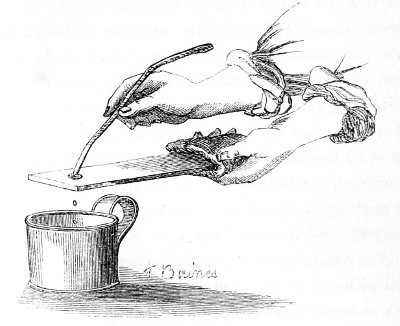
The manufacture of shot by the amateur, although not quite as easy of accomplishment as the preparation of slugs, may be, with the exercise of a little ingenuity, successfully carried out; and although the produce of his labours will not equal the perfect spheres produced by the professional shot manufacturer, by the aid of his costly tower, yet it will be good enough for the description of shooting he will be likely to obtain in situations where the making of shot is rendered necessary. We were driven to the necessity of devising the plan we are about to describe by the impossibility of obtaining shot, coupled with the urgent want of that to be procured with it. Thus is the operation to be conducted:—A piece of iron, such as horse-shoes are made from, is to be obtained if possible, if not, any other piece of iron, about 2ft. long and of moderate width and thickness, will answer the purpose. About an inch from the end of this drill a wide-mouthed, funnel-shaped hole, of the form known as a countersink, until within about the eighth of an inch of going through the bar; then, with a drill about the size of a knitting-needle, extend the hole quite through; next, get a piece of dry plank, about 3ft. long, and in it, with a handsaw, cut as many longitudinal cuts as the width of the board will admit of, making them a little over the eighth of an inch deep and the thickness of the saw wide. The board, when placed slightly on the incline, must be so treated with a charge of molten lead that all the cuts are filled with it from the upper end; the result will be the formation of a great number of long lead wires. These are to be taken from the grooves and fresh batches run, until as many pounds have been made as it is intended to make shot. A preserved-meat tin, or an ordinary tin pot, must now be about one-third filled with water, and the remaining two-thirds filled up with oil; the pot must be placed on a plate or dish, in order to catch any oil which may run over as the work proceeds. The end of the iron bar which has the hole in it is now to be placed in the fire and heated to a bright-red heat: when the other end, round which a piece of cloth may be bound, is grasped with the left hand, and the bar quickly withdrawn from the fire, struck smartly against some solid body, in order to remove adhering dust and ashes, and then held with the wide mouth of the hole upward, a short distance above the surface of the oil in the pot. A lead wire is now to be quickly taken up in the right hand and its end pressed well down into the hole (as shown in the above illustration); if the iron is well heated, the wire will melt away very rapidly and run in a succession of drops into the oil: wire after wire is to be thus melted, until the iron requires reheating. (It is a good plan to have two or more irons at work, but it is not essential.) This wire-melting process must be continued until all the stock has been expended, when the solid contents of the pot may be taken out. If the operation of dropping has been properly performed the result will be shot of about three sizes—No. 7, No. 4, and duck shot. Certain conditional circumstances somewhat alter these sizes, but approximately they are to be expected, and a certain number more or less tailed will generally be found amongst the rest. To separate the three sizes of round shot two flat tin boxes or empty sardine tins are required. With a piece of nail filed down, so as to make a hole the size to just let No. 7 shot through, punch a number of holes in the bottom of one of the boxes, so as to make a sort of sieve of it; then with another nail make holes in the bottom of the second box, just large enough to let your No. 4 through. When these are prepared, wash your mixed shot in water, with wood ashes in it; this removes all the oil in the form of soap. The shot, when dry, is ready for sifting with the boxes. The first box lets only No. 7 or a size or so smaller through, keeping back the No. 4. The second box lets the No. 4 through, retaining the duck shot. Each size may now have its own respective tailers, or pear-shaped shot, mixed with it; these can be got rid of by allowing the shot to run down over a sloping board, when the round shot run straight to the bottom, whilst the tailers run off at the sides, and can be collected to melt up again.
Lead plates, to make.
Plates of lead for writing inscriptions on can be cast by turning up the edges of a piece of sheet copper, iron, or tin, just high enough to form a sort of shallow tray to hold the molten lead. In the absence of sheet metal, the surface of a box of sand, or a flat stone with a little wall of clay round it, may be made use of.
Lead pencils and stock whip handles.
Lead pencils, for rough carpenter’s work, can be made by filling joints of small cane, marsh reeds, or weed stalks, with melted lead, and then pointing them with a knife. The handles of stock whips and some other implements are weighted, and prevented from splitting, by having lead run into them; some of the former are occasionally very elaborately ornamented. The operation is performed by first cutting out the intended pattern on the handle with a sharp-pointed knife or other instrument, taking care that the cutting penetrates the wood deeply, that the form of the groove is slightly undercut, and that each ring of the pattern communicates with the one below it. The first ring on the stick must have an inlet made in it; strips of stout brown paper are now, after being slightly moistened and touched over with paste, rolled round the stick, layer after layer in spiral form, until its whole length has been thickly covered like the case of a rocket. When thoroughly dry the lead is run in at the inlet, and when cold the paper can be stripped off, and the handle finished off and polished with sand-paper or a bit of fish-skin.
Bruised gun-barrels, to repair.
Indentations in the sides of gun or rifle barrels can be taken out by the following process:—Take the barrel out of the stock; cut a cork so as to fit the muzzle tightly, and then force it down three inches, ram in about a quarter of an inch of dry powdered clay on the cork, twist a cloth dipped in cold water several times round the barrel in order to prevent the rib from becoming unsoldered by heat, and then fill up the space above the clay with molten hardened lead. (See “To harden bullets,” p. 228.) You will then have a metal plug exactly fitting the barrel. Remove the cork and clay, and fashion from strong hardwood a rod just long enough to reach a few inches beyond the indentation. A bar of iron is now to be heated to a red heat, and placed against the indented spot on the outside of the barrel; the wet cloth being at the same time wound above and below it. The metal plug is now to be forced down the tube with the rod until it rests on the obstruction, when a few blows with a piece of heavy wood on the upper end of the rod will generally pass the plug onwards by forcing the tube back to its proper position. It will be well to reverse ends with the plug and force it up and down several times, until it travels quite freely past the point of obstruction.
Make-shift rifle shells.
Rifle shells may be extemporised by having little tin tubes the length of the conical bullet and the size of the gun nipple made. These, when their ends have been plugged with wood, are placed one by one in the mould, held upright by a bit of very fine brass wire, and the lead cast round them, so that the lead at the base of the bullet may extend beyond the end of the tube and cover it. The thin end of the tube should project just a trifle beyond the apex of the cone, as a rest for the cap. The wooden plug at this end is now taken out; the tube filled with the best sporting powder, and a strong, well made percussion-cap put on the tube, and secured there with strong varnish, sealing-wax, or pitch. The loading of a breech-loader with these is accomplished with no danger, but with a muzzle-loader the very greatest caution is required. The end of the ramrod or loading stick should be very deeply countersunk, in order to take all pressure off the cap; and even with this precaution it is well to make use of an overhanging branch of a tree to place the rod against, whilst the rifle is thrust muzzle upwards until the ball is home. Shells somewhat on this principle were first brought into notice by the late General Jacob, of the Scinde Irregular Horse. They are tremendously destructive when skilfully used: destroying large animals by exploding in them, and blowing up magazines of gunpowder at all but incredible distances; but we have known them explode outside the elephant and other large pachyderms, thus failing completely in the object they were used for. Mr. Metford’s improvement on the Jacob shell is worthy of remark. Finding that it did not always explode, he mixed equal parts of chlorate of potass and sulphate of antimony; the two can be mixed on a plate with a bone paper-cutter or a quill pen. The more they are mixed, the more sensitive is their detonating power. The bullets are moulded with a hole from point nearly to base, as for Jacob’s shells, but no copper tube is used. The powder is filled in with a quill to the top, and settled down by a few taps of the base of the bullet on a table, and the end is then stopped with wax. But it is very questionable whether, in close encounter with large animals, it is not better, after all, to rely on the more certain effects of heavy balls of ordinary construction, with strong charges of powder behind them. With the numerous improvements in rifle shells we cannot deal, as many of them are too complex in their component parts for a wandering hunter or explorer to be able to imitate successfully.
Ladles, spoons, and other substitutes.
Small ladles or iron spoons are usually used to melt lead in, but, in the absence of these, bullets and other small matters may be cast in the following manner, which is a favourite one amongst the Indians:—A piece of dry hard wood, about 16in. long, 3in. broad, and 2in. thick, is prepared; on one end of this a spoon-shaped cavity, with a lip-shaped groove in the end, is made; in the bottom of this a few red-hot wood embers from the fire are placed on these same fragments of flattened lead, and on the lead some good-sized pieces of red-hot embers. A bit of bark is now twisted into a blow-pipe, from which a steady stream of air is directed to the miniature furnace, which almost instantly melts the lead, and fits it for running by the lip into the mould, just as it would from a spoon. Clean, excellent bullets are to be made in this way.
Lead ore smelting.
It sometimes happens that lead ore or galena is discovered. Lead as a metal, except in very rare instances, is not found in a native or malleable form; and as the ore is a sulphuret, brittle, and easily pulverised, some method must be had recourse to in order to smelt and render it fit for use. Some Indians do it in the following manner:—After reducing a large quantity of the ore to powder, between heavy stones, they seek out a hollow tree stump, clear out the bottom flush with the ground, and dig a pit just outside it. Then on the bottom or floor of the stump a thick layer of dry wood is placed, evenly on this a layer of the powdered ore, then another layer of wood, then one of ore, and so on until the stump is quite full. A small hole is then chopped with a tomahawk through the side of the stump, level with the ground and opposite the pit. Through this orifice fire is introduced, and the stump soon becomes a mass of glowing heat as the air rushes in at the hole at the bottom; so fast as the galena (which is usually very pure) is reduced to melted lead it trickles through the interstices of the heated pile, and runs out into the pit, where it is allowed to settle and cool.
The Dutch-Africans like to have their bullets of such a size that when one is put into a clean barrel it passes slowly down without rattling, the slight noise of the escaping air being heard as it descends. In a skirmish they load very quickly; the powder is poured from the large ox-horn into the hollow of the hand, and thence into the gun: a number of bullets are held in the mouth, one is dropped in, and the moisture cakes the powder round and holds it in its place with a very slight tap from the ramrod, or sometimes perhaps without; though we should never advise any one to incur so great a risk of bursting his gun.
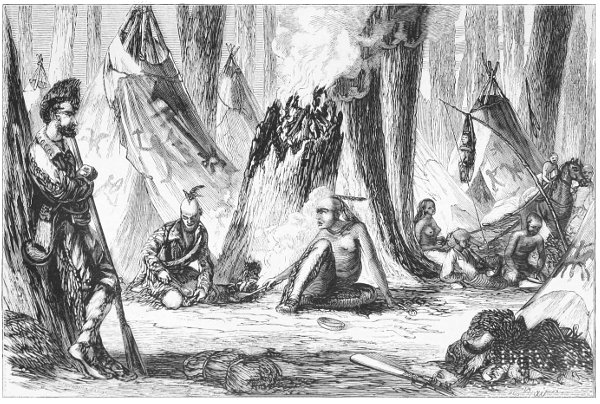
LEAD SMELTING IN THE FOREST.
To harden bullets.
For such game as the elephant or rhinoceros the hunters harden their bullets with a little tin—not more than one-tenth; if too much is added it makes the bullet brittle, and detracts from its specific gravity; it should be just hard enough to show a slight indentation when bitten. The lead must be first melted as requiring the greater heat, and the tin added afterwards. Type metal, or worn-out type from printing offices, is much used for this purpose; but quicksilver, which, from its own great specific gravity, does not detract from the weight of the bullet, is the best alloy. Sir S. Baker says:—“The lead is melted in a pot, which is kept at red heat. Enough to make three or four bullets is taken in a smaller ladle, and one-tenth of quicksilver added and stirred into it with a bit of iron, as if the quicksilver is exposed to the great heat of the larger pot it will soon evaporate. The rifle bullets used in the army, being compressed instead of cast, are hard enough without alloy; and in breech-loaders, where the bullet has to pass through a barrel which is generally a trifle smaller than the chamber, it would be unsafe to harden it too much.”
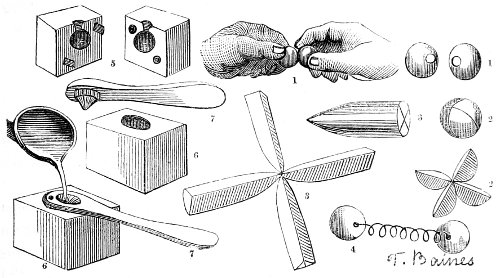
Cleft bullets.
The Fingoes and Kafirs cut a small piece off two bullets, so as to produce flat surfaces (Fig. 1); then, while the lead is still clean, press them strongly together, giving them a half turn to expel the air and bring them perfectly in contact. They will adhere so strongly as to bear throwing on the ground, and when fired at a hundred yards will separate only a few inches. A bullet cleft very nearly through with two cuts, so that it spreads into four parts (Fig. 2), makes a fearful wound at close quarters—a conical cut from its base (Fig. 3) particularly so. Sometimes two bullets are connected by a bit of bell wire rolled up spirally as a spring (Fig. 4). We have seen bundles of nails bound together with wire by the rebel Hottentots in imitation of conical bullets. The Kafirs use bits of the legs of iron pots. Some of the native hunters use iron bullets, or rather bolts twice as long as their diameter; but they creep so close that they cannot miss, and follow the wounded animal till he dies, so that they always recover their bullet.
Extemporising bullet moulds.
Bullet moulds may be extemporised in many ways. Two shallow boxes may be made and filled with loam or clay, much as the moulds for cannon shot, before described, are made (of which last no material is better than a pounded anthill), and the surface of the lower one must be smooth. A piece of stiff paper pierced with holes the size of the bullet laid on it, and as many bullets as convenient pressed half way into the clay, the other half must then be pressed down upon it, and when nearly dry the bullets must be taken out, holes made through to the outer surface, on which a small channel should be cut, so that the lead may run to the entrance and not waste itself by spreading. Most likely the mould would be damaged after two or three castings, but it is easy to make a new one. The Dutch boers frequently use blocks of steatite or soapstone, with half the bullet cut into each, and pegs or projections on one half, with corresponding hollows in the other, keep the two parts in true position (Fig. 5).
In Sydney we required a conical bullet mould; and, as such things were not generally kept for sale, we engaged a founder to make a solid block of brass, as in Fig. 6, and in this to bore a cylindro-conical hole, point downwards, about ½ in. deeper than the length of the bullet; another piece was made with a handle at one end, and at the other a projection (Fig. 7), to fit into the block and give the form of the hollow back of the bullet; a hole was bored through this a little smaller above than below, so that when the superfluous lead was cut off the bullet would come away with a tail about 1 in. long, tapering to the end; this was easily cut off with proper pincers; there was a small notch cut up the side of the inserted block so as to allow of the escape of air as the lead was poured in. In some conical moulds the lead is poured in from the side, and in others from the point. We do not approve of either of these methods. The greatest hardness, weight, and density should be at the point, and therefore this should be downward in the mould, while the metal is poured in at the base.
Of course the great range acquired by some of our most perfect rifles with cylinder conical bullets is an immense advantage, for if animals cannot be approached they may be shot at long ranges; and very frequently during the last Kafir war, while parties with the common musket have been defending themselves against savages who occupied almost impregnable positions, those among the colonists who possessed long ranged rifles would occupy a hill perhaps a couple of thousand yards off, and send bullets among the enemy with quite sufficient accuracy to create a very uncomfortable feeling of insecurity.
A very favourite form of gun was a double-barrel, with one barrel rifled, and very carefully sighted for long ranges, and the other plain, and capable of throwing a good charge of buck shot, which we have seen very effectively used at thirty or forty yards.
Sporting rifles.
When the elephant hunters lie at the water by night, and shoot at very close quarters, they find that a sharp-pointed conical with very high velocity, pierces so suddenly and sharply, that the animal feels no shock to the nervous system, and gets away for many miles, and dies beyond their reach. They therefore choose a short, smooth-bore gun, with a very large round bullet. We have seen them as large as half a pound; and this, with a comparatively small charge of powder, say 9drs. or 10drs., bruises rather than pierces, communicating such a shock to the adjacent parts that the creature is stunned as well as wounded, and is not able to make those marvellous last efforts that in the former case would enable him at least to die in peace far out of reach of his pursuers. We, after a fair trial of the conical ball in India, abandoned it on account of the quantity of wounded game lost, and returned to the old spherical projectile.