Chapter II · BOATS, RAFTS, AND MAKE-SHIFT FLOATS. (continued 2)
Reading edition
Paddling.
In paddling a canoe sit near the stern, looking forward, and with the paddle on your right side make a long fair stroke; never mind the deviation of her head to the left; but just before you lift your paddle from the water, feather the blade of it by turning the right hand inward from the wrist, turn the right elbow outward, and draw the left hand inward across your breast; this will “port your helm” and bring her to her course again.
If you have a mate who handles another paddle this is less needful; but it is well to learn to paddle your own canoe practically as well as metaphorically, single handed.
The kroomen about Sierra Leone use a canoe pointed at both ends and with a great sheer; this, to a novice, is much more difficult to keep to a true course, but a single krooman tossing his paddle from hand to hand, without missing a stroke, will make her fly direct as an arrow the way he means to go.
In the gunning boats on the Norfolk coasts, when strict silence is not needed, and in canoes of some other countries, a double-bladed paddle is used. The pole is grasped by both hands, like the balance-pole of a rope-dancer, and equal strokes are given alternately, or the course is changed by a more powerful stroke on the other side.
We have occasionally found that the power of handling the native paddle has been of great service, for when we have wished to cross a river to secure some specimen of wading bird, and the bargaining over the hire would have occupied half a day, we have cut the matter short by stepping into the canoe, paddling to the other side, shooting our bird, and making the owners a sufficient present on our return; and, while we advise that all travellers should most scrupulously regard the rights of the natives, we must also intimate that they will not gain the respect of savages by submitting tamely to extortion, or showing themselves in any way afraid to maintain their own.
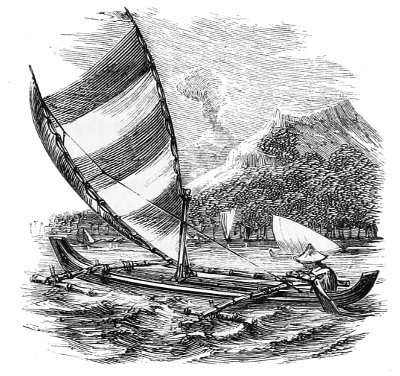
THE PROA.
Proas.
The proas, or outrigger canoes, of the Malays and Indian islanders, are so proverbially swift that they have fairly earned the title by which they are generally known, of “flying proas.” We have seen and admired many varieties of these, as well as their fan-shaped sails, sometimes of matting—bright and yellow while new, and deepening to browner tints with age, and sometimes of snow-white cotton, or of white alternated with cloths of blue or pink, and gay streamers floating from the bending yards. The most common, and we may almost say the most beautiful of these, were the little proas sailed by one man only, as represented in our sketch. The hull consisted of a single log, perhaps twenty feet in length, and hardly as many inches in depth and breadth; the mast was about six feet in height; and the sail, of triangular form, was laced to a couple of bamboos nearly as long as the canoe; the thick ends of these crossed, and were lashed together at the tack of the sail, and were made fast, loosely enough to give them sufficient play, a little before the mast thwart; a loop attached to the upper bamboo, or yard, at about six feet from the tack, was hitched over a knob on the mast-head, instead of hoisting the sail by halyards, and the sheet was attached by loops like kite loops, or bowline bridles, to the lower bamboo or boom; in hauling to the wind, the simple gathering in of the sheet trimmed the sail nearly down to the gunwale, as seen in the distant proa, while in going free the slackening of it allowed the sail to rise to the wind, till in the distance it reminded us of the beautiful fan-shaped sea-shells, so often found upon the coast. Stability was imparted under this enormous press of sail by two bamboos twelve or fifteen feet long, and from four to six inches thick, kept parallel to the boat at six or eight feet from her sides by two beams of the same lashed across her gunwales, bending slightly downward, but the foremost less so than the after, so that the fore end of the outrigger might be raised slightly above the water, and not impede the boat. The rudder was just like that of our own boats, except in its fittings, which consisted simply of a rope grummet at its neck, by which it could be hitched on to a timber head on either quarter, and we believe it made so little difference that the boatman seldom gave himself the trouble to shift it from one to the other. Of course a tiller was used, as yokes and lines would have been inapplicable. We cannot tell exactly their rate of sailing, but they passed our swift and handy little schooner the “Tom Tough” with ease, even when the breeze was at its freshest. The hull is generally whitened with a mixture of chunam, or coral lime, and cocoa-nut oil, and the raised ends are ornamented with devices in red or green, and sometimes a red streak runs along the side. The tambanga, or waterman’s boat for passengers, has more beam, no outrigger, and a smaller though similarly shaped sail.
Some of these proas were much larger, being fifty or more feet in length, and then the sides of the log forming the bottom of the canoe would be raised either by other planks sewn on or by a framework of bamboo, with pieces cross cut from the leaves of the fan-palm, so that the leaf ribs should stand vertically, stitched to them to form the extra height of side, while a roof of the same was built over the centre where cargo would be stowed, or over the after end, to form a kind of cabin. When planks are used for raising the sides, they are not sawn like ours, with economy of time, labour, and material, but are laboriously chopped out of the solid; and, instead of being bent, are patiently dubbed down to the requisite curve with numberless strokes of the keen little Malay adze, projections being left on the inner side through which holes are bored to lash them to the timbers, while rows of holes along the edges admit of their being sewn together with strips of rattan, and shreds of palm leaf laid along the seam and confined by the tightening of the stitches, help to reduce the leakage, which, if the vessel works at all in a sea-way, can never be entirely stopped. They have two large sails similar in form to those of the smaller proas, and sometimes a third, as a mizen. This is small enough to be hitched over the mast-head, as before; but the others have to be hoisted by halyards, and the long yards supported by propping them at some distance from the slings by bamboo poles. The stays were formed of slips of bamboo, and sometimes even of the poles, which, being well fastened, would not only resist tension on the weather-side as well as ropes, but on the lee would, by their rigidity, help to support the masts. The outriggers of these were more elaborately framed with a lighter set of beams, which supported stanchions and hand-rails, so that, when the wind freshened, men might run out upon the weather outrigger and, holding on by the hand-rail and stays, which lead from the mast-head, serve as a counterpoise to the immense sails as the boat dashed through the water. Reefing seemed never to be thought of, and our own men soon got into the habit of speaking of a one-man or two-man breeze, according to the number seen on the weather outriggers of the proas that flew past us. The appearance of these vessels when going wing and wing before the wind was very pretty. And others, in the fashion of the Chinese junk, or in every modification of European, engrafted on native form, afforded picturesque contrast, but need not be here described.
The professional pirate has the outrigger only on the weather-side, and this is frequently a log of light wood trimmed sharp at either end, so that while its specific gravity is small enough to keep it buoyant, it is still so heavy as not to be easily lifted out of the water, like a bamboo, and when requisite, men sent on it, as in the former case, will give it additional weight. But the chief peculiarity is in the hull of the vessel, which is only half a boat, the lee-side being perfectly flat, while the weather, or that toward the outrigger, is rounded as usual; they will be frequently more than fifty feet in length, and six or eight in breadth. We speak of the lee-side, because when the course has to be changed—say in beating to windward—they do not go about like a ship, that must go with her bows forward and be steered from the stern, and therefore turns to receive the wind on the other side. This would be fatal to the proa, as the buoyancy of the outrigger would not prevent her from capsizing; and therefore, while the steersman lets that end which is temporarily her bow fall off from the wind, the men who have charge of the tack run round with it on the platform to windward of the mast, the sheet is brought round to leeward, a steersman takes his place at the other end, and that which has been the stern now becomes the bow, and cleaves the waves at the rate of twenty miles per hour. But no one need fear a proa with a double outrigger, for she is not intended to lay alongside and board.
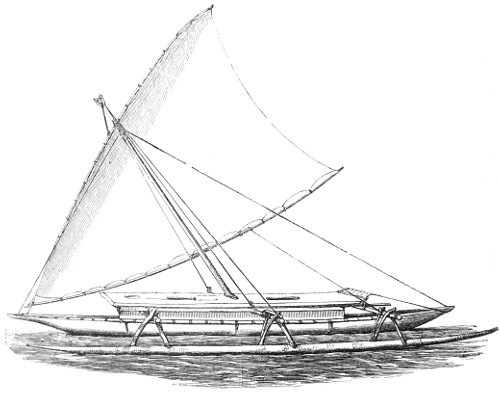
PROA WITH OUTRIGGER ON WEATHER-SIDE ONLY, TO SAIL WITH EITHER END FIRST, AS REQUIRED.
The engraving represents a proa with an outrigger only on the weather-side; and not only would the sail be made to traverse by shifting the tack to that end which, for the time being, was intended to go foremost, but the mast is also fitted to be inclined forward by slackening that which happens to be the back stay, and tightening that which is pro tempore the fore. Those which serve for shrouds, being exactly abreast of the mast, are so arranged for the purpose of facilitating this.
The commander of the United States Exploring Expedition, Charles Wilkes, U.S.N., gives the following description of the Fejee canoes:—
Fejee canoes.
“They are superior to those of other islands. They are generally double, and the largest are 100ft. in length; the two canoes are of different sizes, the smaller serving as an outrigger to the other, and are connected by beams on which a platform is laid, 15ft. wide, and extending 2ft. or 3ft. beyond the sides. The bottom of each canoe is a single plank; the sides are fitted to them by dovetailing and by lashings passed through flanges left on each piece; the joints are closed by the gum of the bread-fruit tree, which is also used for smearing them. They have a depth of hold of about 7ft., and the ends are decked for 20ft., to prevent their shipping seas. Amidships[B] they have a small thatched weather house, above which is a staging on which several people can sit. The canoes of the chiefs are much ornamented with shells. The sails are so large as to appear out of proportion with the vessel, and are of tough and pliable mats; the mast is half the length of the canoe, and is stepped on deck in a chock; the yard and boom are twice as long as the mast; the halyards are carried over a crescent on the mast-head, they are bent on to the yard at a distance from its tack or lower end nearly equal to the length of the mast. The natives manage these vessels very expertly; they require much skill in beating against the wind, for it is necessary that the outrigger should be always on the weather-side, as, if it gets to leeward, no vessel is so easily capsized; in tacking, therefore, the helm is put up instead of down, until the wind is brought abaft the beam, then the tack of the sail is carried to that end which was previously the stern, but which has now become the bow, and the canoe is steered from the other end; they carry sail even when it blows heavily, by sending men on the outrigger to counterbalance the force of the wind. The canoes are of logs hollowed and built upon; they make long sea-voyages, and are provisioned only with yams; they are ornamented with Cypræa-ovula shells, and carry white pennants; they carry water in cocoa-nut shells, and, with fire and an ‘ava’ bowl, are equipped for sea. The chief holds the end of the sheet, and it is his duty to prevent the canoe capsizing; the steer oar has a large blade. In smooth water they sail very swiftly, but the force of the sail strains them, and they leak badly, so that the men are constantly baling. The planks are kept in shape by small ribs as with us. The principal tool used is an adze, which is now made by lashing a European plane iron to a crooked handle; they are anxious to possess our tools, and especially the American axe. Their knives are made of bamboo, cut into form while it is still green; after being dried it is charred, which makes it very hard and sharp; a second charring, followed by grinding on a smooth stone, will even fit it for surgical operations.”
The balsas.
The balsas, at Guayaquil, as described by Sir E. Belcher, in his journal of the voyage of the “Sulphur,” are rafts of ten logs 14in. in diameter, and 60ft. long. The wood is a kind of bombax, called balsa wood, they bear fifteen or twenty tons independent of their crew, and bring fresh water down the river in jars of seven gallons each. Houses thirty or forty feet long, and twelve feet wide, are built on some of them, and families take passage or live permanently on board.
The balsas, at Arica, in Peru, are differently constructed; they are simply skins, stripped off the animal, with as little cutting as possible; the absolutely necessary incisions are then securely closed, the hides are inflated and allowed to dry and harden, and two being laid alongside each other a platform is laid across them, on which the cargo is kept sufficiently high above the spray or ripple, and brought dry ashore even through a heavy surf. Two ox-hides would make a very serviceable balsa, as would also a pair of the large seal, the sea-elephant, porpoise, or other marine animal of suitable size.
Cape waggon chests as rafts.
We will now endeavour to show how the chests that are usually carried in Cape waggons might be converted into a buoyant, roomy, and manageable raft. These chests are generally about three feet in length, and sixteen inches wide and deep; two of them, the fore and after chests, are indispensable, as the waggon cannot be kept in shape nor the cargo properly secured without them; sometimes more are carried, and others of smaller size are affixed to either side, but the objection to these is that in a densely-wooded country, stumps and stout branches are apt to catch the angles of the side chests, and damage or carry them away.
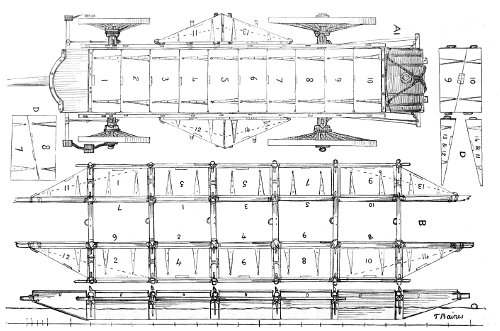
CAPE WAGGON BOXES SO FITTED AS TO BE AVAILABLE FOR A RAFT.
We propose that, in the waggon used by the traveller for his own conveyance, as many of these chests should be stowed as will stand fairly on the floor beside each other, say ten, as in the illustration (A, p. 142). Then, instead of the two usual square-ended side chests, we would advise that four should be fitted (Nos. 11 to 14), each of them having one end 16in. square like the other chests, but tapering at the other end to the mere thickness of the plank, and with the bottom also sloping, so that the narrow end should be only 8in. deep. Two of these with the broad ends together could be fitted on each side the narrow points passing well clear within the wheels. Care should be taken to have them water-tight; and, if made of well-seasoned plank and well oiled, they would remain so for a long time. When they are required for a raft, take them from the waggon and place them in two rows about three feet apart, and also with an interval of 3in. between the ends of the boxes in the same line—as shown in the illustration (B, p. 142)—with the tapered side boxes, as indicated by the numbers, forming the four ends. If you have been able to carry a couple of long stout bamboos, lay them along the inner side of each line of boxes, and if you have lighter ones to lay along the outer sides so much the better; if you have not bamboos, the dissel-booms and lifter poles of the waggons must be pressed into service, or poles sought in the nearest forest, as long and as straight as possible; then take the yokes of the oxen and lay them across in the 3in. spaces between the boxes, and passing the “reims” or other thongs cut from raw hide through the holes made for the yoke “skeis,” lash each yoke to the fore and aft poles, securing the boxes each in its own compartment by passing a few turns through the handles in the ends and round the yokes. When this is completed, you will have a very serviceable raft or double canoe. The hinges of the chests will, of course, be towards the centre, so that when opened the lids will fall inwards; and if other poles are now laid fore and aft upon the yokes, they will support the lids so as to form the deck, leaving the chests open, so that, if any of them should leak, the water may be at once seen and baled out; but should it be thought preferable to keep the boxes closed, the buik plank or floor of the waggon, or even its sides, may be made use of for the deck. If the traveller contemplates a long voyage, and requires a sharper boat so as to attain more speed, he may make four of his boxes (marked D 7, 8, 9, 10) tapering diagonally to 8in. at one end; but he must take care that they are made in pairs, so that he may be able to place the straight and the diagonal side of each in its proper position in the raft. He will then also find that they will be easily arranged so that each pair will stow square in the waggon; then the side boxes (D 11 to 14) must be made only 8in. wide at the larger end, tapering as before at the smaller, and, with a slight diminution of floating power, he will have a sharper and more speedy boat. The figures in the central spaces of B indicate the changes of position in the numbered boxes, and the dotted lines show the increase of sharpness at the ends. It is of importance that in the boxes which taper, one side should be straight and square with the end, and one only diagonal, as it might be necessary in a narrow stream, to place both the lines of boxes close together, and then the line of the inner sides being perfectly straight and the outer tapering, the whole would form one boat sharp enough at either end.
Some of the yoke “skeis” might be left in their sockets where required, as shown in the elevation, or other pieces might be cut to a proper length, to serve for tholes or rowlocks, awning stanchions, or belaying pins. If a mast were needed, it might be stepped by cutting jaws like those on the gaff of a cutter, and setting them across one of the yokes. The fork of a branch might serve; but as poles generally become thinner upward, and the natural position would be thus reversed, it would be less laborious to cut or fit on jaws to the butt of the pole, and leave the fork at top for the halyards to run over. Two back stays would be required, spreading at a considerable angle; and one or two fore stays, with sufficient spread not to interfere with the free motion of the yard; two, three, or four poles, set up as a triangle or sheer legs, would also serve, and then only one stay, stretching perpendicularly downwards between them, would be required.
In ferrying wheels over, the readiest way (if the breadth of the boat permits) is to keep each pair on their own axle, which is laid across the boat, with the wheels overhanging each side.
Even if the traveller be not provided with a waggon, he must have with him a quantity of stores, or materials for whatever scientific pursuit he is engaged in, as well as beads, calico, or other currency of the country, to pay for service, or purchase food; and if his boxes for containing these were all of uniform size, they would serve equally well as a raft; the copper boxes described at pages 8 and 9 are expressly designed for this service.
To float waggons.
In floating a waggon over without extraneous assistance, the buik plank or floor, the water cask, the fore and after chests, and the side boxes, will be sufficient, if tolerably water-tight—and if not, they may easily be made so, either by covering them with canvas, by caulking them or even laying them in the river all night to let the wood swell, which will generally have the desired effect. But it would be well, if this is at all doubtful, to remove the drag-chains, “reim-schoens,” and all easily detachable ironwork, and first float over only the under carriage and its wheels. If a line can be previously stretched across the river, and the oxen ready in their yokes on the other side attached to it, they may save much trouble by towing it across, while one or two men steer till the wheels take the ground, and it is drawn on shore in the natural way. The buik plank, with the casks and chests still fast to it, can be taken back for the rest of the heavy gear, and as much of the cargo as it will carry. If large hollow reeds—the drier the better—can be obtained, faggots of these can be fastened fore and aft, within the side chests, filling up nearly the whole space, except sufficient for the men to stand on in the centre; and a light platform can be laid above the top of the chests, on which to lay light goods which require to be kept dry. But bear in mind that the cargo a raft can carry above water is always small, and not at all like the mountain of treasure invariably represented on that of Robinson Crusoe.
About 1849 or 1850, while staying with our fellow-traveller, Joseph Macabe, at Vaal River, an extraordinary drought prevailed; the great river could be crossed dryshod at the “drift” by means of stepping-stones, though there were long reaches above and below in which a good-sized vessel might have floated, and on one of the sand-banks then laid bare appeared an upright pole, belonging to a waggon which the owner had attempted to float over with bundles of green reeds, leaving the “rein-schoems” and drag-chains on as ballast, and previously removing the sides, the chests, buik plank, and everything else that could impede its passage to the bottom.
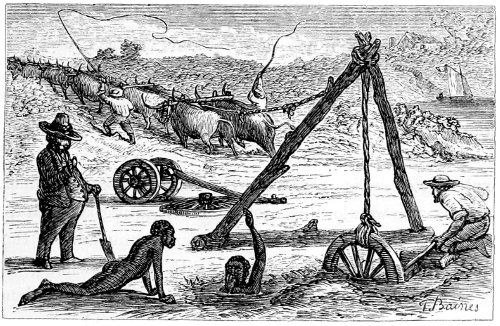
EXTEMPORE SHEARS.
Extricating waggons from quicksands, &c.
Whilst gazing at this odd landmark, Mynheer appeared; with him came a goodly staff of tall athletic sons and nephews, attended by a numerous train of native helpers. On digging for the waggon, it was found to have settled so far below the sand that when the tallest of the family stood on the tire of the wheel his shoulders were barely at the surface of the water, and Mynheer had yoked his oxen and was attempting to draw out the waggon by a horizontal strain. We forbore to offer advice which would certainly have been rejected, but retired to the house, and when one of the sons visited us after the day’s fruitless labour, we rigged a pair of miniature shears, and, letting them incline over a weight, showed how easily it might be lifted by applying a horizontal strain to cause the shears to rise to a vertical position. The result of this was that Mynheer sent up a request that, as “een groote zee-water’s men,” we would come and give him a bit of advice. We accordingly suggested that, as the sand was not firm enough to set the shear legs upon, he should cut three good-sized beams, and laying one horizontally, cut mortices in the ends, while tenons were cut on the other two to fit in them, the apex of the triangle being firmly lashed with the “reims” or thongs of softened hide, used for spanning in the oxen. The triangle was now set up, sloping somewhat over the fore-stell or carriage of the buried waggon, and one of the drag-chains was fastened to the wheel and led over the top of the shears, whence, lengthened out by the other chain and spare rope, it was bent on to the “trek-touw,” to which the oxen were already yoked. At length the cattle bent them to the yokes, the gear tightened and strained, the dissel-boom, that so long had been our beacon, began to rise, when some fastening gave way and all came down by the run; the pole, however, remaining a foot higher than it was before. A native was desired to refasten the chain; and, sticking two fingers of his left hand into his nostrils in a manner no European could imitate, he settled down below the water, and worked with his right hand only. Piece by piece the waggon was hauled out during the succeeding days, after having been three years and three days imbedded.
In exploring countries covered with dense forests or difficult to be traversed, rafts are wonderfully useful for navigating lakes and rivers, or for conveying your goods. Dr. R. Brown, commander of the expedition in Vancouver’s Island, favours us with the following note:—
Trenneled rafts.
“We travelled long distances by rafts in Vancouver’s Island, and, in order to have facilities for making them, we caused an auger (2in.) to be constructed with a ring-head instead of the usual spike with a nut, so that, by a piece of wood being put through it, a handle might be extemporised. Generally speaking we could find dry fallen cedar (Thuja gigantea, Natl.) by the borders of lakes or rivers, or if not living cotton wood (Salix Scouleriana) will do; and in fact any wood, though pine is rather too heavy and apt to get waterlogged.
“Cutting two lengths of logs, the length of the raft required, sharpening the ‘bows’ off roughly, we laid them on the ground, parallel, and as far apart as we wished them. Then two cross-pieces, composed of a log split in two, were pegged by means of the auger across near the ends, over them was built a floor of split cedar boards. Two rowlocks were pegged in here and there according to the number of rowers required, and one pair at the end for a steering oar. Oars were soon extemporised by means of the axe, and the raft moved lazily along at about one and a half or two miles an hour on a lake, but the labour was infinitely easier than working through the wood with a seventy or eighty pound load on your back.
“Sometimes we constructed even ruder rafts than these. Mr. Frederick Whymper and Mr. Ranald M’Donald once descended twenty miles of a river on a little raft composed of the boards out of an Indian’s hunting lodge, tying it together with withes of cedar twigs, which are very tough, and used by the Indians for sewing their canoes and fastening their lodge planks together. The holes they made with pistol bullets.”
Principles of raft building.
The general principle on which all rafts are or ought to be constructed is nearly the same; that is, if they are intended to be worked or to make progress through the water, as in most cases is desirable. The exceptions to this are generally when it is merely desired to float down a stream, abandoning the raft as worthless when the voyage is completed, or when produce or manufacture of any kind has to be brought down from a higher country to a lower, and, from its buoyancy it may be collected into a raft, which, on reaching its destination, may be reduced to its component parts and sold; or where, as in still more exceptional cases, it is necessary to provide floating habitations for families or small communities without reference to locomotion, which is effected by other means.
In the first and most general case, the object is to obtain sufficient carrying power with as little resistance to progression as possible; and to this end the larger spars, on which the buoyancy of the whole depends, ought to be laid parallel to, and at such a distance from, each other as seems necessary either to insure the requisite stability, to give sufficient room on deck, or to suit the length of those that are to be used as cross-beams; but they should never be laid close together so as to present a broad united surface to be forced through the water, nor even so close as to convert that portion of fluid between them into dead water to be dragged like a solid body with the raft. We would say, if there be two or more spars of equal size, let the interval between them be at least three times as broad as their diameter, and generally let the width of your raft be not more than one-sixth of its length. If you have only one large spar, let that form the centre, or, as it may be called, the keel, and let the smaller ones, either singly or lashed together in bundles of convenient size, be laid parallel to it at proper distances on either side. Endeavour as much as possible to keep your cross-beams as high above the water as possible, for if these are submerged, their sides will offer as much resistance to your progress as if the whole raft had been filled up with solid logs. On this account, therefore, it would be advisable to lash or pin on the top of each of the main beams either a smaller one to increase its height, or short pieces at intervals, as chocks on which to lay the cross-beams.
Let the ends of the spars that form your floats be pointed to an acute angle by either sawing off wedge-shaped pieces of about 15° or 20° in the sides, or chopping them with axe or adze.
The cross-beams at each end and one in the centre must be securely fastened. Do not have too many, nor keep them too close together; but let the others cross diagonally in opposite directions, or even brace the frame thus formed by stout ropes stretched diagonally from corner to corner, and seized together with smaller lines where they cross each other in the centre, which will give great firmness and rigidity to the structure.
Let us suppose, for instance, the case of a stranded or waterlogged brig of about 200 tons, of which the lower masts and the wreck of some of the other spars are still available. If the masts can be got out so much the better, for they would be in the whole not much short of 60ft. long; but it is much more probable they would have to be cut by the board, and perhaps also below the hounds, which would still leave clean spars between 30ft. and 40ft. in length, and most likely 14in. thick. If the mast-heads were left on they would be at least 10ft. longer, but the tops should be removed, and the projecting portion of the hounds chopped down so as to offer as little impediment to progress as possible; the masts should be laid parallel to each other about 8ft. apart, and the main boom, lower yards and jib boom, or spare topmast, if available, lashed together as a faggot, and laid between them as a central spar. A short, stout spar, such as the heel of a broken topmast, should then be laid across at 6ft. or 8ft. from either end, and firmly lashed to them, and one, or at most two, more may be laid across in like manner near the centre; the intervals between these should be occupied by small spars laid across diagonally, or by cross bracings of rope as before described; it is of little use to peg or treenail the parts together, unless the water is very smooth, for the pegs would be sure to break with the working of the raft in a heavy sea. We have suggested the heels of the topmasts as crossbeams, because their thickness would help to raise the platform above the level of the sea, and this might be farther raised by laying a couple of studding sail booms fore and aft upon the masts under them, and laying the deck with short spars or pieces of plank across the booms. If tools can be got at or used, mortices may be sunk in the masts, or fore and aft spars, and handspikes or capstan bars set upright in them at intervals of 6ft.; these will carry a light rail to prevent men being washed off, and will serve to spread an awning when such a luxury can be attempted, and also as supports to which rowlocks can conveniently be fastened.
If the vessel is provided with sleeping bunks, which are sometimes lashed to ring-bolts on the deck, it might be well to secure at least one of them; if not an empty hogshead or anything that can serve as a place of temporary shelter for a wearied man, or for the commander to consult his charts and compass in, should be fitted on the platform. A sheet of iron, or non-combustible material of any kind, should be taken to form the foundation of a fire-place; and if there is choice of provisions, preserved fresh meat should be taken in preference to salt, with as much biscuit, vegetables, vinegar, sugar, tea or coffee, and fresh water, as circumstances permit. If canvas is at hand, sails will be easily made, if not, any flat surface, sheets of iron or planks, either separate or framed together, may be set up that the raft may sail free, or trimmed for her to go as near the wind as she will lie.
If three casks are available as floating power, make a triangle of studding sail booms, and lash each angle firmly on the top of one of the casks, taking care to keep their heads pointing forward to that which is intended to be the bow; then on these spars build such platform as you need, and erect your mast and sail.
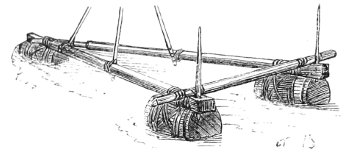
A couple of spare topmasts brought together at their heads, and extended by a shorter spar at their heels, so as to form a triangle more or less acute, form a good foundation for a raft; the space between may then be filled with whatever buoyant material you possess, whether casks, boxes, or smaller spars. No rules can be considered absolute in raft making; anything that will float, and can be lashed together in any manner, must be used; if a portion of the vessel’s deck can be cut out by axe or saw it may form a good foundation; if the raft can be built on board the wreck, or on the beach beside her, so much the better, but it would be better to throw the materials overboard, and, at the cost of any extra labour, construct it in the water, than not be able fairly to launch it when completed. We have seen the waist stanchions of a waterlogged vessel cut away for such a purpose, or in extreme cases the hull may be expected to go down, and then the only anxiety will be to complete the raft so that it may be capable of floating off the sinking vessel. In the water a rectangular raft is best built alongside the vessel, but the triangular one must be built astern.
Pot raft.
Of buoyant merchandise formed into rafts for the purpose of floating down rivers to the markets, we have an example in the pottery floats upon the Nile, where a number of jars having been made, are bound together, and a platform of reeds laid on them. Tho long timber rafts upon the Rhine and on the rivers of Canada and North America are also examples of this principle.
Sedge-grass rafts.
On some of the larger rivers of Africa, as the Okovango, discovered by our late friend C. J. Andersson, the Teoughe and others, rafts of sedge grass are used; sometimes these, if only intended to carry a few persons across a river, are small and comparatively manageable, and have even an attempt at comfort and security in a kind of rail raised round them of faggots of the same material. Others, used in hippopotamus hunting, are mere floats on which the small canoes are drawn up, and their chief merit is that they are so like natural accumulations that the animal does not think of getting out of their way.
On a still larger heap of these Mr. Andersson descended the tortuous course of the Teoughe for many miles; and Mr. Oscar T. Lindholm, who accompanied the eminent but unfortunate Swedish naturalist Wahlberg, gave us a most graphic account of a similar voyage. Immense quantities of sedge was collected, and bundles of it were thrown upon the water in some quiet nook, without any regularity and with no other fastening than its own natural cohesion and entanglement when one layer was thrown almost at random across another. A small hut was built upon the heap when it had acquired sufficient size, and the whole, when ready, was forced out into the stream, which brought it down at an average rate of two and a half miles per hour. If it took the ground, the only consequence was the loss of a few reeds from the bottom layer as the mass swung round and cleared itself. Snags, projecting points, or other impediments might tear off more, but nothing could stay the quiet but irresistible movement of the great raft, which, as the grass below became densely pressed and sodden, began to draw nearly 6ft. of water, and sank deeper every day; to remedy which, fresh grass was cut and thrown daily upon the upper layers. Frequently overhanging trees tore off portions, and once a large trunk lay so close to the water that it fairly swept the decks fore and aft; the occupants saved themselves by climbing over the tree, but the hut, with many valuables, was carried right away. With this exception the voyage was accomplished safely, but it was a task of great difficulty to prevent the unwieldy mass being swept by the stream into Lake Ngami, in the still waters of which it might have floated for an indefinite period without coming nearer to the shore.
The obelisk of Luxor was removed by laying a vessel ashore, with her head towards it, when the river was at its highest; the masts were lifted and shored up from the deck, so as to allow an immense packing case to be built upon the keelson; ways like those for launching a ship were built, and on them the heavy monolith was forced onward till it lay at length fairly in the vessel, occupying nearly her entire length; a deep channel cut from the vessel to the river, and at the next rise of the water she floated off. But without forgetting this, we do not remember a case of more ingenious and persevering adaptation of apparently insufficient means to great and important ends, than that of the conveyance by our countryman Layard of the great human-headed bulls and lions from the magnificent ruins in which he found them to the point of embarkation on the Tigris, and thence, by rafts so frail that we almost wonder how the ponderous masses were supported, to a place where vessels more adequate to the carriage of such a burden could receive them. It would be a pity to curtail the brief and graphic description, and we therefore give it in his own words:—
“I did not doubt that the skins, once blown up, would support the sculptures without difficulty as far as Baghdad. The journey would take eight or ten days, under favourable circumstances. But there they would require to be opened and refilled, or the rafts would scarcely sustain so heavy a weight all the way to Busrak; the voyage from Baghdad to that port being considerably longer, in point of time, than that from Mosul to Baghdad. However carefully the skins are filled, the air gradually escapes. Rafts bearing merchandise are generally detained several times during their descent to enable the raftmen to examine and refill the skins. If the sculptures rested upon only one framework, the beams being almost on a level with the water, the raftmen would be unable to get beneath them to reach the mouths of the skins, when they require replenishing, without moving the cargo. This would have been both inconvenient and difficult to accomplish; I was, therefore, desirous of raising the lion and bull as much as possible above the water, so as to leave room for the men to creep under them.
“It may interest the reader to know how these rafts, which have probably formed for ages the only means of traffic on the upper parts of the rivers of Mesopotamia, are constructed. The skins of full-grown sheep and goats are used. They are taken off with as few incisions as possible, and then dried and prepared. The air is forced in by the lungs through an aperture, which is afterwards tied up with string. A square framework, formed of poplar beams, branches of trees, and reeds, having been constructed of the size of the intended raft, the inflated skins are tied to it by osier and other twigs, the whole being firmly bound together. The raft is then removed to the water and launched. Care is taken to place the skins with their mouths upwards, that, in case any should burst or require filling, they can be easily opened by the raftmen. Upon the framework of wood are piled bales of goods and property belonging to merchants and travellers. When any person of rank or wealth descends the river in this fashion, small huts are constructed on the raft, by covering a common wooden “takht,” or bedstead of the country, with a hood formed of reeds and lined with felt. In these huts the travellers live and sleep during the journey. The poorer passengers seek shade or warmth by burying themselves amongst bales of goods and other merchandise, and sit patiently, almost in one position, until they reach their destination. They carry with them a small earthen “mangal,” or chafing-dish, containing a charcoal fire, which serves to light their pipes and to cook their coffee and food. The only real danger to be apprehended on the river is from the Arabs, who, when the country is in a disturbed state, invariably attack and pillage the rafts.
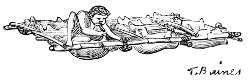
INFLATED FLOATS.
“The raftmen guide their rude vessels by long oars—straight poles, at the end of which a few split canes are fastened by a piece of twine. They skilfully avoid the rapids, and, seated on the bales of goods, work continually, even in the hottest sun. They will seldom travel after dark before reaching Tekrit, on account of the rocks and shoals which abound in the upper part of the river; but when they have passed that place they resign themselves, night and day, to the sluggish stream. During the floods in the spring, or after violent rains, small rafts may float from Mosul to Baghdad in about eighty-four hours; but the large rafts are generally six or seven days in performing the voyage. In summer, and when the river is low, they are frequently nearly a month in reaching their destination. When the rafts have been unloaded, they are broken up, and the beams, wood, and twigs are sold at a considerable profit, forming one of the principal branches of trade between Mosul and Baghdad. The skins are washed and afterwards rubbed with a preparation of pounded pomegranate skins, to keep them from cracking and rotting. They are then brought back, either upon the shoulders of the raftmen or upon donkeys, to Mosul or Tekrit, where the men engaged in navigation of the Tigris usually reside.”
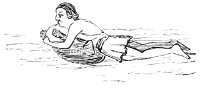
In one of the sculptures thus brought to our own country by the energetic traveller, an army is represented crossing a river, and the soldiers are supported each by an inflated goatskin held under the chest, while one of the legs being led upwards to the swimmer’s mouth enables him to keep it distended, should any air escape. In making these bags, the only sewing necessary is at the aperture through which the animal is skinned; the neck, cut close to the head, may be tightly bound up with a thong, and an over-hand knot cast in the three legs; the fourth being left with a tube for re-inflation.
Sir Samuel Baker says, when speaking of crossing the Atbara River, “I had eight inflated skins attached to the bedstead, on which I lashed our large circular sponging bath, 3ft. 8in. in diameter. This was perfectly safe for my wife, and dry for the baggage; the watertight iron box that contained the gunpowder was towed as a pinnace behind the raft. Four hippopotamus hunters harnessed themselves as tug steamers, and there were relays of swimmers. The raft answered well, and would support about 300lb.; the sponging bath would carry 190lb.”
American portable boat.
Colonel R. C. Buchanan, of the United States service, is the inventor of a very useful form of portable boat. It was used in several expeditions, in Oregon and Washington territory, with much advantage. It is thus described:—
“It consists of an exceedingly light framework of thin and narrow boards, in lengths suitable for packing, connected by hinges, the different, sections folding into so small a compass as to be conveniently carried upon mules. The frame is covered with a sheet of stout cotton canvas or duck, secured to the gunwales with a cord running diagonally back, and put through eyelet holes in the upper edge. When first placed in the water, the boat leaks a little, but the canvas soon swells, so as to make it sufficiently tight for all practical purposes. The great advantage to be derived from the use of this boat is, that it is so compact and portable as to be admirably adapted to the requirements of campaigning in a country where the streams are liable to rise above a fordable depth, and where the allowance of transportation is small. It may be put together or taken apart and packed in a very few minutes, and one mule suffices to transport a boat, with all its appurtenances, capable of sustaining ten men. Should the canvas become torn, it is easily repaired by putting on a patch, and it does not rot or crack, like india-rubber or gutta-percha; moreover it is not affected by changes of climate or temperature.”
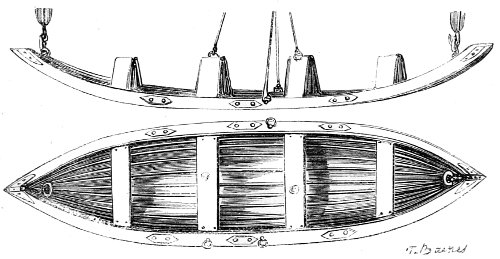
COLLAPSIBLE BOAT.
Collapsible boat.
We have not seen Colonel Buchanan’s boat, but we remember one perhaps not very dissimilar, it was, in fact, a collapsible boat—the gunwales, the keel, and all the intermediate pieces being exactly alike, and made of ¾in. plank from 4in. to 6in. wide; these were hinged together at the two ends, just as are the frames of the oval reticules, and covered with stout canvas; the thwarts have hinges below the centre, from which also the third board, serving as a stanchion, reaches downward to rest upon the keel. There is a ring-bolt near the centre of each of the midship thwarts, and when the boat is hoisted out of the water by tackles at either end, a couple of small lines from these rings jerk up the centre of the thwarts and allow the gunwales and all the corresponding boards on either side to fall down beside the keel, as shown in the upper figure of our illustration (p. 155). There are also ring-bolts to the gunwales, and a couple of lines from these are held fast while the boat is lowered; the gunwales rise, and a man sitting upon the thwarts presses them into their place and the boat assumes its proper shape: of course the segments of plank below the gunwales have to be cut a little shorter at each end as they come nearer to the keel, or the boat would not shut up on its hinges. A boat 4ft. wide would collapse into a width of not more than 1ft. Such a frame could be readily taken to pieces by withdrawing the bolts of the hinges, and if each piece, supposing the boat to be 4ft. wide and 16ft. long were hinged in its centre, it would not be much too long to carry on a mule, except the country were more than ordinarily difficult, when it might be hinged in three lengths.
At the meeting of the British Association, in Birmingham, we saw some model boats of good form, but with very little projection of keel or stem or stern post, so that one might be fitted into the other without rising more than a few inches above the gunwale of the first; the thwarts of the lower one are stowed between the two very conveniently, and three or four may be thus packed, the uppermost, however, retaining all her fittings in readiness for immediate use.
Canoe birch.
The aborigines of many countries make use of the bark of certain trees for the purpose of canoe building. The most important of these is the canoe birch (Betula papyracea); its range may be estimated at 37° north to 43° south. Trees of this description not unfrequently grow to 70ft. in height, and are proportionately thick, so that sheets of bark of very large size can be readily stripped from them. The bark canoes of the Canadians and Indian traders are often of a very large size.
In the absence of forest conservators, economic considerations go for very little. It may be convenient, when canoe building or repairing is the object, to “fall” the tree, and, in doing so, care must be taken that the bark shall not be rent or bruised, either by fracture of the tree or by falling across a rock or stump, while the log ought to lie with both ends somewhat supported, so that the required sheet of bark may not be crushed between it and the ground. Perhaps it will be found generally easier to detach the bark while the tree is standing, and in this case a cut must be made all round the tree at the lower end of the sheet; the most perfect side should be left for the bottom of the canoe, and the longitudinal slit should be so made as to cut right through any defective portion which may thus be cut out with the least possible waste of material. If the tree has an inclination, it will be easier work to make the slit on the upper side. The bark should be detached by broad round-edged spuds of soft wood, thrust gently and cautiously between it and the tree; and it may also be previously loosened by striking it with a broad log or mallet on the outside, taking care not to break its texture. Steps may be cut in the wood to stand in, and hand-holds also as the work proceeds; and the lower part of the bark should be made fast with cord or slips of bark, passed loosely round, so that it may not swing clear of the tree and split the upper part before it is finally detached.
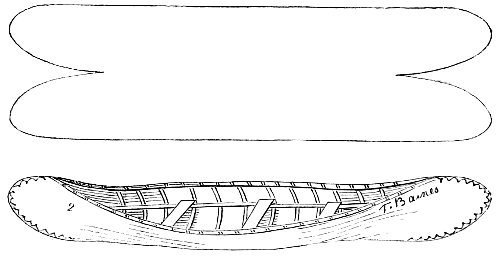
CANADIAN BARK CANOE.
Canadian bark canoe.
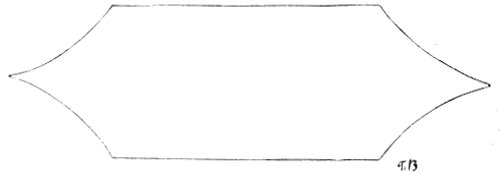
The sheet should now be taken to a plot of level ground, carefully spread out with the inside downward, and the outside should be cleaned from any knots, excrescences, or hard and brittle layers that increase its weight without adding to its strength; and it should then be cut nearly to the form shown in the sketch (Fig. 1). A sufficient number of ribs or hoops of light flexible wood should be provided, and great care should be taken, in bending it, not to split or unduly to force any part so as to make an unsightly protuberance, which would also most probably become a leak. The holes should be carefully bored along the edges that come in contact, and they may be sewn with fibres from the roots of pine trees or from small cedar twigs, and rendered water-tight by the use of pine-tree gum. Flexible poles or laths are then stitched in for gunwales or thwart stringers, and the canoe is more or less tastefully trimmed off and ornamented, according to the taste of the builder, as in Fig. 2 (p. 157).
Nothing can be lighter or handier than these canoes, but their very lightness and want of “hold on the water” makes them difficult for Englishmen to handle until experience has been their instructor.
Queen Charlotte’s Island canoe.
Canoes of this description are wonderfully buoyant, and draw very little water; and, when managed by skilful hands, few boats are more reliable. Our friend, Mr. F. Poole, who has spent many years among the Indians of North-West America, and is a canoeman of no ordinary skill, has recently completed a tour of extraordinary extent and interest, paddling fearlessly, and alone, far out to sea. The dimensions of the canoe he uses, which was made expressly for him by the Indians of Queen Charlotte’s Island, are as follows: Length, 15ft.; width across beam, 3½ft.; depth, 15in.; weight, 100lb.
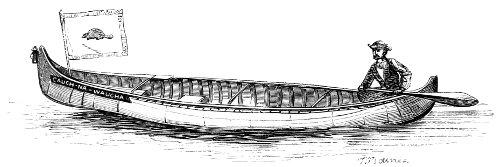
BIRCH BARK CANOE OF QUEEN CHARLOTTE’S ISLAND.

In her Mr. Poole started from Liverpool, paddling to New Brighton, from thence to Southport, Blackpool, Fleetwood, Dutton Sands, Whitehaven, Kirkcudbright, Whitehorn, Port William and Glen Luce. From thence by the use of wheels—two pairs of which, composed of iron, mounted on iron axles, are kept, until required, stowed away in the canoe—Mr. Poole proceeded overland to Stranraer; from thence paddled along the coast and up the river to Glasgow; then by canal to Grangemouth, and by sea to Leith. For two nights and the greater part of two days Mr. Poole was out of sight of land, and the voyage was prosecuted during the prevalence of the equinoctial gales. Such of our readers as may contemplate canoe voyaging will do well to borrow a few hints from Mr. Poole’s equipment. A powerful bull’s-eye lamp was always carried, lashed fast to the stem at night, and a mariner’s compass was provided to steer by.
The wheels before referred to are extremely useful in many ways. They are like those of an ordinary perambulator, only of light wrought iron; they are 1ft. in diameter; the axle is also of wrought iron, ¾in. square, and long enough to carry the wheels clear of the canoe’s sides when mounted on them. To travel the canoe on dry land, the axles, each covered with a strong common pillow, are brought under the fore and after portions of the canoe, like the axles of a long narrow carriage. Rope lashings are now brought from the thwarts down to the axle bars, through which iron belaying pins pass; these keep the lashings from shifting, and keep all secure when the canoe is pushed or drawn onwards. The wheels are an immense assistance in beaching the canoe and getting her above high-water mark, when there is but one voyager. They also serve as ballast, and are useful for a number of camping and make-shift purposes.
The paddle shown in the accompanying illustration, kindly furnished by Mr. Poole, is of the exact form requisite to obtain perfect efficiency. It is composed of red cedar, and is exactly one-tenth, diminished scale.
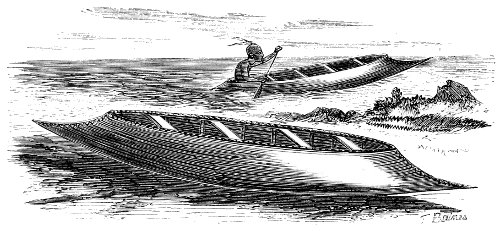
CEDAR-BARK CANOE.
Cedar-bark canoe.
SHOE CANOE.
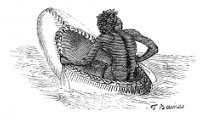
The bark of the cedar (Thuja gigantea) is also much used by certain Indians of North-West America for canoe building; but the form usually made from it differs materially from that just described. The cedar-bark canoes are in shape much like some of our iron-clad rams, having projecting beaks, or prows, almost in a line with their keels. The Indian paddling one of these frail craft, sits, or rather squats, at one extreme end of the bottom, which has the effect of tilting the bow end up in the air, burying the stern end deeply in the water. The sharp tail-like point thus immersed seems to impart speed and capability of evolution to a remarkable degree; much practice is required before the exact poise and adjustment of weight are acquired. The Indians, who half live in their canoes, manage them with extraordinary dexterity, ascend and descend rapid rivers, and cross wide stretches of lake fearlessly. The form of these canoes, and of the bark sheet used for making them, is shown in the above illustration. The mode of sinking the stern of a canoe is also had recourse to by the Rockingham Bay savages, who manage the so-called shoe canoe with much skill. The frame is of rough wicker-work, the covering of hide, and the two short shovel-shaped paddles made use of are shown in our illustration. A canoe of this kind is very easily made, and is not difficult to manage.
FUEGIAN CANOE.
Fuegian canoe.
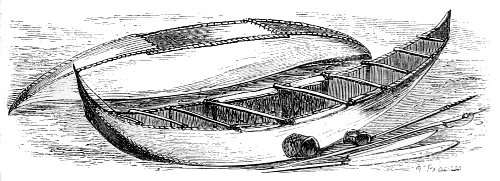
We have just seen a small canoe sent from Terra del Fuego by the Governor of the Falkland Islands to the Royal Geographical Society. It is small, and was paddled by a girl eight years of age; it is chiefly interesting as showing how small pieces of bark may be utilised. It is about 8ft. long, 22in. wide, and 18in. or 20in. deep; the centrepiece of the bottom is nearly 3ft. long and 10in. wide, and to this are stitched two pieces, each about 4ft. long, tapering to a point, and curving upward to a high peak at either end. The sides are pieces of bark nearly 8ft. long and 18in. deep, straight on the upper edge, and cut to the curve of the bottom on the lower. The whole are stitched together with wood fibre, for which sometimes strips of whalebone are substituted, and caulked with the fibre of the wild celery. The boat is kept in shape by ribs of winter bark twigs, not thicker than the little finger, and packed closely side by side through the whole length; nine small sticks lashed athwart the gunwales keep them in their proper shape, and a sheet of bark midships serves to sustain a patch of clay on which to keep a small fire. A bundle of weapons of the chase accompany this canoe.
The spears are pointed with bone, and the barbed one used for fish and cetaceans is only shipped loosely into the shaft, to which it is attached by a lanyard, so as to remain fast during the struggles of the animal; while that used for birds is serrated, and is firmly fastened into the shaft.
AUSTRALIAN BARK CANOE.
Australian bark canoe.
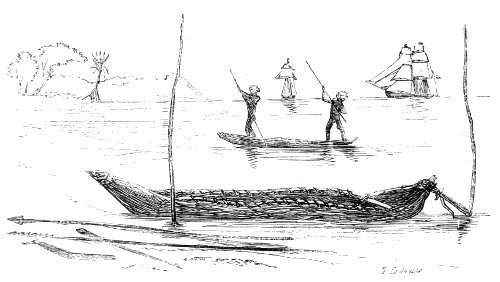
The tea-tree bark is sometimes used in Australia for canoes. We have seen a length of it roughly tied up at the ends, and strengthened a little by poles along the gunwales, in use at Moreton Bay, as shown in our illustrationEB. It is just possible to make the bark of the gum tree answer the purpose in the absence of better material. We have often searched in Africa for a tree with bark fit to make a canoe of, but never succeeded in finding one. Along the eastern coast of Australia, especially towards Torres Strait, we frequently fell in with canoes, some with outriggers and others double. They were generally long straight logs, of very little breadth or depth; and the advantage of this seemed to be that though the ripple would frequently wash into them, yet, if they pitched ever so little, their great length and shallowness would tilt out the greater portion of the water. The outriggers were mostly logs of wood sharpened at either end, and with pegs set up in them, so that the outrigger beams might not dip into the water and impede the motion of the canoe.
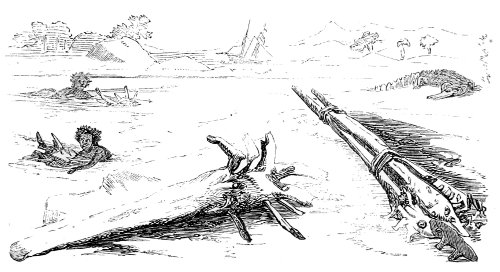
MANGROVE FLOATS.
When we reached the Victoria River we found that the natives were accustomed to support themselves in crossing on logs of the light mangrove wood, either singly or tied up in bundles. The part near the roots seemed to be the favourite, as the stumps of the roots formed pegs on which to hang their spears, skins, or other possessions. The wood of the milk bush, which is about half the specific gravity of cork, is much used by the natives of equatorial Africa for the above purpose.
Long canoes.
At Shupanga, on the Zambesi, we have seen dug-out canoes, 50ft. long and about 5ft. wide and deep; at all events, a tall man standing beside them did not stoop much when he rested his arms upon the gunwale. These were hollowed and roughly shaped in their native forests, and hauled along nearly thirty miles, on rollers, by the long rope-like stems of the vines and creepers common in tropical forests. They were made only for the Portuguese. The upper part of the bows expanded into a platform sufficiently large for the chief boatman to stand on, while the stern was cut into an imitation of a run and dead wood, with a couple of holes in the after part, to which a rudder was secured by lashings. Nothing can be better for hollowing a canoe than the adze, but our Kroomen used a broad spud or chisel on a staff about 6ft. long, driven in a manner which will be best understood by a glance at the statue of “Michael overthrowing Satan.” The Krooman’s method of baling is characteristic. Should the canoe fill, all hands jump overboard, seize the gunwales, and sally her fore and aft till the water flies out at either end and leaves her absolutely free. We have seen a canoeman, near Lake Ngami, walk to one end of his leaky craft and, thus depressing it, cause the water to flow towards him, when, making his broad foot do duty for a scoop, by a succession of vigorous kicks, he soon had his canoe as free as he desired.
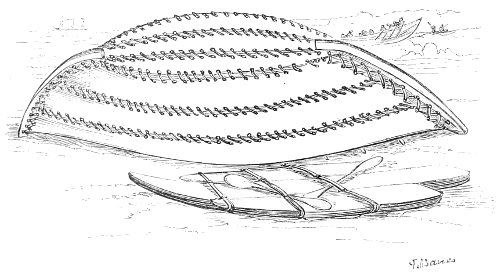
MASSOOLAH BOATS.
Massoolah boats.
In many parts of the world, boats of almost any size are built without metal fastenings, and the Massoolah boat of Madras may be taken as a fair type of those which are sewn or laced together. It will be seen in our illustration, copied by permission from a model in the United Service Museum, that the bottom boards are flat and form an oval elongated and pointed at the ends, so that the side planks curve naturally to meet the stem and stern-post, and give the boat an easy sheer. They are sewn together with coir yarn (or cocoa-nut husk fibre), the stitches crossing over a wadding of coir or straw, which presses on the seam and prevents much leakage. They are very elastic and give to the shock as they take the ground in the surf, which runs sometimes nearly 16ft. high; they are from 30ft. to 35ft. long, 10ft. or 11ft. wide, and 7ft. or 8ft. in depth; they pull double banked, six oars on a side, made of long rough poles with oval pieces of board lashed on the ends; they are steered by an oar. Our illustration shows also the catamaran or log float, on which the natives will pass to and from the shore when no other craft, not even the Massoolah boat, would venture. It must be remembered, however, that the men are themselves nearly amphibious, and care as little for being washed off their rafts as so many frogs; while the letters or small parcels they carry are kept dry only by being worn in a kind of oil-cloth turban.
Norwegian boats.
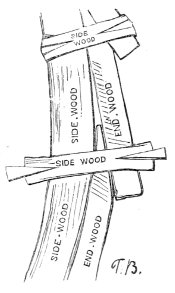
We have seen very nice boats built in Norway with dowels instead of nails; they were clinker built, and the dowels were about ½in., or fully as thick as the planking. A number of rods, from 3ft. to 4ft. long, are planed up to the required size, and cut into lengths say, when two thicknesses of ½in. plank are to be clinched, to 1½in., or, when the two planks and a timber of perhaps 1in. are to be fastened, to 2½in., so that both ends may project a little beyond the wood they are to fasten; the dowel is then split at each end with a sharp chisel, taking care that the cut is made at right angles to the grain of the plank or rib, wedges are driven in, and the end, being slightly spread out by the use of the clinch hammer, is trimmed off not too close; the wedges should be all neatly cut with a fine saw, and by sawing them in breadths from a board, and then splitting them to the required size, labour may be greatly economised. The holes should be bored with a sharp centre-bit; and if the dowels fit tightly the wedges may be dispensed with, as the ends will spread sufficiently under the clinch hammer without breaking the grain.
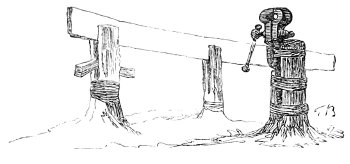
In building, if any difficulty should be found in drawing down the end of the plank to the stem, it will be advisable, after having fitted it carefully, to slack up the centre, let the end come to its place, fasten it, and then again bend the plank downwards. In some boats, especially in the navy, the planks do not run fore and aft, but two thin layers are crossed over each other diagonally, and clinched together; this leaves the outside perfectly smooth, and is perhaps the strongest known method of boat building. In planing up the edges of planks, &c., it is absolutely necessary to have a vice of some kind, and nothing is better than a tree vice, unless you have a blacksmith’s. Saw off a young tree from 6in. to 8in. thick, at about 3½ft. from the ground; saw the stump down the middle as low as you can; bind the lower part tightly with thongs of raw hide to prevent its splitting, then insert wedges to open the upper part, put your planks in, withdraw the wedges, and it will hold tight enough. It is as well to cut the upper part of the opening sufficiently wide to admit an inch plank, as short pieces can easily be put in to fill up should you wish to hold a thinner one.
Portable steel boat.
We have already mentioned the principle on which Mr. E. D. Young’s portable steel boat for the Livingstone Search Expedition was built; and although, as we then said, none but a skilled workman could hope to turn up the edges of a curved sheet of metal, we think the principle might be applied to a flat-bottomed boat by merely snipping the flanges at the turn of the bilge, and bending upward the sides at any convenient angle; by cutting these more and more diagonally from the centre, the boat might be tapered to each end—not, indeed, in a true curve, but in a succession of short straight lines, which would tolerably represent one.
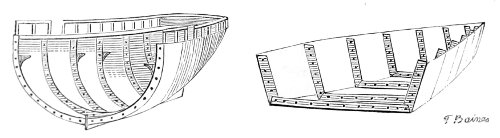
The number of pieces composing the “Search”—the boat used in the expedition sent in quest of Dr. Livingstone—were as follows: Thirty-six side pieces of steel, each being a load for one man; the midship piece required 2; the stern piece, 3; the bow piece, 3; the mast, 2; the boom, 2; the sails, 2; chain cable, 6; anchor, 1; and the whole with provisions, luggage, &c., made up 180 loads.
Captain Faulkner, who, as a volunteer, accompanied Mr. Young on the Search Expedition, has determined on returning with a party of ardent hunters and explorers, and an engineer, to Lake Nyassa, and for this purpose an iron steamer has been built 50ft. long, 5½ft. deep, and 11½ft. broad. The little craft, appropriately named the “Faugh-a-ballagh,” is composed of 75 sections, put together with 8000 screws, so that she may be carried, as was the “Search,” past the rapids and cataracts of the Shire River.
American life raft.
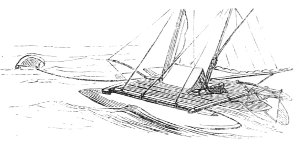
The American life raft “Nonpareil,” which recently made the voyage across the Atlantic, may be taken as a successful application of the tubular system. It will be seen that she was constructed of three parallel inflatable tubes, covered with stout canvas, connected by breadths of the same, and with a rectangular frame laid over all to support the masts and rudder fittings; but the sketch is introduced here also to show the use of the droge, by which the little craft may in effect be anchored in the open sea, or at least may have her drift effectually checked, while the sea itself is broken before it reaches her. The droge in the present instance is of canvas, stretched on a large hoop with four lines, so attached to its circumference that when the strain comes on it it stands vertically in the water, and opposes the resistance of its entire surface. The oars or mast, and sails of a boat, will also answer this purpose; and we have heard of one instance in which the imperilled crew added also a number of the skins of freshly-killed seals, the oil working out of which calmed the water for a considerable distance. It is necessary to watch the length of the sea, so that the boat may be veered as far from the droge or raft as it will serve to protect her against the breaking waves. We have heard the captain of a vessel say that he would never incur the risk of wearing in a gale, but would rather sacrifice some spar or piece of lumber to bring the ship’s head to the wind. In doing this, the hawser would be carried round from the droge on the weather bow, under the bobstays and bowsprit rigging to the lee bow, and finally to the quarter; the droge would be thrown over, sufficient line paid out, and then held on to till the ship’s head came to the wind; the strain would be then changed for a moment to the lee bow, and then to the quarter, whence it would be cut away as the ship fell off upon the other tack. A spar held by a hawser and bridle, with a stout sail bent to it—the clews, or lower corners, being weighted with shot, lead, or iron, to make them heavy—forms an excellent droge for a small craft to lie to under.
Temporary repairs of vessels.
Although this subject may seem almost beyond the province of our work, it is by no means improbable that explorers may have to turn their attention to it, or that shipwrecked crews, or dwellers on a lonely coast, may have to repair or build small craft for themselves. We have seen first-class waggons built by missionaries, and others have built vessels; and the reader may remember with advantage the description given by Ulysses of his laying down side by side ten or a dozen pine trees more or less smoothed off as a foundation on which to build his upper works.
During the progress of the North Australian Expedition, we were ascending the Victoria River with our little schooner, the “Tom Tough.” There was little or no wind, and with the boat ahead towing and the lead going we were drifting up with a strong flood-tide, and the captain, elated by success, and anxious to make the most of his opportunity, kept going onward instead of prudently anchoring while the tide was still rising. In consequence of this, when the vessel touched the ground, there was no subsequent rise of water to float her off; indeed, it was remarked that the water began to fall while the tide was still running upward, and she was left at low water on the 27th of September, 1855, on a mud bank, with her bows uncomfortably propped up by a projecting rock.
On the 29th she floated; but the flood-tide was so nearly done, that we had no time to choose an anchorage, and the schooner grounding with the ebb, parted her chain cable and heeled over with the force of the tide till we could barely stand upon her decks.
Day after day the schooner drifted to and fro upon this sand-bank, sometimes moving a length or two, and sometimes only a few feet during a tide; the sand scoured out from beneath her bow and stern, leaving holes with 6ft. or more of water there, while hillocks accumulated under her in midship; and the sand seemed to travel so evenly with her, that the usual criterion—a hand lead, allowed to trail upon the ground—was of no service in enabling us to estimate the distance she had moved.
On the 10th of October the decks had rifted, the combings of the main hatch had started up, the starboard side between the masts was hogged up 18in., and at the turn of the bilge, where the floor timbers join the ribs, one of the planks had split for 15ft. or more, leaving spaces into which the flat hand might easily be passed.
We laid broad strips of blanket and sheepskin well tarred on the principal rents, and nailed thin planks over them (Fig. 8, p. 170), but in another day or two she was just as bad on the other side; her stern was peaked into the air, while her bows dipped about 7ft. into a hole, the water pouring out of the fresh rifted planking as the tide fell. The mainmast rose up through the partners, so that we were obliged to slack off the rigging, and it became a question whether the stanchion under the main hatch should be knocked away to prevent its bursting up the deck, or whether it should remain so that the strength of the deck might keep the bottom a little longer from breaking.
On the 25th we again floated, after nearly a month of straining to and fro upon the sand-banks, and drifted rather than navigated the vessel up to the camp we had established below Steep-head.
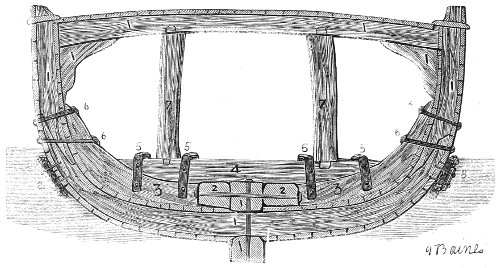
Captain Gourlay with his crew, and some of the expedition men, found suitable trees some little distance up the river at Timber Creek, which, however, after a rather exciting adventure with some wandering natives, acquired the name of Cut-Stick Creek instead. Two long heavy gum trees as straight as possible were selected, brought to the vessel, and laid as sister keelsons (Fig. 2) alongside the real one, which, as well as all the original framework, is marked Fig. 1 in our illustration. Three or four pair of heavy crooks, each representing the half of a floor timber (Fig. 3), were then laid on the inner skin, with the inner ends abutting on the sister keelson, and the outer reaching up above the junction of the ribs with the floor heads. Heavy riders (Fig. 4) were placed upon them crossing the three keelsons, and were secured by clamps (Fig. 5) made of the tires of our dray wheels, which we had no hope of being able to put to their proper use. Being now above the rise and fall of the tide we could not beach the vessel, and, therefore, the frame could only be bolted to the true sides above the water line (Fig. 6), but it was pressed down upon the bottom not only by its own weight but by stanchions (Fig. 7) between it and the deck beams.
The schooner being detained for repairs, it was decided to undertake an expedition to the Albert River in the long boat; and thus, by reaching Mr. Gregory in time to assure him that a vessel was coming, prevent his starting for the colony with insufficient supplies; Mr. George Phibbs, the overseer of the expedition, and Mr. Graham, the mate of the “Messenger,” volunteering for the trip, we commenced our preparations. The boat was cleaned, repainted, the leaks stopped; and two inflatable tubes were made, each of them of one piece of canvas, 14ft. long, lined with waterproofed calico, folded so that the two sides should come together, a rope along the seam, with eyes turned in at the corners, to make it fast by, and, with one of the screw valves from our worn-out boat (p. 48), let into the after end, to receive the nozzle of the bellows. These we at first intended to stretch beneath the thwarts, inside, but eventually laced them outside each gunwale, where they were less in the way, and, when kept in a state of semi-inflation, projected sufficiently to prevent a great deal of the ripple of the sea washing into the boat, and this advantage we made the most of when we were fairly at sea, by fitting light bamboo stanchions forward, and securing the tubes to them, so as to make a kind of raised wash streak round the bows.
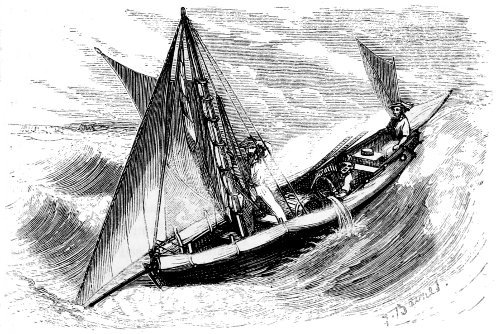
BOAT FITTED WITH INFLATED TUBES.
We left the vessel on the 23rd of October off New Year’s Island, and at first had fine weather with good working breezes, but in a few days strong adverse gales came on. On the 2nd of November we worked all day clawing off a lee shore, the sea raging furiously over the shallow bottom; but our boat, though only 18ft. long and 6ft. beam, behaved well, and we weathered the rocks by less than a quarter of a mile after sunset. Darkness came on at once, and, as we dare not run in for shelter, we made the boat snug and hove to under foresail and mainsail all night. We ran through between the Crocodile islands, the crest of the short sea behind us foaming around our quarters, while our bowsprit was actually dipping in the next, and began to fear that we should have to pass the islands without finding a shelter, when Phibbs volunteered to swim ashore. We let go our carronade as an anchor, and ran in to the full length of the line; he sprang overboard, and with some difficulty reached the shore, where he soon found a quiet little nook to which he beckoned us to steer.
We will only add that on the 17th of November, after having sailed nearly 750 miles, we reached the mouth of the Albert River, in the Gulf of Carpentaria.
Sails and their substitutes.
We cannot dismiss the subject of boats without appending a few remarks on such simple forms of sails as are likely to be of service in such small craft as a traveller might possess, and we shall take, as the maximum, one of those swift and handy fore and aft schooners in which the Americans push their trade in all quarters of the world. Each lower mast and topmast would most likely be in one piece, combining great strength with neatness, and obviating the necessity for much staying. The bowsprit is also of a single piece; the sails are a jib from the foremast head to the bowsprit end, a forestaysail set to the stem head, a foresail and mainsail on gaffs made to lower when the sail is reefed or taken in; the foot of the mainsail is always extended by a boom, and that of the foresail sometimes; if they are laced to the boom, as in the yacht “America,” which had booms even to the foot of her jibs, the sails sit flatter and better on a wind, but if they are not, there is the advantage of being able to reduce the sails without the trouble of reefing, by tricing up the foot; gaff topsails may be either jib-headed, like the fore, or on a gaff, like the main, in Fig. 1. The mainstay causes some little difficulty; if it goes from mast to mast, the tack and sheet of the fore gaff topsail must be passed over to leeward of it when the vessel goes about; if it leads down to the deck there must be two parts, one on each side the foresail, and the lee one ought to be slacked, and the weather one set up on each tack. If a foreyard, or rather a cross-jack, is carried, a flying squaresail, half the width of the yard, may be sent up on the weather side, and a topsail may be set in the same manner, the fore and aft sails supplying canvas enough on the lee side.
The cutter (No. 2) has a jib, a foresail on the stay, and a mainsail; the jib topsail runs with grummets on the topmast stay, but the halyards only reach the lowermast head; a lug-headed gaff topsail gives opportunity for a greater spread of canvas.
The boat (No. 3) is rigged with foresail and spritsail. An eye in the peak of the latter receives the upper point of the sprit, while the lower end is set into the eye of a snorter, a bight of rope passing round the mast and tightened chiefly by the strain of the sail upon it. Sometimes it is pushed up by hand while the sail shakes, so as to set it properly up, but it is better to have a small tackle as seen on page 171 to set it up with.
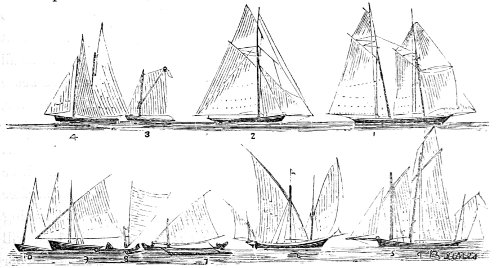
No. 4 has shoulder-of-mutton sails, the peaks of which are bent on to small taper yards which slide up and down on and abaft the lower masts like gunter topmasts; this facilitates the reefing of the sails, and also the setting of the jib from the foremast head.
No. 5 is a lugger, the yards are slung in the thirds, the shortest and thickest arm is forward, and the longest tapers aft; the foremost leach of the sail is very strongly roped, so that the tack holds down the forearm and elevates the peak. Sometimes in well-manned vessels the lugs are dipped so as to pass to leeward of the mast whenever they go about, and in this case the tack may be bowsed down considerably in front of the mast and a large sail carried; but in short-handed craft the tacks are brought down to the mast, and the foresail and mizen are set on one side and the mainsail on the other, and are not dipped. The after leach of the jib must be cut so as to go clear of the foreyard, the topmasts to slide abaft the lower masts; and there is always some difficulty in setting a fore topsail, as there must either be a double tack to pass the sail over the jib halyard in going about, or its fore leach must remain to leeward of it.
The lateen (No. 6) has triangular sails with very long taper yards, the head and fore leach becoming one; indeed, if there be any distinct fore leach, the sail becomes an ill-shaped lug, and not a lateen. The masts are somewhat short; sometimes mere stumps, but then the halyards and the tacks must be enormously strong to counterpoise the immense length of the yard.
The proa sail (Figs. 7 and 8, p. 173), a triangle spread upon two bamboos, hitched upon a stump mast in small boats, we have described at p. 135. No. 9 is a modification of it, by which a boat sets jib and mainsail in one, the angle formed by the yard and boom becomes more acute at each reef as indicated by the lines. It would be difficult, however, to work the boat without a small mizen to help her round in staying. No. 10 is the shoulder-of-mutton sail, set on a single taper yard or mast.

Palm leaves are sometimes used as sails; our sketch represents three or more cocoanut leaves, so woven together as to present a surface to receive the wind. Blankets and articles of clothing are used in emergencies. Oars are set up, and a boat will gather considerable way under them. Planks, the broader and flatter the better, are excellent substitutes, and may be trimmed at pleasure. It must not be forgotten that, however graceful in art and poetry the bellying canvas may be, the chief object of the sailmaker is to get it “to sit like a board.”
Reefing of sails from the sides.
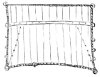
Sometimes when a sail is split, or otherwise rendered unserviceable, it is desirable to use another for a substitute without spoiling it by cutting. We remember reading of a vessel in which the topsail was split in a heavy gale; a spare foresail was got out and stout bands sewed on it, from the clews to the reef-band, diminishing upwards to the width the topsail head ought to be; eyelet holes were worked in, points or lacings inserted, and the sail, thus reduced, sent up to do duty as a topsail.
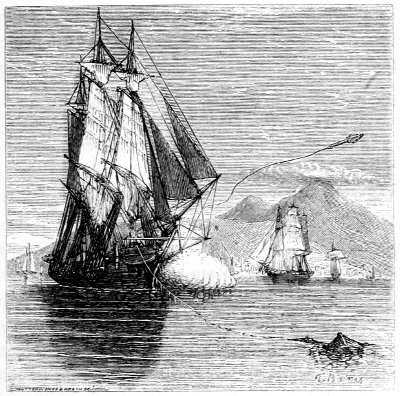
Captain (now Admiral Sir E.) Belcher, when in command of H.M.S. “Sulphur,” made use of a very clever expedient for imparting motion to his vessel when the wind failed. He constructed a couple of bolts, with stout umbrella framework covered with canvas at their heads, and with their butts so thickened as to fit loosely into the bow guns. A line was attached to each butt, and one was given in charge to the port and the other to the starboard watch; the first was fired to a good distance ahead, and as soon as the line was hauled upon the frame expanded and opposed its full resistance, so that, as it could not be drawn backwards through the water, the vessel must begin to move. Before this was hauled in the next was fired, the ship would increase her rate of progress, and, the impetus being once acquired, she would “hold her way,” so that eventually the men would have little more to do than gather in the slack of the line. No sailor likes the inaction of a calm, and besides this the captain had judged rightly in exciting the emulation of his men by giving one to each watch, and further stimulating it by an occasional glass of grog to the hardest working side, so that the cry of the port watch would be, “Haul away, and run her up to the umbrella before the starbowlines get theirs laid out,” and vice versâ, till sometimes a speed of four knots an hour was obtained. Thus was the good ship hauled out of many a belt of calms, and brought into the region of the winds, which might be only a few miles distant, while other vessels not so provided might have lain becalmed for weeks; and not only this, but her position in a bay or anchorage could be shifted at pleasure, and she became almost independent of wind or extraneous assistance by this ingenious expedient.
Paddles worked by mill sails have been proposed; but of these it will be sufficient to remark that the power of the paddles to drive the vessel’s head to wind will be less than that of the wind to drive her backward by the full amount of all that is expended in overcoming the friction of the machinery; in every other position the wind on the sails would do its work without the paddles.
Hints in emergencies.
A Prussian vessel, with the leaks gaining on her and her crew exhausted, was saved by lashing a spar across the mainmast, with one end projecting overboard with a barrel half full of water fast to it, so as to rise and fall with the sea. The pump brakes were made fast to the spar, and the vessel was thus kept afloat, while the crew were relieved from their labour.
A boat has been known to come ashore safe through a heavy sea by means of a handful of oil judiciously thrown over by one of the men whenever a wave threatened to break near her; and Captain Basil Hall relates how one of his boats was hove to all night under a droge of all her spars and sails and two or three seal skins, the oil of which working out calmed the water for a considerable distance.
Instances of this kind might be indefinitely multiplied; but we note only a few as suggestions. No amount that we could give would supply the want of presence of mind and the ready power of adapting the means at hand to the emergency.
Our space will not allow us to go into all the details of boat sailing, but we must find room for one or two general rules. In seeking to land through breakers, which must always be effected by the oars, wait just outside them till you find the heaviest roller coming in; then give way, and come in upon it, with your boat’s bow all but overhanging its crest, and, as it lands, you jump out and haul your boat beyond the power of its reflux. Some crews are in the habit of giving two or three powerful strokes just before they reach the shore, and then pitching their oars simultaneously as far from them as possible, picking them up again when they have secured their boat. It is well, however, to know that there is no current to set the oars out to sea before doing this.
In coming off face the breakers boldly, but judiciously watch the smaller waves, and give her good way through them. Keep your boat’s head on to the sea, and never let her take a breaker more than two points on either bow.
Trim the sails so that when brought to the wind the boat will very nearly steer herself, and she will attain her utmost speed. The action of the rudder has always a slightly-retarding influence, but if there is any want of balance let it be on the side of ardency or tendency to fly up in the wind, so that she may carry a little weather helm rather than want helping up by a lee one, and thus, in case of sudden squalls, the boat will, as if by instinct, obey the first touch of the lee helm, and, shaking the wind out of her sails, will right herself. The main sheet of an open boat should never be made fast, but held either by the steersman, or some one near him, in readiness to ease off. A squall seldom comes so suddenly that the first puff, if well watched, will not help the boat into the wind before the full strength comes; but on the coast of Australia we have known a squall come so suddenly through the dead calm of the night that it struck us at once like a blow from a sledge-hammer, and, though we had taken all the usual precautions, the sea was pouring like a jet-black cataract flecked with diamonds over 8ft. of the lee gunwale before the boat came to the wind; and we would say, therefore, if there is not an air to bring the boat’s head up when you expect a squall, help her with the sweep of an oar into the best position to receive it.
If you want to carry on sail do not attempt to stiffen the boat by making all the crew sit to windward; for, should the mast break, as is not unlikely with the increased strain, nothing can prevent her capsizing; let them sit in the bottom. In the way of ballast, nothing can be better than bags nearly filled with fresh water. They will assume the form of any place you want to stow them in, and will not sink the boat if she should fill; in fact, being lighter than salt water, they would impart a trifling buoyancy.
Temporary rudders.
The loss of the rudder, an accident which is by no means so unfrequent at sea as may be imagined, involves also, for a time at least, the loss of control over the vessel’s course. Even in the open sea this must be attended with considerable peril; but when it happens in the vicinity of rocks or shoals, and the vessel has not sea-room, the danger becomes appalling. The careful and vigilant trimming of the sails is the readiest means of regaining command of the vessel, and we believe the “Wager” was extricated from a most perilous position by this alone; but it is a work of immense labour, and harasses the crew severely. A stream cable payed out astern, and veered to either quarter, is sometimes used; or, if the accident should occur in moderate weather, by striking on a bar, the jolly boat with the plug out may be lowered and towed astern, but both these plans check the speed of the vessel, and are only useful when they can be made to impede one side more than the other; and that this is not the true principle of steering is known to every butcher’s boy, who apologises for wearing but one spur by saying “if one side of his horse goes the other must.” The rudder may be considered as a continuation of the keel, capable of moving on a hinge to an angle of 22½° on either side, and when the vessel moves forward, and the helm, for instance, is put to port, the water impinging on the starboard side of the rudder is reflected from it at an equal square to that of its incidence, and the resulting force tends to drive the stern to port and incline the head to starboard. But as the force acts in the direction of a line midway between the angles of incidence and of reflection, it has also a retarding tendency, and if the helm were put over to an angle of 45° the greater part of the power would be expended in stopping rather than in steering the vessel. If a ship could be made so flexible as to be converted like a fish into the segment of a circle either way at pleasure, the very perfection of steering would be attained, and the rudder is merely the best imitation of this that can be devised.