Chapter XIII · WATER, AND THE SAP OF PLANTS. (continued 2)
Reading edition
The “wortleberry” of the trappers, or “bellois” of the Canadians, is extremely abundant in a great number of localities. To prepare the fruit a thick close basket-work tray, or hurdle of white cedar, is used. This, when covered with a layer of ripe berries, is suspended over a slow steady wood fire until dry, when they are packed away in bark boxes. They are either mixed with dough to form cake, or boiled with meat or fish.
The “mashkigimin” of the Indians, “les ottakas” of the Canadians, the “cranberry” of the trappers: this fruit, although commonly known among trappers and English settlers as the cranberry, is much larger than the European variety. Swampy ground is most congenial to its growth. It is fit to gather as early as the month of October, but remains on the bushes even after being thickly buried by snow in the winter season. Immense quantities of these berries are annually gathered by the Indians, not only for their own use, but as a branch of trade with the United States traders, who readily purchase them for preserving. For Indian use, they require no treatment, as they do not readily decay; but by settlers they are usually boiled in syrup, or preserved in maple sugar.
Wild hazel nuts are found in great abundance. These are best kept by first packing, and then burying them in an earthen jar or bark box.
“Swan potatoes” are found growing on the shallow margins of rivers, lakes, and streams. These, when dug from the soft ooze and washed clean, are strung on a long thin strip of white cedar wood, and hung up over the fire to dry. They are boiled for use, when they become plump and palatable.
Wild raspberries, strawberries, &c., are to be met with in many parts of America.
Butter nuts, hickory nuts, and pinons, or cone nuts, are all, more or less, deserving of the attention of the hunter or explorer.
Sago-making.
In some islands of the Indian Archipelago nature has so bountifully provided for the wants of the human race that it seems as if a remnant of Paradise yet lingered upon earth, and man had never been sentenced to eat his bread in the sweat of his brow. At all events, the inhabitants of these islands are relieved from that necessity, and to all appearance they are little better for it. The man who, by chopping down a tree and washing its pith for a week or two, can provide himself with a substitute for bread for a whole year is not likely to be, nor is he really equal either in physical strength, activity, or intelligence to him who must earn his food by cultivation of the soil, by chasing wild animals in their forest haunts, or by launching his little craft upon the waters, and ensnaring or doing battle with the denizens of the ocean.
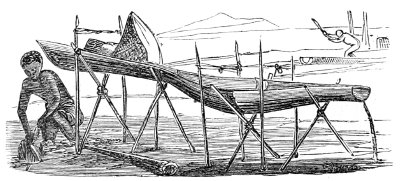
Our sketch represents the principal processes of sago-making. The palm which yields the sago is cut down; a slab is chopped off from the upper side of the trunk, leaving the pith which occupied the large internal hollow exposed; this is beaten out in fragments, rather than chopped, by a club of heavy wood, in the end of which a sharp angular fragment of quartz or other stone is set. The pith is then washed in a trough composed of the swelling portions of the leaf stems, where they embrace the trunk on which they grow, just as the jaws of a cutter’s gaff go round the mast. Two of these are placed with their broad ends together, supported by stakes and cross-bars, so as to form a long trough widest in the middle, and out of level. A third is set with its narrow end meeting that of the next piece, whilst the wide end rises at a slight elevation. Across this is placed a screen of fibrous cloth, supported by another stick, elastic enough to keep it always tolerably tight without undue strain, and a mass of the pith being placed behind this is washed by water poured repeatedly upon it and allowed to percolate through and run off till all the superfluous matter is washed away, and the sago alone is left.
The different members of the banana and plantain family, too, lend their aid in furnishing a larger quantity by far of life-supporting elements than the finest descriptions of wheat grown on the same area of ground. Whether eaten in a ripe state as a fruit, or boiled green as a vegetable (when it is not a bad substitute for the potato), this production is both palatable and wholesome. A good store food is made by cutting the fruit into slices, hanging it up to dry, and, when required for use, boiling it into a pulp.
Useful roots.
Plantain flour is made by thoroughly drying the fruit, and then grinding it in one of the native mills hereafter described. Then the root of the Taro (Calandium esculentum), that of the sweet potato (Battata convolvulans), and the roots of certain edible ferns (Pteris esculenta amongst the number), are valuable as yielding food. Many of these productions furnish drink as well. The plantains before referred to yield a very palatable cider, which is made as follows: A deep hole is dug in the earth, and a number of plantains stripped from the main stem is thrown in; straw and earth are cast on, and the plantains are allowed to remain at rest for eight days. The peel is then stripped off, and the pulp is placed in a large open trough with water, where it is thoroughly washed and mixed with it. At the end of two days the cider may be strained off for use.
Whisky may be made from sweet potatoes in the following manner: Dig up as many of the tubers as you may find it convenient to treat; boil them until quite soft; place them in large jars, or other vessels, with about their own bulk of water; stir this mixture well about, and then to each jar add a little “merissa” barm (obtained from native beer-brewing), which may be placed on a small bundle of cocoa-fibre or cotton. When fermentation has taken place, erect your still, which may be of the kind described and figured at page 495; or a large native pot may be mounted on a hollowed-out ant-hill to serve as the still boiler; a smaller pot inverted and placed on the open mouth of this forms the still head or dome. When the lower pot is charged with the fermented “wash,” the upper pot is luted fast with clay. A small hole is bored near its top for the reception of the end of any hollow tube you can get; this is also secured with clay. The condensing process is carried out by keeping the tube cold with cloths or mats and cold water. The depending end of the tube should discharge itself into any convenient vessel partly sunk beneath the surface of cold water. A native pot, or a common tea-kettle, will make a good receiver; and an ordinary pail, or tub, a convenient water tank in which to place it. By the use of such a contrivance as this, half-a-dozen bottles of very good spirits may be made in one day’s distilling.
Milk-spirit.
The Mongols make their milk-spirit—known as “kumis”—in the following manner: A large quantity of milk of any kind (mare’s milk is considered best) is first turned sour, and then allowed to ferment. It is then poured into a large iron camp-kettle or pot; one of the wooden bowls or dishes in use among the Tartars is now fitted closely into the mouth of the kettle or boiler, and luted fast round the edges with wet cow-dung or clay; an elbow-shaped, hollow branch of a tree, or a curved tube, is now fitted into a hole in the convex surface of the bowl, and more cow-dung or clay is applied. Into the mouth of this bent pipe a wooden tube is fixed, which is kept cold by the constant contact of a wet sheepskin. As the pot boils the spirit passes over, and is collected for use in some suitable vessel placed as a receiver. This is also kept cold by the aid of sheepskins and water.