Chapter I · OUTFIT TO TAKE ABROAD. (continued 2)
Reading edition
Medical Chest for 2 years and 20 men.
Naturalists’ Stores.
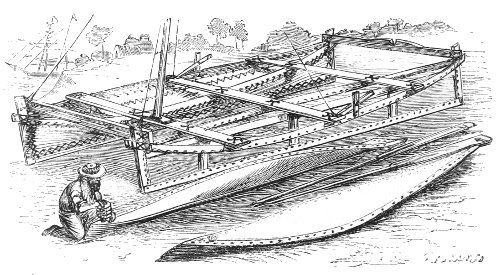
NORTH AUSTRALIAN EXPEDITION INFLATABLE DOUBLE BOAT.
Boats.
We took, for conveyance across rivers, or navigation of any inland waters, a portable canoe of inflated canvas, in four sections, each of which, when inflated and laced to a frame, formed half a boat; the whole forming a double canoe, on which could be laid a platform of 15ft. by 7ft.
Inflated canvas boat.
The boat was made by Messrs. Edgington from a model which we had previously constructed and tested as to its buoyancy and sailing qualities. The framework was of ash battens, 3in. wide and ¾in. thick. The uprights at stem and stern were mortised into the keel, as well as into the corresponding fore-and-aft batten above; they were secured by cross lashings passing through holes properly bored for the purpose. The gunwales were lashed on; and then the thwart pieces, 6in. wide, were secured in the same manner. The four canvas bags, each cut so as to form half a whale boat, 15ft. long and 18in. in the half breadth, were then laced in and inflated. Each rowlock was formed of two pieces of ash screwed to the gunwale, as seen in the preceding engraving; and two oars and a lug sail completed the equipment. The whole might be used either as a double canoe or as two separate boats, and Mr. Gregory was much pleased with them when put together; but, in consequence of a technical difficulty at home, they were not so efficient as they ought to have been. We had agreed with Messrs. Edgington as to the quality of canvas and of the sewing to be used in every part, but on applying to the Waterproofing Company he found they would not waterproof his work, nor allow him to do it. He had therefore to give over the whole of the work to the company. When finished, we found that the seams were not stitched at all, but cemented together; and, though warranted to stand 170° of heat, we found that with the strain of actual use upon them they softened and gave way. If the sections in their proper form were made of stout canvas, with the india-rubber bags, so large that they should bear no strain, inclosed within them, this would be a serviceable boat—for the india-rubber did not actually melt with the heat, but just softened, so that it was unable to resist the strain upon it. We had taken them up the river, about thirty miles, in the schooner’s gig, to fill with fresh water, and instead of standing a heat of 170° they burst at 120°.
Although, as we have stated, our double inflatable boat partially failed in Australia, from the inability of the waterproof cement to bear the intense heat to which it was subjected, we believe that, had Messrs. Edgington been allowed to waterproof their own work, or had the company consented to waterproof the sections, properly seamed by practical tentmakers, according to the directions we gave, the finished boat would have been as successful in every respect as was the model.
When required for an exploring trip up the river, we decided to use them not as a double boat, but as two single ones, and we spent some days in securely stitching round every seam that should have been so treated by the original maker. Every one will understand how the fibre of the waterproof cloth would no longer close up round the threads, as would that of the new canvas, so that, notwithstanding all our care, there was always a little air leakage; however, spare bellows had been provided, and one was apportioned to each boat.
Four or five 6lb. tins of preserved beef were thrust in between the sections in each boat, so as to rest along the keel, our lighter stores were laid as might be said “on deck,” and with two small oars in each we started, pulling up wherever there was sufficient water, and when we came to the dry intervals, slinging the boats one at a time under two oars, and carrying them easily with all their cargo to the next water. The voyage lasted some days, and the boats, therefore, occasionally required re-inflating.
Canoe for one man.
If the traveller only wishes for the means of ferrying himself over rivers, he might take a couple of waterproof tubes, not less than 7ft. long and 8in. in diameter, inclosed in unprepared covers of canvas so tight as to relieve them from any strain, and connected by one breadth of canvas for him to sit upon. A small frame should keep these parallel to each other, and about 20in. or 2ft. apart; and the frame should be kept just above the water, so as not to impede the motion. It is a great thing to be independent of native help. If a man has his own canoe, however small, the people will come to offer theirs; but if he has none, they will make a hard bargain with him.
Metal boats.
Perhaps as good a material as any for a boat, if the explorer is able to carry it, is pure sheet copper, of about 1lb. to the square foot. It is flexible, easily worked, will turn and bend in any form and at any angle; it may be folded down to a sharp edge like a sheet of paper, and opened again, a test which no iron ordinarily procurable could stand; it is nearly indestructible, and retains a proportionate value as old copper however much it may be worn.
We have heard of an officer who had the two ends of a yawl or whale-boat built of copper, and, though the stem would frequently be doubled up by touching the ground in crossing the bar of some African river, no leakage took place, and half an hour’s skilful hammering brought it into shape again. We believe that the boats, or at least one of them, on the expedition of Mr. Lynch to the Dead Sea and the Jordan, were of copper. If we remember rightly a copper boat was carried in sections upon camels to Lake Chad.
Captain Burton took to Zanzibar a boat of corrugated iron, which was so speedy that the Arabs called her the Runner-away; it would be interesting to know the details of her construction. We at one time experimented with galvanised iron, but did not find it sufficiently flexible to bend so sharply as we required. In consequence of this—when preparing, in conjunction with a long-known friend, Mr. James Chapman, for a journey across Africa, from Walvisch Bay, on the west coast, to the Victoria Falls, from which we hoped to navigate the Zambesi to the Eastern Sea—we decided on building one of copper; and many reasons induced us to make this on the principle of a double canoe or twin steamer: in the first place, it would be difficult to carry a boat of more than three feet in breadth or depth, in an ox waggon, and these dimensions would afford room only for the closest possible stowage of our own persons, and a very scanty equipment. It was also, probable, that the boats would have, at rapids like Chicova or Kebrabasi, to be taken out of the water and carried over rugged and intricate country, where their length would render it impossible to manage them.
It was necessary, therefore, to build each boat in six watertight compartments, of 4ft. in length, of one sheet of copper, each of which overlapped the one behind it, just as the scales of a lobster are arranged, making the actual length of the boat 22ft. The “skin” of each section was made of three sheets of copper, 2ft. wide, laid side by side with their edges doubled over each other, so as to make a perfectly turned joint that required no riveting, and was only soldered to render it more certainly watertight. The ends of each section were marked to the curve required, but cut three inches larger, the extra circumference being cut with snips directed toward the centre, so that they might be turned outward to fit the curve of the skin, thus leaving a flange of 3in. at each end of the section, a strip of copper 6in. wide was doubled and slipped over both parts, riveted and soldered, the necessary surfaces having been previously tinned.
We hope the engraving on the next page will make this plan tolerably plain. The end to the right is left unfinished, with the separate pieces a little apart ready to be put together; the farther shows the manner in which the flange of the foremost section overlaps the after, and is bolted to it with copper screws and nuts, leaving a space between, into which the hand and arm could be thrust if it were needful to reach the bottom; the water would flow in or out of this narrow space freely, the compartments only being guarded against leakage; the nuts were all on the inside, and the iron key shown in the sketch was for the purpose of turning them on or off, while the heads were held outside by the screw wrench. The copper was kept in shape by an inner frame of wood, and strengthened externally by seven rib-bands or stringers of good straight grained red deal, running the entire length, of which two served for gunwales and one for the keel, the ends of this being let into sockets formed in the pieces of copper which were doubled over the stem and stern post. One of the connecting beams is shown in this sketch, and also the rings by which the sections were to be carried when separated for overland conveyance.
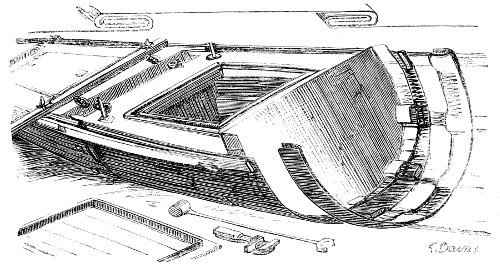
METHOD OF BUILDING AND CONNECTING SECTION OF COPPER BOAT.
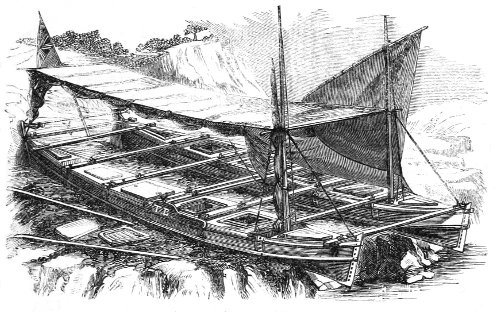
COPPER BOATS ADJUSTED SIDE BY SIDE.
For the purpose of keeping the cargo dry and secure from pilfering, it was necessary that each section should have its own deck, and this, to bear the weight of people standing on it, had to be made of ¾in. plank, covered like the other parts with copper. Around each hatchway were two mouldings, ¾in. high, the hollow between which, in heavy rains, we intended to fill with wax or grease, so that when the corresponding moulding of the hatch fitted into it it might be watertight. The connecting beams were 12ft. long, and made each of two pieces of ¾in. red deal, 2in. wide, so as to afford us, with the platform laid on them, an available deck space of 12ft. by 20ft., on which, when the river was broad and open, we might live or work with comfort; while, if it narrowed, as we expected it would at Kansalo, Chicova, or Kebrabasi, we could separate the boats and take each through singly, towing the deck-raft, or even, if necessary, casting it adrift and trusting to pick it up as the current brought it down. Two ¾in. planks, 9in. deep and 4ft. long, so as to catch the bolts at either end of the section, served to support the rowlocks. Each boat was provided with her own rudder, and we purposed, if necessary, to connect the tillers by a light rod, although we believe she would have steered by one alone. The masts were shipped in a wooden case, between the foremost and the next section, and the mode of setting the lug sails and awning will, we trust, be made sufficiently plain by the engraving. Care had to be taken that no iron or other metal capable of exerting a corrosive action came in contact with any part of the copper that was likely to be wetted. And the reader will pardon us if, while stating that the whole was built piece by piece in a little bedroom scarce 8ft. by 12ft., we take this opportunity of paying a slight tribute of gratitude to our warmhearted friend Frederick Logier, to whose hospitality we were mainly indebted for the means of completing our equipment, and who fell a victim to the fever so fearfully prevalent in Cape Town in October, 1867. The ensign, kindly made for us by a lady of that town, after having floated over our house at Logier Hill, on the Zambesi, and served as the flag of our little artillery corps at Otjimbengue, we still preserve as a relic of the journey.
The difficulties of the road, and deficiency of carriage, which compelled us to leave behind eight out of the twelve sections, and our expedients to replace them, will be more fully described hereafter: we, therefore, append only an abstract of the materials employed in building:—
76 sheets copper, 4ft. by 2ft. 16oz. to the foot, at 1s. 6d. per foot (but, as the supply was limited, we had to take some heavier, and consequently more expensive), one sheet same size 16lb. for stem, and stern post and rudder fittings £51 12 0

100½in. copper, screwed bolts and nuts, 3in., at 1s. 1d. 5 8 4
80 ditto ditto ditto 5in., at 1s. 5d. 5 13 4
5 ditto ditto ditto 7in., at 1s. 9d. 0 8 9
300 leather washers 1 5 0
174½lb. solder, at 1s. 6d. 5lb. fine tin, at 2s. 3d. Extra quantity not specified 13 4 4 0 11 3 3 15 1½ 17 10 8½
Men’s time for soldering 17 17 6
Coke 1 2 6
2 nut wrenches 0 11 3
4lb. of sal ammoniac, at s. 6d. 0 6 0
4lb. of resin, at 4½d. 0 1 6
1 bottle of spirit of salts 0 1 4
6lb. of lead, at 4½d. 0 2 3
3lb. of copper boat nails, at 3s. 6d. 0 10 6
2lb. of nails and 2lb. of rivets, at 3s. 0 12 0
3 steel punches, at 1s. 0 3 0
2 pair of rowlocks, with sockets and screws 0 7 6
Total £103 13 5½
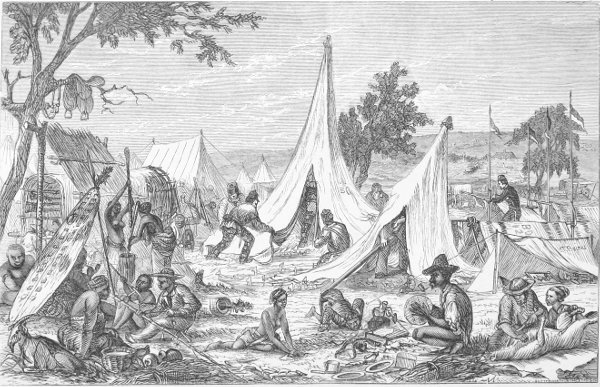
CAMP SCENE IN AFRICA.
It is impossible, at this distance of time, to collect every item used, nor is it necessary to do more than to give an approximate idea of the cost and proportion used of the principal materials. Perhaps the wood, with a lad to assist in working it, cost about 10l.; paint, oil, sails, and other extras, about 10l. more; and 10l. freight from Cape Town to Walvisch Bay. We think 6d. per lb. was allowed on such old copper as was brought back.
Tents, Canvas Buckets and Articles made of Canvas generally.
Tent-pitching.
In an army where men are plentiful and tents very few, the eighteen or twenty fortunate fellows to whom a bell tent may be allotted, can pitch it easily and rapidly enough; one, standing inside, will hold up the central pole, while the others, driving pegs all round, draw out and affix the cords to them. We found, however, when accompanying the division in Kafirland under General Somerset, that we could set up our own tent, shared by Mr. Hoole, the interpreter, almost as quickly alone, leaving our friend’s servant at liberty to prepare our meal. Our plan was to make two knots on the cord used for lashing up the tent, one marking the radius of the inner line of pegs and the other that of the outer, setting a central peg into the ground and looping over it the end of the line; we held another at the knots, and with it drew the two concentric circles. Twenty pegs are necessary for each. We, therefore, threw four on the quarters of each circle, and distributing four between each, drove them all into the ground; then spreading the tent in the space, we looped on all the lines, and inserting the pole, raised it up, its division into two pieces much facilitating this, and tightened the cords at leisure. (See illustration, “Camp Scene in Africa.”)
Patrol tent.
Our patrol tent was just three yards of double width calico; a small cord was stitched along the middle and loops of tape along the sides. The diagonal pieces cut out of one end were stitched on to form the flaps of the other, and a couple of small sticks for the supports, the size of ramrods, were easily secured with the straps of our gun-bucket on the right side of the saddle.
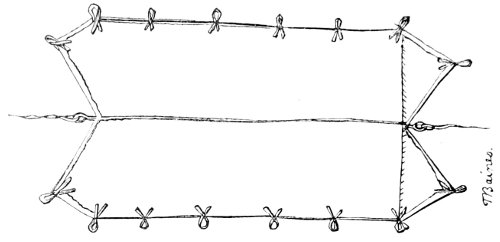
CALICO PATROL TENT.
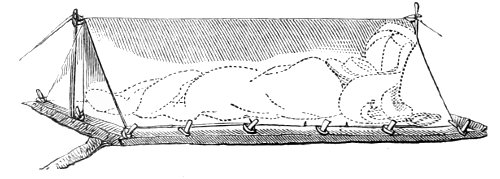
CALICO PATROL TENT.
Our little tent weighed next to nothing; it was seven feet in length, thirty inches high, and nearly thirty inches wide. We rolled our blankets in it, and so kept them clean. The package was carried strapped across the front of the saddle, and the latter, when set in one end of the tent, formed an additional protection to the head, and no rain ever penetrated our little dwelling, unless when a violent side wind would force through the interstices of the calico a slight sprinkling of minute drops, which would lie like dew outside the blanket in the morning. Waterproof material is not required for a tent; oiling the canvas or calico would only rot it; stout well-woven canvas is nearly waterproof in itself, and no matter how porous or open the material, the power of a tent to keep out rain depends more on the “pitch” of its sides or roof than anything else. Let a plate of glass lie in a sloping position, and let a drop of water be touched upon its under surface, if that surface makes an angle of less than 45° with the horizon the water will drop off it, but if the angle be above 45° it will run from top to bottom along the lower side; in like manner if the sides of the tent are pitched at a higher angle than 45° with the horizon, the heaviest shower will run down them instead of penetrating. A piece of waterproof is, however, very convenient to lay upon the ground to spread the blankets on.
Gipsy tent.
Most of our readers who have visited the by-lanes and breezy downs of England, will be familiar with, at least, the exterior of the gipsy’s tent. Its mode of arrangement is both ingenious and thoroughly practical. We know of no plan by which a comparatively comfortable resting place can be extemporised equal to it. Blankets, skins, mats, canvas, or old rugs, serve to form a covering. The thicket furnishes the hazel wands or “benders,” of which there are usually eight, of 7ft. long, and almost any description of tough wood, the “hole piece” and farmer’s gate shivers are not unfrequently purloined by the Romany Rye to be thus utilised. A red hot poker serves to bore the holes. A few pieces of odd cord keep the framework in place, and a set of pegs is readily cut from the nearest hedge.
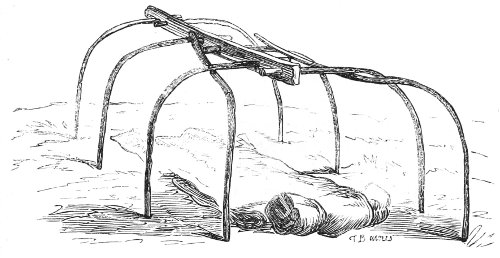
GIPSY TENT FRAME.
The ends of the benders intended for insertion in the earth are usually fire-hardened, and one set will, with care, last a whole season. The above illustration will better explain the mode by which the contrivance is arranged than would any further description.
Tente d’abri.
The tente d’abri, as used by the French army, is an extremely useful arrangement for a small band of travellers or explorers to provide themselves with. It is composed of a number of sheets or pieces of canvas. Each of these has a row of buttons and button-holes sewn along the sides and upper edges, in order that they may be joined to each other, much on the principle of a double-breasted waistcoat, as shown in the engraving on the next page. The corners of the sheets are provided with strong short loops of rope, through which the heads of the tent pegs pass when the tent is pitched. The sheets are 5ft. 8in. by 5ft. 3in. Each member of a party of four or six is supposed to carry his share of the tent, which consists of one sheet, three tent pegs, and the half of a round wooden staff ferruled in the centre like a fishing-rod. This, when put together, measures 4ft. 4in. in length, and is 1½in. in diameter. The total weight of each share is 3½lb. Tents of this description can be arranged by either buttoning four or six sheets together, one sheet being considered as representing the accommodation of one man; but when it is considered necessary to close the two ends of the tent four sheets only are used as a covering, the other two being used as doors. A centre tent pole is also set up, so that a tent for six men has, when pitched, three poles, ten pegs, and six sheets of canvas. When both ends are suffered to remain unclosed, as they would be when shade alone is sought, four tent poles or sticks and fourteen tent pegs are required; there would, then, be two spare poles and four pegs. By digging out a cavity in the earth as described at page 62, the comfort and internal capacity of the tente d’abri is much increased, and it forms a very convenient and portable shelter. We remember seeing a French line regiment, which was for some considerable time stationed on the heights above the Inkerman Valley, most comfortably domiciled in this way.
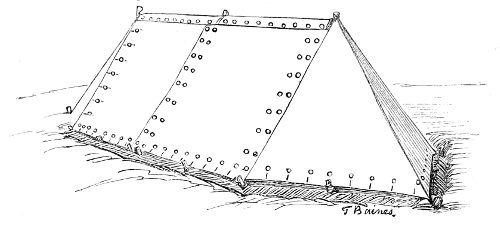
TENTE D’ABRI.
Lancers’ tent.
The Lancers, in Kafirland, used to form very commodious tents by sticking upright in the ground one lance and two swords; a second lance was passed as a ridge pole through the becket or loop of the first and the hilts of the two swords, as seen in illustration, “Camp Scene in Africa.” One blanket was stretched over it as a tent, and another, with the saddle cloths, &c., formed a comfortable bed for two soldiers.
A simpler form of tent may be made at a moment’s notice. If rain comes on, sit upright, joining the hands above the head as if you were about to dive, supporting the blanket on them, and allowing it to hang down on all sides that the rain may run off. If you have no blanket, you may still keep your gun, ammunition, or sketch-book dry by sitting on them.
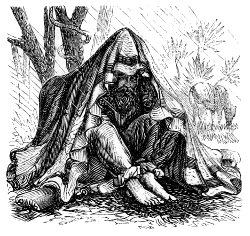
TENT EXTEMPORISED FROM A BLANKET.
Australian tent.
The tents we used on the North Australian expedition were very light, convenient, and easily set up. They were simply four-sided pyramids of calico, eight feet square in the base, and from 9ft. to 10ft. in height (see p. 65). They were lightly roped at the angles, and would set up with four principal pegs, though there were loops for intermediate ones along the sides. Poles could not conveniently be carried on the packhorses, but there were few places in Australia where we could not cut them if needed; and in fine weather, we mostly dispensed altogether with the tents, except as mere sun-shades, and slept only in our blankets. Their weight, dry, was trifling, but, on account of their bulk, they formed the greater part of the load of one horse, and when we had to travel—after a rainy night, without drying them—we found that two wet tents, with the farrier’s tools and a few horseshoes, were quite heavy enough as a load for one animal.
Cape-waggon tent.
A very favourite form of tent in the Cape colony is made like the longitudinal half section of a ridge-pole tent. This is fastened to the roof of the travelling waggon and stretched beside it. When the traveller has two of these, one on each side his vehicle, he will find it of the greatest possible convenience. The waggon, with its own aristocratic kap-tent, or humble but more durable wattled roof, serves as the sleeping chamber; while the half tent on one side may serve as a dining or general reception room, and the other as a working or retiring apartment. These may either be raised or lowered according to the position of the sun or wind, or may be completely closed in at night; or, if required, the two halves can be taken away from the waggon altogether, laced together, and, with poles cut upon the spot, set up at once as a double-pole tent, as shown on p. 65.
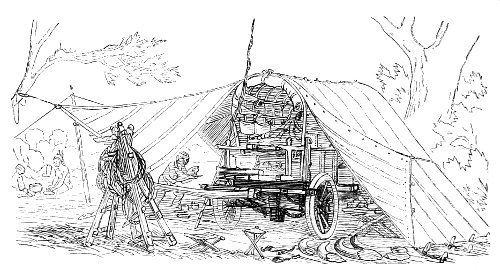
THE CAPE-WAGGON TENT.
Extemporary tents.
We have found in Australia and Africa, that the possession of a large square of duck or canvas, eylet-holed at the corners and sides, or a couple of good sized sheets of stout unbleached calico, with loops of tape or cord stitched at the sides and angles, have enabled us to construct extemporary screens from sun or wind, or even rain, and when not so required have served admirably as the basis for our bedding. In boat parties the sails or awnings of the boat may be stretched upon the mast or oars, two oars at each end may be lashed crosswise, and set up as shear legs, while the mast is used as a ridge pole, and the sail drawn across them; there is, however, the objection that the blades of the oars if projecting upward will hold wind, and they should therefore be “feathered” toward the quarter whence it may be expected to blow; but never forget that the making of a tent is only a secondary and exceptional use for a boat’s gear; if the sail is chafed or cut, its proper usefulness will be much deteriorated; and if the oars are allowed to sag or bend, by undue strain, they become worse than useless. You can no more pull effectively with a warped or twisted oar than you can shoot well with a crooked gun. In a boat voyage on a river, or where you can make fast and shelter your boat at night, if you set up two stanchions three or four feet higher than the gunwale, one at the after and another at the bow thwart, and then make fast a line to the ringbolt in the stern post, and lead it over the stanchions to the other ring in the stem, it will form a ridge rope on which the boat’s awning with the yards or stretchers removed may be laid, and the sides sloped down tent fashion to the gunwales, and made fast either to the rowlocks or, still better, to a stout line passed tightly all round the boat outside of and just below the gunwale streak.
If you build a hut, and have not time or material to make it weather proof, the tent may with great advantage be pitched as a lining to it, and it is wonderful what effective shelter may be obtained from very imperfect hutting done in this manner.
We have frequently heard of officers and men setting up their tents or marquees, then building the framework of their hut over them, covering it roughly, and finishing at their leisure, so that, by the time the tents have been worn out, very efficient thatched houses have taken their places.
We should think that a bell tent (such as may be purchased at any town where military stores are kept), cut in half, and supplemented with a couple of squares of canvas, eylet-holed at two inches or more from the edge, so as to lace between the two halves of the bell tent, and used as a double-pole tent, either with a ridge pole or with a rope extended at either end as a stay, would form a very commodious habitation, and would be specially useful where the number of occupants is subject to changes.
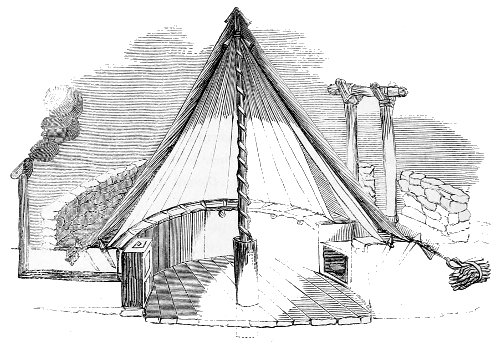
SECTION OF CRIMEAN TENT.
Fitting up of tent.
When a tent is to be occupied for any length of time, it will be advisable to dig a hole in the earth to pitch it over, doing so not only adds materially to the space inside the tent, but makes it much more comfortable to reside in, from the shelter afforded by the sides of the excavation. Many of the huts built by the Russian soldiers in the neighbourhood of Sebastopol were sunk to a very great depth, being in fact merely large holes in the earth with roofs to them. The roofs were of poles thickly laid over with brushwood, and then covered with earth, light was admitted through holes in the low framework of the sides, oiled paper being used as a substitute for glass. About 2ft. 6in. will be found a good depth for the excavation for an ordinary military tent to stand over. In digging it see that the sides are cut down evenly, and that the bottom is level. If planks can be procured to floor and line it so much the better. Some persons leave a round bank of earth in the middle for the pole to rest on, but we much prefer fixing a log of wood, cut from a tree trunk, in the centre of the floor. The habitation we formed for ourselves in the Crimea, when encamped before Sebastopol, was thus arranged. We first made a hole in the earth a little less than the diameter of the bottom of the tent, and of the depth before referred to; we then made a pit in the centre about 18in. in depth. In this we sank the lower end of a piece of old tree trunk, 4ft. long and 7in. in diameter. In its upper surface we cut with a gouge a cup-like cavity. We then nailed a spiral strapping of forage hoop round a boat mast we were fortunate enough to hunt out at Balaklava; we then rounded the lower end so as to make it loosely fit into the cup on the head of the block. The bell or upper portion of an old tent was then raised on our mast tent pole, and over it our own new and complete tent, forming so to speak a double roof, having about a couple of inches of space between the two surfaces of canvas. This, by holding a certain portion of air, added in an extraordinary degree to its sheltering properties. We next dug a deep drain completely round the tent, and placed a quantity of broken stones in its bottom. An old wooden packing case was then let in, by digging into one of the sides of the excavation immediately under the doorway. This not only answered the purpose of a step to enter by, but formed an excellent storehole for all sorts of stray matters. The pipe from a small Maltese stove was carried out through the earth, and discharged its smoke outside a low wall of rough stones which encircled the tent. We drove two strong posts deeply into the earth beside the door, across their tops we nailed a strong bar, which served to hitch horses to, rest gun against, &c.; whilst across their lower portions we stretched a piece of forage hoop, edge upwards, to perform the part of a bootscraper. Towards the end of the war we were enabled to procure plank enough to both floor and line the tent throughout, thereby adding much to our comfort. The lining is carried out by placing boards the height of the side banks on their ends, all round the tent, like the staves of a barrel, and then nailing the flooring boards here and there fast to them. The upper ends are kept in their places by nailing short battens of wood across the joints.
The illustration on page 62 is a section of the tent referred to, and shows the manner in which many of the arrangements described are made. Many tents we have seen have been dug out to a sufficient depth to admit of a sort of cellar or lower room being formed; this can only be done at the expense of much trouble and labour. The arrangement of the interior of a tent admits of the exercise of a considerable amount of ingenuity. Cart, waggon, or gun wheels are extremely useful, both for forming a secure base for the pole to rest on, and for a table and gun rack. The tent pole, as shown in the engraving on the next page, rests on one wheel, whilst it passes through the centre of the nave of another. The hooks for hanging various objects from are formed by the natural branches of the tree from which the pole has been made. We seldom make use of the ferruled pole furnished with the tent when we have young forest trees at hand; in the absence of these, the conventional deal stick serves to fall back on.
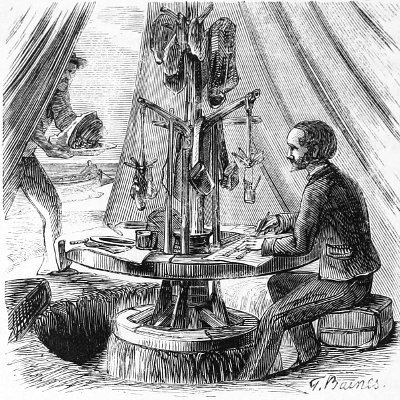
THE UTILIZATION OF WHEELS.
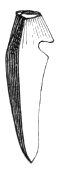
TENT PEG.
Tent peg.
Modes of securing tent ropes, &c.
Much of the efficiency of a tent depends on the way in which it is pitched. An experienced hand will so adjust his pegs and lines, that the gale of wind which prostrates the canvas houses of the inexperienced, passes his harmlessly by. Much has been said and written in praise of iron tent pegs, and, under some circumstances, they may be found highly useful, but there are very serious objections to their use in wild countries. If of sufficient size and length to be efficient, their weight becomes a matter of considerable importance. Their value to natives is so great that to prevent loss by theft is next to impossible; added to which, it is almost certain that one or two will be left in the ground, every now and then, on striking camp. We therefore prefer wooden pegs, made from some tough sound wood. Burn the points in the fire in order to harden them, and keep a good stock always on hand. The timber of the oriental plane makes excellent tent pegs. A strong and useful form of peg is shown in the annexed illustration. TENT PEG. made of some heavy and hard wood, such as mimosa or baubul thorn. The handle should be made larger at one end than the other, so that it may be removed from the head of the mallet, just as the axe handles before described are separated from the blades. It not unfrequently happens, during tropical rains, or in sandy soil, that pegs driven in the ordinary way will not hold. Modes of securing tent ropes, &c. It then becomes necessary to dig a moderately deep pit at the point at which the peg should stand. Bind together a small faggot of brushwood, reeds, or weed stalks; fasten a loop of rope or thong to it long enough to come 3in. or 4in. above the level of the pit where the faggot is buried. Place your prepared faggot in the bottom of the pit crosswise, and then well stamp in the earth over it. A bag of sand, a stone, or a bundle of old hide answers the same purpose. In rough stormy weather, it is sometimes necessary to back your pegs; this is done by driving in an additional one in a line with the first, and then forming a couple of half hitches with the tent rope over its head. It was a common practice in the Crimea to employ an old Russian bayonet in this way, driving it into the earth until the curved neck alone remained above the surface for the hitch to pass round. All tent ropes should be relaxed on the approach of rain, or the tightened cord will, in all probability, draw the pegs, and thus allow the wet canvas to come flapping down about your ears, causing no end of discomfort and confusion. A tent may be securely pitched, even on the sands of the desert, by laying a waggon wheel flat on the ground, fixing the pole over the hole through which the axle passes on the head of a plug driven far enough into it to prevent the pole from passing through; secure your ropes to bags of sand buried in the manner before described, and no ordinary weather will blow down a tent thus arranged.
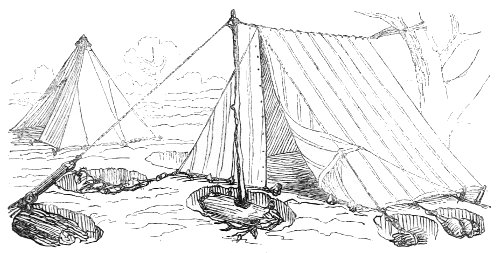
MODES OF SECURING TENT-POLE AND ROPES IN LOOSE GROUND.
Selection of ground for tent pitching.
In selecting a spot on which to pitch your tent much will depend on the period of time you are likely to spend in the locality. The nature of the country through which you are passing will also influence the choice. When travelling onwards, and merely resting for one or two days at a time, a dry, raised, level spot, in the vicinity of wood, grass, and water, may safely be selected. Do not, however, encamp too close to water in countries where venomous snakes are met with, as they generally congregate where it is to be found most abundantly. It is not wise, either in Australia or Texas, to encamp beneath certain trees, as the branches at times drop suddenly off and fall with a crash to the earth. In India or Africa we have always sought the friendly shade afforded by some wide-spreading forest giant, as we have never known an instance of “branch-fall” in those countries. In clearing the ground of stray stones, tufts of weeds, &c., look well about for holes in the earth, and, when any are discovered, stamp suitable stones or pieces of broken wood well into them. Reptiles of many kinds are not unfrequently found in these underground burrows. We have found a large square of tarpauling invaluable as a tent carpet. When about to set up your tent for a long sojourn additional precautions are requisite. See well to the lay of the land as regards the flood level of the nearest river or lake; the stray bits of driftwood and weeds washed into the branches of waterside trees will be a useful guide. See that no flags or rushes are growing near your proposed resting-place, as they are certain indications of a boggy soil, unfit for camping on. Choose, if possible, an elevated position, well above the influence of the miasma and night mists of the low grounds and rivers. We have often seen a slightly raised hill standing bare and island-like in a sea of humid vapour. See also that no dry grass is allowed to stand in the vicinity of the camp, lest it should be ignited by a stray spark or a hostile native.
Umbrella tent.
A stout carriage umbrella, with a curtain of 3ft. 6in. buttoned or laced round the edge, would make a very convenient shelter for one person. If the curtains were gored so as to give more room below, two persons might sleep under it comfortably. An extra joint would be required to give sufficient length to the handle. A similar frame made proportionately strong, and with a curtain or wall of six or seven feet, might be found useful in cases where the height of a bell-tent or marquee is objectionable. Malacca cane would be a good material for such a frame. We have heard of an adventurous American traveller who had his umbrella tent made of starred and striped material, so that he might be always under the protection of his country’s flag.
Canvas buckets.
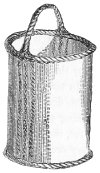
CANVAS BUCKET.
Stout canvas buckets answer very well to carry water in for almost any distance, and if stiffly roped will retain their form when filled, and collapse when empty; if a little flour is rubbed into the canvas, it will render them somewhat tighter, and will not materially affect the taste of the water, but we prefer to take the stoutest canvas. Keep it perfectly clean, and trust solely to the natural contraction of the threads when wet, to thicken up and tighten the material so as to render it for all practical purposes nearly waterproof. India-rubber bags, especially if carried into a hot sun, and not quite full, always make the water taste badly. When we served on the North Australian expedition, we always had a canvas bucket hanging in the doorway of the hut, just shaded and exposed to a free current of air. The partial evaporation through its sides kept the water deliciously cool.
Mosquito nets.
If the traveller can afford such a luxury, and is likely to have plenty of tent room, and a sufficient train of well ordered and obedient servitors, we should advise him by all means to take plenty of mosquito net, gauze or tarletan, green or blue. This should be suspended around his bed so as to form an inner tent, pervious in every direction to the cooling breeze, but having no aperture whatever by which a single insect could gain admittance. If the nights are cool, so that he can bear plenty of bedclothing, the face alone may be protected by the net; but if they are likely to be warm, so that he lies with the thinnest possible coverlet, and frequently throws off even that, it must be large enough to inclose the whole bed, and be tucked in or otherwise secured all round; in all cases it must be capacious enough to give him plenty of room to sleep, without touching its sides, for if an unfortunate limb should by any accident touch the gauze, the infinitesimal tormentors would assuredly not neglect to improve their opportunity.
The net may be simply a large square, a portion of the centre may be gathered in the hand, and a cord knotted to it by which to suspend it from above, while the edges are brought round and tucked under the mattrass. If two points of suspension, one near the head and the other at the feet, can be obtained, with a light rod or ridge pole between them, the material may be used to more advantage, and it may, if convenient, be distended by a hoop, square or oblong frame of light canes or twigs, lashed together with a bit of cord.
We had one when in India, cut, and stitched into a cone, or crinoline shape, suspended from above, and tucked around under our bedding, and found it exceedingly serviceable—of course, when the real hard work comes on, all these luxuries go to the rear; but it is wise to enjoy them when you can.
In many parts of the world, we might say in all, where flies are found, dense swarms are sure to seek the shelter of the traveller’s tent, causing endless annoyance to the inmates by settling on, or buzzing about, their faces, hands, or the work they may be doing—drinking up every drop of moisture from the angles of the eyes, inserting their probosces into any cut or open sore on the hands for the same purpose.
Odds and Ends.
The ditty bag.
There are a number of articles which, although not strictly found under either of the heads we have before dealt with, will be found of very considerable service in wild countries. A “ditty bag” should be made of some tough strong material, such as fustian, velveteen, or canvas. It should contain a large assortment of needles, especially of the larger and stouter sizes; half-a-dozen medium-sized sail needles, three roping needles, two packing needles, half-a-dozen duck needles, sailmaker’s thimble and palm, sail hook, rubber, and piercer; roping, sail, and duck twine. (Learn how to use the palm from a sailor on the voyage.) A dozen skeins of black thread, ditto brown; one dozen skeins of carpet thread, brown; six slips of black silk, six white ditto; six hanks of worsted, the colour of the socks and shirts. All these skeins should be wound off on cards, as endless entanglements follow the attempts made by the inexperienced to use thread from the uncut skein. We also advise winding on cards, as cut thread is not so well adapted, from the number of short lengths in it, for splicing broken fishing-rod joints, &c. A few reels of strong white sewing cotton, a little bag of buttons of all sorts, a lump of beeswax, six pieces of strong tape, a packet of pins, a bodkin, and a pair of strong large bowed scissors. A little ingenuity will enable the traveller to perform an endless number of repairs with the contents of a bag thus furnished. The more needles you can take the better, as they are at all times eagerly sought after by natives.
Bellows.
A small pair of common bellows can be bought for about a shilling. Do not fail to provide at least one of these useful contrivances. It is perfectly surprising to note the number of valuable ends they serve to answer. Stubborn fires, formed of saturated brushwood and damp moss, are, by their aid, forced into a blaze, when ordinary coaxing and fanning only produced suffocating smoke and grievous loss of temper. The fine sand and almost impalpable dust which, in some regions, finds its way in some strange manner into your very gun locks is best removed by the aid of your bellows. Laid flat on the knees a capital board for writing, drawing, or the examination of minute objects, is formed. When cutting out leather thongs with the knife, or fashioning raw hide covers for various things, they may be used for a cutting-board. When snatching a hasty meal at the camp fire at early dawn, before starting on the march or hunt, we do not sit on the damp earth, but usually place our bellows on the ground and sit on that. Most of our small job work, such as fileing, soldering, fish-hook tying, and tackle making, is performed on the ever-ready surface of the bellows; and when small objects of iron or steel require heating, either to be worked, tempered, or case-hardened, a hole in the ground, a little charcoal and dry cow dung, by the aid of the bellows, enables us to extemporise a small forge. Larger forges will be described when smith’s work comes under consideration.
Canteens.
Pots and pans.
Table necessaries.
Do not on any account be induced to encumber yourself with what is called a “canteen,” a contrivance which is in our opinion much like the many-bladed knife we have before referred to. A few months since, when the expedition in search of Dr. Livingstone was about being sent to Lake Nyassa, two contrivances for cooking were brought to the Royal Geographical Society for approval, and of these, were they to be used by a man who would take proper care of them, we could only speak in terms of unqualified praise. But they were declined simply because it would be impossible to teach a native cook how to use them, and it would be easier to give him a fathom of calico to buy half-a-dozen earthen pots, and to buy more when these were broken. It is, no doubt, vastly ingenious to make a pepper dredge fit into a tea-canister which belongs in the teapot, which in turn should go into the saucepan, only unfortunately the class of persons to whom utensils of this kind are usually entrusted in wild countries are slow to appreciate mechanical puzzles, and usually throw the whole lot into the first bag they can get, when the spout of the teapot gets knocked off, and the pepper becomes hopelessly amalgamated with the tea, to the decided detriment of both. Table necessaries. Rather provide yourself with a few plain useful articles for table use. In giving a list of these, we will suppose that one person has to be catered for: a well-made strong quart tin pot, with both hook and handle, is better for making tea in than the conventional teapot; it is also useful for an endless number of other cooking purposes. A knife, fork, and spoon, should be packed in a leather hold-all, like that filled with small tools, which we have already represented on page 43. The knife and fork should have the steel of their blades carried through the handles in a flat plate, to which the cheeks of the haft are riveted; those made with tangs are always shifting round or coming out from being washed in hot water or placed in the sun; the spoon should be of iron, tablespoon size. We have, on more than one occasion, had to melt lead in ours for bullet making, which could not be done if it had been made of any other metal. Get two small wooden bowls, such as bankers keep gold in, take them to a tin-plate worker’s, and have narrow copper hoops let into the wood just below the edges, this prevents splitting. Nothing is equal to these for drinking hot tea out of; metal cups of all sorts scald the lips if the tea is moderately heated, and earthenware vessels are too liable to be broken. A half-pint horn cup will be found very useful, and is next to indestructible. We have one which we extemporised from an old Russian powder horn we picked up in the Redan. This has travelled many thousands of miles with us since its conversion, and is just as capable of containing good liquor as ever. Pots and pans. A frying-pan is worth anything to a campaigner; fish, flesh, or fowl are all equally well cooked in it. Coffee can be roasted, pancakes made, stews prepared, and a whole host of useful offices performed. Do not forget your frying-pan. It is a good plan to have a “parasol joint,” as it is called, made in the handle close to the pan, this will, by bending the handle a little, admit of its being folded across the pan, and thus more easily stowed away. It may be well to observe, perhaps, that the “parasol joint” is formed by cutting two slots in the divided ends, fitting in a short plate, running two rivet-pins through them, and then sliding a ferrule over the joint, which keeps it stiff. Take two dinner plates of enamelled iron; these are best kept with the hold-all, in a flat leather pouch with partitions. A leather loop, or D, at each corner enables you to attach the plate pouch to either your own or the pack saddle. Have a tin canister made; it should be of cylindrical form, and should have a division in the middle, a cover at each end, and be capable of holding 2oz. of ground pepper and 4oz. of fine salt.
The most useful kind of cooking pot we know is the common cast-iron crock of Meg Merrilies pattern. Use it with moderate care, and it will last a lifetime. A wooden cover is easily fitted to it in event of the iron pot lid being lost; and should by any misfortune one of the legs get broken off, and a hole made in the bottom of the crock, a good thick pledget of cotton cloth drawn through it will stop the leak, and remain unconsumed during the boiling process. Bread, meat, birds, fish, vegetables, or fruit can be baked readily in or under the crock, as will be seen when bush cookery is treated on. It is also useful for a variety of other purposes, as will be seen as the work proceeds—take a crock, therefore, by all means. An all-blaze pan is another most useful utensil. It is thus made: Have two deep copper bowls made of a size sufficient to hold about three pints each. These should each have two lugs or handles riveted to them, and a flange raised round the edges should admit of the mouths of the two bowls fitting closely into each other like a box and its cover. The insides must be tinned in the usual manner, and the handles so adjusted that when the two bowls are joined they are opposite to each other and near enough together to be lashed fast with twine. The formula for preparing food by the use of these pans will be given under the head “Camp Cookery.”
Leather buckets.
Other odds and ends.
A leather bucket, such as firemen use, will also be found of great service for an endless number of purposes. We invariably carried, when in Central India, a miniature bucket composed of leather, attached to the pack saddle; it held a quart, and by the use of twenty yards of ordinary sea-fishing line, which was always coiled away in it, we have often been enabled to obtain water from deep native wells when other travellers not so provided have been destitute of this priceless treasure. In some portions of the East, the wells are very deep and narrow, so that, without some such contrivance as the above, it is impossible to reach their contents. When collecting specimens of natural history in Turkey, we were on one occasion in much distress for want of water, and after a long search discovered one of these tantalising excavations. There lay the longed-for fluid, glittering like silver down below, but far too deep to reach without some shift or expedient, so we betook ourselves to the sea beach, which was not far off, to see what good fortune would cast in our way. An empty univalve shell, not unlike that of an overgrown whelk, soon rewarded our search; we fixed a stick across its mouth, dragged forth the trailing vines and creepers from a neighbouring thicket, knotted them together, fastened on our shell in company with a goodly stone to give it weight, lowered away briskly, drew up cautiously, and thus treated the parched palate and dry tongue to that which they so much needed. Again and again did our good sea shell travel up and down until, having satisfied the cravings of nature, we resumed our journey; and to the sea shell and vine are we indebted for the design of our miniature bucket and cord which now invariably accompany us on our wanderings. We advise, therefore, that one common fire bucket of leather, and one to contain a quart be provided. Guttapercha buckets are very neat and pleasant to look at, but the sun of the tropics has an awkward habit of causing their bottoms to fall out; we, on one occasion, saw six rendered perfectly unserviceable in one day from this cause. Get a good stock of leather straps and buckles of different sizes from a saddler, these are useful for a variety of purposes. It will be well also to provide a goodly number of padlocks, of two sizes; let the largest be “iron rim,” say three inches in diameter, and the smaller size of brass, such as are sold at one shilling each—sixpenny ones are useless; keep one key for each size attached to your watch guard, and carefully lock away all the rest. A butcher’s steel, of good quality, is well worth taking. A selection of fishing gear, too, is of the greatest value, of this subject we shall treat at length under the head “Fishing.” A corkscrew should be provided, the best pattern we know is that in which the worm fits by a screw into a hollow tube. Other odds and ends. When required for use, the tube is passed through a flat ring in the end of the shank, and forms a cross handle; screws of this kind are conveniently carried in the waistcoat pocket. Tin boxes of wax vesta matches are exceedingly useful; take a good number of these; get also a tube and cap “strike-a-light” with a chain, striker, bit of agate, and spare cotton cord slow match.
Medicine and Dressings for Wounds.
Medical stores.
On one of Nelson’s boat expeditions up a tropical river, the medical chest was unanimously voted a piece of lumber; but, before the arduous voyage had been completed, the only regret was that sufficient medicine had not been taken. An unmanly fear of fever, or other sickness, would probably aid in bringing it on, but reasonable precaution ought never to be neglected.
Many countries have an unenviable notoriety for the prevalence of peculiar and local diseases: some are perfect hotbeds of fever in various forms; and wounds from gunshot, sharp-edged tools or weapons, bruised and fractured bones, are casualties that may befall the traveller in any country, and therefore a few articles for the dressing of these should certainly find a place among his stores.
In case of wounds, cleanliness and repeated washing in cold or tepid water as may be best for the particular case, is the most generally successful treatment, and for this purpose plenty of sponge or flannel should be provided; the sponges should be of moderate size, perfectly clean from grit or bits of shell, close grained, and soft. Flannel is a good substitute; but if a piece of either is used for washing an unhealthy wound on one person, it should never again be used upon another, as it might convey infection, and, indeed, it would be much safer to destroy it utterly.
Lint is, of course, well known to be one of the best coverings for an injured part, and a good supply ought to be taken as, although the underclothing, or sometimes even the bedding, of the party, may supply bandages, very few travellers going on a serious exploration in a wild country would think of taking linen shirts, while sheets would be equally scarce among their bedding.
Cambric or lawn handkerchiefs would be good substitutes.
Calico, for bandages or rollers, would be more likely to be at hand in some parts of Africa, such as the Portuguese stations on the Zambesi, or at Great Fish Bay, where a wrapper of six feet square forms the dress of the native who borders on the possessions of the white man; while in Kafirland or Damaraland, where soft untanned leather is the prevailing dress, it would be less certain to form any considerable part of the equipment.
Adhesive plasters.—Of these perhaps common diachylon is the best; but in a hot country, like Africa, we have seen a roll of it soften during the journey, and, in exemplification of its name, sticking so fast together that it looked more like a field marshal’s baton than anything else, and the spreading out of it again into a sheet was a hopeless task. It would therefore be better to carry the diachylon in a gallipot, and spread it when required on thin cotton. Isinglass and court plaster are useful for keeping clean small hurts—the fluid obtained by boiling tendons in water spread on silk makes a very useful plaster—though, in trifling cases, we are in favour of letting the coagulated blood form the natural covering while the cut heals up beneath it.
Cerate, which may, on occasion, be made of beeswax and pure fat or oil, in such proportions as the temperature of the country may require, is very useful, spread on lint or linen, as a cooling ointment for sores that require to be kept soft.
Spongio pilene, a material composed of small fragments of sponge, attached to a backing of india-rubber sheeting, will be found valuable in applying hot or cold water to injured surfaces. It can be cut with readiness to any required size or shape.
During the Zambesi expedition, Dr. Kirk was provided with a good store of gutta-percha tissue, in sheets, for the purpose of covering poultices, moist applications, &c. The tissue should be cut much larger than the lint or other material, the moisture of which is to be confined. Other sheets were of various thicknesses, from that of writing paper up to cardboard or millboard, so as to give support, if necessary, as well as covering. He also carried gutta-percha splints for the leg or arm, properly fitted, for inside or outside, right or left; and cases might occur in which the possession of one of these, at the moment it was required, would be invaluable. They packed very easily one within the other, occupying little more room than so many flat sheets.
Millboard in strips, 18in. long and 6in. wide, for leg splints, or 15in. by 4in. for the arm, would stow easily, and by moistening would be easily moulded on the limb of a healthy person to the shape required. A few bandages, 3in. wide and 6ft. or 8ft. long, should be kept rolled up in the medicine chest; but if a store of calico is carried, there is no need to tear off more till they are wanted. (N.B. They should always be torn—not cut.) It is not to be expected that every traveller should carry or be able to use the formidable array of deadly looking keen-edged knives, of saws, and other instruments of torture; nevertheless, it would be prudent that a small selection should be taken, and we extract from a clever little work, “First Help in Accidents,” the following list:—
Lint,
Compressors,
Rollers,
Sticking plaster,
Silk,
Small sponge,
Tourniquet,
Scissors,
Tenaculum,
Suture needles,
Lancet,
Dressing forceps,
Scalpel.
Small pocket cases containing all the requisite instruments are to be obtained of any surgical instrument maker. Among medicines quinine stands pre-eminent as an effectual, though perhaps not always an infallible, febrifuge; it is, however, so excellent a tonic that its moderate and occasional use may safely be recommended, and we do not know of a better remedy in case of fever. It is best dissolved in wine, if the traveller should be fortunate enough to be able to carry any. It may be given in rum or other spirit, which is more portable and likely to be at hand, and which is also useful for preserving insects; but if a man wants any peace while passing through most wild countries, or is doubtful of his own powers of self-denial, we would recommend him to convert all his wine into a strong solution of quinine before starting, and to do the same with half his rum or spirit of wine, having the rest strongly methylated for use, either in a spirit lamp or preservation of specimens. Let both these be labelled with a death’s head and cross bones, such as is used by chemists in the Cape and other countries, where many of the native population cannot read, or do not understand, English, to signify poison.
A proportion of wine or spirit may, of course, be reserved for prudent and moderate use, as a glass, or even a bottle judiciously given may go very far to gain the good will of a native chief, or to induce either the proper servants or occasional assistants of the traveller to work heartily in helping him out of some difficulty. We have generally found a good pannikin of hot coffee accepted readily enough by the people after a long night journey; but there are times when a fire could not be made, and a drop of spirit, imparting a momentary sensation of warmth, even if it produces no other good effect, has, at least, that of showing that their employer cares for them, and does what he can to cheer them after their labour.
In most tropical rivers there are extensive deltas, intersected with netlike labyrinths of shallow impracticable channels, alternated with shoals, which the advanced guard of mangroves is just reclaiming from the sea, and where tangled, dank, and unwholesome wildernesses and swamps are formed, there fever, in its most deadly forms, is sure to prevail.
The delta of the Zambesi is also a place of danger from this cause; and persons of a full stout habit are said, and we believe with some reason, to be more liable to fever than others of a spare and meagre build; indeed, the Portuguese, when they see a well-framed athletic man, in prime condition, enter the river, prophetically mark him as one of the first victims. We have ourselves suffered severely and continuously from this malady, which generally came on with a cold shivering or ague, and was succeeded by the fever, accompanied by intense perspiration, prostration of strength, nausea and inability to eat, or even to retain the necessary medicine or cooling drink; an immoderately exaggerated idea of the length of time; short uneasy slumbers, disturbed by incongruous dreams—generally of some difficulty previously experienced—or total want of sleep, total failure of memory, and in bad cases delirium while awake.
When the “Pearl” first entered the Zambesi Dr. Kirk ordered that a glass of spirit with quinine in it should be served to the men every morning; and we would frequently, as the large doses administered were intensely bitter, make up the quinine into pills, with chocolate or cocoa paste, or sometimes place the quinine powder dry on the tongue, and then swallow a copious draught of water to wash it down.
We give, first, Dr. Livingstone’s remedy for fever; but, useful and effective as it really is, we cannot say, from experience, that it is infallible; and the fatality among the gentlemen of the mission proves that we do not, as yet, possess a remedy for the fever that will supply the place of a sufficient and generous diet, total cessation of exposure to the malaria, and removal to a more elevated and healthy country, even though it be but a few hours’ journey from the infected district. The doctor’s receipt is as follows:—
“Linyante, 12th of September, 1855.
“A pill composed of three or four grains of resin of jalap, three or four of calomel, and an equal number of quinine; a drop or two of tincture of cardamoms to dissolve the resin to form the bolus.
“I have had a great many cases in hand, and never met with a single case of failure; it ought not to purge; the quantity of resin must be regulated to produce only a gentle movement, which, when felt, is accompanied by perspiration and a sound sleep. A check to this perspiration has, in my own experience, given rise to vomiting large quantities of pure blood.”
In another letter:—
“We make a pill of equal parts of resin of jalap, calomel, rhubarb, and quinine; say for a powerful man eight grains of resin of jalap, eight grains of calomel, four or six grains of rhubarb, and four or six grains of quinine; make the whole into pills with tincture of cardamoms. This relieves the very worst cases in a few hours.
“We then give quinine till the system is affected with cinchonism, the calomel is removed at once from the system, and, curiously enough, decreasing doses serve. In some of us half a grain of the mass produces as much effect as twenty-four grains did at first.”
A friend in Capetown, who had travelled in the Brazils, gave us the following receipt, used, we believe, by an Italian doctor; there he tells us it was efficacious, but we have not had opportunity to put it to the test:—
“To one bottle of water add 36grs. of sulphate of quinine, 2 teaspoonfuls of Epsom salts, 34 drops of sulphuric acid, and 40 drops of ether; this mixture is called antiperiodic water; a wine-glassful three times a day as soon as the first symptoms are perceived, and continued for three or four days after recovery. If delirious, an injection of 1 tablespoonful of vinegar to 10 of this water.”
Warburg’s fever drops are well spoken of. Very large doses of quinine are given in India and Africa, sixteen or twenty grains at a time; and we have frequently taken in powder as much as would lie upon a shilling.
Sometimes violent exertion, producing perspiration and exhaustion, if practised in time, may avert an attack. We have heard of a doctor visiting a man when the shivering fit was about to come on, who locked the door, mixed two glasses of stiff hot grog, put on the gloves, and engaged his patient in a boxing match, which, at least, for that time averted the fever.
We do not give our unqualified recommendation of this treatment; but we have often found that, during a period of severe and long sustained labour, we have remained in health, but that an attack of fever has accompanied the reaction induced by an intermission of the work.
Simple aperients should be taken; we have used Cockle’s anti-bilious pills, salts, senna, or jalap; and their opposites in case of diarrhœa. With a little opium and a bit of carpenter’s chalk, we have been able to give almost marvellous relief to a poor coloured woman in excruciating agony.
Take a good supply of Chlorodyne. Opium both in gum and tincture. A few drops of the latter, placed within the eyelids of those suffering from snow blindness, often prove of the greatest advantage; chloroform must be used with caution; still, in cases of great suffering, it is worth while to try it. We have known one exceedingly severe case of illness in which messengers had to be sent to every white man within 240 miles for medicines, and letters were written on the chance that some passing vessel might take them to a port whence by some other agency a supply of drugs might be forwarded.
Emetics, which are commonly sold in doses, white and grey, and of different degrees of strength.
Sudorifics—among which we have used Dover’s powders as a convenient form.
Eyewashes.—Weak solutions, sulphate of zinc and diacetate of lead, or weak brandy and water, may be used.
It may be needful to carry a small quantity of blistering plaster—or rather the materials of which to make it—soft wash-leather, ointment of Spanish fly, &c., or mustard.
Tincture of arnica, used in the proportion of one part tincture to eight parts water, is a valuable application for strains or contusions.
Glycerine, or cold cream, may be used as cooling applications to irritated surfaces.
Effervescing powders.—The blue paper contains carbonate of soda, 30grs.; the white, tartaric acid, 25grs. 1lb. of carbonate of soda, and 13½oz. of tartaric acid, make 256 powders of each sort; or, 1½oz. of carbonate of soda, and 3oz. of tartarised soda, packed in blue, and 7drs. of tartaric acid, in white, will make twelve sets.
All salts must be kept in bottles closely stoppered, and only put in paper for immediate use.
Antiscorbutics.—Almost any vegetable; plenty of sugar; fresh fruit; dried tamarinds; good lime juice, vinegar, or citric acid; raw potatoes, with the strong earthy taste as fresh as possible; the pulp of the cream of tartar tree or Baobab in Africa, or of the Gouty-stem (Adansonia Gregorii) in Australia. Dr. Kane, in his Arctic voyages, found fresh raw meat a remedy.
It will be well for the traveller to limit his equipment to a few simple and really useful medicines, of which a sufficient supply for the maladies to be expected in the country he is bound for should be taken. A complicated assortment would serve only to confuse him, and it is better even to trust solely to nature than to tamper unskilfully with dangerous remedies.
Poisons and antidotes.
Poisoning, whether from accident or otherwise, should always be provided for, and it will be well to be supplied with a few antidotes. Some poisons are best ejected by vomiting—draughts of salt or mustard and warm water, half a wine-glassful of ipecacuanha wine, or a glassful of warm water with twenty or thirty grains of sulphate of zinc. Antimonial preparations, as tartar emetic, are too depressing, and not controllable.
In others, the action on the stomach may be diminished by mucilaginous or oily drinks, as milk, barley water, white of egg, and salad oil.
For poisonous acids use no emetics; alkaline remedies are proper. Soda or potash in water, given plentifully; carbonate of magnesia, Dinneford’s solution, common whitening, or chalk in water, followed by some mucilaginous fluid, as milk or barley water.
Against alkalies, as potash, soda, &c., acids must be used—diluted vinegar, citric or tartaric acid, lemon juice or sour beer; soothing drinks as before, after the poison has been neutralised.
For metallic poisons an emetic may generally be tried.
For arsenic, avoid emetics. Take a mixture of milk and lime water, or soda water in equal quantities. Light magnesia diffused in water may be taken. Common animal charcoal may be tried.
For corrosive sublimate give white of egg and plenty of milk; if eggs are not at hand, use flour mixed with water.
Vegetable irritants.—Give an early emetic and demulcent drinks.
Narcotic poisons.—Opium. Give an emetic; pour cold water on the head and neck and shoulders; place mustard poultices on the calves of the legs or feet; give hot strong coffee and free air; keep the patient moving till drowsiness passes off.
Prussic acid in small doses.—Give ammonia or strong coffee; pour cold water on head and chest, rubbing dry with warm towels, and give free air; in large doses no treatment will avail.
Strychnine.—In Australia, South Africa, and some other countries strychnine is extensively used; and a correspondent thus writes in the Field concerning it:—“It sometimes happens that dogs are poisoned, accidentally or otherwise, by nux-vomica, or its alkaloid. It may not, therefore, be useless to inform the reader what treatment should be adopted in such a case. The poison acts very rapidly, tetanus comes on, and the dog soon dies, exhausted by the violence of the fits. If the poison have only been just taken, and no fits have occurred, the best remedy is tannin, in the form of pounded galls, or the areca-nut powder so much used in kennels. But if the dog be already seized with tetanus, the only remedy is the permanganate of potash. I have found, in several experiments on animals, that, when once the tetanic spasm has set in, permanganate of potash is the only remedy giving any chance of recovery; if administered in time it is most successful. Condy’s fluid, now so much used in the stable and kennel, is the most convenient form for its administration. A wineglassful of Condy’s fluid, slightly diluted, may be given. During the treatment the dog must be kept quiet, and touched as little as possible. This treatment, which has never yet been suggested (to my knowledge), I beg to offer to those readers who may be in need of it; but I cannot speak of its effects on the human subject.”
Alcohol in excess.—Evacuation of the stomach, followed by hot coffee, external stimulants and friction.
Suffocation by gases, &c.—Removal to pure air, cold water on face and chest, artificial inducement of respiration, friction of surface, followed by hot coffee or brandy and water.
Animal poisons—stings of insects, snake-bites, &c.—If a sting remains in the wound, extract it, and apply a strong wash of ammonia in spirit or water, or, in its absence, warm oil; if faintness follows, some stimulant, as brandy and water, may be given freely for snake-bites; in addition to this cauterise the wound with nitric acid or a white-hot iron.
The trappers of America place great dependance on strong whisky; if great exertion can be maintained, so as to produce excessive fatigue and perspiration, the system may throw off the poison.
In the Cape colony an antidote for snake-bites is sold under the name of Croft’s Tincture of Life. This was analysed, when we were in Grahamstown, by the faculty, and the ingredients they found were pronounced good; but there were others which the maker would not reveal. We have seen several testimonials as to its efficacy. The medical men, however, arranged a case somewhat larger than a fifty-likeness carte-de-visite album, containing lancet, ligature, cupping-glass, a bottle of ammonia, lint, and a piece of lunar caustic; but it was much too large to be carried about by any traveller in expectation of being bitten by a snake. We therefore took a small tin vesta match box, put a lancet, small bottle of ammonia, lunar caustic, in a stoppered bottle, lint, and ligature in it, and kept it in the waggon. We are happy to say we never had to put it to the test, for we were never bitten by a serpent. Sometimes a little judicious humouring of the patient does as much good as medicine.
In the Bushman country around Lake Ngami, where the entrails of the Ngwa or poisonous grub are used to give such fatal effect to the insignificant-looking arrows, a small plant with a yellow star-like flower, called the Kala-haetlwe, is used as an antidote. Fat is also rubbed into the wound and also given internally till the effect of the poison is neutralised.
The snake-stone of India, if it has any good qualities, seems to owe them entirely to its absorbent properties, and these would be more efficiently performed by scarification and the cupping glass.
Ipecacuanha, applied as a poultice, has been by some considered a most valuable antidote to snake-bites. This antidote is equally effective in the stings of scorpions and other venomous reptiles.
The fiction of the cup of rhinoceros horn, which caused all poisonous drink to effervesce and bubble over, is so firmly believed, that we have known a Cape trader offer to drink any poison we could give him out of such a cup; but we declined the experiment.
A preparation of the guaco plant is highly esteemed on the Spanish main as an antidote against bites of snakes of all kinds.
Acetic acid rubbed on the wound caused by the bite of scorpions or centipedes is very efficacious. In the absence of this, chewed tobacco is often made use of; but the natives are of opinion that the scorpion inflicting the wound crushed between two stones and laid on the injured part is a certain remedy, and, from what we have been enabled to learn from them on the subject, there seems to be some foundation for the belief.
Imaginary ailments of natives.
The imaginary ailments of natives are neither few nor far between; but it is not at all times wise to disregard them. We have known our followers come, night after night, with small sicknesses, when we had but a few doses of fever mixture left, and, by some chance or other, a little currie powder. Now, had we sent away a man with his “little sickness,” he would have been really ill next morning. We therefore looked as wise as possible, felt his pulse, looked at his tongue, read a paragraph or two, and sent him to boil some water and bring it to us; we then carefully measured out a spoonful of currie powder, mixed it, saw him drink it off, and sent him to make himself as warm as he could till next morning.
Horse Medicines and Farrier’s Stores.
If an expedition is about to be undertaken where the services of many horses or mules are required, a list of medicine stores should be furnished for them, which may be approximately as follows, the quantities being arranged for twenty animals for six months:—
Raw linseed oil, 4 galls.
Olive oil, 2 galls.
Spirits of nitre, ether, 4lb.
Nitrate of potash, 6lb.
Barbadoes aloes, 2lb.
Potassio tartrate of antimony, 1lb.
Camphor, 1lb.
Ginger, in powder, 6lb.
Palm oil, 6lb.
Tincture of opium, 4lb.
Spirits of ammonia, 4lb.
Spirits of turpentine, 1 gall.
Cantharides, in powder, 1lb.
Lard, 6lb.
Linseed meal, 8lb.
Compound tincture of myrrh and aloes, 2lb.
Calomel, 1oz.
Nitrate of silver, ½oz.
Sulphate of copper, 2lb.
Alum, 2lb.
Sugar of lead, 1lb.
Sulphate of iron, 2lb.
Powdered gentian, 4lb.
Prepared chalk, 6lb.
Stockholm tar, 10lb.
Tow, 6lb.
Old flannel and sheeting for bandages, two or three sponges, a packet of pins, a hank of fine twine, six pieces of coarse tape, a pestle and mortar, set of scales and weights, palate knife, graduated measure, a quire of whitey-brown paper, two pairs of scissors, one straight and the other curved; a drenching-horn, phleam, lancet (horse size), glyster syringe (quart size), and blood can. Hoof picker, searcher, drawing knife, buffer, pincers, shoeing hammer, hoof rasp, and set of hobbles. The use of these matters will be treated on under the head of “Veterinary Surgery.”
Lamps, Lights, and Lanterns.
Lamps.
About the most simple and effective lamp we have ever seen is that used by the Portuguese at Tette, in their illuminations; it consists of a shallow pan of clay, as big as the palm of the hand, slightly baked, or, perhaps, merely sun-dried—to contain the oil—a spoonful of salt is tied up in a piece of rag, the ends being left just long enough for a wick, and this cheap and simple arrangement serves all the purposes of out-door illumination. Sticks about three feet high, with their upper ends cleft into three parts, which are kept open by the insertion of a wedge, are planted in lines along the streets, and the lamps supported on these, or ranged along the porticoes or fences of the various houses, burn brightly and steadily for many hours, defying even a tolerably stiff breeze to blow them out. The oil used is that of the ground nut, which, beside being cheap and plentiful, is so pure that it may be used for almost any purpose, scarcely an article of food in Tette being prepared without it; in fact, the nut itself, which may be eaten plain, roasted, treated as a “confect” in various ways, or infused as a substitute for coffee, contains so much essential oil that it will burn for more than a minute with as bright a flame as a good candle; when arranged one over the other on a stick or wire they give a good permanent light.
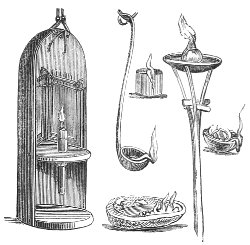
MAKE-SHIFT LAMPS.
It is often necessary, however, for the traveller to supply himself with light when the grease at his command is neither liquid enough to rise through the fibres of a wick, nor hard enough to be moulded into a candle. In this case, the wick should be allowed to rest on and overhang a little the sides of the vessel used as a lamp—a cup of earthenware, a common tin cap box, or even a bit of tin or sheet iron bent up will answer well enough; the flame soon heats the side sufficiently to melt a portion of the fat, and a constant supply is thus kept up as the wick requires it.
Almost anything will serve as a wick—a bit of old rag, or the flax-like fibres of the various plants used as cordage by the natives; strips of bark beaten to separate the fibres, or even small twigs may be used; rushes with enough of the outer covering removed to expose the pith, while on one side a strip of bark is left sufficiently strong to support it, are also worth looking to in case of need; but it is best to be provided with a sufficiency of cotton which is cheap, easily carried, and useful for many other purposes. If possible, a good supply of the best sperm candles, or others of material not likely to be affected by changes of climate, should be carried. On the Australian expedition, we used Price’s vegetable wax candles; and some of these—after having twice crossed the line, gone round Australia and part of the Indian archipelago, and made the circuit of the globe—are now in Kew Museum in as good condition as when they were issued from the factory.
The common bull’s-eye or police lamp is very useful if only required by one person for a specific purpose, such as reading off a sextant after observation of a star, but it does not diffuse light enough for general purposes. In fact, if wood is plentiful, a roaring fire will give greater facility for reading, writing, or such other occupations as are likely to employ a traveller’s evening than anything else. If you want warmth, let your fire be on the ground and sit round it; if you want light to work by, make it on a slight elevation, say from eighteen inches to two feet high. If you want wood, and your native attendants, when called on, make excuses, or Jem tells Sambo and Sambo tells the old woman to fetch wood for the master, do not put yourself to the trouble of scolding them, but take the wood off their fire and put it on your own, and let them settle whose duty it is to bring more. Experto crede.
A horn lantern is good “to keep the light from going out;” but then, perhaps, the operator may desire that the light should not be so literally “kept in;” and it is said that a piece of rag dipped in salt and water, and wrapped round a candle, will answer the purpose of preserving it from extinction in windy weather without lessening its illuminating powers. This, however, requires continuous attention, in order that it may be cut down as the candle burns low. The Esquimaux lamp is a piece of soft stone with a slight groove along the front edge; in this is laid a wick of moss or other material, and, the heat imparted to the stone being quite sufficient to melt the fat laid on it, it is fed with very little trouble. One who has made a turnip lantern in his youth will seldom be at a loss to extemporise a shelter for his bit of candle. A calabash or gourd, with perforations to allow the passage of the light, covered or not with oiled calico or paper; a worn-out pannikin or preserved meat tin; the body of a quart bottle, the more transparent the better; or, what is best of all, one of the oblong tins in which fancy biscuits are generally sold, will answer admirably; the polished surface of the latter serving also as a powerful reflector. We had one of these slung from the roof of the waggon, the bowl of a broken ladle was secured in the bottom of it, and with a bit of cotton wick and a few pieces of hard fat, a light steady enough to work by was secured for the evening; the common forecastle lamp used on board our merchantmen is a useful form, and the shadowless railway lamp we found very servicable, as long as the glass could be preserved.
We have constructed a very powerful reflecting lamp from a large sheet of tin, nearly two feet in height, curved round so as to form half a cylinder, six or eight inches in diameter; about eight inches from its base, we made a shelf to sustain the oil lamp, and a socket to contain the candle if we should be fortunate enough to have one, and behind this we arranged a couple of sixpenny trade looking-glasses at an angle of 90° with each other, and by the light thus thrown forward we were able to write or sketch with facility during many hours of the weary night. (See p. 85.) A lamp commonly used in India is a tumbler half full of water with oil on the top, and a wick wrapped round a stone or bit of lead, with its end projecting above the oil; but it has this disadvantage, that rats may upset the glass while drinking the oil, carry off the burning wick, and so expose the house to great danger. A float may easily be made of bottle wire and three bits of cork, in which half an inch of wick is enough to last all night.
Candles.
It is often desirable to make candles, and for this purpose the hard fat and tallow of any animal that may be killed should be preserved, that is, if it can be spared from the no less important purpose of greasing the axles; or beeswax, if it can be obtained, may be used either in combination with it or separately. If you wish to make dip candles, take a sufficient number of strands twice the length you require, twist them slightly and double them, and let the parts twist together; pass a small rod through the “bights” of as many of these wicks as you find convenient, say half a dozen; take a bucketful of hot water, throw the fat or wax in, and it will soon melt and float upon the surface; let the wicks absorb as much as they will, straighten and let them harden; then, holding the rod by the end left for that purpose, dip them quickly to their full length, withdraw and allow them to cool, and repeat the operation till your candles attain the desired size. If you have fat enough you may have half a dozen or more sets of wicks and can keep on dipping in rotation, thus allowing each plenty of time to cool before its turn comes round again. If you aspire to mould candles, nothing is better for your purpose than a piece off the end of a gun-barrel—and very few African hunters make a journey without shortening some lengthy weapon by eight or ten inches. In this case, pass a small stick an inch or two in length through the bight of the wick, bring the end out through the “mould” and make it fast to another, or pass it through a gun wad or section of a cork, so as to stretch it fairly and evenly in the centre, and stop the lower end; then pour in the tallow or wax, and, when cool, warm the mould slightly and the candle will draw out. In some countries wood may be found sufficiently resinous to be used as candles, but a supply of sticks cut to a convenient size must be prepared and a rest of some sort contrived so that they may be easily placed in it or withdrawn when nearly burnt out; the angle they ought to make with the horizon varies with the quality of the wood, if very combustible they may be set nearly upright, if less so they must be more nearly horizontal.
All candles, however, waste rapidly unless screened from the wind, if the traveller can carry a spring burner, this inconvenience is in a great measure obviated; but often this is impossible, and he must make the best shelter he can with a bit of bent tin, a joint of bamboo, or whatever material may be at hand. If the candles have to be packed in bags where stowage is of importance, and cases must be thrown away, it is best to cut them in two, as the risk of breakage is much reduced by the diminution of their length; in cutting them the knife should be warmed slightly, as it divides them without chipping off fragments. In lighting the lower half, if you have wax vestas, and stick one of them in alongside the wick that has been cut, you avoid the necessity of cutting down the wax to expose the end, and so may save three quarters of an inch of candle.
Torches.
We have seen the Malays, in the Island of Timor, take a soft porous stick, or the pith of a peculiar rush, and then wrap round it a coating of beeswax, to serve as a torch or candle. The natives of the shores of British Columbia and Vancouver Island use a fish known as the Eulachon, or North-West Capelin, as a source of light. The leaf of the cocoa-nut palm possesses strong illuminating power. The pine knot and birch bark of North America and Canada are extensively used for giving light in deer-hunting, fish-spearing, and on other occasions. The bog deal of Ireland is also used. The Damaras, who have a custom of obtaining their fire only from that kept burning at the hut of their chief, carry with them dry flakes of “Kraal mist” or cattle droppings, ignited and held between the forks of a cleft stick; and the Indian matchlock men carry fire in the same way. The mussalchees or torch-bearers of Central India, who commonly accompany troops during night marches, use long sausage-shaped rolls of cotton cloth; the ends of these they from time to time moisten with oil poured from a vessel carried for the purpose. The hill guides usually employ large splinters cut from the Deodar cedar. In Mexico, the brilliant fire-flies are sometimes caught and used for giving a temporary light: the direction of a letter, or the points of a compass, may be read by them.
The sparks from a flint and steel, a bit of quartz, sulphuret of iron or agate, and a pocket knife, will give light enough to read the compass, or to form a night signal.
There are many very nice arrangements for the purpose of light giving and cooking, which may be obtained from any military outfitter; but their chief defect is, that they will only answer their purpose under tolerably convenient circumstances, and become useless when the real hard work of travel begins.
Samovar.
Travellers, both on sea and land, often require to cook a small allowance of coffee or tea when, from severity of weather, scarcity of fuel, or the impossibility of halting long enough, it is impossible to kindle a fire in any of the ordinary methods, and frequently when, from the pitching of a small vessel or the jolting of a waggon, it would be dangerous to use a spirit lamp, an Etna, or an uncovered fire of any kind. Under these circumstances we should think the principle of internal heat, as applied in the Russian samovar or tea urn, might be successfully adopted. This, with various modifications in outward form, may be described as a small furnace for burning wood or charcoal in that part which serves as the base of the urn, with a funnel or stove pipe, wide at the bottom, but tapering rather sharply upward, leading straight up through the water, and having at top a telescope joint, by which the funnel can be lengthened and the draught increased when requisite.
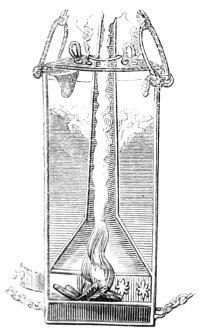
SAMOVAR.
Our own idea is to have an upright cylinder of copper tinned inside, and from about a couple of inches above the lower part of this an internal cone, like an inverted funnel, exactly fitting the cylinder at its lower edge, and tapering up to a small aperture at top. A double floor would be let into the cylinder about an inch from its base, so that it might be set upon a plank without danger from the fire. The cover would have a central hole for the funnel or smoke pipe to rise through; a small lip spout would serve to pour off the water, and ring handles, with chains long enough to obviate all danger, would serve to suspend it from the waggon roof, or from the beams of a small vessel, while others on either side would help to stay and steady it. A broad cap or roof of copper hooked on to links of the chains an inch or two above the end of the smoke pipe would prevent any possible risk from fire reaching any woodwork from which the samovar might be suspended.