Chapter III · WORKING IN METALS. (continued 2)
Reading edition

Cartridge making.
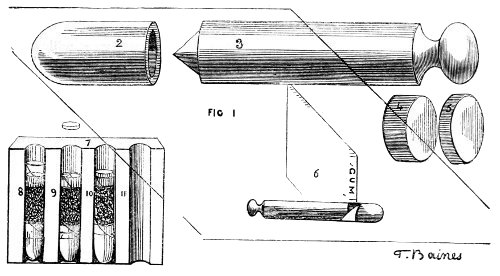
Improvements in guns are long before they are generally adopted in wild and distant countries. The old flint musket is to this day the favoured weapon of most of the border tribes of South Africa, America, and the East; it will shoot quite well enough for them, and, if of military make, it lasts a long time in comparatively good order. Percussion guns found their way very slowly even among the Dutch colonists; many admitted their superiority, but there was always the uncertainty of being able to obtain a supply of caps, and, in the same way, many excellent forms of breech-loaders cannot be adopted by persons travelling or residing far from civilisation, because complicated and expensive cartridges are required, and when the supply runs short the gun is useless. And sometimes, because however perfect the gun may be while well taken care of, its delicate adjustments soon give way under the rough wear and tear of actual hard service. The advantages of facility in reloading, especially on horseback, or while running after or away from the game or enemy, are so great that if a breech-loader can be made sufficiently strong and simple in all its parts, capable of being used as a muzzle-loader on emergencies, or with cartridges so simple that a person of ordinary skill can make them for himself, it will surely commend itself to men whose lives, in many cases, depend upon the effectiveness of their guns. It would be invidious in us to compare the merits of the various forms. We have already mentioned the satisfaction with which we used the single-barrelled Wilson breech-loader, the simplicity and strength of which, combined with facility of loading, were all that could be desired, unless, indeed, it were made self-capping, which we believe could easily be done. A metal breech-plug, to be inserted when required, converts it into a muzzle-loader; but then a smaller size of bullet must be used, and the cartridges are so simple and inexpensive, that we found it more easy to make them on the spot. The materials required were a few sheets of tissue paper, a quantity of felt wads, tolerably stout, half of them the exact size of the bore, and the rest a little smaller. A piece of tin of the form and size indicated by the diagonal lines (Fig. 1) in our illustration was used as a pattern by which to cut the paper. The straight edge that was to surround the bullet, and the farthest diagonal side, were touched with a little gum, gathered from the nearest mimosa. A small cylinder of wood (Fig. 3) was then taken by the knob, in the left hand, and, with the right, the hollow base of the bullet (Fig. 2) was fitted on to the convex end, laid fairly on the paper (Fig. 6) and rolled forward until the cartridge case was formed. The wood was then withdrawn, and the paper, adhering to the bullet, left to dry. When a sufficient number were completed, they were set upright in any convenient trough, or in a block of wood (Fig. 7), 3in. deep, bored with holes of the proper size (Fig. 11). The charge of powder was poured into each and covered with a small disc of card or paper. One of the small wads, saturated with grease, was next put in (Fig. 8), the superfluous paper folded down on it (Fig. 9), and a full-sized wad was then affixed to the end with a drop of gum (Fig. 10). The tissue paper was quite strong enough to confine the powder, and a military cap, of fair average quality, never failed to drive the fire through it to the charge. We found it best to saturate our wads by melting, or rather heating, our hardest fat nearly to boiling point, throwing them in and letting them absorb as much as possible, and then spreading them out on a clean surface to cool. Of course we carried a couple of wad punches of the proper size in case our supply should run short. In making a cartridge for a muzzle-loading rifle, the wooden roller should have a hollow to receive the point of the bullet; the bullet is placed on the paper with the base towards the right hand, just so far within the edge as to allow a wad to be put behind, and the paper turned down over it. The powder is then measured into the case on the point, and, in loading, the powder is first poured into the gun, then the bullet is reversed and the paper torn off before it is rammed down. It is questionable, however, whether any form of single-barrelled rifle or shot gun can compete with a double barrel for general usefulness and efficiency. Whilst on the subject of cartridges, it may not be amiss to refer to the tallow cartridges used for shot guns. They add greatly to the length of range, and are extremely valuable for wildfowl shooting. The following communication to the Field newspaper will serve to explain the mode to be observed in their manufacture:—
Grease cartridges, to make.
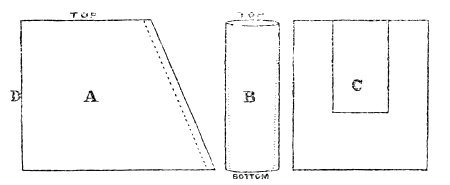
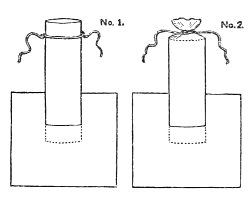
“A represents a piece of common cartridge paper; B a roller of boxwood, or any hard wood, turned to the size to admit the paper A being rolled once round it, and then fitting into the chamber C; C a chamber turned out of a solid piece of wood, the chamber to be the exact size of bore of gun the cartridges are intended for. To make the cartridges, cut a piece of paper in the shape of the drawing A, cutting the top to the width requisite, to allow the paper at top to overlap nearly a quarter of an inch; then gum the edge of the paper to about the eighth of an inch, as marked by the dotted line on the drawing A. Place the roller B on to the paper at D, and roll up firmly; wind round it a little thread, to keep the paper from slipping. In a few minutes it will be dry. You can then push the roller out of the case, and proceed in the same way till you have enough cases. Secondly, take the roller and return it to the case, excepting that you leave the roller exposed at the top, say for 16-gauge about ⅜in.; place the case and roller in the chamber, bottom upwards, then take some fine strong twine and place round as in drawing No. 1. When drawn tight, tie firmly, and it will appear as in No. 2: then reverse the roller and case, bringing the tied end down to bottom of chamber, press down hard to flatten the bottom of case, draw out the roller, pour into the case some melted tallow of about the consistency of cream, and then put in your charge of shot, having sufficient quantity of tallow to just cover the shot. Put by until cool; when set firm, place on the top of the tallow a leather wad (the size for 16-gauge cartridge will be 18-gauge). Any leather not too thick will do, and you can cut the wads out with a punch. Turn down the case neatly over the leather wad, and make fast with sealing-wax. When loading place the tied end of cartridge next to the powder. These directions are for both muzzle and breech-loaders, the only difference being in the roller, which for muzzle-loaders must be made 1⁄16in. smaller at the bottom end, as marked by the dots in drawing B. After a little practice the cartridges do not take long to make.”
Makeshift cartridges.
Wherever the means of transport will permit, take plenty of Ely’s wire cartridges, but when they cannot be obtained, a makeshift form, well adapted for general use, may be made as follows:—Prepare a stick, about 18in. long, by rounding it carefully and making it fit the bore of your gun loosely. Round this take two or three turns of oiled silk, such as chemists sell. Then draw off the end of the stick tube enough to hold the charge of shot and admit of two ties being made round it. Now, with a piece of fine twine, put on the first tie close to the stick; then put in your charge of shot, and when it is shaken into place, put the other tie on the outer end, just as sausage skins are secured. The cartridge is now complete, and can be cut off next the stick, when you proceed as before until all the tube has been used. We manufactured a great number of these in Tartary, and found them hard-hitting and durable. We usually carried a waistcoat pocket full of them, and rammed one down on each charge of powder without any wad between the cartridge and powder, but always placed one over the cartridge, in order to prevent it from rising in the barrel. Cartridges of this description kill considerably farther than a loose charge, and are exceedingly handy when shooting from the horse’s back. We, with 1oz. of No. 4, killed in this way, near Phoros Pass, an eagle, which we gave Captain Blackiston, R.A., who, we believe, deposited it in the Royal Artillery Institution at Woolwich. The fingers of old kid gloves should always be kept, as they serve as excellent covers both for shot and ball. Shot will require one tie to keep it in; balls will remain in without fastening. A little grease or oil should be smeared over them when first made.
Hints on firearms.
On many occasions we have been obliged to fire shot from a rifle, for the purpose of obtaining birds, when the smooth-bores were not at hand. Either the oiled silk or glove-finger cartridge is very far superior to a loose charge. In loading ordinary guns with loose shot, it sometimes happens that a few grains get dropped into the loaded barrel between the ramrod head and the barrel. When this happens, invert the gun, pass the rod upwards, and the shot will fall out, when the rod can be withdrawn. The ramrod will also at times get firmly fixed in a foul barrel, and defy every ordinary effort to get it out. A little water, spirit, or any other fluid poured down the barrel almost instantly releases it. Should a gun or rifle miss fire, or be exposed for any time to damp, cut a small peg of dry, soft wood, hammer it well down into the nipple, cut it off flush, put on a new cap, and pull the trigger, when the weapon is almost certain to go off. We first saw this plan in use among the Sardinian Bersigliari, and have since found it answer perfectly.
When hunting through wet jungles, or the reeds of the marsh, percussion caps can be rendered almost waterproof by melting a little beeswax on a piece of tin and then dipping the mouth of each separate cap in it. These, when cold, are set aside for use. When placed on the nipple, the wax forms a shield between the cap and nipple, which prevents the water from working its way up. All vegetable oil used about gun-locks should be prepared as follows:—Partly fill a common vial with oil, throw in a half charge of shot, hang it in the air with the cork out, and in a few days drain off all the clear oil from the top for use.
Gun cleaning.
Spirits of turpentine, when it can be procured, is very valuable for cleaning the interiors of guns, pistols, and rifles. When water is used, wash the barrels out thoroughly with cold water, making use of a tough wooden rod with a number of notches at the end. Round this a piece of woollen cloth may be twisted until of a size to act as a sucker in the barrel. Woollen is better than tow, linen, or cotton, as there is no danger of ignitable threads being left behind, and it can be used repeatedly by washing and drying it. When the barrels are thoroughly clean, fill them with boiling water. When this has all run off through the nipple holes, commence with a fresh strip of cloth to dry out the barrels, which must be held in a folded cloth, in order to guard the hand from the heat of the water. When quite dry, and before the barrels are cold, finish off with a little spirits of turpentine. Lead may be removed by the use of a little quicksilver. The cleaning of fire-arms in a wild country is a matter of the very greatest importance, and should never be entrusted to servants, unless, from long service and great experience, they may be implicitly depended on. Even with such followers about us, we always, however fatigued, clean our own guns.
It not unfrequently happens that white men residing alone or in small communities in the vicinity of numerous and powerful native tribes possess cannon of some kind or other, generally small signal guns from merchant ships, perhaps recovered from wrecks upon the coast, or field-pieces abandoned as not worth the trouble of bringing away when some military outpost has ceased to be occupied.
Mounting cannon.
During 1863 and 1864 the barbarous and desultory war between the Namaqua Hottentots and the Damaras, whom they had so long oppressed, was keeping the country in a state of alarm for many hundred miles around, and we were requested to take charge of a couple of brass yacht guns. It was necessary to mount them, so that they might be easily moved from point to point on the plain around the village; and for this purpose we took for each the hinder wheels and axle of a Cape waggon, inserting a pole to serve as the “trail” into the socket of the “lang-wagen” in the centre of the axle; we then took a plank of stinkwood, 1ft. wide, 3in. thick, and about 4ft. long. About 1ft. from the foremost end a stout bolt passed through it and the centre of the axle so as to let it work freely, the after end was tapered to a point and travelled on a quadrant, made from the felloe of an after wheel.
On this, as a swivel bed, we bolted down a pair of cheeks of 2in. stinkwood to carry the guns. The quoins and wedges ran in grooves, formed by 1in. slips of stinkwood nailed upon the bed, to which they were secured by lanyards of raw hide; the boxes for ammunition on either side were covered with raw hide, and that containing the powder was thickly lined with green baize; the matches were kept in a small box in front of the gun-carriage; the fuze-holder was made from the segment of a hollow brass curtain ring fixed to a handle of hard wood; the fuze itself was a strip of calico 1in. broad, doubled and loosely twisted into a two-stranded rope; it was steeped in a solution of gunpowder, and the colour indicated its strength—light grey was slow match, and dark grey was quick.
As we did not contemplate moving the guns farther than necessary for the defence of the village, we made no provision for yoking draught oxen, but this could easily have been done if needed. It was enough for our purpose to provide man ropes, one pair behind the gun and one before, so that, either in advance or retreat, its muzzle might be towards the enemy.
The bullets were all tied up in calico, with wads made by cutting off sections of soft deal rods, and cartridges of twelve or fourteen musket balls or fifty revolver bullets were made up.
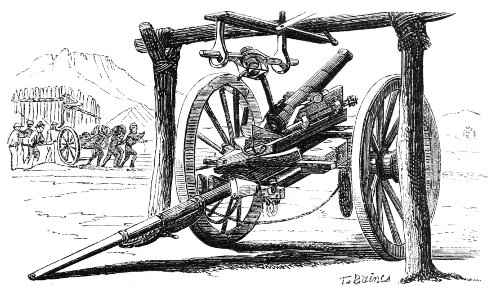
TIME GUN.
Time guns.
One use to which one of our guns was put is shown in the illustration. We were asked to repair the clock, but this is always difficult, and it is uncertain how long it may go correctly afterwards. We therefore erected a frame over the gun, and fitted the lens of a camera on an axle placed due east and west, so that it could turn in the plane of the meridian, and so be adapted to the sun’s gradual change of declination. Below the lens we fitted a piece of tin with its edges turned downwards, to hold a piece of quick match, a strip of calico, steeped in a strong solution of gunpowder, beneath it; a small slit in the tin was then so adjusted as to let the focus of light fall through it exactly at 12 o’clock; a small clip of tin confined the other end of the match over the vent. The moment of noon was announced with a regularity that no clock in our possession could have attained; and one great advantage was, that if by the interposition of a cloud, which would not happen once in nine months, the gun should fail to fire at the proper moment, it could not go wrong, for the speck of light would pass the narrow slit, and no discharge would take place till the next day.
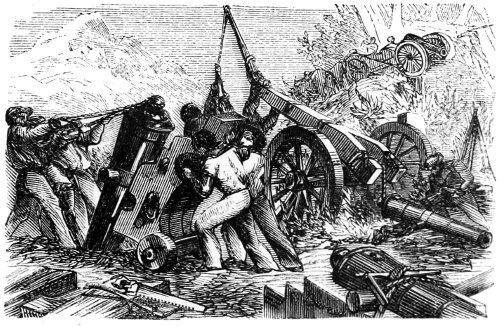
The absence of the cap squares of a gun can be remedied by lashing the metal firmly down to the carriage with a raw hide rope, and then twisting it up tight with a stick, as shown in the above illustration; which also exhibits the mode of raising a gun by making use of the trail as a lever. A heavy gun may be mounted by letting its muzzle into a hole in the ground while the carriage is run under it.
Percussion caps and substitutes.
During the continuance of the Damara and Hottentot war we were becoming exceedingly short of percussion caps, and were obliged not only very carefully to husband the few that were left, but to turn our attention to the manufacture of substitutes. The tips of Congreve matches, with the wood cut to a point so as to stick in the nipple of the gun, proved very effective, but were liable to be brushed or shaken off, or to become damp if carried for any length of time before firing. We, therefore, first inclosed the end of the match in the shell of an expended cap, and finding this answer, we dissolved the composition, and put a drop into the cap without the wood; we then dissolved it off a whole box of matches at a time, and with a camel-hair pencil put small drops into as many cap shells as it would serve. This answered admirably; but our next fear was that the supply of matches would run short, and therefore, drawing on our own artificial horizon for the quicksilver, on the photographic stores for nitric acid, and on our friends, the missionaries, for a supply of alcohol from their natural-history department, we set about the manufacture of fulminate of mercury according to the following recipe:—Dissolve 10 grs. of mercury in 1½ oz., by measure, of nitric acid; the solution is poured cold into 2 oz., by measure, of alcohol in a glass vessel, and gentle heat is applied till effervescence is excited, though it ordinarily comes on at common temperatures, a white vapour undulates on the surface, and a powder is gradually precipitated, which is immediately to be collected in a filter, well washed, and cautiously dried. It detonates by gentle heat or slight friction. Two grains and a half, with one-sixth of gunpowder, form the quantity for one percussion cap. We used a conical twist of blotting-paper for the filter, and mixed the fulminate, while still moist, with a small palette knife upon a plate with the gunpowder, treating it very gently, and in small quantities. We collected all the shells of expended caps, and for new ones cut out a cross of thin copper; then, making a hole in a piece of iron and a punch the size of the nipple, we drove the centre of the cross in, and the shell was formed. Stiff cartridge-paper stiffened with gum would have answered for dry weather, but would not have been secure against wet.
Brass guns and their charges.
The block-houses erected by the Hudson’s Bay Company, as depôts and forts in connection with the fur trade, usually have guns mounted in them. Brass field guns and howitzers are also at times to be met with at the border stations of wild countries, and it may, therefore, be well to know the charges and ranges of the ordinary kinds, which are as follows:
BRASS FIELD GUNS.
6-pounder Gun. Weight, 6cwt. Service Charge, 1½lb.
Elevation. Ranges.
Round Shot. Shrapnel. Case. Length of fuse.
P.B. 310 — 100 ·3
½° 470 450 150 ·4
1 620 600 200 ·5
1½ 760 710 250 ·6
2 890 820 300 ·7
2½ 1000 920 — ·8
3 1100 1020 — ·9
3½ 1190 1110 — 1·
4 1280 1180 — 1·
4½ 1370 1250 — —
5 1450 1320 — —
5½ 1530 1380 — —
6 1600 1440 — —
6-pounder Gun. Weight, 6cwt. Service Charge, 1½lb.
Elevation. Ranges.
Round Shot. Shrapnel. Case. Length of fuse.
P.B. 300 — 150 —
0½° 500 — 200 —
1 680 670 250 ·3
1½ 830 800 300 ·4
2 960 910 — ·5
2½ 1080 1020 — ·6
3 1190 1120 — ·7
3½ 1300 1220 — ·8
4 1400 1320 — ·9
4½ 1500 1410 — ·9
5 1590 1500 — —
5½ 1680 1590 — —
6 1760 1680 — —
BRASS HOWITZERS.
12-pounder Howitzer. Weight, 6·5cwt. Service Charge, 1¼lb.
Elevation. Ranges.
Common Shell. Shrapnel. Case. Length of fuse.
P.B. 200 — 100 —
0½° 310 — 150 —
1 420 400 200 ·3
1½ 530 520 250 ·4
2 630 630 300 ·5
2½ 715 725 ·6
3 800 820 ·7
3½ 885 910 ·8
4 970 1000 Ricochet ·9
4½ 1050 1090 1·0
5 1135 1180 Charge 6oz. el ·7°.600 1·1
5½ 1220 1270 ” 8oz. ” ·6 .600 1·2
6 1290 1350” 10oz. ” ·6 .600 1·3
24-pounder Howitzer. Weight, 12·5cwt. Service Charge, 2½lb.
Elevation. Ranges.
Common Shell. Shrapnel. Case. Length of fuse.
P.B. 270 — 100 —
0½° 390 — 150 —
1 520 — 200 ·3
1½ 640 500 250 ·4
2 760 630 300 ·5
2½ 860 870 ·6
3 960 980 ·7
3½ 1060 1090 ·8
4 1160 1200 Ricochet ·9
4½ 1260 1300 1·0
5 1350 1400 See Table B. 1·1
5½ 1440 1500 1·2
6 1520 1600 1·3
Table B.
Ricochet. 24-pounder Howitzer. Ricochet. 24-pounder Howitzer.
Charge. Elevation. Pitch. Charge. Elevation. Pitch.
oz. deg. oz. deg.
6 7·5 400 12 5·25 —
9 4·38 — 14 5· —
8 9· 500 14 7·75 600
10 7·5 — 12 6·5 —
11 6· — 16 4·75 —
11½ 7·5 — 12
Cartridges and wads for cannon.
Cartridges for either brass or iron guns are best made of some woollen material; trade serge or old blanketing answers very well for the purpose. Bags should be made a little less than the bore, and into these the charge of powder is to be poured. A piece of woollen thread, double worsted, or twine should now be used to close the end of the bag, after which it is to be passed two or three times round the bag, giving it at the same time a compact cylindrical form by rolling on a board or table under the hand. Passing the thread through the substance of the cartridge aids much in keeping its form and facilitates loading. A cartridge needle should be used to perform this operation. This needle can be easily made from a piece of stout copper or brass wire. Flatten out one end, drill or punch a hole in it to form the eye, and file the other end sharp for a point. Fourteen inches is a convenient length for a cartridge needle. It is said that a sailor’s wife enabled a British vessel to continue a long and desperate fight by pillaging the officers’ quarters of all the stockings she could find, and handing them up to be filled for cartridges. The intestines of animals, according to their size, would make as good cartridge cases as could be desired. Wads may be made of picked oakum twisted in a flat spiral to the proper size of the bore, when they are made to retain their shape by being secured here and there with fine twine passed through with the needle. In the absence of oakum, wooden wads may be made by first spokeshaving a stout pole to the size of the bore, and then sawing it up into convenient lengths.
Guns to unspike and repair.
Old guns which have been laid by will not uncommonly be found spiked, by having a common nail driven into the vent. If efficient tools are at hand this may be drilled out, if not, put a charge of powder in the gun, bore a gimlet hole in one of your wooden wads, through which pass a loosely-twisted string well impregnated with dissolved gunpowder, and afterwards dried. Cut the end of your prepared string just at the muzzle of the gun, light it, and get out of the way, when the explosion, which soon takes place, will not unfrequently expel the spike. A gun which has had its trunnions knocked off, with a view to rendering it useless, may be made nearly as effective as ever by cutting with the axe or adze a bed for it in a stout piece of log, of such a form that the cascabel of the gun and the breech end are rather more than half buried in solid wood. The log may now be trimmed off to convenient dimensions, and all made secure by a lashing of wet raw hide rope, which rests in a broad shallow notch cut in the log to receive it. The gun and its bed are thus, as the rope dries, held together by a material little less rigid than iron.
Priming cups, to make.
The bed log and gun may now be mounted by placing a very strong round bar of hard tough wood across the slide or carriage immediately below where the trunnions would have rested. This receives a deep semicircular notch, cut to exactly correspond with it on the under side of the bed log. The gun can now be elevated and depressed in the usual manner by placing wedges under the log. The common mode of priming a gun from a flask or horn, when there are no percussion or friction tubes to be obtained, is, to say the least of it, inconvenient and dangerous. It is far better to keep on hand a few priming cups. These are made as follows: From the joints of a bamboo cut a number of little cups, the bottoms being formed by the knots of the cane; in the centre of the bottom bore a hole, with a gimlet or red hot wire, large enough to admit a piece of marsh reed, hollow cane, weed stalk, or quill, about 3in. long, and small enough in diameter to pass down into the vent of the gun easily; stop the small end with a bit of melted sealing-wax; secure the large end in the cup by the same agency.
The cup becomes now a sort of funnel, through which common fine sporting powder should be poured until both tube and cup are full, when a piece of oiled paper is strained over the top of the cup like the head of a drum, and is tied fast with twine. When the gun is to be fired, the cartridge is pierced in the usual way with the priming wire. The tube of the priming cup is now to be inserted at the mouth of the vent, and pressed down until the bottom of the cup rests on the metal of the gun, when on the port fire or linstock being applied, the paper lid is instantly burned through, and the gun discharged. In windy weather, heavy tropical rains, or at night, these cups are extremely useful.
Makeshift firearms.
A cannon, of very tolerable efficiency for close quarters, and slug or bullet charges, may be made by boring a hole partly through a piece of tough strong log, with a pump auger; bore a vent with a gimlet, put on one or two hoops or rings of iron or raw hide, and the gun is ready for use. We have seen several of these, which were effectually used during the rebellion in Canada.
In 1838, at the siege of Herat, Mahomed Shah brought up a quantity of metal on the backs of camels, and had a heavy bronze gun cast, and completely finished before the town; and when the siege was raised the king had his gun sawn to pieces and taken to Teheran. Shah Abbas, of Ispahan, had a heavy piece of artillery, but said it would delay his march, and he would much rather carry metal on camels and cast artillery before the enemy’s town.
During the Indian mutiny, the rebels pulled down the telegraph-posts which had iron tube sockets fitted to them in order to keep off the white ants. These sockets were taken off, and vents drilled in them. They were then loaded with powder, and charges of slugs made from doubled up and hammered pieces of the telegraph wire. We have seen a piece of common iron gas-pipe, a piece of wood, and a few bits of sheet copper, converted into a very formidable matchlock pistol.
In our Australian boat voyage we had a small 1lb. swivel carronade. We jammed a pole about 6ft. long into the fork of the swivel, and had we met any of the Malay trepang fishers, who go in companies of a hundred or more, we should have made the swivel-bolt fast to the bowsprit just outside the stem of our boat, and, letting the trail rest on the mast thwart, have defended ourselves with heavy charges of musket bullets. Of course the fishers might have been friendly, or, if not, the knowledge that we had a gun would have made them so, and we should not in any case have been the aggressors.
The Zemboureks, or dromedary artillery.
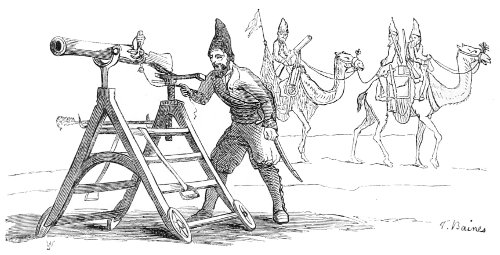
Light guns mounted on dromedaries or camels are valuable for the defence of caravans, &c. The Afghans first used these in an emergency against the Persians. A number of pivoted arquebuses were mounted on the saddles of dromedaries, which were taught to kneel while the pieces were fired from their backs. The Persians, profiting by the lessons of their defeat, also organised a similar force, the guns weighing not more than 75lb. The saddle was originally constructed of two-forked branches connected by wooden bars, and if the gun was slightly overloaded the recoil would injure the fittings, and disturb the animal; but subsequently the saddle was much improved, and wheels were added, so that it might be taken from the animal’s back and used as a field gun. It will be seen that the staff of the bannerol carries a little tent, and this covers the ammunition bags. A skin of water hangs under the belly of the camel. The Persians have sought out with eagerness and perseverance the best form of artillery to be carried on the backs of animals; and, as it seems that dromedaries have been successfully imported into America and Australia, it may be of advantage to know that they are capable of being utilised in this way. Other animals, perhaps oxen, might be trained to carry smaller guns.
Very efficient common case shot can be made by filling empty preserved-meat tins with rifle or pistol balls. A bag of cooper’s iron hoop rivets is a very favourite charge among the South-Sea whalers. Round shot can be made as directed under the head “Lead, and its Uses.”
Grenades and rocket arrows.
Extempore grenades can be made from empty soda-water bottles or old ink jars. On one occasion we made a number from the latter vessels by filling them with a mixture of buck shot and strong sporting powder; stoppers of wood were then fitted by notching the upper ends, and fastening them down with wire, like the corks of champagne bottles, a gimlet hole was then bored in each, and a few inches of quick match put in. When the fuse has been lighted, these vessels are either hurled from the hand or fired from large powerful cross-bows, when they, by exploding in full flight or on the ground, cause no trifling confusion among an undisciplined enemy, a pack of wolves, or a sounder of hog in a cactus brake.
An unarmed merchantman was chased by a pirate galley; she hove to, and pretended to surrender, but two men stood at the gangway with a cask of powder. As soon as the long low open boat came alongside they threw it into her, and the cook, running out of the galley, threw a shovelful of hot coals after it. The ship forged ahead before the smoke had cleared away, and escaped, leaving the desperadoes to their fate.
Large arrows tipped with strong paper cases, such as are made for rockets, only choked at the bottom, become most formidable projectiles. The cases are partly filled with powder, a wad, with a hole in it, is rammed down on the charge, a quill is put in the hole, about thirty buck shot are deposited round the quill, which is filled with meal powder. The case and quill head are then capped with paper which has been soaked in dissolved gunpowder or nitre. Arrows thus made are to be fired from powerful hand-bows, after the match has been lighted. In the true rocket arrow the touchpaper is ignited just before the arrow is fixed in the bow, and it is shot just before the fire reaches the composition; the combustion then aids the flight rather than retards it. The head is strongly barbed, so that it may not easily be drawn from thatched roofs, &c.; the Chinese and Indian tribes often use these.
Gunpowder, to make.
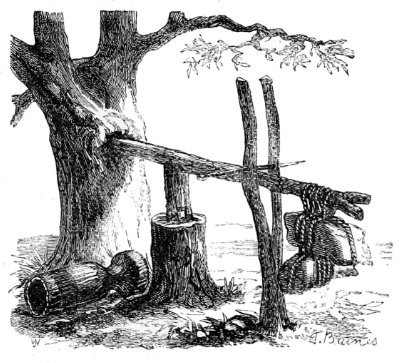
It sometimes happens that the hunter or explorer has, like many members of the Algerian, Tartar, and Mongolian tribes, to turn gunpowder manufacturer. To make gunpowder three ingredients are requisite: viz., saltpetre (nitrate of potash), sulphur, and charcoal. The two former ingredients should form a part of the equipment of an expedition (see “Farrier’s Stores,” p. 84). Still, where such stores are not carried, sulphur and saltpetre are usually to be obtained, more or less pure, from the natives of all but the most unfrequented and isolated countries. The saltpetre will require recrystallisation, which is carried out as follows: Take equal quantities, by measure, of the saltpetre and boiling water, stir them well about with a stick until all the lumps are thoroughly dissolved; strain the resulting fluid through a coarse cloth in order to get rid of sticks, chips, and stones, and set it aside to crystallise; when the process is complete drain the water from the crystals, set them to dry on a skin or a cloth. The sulphur, if in lumps as imported, will require purification by melting. This operation must be conducted over a very slow fire, and immediately the mass becomes liquid in the pot it should be put to stand for a few minutes in hot wood ashes in order that impurities may settle to the bottom. The neck of the vessel may then be held fast in a twisted stick, and the contents poured dexterously out into a convenient mould until the sediment at the bottom, which is useless, is left. Flour of sulphur will not require this treatment. The charcoal (see “Charcoal Burning,” p. 267) should, for gunpowder making, be prepared from some light, clean-grained wood. In this country willow, withy, alder, hazel, linden, &c., are held in high esteem for the purpose; but in wild countries the nearest approach to these within reach should be obtained. The three ingredients must be first separately ground, either in a native quern or stone handmill, between two conveniently-formed stones, or in an extempore pestle and mortar, until reduced to perfect powder, quite free from lumps or grit. The three powders are to be now weighed out carefully in the following proportions: One part sulphur, one part charcoal, and six parts saltpetre. Mix these on a skin pegged out on the ground, and rub the mixture together with the palms of the hands until most intimately and thoroughly blended; then, with an empty percussion-cap box or drinking cup, measure your mixture, and for every ten cups or boxes of powder put down a stone or make a mark, and for every mark put aside a cup full of warm water, so that you have just one-tenth of fluid. This you sprinkle with a bunch of feathers or grass, a little at a time, on the powders, until, by constant and persistent working and kneading, a smooth homogeneous paste is formed. Two well-selected stones much facilitate this stage of the process; one should be large and flat, the other water-rounded and oval; in fact, a water-worn pebble of about 2lb. weight. By sitting on the stretched skin with the flat stone between the legs, the water and sprinkler at the side, and the pebble between the hands, the paste can be effectually worked up; and it is well to bear in mind that on the perfect homogeneity of this paste depends, in great measure, the quality of the gunpowder. The paste—or devil as it is sometimes called—being thoroughly elaborated, make square flat cakes of it 6in. square and 2in. thick, and wrap them compactly up in cotton cloth or old sheeting four or five times doubled; then stitch up a stout hide bag just large enough to contain all your cakes and their coverings when built in compactly one on the other, and sew up the opening; then, with a chisel, scoop out a cavity in the end of a log just deep enough to half bury your case of cakes; then, with the aid of a neighbouring tree, and a few suitable pieces of wood, which are easily fashioned with the axe, prepare such a press as is shown in the above illustration. The weight should be increased gradually, and the pressure intensified until the cakes are pressed into compact masses. The coverings are now to be removed, and then the process of coming begins, and the help of a corning sieve is required. This is made as follows: Make a wide stout hoop of any pliant wood, and over one of its edges stretch a head of parchment, like that of a banjo, nail or lace it on wet, and when dry it will become perfectly tight, like the head of a tambourine. Now, take a very small-sized key, file off the wards and bow, sharpen the lower edges round the tube with the file until it is converted into a sharp hollow punch. Turn your tambourine upside down on a smooth-faced log of suitable size, and, with a small hammer and your little punch, proceed to perforate the parchment until the head is covered with small round holes. Now fashion from any dry, hard, heavy wood a flat disc 1½in. thick and 4½in. in diameter; this, with the broken cake, is put in the sieve and rattled about forward and back until the small broken granular fragments are in numbers forced through the holes in the parchment, and fall on the skin stretched to receive them. It will be found that among the grains thus formed there will be a certain quantity of fine dust; this can be separated by sweeping the grains over a sloping board on which flannel has been stretched, the grains pass on, the dust remains amongst the fibres of the wool, and can be collected to work up again. The granules can now be placed in a little wooden box and shaken about until rubbed smooth against each other. To finish them off it is well to place a large sheet of iron, copper, tin, or any other metal over a pot of boiling-hot water, throw the now all-but-finished gunpowder on the plate and stir it about until completely dry. A clean frying-pan is by no means a bad instrument for powder drying; take care that it is only placed on hot water, and not subjected to fire heat, or a blow-up will probably follow. Too much caution cannot be used after the powder has been subjected to the granulating process; before that there is little to fear, after it a great deal.
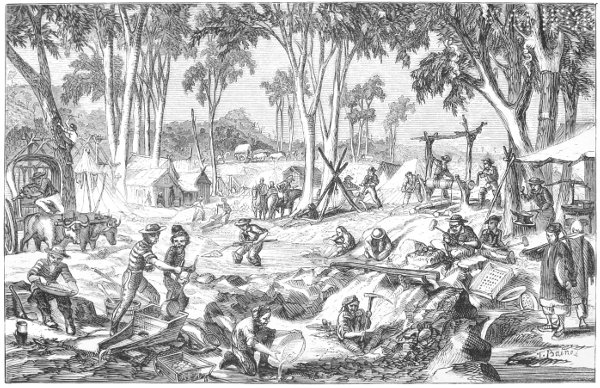
SEARCHING FOR GOLD.
Geology for travellers.
Metals, to identify.
Hints to gold searchers.
In travelling through little known or comparatively undescribed countries, it will be well for the experienced traveller to closely investigate and carefully study the geology of the region he is passing through; outcropping rocks and the stones of the river beds should be closely investigated. Sand should be gathered on the borders of the deep pools, dried, spread out on paper, and examined under the lens. Thus will the formation of inaccessible mountain regions be often brought to light. The winter ices and spring floods, by breaking up and disintegrating the rocks they flow through, gradually, by friction and the grinding power of water-moved boulders, reduce the detritus which accompanies them to sand, more or less ponderous according to the metallic elements of which it is formed. Thus, by the breaking up of quartz veins by the agencies just referred to, gold is released from its matrix to enrich the sands and shingle beds of certain rivers. Alluvial tin is in the same way set free in grains and nodules from the granitic or other formations in which it resides, and, water borne, travels onward until arrested by some deep pit or crevice in the river bed, where it remains until disturbed by floods of more than ordinary magnitude, or the pick and shovel of the miner. Our space will not admit of our dealing at length with the indications of gold or other metals, or of the regions in which the precious metals and gems are to be sought. Metals, to identify. We shall, therefore, content ourselves by giving a few plain, and we trust practical, hints for the finding and identification of such metals, stones, &c., as the traveller is likely to meet with. First in importance we class gold; and, although precarious and uncertain in the bulk of its deposits, is more generally distributed throughout the earth’s surface than any other metal. Hints to gold searchers. Clay slate formations, traversed by iron-stained quartz dykes, are well worth investigating; and most of the streams which flow through such formations will be found, on careful examination, more or less auriferous. In prospecting a stream, or river bed, choose localities where the stream, after a sharp descending run, has impinged against a perpendicular bank, forming an eddy before flowing onward. Dig away boldly all the top deposit until the bed rock is reached. Rout out all the depressions, crevices, and holes in this, scooping up all the clay, gravel, and grit they may contain. Place all this in convenient quantities in a broad shallow metal pan or dish, add water to it, rub it about briskly with the hand, pour away all the dirty water, add more, shake it about, give a sweeping rotatory motion to your pan, pick out all large lumps of stone or quartz, giving a sharp look at the latter; still add water, and work the pan until nothing but fine clear sand remains in it. A dexterous rolling, tilting motion is given by the initiated, which at once clears away the baser fragments, and reveals the “colour,” as the gold dust is called by the miners. A broad shovel is at times used somewhat in the same manner, the handle being held as shown in the full-page illustration “Searching for Gold,” when the process is called vanning.
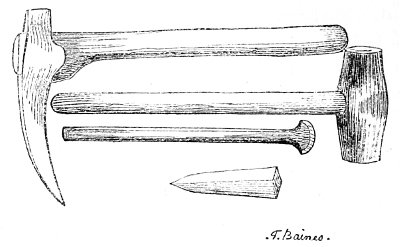
Mining and miners’ tools.
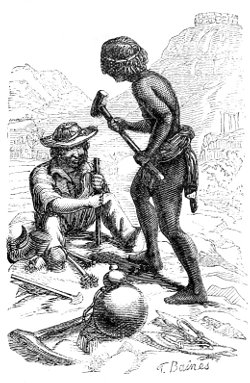
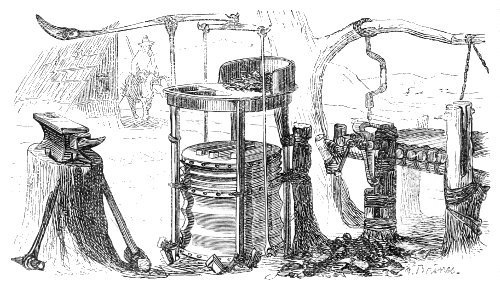
To carry out a regular system of investigation among quartz reefs, mineral veins, and metalliferous rocks, certain tools and appliances will be needed—picks of Cornish pattern, such as is represented in the above illustration, sets of steel borers, with cockscomb ends, sets of steel gads or wedges, borer, steel and gad steel in bars, blasting powder, safety match in coils, some heavy hammers, a portable forge (such as is here represented), set of smith’s tools, shovel blades, spare pick-heads, and hilts of ash, &c. When it is deemed requisite to blast a portion of rock, the borer and hammer are used much as shown in the annexed illustration. One man, sitting on the ground, holds the borer upright and turns it freely round, whilst his assistant strikes it with the hammer. A little water dropped from time to time down the hole keeps the bit cool, and facilitates the operation. As sludge collects, it is removed with a species of scraper, fashioned from the end of an iron bar. A small rod or stick, with its end fibres frayed and set up like a mop, is used for drying out the hole. Should it be in wet ground, where moisture remains in spite of swabbing out, a cartridge composed of tallowed cotton or oiled paper, may be used to inclose the powder in. According to the old-fashioned plan, which some miners still follow, a long pointed copper rod or needle was pressed into the charge after it had been rammed into the bottom of the hole. Round this rod clay, pulverised clay, slate, &c., was closely packed, and driven with a copper tamping rod until the hole was compactly filled up. The needle was now withdrawn, and a match, composed of a long marsh reed filled with mealed powder, thrust down the orifice until the charge was reached, when the upper end was held in its place by clay. A bit of rag, smeared with moistened powder, was attached to the head of the reed, which, when fired, burned long enough to afford time for the miners to shelter themselves from the effects of the explosion. Since the introduction of the so-called patent safety match, it has been with great advantage substituted for the reed; the burning of this match or fuse is generally so uniform, that it has only to be cut according to the distance between the hole and the place of shelter. Even this great improvement in the means of ignition falls very short of exploding by voltaic electricity, which should always, when practicable, be had recourse to. The wandering miner and explorer will, however, seldom be able to avail himself of its valuable aid, or the use of gun cotton or nitrate of glycerine, which agents have of late been much lauded as substitutes for gunpowder in mining operations.
It not unfrequently happens that diamonds and other precious stones are found in river beds, and such other localities as miners are in the habit of examining. We therefore offer a few hints and directions for the identification of these in their rough state, as given by Professor Tennant:
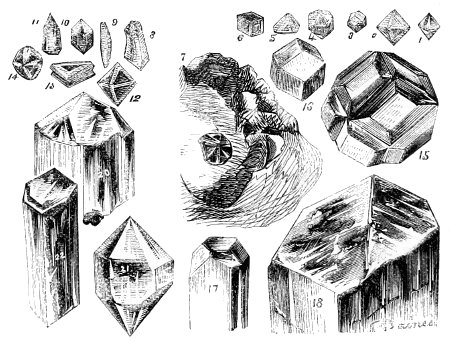
Precious stones, to identify.
“Fig. 1 is an octahedron; Fig. 2 an octahedron having six planes on the edges; Fig. 3, dodecahedron with rhombic faces; Figs. 4, 5, and 6 are rarer forms. Out of 1000 diamonds I have generally found about one of the form of Fig. 6; about ten like Fig. 5; fifty like Fig. 4; and the remainder like 1, 2, 3, in about an equal proportion. With regard to the size and weight of diamonds, 500 out of 1000 which came in the same parcel were found smaller than Fig. 1, which is the exact size of a diamond weighing half a carat; 300 were of the size 3, 4, 5, and 6—none of these exceeded a carat in weight; eighty of the size 2 weighed a carat and a half; only one was as large as Fig. 16—this weighed 24 carats. The remainder varied from 2 to 20 carats, a carat being equal to three grains and one-sixth troy. Fig. 7 consists of a conglomerated mass of quartz pebbles rounded through having been water-worn, a crystal of diamond, the size of a small pea, and various grains of gold, the whole cemented together by oxide of iron. This specimen is peculiarly interesting at the present time, as showing the association of diamonds with gold. In 1844 a slave was searching for gold in the bed of a river in the province of Bahia, and discovered diamonds. It being a new locality for diamonds, 297,000 carats were collected in two years, which produced upwards of 300,000l. I see no reason why diamonds should not be found in Australia, Canada, California, as well as in those other gold districts from which they have hitherto been obtained. The value of the most inferior diamonds, unfit for jewellery, is 50l. per ounce. Could they be found in sufficient abundance to be sold at 5l. per ounce, the benefit to the arts would be incalculable. Not only would the seal engraver, watchmaker, lapidary, glazier, &c., be able to procure them at easier prices, but numerous substances would be rendered useful which at present cannot be profitably worked owing to the high price of diamonds.
“Figs. 8 to 11 represent four crystals of corundum. This substance is commonly found in six-sided prismatic crystals, and frequently terminated at each end by six-sided pyramids. When transparent, and of a blue colour, it is known in jewellery as the sapphire; when merely of a red colour, it is called Oriental ruby; and when this colour is of a rich depth, the stone is more valuable than even the diamond.
“Figs. 12 to 14. Three crystals of spinel-ruby. It is of various shades of red, and is easily distinguished from corundum by the peculiarity of its crystalline form and inferior hardness.
“Figs. 15 and 16. Crystals of garnet. These are chiefly found in the form of the rhombic dodecahedron; are occasionally of a beautiful red colour; when semi-transparent, are called by the jewellers “carbuncles.” They are of comparatively little value.
“Figs. 17 and 18. Two rhombic prisms of topaz. It is found in rivers, frequently with all the edges and angles of the original crystal worn off, and presenting a round appearance, in which state it is often mistaken for the diamond, owing to the colour and specific gravity of each being the same. It may, however, easily be distinguished from it by the difference of the hardness and fracture. The diamond yields readily to mechanical division parallel to all the planes of the regular octahedron, the topaz only at right angles to the axis of the crystal.
“Fig. 20. Tourmaline. A crystal having six sides, deeply striated in the longitudinal direction, and terminated by a three-sided pyramid; colour varying from black to brown and green. Transparent specimens are useful to the philosopher in experiments on polarised light.
“Fig. 21. Crystal of transparent quartz or “rock crystal,” frequently called a “diamond” in the mining districts, as “Bristol diamond,” a “Cornish diamond,” &c. The crystal represented by this figure was brought from California by a person who refused 200l. for it, under the impression that it was a real diamond, because it scratched glass and could not be scratched with a file. Its real value, however, is not more than 2s. 6d.
“Fig. 22. Beryl, presents a six-sided prism, and is usually of a green colour.”
River pearls, to find.
When substances are found which are supposed to be precious stones, the file test should be at once applied; if the teeth of the instrument “bite,” as it is called, or cut into the substance, it will be at once fair to infer that some inferior mineral has been discovered. The bit of sapphire from the case may also be called into use, and if the stone you have found is of white colour, and a corner of your sapphire bites or scratches it, there is no hope of its being a diamond. If on weighing it the specific gravity of the specimen is found to be less than 3·9, it will not turn out to be a ruby or sapphire. The application of heat is another test, as if no electricity is manifested it will not turn out to be a gargoon or a topaz. If, on testing it on your piece of flint glass, the surface of that is bitten by the specimen, it will probably be found to be either rock crystal, quartz, or perchance beryl. The rivers of many countries, our own amongst the number, not unfrequently contain large mussel-like shells; these are the fresh-water pearl mussels (Unio margaritiferus), and the pearls which these at times contain are of considerable value, and well repay being looked for when the rivers are low.
“All is not gold that glitters.” Sulphuret of iron and yellow mica are not unfrequently mistaken by the inexperienced for gold, and we have not unfrequently had some little difficulty in convincing the sanguine discoverer of his error. Sulphuret of iron, pyrites, or the mundic of the miners, is a bright yellow glittering mineral, which sometimes has gold associated with it. The differences between it and gold are sufficiently marked. Strike the suspected fragment on a hard substance with a hammer, and if “mundic,” it at once becomes reduced to minute fragments, whilst gold would be only slightly flattened. Gold is malleable; mundic is not. Gold can be cut with the pocket-knife just as easily as copper; mundic resists the knife, turns its edge, and will strike fire against its back, giving out sulphurous fumes. Mundic, after being made red hot, is attracted by the magnet; gold never is. Hot nitric acid causes it to decompose with much effervescence, leaving such spangles of gold as it may contain free in the bottom of the test tube. Gold dust is readily taken up by quicksilver; mundic is not. Yellow mica is so much lighter than gold that its comparative want of ponderability should at once distinguish it; a small portion placed on an iron bar, and heated in the fire to redness becomes, on cooling, flakey and lustreless, whilst gold would remain unaltered; it floats on the surface of mercury, refusing to unite with it, whilst gold is immediately converted into an amalgam. Sulphuret of copper, or copper ore as it is usually called, breaks freely under the hammer, but can be cut easily with the knife, only instead of producing a solid metallic chip it crumbles into powder, just as soft stone or chalk would. Alluvial tin can in no case be mistaken for either gold, silver, or copper. It is dark coloured, breaks into powder under the hammer, and is exceedingly ponderous. With the so-called rosin and wood tin we cannot deal here, as the explorer is not very likely to find them. Minute fragments of stream tin are to be easily distinguished from small bits of iron ore by first heating them red hot, and then subjecting them to the magnet; iron will be attracted, tin will not.
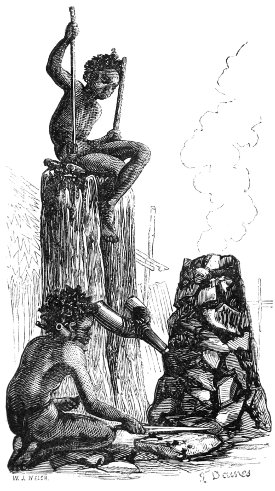
Iron ore, to smelt.
Many wild countries produce iron ore of remarkable purity, and a number of native tribes, by a rough system of smelting, contrive to obtain enough metal for the manufacture of their weapons, implements, &c. The greater the purity of the metal, the less difficulty will be experienced in dealing with it. Should the explorer at any time be called on to smelt a little iron ore, he may proceed as follows: Build a turret-shaped furnace, proportioned to the quantity of ore to be treated, line it with ant-hill clay, or common clay and sand, leaving a hole in the front near the bottom, which has a temporary stopper of clay placed in it, and another orifice about 2ft. up the back for the air blast to enter at. Either a large pair of double bellows, compressible skin air-bags, such as we have before described, or blowing cylinders, such as are represented in the annexed illustration, must be set up at a convenient distance from the back of the furnace. These cylinders are used by the inhabitants of New Guinea instead of bellows, and answer remarkably well. They are composed of two hollow tree trunks, placed side by side; a wooden tube, which serves to let the air out, unites them; and a man or boy sits on the tops of the tubes, and works alternately up and down a couple of mop-shaped pistons, which are made from poles armed at the ends with bundles of fibre, feathers, or dry grass, so adjusted that they expand on being thrust down and collapse on being drawn up. As one piston man gets fatigued, another takes his place; thus a continuous stream of air is kept up. Whatever method of blast is decided on, it must be so arranged as to be continuous and powerful. When the interior of the furnace is quite dry, throw in a good quantity of well-burned charcoal; then a layer of split dry wood until it reaches about 1ft. above the entrance of the blast; then another layer of charcoal and dry cow dung a few inches deep; then sprinkle in loosely a layer of broken iron ore, mixed with a little limestone if you can get it; then another layer of charcoal and dry cow dung, and another of ore; and so on until the furnace is all but full, only one layer of wood being used. Now through the blast entrance introduce some well-ignited and glowing embers from your fire; put in the tube of your blast, which may be of baked clay; lute it fast in its place, so as to prevent any escape of air; and proceed to blow, when your furnace will soon be in a state of active ignition and glow. Keep up the blast steadily, and as the contents of the furnace sink down add to them from above layer by layer as before directed, until it is considered that enough metal has been cast in. So soon as it is thought probable that the iron has melted, a small portion of the clay of the tap-hole may be removed with an iron bar, when, if in a sufficiently fluxed condition, the iron will run freely out into long shallow pits dug to receive it. The iron thus procured is called bloom, and has to be heated in pieces in the forge fire, and thoroughly roasted and thumped about until it is soft and tough enough for general use. The natives do not as a rule wait for their iron to flow, but open the furnace when it cools down, and then drag out such bloom as may have settled to the bottom. Excellent steel is made from iron thus procured by the natives of the hill districts of India, by putting it in small earthen crucibles with charcoal, rice, chaff, peroxide of manganese, and green leaves. These pots are then luted down with clay, and placed in a clay furnace heated with dry cow dung and charcoal. Here they remain for a considerable time, when the fire is allowed to burn out; the pots are then, when cool, removed, and the steel taken out to be fashioned by the hand of the smith into any form required. We have used a great deal of both iron and steel prepared as above described, and found both of admirable quality.
Chemical tests for minerals.
A common horse-shoe magnet, such as can be bought for a mere trifle at any toyshop, will be found very useful for extracting particles of iron from other mineral. Whenever the means of transport will admit, it is well to take a small compact case of simple appliances, tests, and reagents. The whole, by a little ingenuity, may be easily packed in a solid leather case very little larger than an ordinary sandwich box. Its contents should be as follows: Small glass-stoppered and capped bottle of nitric acid, ditto hydrochloric acid, ditto liq. ammonia, ditto quicksilver, small corked bottles of ferrocyanide of potassium, bi-chromate of potash, fused borax, and common salt; a small jointed blowpipe, a pair of forceps, a small pair of scales, fitted for taking specific gravities, and a set of weights, a bit of flint glass, a piece of sapphire, which can be obtained from any lapidary; half a dozen test tubes to nest one within the other; half a dozen old watch glasses, to be obtained for a few pence from any watchmaker; half a dozen narrow strips of window glass, cut to a thickness little greater than stout wire, and 5in. long (these are for stirring up hot acids, &c.); a piece of stout copper wire, shaped like the figure 9, to hold the watch glasses on whilst they are over the lamp or candle flame; a small fine file and a few narrow slips of well burnt light charcoal; a common wire cigar-holder, to hold the test tubes in whilst heated; and a very small bright-faced hammer, such as watchmakers use. It is truly astonishing how much qualitative analysis can be carried out with these comparatively limited means. We will suppose that a little bag of sand has been obtained; that it shows, on being spread out, a number of particles of a glittering yellow substance, as well as black-coloured grains, mixed with common quartz and minute fragments of stone. We first place our sand on a sheet of white paper, and with our pocket lens have a thorough examination of the various constituents. Should any grains of sufficient size and questionable character present themselves, they may be at once taken up on the moistened point of a pin. If one of them should look like gold, place it on some hard substance and give it a blow with your hammer. If it flattens without powdering, drop it into one of your test tubes, pour in a little nitric acid, and hold it in the flame until it boils thoroughly. If your particle gives off a train of minute bubbles and gradually dissolves, pour a little of the contents of your tube into two separate watch glasses placed side by side, add a little water to each. Add a little common salt to No. 1; if the particle is silver, you will at once have a thick white precipitate—chloride of silver. Drop a few drops of your liquor ammonia into No. 2; and if copper, the beautiful and well-marked blue colour of ammonuret of copper will at once appear. Should the particle have crushed under the blow, it is probably either sulphuret of iron or copper ore. To distinguish these two substances when in a minute state of division, proceed with the acid as just described, and test one watch glass with a small fragment of ferrocyanide of potassium, when, if sulphuret of iron or “mundic,” you will have a dense cloud of Prussian blue in your watch glass. Treat the other with your liquor ammonia, and you will have the same brilliant ammonuret of copper colour as if the particle had been native or malleable copper. Having satisfied ourselves as to the selected particles—for should the flattened grain resist the action of the hot acid and remain bright, it is surely gold—we place our sand on a shovel, and hold it there until the whole is red hot; it may then be taken from the fire, and allowed to cool on the shovel. The magnet will now take out all the bits of iron. Now with a hammer-face or smooth water-worn pebble proceed to crush all the substances on the shovel fine. Then at the nearest stream of water, or in a large tub, carefully van and wash your sample until all the earthy and worthless matters have been washed away; then the practised eye will instantly distinguish the gold, if any. The utterly inexperienced may, however, be deceived by remaining fragments of mundic or copper ore before referred to; therefore, to make assurance doubly sure, let him dry his washed metal powder on the shovel over the fire, then carefully place it in a small, clean, dry vial-bottle with a little quicksilver. Shake and rattle it well about until all the particles have been brought well in contact with the mercury. Such fragments as it will not take up are not gold; but to find that which it has converted into an amalgam, place the mercury in a piece of clean chamois leather, press it carefully, and the mercury will force its way in minute globules through the leather, leaving the gold in a soft mass within. This, by being heated to redness, throws off the remaining quicksilver, and can be estimated as gold. Silver will also amalgamate with mercury, but can always be distinguished from gold by the nitric acid and salt test before described. Lead ore is rarely mistaken for anything else, its peculiar colour, cubical form of crystallisation, and gravity being generally sufficient to identify it. A small quantity, reduced to a fine powder and mixed with a little fused borax, readily fuses on a charcoal slip before the blowpipe, and is then ordinary lead. The silver often associated with lead ores can alone be estimated by a regular assay, requiring the use of crucibles, cupels, furnace, &c. Sulphuret of antimony, although massive and somewhat lead-coloured, leaves a thick rough deposit on the charcoal, and fuses into a brittle crystalline regulus, in no way resembling lead. Small specimens of galena, or lead ore, should always be preserved for future investigation, as it is at times extremely rich in silver, whilst at others a mere trace only remains. We have analysed lead ore from Cornwall which yielded between 90oz. and 100oz. of silver to the ton, whilst other samples, raised in Wisconsin, although yielding 85 per cent. of lead, did not contain enough silver to render its extraction remunerative. The points of distinction between minerals and metals we have thus been briefly laying down do not properly apply to the investigations of the regular gold-digger, but are mainly intended for the use of those who are engaged in exploration and research. The professed gold-seeker, as a rule, casts all aside save the one great centre of his hopes and pursuit. He, in his prospecting expeditions, makes use of the broad shallow metal pan shown in the illustration which represents “Searching for Gold.” The quantity of gold brought to light by its aid guides him in his choice of a locality. If it is considered rich enough, he, with his mates, sinks down to “the pay dirt,” or deposit containing the gold; this is either washed out at once on the cradle, or piled in heaps for future treatment. With gold quartz-crushing, amalgamation on a large scale, or the washing down of drift by hydraulic power and the use of flumes as practised in California, we cannot deal here, as the appliances are far more complicated and ponderous than the mere traveller could carry with him.
Base metal, to detect.
It sometimes happens that imposition is attempted in far-off lands, and imitation gold ornaments offered to the traveller. To test the quality of these, it will be requisite to have a bit of black terra-cotta pot, or a fragment of any hard smooth black stone. Rub the suspected ornament on this until a metallic streak is left, dip one of your bits of glass rod in your nitric acid, and let a drop or two fall on the track left by the metal. If of base material, the particles will rapidly turn green and dissolve; if gold, they will remain unchanged; and if an alloy, the combined metal will be removed, and the gold wall remain stationary on the black surface. The exact standard of mixture or combination can only be arrived at by the use of a set of touch-needles, which are rubbed and compared with the doubtful marks on the stone.
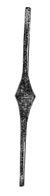
Stone, to quarry.
There are many situations in which stone may be advantageously used for the erection of houses, forts, or defensible depôts. On the discovery of a bed of rock adapted for the purpose, the head or covering earth should be removed, either by the agency of water obtained by diverting some neighbouring stream for the purpose, or by digging with the spade or shovel. Careful examination will now generally disclose veins or seams traversing the stone, such of these as run in favourable directions should be selected, and the gads or wedges before described had recourse to. It is well to have, at least, a dozen of these for stone splitting. They should be about 5in. long, 1½in. wide, and ½in. thick, tapering to the edge, which should not be too sharp. All gads should be made of the best gad steel, carefully pointed and tempered. In entering the gads, it will be well to insert them in the selected seam at about 1ft. apart; then, with the heavy hammer or pick-head, strike each gad a blow or two in succession, which will serve to open the seam, and not unfrequently detach the required fragment. When large square or oblong blocks are required, it is well to first mark out the size required on the rock with the pick’s point, and then with either the borer before described, or a jumping bar (of form shown in the annexed illustration), drill a row of holes about 8in. apart on the line before marked out, in depth proportioned to the intended thickness of the stone, in each hole should be placed a pair of gad cheeks—these are pieces of half-round iron bar. The rounded sides rest against the sides of the holes as the gad is driven between the flat surfaces, thus forcing open the grain of the rock without breaking away the sides of the holes by gad clinching. As in the former case, each gad is gradually driven home until the line of holes run into one long fissure and the block is detached. In breaking out flat slabs of comparatively thin stone, it will be found a good plan, after measuring and marking the size decided on, to sink a shallow groove either with the pick’s point or a stonecutter’s chisel across the extreme length of the slab; then, by inserting the gads at the outer face or edge of the deposit, the slab will not only be raised but evenly broken off. Fire is a most powerful agent and aid in stone-breaking, especially when assisted by water. The huge and massive boulder of rock which bids defiance to the sledge-hammer may very soon be reduced to fragments by making a strong fire round it, and, when thoroughly heated, throwing buckets of water over it.
The treatment of stone.
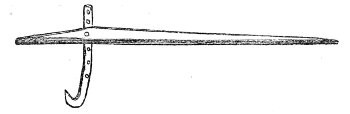
Some Indians are particularly clever in the art of stone dividing. They build a double wall of clay the whole length of the stone, leaving about six inches of bare rock between them. They then lay more clay on the outsides of the walls, nearly the width of the stone. Then between the walls of clay they make a long line of fire with dry cow dung and chips of hard, dry wood. An incredibly short space of time elapses before the division of the stone is completed, when the fire is carefully extinguished with earth or sand, and the stone allowed to cool. Rocks, so placed as to prevent recourse being had to either of the expedients described, may be split out by the action of a small charge of powder, fired, as before directed, in a hole made by the jumping bar. To drill a hole with this no hammer man is required, but the weight of the protuberance on the instrument, when aided by a jumping and rotatory motion, is sufficient to cut away the rock. Water swab, shell scraper, &c., are used with these implements, just as they are with the miner’s borer, which can be used in confined spaces and under outlying works, where the jumper would be useless. A crowbar or two will be found very useful for lifting out broken pieces of stone, &c. There is also an instrument much used in America called a “canthook,” which is here represented. It is extremely valuable for moving both stones of large size and logs of unwieldy dimensions. The handle, or lever, is made of tough, well-seasoned timber, and is usually from 6ft. to 7ft. long. The claw is of sound, tough, wrought iron, and proportioned in weight and spread to the bodies it is applied to. Two or three sizes of claws fit one handle, just as a dentist’s key is adapted to the size of the tooth it is to grasp. An oblong square hole is cut through the lever for the claw’s end to pass through, and a stout iron pin, with a hole in the end for a split stop to go into, keeps the claw at its proper point of adjustment. The boulder claw is another most useful implement. It is used for turning over and rolling out large boulders of rock, lifting out logs, &c. These claws, and the chains and rings to which they are attached, should be made of the best Swedish iron; the claw point should be of gad steel, welded in. The form of the hook or claw is very important, as, if not turned to the exact bend, it will not grip or hold. The above illustrations will serve to show both the form of the claw and its mode of action when in use.
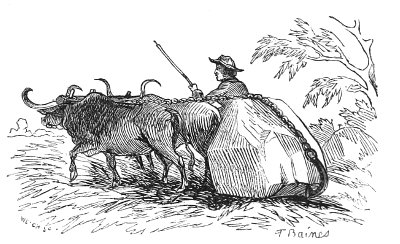
THE BOULDER CLAW.
Miners’ pump, to make.
When water settles in a comparatively shallow pit, too large to be conveniently emptied by the aid of buckets, a very simple form of pump will be found useful. Nail four long planks together in the form of a narrow square box or tube, say 1ft. square; now procure a stout pole a little longer than the box, nail a flat board to one end of it just as a table is attached to its stand, cut away the edges until it fits the box loosely, then nail a bordering of old boot leather or hide round the edges until it fits tight enough to suck; cut a large square hole in it, and fasten over this with tacks a piece of tapping leather or raw hide backed with wood for a valve; bore a hole in the upper end of the pole to put a cross handle through; bore an auger hole through the lower end of your box about 1ft. from the opening, and through this drive a stout stick to keep the sucker from coming too far down; your pump is now complete. Place it in a slightly slanting direction in the pond, and secure it with a crooked stick driven in by its side; push the sucker to the bottom, pour a bucket of water or so in to make it draw, and you will, by working the piston steadily up and down, soon have the water pouring in a flood over the upper edge of the box, where it can be caught in a hollow log or a pit lined with clay. One of these box pumps is shown in the full page illustration “Searching for Gold.”
Charcoal burning.
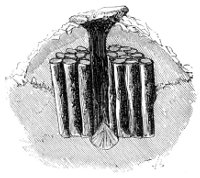
The traveller will find it extremely useful to be able to manufacture his own charcoal. There are several methods by which he can do this, all depending on the same general principles. Pieces of wood of suitable length and convenient size are prepared. We show here the most effective arrangements.
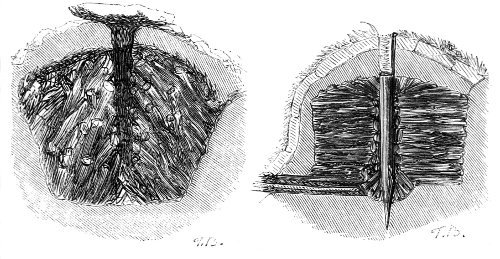
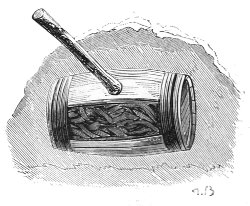
The pile, when evenly and completely built up, is covered with turf and a little sand or earth—leaving one fair-sized orifice as a draught hole. Fire is introduced either at the bottom of the pile through a hole left for it, or dropped down through the space left by the withdrawal of the centre post. The orifices of all charcoal pits or chambers should remain open until the fire has become well distributed through the mass of wood, but should be covered with a stopper of turf or clay directly the light grey smoke of active combustion shows itself. The contents of the pile may from time to time be tested by removing a small portion of the stopping or covering turf and inserting a hooked iron rod, by the aid of which a sample of the baking may be withdrawn for examination. Immediately on being satisfied that the charcoal has been sufficiently burned, more earth, turf, sand, &c., should be heaped on the top of the pile, until every crevice is stopped completely. The fire will then soon die out, and the contents of the pile can be removed. We also represent a contrivance for preparing charcoal for gunpowder making. A small cask has one head removed, a stout pole run through the bung-hole, and is then evenly packed with selected billets of light suitable wood. (See “Gunpowder, to make,” p. 247.) The head is then replaced, the cask covered with well-worked clay, and then sunk in a pit prepared for its reception. The pole is then withdrawn, and a good quantity of red-hot embers thrown down the hole. The cask, after being used for charcoal making, is very useful for an oven, as will be shown when cookery is under consideration.