POULTRY AND THEIR DISEASES.
Reading edition
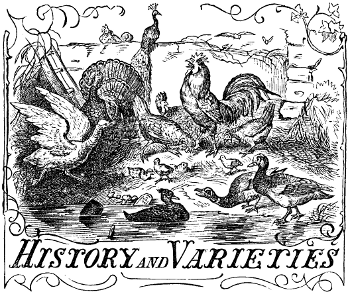
The domestic fowl. The cock tribe is used as a generic term, to include the whole family of domestic fowls; the name of the male, in this instance, furnishing an appellation sufficiently comprehensive and well recognized.
The domestic cock appears to have been known to man from a very early period. Of his real origin there is little definitely known; and even the time and manner of his introduction into Greece, or Southern Europe, are enveloped in obscurity. In the palmiest days of Greece and Rome, however, he occupied a conspicuous place in those public shows which amused the masses of the people. He was dedicated to the service of the pagan deities, and was connected with the worship of Apollo, Mercury, Mars, and particularly Esculapius. The flesh of this bird was highly esteemed as a delicacy, and occupied a prominent place at the Roman banquets. Great pains were taken in the rearing and fattening of poultry for this purpose.
The practice of cock-fighting, barbarous as it is, originated in classic times, and among the most polished and civilized people of antiquity. To its introduction into Britain by the Cæsars we owe our acquaintance with the domestic fowl.
It is impossible to state positively to what species of the wild cock, known at present, we are to look for the primitive type, so remote is the date of the original domestication of the fowl. Many writers have endeavored to show that all the varieties of the domestic fowl, of which we now have knowledge, are derived from a single primitive stock. It has, also, been confidently asserted that the domestic cock owes his origin to the jungle fowl of India. The most probable supposition, however, is, that the varieties known to us may be referred to a few of the more remarkable fowls, as the progenitors of the several species. The great fowl of St. Jago and Sumatra may, perhaps, safely be recognized as the type of some of the larger varieties, such as the Spanish and the Padua fowls, and those resembling them; while to the Bankiva cock, probably, the smaller varieties belong, such as Bantams, the Turkish fowl, and the like.
The reasons assigned for supposing these kinds to be the true originals of our domestic poultry, are, first, the close resemblance subsisting between their females and our domestic hens; second, the size of our domestic cock being intermediate between the two, and alternating in degree, sometimes inclining toward the one, and sometimes toward the other; third, from the nature of their feathers and their general aspect—the form and distribution of their tails being the same as our domestic fowls; and, fourth, in these two birds alone are the females provided with a crest and small wattles, characteristics not to be met with in any other wild species.
The wild cock, or the St. Jago fowl, is frequently so tall as to be able to peck crumbs without difficulty from an ordinary dinner-table. The weight is usually from ten to thirteen or fourteen pounds. The comb of both cock and hen is large, crown-shaped, often double, and sometimes, but not invariably, with a tufted crest of feathers, which occurs with the greatest frequency, and grows to the largest size, in the hen. The voice is strong and very harsh; and the young do not arrive to full plumage until more than half grown.
The Bankiva fowl is a native of Java, and is characterized by a red indented comb, red wattles, and ashy-gray legs and feet. The comb of the cock is scolloped, and the tail elevated a little above the rump, the feathers being disposed in the form of tiles or slates; the neck-feathers are of a gold color, long, dependent, and rounded at the tips; the head and neck are of a fawn color; the wing coverts a dusky brown and black; the tail and belly, black. The color of the hen is a dusky ash-gray and yellow; her comb and wattles much smaller than those of the cock, and—with the exception of the long hackles—she has no feathers on her neck. These fowl are exceedingly wild, and inhabit the skirts of woods, forests, and other savage and unfrequented places. These Bankivas resemble our Bantams very much; and, like them, are also occasionally to be seen feathered to the feet and toes.
Independent of all considerations of profitableness, domestic fowls are gifted with two qualifications, which—whether in man, beast, or bird—are sure to be popular: a courageous temper and an affectionate disposition. When we add to these beauty of appearance and hardiness of constitution, it is no wonder that they are held in such universal esteem.
The courage of the cock is emblematic, his gallantry admirable, and his sense of discipline and subordination most exemplary. The hen is deservedly the acknowledged pattern of maternal love. When her passion of philoprogenitiveness is disappointed by the failure or subtraction of her own brood, she will either continue incubating till her natural powers fail, or will violently kidnap the young of other fowls, and insist upon adopting them.
It would be idle to attempt an enumeration here of the numerous breeds and varieties of the domestic fowl. Those only, therefore, will be described which are generally accepted as the best varieties; and these arranged, not in the order of their merits necessarily, but alphabetically, for convenience of reference.
THE BANTAM.
The original of the Bantam is, as has been already remarked, the Bankiva fowl. The small white, and also the colored Bantams, whose legs are heavily feathered, are sufficiently well-known to render a particular description unnecessary. Bantam-fanciers generally prefer those which have clean, bright legs, without any vestige of feathers. A thorough-bred cock, in their judgment, should have a rose comb; a well-feathered tail, but without the sickle feathers; full hackles; a proud, lively carriage; and ought not to exceed a pound in weight. The nankeen-colored, and the black are the general favorites.
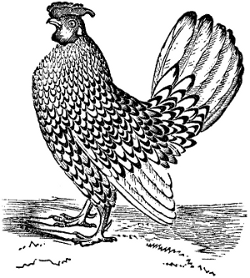
THE BANTAM.
These little creatures exhibit some peculiar habits and traits of disposition. Amongst others, the cocks are so fond of sucking the eggs laid by the hen that they will often drive her from the nest in order to obtain them; they have even been known to attack her, tear open the ovarium, and devour its shell-less contents. To prevent this, first a hard-boiled, and then a marble egg may be given them to fight with, taking care, at the same time, to prevent their access either to the hen or to any real eggs. Another strange propensity is a passion for sucking each other’s blood, which is chiefly exhibited when they are moulting, when they have been known to peck each other naked, by pulling out the new feathers as they appear, and squeezing with their beaks the blood from the bulbs at the base. These fowls being subject to a great heat of the skin, its surface occasionally becomes hard and tightened; in which cases the hard roots of the feathers are drawn into a position more nearly at right angles with the body than at ordinary times, and the skin and superficial muscles are thus subjected to an unusual degree of painful irritation. The disagreeable habit is, therefore, simply a provision of Nature for their relief, which may be successfully accomplished by washing with warm water, and the subsequent application of pomatum to the skin.
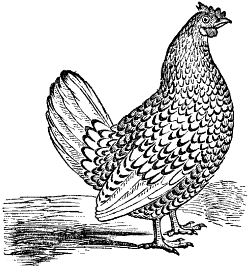
BANTAM.
Bantams, in general, are greedy devourers of some of the most destructive of our insects; the grub of the cock-chafer and the crane-fly being especial favorites with them. Their chickens can hardly be raised so well, as by allowing them free access to minute insect dainties; hence, the suitableness of a worn-out hotbed for them during the first month or six weeks. They are thus positively serviceable creatures to the farmer, as far as their limited range extends; and still more so to the gardener and the nurseryman, as they will save various garden crops from injuries to which they would otherwise be exposed.
The fowl commonly known as the Bantam is a small, elegantly-formed, and handsomely tinted variety, evidently but remotely allied to the game breed, and furnished with feathers to the toes.
The African Bantam. The cock of this variety is red upon the neck, back, and hackles; tail, black and erect, studded with glossy green feathers upon the sides; breast, black ground spotted with yellow, like the Golden Pheasant; comb, single; cheeks, white or silvery; the pullet is entirely black, except the inside of the wing-tips, which is perfectly white. In size, they compare with the common pigeon, being very small; their wings are about two inches longer than their bodies; and their legs dark and destitute of feathers. They are very quiet, and of decided benefit in gardens, in destroying bugs.
These symmetrically-formed birds are highly prized, both by the fancier and the practical man, and the pure-bloods are very rare. They weigh from eight to twelve ounces each for the hens; and the cocks, from sixteen to twenty ounces.
THE BOLTON GRAY.
These fowls—called, also, Dutch Every-day Layers, Pencilled Dutch Fowl, Chittaprats, and, in Pennsylvania, Creole Fowl—were originally imported from Holland to Bolton, a town in Lancashire, England, whence they were named.
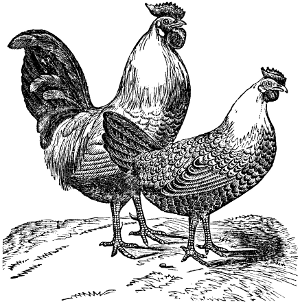
BOLTON GRAYS OR CREOLE FOWL.
They are small sized, short in the leg, and plump in the make; color of the genuine kind, invariably pure white in the whole cappel of the neck; the body white, thickly spotted with black, sometimes running into a grizzle, with one or more black bars at the extremity of the tail. A good cock of this breed may weigh from four to four and a half pounds; and a hen from three to three and a half pounds.
The superiority of a hen of this breed does not consist so much in rapid as in continued laying. She may not produce as many eggs in a month as some other kinds, but she will, it is claimed, lay more months in the year than probably any other variety. They are said to be very hardy; but their eggs, in the judgment of some, are rather watery and innutritious.
THE BLUE DUN.
The variety known under this name originated in Dorsetshire, England. They are under the average size, rather slenderly made, of a soft and pleasing bluish-dun color, the neck being darker, with high, single combs, deeply serrated. The cock is of the same color as the hen, but has, in addition, some handsome dark stripes in the long feathers of the tail, and sometimes a few golden, or even scarlet marks, on the wings. They are exceedingly impudent, familiar, and pugnacious.
The hens are good layers, wanting to sit after laying a moderate number of eggs, and proving attentive and careful rearers of their own chickens, but rather savage to those of other hens. The eggs are small and short, tapering slightly at one end, and perfectly white. The chickens, on first coming from the egg, sometimes bear a resemblance to the gray and yellow catkin of the willow, being of a soft bluish gray, mixed with a little yellow here and there.
Some class these birds among the game fowls, not recognizing them as a distinct race, upon the ground that, as there are Blue Dun families belonging to several breeds—the Spanish, the Polish, the Game, and the Hamburghs, for example—it is more correct to refer each Blue Dun to its own proper ancestry.
THE CHITTAGONG.
The Chittagong is a very superior bird, showy in plumage, exceedingly hardy, and of various colors. In some, the gray predominates, interspersed with lightish yellow and white feathers upon the pullets. The legs are of a reddish flesh-color; the meat is delicately white, the comb large and single, wattles very full, wings good size. The legs are more or less feathered; the model is graceful, carriage proud and easy, and action prompt and determined.
This breed is the largest in the world; the pullets usually weighing from eight to nine pounds when they begin to lay, and the cocks from nine to ten pounds at the same age. They do not lay as many eggs in a year as smaller hens; but they lay as many pounds of eggs as the best breeds. This breed has been, by some, confounded with the great Malay; but the points of difference are very noticeable. There is less offal; the flesh is finer, although the size is greatly increased; their fecundity is greater; and the offspring arrive earlier at maturity than in the common Malay variety.
There is also a red variety of the Chittagong, which is rather smaller than the gray. These have legs sometimes yellow and sometimes blue; the latter color, perhaps, from some mixture with the dark variety; the wings and tail are short. Sometimes there is a rose-colored comb, and a top-knot, through crossing. This variety may weigh sixteen or eighteen pounds a pair, as ordinarily bred. The eggs are large and rich, but not very abundant, and they do not hatch remarkably well.
There is, besides, a dark-red variety; the hens yellow or brown, with single serrated comb, and no top-knot; legs heavily feathered, the feathers black and the legs yellow. The cock is black on the breast and thighs.
The Chittagongs are generally quite leggy, standing some twenty-six inches high; and the hens twenty-two inches. A first cross with the Shanghae makes a very large and valuable bird for the table, but not for breeding purposes.
THE COCHIN CHINA.
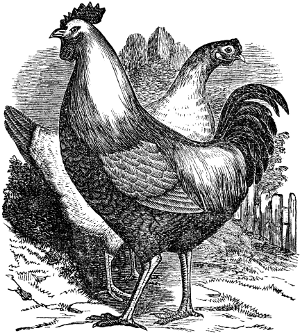
The Cochin China fowl are said to have been presented to Queen Victoria from the East Indies. In order to promote their propagation, her majesty made presents of them occasionally to such persons as she supposed likely to appreciate them. They differ very little in their qualities, habits, and general appearance from the Shanghaes, to which they are undoubtedly nearly related. The egg is nearly the same size, shape, and color; both have an equal development of comb and wattles—the Cochins slightly differing from the Shanghaes, chiefly in being somewhat fuller and deeper in the breast, not quite so deep in the quarter, and being usually smooth-legged, while the Shanghaes, generally, are more or less heavily feathered. The plumage is much the same in both cases; and the crow in both is equally sonorous and prolonged, differing considerably from that of the Great Malay.
COCHIN CHINAS.
The cock has a large, upright, single, deeply-indented comb, very much resembling that of the Black Spanish, and, when in high condition, of quite as brilliant a scarlet; like him, also, he has sometimes a very large white ear-hole on each cheek, which, if not an indispensable or even a required qualification, is, however, to be preferred, for beauty at least. The wattles are large, wide, and pendent. The legs are of a pale flesh-color; some specimens have them yellow, which is objectionable. The feathers on the breast and sides are of a bright chestnut-brown, large and well-defined, giving a scaly or imbricated appearance to those parts. The hackle of the neck is of a light yellowish brown; the lower feathers being tipped with dark brown, so as to give a spotted appearance to the neck. The tail-feathers are black, and darkly iridescent; back, scarlet-orange; back-hackle, yellow-orange. It is, in short, altogether a flame-colored bird. Both sexes are lower in the leg than either the Black Spanish or the Malay.
The hen approaches in her build more nearly to the Dorking than to any other breed, except that the tail is very small and proportionately depressed; it is smaller and more horizontal than in any other fowl. Her comb is of moderate size, almost small; she has, also, a small, white ear-hole. Her coloring is flat, being composed of various shades of very light brown, with light yellow on the neck. Her appearance is quiet, and only attracts attention by its extreme neatness, cleanliness, and compactness.
The eggs average about two ounces each. They are smooth, of an oval shape, equally rounded at each end, and of a rich buff color, nearly resembling those of the Silver Pheasant. The newly-hatched chickens appear very large in proportion to the size of the egg. They have light, flesh-colored bills, feet, and legs, and are thickly covered with down, of the hue commonly called “carroty.” They are not less thrifty than any other chickens, and feather somewhat more uniformly than either the Black Spanish or the Malay. It is, however, most desirable to hatch these—as well as other large-growing varieties—as early in the spring as possible; even so soon as the end of February. A peculiarity in the cockerels is, that they do not show even the rudiments of their tail-feathers till they are nearly full-grown. They increase so rapidly in other directions, that there is no material to spare for the production of these decorative appendages.
The merits of this breed are such that it may safely be recommended to people residing in the country. For the inhabitants of towns it is less desirable, as the light tone of its plumage would show every mark of dirt and defilement; and the readiness with which they sit would be an inconvenience, rather than otherwise, in families with whom perpetual layers are most in requisition. Expense apart, they are equal or superior to any other fowl for the table; their flesh is delicate, white, tender, and well flavored.
THE CUCKOO.
The fowl so termed in Norfolk, England, is, very probably, an old and distinct variety; although they are generally regarded as mere Barn-door fowls—that is, the merely accidental result of promiscuous crossing.
The name probably originated from its barred, plumage, which resembles that on the breast of the Cuckoo. The prevailing color is a slaty blue, undulated, and softly shaded with white all over the body, forming bands of various widths. The comb is very small; irides, bright orange; feet and legs, light flesh-color. The hens are of a good size; the cocks are large, approaching the heaviest breeds in weight. The chickens, at two or three months old, exhibits the barred plumage even more perfectly than the full-grown birds. The eggs average about two ounces each, are white, and of porcelain smoothness. The newly-hatched chickens are gray, much resembling those of the Silver Polands, except in the color of the feet and legs.
This breed supplies an unfailing troop of good layers, good sitters, good mothers and good feeders; and is well worth promotion in the poultry-yard.
THE DOMINIQUE.
This seems to be a tolerably distinct and permanent variety, about the size of the common Dunghill Fowl. Their combs are generally double—or rose, as it is sometimes called—and the wattles small. Their plumage presents, all over, a sort of greenish appearance, from a peculiar arrangement of blue and white feathers, which is the chief characteristic of the variety; although, in some specimens, the plumage is inevitably gray in both cock and hen. They are very hardy, healthy, excellent layers, and capital incubators. No fowl have better stood the tests of mixing without deteriorating than the pure Dominique.
Their name is taken from the island of Dominica, from which they are reported to have been imported. Take all in all, they are one of the very best breeds of fowl which we have; and although they do not come in to laying so young as the Spanish, they are far better sitters and nursers.
THE DORKING.
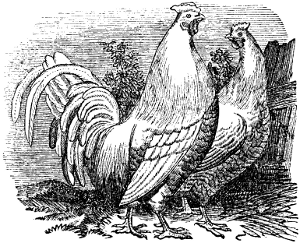
This has been termed the Capon Fowl of England. It forms the chief supply for the London market, and is distinguished by a white or flesh-colored smooth leg, armed with five, instead of four toes, on each foot. Its flesh is extremely delicate, especially after caponization; and it has the advantage over some other fowls of feeding rapidly, and growing to a very respectable size when properly managed.
WHITE DORKINGS.
For those who wish to stock their poultry yards with fowls of the most desirable shape and size, clothed in rich and varigated plumage, and, not expecting perfection, are willing to overlook one or two other points, the Speckled Dorkings—so called from the town of Surrey, England, which brought them into modern repute—should be selected. The hens, in addition to their gay colors, have a large, vertically flat comb, which, when they are in high health, adds very much to their brilliant appearance, particularly if seen in bright sunshine. The cocks are magnificent. The most gorgeous hues are lavished upon them, which their great size and peculiarly square-built form display to the greatest advantage. Their legs are short; their breast broad; there is but a small proportion of offal; and the good, profitable flesh is abundant. The cocks may be brought to considerable weight, and the flavor and appearance of their meat are inferior to none. The eggs are produced in reasonable abundance; and, though not equal in size to those of Spanish hens, may fairly be called large.
They are not everlasting layers, but at due or convenient intervals manifest the desire of sitting. In this respect, they are steady and good mothers when the little ones appear. They are better adapted than any other fowl, except the Malay, to hatch superabundant turkeys’ eggs; as their size and bulk enable them to afford warmth and shelter to the young for a long period. For the same reason, spare goose eggs may be entrusted to them.
With all these merits, however, they are not found to be a profitable breed, if kept thorough-bred and unmixed. Their powers seem to fail at an early age. They are also apt to pine away and die just at the point of reaching maturity. They appear at a certain epoch to be seized with consumption—in the Speckled Dorkings, the lungs seeming to be the seat of the disease. The White Dorkings are, however, hardy and active birds, and are not subject to consumption or any other disease.
As mothers, an objection to the Dorkings is, that they are too heavy and clumsy to rear the chickens of any smaller and more delicate bird than themselves. Pheasants, partridges, bantams, and Guinea fowl are trampled under foot and crushed, if in the least weakly. The hen, in her affectionate industry in scratching for grub, kicks her smallest nurslings right and left, and leaves them sprawling on their backs; and before they are a month old, half of them will be muddled to death with this rough kindness.
In spite of these drawbacks, the Dorkings are still in high favor; but a cross is found to be more profitable than the true breed. A glossy, energetic game-cock, with Dorking hens, produces chickens in size and beauty little inferior to their maternal parentage, and much more robust. The supernumerary toe on each foot almost always disappears with the first cross; but it is a point which can very well be spared without much disadvantage. In other respects, the appearance of the newly-hatched chickens is scarcely altered. The eggs of the Dorkings are large, pure white, very much rounded, and nearly equal in size at each end. The chickens are brownish-yellow, with a broad brown stripe down the middle of the back, and a narrower one on each side; feet and legs yellow.
THe Fawn-colored Dorking. The fowl bearing this name is a cross between the white Dorking and the fawn-colored Turkish fowl. They are, of lofty carriage, handsome, and healthy. The males of this breed weigh from eight to nine pounds, and the females from six to seven; and they come to maturity early for so large a fowl. Their tails are shorter and their eggs darker than those of other Dorkings; their flesh is fine and their eggs rich. It is one of the best varieties of fowl known, as the size is readily increased without diminishing the fineness of the flesh.
The Black Dorking. The bodies of this variety are of a large size, with the usual proportions of the race, and of a jet-black color. The neck-feathers of some of the cocks are tinged with a bright gold color, and those of some of the hens bear a silvery complexion. Their combs are usually double, and very short, though sometimes cupped, rose, or single, with wattles small; and they are usually very red about the head. Their tails are rather shorter and broader than most of the race, and they feather rather slowly. Their legs are short and black, with five toes on each foot, the bottom of which is sometimes yellow. The two back toes are very distinct, starting from the foot separately; and there is frequently a part of an extra toe between the two.
This breed commence laying when very young, and are very thrifty layers during winter. Their eggs are of a large size, and hatch well; they are perfectly hardy, as their color indicates, and for the product are considered among the most valuable of the Dorking breed.
THE DUNGHILL FOWL.
This is sometimes called the Barn-door fowl, and is characterized by a thin, serrated, upright comb, and wattles hanging from each side of the lower mandible; the tail rises in an arch, above the level of the rump; the feathers of the rump are long and line-like; and the color is finely variegated. The female’s comb and wattles are smaller than those of the cock; she is less in size, and her colors are more dull and sombre.
In the best specimens of this variety, the legs should be white and smooth, like those of the Dorking, and their bodies round and plump. Being mongrels, they breed all colors, and are usually from five to seven or eight pounds per pair.
THE FRIZZLED FOWL.
This fowl is erroneously supposed to be a native of Japan, and, by an equally common error, is frequently called the “Friesland,” under the apprehension that it is derived from that place. Its name, however, originates from its peculiar appearance. It is difficult to say whether this is an aboriginal variety, or merely a peculiar instance of the morphology of feathers; the circumstance that there are also frizzled Bantams, would seem to make in favor of the latter position.
The feathers are ruffled or frizzled, and the reversion makes them peculiarly susceptible of cold and wet, since their plumage is of little use as clothing. They have thus the demerit of being tender as well as ugly. In good specimens, every feather looks as if it had been curled the wrong way with a pair of hot curling-irons. The plumage is variegated in its colors; and there are two varieties, called the Black and White Frizzled. The stock, which is rather curious than valuable, is retained in this country more by importation than by rearing.
Some writers say that this variety is a native of Asia, and that it exists in a domestic state throughout Java, Sumatra, and all the Philippine islands, where it succeeds well. It is, according to such, uncertain in what country it is still found wild.
THE GAME FOWL.
It is probable that these fowl, like other choice varieties, are natives of India. It is certain that in that country an original race of some fowl exists, at the present day, bearing in full perfection all the peculiar characteristics of the species. In India, as is well known, the natives are infected with a passion for cock-fighting. These fowls are carefully bred for this barbarous amusement, and the finest birds become articles of great value. In Sumatra, the inhabitants are so much addicted to the cruel sports to which these fowls are devoted, that instances are recorded of men staking not only their property upon the issue of a fight, but even their wives and children. The Chinese are likewise passionately fond of this pastime; as, indeed, are all the inhabitants of the Indian countries professing the Mussulman creed. The Romans introduced the practice into Britain, in which country the earliest recorded cock-fight dates back to about the year 1100. In Mexico and the South American countries it is still a national amusement.
GRAY GAME FOWLS.
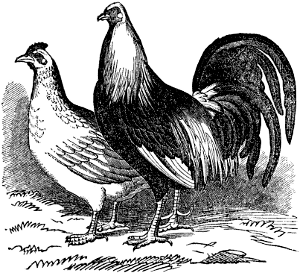
The game fowl is one of the most gracefully formed and beautifully colored of our domestic breeds of poultry; and in its form, aspect, and that extraordinary courage which characterizes its natural disposition, exhibits all that either the naturalist or the sportsman would at once recognize as the purest type of high blood, embodying, in short, all the most indubitable characteristics of gallinaceous aristocracy.
It is somewhat inferior in size to other breeds, and in its shape approximates more closely to the elegance and lightness of form usually characteristic of a pure and uncontaminated race. Amongst poultry, he is what the Arabian is amongst horses, the high-bred Short-horn amongst cattle, and the fleet greyhound amongst the canine race.
The flesh is beautifully white, as well as tender and delicate. The hens are excellent layers, and although the eggs are under the average size, they are not to be surpassed in excellence of flavor. Such being the character of this variety of fowl, it would doubtless be much more extensively cultivated than it is, were it not for the difficulty attending the rearing of the young; their pugnacity being such, that a brood is scarcely feathered before at least one-half are killed or blinded by fighting.
With proper care, however, most of the difficulties to be apprehended may be avoided. It is exceedingly desirable to perpetuate the race, for uses the most important and valuable. As a cross with other breeds, they are invaluable in improving the flavor of the flesh, which is an invariable consequence. The plumage of all fowl related to them is increased in brilliancy; and they are, moreover, very prolific, and the eggs are always enriched.
THe Mexican Hen-cock. This unique breed is a favorite variety with the Mexicans, who term them Hen-cocks from the fact that the male birds have short, broad tails, and, in color and plumage, the appearance of the hens of the same variety, differing only in the comb, which is very large and erect in the cock, and small in the hen. They are generally pheasant-colored, with occasional changes in plumage from a light yellow to a dark gray; and, in some instances, there is a tendency to black tail-feathers and breast, as well as an inclination to gray and light yellow, and with a slight approximation to red hackles in some rare instances.
This variety has a strong frame, and very large and muscular thighs. The cocks are distinguished by large, upright combs, strong bills, and very large, lustrous eyes. The legs vary from a dirty to a dark-green color. The hen does not materially differ in appearance from the cock. They are as good layers and sitters as any other game breed, and are good nurses.
THe Wild Indian Game. This variety was originally imported into this country from Calcutta. The hen has a long neck, like a wild goose; neither comb nor wattles; of a dark, glossy green color; very short fan tail; lofty in carriage, trim built, and wild in general appearance; legs very large and long, spotted with blue; ordinary weight from four and a half to six pounds. As a layer, she is equal to other fowls of the game variety.
The cock stands as high as a large turkey, and weighs nine pounds and upward; the plumage is of a reddish cast, interspersed with spots of glossy green; comb very small; no wattles; and bill unlike every other fowl, except the hen.
The Spanish Game. This variety is called the English fowl by some writers. It is more slender in the body, the neck, the bill, and the legs, than the other varieties, and the colors, particularly of the cock, are very bright and showy. The flesh is white, tender, and delicate, and on this account marketable; the eggs are small, and extremely delicate. The plumage is very beautiful—a clear, dark red, very bright, extending from the back to the extremities, while the breast is beautifully black. The upper convex side of the wing is equally red and black, and the whole of the tail-feathers white. The beak and legs are black; the eyes resemble jet beads, very full and brilliant; and the whole contour of the head gives a most ferocious expression.
THE GUELDERLAND.
GUELDERLANDS.
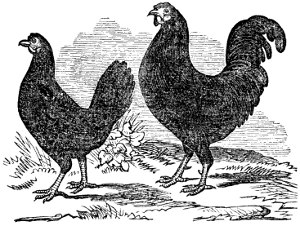
The Guelderland fowl were originally imported into this country from the north of Holland, where they are supposed to have originated. They are very symmetrical in form, and graceful in their motions. They have one noticeable peculiarity, which consists in the absence of a comb in either sex. This is replaced by an indentation on the top of the head; and from the extreme end of this, at the back, a small spike of feathers rises. This adds greatly to the beauty of the fowl. The presence of the male is especially dignified, and the female is little inferior in carriage.
The plumage is of a beautiful black, tinged with blue, of very rich appearance, and bearing a brilliant gloss. The legs are black, and, in some few instances, slightly feathered. Crosses with the Shanghae have heavily feathered legs. The wattles are of good size in the cock, while those of the hen are slightly less. The flesh is fine, of white color, and of excellent flavor. The eggs are large and delicate—the shell being thicker than in those of most other fowls—and are much prized for their good qualities. The hens are great layers, seldom inclining to sit. Their weight is from five pounds for the pullets, to seven pounds for the cocks.
The Guelderlands, in short, possess all the characteristics of a perfect breed; and in breeding them, this is demonstrated by the uniform aspect which is observable in their descendants. They are light and active birds, and are not surpassed, in point of beauty and utility, by any breed known in this country. The only objection, indeed, which has been raised against them is the tenderness of the chickens. With a degree of care, however, equal to their value, this difficulty can be surmounted, and the breed must be highly appreciated by all who have a taste for beauty, and who desire fine flesh and luscious eggs.
THE SPANGLED HAMBURGH.
The Spangled Hamburgh fowl are divided into two varieties, the distinctive characteristics being slight, and almost dependent upon color; these varieties are termed the Golden and Silver Spangled.
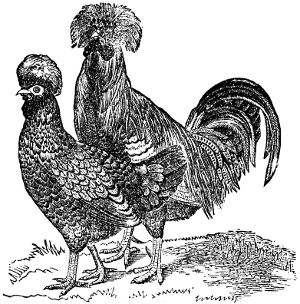
HAMBURGH FOWLS.
The Golden Spangled is one of no ordinary beauty; it is well and very neatly made, has a good body, and no very great offal. On the crest, immediately above the beak, are two small, fleshy horns, resembling, to some extent, an abortive comb. Above this crest, and occupying the place of a comb, is a very large brown or yellow tuft, the feathers composing it darkening toward their extremities. Under the insertion of the lower mandible—or that portion of the neck corresponding to the chin in man—is a full, dark-colored tuft, somewhat resembling a beard. The wattles are very small; the comb, as in other high-crested fowls, is very diminutive; and the skin and flesh white. The hackles on the neck are of a brilliant orange, or golden yellow; and the general ground-color of the body is of the same hue, but somewhat darker. The thighs are of a dark-brown or blackish shade, and the legs and feet are of a bluish gray.
In the Silver Spangled variety, the only perceptible difference is, that the ground color is a silvery white. The extremity and a portion of the extreme margin of each feather are black, presenting, when in a state of rest, the appearance of regular semicircular marks, or spangles—and hence the name, “Spangled Hamburgh;” the varieties being termed gold or silver, according to the prevailing color being bright yellow, or silvery white.
The eggs are of moderate size, but abundant; chickens easily reared. In mere excellence of flesh and as layers, they are inferior to the Dorking or the Spanish. They weigh from four and a half to five and a half pounds for the male, and three and a half for the female. The former stands some twenty inches in height, and the latter about eighteen inches.
THE JAVA.
The Great Java fowl is seldom seen in this country in its purity. They are of a black or dark auburn color, with very large, thick legs, single comb and wattles. They are good layers, and their eggs are very large and well-flavored; their gait is slow and majestic. They are, in fact, amongst the most valuable fowls in the country, and are frequently described as Spanish fowls, than which nothing is more erroneous.
They are as distinctly an original breed as the pure-blooded Great Malay, and possess about the same qualities as to excellence, but fall rather short of them in beauty. Some, however, consider the pure Java superior to all other large fowls, so far as beauty is concerned. Their plumage is decidedly rich.
THE JERSEY-BLUE.
The color of this variety is light-blue, sometimes approaching to dun; the tail and wings rather shorter than those of the common fowl; its legs are of various colors, generally black, sometimes lightly feathered. Of superior specimens, the cocks weigh from seven to nine pounds, and the hens from six to eight.
They are evidently mongrels; and though once much esteemed, they have been quite neglected, so far as breeding from them is concerned, since the introduction of the purer breeds, as the Shanghaes and the Cochin-Chinas.
THE LARK-CRESTED FOWL.
This breed is sometimes confounded with the Polish fowl; but the shape of the crest, as well as the proportions of the bird, is different. This variety, of whatever color it may be, is of a peculiar taper-form, inclining forward, with a moderately depressed, backward-directed crest, and deficient in the neatness of the legs and feet so conspicuous in the Polands; the latter are of more upright carriage and of a more squarely-built frame. Perhaps a good distinction between the two varieties is, that the Lark-crested have an occipital crest, and the Poland more of a frontal one.
They are of various colors: pure snow white, brown with yellow hackles, and black. The white is, perhaps, more brilliant than is seen in any other domesticated gallinaceous bird, being much more dazzling than that of the White Guinea Fowl, or the White Pea Fowl. This white variety is in great esteem, having a remarkably neat and lively appearance when rambling about a homestead. They look very clean and attractive when dressed for market; an old bird, cleverly trussed, will be, apparently, as delicate and transparent in skin and flesh as an ordinary chicken. Their feathers are also more salable than those from darker colored fowls. They are but little, if, indeed, any, more tender than other kinds raised near the barn-door; they are in every way preferable to the White Dorkings.
In the cocks, a single, upright comb sometimes almost entirely takes the place of the crest; the hens, too, vary in this respect, some having not more than half a dozen feathers in their head-dress.
If they were not of average merit, as to their laying and sitting qualifications, they would not retain the favor they do with the thrifty house-wives by whom they are chiefly cultivated.
THE MALAY.
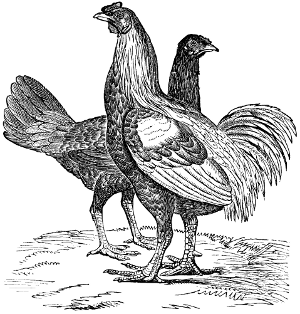
MALAYS.
This majestic bird is found on the peninsula from which it derives its name, and, in the opinion of many, forms a connecting link between the wild and domesticated races of fowls. Something very like them is, indeed, still to be found in the East. This native Indian bird—the Gigantic Cock, the Kulm Cock of Europeans—often stands considerably more than two feet from the crown of the head to the ground. The comb extends backward in a line with the eyes; it is thick, a little elevated, rounded upon the top, and has almost the appearance of having been cut off. The wattles of the under mandibles are comparatively small, and the throat is bare. Pale, golden-reddish hackles ornament the head, neck, and upper part of the back, and some of these spring before the bare part of the throat. The middle of the back and smaller wing-coverts are deep chestnut, the webs of the feathers disunited; pale reddish-yellow, long, drooping hackles cover the rump and base of the tail, which last is very ample, and entirely of a glossy green, of which color are the wing-coverts; the secondaries and quills are pale reddish-yellow on their outer webs. All the under parts are deep glossy blackish-green, with high reflections; the deep chestnut of the base of the feathers appears occasionally, and gives a mottled and interrupted appearance to those parts.
The weight of the Malay, in general, exceeds that of the Cochin-China; the male weighing, when full-grown, from eleven to twelve, and even thirteen pounds, and the female from eight to ten pounds; height, from twenty-six to twenty-eight inches. They present no striking uniformity of plumage, being of all shades, from black to white; the more common color of the female is a light reddish-yellow, with sometimes a faint tinge of dunnish-blue, especially in the tail.
The cock is frequently of a yellowish-red color, with black intermingled in the breast, thighs, and tail. He has a small, but thick comb, generally inclined to one side; he should be snake-headed, and free from the slightest trace of top-knot; the wattles should be extremely small, even in an old bird; the legs are not feathered, as in the case of the Shanghaes, but, like them and the Cochin-Chinas, his tail is small, compared with his size. In the female, there is scarcely any show of comb or wattles. Their legs are long and stout; their flesh is very well flavored, when they have been properly fattened; and their eggs are so large and rich that two of them are equal to three of those of our ordinary fowls.
The Malay cock, in his perfection, is a remarkably courageous and strong bird. His beak is very thick, and he is a formidable antagonist when offended. His crow is loud, harsh, and prolonged, as in the case of the Cochin-China, but broken off abruptly at the termination; this is quite characteristic of the bird.
The chickens are at first very strong, with yellow legs, and are thickly covered with light brown down; but, by the time they are one-third grown, the increase of their bodies has so far outstripped that of their feathers, that they are half naked about the back and shoulders, and extremely susceptible of cold and wet. The great secret of rearing them is, to have them hatched very early indeed, so that they may have safely passed through this period of unclothed adolescence during the dry, sunny part of May and June, and reached nearly their full stature before the midsummer rains descend.
Malay hens are much used by some for hatching the eggs of turkeys—a task for which they are well adapted in every respect but one, which is, that they will follow their natural instinct in turning off their chickens at the usual time, instead of retaining charge of them as long as the mother turkey would have done. Goslings would suffer less from such untimely desertion.
The Pheasant Malay. This variety is highly valued by many, not on account of its intrinsic merits, which are considerable, but because it is believed to be a cross between the pheasant and the common fowl. This is, however, an erroneous opinion. Hybrids between the pheasant and the fowl are, for the most part, absolutely sterile; when they do breed, it is not with each other, but with the stock of one of their progenitors; and the offspring of these either fail or assimilate to one or the other original type. No half-bred family is perpetuated, no new breed created, by human or volucrine agency.
The Pheasant Malays are large, well-flavored, good sitters, good layers, good mothers, and, in many points, an ornamental and desirable stock. Some object to them as being a trifle too long in their make; but they have a healthy look of not being over-bred, which is a recommendation to those who rear for profit as well as pleasure. The eggs vary in size; some are very large in summer, smooth, but not polished, sometimes tinged with light buff, balloon-shaped, and without the zone of irregularity. The chickens, when first hatched, are all very much alike; yellow, with a black mark all down the back. The cock has a black tail, with black on the neck and wings.
THE PLYMOUTH ROCK.
This name has been given to a very good breed of fowls, produced by crossing a China cock with a hen, a cross between the Fawn-colored Dorking, the Great Malay, and the Wild Indian.
At a little over a year old, the cocks stand from thirty-two to thirty-five inches high, and weigh about ten pounds; and the pullets from six and a half to seven pounds each. The latter commence laying when five months old, and prove themselves very superior layers. Their eggs are of a medium size, rich, and reddish-yellow in color. Their plumage is rich and variegated; the cocks usually red or speckled, and the pullets darkish brown. They have very fine flesh, and are fit for the table at an early age. The legs are very large, and usually blue or green, but occasionally yellow or white, generally having five toes upon each foot. Some have their legs feathered, but this is not usual. They have large and single combs and wattles, large cheeks, rather short tails, and small wings in proportion to their bodies.
They are domestic, and not so destructive to gardens as smaller fowls. There is the same uniformity in size and general appearance, at the same age of the chickens, as in those of the pure bloods of primary races.
THE POLAND.
The Poland, or Polish fowl, is quite unknown in the country which would seem to have suggested the name, which originated from some fancied resemblance between its tufted crest and the square-spreading crown of the feathered caps worn by the Polish soldiers.
The breed of crested fowls is much esteemed by the curious, and is bred with great care. Those desirous of propagating any singular varieties, separate and confine the individuals, and do not suffer them to mingle with such as have the colors different. The varieties are more esteemed in proportion to the variety of the colors, or the contrast of the tuft with the rest of the plumage. Although the differences of plumage are thus preserved pretty constant, they seem to owe their origin to the same breed, and cannot be reproduced pure without careful superintendence. The cocks are much esteemed in Egypt, in consequence of the excellence of their flesh, and are so common that they are sold at a remarkably cheap rate. They are equally abundant at the Cape of Good Hope, where their legs are feathered.
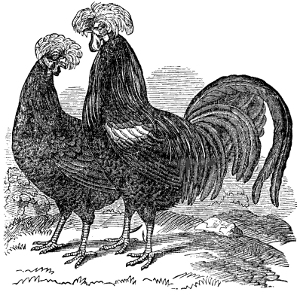
POLAND FOWLS.
The Polish are chiefly suited for keeping in a small way, and in a clean and grassy place. They are certainly not so fit for the farm-yard, as they become blinded and miserable with dirt. Care should be exercised to procure them genuine, since there is no breed of fowls more disfigured by mongrelism than this. They will, without any cross-breeding, occasionally produce white stock that are very pretty, and equally good for laying. If, however, an attempt is made to establish a separate breed of them, they become puny and weak. It is, therefore, better for those who wish for them to depend upon chance; every brood almost of the black produces one white chicken, as strong and lively as the rest.
These fowls are excellent for the table, the flesh being white, tender, and juicy; but they are quite unsuitable for being reared in any numbers, or for general purposes, since they are so capricious in their growth, frequently remaining stationary in this respect for a whole month, getting no larger; and this, too, when they are about a quarter or half grown—the time of their life when they are most liable to disease. As aviary birds, they are unrivalled among fowls. Their plumage often requires a close inspection to appreciate its elaborate beauty; the confinement and fretting seem not uncongenial to their health; and their plumage improves in attractiveness with almost every month.
The great merit, however, of all the Polish fowls is, that for three or four years they continue to grow and gain in size, hardiness, and beauty—the male birds especially. This fact certainly points out a very wide deviation in constitution from those fowls which attain their full stature and perfect plumage in twelve or fifteen months. The similarity of coloring in the two sexes—almost a specific distinction of Polish and perhaps Spanish fowls—also separates them from those breeds, like the Game, in which the cocks and hens are remarkably dissimilar. Their edible qualities are as superior, compared with other fowls, as their outward apparel surpasses in elegance. They have also the reputation of being everlasting layers, which further fits them for keeping in small enclosures; but, in this respect, individual exceptions are often encountered—as in the case of the Hamburghs—however truly the habit may be ascribed to the race.
There are four known varieties of the Polish fowl, one of which appears to be lost to this country.
The Black Polish. This variety is of a uniform black—both cock and hen—glossed with metallic green. The head is ornamented with a handsome crest of white feathers, springing from a fleshy protuberance, and fronted more or less deeply with black. The comb is merely two or three spikes, and the wattles are rather small. Both male and female are the same in color, except that the former has frequently narrow stripes of white in the waving feathers of the tail, a sign, it is said, of true breeding. The hens, also, have two or three feathers on each side of the tail, tinged in the tip with white. They do not lay quite so early in the spring as some varieties, especially after a hard winter; but they are exceedingly good layers, continuing a long time without wanting to sit, and laying rather large, very white, sub-ovate eggs. They will, however, sit at length, and prove of very diverse dispositions; some being excellent sitters and nurses, others heedless and spiteful.
The chickens, when first hatched, are dull black, with white breasts, and white down on the front of the head. They do not always grow and get out of harm’s way so quickly as some other sorts, but are not particularly tender. In rearing a brood of these fowls, some of the hens may be observed with crests round and symmetrical as a ball, and others in which the feathers turn all ways, and fall loosely over the eyes; and in the cocks, also, some have the crest falling gracefully over the back of the head, and others have the feathers turning about and standing on end. These should be rejected, the chief beauty of the kind depending upon such little particulars. One hen of this variety laid just a hundred eggs, many of them on consecutive days, before wanting to incubate; and after rearing a brood successfully, she laid twenty-five eggs before moulting in autumn.
The Golden Polands. These are sometimes called Gold Spangled, as their plumage approaches to that of the Gold Spangled Hamburghs; but many of the finest specimens have the feathers merely fringed with a darker color, and the cocks, more frequently than the hens, exhibit a spotted or spangled appearance. Many of them are disfigured by a muff or beard; as to which the question has been raised whether it is an original appendage to these birds or not. A distinct race, of which the muff is one permanent characteristic, is not at present known. This appendage, whenever introduced into the poultry-yard, is not easily got rid of; which has caused some to suspect either that the original Polish were beardless, or that there were two ancient races.
The Golden Polands, when well-bred, are exceedingly handsome; the cock has golden hackles, and gold and brown feathers on the back; breast and wings richly spotted with ochre and dark brown; tail darker; large golden and brown crest, falling back over the neck; but little comb and wattles. The hen is richly laced with dark-brown or black on an ochre ground; dark-spotted crest; legs light-blue, very cleanly made, and displaying a small web between the toes, almost as proportionately large as that in some of the waders.
They are good layers, and produce fair-sized eggs. Many of them make excellent mothers, although they cannot be induced to sit early in the season. The chickens are rather clumsy-looking little creatures, of a dingy-brown, with some dashes of ochre about the head, breast and wings. They are sometimes inclined to disease in the first week of their existence; but, if they pass this successfully, they become tolerably hardy, though liable to come to a pause when about half-grown. It may be noted as a peculiarity in the temper of this breed, that, if one is caught, or attacked by any animal, the rest, whether cocks or hens, will instantly make a furious attack upon the aggressor, and endeavor to effect the rescue of their companion.
The Silver Polands. These are similar to the preceding in shape and markings, except that white, black, and gray are exchanged for ochre or yellow, and various shades of brown. They are even more delicate in their constitution, more liable to remain stationary at a certain point of their adolescence, and, still more than the other varieties, require and will repay extra care and accommodation. Their top-knots are, perhaps, not so large, as a general thing; but they retain the same neat bluish legs and slightly-webbed feet. The hens are much more ornamental than the cocks; though the latter are sure to attract notice. They may, unquestionably, be ranked among the choicest of fowls, whether their beauty or their rarity is considered. They lay, in tolerable abundance, eggs of moderate size, French-white, much pointed at one end; and when they sit, acquit themselves respectably.
The newly-hatched chickens are very pretty; gray, with black eyes, light lead-colored legs, and a swelling of down on the crown of the head, indicative of the future top-knot, which is exactly the color of a powdered wig, and, indeed, gives the chicken the appearance of wearing one. There is no difficulty in rearing them for the first six weeks or two months; the critical time being the interval between that age and their reaching the fifth or sixth month. They acquire their peculiar distinctive features at a very early age, and are then the most elegant little miniature fowls which can possibly be imagined. The distinction of sex is not very manifest till they are nearly full-grown; the first observable indication being in the tail. That of the pullet is carried uprightly, as it ought to be; but in the cockerel, it remains depressed, awaiting the growth of the sickle-feathers. The top-knot of the cockerel inclines to hang more backward than that of the pullets. It is remarkable that the Golden Polish cock produces as true Silver chickens, and those stronger, with the Silver Polish hen, as the Silver Polish cock would bring.
The Silver Polands have all the habits of their golden companions, the main difference being the silvery ground instead of the golden. This variety will sometimes make its appearance even if merely its Golden kind is bred, precisely as the Black Polish now and then produce some pure White chickens that make very elegant birds.
The Black-topped White. This variety does not at present exist among us; and some have even questioned whether it ever did. Buffon mentions them as if extant in France in his time. An attempt has been made to obtain them from the preceding, by acting on the imagination of the parents. The experiment failed, though similar schemes are said to have succeeded with animals; it proved, however, that it will not do to breed from the White Polish as a separate breed. Being Albinos, the chickens come very weakly, and few survive.
This breed is now recoverable, probably, only by importation from Asia.
THE SHANGHAE.
For all the purposes of a really good fowl—for beauty of model, good size, and laying qualities—the thorough-bred Shanghae is among the best, and generally the most profitable of domestic birds. The cock, when full-grown, stands about twenty-eight inches high, if he is a good specimen; the female, about twenty-two or twenty-three inches. A large comb or heavy wattles are rarely seen on the hen at any age; but the comb of the male is high, deeply indented, and his wattles double and large. The comb and wattles are not, however, to be regarded as the chief characteristics of this variety, nor even its reddish-yellow feathered leg; but the abundant, soft, and downy covering of the thighs, hips, and region of the vent, together with the remarkably short tail, and large mound of feathers piled over the upper part of its root, giving rise to a considerable elevation on that part of the rump. It should be remarked, also, that the wings are quite short and small in proportion to the size of the fowl, and carried very high up the body, thus exposing the whole of the thighs, and a considerable portion of the side.
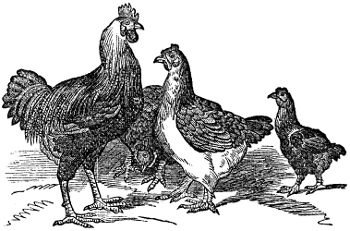
SHANGHAES.
These characteristics are not found, in the same degree, in any other fowl. The peculiar arrangement of feathers gives the Shanghae in appearance, what it has in reality—a greater depth of quarter, in proportion to the brisket, than any other fowl.
As to the legs, they are not very peculiar. The color is usually reddish-white, or flesh-color, or reddish-yellow, mostly covered down the outside, even to the end of the toes, with feathers. This last, however, is not always the case. The plumage of the thorough-bred is remarkably soft and silky, or rather downy; and is, in the opinion of many, equally as good for domestic purposes as that of the goose. The feathers are certainly quite as fine and soft, if not as abundant.
In laying qualities, the pure Shanghae equals, if it does not excel, any other fowl. The Black Poland, or the Bolton Gray, may, perhaps, lay a few more eggs in the course of a year, in consequence of not so frequently inclining to sit; but their eggs are not so rich and nutritious. A pullet of this breed laid one hundred and twenty eggs in one hundred and twenty-five days, then stopped six days, then laid sixteen eggs more, stopped four days, and again continued her laying. The eggs are generally of a pale yellow, or nankeen color, not remarkably large, compared with the size of the fowl, and generally blunt at the ends. The comb is commonly single, though, in some specimens, there is a slight tendency to rose.
The flesh of this fowl is tender, juicy, and unexceptionable in every respect. Taking into consideration the goodly size of the Shanghae—weighing, as the males do, at maturity, from ten to twelve pounds, and the females from seven and a half to eight and a half, and the males and females of six months, eight and six pounds respectively—the economical uses to which its soft, downy feathers may be applied, its productiveness, hardiness, and its quiet and docile temper, this variety must occupy, and deservedly so, a high rank among our domestic fowls; and the more it is known, the better will it be appreciated.
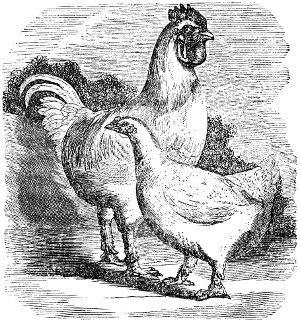
WHITE SHANGHAES.
The White Shanghae. This variety is entirely white, with the legs usually feathered, and differ in no material respect from the red, yellow, and Dominique, except in color. The legs are yellowish, or reddish-yellow, and sometimes of flesh-color. Many prefer them to all others. The eggs are of a nankeen, or dull yellow color, and blunt at both ends.
It is claimed by the friends of this variety that they are larger and more quiet than other varieties, that their flesh is much superior, their eggs larger, and the hens more profitable. Being more quiet in their habits, and less inclined to ramble, the hens are invaluable as incubators and nurses; and the mildness of their disposition makes them excellent foster-mothers, as they never injure the chickens belonging to other hens.
These fowls will rank among the largest coming from China, and are very thrifty in our climate. A cock of this variety attained a weight of eight pounds, at about the age of eight months, and the pullets of the same brood were proportionably large. They are broad on the back and breast, with a body well rounded up; the plumage white, with a downy softness—in the latter respect much like the feathering of the Bremen goose; the tail-feathers short and full; the head small, surmounted by a small, single, serrated comb; wattles long and wide, overlaying the cheek-piece, which is also large, and extends back on the neck; and the legs of a yellow hue, approaching a flesh-color, and feathered to the ends of the toes.
THE SILVER PHEASANT.
This variety of fowls is remarkable for great brilliancy of plumage and diversity of colors. On a white ground, which is usually termed silvery, there is an abundance of black spots. The feathers on the upper part of the head are much longer than the rest, and unite together in a tuft. They have a small, double comb, and their wattles are also comparatively small. A remarkable peculiarity of the cock is, that there is a spot of a blue color on the cheeks, and a range of feathers under the throat, which has the appearance of a collar.
The hen is a smaller bird, with plumage similar to that of the cock, and at a little distance seems to be covered with scales. On the head is a top-knot of very large size, which droops over it on every side. The Silver Pheasants are beautiful and showy birds, and chiefly valuable as ornamental appendages to the poultry-yard.
THE SPANISH.
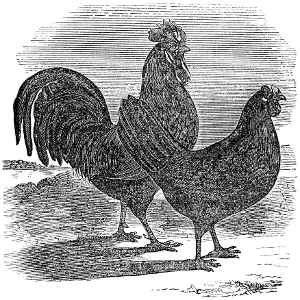
SPANISH FOWLS.
This name is said to be a misnomer, as the breed in question was originally brought by the Spaniards from the West Indies; and, although subsequently propagated in Spain, it has for some time been very difficult to procure good specimens from that country. From Spain, they were taken in considerable numbers into Holland, where they have been carefully bred, for many years; and it is from that quarter that our best fowls of this variety come.
The Spanish is a noble race of fowls, possessing many merits; of spirited and animated appearance; of considerable size; excellent for the table, both in whiteness of flesh and skin, and also in flavor; and laying exceedingly large eggs in considerable numbers. Among birds of its own breed it is not deficient in courage; though it yields, without showing much fight, to those which have a dash of game blood in their veins. It is a general favorite in all large cities, for the additional advantage that no soil of smoke or dirt is apparent on its plumage.
The thorough-bred birds should be entirely black, as far as feathers are concerned; and when in high condition, display a greenish, metallic lustre. The combs of both cock and hen are exceedingly large, of a vivid and most brilliant scarlet; that of the hen droops over upon one side. Their most singular feature is a large, white patch, or ear-hole, on the cheek—in some specimens extending over a great part of the face—of a fleshy substance, similar to the wattle; it is small in the female, but large and very conspicuous in the male. This marked contrast of black, bright red, and white, makes the breed of the Spanish cock as handsome as that of any variety which we have; in the genuine breed, the whole form is equally good.
Spanish hens are celebrated as good layers, and produce very large, quite white eggs, of a peculiar shape, being very thick at both ends, and yet tapering off a little at each. They are, by no means, good mothers of families, even when they do sit—which they will not often condescend to do—proving very careless, and frequently trampling half their brood under foot. The inconveniences of this habit are, however, easily obviated by causing the eggs to be hatched by some more motherly hen.
This variety of fowl has frequently been known to lose nearly all the feathers in its body, besides the usual quantity on the neck, wings, and tail; and, if they moult late, and the weather is severe, they feel it much. This must often happen in the case of an “everlasting layer;” for if the system of a bird is exhausted by the unremitting production of eggs, it cannot contain within itself the material for supplying the growth of feathers. They have not, even yet, become acclimated in this country, since continued frost at any time is productive of much injury to their combs; frequently causing mortification in the end, which at times terminates in death. A warm poultry-house, high feeding, and care that they do not remain too long exposed to severe weather, are the best means of preventing this disfigurement. Some birds are occasionally produced, handsomely streaked with red on the hackle and back. This is no proof of bad breeding, if other points are right.
The chickens are large, as would be expected from such eggs, entirely shining black, except a pinafore of white on the breast—in which respect they are precisely like the Black Polish chickens—and a slight sprinkling under the chin, with sometimes also a little white round the back and eyes; their legs and feet are black. Many of them do not get perfectly feathered till they are three-fourths grown; and, therefore, to have this variety come to perfection in a country where the summers are much shorter than in their native climate, they must be hatched early in spring, so that they may be well covered with plumage before the cold rains of autumn. There is, however, a great lack of uniformity in the time when they get their plumage; the pullets are always earlier and better feathered than the cockerels—the latter being generally half naked for a considerable time after being hatched, though some feather tolerably well at an early age.
The Black is not the only valuable race of Spanish fowl; there is, also, the Gray, or Speckled, of a slaty gray color, with white legs. Their growth is so rapid, and their size, eventually, so large, that they are remarkably slow in obtaining their feathers. Although well covered with down when first hatched, they look almost naked when half-grown, and should, therefore, be hatched as early in spring as possible. The cross between the Pheasant-Malay and the Spanish produces a particularly handsome fowl.
As early pullets, for laying purposes in the autumn and winter after they are hatched, no fowls can surpass the Spanish. They are believed, also, to be more precocious in their constitution; and consequently to lay at an earlier age than the pullets of other breeds.
THE NATURAL HISTORY OF DOMESTIC FOWLS.
Fowls are classed by modern naturalists as follows:
Division. Vertebrata—possessing a back bone. Class. Aves—birds. Order. Rasores—scrapers. Family. Phasianidæ—Pheasants. Genus. Gallus—the cock.
Birds, as well as quadrupeds, may be divided into two great classes, according to their food: the Carnivorous and the Graminivorous. Fowls belong, strictly speaking, to the latter.
In the structure of the digestive organs, birds exhibit a great uniformity. The œsophagus, which is often very muscular, is dilated into a large sac—called the crop—at its entrance into the breast; this is abundantly supplied with glands, and serves as a species of first stomach, in which the food receives a certain amount of preparation before being submitted to the action of the proper digestive organs. A little below the crop, the narrow œsophagus is again slightly dilated, forming what is called the ventriculus succenturiatus, the walls of which are very thick, and contain a great number of glands, which secrete the gastric juice. Below this, the intestinal canal is enlarged into a third stomach, the gizzard, in which the process of digestion is carried still farther. In the graminivorous birds, the walls of this cavity are very thick and muscular, and clothed internally with a strong, horny epithelium, serving for the trituration of the food. The intestine is rather short, but usually exhibits several convolutions; the large intestine is always furnished with two corea. It opens by a semicircular orifice into the cloaca, which also receives the orifices of the urinary and generative organs. The liver is of large size, and usually furnished with a gall-bladder. The pancreas is lodged in a kind of loop, formed by the small intestine immediately after quitting the gizzard. There are also large salivary glands in the neighborhood of the mouth, which pour their secretion into that cavity.
The organs of circulation and respiration in birds are adapted to their peculiar mode of life; but are not separated from the abdominal cavity by a diaphragm, as in the mammalia. The heart consists of four cavities distinctly separated—two auricles and two ventricles—so that the venous and arterial blood can never mix in that organ; and the whole of the blood returned from the different parts of the body passes through the lungs before being again driven into the systemic arteries. The blood is received from the veins of the body in the right auricle, from which it passes through a tabular opening into the right ventricle, and is thence driven into the lungs. From these organs it returns through the pulmonary veins into the left auricle, and passes thence into the ventricles of the same side, by the contraction of which it is driven into the aorta. This soon divides into two branches, which, by their subdivision, give rise to the arteries of the body.
The jaws, or mandibles, are sheathed in a horny case, usually of a conical form, on the sides of which are the nostrils. In most birds, the sides of this sheath or bill are smooth and sharp; but in some they are denticulated along the margins. The two anterior members of the body are extended into wings. The beak is used instead of hands; and such is the flexibility of the vertebral column, that the bird is able to touch with its beak every part of its body. This curious and important result is obtained chiefly by the lengthened vertebræ of the neck, which, in the swan, consists of twenty-three bones, and in the domestic cock, thirteen. The vertebræ of the back are seven to eleven; the ribs never exceed ten on each side.
The clothing of the skin consists of feathers, which in their nature and development resemble hair, but are of a more complicated structure. A perfect feather consists of the shaft, a central stem, which is tubular at the base, where it is inserted into the skin, and the barbs, or fibres, which form the webs on each side of the shaft. The two principal modifications of feathers are quills and plumes; the former confined to the wings and tail, the latter constituting the general clothing of the body. Besides the common feathers, the skin of many birds is covered with a thick coating of down, which consists of a multitude of small feathers of peculiar construction; each of these down feathers is composed of a very small, soft tube imbedded in the skin, from the interior of which there rises a small tuft of soft filaments, without any central shaft. These filaments are very slender, and bear on each side a series of still more delicate filaments, which may be regarded as analogous to the barbules of the ordinary feathers. This downy coat fulfils the same office as the soft, woolly fur of many quadrupeds; the ordinary feathers being analogous to the long, smooth hair by which the fur of these animals is concealed. The skin also bears many hair-like appendages, which are usually scattered sparingly over its surface; they rise from a bulb which is imbedded in the skin, and usually indicate their relation to the ordinary feathers by the presence of a few minute barbs toward the apex.
Once or twice in the course of a year the whole plumage of the bird is renewed, the casting of the old feathers being called moulting. The base of the quills is covered by a series of large feathers, called the wing coverts; and the feathers of the tail are furnished with numerous muscles, by which they can be spread out and folded up like a fan. In the aquatic birds—like the goose, the duck, and the swan—the feathers are constantly lubricated by an oily secretion, which completely excludes the water.
In their reproduction, birds are strictly oviparous. The eggs are always enclosed in a hard shell, consisting of calcareous matter, and birds almost invariably devote their whole attention, during the breeding season, to the hatching of their eggs and the development of their offspring; sitting constantly upon the eggs to communicate to them the degree of warmth necessary for the evolution of the embryo, and attending to the wants of their newly-hatched young, until the latter are in a condition to shift for themselves.
In the structure and development of the egg there is a great uniformity; but there is a remarkable difference in the condition of the young bird at the moment of hatching. In the class under consideration, the young are able to run about from the moment of their breaking the egg-shell; and the only care of the parents is devoted to protecting their offspring from danger, and leading them into those places where they are likely to meet with food.
The longevity of birds is various, and, unlike the case of men and quadrupeds, seems to bear little proportion to the age at which they acquire maturity. A few months, or even a few weeks, suffice to bring them to their perfection of stature, instincts, and powers. Domestic fowls live to the age of twenty years; geese, fifty; while swans exceed a century.
The order Rasores includes the numerous species of gallinaceous birds, and the term is applied to them from their habit of scratching in the ground in search of food. They are generally marked by a small head, stout legs, plumage fine, the males usually adorned with magnificent colors, and the tails often developed in a manner to render the appearance extremely elegant. The wings are usually short and weak, and the flight of the birds is neither powerful nor prolonged. The corla of this order are larger than in any other birds.
The species are found in almost all parts of the world, from the tropics to the frozen regions of the north; but the finest and most typical kinds are inhabitants of the temperate and warmer parts of Asia. They feed principally on seeds, fruit, and herbage, but also, to a considerable extent, on insects, worms, and other small animals. Their general habitation is on the ground, where they run with great celerity, but many of them roost on trees. They are mostly polygamous in their habits, the males being usually surrounded by a considerable troop of females; and to these, with a few exceptions, the whole business of incubation is generally left. The nest is always placed on the ground in some sheltered situation, and very little art is exhibited in its construction; indeed, an elaborate nest is the less necessary, as the young are able to run about and feed almost as soon as they have left the egg; and at night or on the approach of danger, they collect beneath the wings of their mother. Most of these species are esteemed for the table, and many of them are among the most celebrated of game birds.
The pheasant family, of this order, includes the most beautiful of the rasorial birds; indeed, some of them may, perhaps, be justly regarded as pre-eminent in this respect over all the rest of their class. In these, the bill is of moderate size and compressed, with the upper mandible arched to the tip, where it overhangs the lower one; the tarsi are of moderate length and thickness, usually armed with one or two spurs; the toes are moderate, and the hinder one short and elevated; the wings are rather short and rounded, and the tail more or less elongated and broad, but frequently wedge-shaped and pointed. The head is rarely feathered all over; the naked skin is sometimes confined to a space about the eye, but generally occupies a greater portion of the surface, occasionally covering the whole head, and even a part of the neck, and frequently forming combs and wattles of very remarkable forms. In some species, the crown is furnished with a crest of feathers.
The birds of this family are, for the most part, indigenous to the Asiatic continent and islands, from which, however, several species have been introduced into other parts of the globe. The Guinea Fowl of Africa, and the Turkeys of America, are almost the only instances of wild Phasianidous birds out of Asia. Some species, such as the Domestic Fowl, the Peacock, the Turkey, and the Guinea Fowl, have been reduced to a state of complete domestication, and are distributed pretty generally over the world.
THE GUINEA FOWL.
This bird belongs to the same division, class, order, and family as the Domestic Fowl; but is assigned by naturalists to the genus Numida, or Numidian. It is indigenous to the tropical parts of Africa, and in a wild state, Guinea Fowls live in flocks, in woods, preferring marshy places, and feed on insects, worms, and seeds; they roost on trees; the nest is made on the ground, and usually contains as many as twenty eggs. They have been propagated in the Island of Jamaica to such an extent as to have become wild, and are shot like other game. They do much damage to the crops, and are therefore destroyed by various means; one of which is, to get them tipsy by strewing corn steeped in rum, and mixed with the intoxicating juice of the cassava, upon the ground; the birds devour this, and are soon found in a helpless state of inebriety.
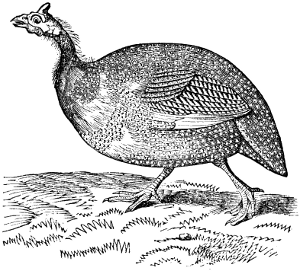
THE GUINEA FOWL.
The Guinea Fowl, to a certain degree, unites the characteristics of the pheasant and the turkey; having the delicate shape of the one, and the bare head of the other. There are several varieties: the White, the Spotted, the Madagascar, and the Crested. The latter is not so large as the common species; the head and neck are bare, of a dull blue, shaded with red, and, instead of the casque, it has an ample crest of hair-like, disunited feathers, of a bluish black, reaching as far forward as the nostrils, but, in general, turned backward. The whole plumage, except the quills, is of a bluish black, covered with small grayish spots, sometimes four, sometimes six on each feather.
This fowl is not a great favorite among many keepers of poultry, being so unfortunate as to have gained a much worse reputation than it really deserves, from having been occasionally guilty of a few trifling faults. It is, however, useful, ornamental, and interesting during its life; and, when dead, a desirable addition to the table, at a time when all other poultry is scarce.
The best way to commence keeping Guineas is to procure a sitting of eggs which can be depended upon for freshness, and if possible, from a place where but a single pair is kept. A Bantam hen is the best mother; she is lighter, and less likely to injure them by treading on them than a full-sized fowl. She will cover nine eggs, and incubation will last a month. The young are excessively pretty. When first hatched, they are so strong and active as to appear not to require the attention which is really necessary to rear them. Almost as soon as they are dry from the moisture of the egg, they will peck each other’s toes, as if supposing them to be worms, scramble with each other for a crumb of bread, and domineer over any little Bantam or chicken that may chance to have been hatched at the same time with themselves. No one, ignorant of the fact, would guess, from their appearance, to what species of bird they belonged; their orange-red bills and legs, and the dark, zebra-like stripes with which they are regularly marked from head to tail, bear no traces of the speckled plumage of their parents.
Of all known birds, the Guinea fowl is, perhaps, the most prolific of eggs. Week after week, and month after month, there are very few intermissions, if any, of the daily deposit. Even the process of moulting is sometimes insufficient to draw off the nutriment which it takes to make feathers instead of eggs; and the poor thing will sometimes go about half-naked in the chilly autumn months, unable to refrain from its diurnal visit to the nest, and consequently unable to furnish itself with a new outer garment. The body of the Guinea hen may be regarded, in fact, as a most admirable machine for producing eggs out of insects, grain, and vegetables, garbage, or whatever material an omnivorous creature can appropriate.
Its normal plumage is singularly beautiful, being spangled over with an infinity of white spots on a black ground, shaded with gray and brown. The spots vary from the size of a pea to extreme minuteness. The black and white occasionally change places, causing the bird to appear covered with a net of lace.
The white variety is not uncommon, and is said to be equally hardy and profitable with the usual kind; but the peculiar beauty of the original plumage is, certainly, all exchanged for a dress of not the purest white. It is doubtful how long either this or the former variety would remain permanent; though, probably, but for a few generations. Pied birds blotched with patches of white, are frequent, but are not comparable, in point of beauty, with those of the original wild color.
THE PEA FOWL.
This bird is assigned to the genus paro, or peacock—the division, class, or sex, and family, being the same as the preceding. The male of this species is noted for its long, lustrous tail, which it occasionally spreads, glittering with hundreds of jewel-like eye-spots, producing an unrivalled effect of grace and beauty. The form of the bird is also exceedingly elegant, and the general plumage of the body exhibits rich metallic tints; that of the neck, particularly, being of a fine deep blue, tinged with golden green. The female, however, is of a much more sober hue, her whole plumage being usually of a brownish color. The voice of the peacock is by no means suitable to the beauty of its external appearance, consisting of a harsh, disagreeable cry, not unlike the word paon, which is the French name of the bird.
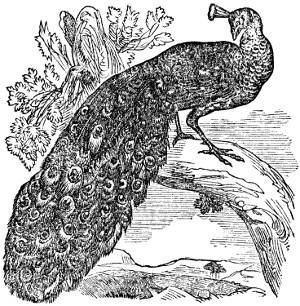
THE PEA FOWL.
Although naturalized as a domestic bird in Europe and America, the pea fowl is a native of India, where it is still found abundantly in a wild state; and the wild specimens are said to be more brilliant than those bred in captivity. The date of its introduction into England is not known; but the first peacocks appear to have been brought into Europe by Alexander the Great, although these birds were among the articles imported into Judea by the fleets of Solomon. They reached Rome toward the end of the republic, and their costliness soon caused them to be regarded as one of the greatest luxuries of the table, though the moderns find them dry and leathery. This, perhaps, as much as the desire of ostentation, may have induced the extravagance of Vitellius and Heliogabulus, who introduced dishes composed only of the brains and tongues of peacocks at their feasts. In Europe, during the middle ages, the peacock was still a favorite article in the bill of fare of grand entertainments, at which it was served with the greatest pomp and magnificence. And during the period of chivalry, it was usual for knights to make vows of enterprise on these occasions, “before the peacock and the ladies.” At present, however, the bird is kept entirely on account of the beauty of its appearance.
In a state of nature, pea fowl frequent jungles and wooded localities, feeding upon grain, fruits, and insects. They are polygamous, and the females make their nests upon the ground among bushes; the nest is composed of grass, and the number of eggs laid is said to be five or six. They roost in high trees, and, even in captivity, their inclination to get into an elevated position frequently manifests itself; and they may often be seen perched upon high walls, or upon the ridges of buildings.
The latter characteristic is, indirectly, one reason why many are disinclined to keep pea fowl in a domestic state. Their decided determination so to roost prevents such a control being exercised over them as would restrain them from mischief, until an eye could be kept on their movements; and, consequently, they commit many depredations upon gardens, stealing off to their work of plunder at the first dawn, or at the most unexpected moments. Their cunning indeed is such that, if frequently driven away from the garden at any particular hour of the day or evening, they will never be found there, after a certain time, at that special hour, but will invariably make their inroads at day-break. Many have tried, as a last resort, to eject them with every mark of scorn and insult, such as harsh words, the cracking of whips, and the throwing of harmless brooms; but they remain incorrigible marauders, indifferent to this disrespectful usage, and careless of severe rebuke.
A mansion, therefore, where the fruit and vegetable garden is at a distance, is almost the only place where they can be kept without daily vexation. The injury they do to flowers is comparatively trifling; though, like the Guinea-fowl, they are great eaters of buds, cutting them out cleanly from the axillae of leaves. They must likewise have a dusting-hole, which is large and unsightly; but this can be provided for them in some nook out of the way; and by feeding and encouragement, they will soon be taught to dispose themselves into a pleasing spectacle, at whatever point of view may be deemed desirable. No one with a very limited range should attempt to keep them at all, unless confined in an aviary. Where they can be kept at large, they should be collected in considerable numbers, that their dazzling effects may be as impressive as possible.
A wanton destructiveness toward the young of other poultry is also charged upon them. Relative to this, however, statements differ; some contending that such instances of cruelty constitute the exceptions, and not the rule.
The hen does not lay till her third summer; but she then seems to have an instinctive fear of her mate, manifested by the secrecy with which she selects the place for her nest; nor, if the eggs are disturbed, will she go there again. She lays from four or five to seven. If these are taken, she will frequently lay a second time during the summer; and the plan is recommended to those who are anxious to increase their stock. She sits from twenty-seven to twenty-nine days. A common hen will hatch and rear the young; but the same objection lies against her performing that office, except in very fine, long summers, for the pea fowl as for turkeys—that the young require to be brooded longer than the hen is conveniently able to do. A turkey will prove a much better foster-mother in every respect. The peahen should, of course, be permitted to take charge of one set of eggs. Even without such assistance, she will be tolerably successful.
The same wise provision of Nature noticed in the case of the Guinea fowl is evinced in a still greater degree in the little pea chickens. Their native jungle—tall, dense, sometimes impervious, swarming with reptile, quadruped, and even insect, enemies—would be a most dangerous habitation for a little tender thing that could merely run and squall. Accordingly, they escape from the egg with their quill-feathers very highly developed. In three days, they will fly up, and perch upon any thing three feet high; in a fortnight, they will roost on trees, or the tops of sheds; and in a month or six weeks, they will reach the ridge of a barn, if there are any intermediate low stables or other buildings to help them to mount from one to the other.
There are two varieties of the common pea fowl: the pied and the white. The first has irregular patches of white about it, like the pied Guinea fowl, and the remainder of the plumage resembling the original sorts; the white have the ocellated spots on the tail faintly visible in certain lights. These last are tender, and much prized by those who prefer variety to real beauty. They are occasionally produced by birds of the common kind, in cases where no intercourse with other white birds can have taken place. In one instance, in the same brood, whose parents were both of the usual colors, there were two of the common sort, and one white cock, and one white hen.
THE TURKEY.
The Wild Turkey. The turkey belongs to the genus meleagris, and, though now known as a domestic fowl in most civilized countries, was confined to America until after the discovery of that country by Columbus. It was probably introduced into Europe by the Spaniards about the year 1530. It was found in the forests of North America, when the country was first settled, from the Isthmus of Darien to Canada, being then abundant even in New England; at present, a few are found in the mountains of Massachusetts, New York, and New Jersey; in the Western and the Southwestern States they are still numerous, though constantly diminishing before the extending and increasing settlements.
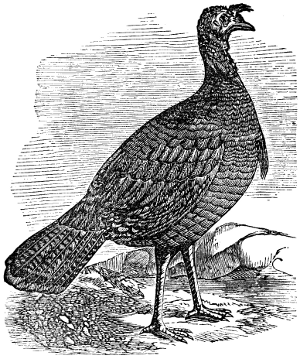
THE WILD TURKEY.
The wild male bird measures about three feet and a half, or nearly four feet, in length, and almost six in expanse of the wings, and weighs from fifteen to forty pounds. The skin of the head is of a bluish color, as is also the upper part of the neck, and is marked with numerous reddish, warty elevations, with a few black hairs scattered here and there. On the under part of the neck, the skin hangs down loosely, and forms a sort of wattle; and from the point where the bill commences, and the forehead terminates, arises a fleshy protuberance, with a small tuft of hair at the extremity, which becomes greatly elongated when the bird is excited; and at the lower part of the neck is a tuft of black hair, eight or nine inches in length.
The feathers are, at the base, of a bright dusky tinge, succeeded by a brilliant metallic band, which changes, according to the point whence the light falls upon it, to bronze, copper, violet, or purple; and the tip is formed by a narrow, black, velvety band. This last marking is absent from the neck and breast. The color of the tail is brown, mottled with black, and crossed with numerous lines of the latter color; near the tip is a broad, black band, then a short mottled portion, and then a broad band of dingy yellow. The wings are white, banded closely with black, and shaded with brownish yellow, which deepens in tint toward the back. The head is very small, in proportion to the size of the body; the legs and feet are strongly made, and furnished with blunt spurs, about an inch long, and of a dusky reddish color; the bill is reddish, and brown-colored at the tip.
The female is less in size; her legs are destitute of spurs; her neck and head are less naked, being furnished with short, dirty, gray feathers; the feathers on the back of the neck have brownish tips, producing on that part a brown, longitudinal band. She also, frequently, but not invariably, wants the tuft of feathers on the breast. Her prevailing color is a dusky gray, each feather having a metallic band, less brilliant than that of the cock, then a blackish band, and a grayish fringe. Her whole color is, as usual among birds, duller than that of the cock; the wing-feathers display the white, and have no bands; the tail is similarly colored to that of the cock. When young, the sexes are so much alike that it is not easy to discern the difference between them; and the cock acquires his beauty only by degrees, his plumage not arriving at perfection until the fourth or fifth year.
The habits of these birds in their native wilds are exceedingly curious. The males, called Gobblers, associate in parties of from ten to a hundred, and seek their food apart from the females, which either go about singly with their young, at that time about two-thirds grown, or form troops with other females and their families, sometimes to the number of seventy or eighty. These all avoid the old males, who attack and destroy the young, whenever they can, by reiterated blows upon the skull. But all parties travel in the same direction, and on foot, unless the dog or the hunter or a river on their line of march compels them to take wing. When about to cross a river, they select the highest eminences, that their flight may be more sure, and in such positions they sometimes stay for a day or more, as if in consultation. The males upon such occasions gobble obstreperously, strutting with extraordinary importance, as if to animate their companions; and the females and the young assume much of the same pompous manner, and spread their tails as they move silently around. Having mounted, at length, to the tops of the highest trees, the assembled multitude, at the signal note of their leader, wing their way to the opposite shore. The old and fat birds, contrary to what might be expected, cross without difficulty, even when the river is a mile in width; but the wings of the young and the meagre, and, of course, those of the weak, frequently fail them before they have completed their passage, when they drop in, and are forced to swim for their lives, which they do cleverly enough, spreading their tails for a support, closing their wings, stretching out their necks, and striking out quickly and strongly with their feet. All, however, do not succeed in such attempts, and the weaker often perish.
The wild turkeys feed on maize, all sorts of berries, fruits, grasses, and beetles; tadpoles, young frogs, and lizards, are occasionally found in their crops. The pecan nut is a favorite food, and so is the acorn, on which last they fatten rapidly. About the beginning of October, while the mast still hangs on the trees, they gather together in flocks, directing their course to the rich bottom-lands, and are then seen in great numbers on the Ohio and Mississippi. This is the turkey-month of the Indians. When they have arrived at the land of abundance, they disperse in small, promiscuous flocks of both sexes and every age, devouring all the mast as they advance. Thus they pass the autumn and winter, becoming comparatively familiar after their journeys, when they venture near plantations and farm-houses. They have even been known, on such occasions, to enter stables and corn-cribs in quest of food. Numbers are killed in the winter, and preserved in a frozen state for distant markets.