POULTRY AND THEIR DISEASES. (continued 2)
Reading edition
The beginning of March is the pairing season, for a short time previous to which the females separate from their mates, and shun them, though the latter pertinaciously follow them, gobbling loudly. The sexes roost apart, but at no great distance, so that when the female utters a call, every male within hearing responds, rolling note after note in the most rapid succession; not as when spreading the tail and strutting near the hen, but in a voice resembling that of the tame turkey when he hears any unusual or frequently-repeated noise.
Where the turkeys are numerous, the woods, from one end to the other, sometimes for hundreds of miles, resound with this remarkable voice of their wooing, uttered responsively from their roosting-places. This is continued for about an hour; and, on the rising of the sun, they silently descend from their perches, and the males begin to strut for the purpose of winning the admiration of their mates.
If the call of a female be given from the ground, the males in the vicinity fly toward the individual, and, whether they perceive her or not, erect and spread their tails, throw the head backward, and distend the comb and wattles, shout pompously, and rustle their wings and body-feathers, at the same moment ejecting a puff of air from the lungs. While thus occupied, they occasionally halt to look out for the female, and then resume their strutting and puffing, moving with as much rapidity as the nature of their gait will admit. During this ceremonious approach, the males often encounter each other, and desperate battles ensue, when the conflict is only terminated by the flight or death of the vanquished. The usual fruits of such victories are reaped by the conqueror, who is followed by one or more females, that roost near him, if not upon the same tree, until they begin to lay, when their habits are altered, with the view of saving their eggs, which the male breaks, if he can get at them. These are usually from nine to fifteen in number, sometimes twenty, whitish and spotted with brown, like those of the domestic bird. The nest consists of a few dried leaves placed on the ground, sometimes on a dry ridge, sometimes on the fallen top of a dead leafy tree, under a thicket of sumach or briers, or by the side of a log. Whenever the female leaves the nest, she covers it with leaves, so as to screen it from observation. She is a very close sitter, and when she has chosen a spot will seldom leave it, on account of its being discovered by a human intruder. Should she find one of her eggs, however, sucked by a snake, or other enemy, she abandons the nest forever. When the eggs are near hatching, she will not forsake her nest while life remains.
The females are particularly attentive to their young, which are very sensitive to the effects of damp; and consequently wild turkeys are always scarce after a rainy season. The flesh of the wild turkey is much superior to that of the domestic bird; yet the flesh of such of the latter as have been suffered to roam at large in the woods and in the plains is, in no respect, improved by this partially wild mode of life.
THE DOMESTIC TURKEY.
The origin of the popular name, turkey, appears to be the confusion at first unaccountably subsisting relative to the identity of the bird with the Guinea fowl, which was still scarce at the time of the introduction of the turkey. Some, however, say that the name arose from the proud and Turkish strut of the cock. There is a question whether the domestic turkey is actually a second and distinct species, or merely a variety of the wild bird, owing its diversity of aspect to circumstances dependent on locality, and consequent change of habit, combined with difference of climate and other important causes, which are known in the case of other animals to produce such remarkable effects.
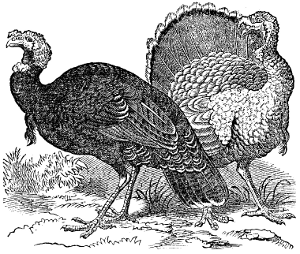
THE DOMESTIC TURKEY.
The varieties of the domesticated turkey are not very distinct; and as to their relative value, it is, perhaps, difficult to give any decisive opinion. Some suppose that the white turkey is the most robust, and most easily fattened. Experience has, however, shown to the contrary. The pure white are very elegant creatures; and though very tender to rear, are not so much so as the white pea fowl. Most birds, wild as well as tame, occasionally produce perfectly white individuals, of more delicate constitution than their parents. The selection and pairing of such have probably been the means of establishing and keeping up this breed. With all care, they will now and then produce speckled birds and so show a tendency to return to the normal plumage. It is remarkable that in specimens which are, in other respects, snow-white, the tuft on the breast remains coal-black, appearing, in the hens, like a tail of ermine, and so showing us a great ornament. The head and caruncles on the neck of the male are, when excited, of the same blue and scarlet hues. The bird is truly beautiful, with its snowy and trembling flakes of plumage thus relieved with small portions of black, blue, and scarlet. They have one merit—they dress most temptingly white for market; but they are unsuited for mirey, smokey, or clayey situations, and show and thrive best where they have a range of clean, short pasture, on a light or chalky subsoil.
The bronze and copper-colored varieties are generally undersized, and are among the most difficult of all to rear; but their flesh is, certainly, very delicate, and, perhaps, more so than that of other kinds—a circumstance, however, that may partly result from their far greater delicacy of constitution, and the consequent extra trouble devoted to their management.
The brown and ashy-gray are not particularly remarkable; but the black are decidedly superior, in every respect, not only as regards greater hardiness, and a consequent greater facility of rearing, but as acquiring flesh more readily, and that, too, of the very best and primest quality. Those of this color appear also to be far less removed than the others from the original wild stock. Fortunately, the black seems to be the favorite color of Nature; and black turkeys are produced far more abundantly than those of any other hue.
The turkey is a most profitable bird, since it can almost wholly provide for itself about the roads; snails, slugs, and worms are among the number of its dainties, and the nearest stream serves to slake its thirst. To the farmer, however, it is often a perfect nuisance, from its love of grain; and should, therefore, be kept in the yard until all corn is too strong in the root to present any temptation.
Notwithstanding the separation which, with the exception of certain seasons, subsists between the cock and hen turkey in a wild state, they have been taught to feed and live amiably together in a state of domesticity. The former, however, retains sufficient of his hereditary propensities to give an occasional sly blow to a froward chicken, but that very seldom of a serious or malicious character.
One reason why the turkeys seen in poultry-yards do not vie in splendor of plumage with their untamed brethren is, that they are not allowed to live long enough. For the same cause, the thorough development of their temper and disposition is seldom witnessed. It does not attain its full growth till its fifth or sixth year, yet it is killed at latest in the second, to the evident deterioration of the stock. If some of the best breeds were retained to their really adult state, and well fed meanwhile, they would quite recompense their keeper by their beauty in full plumage, their glancing hues of gilded green and purple, their lovely shades of bronze, brown, and black, and the pearly lustre that radiates from their polished feathers.
THE DUCK.
This bird is of the order of natatores, or swimmers; family, anatidæ, of the duck kind; genus, anas, or duck. The most striking character of the swimming bird is derived from the structure of the feet, which are always palmate—that is, furnished with webs between the toes. There are always three toes directed forward, and these are usually united by a membrane to their extremities; but, in some cases, the membrane is deeply cleft, and the toes are occasionally quite free, and furnished with a distinct web on each side. The fourth toe is generally but little developed, and often entirely wanting; when present, it is usually directed backward, and the membrane is sometimes continued to it along the side of the feet. These webbed feet are the principal agents by which the birds propel themselves through the water, upon the surface of which most of them pass a great portion of their time. The feet are generally placed very far back, a position which is exceedingly favorable to their action in swimming, but which renders their progression on the land somewhat awkward.
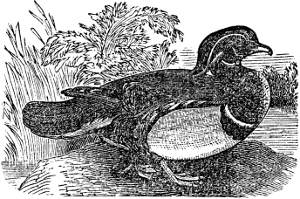
THE EIDER DUCK.
The body is generally stout and heavy, and covered with a very thick, close, downy plumage, which the bird keeps constantly anointed with the greasy secretions of the caudal gland, so that it is completely water-proof. The wings exhibit a great variety in their development; in some species being merely rudimentary, destitute of quills, and covered with a scaly skin—in others, being of vast size and power, and the birds passing a great part of their lives in the air. The form of the bill is also very remarkable; in some, broad and flat; in others, deep and compressed; and in others, long and slender.
Most of these birds live in societies, which are often exceedingly numerous, inhabiting high northern and southern latitudes.
The distinguishing characteristic of the family of the anatidæ is the bill, which is usually of a flattened form, covered with a soft skin, and furnished at the edges with a series of lamellæ, which serve to sift or strain the mud in which they generally seek their food. The feet are furnished with four toes, three of which are directed forward, and united by a web; the fourth is directed backward, usually of small size, and quite free. They are admirable swimmers, and live and move on the water with the utmost security, ease, and grace. Such is their adaptation to this element that the young, immediately after being hatched, will run to it, and fearlessly launch themselves upon its bosom, rowing themselves along with their webbed feet, without a single lesson, and yet as dexterously as the most experienced boatman. They are generally inhabitants of the fresh waters, and for the most part, prefer ponds and shallow lakes, in which they can investigate the bottom with their peculiar bills, without actually diving beneath the surface; yet at some seasons they are found along the borders of the sea. Their food generally consists of worms, mollusca, and aquatic insects, which they separate from the mud by the agency of the lamellæ at the margin of the bill; but most of them also feed upon seeds, fruits, and other vegetable substances.
THE WILD DUCK.
This bird, known also by the name of mallard, is the original of all the domestic varieties. It is twenty-four inches long, and marked with green, chestnut and white. Wild ducks are gregarious in their habits, and generally migrate in large flocks. The males are larger than the females, and the latter are also usually of a more uniform and sober tint.
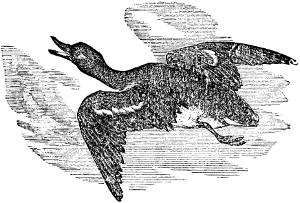
WILD DUCK.
It is an inhabitant of all the countries of Europe, especially toward the north, and is also abundant in North America, where it is migratory, passing to the North in Spring, and returning to the South in autumn. It frequents the lakes of the interior, as well as the sea-coasts. It is plentiful in Great Britain at all seasons, merely quitting the more exposed situations at the approach of winter, and taking shelter in the valleys; or, in case of a severe winter, visiting the estuaries.
They moult twice in the year, in June and November; in June, the males acquire the female plumage to a certain extent, but regain their proper dress at the second moult, and retain it during the breeding season. In a wild state, the mallard always pairs, and, during the period of incubation, the male, although taking no part in the process, always keeps in the neighborhood of the female; and it is singular that half-bred birds between the wild and tame varieties always exhibit the same habits, although the ordinary domestic drakes are polygamous, always endeavoring to get as many wives as they can. The nest is usually placed upon the ground among reeds and ledges near the water; sometimes in holes or hollow trees, but rarely among the branches. The eggs vary from about eight to fourteen in number, and the young are active from the moment of their exclusion, and soon take to the water, where they are as much at home as the old birds.
As the flesh of wild ducks is greatly valued, immense numbers are shot, or taken in other ways. In England, large numbers are captured by decoys, consisting of a piece of water situated in the midst of a quiet plantation, from which six semicircular canals are cut, which are roofed over with hoops, and covered in with netting. Into this vast trap the ducks are enticed by young ducks trained for the purpose.
THE DOMESTIC DUCK.
The duck should always find a place in the poultry-yard, provided that it can have access to water, even a small supply of which will suffice. They have been kept with success, and the ordinary duck fattened to the weight of eight pounds, with no further supply of water than that afforded by a large pool sunk in the ground. In a garden, ducks will do good service, voraciously consuming slops, frogs, and insects—nothing, indeed, coming amiss to them; not being scratchers, they do not, like other poultry, commit such a degree of mischief, in return, as to partially counterbalance their usefulness. A drake and two or three ducks cost little to maintain; and the only trouble they will give is, that if there is much extent of water or shrubbery about their home, they will lay and sit abroad, unless they are brought up every night, which should be done. They will otherwise drop their eggs carelessly here and there, or incubate in places where their eggs will be sucked by crows, and half their progeny destroyed by rats.
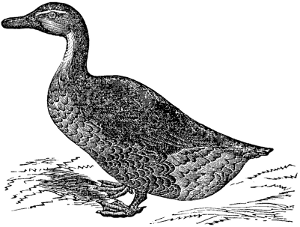
ROUEN DUCK.
The duck is very prolific, and its egg is very much relished by some, having a rich piquancy of flavor, which gives it a decided superiority over the egg of the domestic fowl; and these qualities render it much in request with the pastry-cook and confectioner—three duck’s eggs being equal in culinary value to six hen’s eggs. The duck does not lay during the day, but generally in the night; exceptions, regulated by circumstances, will, of course, occasionally occur. While laying, it requires, as has been intimated, more attention than does the hen, until it is accustomed to resort to a regular nest for depositing its eggs; when, however, this is once effected, little care is needed beyond what has been indicated.
The duck is a bad hatcher, being too fond of the water, and, consequently, too apt to allow her eggs to get cold; she will also, no matter what kind of weather it may be, bring the ducklings to the water the moment they break the shell—a practice always injurious, and frequently fatal; hence the very common practice of setting duck’s eggs under hens.
There are several varieties of tame ducks; but their merits are more diverse in an ornamental than in a profitable point of view. Of white ducks, the best is the Aylesbury, with its unspotted, snowy plumage, and yellow legs and feet. It is large and excellent for the table, but not larger or better than several others. They are assiduous mothers and nurses, especially after the experience of two or three seasons. A much smaller race of white ducks is imported from Holland, useful only to the proprietors of extensive or secluded waters, as enticers of passing wild birds to alight and join their society. This variety has a yellow-orange bill; that of the Aylesbury should be flesh-colored. There is, also, the white hook-billed duck, with a bill monstrously curved downward—a Roman-nosed duck, in fact—with Jewish features, of a most grotesque and ludicrous appearance; the bill has some resemblance in its curvature to that of the Flamingo. White ducks, of course, make but a sorry figure in towns or dirty suburbs, or in any place where the means of washing themselves are scanty.
There are one or two pretty varieties, not very common; one of a slate-gray, or bluish dun, another of a sandy-yellow; there are also some with top-knots as compact and spherical as those of any Polish fowl, which rival the hook-billed in oddity. What are termed the white Poland and the black Poland are crested; they breed early, and are excellent layers; the former are deemed the most desirable though the black are the larger.
Of mottled and pied sorts, there exists a great variety; black and white, bronze and white, lightly speckled, and many other mixtures. To this class belongs the Rouen—or Rhone, or Rohan, since each designation has been used—duck, which has been needlessly overpraised by interested dealers. This variety is highly esteemed by epicures; it is a prolific bird, and lays large eggs; its size is the criterion of its value. There is also a pied variety of the Poland ducks, a hybrid between the white and the black, the Beaver.
Another variety, known as the Labrador, the Buenos Ayres, or the black East Indian duck, is somewhat rare and highly esteemed by dealers. They are very beautiful birds. The feet, legs, and entire plumage should be black; a few white feathers will occasionally appear. The bill also is black, with a slight under-tinge of green. Not only the neck and back, but the larger feathers of the tail and wings are gilt with metallic green; the female also exhibits slight traces of the same decoration. On a sunshiny spring day, the effect of these glittering black ducks sporting in the blue water is very pleasing.
A peculiarity of this variety is, that they occasionally—that is, at the commencement of the season—lay black eggs; the color of those subsequently laid gradually fades to that of the common kinds. This singular appearance is not caused by any internal strain penetrating the whole thickness of the shell, but by an oily pigment, which may be scraped off with the nail. They lay, perhaps, a little later than other ducks, but are not more difficult to rear. Their voice, likewise, is said to differ slightly from that of other varieties; but they are far superior in having a high, wild-duck flavor and, if well kept, are in deserved repute as being excellent food when killed immediately from the pond, without any fattening.
Still another breed, known as the Muscovy duck, is a distinct species from the common duck; and the hybrid race will not, therefore, breed again between themselves, although they are capable of doing so with either of the species from the commixture of which they spring. This duck does not derive its name from having been brought from the country indicated, but from the flavor of its flesh, and should more properly be termed the musk duck, of which this name is but a corruption. It is easily distinguished by a red membrane surrounding the eyes, and covering the cheeks. Not being in esteem, on account of their peculiar odor, and the unpleasant flavor of their flesh, they are not worth breeding, unless to cross with the common varieties; in which case, the musk drake must be put to the common duck. This will produce a very large cross, while the opposite course will beget a very inferior one.
THE GOOSE.
The wild goose. The goose belongs to the same family as the duck, but is classed with the genus anser. The gray-leg goose—a common wild goose of England—is by some regarded as the original of the domestic bird. It is thirty-five inches long; upper parts ash-brown and ash-gray; under parts white. This variety is migratory, proceeding to the Northern parts of Europe and Asia in summer, and to the South in winter.
The Canada, or Cravat goose, the wild goose of this country, is a fine species, forty inches long, often seen in spring and autumn in large, triangular flocks, high in air, and led by an old, experienced gander, who frequently utters a loud honk, equivalent, doubtless, to “All’s well!” This sound often comes upon the ear at night, when the flock are invisible; and it is frequently heard even in the daytime, seeming to come from the sky, the birds being beyond the reach of vision. Immense numbers of these noble birds are killed in Canada, as well as along our coasts, where they assemble in the autumn in large flocks, and remain till driven to more Southern climates by the season.
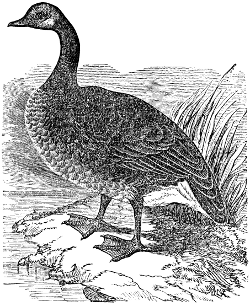
WILD OR CANADA GOOSE.
The Canada goose is capable of domestication, and, in spite of its original migratory habits—which it appears, in almost every instance, to forget in England—shows much more disposition for a truly domestic life than the swan; and it may be maintained in perfect health with very limited opportunities for bathing. They eat worms and soft insects, as well as grass and aquatic plants; with us, they do not breed until they are at least two years old, and so far approach the swan; like which bird, also, the male appears to be fit for reproduction at an earlier period than the female. Many writers speak highly of the half-bred Canada. They are, certainly, very large, and may merit approbation on the table; but with whatever other species the cross is made, they are hideously disgusting.
THE DOMESTIC GOOSE.
The goose is not mentioned in the Bible, but it was known to the ancient Egyptians, and is represented in numerous instances on their monuments, showing that it was anciently used for food, as in our own times. It was held sacred by the Romans, because it was said to have alarmed, by its cackling at night, the sentinels of the capitol, at the invasion of the Gauls, and thus to have saved the city. This was attributed by one of the Roman writers to its fine sense of smell, which enables them to perceive at a great distance the odor of the human race. The liver of this bird seems to have been a favorite morsel with epicures in all ages; and invention appears to have been active in exercising the means of increasing the volume of that organ. It is generally esteemed a foolish bird; yet it displays courage in defending its young, and instances of attachment and gratitude have shown that it is not deficient in sentiment. The value and usefulness of geese are scarcely calculable. The only damage which they do lies in the quantity of food which they consume; the only care they require is to be saved from starvation. All the fears and anxieties requisite to educate the turkey and prepare it for making a proper appearance at the table are with them unnecessary; grass by day, a dry bed at night, and a tolerably attentive mother, are all that is required. Roast goose, fatted to the point of repletion, is almost the only luxury that is not deemed an extravagance in an economical farm-house; for there are the feathers, to swell the stock of beds; there is the dripping, to enrich the dumpling or pudding; there are the giblets, for market or a pie; and there is the wholesome, solid, savory flesh for all parties interested.
They are accused by some of rendering the spots where they feed offensive to other stock; but the explanation is simple. A horse bites closer than an ox; a sheep goes nearer to the ground than a horse; but, after the sharpest shearing by sheep, the goose will polish up the tuft, and grow fat upon the remnants of others. Consequently, where geese are kept in great numbers on a small area, little will be left to maintain any other grass-eating creature. If, however, the pastures are not short, it will not be found that other grazing animals object to feeding either together with, or immediately after, a flock of geese.
The goose has the merit of being the earliest of poultry. In three months, or, about four, from leaving the egg, the birds ought to be fit for the feather-bed, the spit, and the fire. It is not only very early in its laying, but also very late. It often anticipates the spring in November, and, afterward, when spring really comes in March, it cannot resist its general influence. The autumnal eggs afford useful employment to turkeys and hens that choose to sit at unseasonable times; and the period of incubation is less tedious than that required for the eggs of some other birds.
The flight of the domestic goose is quite powerful enough, especially in young birds, to allow them to escape in that way, where they are so inclined. In the autumn, whole broods may be seen by early risers taking their morning flight, and circling in the air for matutinal exercise, just like pigeons, when first let out of their locker. The bird lives to a very great age, sometimes seventy years or more.
As to the origin of our domestic species, opinions differ. By some, as already remarked, the gray-leg is regarded as the parent stock; others consider it a mongrel, like the dunghill fowl, made up of several varieties, to each of which it occasionally shows more or less affinity; and yet others contend that it is not to be referred to any existing species. The latter assert that there is really but one variety of the domestic goose, individuals of which are found from entirely white plumage, through different degrees of patchedness with gray, to entirely gray coloring, except on the abdomen.
The domestic gander is polygamous, but he is not an indiscriminate libertine; he will rarely couple with females of any other species. Hybrid common geese are almost always produced by the union of a wild gander with a domestic goose, and not by the opposite. The ganders are generally, though not invariably, white, and are sometimes called Embden geese, from a town of Hanover. High feeding, care, and moderate warmth will induce a prolific habit, which becomes, in some measure, hereditary. The season of the year at which the young are hatched—and they may be reared at any season—influences their future size and development. After allowing for these causes of diversity, it is claimed that the domestic goose constitutes only one species or permanent variety.
THE BERNACLE GOOSE.
This bird is sometimes called the Barnacle goose; its name originates from the fact that it was formerly supposed to be bred from the shells so termed, which cling to wood in the sea. It is about twenty-five inches long, and is found wild in Europe, abundantly in the Baltic; and, occasionally, as it is said, in Hudson’s Bay, on this continent.
This bird is one of those species in which the impulse of reproduction has at length overcome the sullenness of captivity, and instances of their breeding when in confinement have increased in frequency to such an extent that hopes are entertained of the continuance of that increase. The young so reared should be pinioned at the wrist as a precaution. They would probably stay at home contentedly, if unpinioned, until the approach of inclement weather, when they would be tempted to leave their usual haunts in search of marshes, unfrozen springs, mud-banks left by the tide, and the open sea; or they might be induced to join a flock of wild birds, instead of returning to their former quarters.
Broods of five, six, and seven have been reared; but they are generally valued as embellishments to ponds merely, their small size rendering them suitable even for a very limited pleasure-ground, and the variety being perhaps the prettiest geese that are thus employed. The lively combination of black, white, gray, and lavender, gives them the appearance of being in agreeable half-mourning. The female differs little from the male, being distinguished by voice and deportment more than by plumage. Their short bill, the moderate-sized webs of their feet, and their rounded proportions, indicate an affinity with the curious Cereopsis goose, which is found in considerable numbers on the seashore of Sucky Bay and Goose Island, at the south-eastern point of Australia.
The number of eggs laid is six or seven, and the time of incubation is about a month; it being difficult to name the exact period, from the uncertainty respecting the precise hour when the process commences. They are steady sitters. The young are lively and active little creatures, running hither and thither, and tugging at the blades of grass. Their ground color is of a dirty white; their legs, feet, eyes, and short stump of a bill, are black; they have a gray spot on the crown of the head, gray patches on the back and wings, and a yellowish tinge about the forepart of the head. The old birds are very gentle in their disposition and habits, and are less noisy than most geese.
The service they may render as weed-eaters is important, though their size alone precludes any comparison of them, in this respect, with the swan. Their favorite feeding-grounds are extensive flats, partially inundated by the higher tides; and their breeding may perhaps best be promoted by their being furnished with a little sea-weed during winter and early spring; a few shrimps, or small mussels, would probably not be unacceptable. A single pair is more likely to breed than if they are congregated in larger numbers.
THE BREMEN GOOSE.
The Bremen geese—so called from the place whence they were originally imported, though some term them Embden geese—have been bred in this country, pure, and to a feather, since 1821; no single instance having occurred in which the slightest deterioration of character could be observed. The produce has invariably been of the purest white; the bill, legs, and feet being of a beautiful yellow.
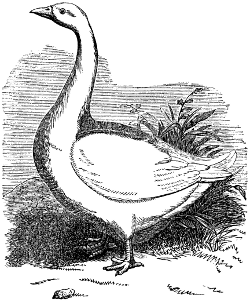
A BREMEN GOOSE.
The flesh of this goose does not partake of that dry character which belongs to other and more common kinds, but is as tender and juicy as the flesh of a wild fowl; it shrinks less in cooking than that of any other fowl. Some pronounce its flesh equal if not superior to that of the canvas-back duck.
They likewise sit and hatch with more certainty than common barn-yard geese; will weigh nearly, and in some instances quite, twice the weight—the full-blood weighing twenty pounds and upward; they have double the quantity of feathers; and never fly.
THE BRENT GOOSE.
This is a small species, twenty-one inches long, common in a wild state, in both Europe and America. On our coast, it is a favorite game-bird, and known by the name of Brant. It is easily tamed, and is said to have produced young in captivity, though no details have been furnished.
This and the Sandwich Island goose are the smallest of their tribe yet introduced to our aquatic aviaries. Their almost uniform color of leaden black, and their compactness of form, make them a striking feature in the scene, though they cannot be compared in beauty with many other waterfowl. There is so little difference in the sexes that it is not easy to distinguish them. Their chief merit rests in their fondness for water-weeds, in which respect they appear to be second only to the swan. They are quiet, gentle and harmless in captivity. Some praise their flesh, while others pronounce it fishy, strong, and oily; they may, however, be converted into tolerable meat by being skinned and baked in a pie.
THE CHINA GOOSE.
This bird figures under a variety of aliases: Knob goose, Hong Kong goose, Asiatic goose, Swan goose, Chinese Swan Guinea goose, Polish goose, Muscovy goose, and, probably, others.
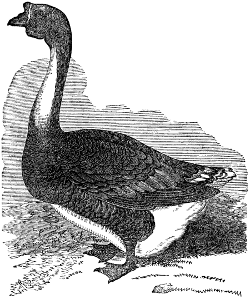
CHINA OR HONG KONG GOOSE.
There is something in the aspect of this creature—in the dark-brown stripe down its neck, its small, bright eye, its harsh voice, its ceremonious strut, and its affectation of seldom being in a hurry—which seems to say that it came from China. If so, it has no doubt been domesticated for many hundred years, perhaps as long as the pea fowl or the common fowl. They may be made to lay a large number of eggs by an increased supply of nourishing food. If liberally furnished with oats, boiled rice, etc., the China goose will, in the spring, lay from twenty to thirty eggs before she begins to sit, and again in the autumn, after her moult, from ten to fifteen more. Another peculiarity is their deficient power of flight, compared with other geese, owing to the larger proportionate size of their bodies. Indeed, of all geese, this is the worst flyer; there is no occasion to pinion them; the common domestic goose flies much more strongly.
The prevailing color of their plumage is brown, comparable to the color of wheat. The different shades are very harmoniously blended, and are well relieved by the black tuberculated bill, and the pure white of the abdomen. Their movements on the water are graceful and swan-like. Slight variations occur in the color of the feet and legs, some having them of a dull orange, others black; a delicate fringe of minute white feathers is occasionally seen at the base of the bill. These peculiarities are hereditarily transmitted.
The male is almost as much disproportionately larger than the female as the Musk drake is in comparison with his mate. He is much inclined to libertine wanderings, without, however, neglecting proper attention at home. If there is any other gander on the premises, a disagreement is sure to result. Both male and female are, perhaps, the noisiest of all geese; at night, the least footfall or motion in their neighborhood is sufficient to call forth their clangor and resonant trumpetings.
The eggs are somewhat less than those of the domestic kind, of a short oval, with a smooth, thick shell, white, but slightly tinged with yellow at the smaller end. The goslings, when first hatched, are usually very strong. They are of a dirty green, like the color produced by mixing India-ink and yellow ochre, with darker patches here and there. The legs and feet are lead-color, but afterward change to a dull red. With good pasturage, they require no farther attention than that bestowed by their parents. After a time, a little grain will strengthen and forward them. If well fed, they come to maturity very rapidly; in between three and four months from the time of leaving the shell, they will be full-grown and ready for food. They do not bear being shut up to fatten so well as common geese, and, therefore, those destined for the table are the better for profuse hand-feeding. Their flesh is well-flavored, short, and tender; their eggs, excellent for cooking purposes.
They are said to be a short-lived species; the ganders, at least, not lasting more than ten or a dozen years. Hybrids between them and the common goose are prolific with the latter; the second and third cross is much prized by some farmers, particularly for their ganders; and in many flocks the blood of the China goose may be traced oftentimes by the more erect gait of the birds, accompanied by a faint stripe down the back of the neck. With the White-fronted goose they also breed freely.
The White-China. These are larger than the preceding, and apparently more terrestrial in their habits; the knob on the head is not only of greater proportion, but of a different shape. It is of a spotless, pure white—though a very few gray feathers occasionally appear—more swan-like than the brown, with a bright orange-colored bill, and a large knot of the same color at its base. It is particularly beautiful, either in or out of the water, its neck being long, slender, and gracefully arched when swimming. It breeds three or four times in the season; the egg is quite small for the size of the bird, being not more than half the size of that of the common goose.
In many instances, efforts to obtain young from their eggs have been unsuccessful; but if the female is supplied with the eggs of the common goose, she invariably hatches and rears the goslings. They sit remarkably well, never showing themselves out of the nest by day; but, possibly, they may leave the nest too long in the cold of the night. Some think that a quiet lake is more to their taste than a rapid running stream, and more conducive to the fecundity of their eggs. It is also believed by many that, under favorable circumstances, they would be very prolific.
THE EGYPTIAN GOOSE.
This species is bred to a certain extent in this country. It is a most stately and rich bird, reminding one of the solemn antiquity of the Nile, with its gorgeous mantle of golden hues and its long history.
It is dark red round the eyes; red ring round the neck; white bill; neck and breast light fawn-gray; a maroon star on the breast; belly red and gray; half of the wing-feathers rich black, the other part of them pure white; black bar running across the centre, back light-red, growing dark-red toward the tail; the tail a deep black.
They are very prolific, bringing off three broods a year, from eight to twelve each time; their weight is about eight pounds each.
THE JAVA GOOSE.
The gander of this species is white, with head and half the neck light-fawn; red tubercle at the root of the bill; larger than the common goose, and longer in the body; walks erect, standing as high as the China goose, the female appearing to carry two pouches, or egg-bags, under the belly.
It is very prolific; and the meat is of fine flavor.
THE TOULOUSE GOOSE.
This bird is said to have been originally imported from the Mediterranean; and is known also by the names Mediterranean goose, and Pyrenean goose. It is chiefly remarkable for its vast size, in which respect it surpasses all others.
Its prevailing color is a slaty blue, marked with brown bars, and occasionally relieved with black; the head, neck, as far as the beginning of the breast, and the back of the neck, as far as the shoulders, of a dark-brown; the breast slaty-blue; the belly is white, in common with the under surface of the tail; the bill is orange-red, and the feet flesh-color.
In habit, the Toulouse goose resembles his congeners, but seems to possess a milder and more tractable disposition, which greatly conduces to the chance of his early fattening, and that, too, at a little cost. The curl of the plumage on the neck comes closer to the head than that on common geese, and the abdominal pouch, which, in other varieties, is an accompaniment of age, exists from the shell. The flesh is said to be tender and well-flavored.
Some pronounce this bird the unmixed and immediate descendant of the Gray-leg; while others assert that it is only the common domestic, enlarged by early hatching, very liberal feeding during youth, fine climate, and, perhaps, by age, and style them grenadier individuals of the domestic goose—nothing more.
THE WHITE-FRONTED GOOSE.
In its wild state, the White-fronted or Laughing goose is twenty-seven inches long, and found in great numbers in Europe and in the North American Fur countries, but rare along our coasts.
When domesticated, it belongs to the class of birds which are restrained from resuming their original wild habits more by the influence of local and personal attachment than from any love which they seem to have for the comforts of domestication; which may be trusted with their entire liberty, or nearly so, but require an eye to be kept on them from time to time, lest they stray away and assume an independent condition. The white-fronted goose well deserves the patronage of those who have even a small piece of grass.
The first impression of every one, upon seeing this species in confinement, would be that it could not be trusted with liberty; and the sight of it exercising its wings at its first escape would make its owner despair of recovering it. This is not, however, the case. By no great amount of care and attention, they will manifest such a degree of confidence and attachment as to remove all hesitation as to the future; and they may be regarded as patterns of all that is valuable in anserine nature—gentle, affectionate, cheerful, hardy, useful, and self-dependent. The gander is an attentive parent, but not a faithful spouse.
The eggs are smaller than those of the common goose, pure white, and of a very long oval; the shell is also thinner than in, most others; the flesh is excellent.
Having completed the enumeration and description of the varieties of poultry, it will, perhaps, be appropriate to give some account, before proceeding to the next general division of the subject, of the structure, or anatomy, so to speak, of
THE EGG.
In a laying hen may be found, upon opening the body, what is called the ovarium—a cluster of rudimental eggs, of different sizes, from very minute points up to shapes of easily-distinguished forms. These rudimental eggs have as yet no shell or white, these being exhibited in a different stage of development; but consist wholly of yolk, on the surface of which the germ of the future chicken lies. The yolk and the germ are enveloped by a very thin membrane.
When the rudimental egg, still attached to the ovarium, becomes longer and larger, and arrives at a certain size, either its own weight, or some other efficient cause, detaches it from the cluster, and makes it fall into a sort of funnel, leading to a pipe, which is termed the oviduct.
Here the yolk of the rudimental egg, hitherto imperfectly formed, puts on its mature appearance of a thick yellow fluid; while the rudimental chick or embryo, lying on the surface opposite to that by which it had been attached to the ovarium, is white, and somewhat like paste.
The white, or albumen, of the egg now becomes diffused around the yolk, being secreted from the blood vessels of the egg-pipe, or oviduct, in the form of a thin, glassy fluid; and it is prevented from mixing with the yolk and the embryo chicken by the thin membrane which surrounded them before they were detached from the egg-cluster, while it is strengthened by a second and stronger membrane, formed around the first, immediately after falling into the oviduct. This second membrane, enveloping the yolk of the germ of the chicken, is thickest at the two ends, having what may be termed bulgings, termed chalazes by anatomists; these bulgings of the second membrane pass quite through the white at the ends, and being thus, as it were, embedded in the white, they keep the inclosed yolk and germ somewhat in a fixed position, preventing them from rolling about within the egg when it is moved.
The white of the egg being thus formed, a third membrane, or, rather, a double membrane, much stronger than either of the first two, is formed around it, becoming attached to the chalazes of the second membrane, and tending still more to keep all the parts in their relative positions.
During the progress of these several formations, the egg gradually advances about half way along the oviduct. It is still, however, destitute of the shell, which begins to be formed by a process similar to the formation of the shell of a snail, as soon as the outer layer of the third membrane has been completed. When the shell is fully formed, the egg continues to advance along the oviduct, till the hen goes to her nest and lays it.
From ill health, or accidents, eggs are sometimes excluded from the oviducts before the shell has begun to be formed, and in this state they are popularly called wind-eggs.
Reckoning, then, from the shell inward, there are six different envelopes, of which one only could be detected before the descent of the egg into the oviduct: the shell; the external layer of the membrane lining the shell; the internal layer of same lining; the white, composed of a thinner liquid on the outside, and a thicker and more yellowish liquid on the inside; the bulgings, or chalaziferous membrane; and the proper membrane.
One important part of the egg is the air-bag, placed at the larger end, between the shell and its lining membrane. This is about the size of the eye of a small bird in new-laid eggs, but is increased as much as ten times in the process of hatching. The air bag is of such great importance to the development of the chicken—probably by supplying it with a limited atmosphere of oxygen—that, if the blunt end of an egg be pierced with the point of the smallest needle, the egg cannot be hatched.
Instead of one rudimental egg falling from the ovarium, two may be detected, and will, of course, be inclosed in the same shell, when the egg will be double-yolked. The eggs of a goose have, in some instances, contained even three yolks. If the double-yolked eggs be hatched, they will rarely produce two separate chickens, but, more commonly, monstrosities—chickens with two heads, and the like.
The shell of an egg, chemically speaking, consists chiefly of carbonate of lime, similar to chalk, with a small quantity of phosphate of lime, and animal mucus. When burnt, the animal matter and the carbonic acid gas of the carbonate of lime are separated; the first being reduced to ashes, or animal charcoal, while the second is dissipated, leaving the decarbonized lime mixed with a little phosphate of lime.
The white of the egg is without taste or smell, of a viscid, glairy consistence, readily dissolving in water, coagulable by acids, by spirits of wine, and by a temperature of one hundred and sixty-five degrees, Fahrenheit. If it has once been coagulated, it is no longer soluble in either cold or hot water, and acquires a slight insipid taste. It is composed of eighty parts of water, fifteen and a half parts of albumen, and four and a half parts of mucus; besides giving traces of soda, benzoic acid, and sulphuretted hydrogen gas. The latter, on an egg being eaten on a silver spoon, stains the spoon of a blackish purple, by combining with the silver, and forming sulphuret of silver.
The white of the egg is a very feeble conductor of heat, retarding its escape; and preventing its entrance to the yolk; a providential contrivance, not merely to prevent speedy fermentation and corruption, but to arrest the fatal chills, which might occur in hatching, when the mother hen leaves her eggs, from time to time, in search of food. Eels and other fish which can live long out of water, secrete a similar viscid substance on the surface of their bodies, furnished to them, doubtless, for a similar purpose.
The yolk has an insipid, bland, oily taste; and, when agitated with water, forms a milky emulsion. If it is long boiled it becomes a granular, friable solid, yielding upon expression, a yellow, insipid, fixed oil. It consists, chemically, of water, oil, albumen, and gelatine. In proportion to the quantity of albumen, the egg boils hard.
The weight of the eggs of the domestic fowl varies materially; in some breeds, averaging thirty-three ounces per dozen, in others, but fourteen and a half ounces. A fair average weight for a dozen is twenty-two and a half ounces. Yellow, mahogany, and salmon-colored eggs are generally richer than white ones, containing, as they do, a larger quantity of yolk. These are generally preferred for culinary purposes; while the latter, containing an excess of albumen, are preferred for boiling, etc., for the table.
Breeding. Good fowls are very profitable in the keeping of intelligent breeders. It is stated, by those most competent to express the opinion, that four acres of land, devoted to the rearing of the best varieties of poultry, will, at ordinary prices, be quite as productive as a farm of one hundred and fifty acres cultivated in the usual way. The eggs of the common and cheaper kinds which might be used for incubators and nurses, would pay—or could be made to pay, if properly preserved, and sold at the right time—all expenses of feed, etc.; while good capons of the larger breeds will bring, in any of our larger markets, from three to five dollars per pair, and early spring chickens from twenty to twenty-five cents per pound.
To make poultry profitable, then, it is only necessary that the better kinds be bred from, that suitable places be provided for them, that they be properly fed, and carefully and intelligently managed. These requirements are too rarely complied with, in every respect, to enable a correct opinion to be formed as to what may be made out of poultry under the most favorable circumstances.
A few general principles, well-understood and faithfully applied, will prove of great value. By “in-and-in breeding” is meant commerce between individuals of the same brood, or brother and sister, so to speak; by “close breeding,” commerce between the parent and his offspring, in whatever degree.
Crossing the breed. To insure successful and beneficial crossing of distinct breeds, in order to produce a new and valuable variety, the breeder must have an accurate knowledge of the laws of procreation, and the varied influences of parents upon their offspring. All the breeds in this country are crosses, produced either by accident or design. Crossing does not necessarily produce a breed; but it always produces a variety, and that variety becomes a breed only where there is a sufficiency of stamina to make a distinctive race, and continue a progeny with the uniform or leading characteristics of its progenitors.
High breeding. When uniformity of plumage can be effected in mixed breeds or varieties without a resort to in-and-in, or close breeding, and without sacrificing the health and vigor of the race, it is desirable; and, in many instances, it can be accomplished in a satisfactory manner. What are called highly-bred fowls are, however, too often the deteriorated offspring of progenitors far below the original stock. Genuine high breeding consists in the selection of parent stock of the same race, perfect in all the general characteristics, and of remote consanguinity. This should be resorted to periodically, in order to secure the best results.
If a race is pure—that is, if the species or variety is absolutely distinct and unsophisticated—the progeny resembles the progenitors in almost every respect. The mixture of races, where the consanguinity is remote, is productive of decided benefits.
To illustrate, in the case of fowls: when the blood is unmixed—as with the Guelderlands, and some others—the offspring, in all respects, resemble their parents; in plumage, general habits, form, outline, etc. In this case, they look almost identically the same. But when the blood is mixed—as with the Cochin Chinas, and many others—the plumage will vary widely, or slightly, according to circumstances, though many or most of the general characteristics may remain the same. The close breeding, to which many resort for the purpose of procuring uniformity, generally results in an absolute deterioration of the race in important respects.
In some cases, close breeding—and, occasionally, in-and-in—seems to be in accordance with the laws of Nature; as with the wild turkey, which, in its natural state, resorts to these modes of breeding; and yet the race does not change in appearance or degenerate. The reason is that the breed is pure. In comparing any number of these birds, not the least dissimilarity is discoverable; they all look alike, as they always have, and always will. They are changed, or deteriorated, only by crossing or confinement.
Most breeds of the hen kind degenerate rapidly from close, or in-and-in breeding, because they are not perfect of their kind; that is, the breed is not pure, but of mixed blood; and in such objectionable breeding, the race degenerates just in proportion as the breed is imperfect, or impure. The perfect Guelderland will admit of these modes of breeding, for a great length of time, without deterioration; but the impure or mixed will rapidly degenerate. This is also true of all breeds, wherein the characteristic marks are uniform and confirmed, showing perfection in the race.
As a general rule, however, close and in-and-in breeding should be carefully avoided where the race is not absolutely perfect, if it is desired to improve the breed; and as all the breeds of this kind of fowls are of mixed blood, the danger of such breeding is greater or less, in exact proportion as the distinctive characteristics are variant or fixed; and the danger still increases if the breed is composed of strains of blood greatly dissimilar, or of races widely differing in the conformation or general habits.
Preserving the distinctive breeds. As to the time when the different breeds of hens should be separated in the spring, in order to preserve the breed pure, the most ample experience indicates that if the eggs be preserved and set after a separation of two days, the breed will be perfect, the offspring having all the characteristics or distinctive marks.
When a valuable breed is produced, either by accident or design, it should be preserved, and the subsequent breeding should continue from that stock; otherwise, there is no certainty of the purity of the blood of the new breed, for it does not follow that a different parentage, though of the same name or original breed precisely, will produce the same new breed, or any thing resembling it. The Dorking fowl, for instance, was originally produced by crossing the Great Malay with the English Game, as an accident; but it by no means follows that Dorkings are the uniform, or even the common result of such a cross, for hundreds of similar experiments have proved unsuccessful. The breeding, therefore, to be pure-blooded, must continue from the stock originally produced by accident; and as such breeding produces the leading characteristics of the race with great uniformity, the genuineness of the breed cannot be doubted.
In order to produce a good cross, the parentage should be healthy, and from healthy races, not materially dissimilar in their general habits. The size of the leg should always be looked to, in order to judge accurately as to purity of blood. If the leg is large for the breed—that is, if larger than the generality of the same breed—the purity of the blood, the fineness of the flesh, and most of the other valuable qualities, can be relied on; but, if the legs are smaller than most others of the same breed, the fowl is spurious, and of deteriorated blood. The fifth toe and feathered legs of some breeds were originally the result of accident; but by long and careful breeding, they have become incorporated into the nature of certain races of general, though not universal or essential, requisites. When a fowl exhibits any special marks indicative of all the races or breeds from which the cross originated, it is a sure evidence of extraordinary purity of blood, and of the superior excellence of the race. The best fowls of the race should always be selected for crossing or general breeding; otherwise the breeds will degenerate.
The quality—that is, the fineness, juiciness, and richness of flavor—of the flesh of domestic fowls is of much more importance than their size. All coarse-meated fowls should, therefore, be rejected, no matter how large they may be. There is no difficulty in discriminating between coarse and fine fowls at any time. In the case of chickens, if the down is straight and stands out, and the body and limbs are loosely joined, the meat is coarse; but if the down is glossy, and lies close to the body, and the body and limbs are compactly formed, the meat is fine; and when grown, if the fowl is light in weight, in proportion to its size, the flesh is coarse; but if heavy, the flesh is fine.
There is also a fitness in the quality of the flesh; for, if the meat is fine, the bones are fine, and the feathers are fine; and the converse holds true. If the flesh is fine, it is juicy and richly flavored; if coarse, it is dry, fibrous, and insipid.
The color of the legs, too, is quite material in judging of the quality of fowls. All other things being equal, dark-legged fowls have the finest flesh, and are most hardy. Turkeys, which have the finest flesh of any fowl of their size, have black legs; the game-cock, likewise, which is universally acknowledged to be the finest-fleshed of any of the domestic fowls, except the Wild Indian fowl of Calcutta, has dark legs. It does not, however, of necessity follow that all dark-legged fowls are fine, or that all yellow or white-legged ones are coarse, since much depends upon the breed; but it is true that the darkest leg which pertains to the breed indicates the finest fowl.
The color of the feathers, also, has more or less to do with the quality of the fowl. Some breeds have a much more brilliant plumage than others; but when brilliancy of plumage is here spoken of, it is to be understood in comparison with others of the same breed. If, therefore, a fowl is selected of rich and glossy plumage, when compared with others of the same breed, the legs will be dark of the kind, and the quality of the bird will excel.
The best breeding is to cross or mix the races; this process improves the breeds, in all respects. When the object in view is to perpetuate distinct varieties of uncontaminated blood, the first requisite is to procure fowls known to be of pure blood, and possessing all the necessary characteristics of their kind. Labor is lost, unless the fowl selected is a perfect specimen of the variety; for whatever imperfection exists is likely to be perpetuated in the progeny. Regard should be had to plumage, size, and form, in making a selection either of a cock or a pullet; and those are preferable which are hatched earliest in the year. The age of the fowls is a matter of considerable importance; and, though it is true that a pullet will lay the greatest number of eggs in her first year, yet it is believed that the chickens which are hatched from the second year’s eggs are more vigorous and hardy. Old hens are generally preferred to pullets as sitters, on account of their more sedate and matronly character. A young cock, though more active in his earliest days, and likely to bestow his attention on the hens with less reserve, is not, however, best for use in keeping up a breed. The eggs impregnated by him after his first season are likely to produce the strongest chickens. It is an error to suppose—as is often represented— that his procreative power is decayed or vitiated after three or four years. On the contrary, a healthy, vigorous cock, if not allowed to walk with too many hens, may be valuable and useful in the poultry-yard for a longer time.
An error is often committed by assigning too many hens to one cock; and the result is a weakly and otherwise deteriorated progeny. Not more than five hens should be allowed to associate with a single cock, when the quality of the breed is a matter of interest. Three, indeed, would be the better number for restriction; but five is the farthest limit which can be safely assigned.
Most persons, in obtaining a single vigorous cock and hen of a desirable variety, find their anticipations more than realized in the production of a fine progeny. The plumage is brilliant, and the chickens are of increased size, and remarkably strong and healthy. This desirable state of things continues so long as the cock is restricted to a small number of hens; but as soon as his harem is enlarged, different effects are manifested, and a deterioration in the stock is clearly observable—attributable, not to close-breeding, but to the increased disproportion of the females to the male, and the consequent overtasking of his powers.
In breeding-time, great cleanliness should be preserved in the lodgings of the fowls, and the quantity and quality of food should be attended to. They should not be suffered to feed to repletion, and such kinds of food as are most nutritious should be carefully provided. Variety of food is essential; and a proper proportion of animal and green food should be given with their usual fare. Suitable arrangements should, of course, be made to prevent any intermixture of breeds. A constant vigilance in this respect is the price of success; and when all proper precautions are taken, the breeder may be perfectly secure that his anticipations will be realized.
SELECTION OF STOCK.
The habits of the domestic fowl, in a wild state, are too little known to ascertain whether the cocks always associate with the hens, or only occasionally. Though hens will lay some eggs without pairing, as this is not natural, the number will, for the most part, be less, and the laying uncertain; it is, therefore, indispensable to attend to the laws of Nature in this respect.
The number of hens to be allowed to one cock should vary with the object in view. The limit for valuable breeding purposes has already been indicated. If profit is sought for, in the production of eggs alone, one cock—if a stout, young, and lively bird—may have as many as twenty-four hens.
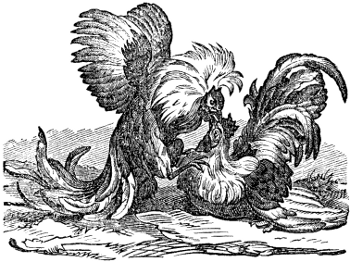
FIGHTING COCKS.
The choice of a cock is a very important thing. He is considered to have every requisite quality when he is of a good middling size; carries his head high; has a quick, animated look; a strong and shrill voice; a fine red comb, shining as if varnished; wattles of a large size, and of the same color as the comb; the breast broad; the wings strong; the plumage black or of an obscure red; the thighs very muscular; the legs thick, and furnished with strong spurs; and the claws rather bent and sharply pointed. He ought, also, to be free in his motions, to crow frequently, and to scratch the ground often in search of worms, not so much for himself as to treat his hens. He ought, withal, to be brisk, spirited, ardent, and ready in caressing the hens; quick in defending them, attentive in soliciting them to eat, in keeping them together, and in assembling them at night.
In breeding game cocks, the qualities required are every mark of perfect health, such as a ruddy complexion; the feathers close, short, and not feeling cold or dry; the flesh firm and compact; and a full breast, betokening good lungs; a tapering and thinness behind. He should be full in the girth, well coupled, lofty and aspiring, with a good thigh, the beam of his leg very strong, the eye large and vivid, and the beak strong, crooked, and thick at the base.
A cock is in his prime at two years old; though cocks are sometimes so precocious as to show every mark of full vigor at four months, while others of the same brood do not appear in that state for several months afterward. When marks of declining vigor are perceived, the cock must be displaced, to make way for a successor, which should be chosen from among the finest and bravest of the supernumerary young cocks, that ought to be reared for this special purpose.
The change of cocks is of much importance, and is frequently very troublesome to manage; for peace does not long subsist between them when they hold a divided dominion in the poultry-yard, since they are all actuated by a restless, jealous, hasty, fiery, ardent disposition; and hence their quarrels become no less frequent than sanguinary. A battle soon succeeds to provocation or affront. The two opponents face each other, their feathers bristling up, their necks stretched out, their heads low, and their beaks ready for the onslaught. They observe each other in silence, with fixed and sparkling eyes. On the least motion of either, they stand stiffly up, and rush furiously forward, dashing at each other with beak and spur in repeated sallies, till the more powerful or the more adroit has grievously torn the comb and wattles of his adversary, has thrown him down by the heavy stroke of his wings, or has stabbed him with his spurs.
In the choice of a hen for sitting, a large bird should be selected, with large, wide-spreading wings. Though large, she must not, however, be heavy nor leggy. No one of judgment would sit a Malay; as, in such case, not only would many eggs remain uncovered, but many, also, would be trampled upon and broken. Elderly hens will be more willing to sit than young and giddy pullets.
After the common hen, which, on account of her fecundity, is deservedly esteemed, the tufted hens may be justly ranked; particularly from being more delicate eating, because she fattens more readily, on account of laying less. The large breed, though less prolific, is preferable in rearing chickens for the market, or for making capons. With regard to these three kinds, the general opinion of breeders is, that the first is more prolific in the number of eggs, while the others produce larger chickens, which bring good prices.
The Spanish fowl are not generally good sitters, but are excellent layers; the Dorkings reverse the order, being better sitters than layers. These qualities will be found to extend pretty generally to hens partaking of the prevailing colors of these two varieties; the black being usually the best layers, and but careless or indifferent sitters, while gray or checkered hens are the best that can be produced.
FEEDING.
Experiments have demonstrated that what may be called the gastric juice in fowls has not sufficient power to dissolve their food, without the aid of the grinding action of the gizzard. Before the food is prepared for digestion, therefore, the grains must be subjected to a triturating process; and such as are not sufficiently bruised in this manner, before passing into the gizzard, are there reduced to the proper state, by its natural action. The action of the gizzard is, in this respect, mechanical; this organ serving as a mill to grind the food to pieces, and then, by means of its powerful muscles, pressing it gradually into the intestines, in the form of pulp. The power of this organ is said to be sufficient to pulverize hollow globules of glass in a very short time, and solid masses of the same substance in a few weeks. The rapidity of this process seems to be proportionate, generally, to the size of the bird. A chicken, for example, breaks up such substances as are received into its stomach less readily than the capon; while a goose performs the same operation sooner than either. Needles, and even lancets, given to turkeys, have been broken in pieces and voided, without any apparent injury to the stomach. The reason, undoubtedly, is, that the larger species of birds have thicker and more powerful organs of digestion.
It has long been the general opinion that, from some deficiency in the digestive apparatus, fowls are obliged to resort to the use of stones and gravel, in order to enable them to dispose of the food which they consume. Some have supposed that the use of these stones is to sheath the gizzard, in order to fit it to break into smaller fragments the hard, angular substances which might be swallowed; they have also been considered to have a medicinal effect; others have imagined that they acted as absorbents for undue quantities of acids in the stomach, or as stimulants to digestion; while it has even been gravely asserted that they contribute directly to nutrition.
Repeated experiments, however, have established that pebbles are not at all necessary to the trituration of the hardest kinds of substances which can be introduced into their stomachs; and, of course, the usual food of fowls can be bruised without their aid. They do, however, serve a useful auxiliary purpose. When put in motion by the muscles, they are capable of producing some effects upon the contents of the stomach; thus assisting to grind down the grain, and separating its parts, the digestive fluid, or gastric juice, comes more readily in contact with it.
Varieties of food. Fowls about a poultry-yard can usually pick up a portion of their subsistence, and, under favorable circumstances, the largest portion. When so situated, the keeping of poultry pays decidedly the best. The support even of poultry not designed for fattening should not, however, be made to depend entirely upon such precarious resources. Fowls should be fed with punctuality, faithfulness, and discretion.
They are fond of all sorts of grain—such as Indian corn, wheat, oats, rye, buckwheat, barley, millet, etc.; but their particular preferences are not so likely to guide in the selection of their food, as the consideration of what is most economical, and easiest to be procured on the part of their owner. They will readily eat most kinds of vegetables in their green state, both cooked and raw. They likewise manifest an inclination for animal food—such as blood, fish, and flesh—whether raw or otherwise; and seem by no means averse to feeding on their own species. Insects, worms, and snails they will take with avidity.
It is usual to give to domestic fowls a quantity of grain once, at least, daily; but, commonly, in less quantity than they would consume, if unrestricted. They feed with great voracity; but their apparent greediness is not the criterion by which the possibility of satisfying them is to be judged. Moderate quantities of food will suffice; and the amount consumed will usually be proportioned to the size of the individuals. Whatever is cheapest, at any given time, may be given, without regard to any other considerations. Different circumstances and different seasons may occasion a variation in their appetite; but a gill of grain is, generally speaking, about the usual daily portion. Some very voracious fowls, of the largest size, will need the allowance of a third of a pint each day.
Wheat is the most nutritive of cereal grains—with, perhaps, the exception of rice—as an article of human food. It is, therefore, natural to suppose that it is the best for fowls; and the avidity with which they eat it would induce the conclusion that they would eat more of this than of any other grain. Yet it appears that when fowls have as much wheat as they can consume, they will eat about a fourth part less than of oats, barley, or buckwheat; the largest quantity of wheat eaten by a fowl in one day being, according to several experiments, about three-sixteenths of a pint. The difference in bulk is, however, compensated by the difference in weight, these three-sixteenths of wheat weighing more than one-fourth of a pint of oats. The difference in weight is not, in every instance, the reason why a fowl is satisfied with a larger or smaller measure of one sort than another. Rye weighs less than wheat; but still a fowl will be satisfied with half the quantity of this grain. Indian corn ranks intermediately between wheat and rye; five-fourths of a pint of Indian corn with fowls being found, by experiment, equal to six-fourths of wheat, and three-fourths of rye.
In estimating the quantity of grain daily consumed by the common fowl, it is wise to use data a little above than below the average. It may, therefore, safely be said that a fowl of the common size, having free access to as much as can be eaten through the day, will consume, day by day, of oats, buckwheat, or barley, one-fourth of a pint; of wheat, three-sixteenths; of Indian corn, five thirty-seconds; and of rye, three thirty-seconds.
It has been conclusively settled, by experiments instituted to that end, that there is the best economy in feeding poultry with boiled grain rather than with dry, in every case where Indian corn, barley, and wheat can be procured. The expense of fuel, and the additional trouble incident to the process of cooking, are inconsiderable in comparison with the advantages derived. Where oats, buckwheat, or rye are used, boiling is useless, when profit is concerned.
Bran. It is an erroneous notion that money can be saved by feeding bran to fowls; since, then, so little of the farina of the grain remains in it, that the nourishment derived from its use is hardly worth mentioning. When boiled, as it always must be, its bulk is but slightly increased. Two measures of dry bran, mixed with water, are equal to but three-fifths of a measure of dry barley.
Millet. This is recommended as excellent food for young chickens. Fowls always prefer it raw; though, as its bulk is increased one-half by boiling, it is doubtless more economical to feed it cooked.
Rice. Fowls are especially fond of this food, although they soon lose their relish for it when allowed to have it at their discretion. It should always be boiled; but its expense puts it out of the question as a daily diet. When used continuously, it should always be mixed with some substance containing less nutritive matter, in order that the appetite may not be cloyed by it.
Potatoes. These are very nutritious, and are usually acceptable to fowls, when properly prepared. When raw, or in a cold state, they appear to dislike them; they should, therefore, be boiled and given when moderately hot; when very hot, it is said that fowls will injure themselves by eating them, and burning their mouths. They should also be broken into pieces of convenient size; otherwise, they will be avoided. Occasionally raw pieces of potato will be devoured; but fowls cannot be said to be fond of the root in this state. The same remark applies to most other roots, especially to carrots and parsnips; these should always be prepared, in order to be wholesome and palatable. Fowls should never be confined to a root diet, in any case; but such food should be mingled or alternated with a sufficient quantity of grain.
Green food. Indulgence in this kind of diet is absolutely necessary to the health of fowls, and is also advantageous in an economical point of view. The more delicate kinds of green vegetables are eaten with the utmost avidity; all succulent weeds, grass, and the leaves of trees and shrubs will also be consumed. If hens have green plots to graze in during the day, the expense of their keeping will be reduced one-half. All the refuse of the kitchen, of a vegetable nature, should be freely thrown into the poultry-yard.
Green food, however, will not answer for an exclusive diet. Experiment has shown that fowls fed with this food alone for a few days together exhibit severe symptoms of relaxation of the bowels; and, after the lapse of eight or nine days, their combs become pale and livid, which is the same indication of disease in them that paleness of the lips is in the human species.
Earth-worms. These are regarded as delicacies by the inhabitants of the poultry-yard; and the individual who is fortunate enough to capture one is often forced to undergo a severe ordeal in order to retain his captive. Earth-worms are more plentiful in moist land, such as pastures, etc., than in that which is cultivated; in gardens, also, they exist in vast numbers. When it is desirable to take worms in quantities, it is only necessary to thrust a stake or three-pronged fork into the ground, to the depth of about a foot, and to move it suddenly backward and forward, in order to shake the soil all around; the worms are instinctively terrified by any motion in the ground, and, when disturbed, hasten to the surface.
It is advisable to store worms, on account of the trouble and difficulty of making frequent collections. They may be placed in casks, filled one-third full with earth, in quantities at least equal in bulk to the earth. The earth should be sprinkled occasionally, to prevent it from becoming too dry. Care should, however, be exercised that the earth does not become too moist; since, in such an event, the worms will perish. In rainy weather, the casks should be protected with a covering.
Animal food. Fowls readily eat both fish and flesh meat, and have no reluctance to feeding even on their own kind, picking much more faithfully than quadrupeds. Blood of any kind is esteemed by them a delicacy; and fish, even when salted, is devoured with a relish. They seem to be indifferent whether animal food is given to them in a cooked or raw state; though, if any preference can be detected, it is for the latter. They are sometimes so greedy that they will attack each other in order to taste the blood which flows from the wounds so inflicted; and it is quite common for them, in the moulting season, to gratify themselves by picking at the sprouting feathers on their own bodies and those of their companions. They appear to be partial to suet and fat; but they should not be allowed to devour these substances in large quantities, on account of their tendency to render them inconveniently fat.
It is highly advantageous to fowls to allow them a reasonable quantity of animal food for their diet, which should be fed to them in small pieces, both for safety and convenience. Bones and meat may be boiled; and the liquor, when mixed with bran or meal, is healthy, and not expensive.
Insects. Fowls have a decided liking to flies, beetles, grasshoppers, and crickets; and grubs, caterpillars, and maggots are held by them in equal esteem. It is difficult, however, to supply the poultry-yard with this species of food in sufficient quantity; but enough may be provided, probably, to serve as luxuries. Some recommend that pailfuls of blood should be thrown on dunghills, where fowls are allowed to run, for the purpose of enticing flies to deposit their eggs; which, when hatched, produce swarms of maggots for the fowls. With the same view, any sort of garbage or offal may be thrown out, if the dunghill is so situated—as it always should be—that its exhalations will not prove an annoyance.
LAYING.
The ordinary productiveness of a single individual of the family of domestic fowls is astonishing. While few hens are capable of hatching more than fifteen eggs, and are incapable usually of sitting more than twice in the year, frequent instances have occurred of hens laying three hundred eggs annually, while two hundred is the average number. Some hens are accustomed to lay at longer intervals than others. The habit of one variety is to lay once in three days only; others will lay every other day; and some produce an egg daily. The productiveness of hens depends, undoubtedly, upon circumstances, to a great degree. Climate has a great influence in this respect; and their lodging and food, as well as the care bestowed upon them, have more or less effect in promoting or obstructing their fecundity.
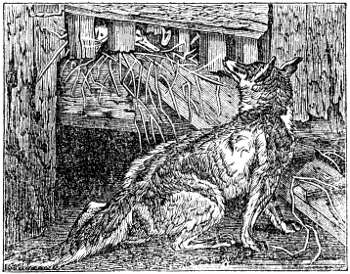
ON THE WATCH.
There seems to be, naturally, two periods of the year in which fowls lay—early in the spring, and in the summer; and this fact would seem to indicate that, if they were left to themselves, like wild birds, they would bring forth two broods in a year. The laying continues, with few interruptions, till the close of summer, when the natural process of moulting causes them to cease. This annual process commences about August, and continues through the three following months. The constitutional effect attending the beginning, continuance, and consequences of this period—a very critical one in the case of all feathered animals—prevents them from laying, until its very close, when the entire coat of new feathers replaces the old, the washing of the nutritive juices, yielded by the blood for the express purpose of promoting this growth, is a great drain upon the system; and the constitutional forces, which would otherwise assist in forming the egg, are rendered inoperative. The approach of cold weather, also, at the close of the moulting period, contributes to the same result. As the season of moulting is every year later, the older the hen is, the later in the spring she will begin to lay. As pullets, on the contrary, do not moult the first year, they commence laying sooner than the elder hens; and it is possible, by judicious and careful management, so to arrange, in a collection of poultry tolerably numerous, as to have eggs throughout the year. It is a singular fact that pullets hatched very late in autumn, and therefore of stunted growth, will lay nearly as early as those hatched in spring. The checking of their growth seems to have a tendency to produce eggs; of course, very tiny ones at first.
When a hen is near to the time of laying, her comb and wattles change from their previous dull hue to a bright red, while the eye becomes more bright, the gait more spirited, and she occasionally cackles for three or four days. These signs rarely prove false; and when the time comes that she desires to lay, she appears very restless, going backward and forward, visiting every nook and corner, cackling meanwhile, as if displeased because she cannot suit herself with a convenient nest. Not having looked out for one previously, she rarely succeeds in pleasing herself till the moment comes when she can no longer tarry, when she is compelled to choose one of the boxes or baskets provided for this purpose in the poultry-house, where she settles herself in silence and lays.
In some instances, a hen will make choice of a particular nest in which to lay, and when she finds, upon desiring to lay, that this is pre-occupied by another hen, she will wait till it is vacated; but, in other cases, hens will go into any nest which they find, preferring, for the most part, those having the greatest number of eggs. The process of laying is, most probably, rather painful, though the hen does not indicate this by her cries; but the instant she has done she leaves the nest, and utters her joy by peculiarly loud notes, which are re-echoed by the cock, as well as by some of the other hens. Some hens, however, leave the nest in silence, after laying.
It seems ever to have been an object of great importance, in an economical point of view, to secure the laying of hens during those parts of the year when, if left to themselves, they are indisposed to deposit their eggs. For this purpose many methods have been devised, the most of which embrace an increase of rich and stimulating food. Some recommend shutting hens up in a warm place during winter, and giving them boiled potatoes, turnips, carrots, and parsnips. Others assign as the reason for their not laying in winter, in some climates, that the earth is covered with snow, so that they can find no ground, or other calcareous matter, to form the shells; and advise, therefore, that bones of meat or poultry should be pounded and given to them, either mixed with their food, or by itself, which they will greedily eat. Upon the whole, it would seem that the most feasible means of obtaining fresh eggs during the winter is to have young hens—pullets hatched only the previous spring being the best—to use extreme liberality in feeding, and to cautiously abstain from over-stocking the poultry-yard.
As serviceable food to increase laying, scraps of animal food, given two or three times a week, answer admirably; the best mode of doing so is throwing down a bullock’s liver, leaving it with them, and permitting them to pick it at will; this is better raw than boiled. Lights, or guts, or any other animal refuse, will be found to answer the same purpose; but these substances require, or, at all events, are better for, boiling. Cayenne pepper—in fact all descriptions of pepper, but especially cayenne pepper in pods—is a favorite food with fowls; and, being a powerful stimulant, it promotes laying.
An abundant supply of lime, in some form, should not be omitted; either chopped bones, old mortar, or a lump of chalky marl. The shell of every egg used in the house should be roughly crushed and thrown down to the hens, which will greedily eat them. A green, living turf will be of service, both for its grass and the insects it may contain. A dusting-place, wherein to get rid of vermin, is indispensable. A daily hot meal of potatoes, boiled as carefully as for the family table, then chopped, and sprinkled or mixed with bran, will be comfortable and stimulating. After every meal of the household, the bones and other scraps should be collected and thrown out.
As to the number of eggs, the varieties which possess the greatest fecundity are the Shanghaes, Guelderlands, Dorkings, Polish, and Spanish. The Poland and Spanish lay the largest eggs; the Dorkings, eggs of good size; while the Game and the smaller kinds produce only small eggs. Those eggs which have the brightest yolks are the finest flavored; and this is usually the case with the smaller kinds. The large eggs of the larger varieties often have yolks of a pale color, and are inferior in flavor.
PRESERVATION OF EGGS.
Eggs, after being laid, lose daily, by transpiration, a portion of the matter which they contain, notwithstanding the compact texture of their shell, and of the close tissue of the flexible membranes lining the shell, and enveloping the white. When an egg is fresh, it is full, without any vacancy; and this is a matter of common observation, whether it be broken raw, or when it is either soft or hard-boiled. In all stale eggs, on the contrary, there is uniformly more or less vacancy, proportioned to the loss they have sustained by transpiration; hence, in order to judge of the freshness of an egg, it is usual to hold it up to the light, when the transparency of the shell makes it appear whether or not there is any vacancy in the upper portion, as well as whether the yolk and white are mingled and muddy, by the rotting and bursting of their enveloping membranes.
The transpiration of eggs, besides, is proportional to the temperature in which they are placed, cold retarding and heat promoting the process; hence, by keeping fresh-lain eggs in a cool cellar, or, better still, in an ice-house, they will transpire less, and be preserved for a longer period sound, than if they are kept in a warm place, or exposed to the sun’s light, which has also a good effect in promoting the exhalation of moisture. As, therefore, fermentation and putridity can only take place by communication with the air at a moderate temperature, such connection must be excluded by closing the pores of the shell.
It is an indispensable condition of the material used for this purpose, that it shall be incapable of being dissolved by the moisture transpired from the interior. Spirits of wine varnish, made with lac, answers the requirement; this is not very expensive, but is rather an uncommon article in country places, where eggs are most abundantly produced.
A better material is a mixture of mutton and beef suet, which should be melted together over a slow fire, and strained through a linen cloth into an earthen pan. The chief advantage in the use of this is, that the eggs rubbed over with it will boil as quickly as if nothing had been done to them, the fat melting off as soon as they touch the water. The transpiration is as effectually stopped by the thinnest layer of fat as by a thick coating, provided that no sensible vestige be left on the surface of the shell. All sorts of fat, grease, or oil are well adapted to this purpose; by means of butter, hog’s lard, olive oil, and similar substances, eggs maybe preserved for nine months as fresh as the day upon which they were laid.
Another method is, to dip each egg into melted pork-lard, rubbing it into the shell with the finger, and pack them in old fig-drums, or butter firkins, setting every egg upright, with the small end downward. Or, the eggs may be packed in the same way in an upright earthen pan; then cut some rough sheep’s tallow, procured the same day that the animal is killed, into small pieces, and melt it down; strain it from the scraps, and pour it while warm, not hot, over the eggs in the jar till they are completely covered. When all is cold and firm, set the vessel in a cool, dry place till the contents are wanted.
Eggs will also keep well when preserved in salt, by arranging them in a barrel, first a layer of salt, then a layer of eggs, alternately. This can, however, also act mechanically, like bran or saw-dust, so long as the salt continues dry; for, in that case, the chlorine, which is the antiseptic principle of the salt, is not evolved. When the salt, however, becomes damp, its preservative principle will be brought into action, and may penetrate through the pores of the shell.
Immersing eggs in vitriol, or sulphuric acid, is likewise a very effectual means of preserving them; the sulphuric acid acts chemically upon the carbonate of lime in the shell, by setting free the carbonic acid gas, while it unites with the lime, and forms sulphate of lime, or plaster of Paris. Another method is, to mix together a bushel of quick-lime, two pounds of salt, and eight ounces of cream of tartar, adding a sufficient quantity of water, so that eggs may be plunged into the paint. When a paste is made of this consistence, the eggs are put into it, and may be kept fresh, it is said, for two years.
Another method of preserving eggs a long while fresh, depends upon a very different principle. Eggs that have not been rendered reproductive by the cock have been found to continue very uncorrupted. In order, therefore, to have eggs keep fresh from spring to the middle or even to the end of Winter, it is only necessary to deprive the hens of all communication with the cocks, for at least a month before the eggs are put away.
It ought not to be overlooked, in this connection, that eggs not only spoil by the transpiration of their moisture and the putrid fermentation of their contents, in consequence of air penetrating through the pores of the shell, but also by being moved about and jostled, when carried to a distance by sea or land. Any kind of rough motion, indeed, ruptures the membranes which keep the white, the yolk, and the germ of the chicken in their appropriate places; and, upon these being mixed, putrefaction is promoted.
CHOICE OF EGGS FOR SETTING.
Eggs for hatching should be as fresh as possible; if laid the very same day, so much the better. This is not always possible when a particular stock is required; but, if a numerous and healthy brood is all that is wanted, the most recent eggs should be selected. Eggs may be kept for this purpose in either of the ways first mentioned; or they may be placed on their points in a box, in a cool, dry place; the temperature about sixty or sixty-five, Fahrenheit; the bottom of the box should be covered with a layer of wheat bran, then a layer of eggs put in, and covered with bran; and so on, alternating. In this mode, evaporation is prevented, and the eggs are almost as certain to hatch out, at the end of six weeks, or even two months, as when they were laid.
It is difficult to fix the exact term during which the vitality of an egg remains unextinguished; as it, unquestionably, varies from the very first, according to the vigor of the parents of the inclosed germ, and fades away gradually till the final moment of non-existence. The chickens in stale eggs have not sufficient strength to extricate themselves from the shell; if assisted, the yolk is found to be partially absorbed into the abdomen, or not at all; they are too faint to stand; the muscles of the neck are unable to lift their heads, much less to peck; and although they may sometimes be saved by extreme care, their usual fate is to be trampled to death by the mother, if they do not expire almost as soon as they begin to draw their breath. Thick-shelled eggs, like those of geese, Guinea fowls, etc., will retain life longer than thin-shelled ones, as those of hens and ducks. When choice eggs are expected to be laid, it is more prudent to have the hen which is to sit upon them wait for them, than to keep other eggs waiting for her. A good sitter may be amused for two or three weeks with a few addle-eggs, and so be ready to take charge of those of value immediately upon their arrival.
As to the choice of eggs for hatching, such should be taken, of course, as are believed to have been rendered productive. Those of medium size—the average size that the hen lays—are most apt to fulfil this requirement. A very fair judgment may be formed of eggs from their specific gravity; such as do not sink to the bottom in a bowl of tepid water should be rejected.
The old-time notion, that small, round eggs produce females, and long, pointed ones males—originally applied, by the ancients, to eating rather than hatching purposes—may be considered exploded. The hen that lays one round egg, continues to lay all her eggs round; and the hen that lays one oblong, lays all oblong. According to this theory, then, one hen would be the perpetual mother of cocks, and another the perpetual producer of pullets; which is absurd, as daily experience proves.
The same fate has been meted out to that other venerable test of sex, the position of the air-bag at the blunt end of the shell. “If the vacancy is a little on one side, it will produce a hen; if it is exactly in the centre, a cock.” Upon this assumption, the cock should be a very rare bird; since there are very few eggs indeed in which the air bottle is exactly concentric with the axis of the egg. In many breeds, on the contrary, the cockerels bear a proportion of at least one-third, and sometimes two-thirds, especially in those hatched during winter, or in unfavorable seasons; the immediate cause, doubtless, being that the eggs producing a more robust sex possess a stronger vitality.