CONTENTS. (continued 4)
Reading edition
Points of fat sheep. The formation of fat, in a sheep destined to be fattened, commences in the inside, the web of fat which envelopes the intestines being first formed, and a little deposited around the kidneys. After that, fat is seen on the outside; and first upon the end of the rump at the tail-head, continuing to move on along the back, on both sides of the spine, or back-bone, to the bend of the ribs to the neck. Then it is deposited between the muscles, parallel with the cellular tissue. Meanwhile, it is covering the lower round of the ribs descending to the flanks, until the two sides meet under the belly, whence it proceeds to the brisket, or breast, in front, and the sham or cod behind, filling up the inside of the arm-pits and thighs. While all these depositions are proceeding on the outside, the progress in the inside is not checked, but rather increased, by the fattening disposition encouraged by the acquired condition; and, hence, simultaneously, the kidneys become entirely covered, and the space between the intestines and the lumbar region, or loin, gradually filled up by the web and kidney fat.
By this time the cellular spaces around each fibre of muscle are receiving their share; and when fat is deposited there in quantity, it gives to the meat the term marbled. These inter-fibrous spaces are the last to receive a deposition of fat; but after this has begun, every other part at the same time receives its due share, the back and kidneys securing the most, so much so that the former literally becomes nicked, as it is termed—that is, the fat is felt through the skin to be divided into two portions, from the tail-head along the back to the top of the shoulder; and the tail becoming thick and stiff, the top of the neck broad, the lower part of each side of the neck toward the breasts full, and the hollows between the breast-bone and the inside of the fore legs, and between the cod and the inside of the hind thighs, filled up. When all this has been accomplished, the sheep is said to be fat, or ripe.
When the body of a fat sheep is entirely overlaid with fat, it is in the most valuable state as mutton. Few sheep, however, lay on fat entirely over their body; one laying the largest proportion on the rump, another on the back; one on the parts adjoining the fore-quarter, another on those of the hind-quarter; and one more on the inside, and another more on the outside. Taking so many parts, and combining any two or more of them together, a considerable variety of condition will be found in any lot of fat sheep, while any one is as ripe in its way as any other.
With these data for guides, the state of a sheep in its progress toward ripeness may be readily detected by handling. A fat sheep, however, is easily known by the eye, from the fullness exhibited by all the external parts of the particular animal. It may exhibit want in some parts when compared with others; but those parts, it may easily be seen, would never become so ripe as the others; and this arises from some constitutional defect in the animal itself; since, if this were so, there is no reason why all the parts should not be alike ripe. The state of a sheep that is obviously not ripe cannot altogether be ascertained by the eye. It must be handled, or subjected to the scrutiny of the hand. Even in so palpable an act as handling, discretion is requisite. A full-looking sheep needs hardly to be handled on the rump; for he would not seem so full, unless fat had first been deposited there. A thin-looking sheep, on the other hand, should be handled on the rump; and if there be no fat there, it is useless to handle the rest of the body, for certainly there will not be so much as to deserve the name of fat. Between these two extremes of condition, every variety exists; and on that account examination by the hand is the rule, and by the eye alone the exception. The hand is, however, much assisted by the eye, whose acuteness detects deficiencies and redundancies at once.
In handling sheep, the points of the fingers are chiefly employed; and the accurate knowledge conveyed by them, through practice, of the exact state of the condition, is truly surprising, and establishes a conviction in the mind that some intimate relation exists between the external and internal state of an animal. Hence originates this practical maxim in judging stock of all kinds—that no animal will appear ripe to the eye, unless as much fat had previously been acquired in the inside as constitutional habit will allow.
The application of this rule is easy. When the rump is found nicked, on handling, fat is to be found on the back; when the back is found nicked, fat is to be expected on the top of the shoulder and over the ribs; and when the top of the shoulder proves to be nicked, fat may be anticipated on the under side of the belly, To ascertain its existence below, the animal must be turned up, as it is termed; that is, the sheep is set upon his rump, with his back down, and his hind feet pointing upward and outward. In this position, it can be seen whether the breast and thighs are filled up. Still, all these alone would not disclose the state of the inside of the sheep, which should, moreover, be looked for in the thickness of the flank; in the fullness of the breast, that is, the space in front from shoulder to shoulder toward the neck; in the stiffness and thickness of the root of the tail; and in the breadth of the back of the neck. All these latter parts, especially with the fullness of the inside of the thighs, indicate a fullness of fat in the inside; that is, largeness of the mass of fat on the kidneys, thickness of net, and thickness of layers between the abdominal muscles. Hence, the whole object of feeding sheep on turnips and the like seems to be to lay fat upon all the bundles of fleshy fibres, called muscles, that are capable of acquiring that substance; for, as to bone and muscle, these increase in weight and extent independently of fat, and fat only increases in their magnitude.
Slaughtering. Sheep are easily slaughtered, and the operation is unattended with cruelty. They require some preparation before being deprived of life, which consists in food being withheld from them for not less than twenty-four hours, according to the season. The reason for fasting sheep before slaughtering is to give time for the paunch and intestines to empty themselves entirely of food, as it is found that, when an animal is killed with a full stomach, the meat is more liable to putrefy, and it not so well flavored; and, as ruminating animals always retain a large quantity of food in their intestines, it is reasonable that they should fast somewhat longer to get rid of it, than animals with single stomachs.
Sheep are placed on their side—sometimes upon a stool, called a killing-stool—to be slaughtered, and, requiring no fastening with cords, are deprived of life by the use of a straight knife through the neck, between its bone and the windpipe, severing the carotid artery and the jugular vein of both sides, from which the blood flows freely out, and the animal soon dies.
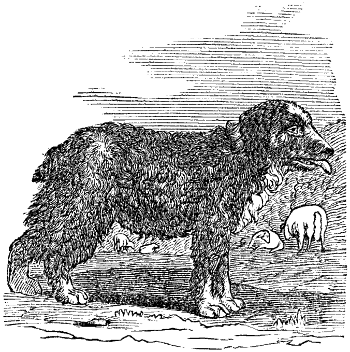
DROVER’S OR BUTCHER’S DOG.
The skin, as far as it is covered with wool, is taken off, leaving that on the legs and head, which are covered with hair, the legs being disjointed by the knee. The entrails are removed by an incision along the belly, after the carcass has been hung up by the tendons of the boughs. The net is carefully separated from the viscera, and rolled up by itself; but the kidney fat is not then extracted. The intestines are placed on the inner side of the skin until divided into the pluck, containing the heart, lungs, and liver; the bag, containing the stomach; and the puddings, consisting of the viscera, or guts. The latter are usually thrown away; though the Scotch, however, clean them and work them up into their favorite haggis. The skin is hung over a rope or pole under cover, with the skin-side uppermost, to dry in an airy place.
The carcass should hang twenty-four hours in a clean, cool, airy, dry apartment before it is cut down. It should be cool and dry; for, if warm, the meat will not become firm; and, if damp, a clamminess will cover it, and it will never feel dry, and present a fresh, clean appearance. The carcass is divided in two, by being sawed right down the back-bone. The kidney-fat is then taken out, being only attached to the peritoneum by the cellular membrane, and the kidney is extracted from the suet, the name given to sheep-tallow in an independent state.
Cutting up. Of the two modes of cutting up a carcass of mutton, the English and the Scotch—of the former, the practice in London being taken as the standard, and of the latter, that of Edinburgh, since more care is exercised in this respect in these two cities—the English is, perhaps, preferable; although the Scotch accomplish the task in a cleanly and workmanlike manner.
The jigot is the most handsome and valuable part of the carcass, bringing the highest price, and is either a roasting or a boiling piece. A jigot of Leicester, Cheviot, or South-Down mutton makes a beautiful boiled leg of mutton, which is prized the more the fatter it is—this part of the carcass being never overloaded with fat. The loin is almost always roasted, the flap of the flank being skewered up, and it is a juicy piece. Many consider this piece of Leicester mutton, roasted, as too rich; and when warm this is, probably, the case; but a cold roast loin is an excellent summer dish. The back-rib is divided into two, and used for very different purposes. The forepart—the neck—is boiled, and makes sweet barley-broth; and the meat, when boiled, or rather the whole simmered for a considerable time beside the fire, eats tenderly. The back-ribs make an excellent roast; indeed, there is not a sweeter or more varied one in the whole carcass, having both ribs and shoulder. The shoulder-blade eats best cold, and the ribs, warm. The ribs make excellent chops, the Leicester and South-Down affording the best. The breast is mostly a roasting-piece, consisting of rib and shoulder, and is particularly good when cold. When the piece is large, as of the South-Down or Cheviot, the gristly parts of the ribs may be divided from the true ribs, and helped separately. This piece also boils well; or, when corned for eight days, and served with onion sauce, with mashed turnips in it, there are few more savory dishes at a farmer’s table. The shoulder is separated before being dressed, and makes an excellent roast for family use, being eaten warm or cold, or carved and dressed as the breast mentioned above. The shoulder is best from a large carcass of South-Down, Cheviot, or Leicester. The neck-piece is partly laid bare by the removal of the shoulder, the forepart being fitted for boiling and making into broth, and the best part for roasting or broiling into chops. On this account, it is a good family piece, and generally preferred to any part of the hind-quarter. Heavy sheep, such as the Leicester, South-Down, and Cheviot, supply the most thrifty neck-piece.
Relative qualities. The different sorts of mutton in common use differ as well in quality as in quantity. The flesh of the Leicester is large, though not coarse-grained, of a lively red color, and the cellular tissue between the fibres contains a considerable quantity of fat. When cooked, it is tender and juicy, yielding a red gravy, and having a sweet, rich taste; but the fat is rather too much and too rich for some people’s tastes, and can be put aside. It must be allowed that the lean of fat meat is far better than lean meat that has never been fat. Cheviot mutton is smaller in the grain, not so bright of color, with less fat, less juice, not so tender and sweet; but the flavor is higher, and the fat not so luscious. The mutton of South-Downs is of medium fineness in grain, color pleasant red, fat well intermixed with the meat, juicy, and tenderer than Cheviot. The mutton of rams of any breed is always hard, of disagreeable flavor, and, in autumn, not eatable; that of old ewes is dry, hard, and tasteless; of young ones, well enough flavored, but still rather dry; while wether-mutton is the meat in perfection, according to its kind.
The want of relish, perhaps the distaste, for mutton has served as an obstacle to the extension of sheep husbandry in the United States. The common mistake in the management of mutton among us is, that it is eaten, as a general thing, at exactly the wrong time after it is killed. It should be eaten immediately after being killed, and, if possible, before the meat has time to get cold; or, if not, then it should be kept a week or more—in the ice-house, if the weather require—until the time is just at hand when the fibre passes the state of toughness which it takes on at first, and reaches that incipient or preliminary point in its process toward putrefaction when the fibres begin to give way, and the meat becomes tender.
An opinion likewise generally prevails that mutton does not attain perfection in juiciness and flavor much under five years. If this be so, that breed of sheep must be very unprofitable which takes five years to attain its full state; and there is no breed of sheep in this country which requires five years to bring it to perfection. This being the case, it must be folly to restrain sheep from coming to perfection until they have reached that age. Lovers of five-year-old mutton do not pretend that this course bestows profit on the farmer, but only insist on its being best at that age. Were this the fact, one of two absurd conditions must exist in this department of agriculture: namely, the keeping a breed of sheep that cannot, or that should not be allowed to, attain to perfection before it is five years old; either of which conditions makes it obvious that mutton cannot be in its best state at five years.
The truth is, the idea of mutton of this age being especially excellent, is founded on a prejudice, arising, probably, from this circumstance: before winter food was discovered, which could maintain the condition of stock which had been acquired in summer, sheep lost much of their summer condition in winter, and, of course, an oscillation of condition occurred, year after year, until they attained the age of five years; when their teeth beginning to fail, would cause them to lose their condition the more rapidly. Hence, it was expedient to slaughter them at not exceeding five years of age; and, no doubt, mutton would be high-flavored at that age, that had been exclusively fed on natural pasture and natural hay. Such treatment of sheep cannot, however, be justified on the principles of modern practice; because both reason and taste concur in mutton being at its best whenever sheep attain their perfect state of growth and condition, not their largest and heaviest; and as one breed attains its perfect state at an earlier age than another, its mutton attains its best before another breed attains what is its best state, although its sheep may be older; but taste alone prefers one kind of mutton to another, even when both are in their best state, from some peculiar property. The cry for five-year-old mutton is thus based on very untenable grounds; the truth being that well-fed and fatted mutton is never better than when it gets its full growth in its second year; and the farmer cannot afford to keep it longer, unless the wool would pay for the keep, since we have not the epicures and men of wealth who would pay the butcher the extra price, which he must have, to enable him to pay a remunerating price to the grazier for keeping his sheep two or three years over.
All writers on diet agree in describing mutton as the most valuable of the articles of human food. Pork may be more stimulating, beef perhaps more nutritious, when the digestive powers are strong; but, while there is in mutton sufficient nutriment, there is also that degree of consistency and readiness of assimilation which renders it most congenial to the human stomach, most easy of digestion, and most promotive of human health. Of it, almost alone, can it be said that it is our food in sickness, as well as in health; its broth is the first thing, generally, that an invalid is permitted to taste, the first thing that he relishes, and is a natural preparation for his return to his natural aliment. In the same circumstances, it appears that fresh mutton, broiled or boiled, requires three hours for digestion; fresh mutton, roasted, three and one-fourth hours; and mutton-suet, boiled, four and one-half hours.
Good ham may be made of any part of a carcass of mutton, though the leg is preferable; and for this purpose it is cut in the English fashion. It should be rubbed all over with good salt, and a little saltpetre, for ten minutes, and then laid in a dish and covered with a cloth for eight or ten days. After that, it should be slightly rubbed again, for about five minutes, and then hung up in a dry place, say the roof of the kitchen, until used. Wether mutton is used for hams, because it is fat, and it may be cured any time from November to May; but ram-mutton makes the largest and highest-flavored ham, provided it be cured in spring, because it is out of season in autumn.
There is an infallible rule for ascertaining the age of mutton by certain marks on the carcass. Observe the color of the breast-bone, when a sheep is dressed—that is, where the breast-bone is separated—which, in a lamb, or before it is one year old, will be quite red; from one to two years old, the upper and lower bone will be changing to white, and a small circle of white will appear round the edges of the other bones, and the middle part of the breast-bone will yet continue red; at three years old, a very small streak of red will be seen in the middle of the four middle bones, and the others will be white; and at four years, all the breast-bone will be of a white or gristly color.
Contributions to manufactures. The products of sheep are not merely useful to man; they provide his luxuries as well. The skin of sheep is made into leather, and, when so manufactured with the fleece on, makes comfortable mats for the doors of rooms, and rugs for carriages. For this purpose, the best skins are selected, and such as are covered with the longest and most beautiful fleece. Tanned sheep-skin is used in coarse book-binding. White sheep-skin, which is not tanned, but so manufactured by a peculiar process, is used as aprons by many classes of workmen, and, in agriculture, as gloves in the harvest; and, when cut into strips, as twine for sewing together the leather coverings and stuffings of horse-collars. Morocco leather is made of sheep-skins, as well as of goat-skins, and the bright red color is given to it by cochineal. Russia leather is also made of sheep-skins, the peculiar odor of which repels insects from its vicinity, and resists the mould arising from damp, the odor being imparted to it in currying, by the empyreumatic oil of the bark of the birch-tree. Besides soft leather, sheep-skins are made into a fine, flexible, thin substance, known by the name of parchment; and, though the skins of all animals might be converted into writing materials, only those of the sheep and the she-goat are used for parchment. The finer quality of the substance, called vellum, is made of the skins of kids and dead-born lambs; and for its manufacture the town of Strasburgh has long been celebrated.
Mutton-suet is used in the manufacture of common candles, with a proportion of ox-tallow. Minced suet, subjected to the action of high-pressure steam in a digester, at two hundred and fifty or two hundred and sixty degrees of Fahrenheit, becomes so hard as to be sonorous when struck, whiter, and capable, when made into candles, of giving very superior light. Stearic candles, the invention of the celebrated Guy Lussac, are manufactured solely from mutton-suet.
Besides the fat, the intestines of sheep are manufactured into various articles of luxury and utility, which pass under the absurd name of catgut. All the intestines of sheep are composed of four layers, as in the horse and cattle. The outer, or peritoneal one, is formed of that membrane, by which every portion of the belly and its contents is invested, and confined in its natural and proper situation. It is highly smooth and polished, and secretes a watery fluid which contributes to preserve that smoothness, and to prevent all friction and concussion during the different motions of the animal. The second is the muscular coat, by means of which the contents of the intestines are gradually propelled from the stomach to the rectum, thence to be expelled when all the useful nutriment is extracted. The muscles, as in all the other intestines, are disposed in two layers, the fibres of the outer coat taking a longitudinal direction, and the inner layer being circular—an arrangement different from that of the muscles of the œsophagus, and in both beautifully adapted to the respective functions of the tube. The submucous coat comes next. It is composed of numerous glands, surrounded by cellular tissue, and by which the inner coat is lubricated, so that there may be no obstruction to the passage of the food. The mucous coat is the soft villous one lining the intestinal cavity. In its healthy state, it is always covered with mucus; and when the glands beneath are stimulated, as under the action of physic, the quantity of mucus is increased; it becomes of a more watery character; the contents of the intestines are softened and dissolved by it; and by means of the increased action of the muscular coat, which, as well as the mucous one, feels the stimulus of the physic, the fæces are hurried on more rapidly and discharged.
In the manufacture of some sorts of cords from the intestines of sheep, the outer peritoneal coat is taken off and manufactured into a thread to sew intestines, and make the cords of rackets and battledores. Future washings cleanse the guts, which are then twisted into different-sized cords for various purposes; some of the best known of which are whip-cords, hatter’s cords for bow-strings, clock-maker’s cords, bands for spinning-wheels, now almost obsolete, and fiddle and harp-strings. Of the last class, the cords manufactured in Italy are superior in goodness and strength; and the reason assigned is, that the sheep of that country are both smaller and leaner than the breeds most in vogue in England and in this country. The difficulty in manufacturing from other breeds of sheep lies, it seems, in making the treble strings from the fine peritoneal coat, their chief fault being weakness; by reason of which the smaller ones are hardly able to bear the stretch required for the higher notes in concert-pitch, maintaining, at the same time, in their form and construction, that tenuity or smallness of diameter which is required in order to produce a brilliant and clear tone.
The dry and healthful climate, the rolling surface, and the sweet and varied herbage, which generally prevail in the United States, insure perfect health to an originally sound and well-selected flock, unless they are peculiarly exposed to disease. No country is better suited to sheep than most of the Northern and some of the Southern portions of our own. In Europe, and especially in England, where the system of management is, necessarily, in the highest degree artificial, consisting, frequently, in an early and continued forcing of the system, folding on wet, ploughed ground, and the excessive use of that watery food, the Swedish turnip, there are numerous and fatal diseases, a long list of which invariably cumbers the pages of foreign writers on this animal.
The diseases incident to our flocks, on the contrary, may generally be considered as casualties, rather than as inbred, or necessarily arising from the quality of food, or from local causes. It may be safely asserted that, with a dry pasture, well stocked with varied and nutritious grasses; a clear, running stream; sufficient shade and protection against severe storms; a constant supply of salt, tar, and sulphur in summer; good hay, and sometimes roots, with ample shelters in winter—young sheep, originally sound and healthy, will seldom or never become diseased on American soil.
The comparatively few diseases, which it may be necessary here to mention, are arranged in alphabetical order—as in the author’s “Cattle and their Diseases”—for convenience of reference, and treated in the simplest manner. Remedies of general application, to be administered often by the unskilful and ignorant, must neither be elaborate nor complicated; and, if expensive, the lives of most sheep would be dearly purchased by their application.
A sheep, which has been reared or purchased at the ordinary price, is the only domestic animal which can die without material loss to its owner. The wool and felt will, in most instances, repay its cost, while the carcass of other animals will be worthless, except for manure. The loss of sheep, from occasional disease, will leave the farmer’s pocket in a very different condition from the loss of an equal value in horses or cattle. Humanity, however, alike with interest, dictates the use of such simple remedies, for the removal of suffering and disease, as may be within reach.
ADMINISTERING MEDICINE.
The stomach into which medicines are to be administered is the fourth, or digesting stomach. The comparatively insensible walls of the rumen, or paunch, are but slightly acted upon, except by doses of very improper magnitude. Medicine, to reach the fourth stomach, should be given in a state as nearly approaching fluidity as may be. Even then it may be given in such a manner as to defeat the object in view.
If the animal forcibly gulps fluids down, or if they are given hastily and bodily, they will follow the caul at the base of the gullet with considerable momentum, force asunder the pillars, and enter the rumen; if they are drunk more slowly, or administered gently, they will trickle down the throat, glide over these pillars, and pass on through the maniplus to the true stomach.
BLEEDING.
Bleeding from the ears or tail, as is commonly practised, rarely extracts a quantity of blood sufficient to do any good where bleeding is indicated. To bleed from the eye-vein, the point of a knife is usually inserted near the lower extremity of the pouch below the eye, pressed down, and then a cut made inward toward the middle of the face.
Bleeding from the angular or cheek-vein is recommended, in the lower part of the cheek, at the spot where the root of the fourth tooth is placed, which is the thickest part of the cheek, and is marked on the external surface of the bone of the upper jaw by a tubercle, sufficiently prominent to be very sensible to the finger when the skin of the cheek is touched. This tubercle is a certain index to the angular vein, which is placed below. The shepherd takes the sheep between his legs; his left hand more advanced than his right, which he places under the head, and grasps the under jaw near to the hinder extremity, in order to press the angular vein, which passes in that place, for the purpose of making it swell; he touches the right cheek at the spot nearly equidistant from the eye and mouth, and there finds the tubercle which is to guide him, and also feels the angular vein swelled below this tubercle; he then makes the incision from below upward, half a finger’s breadth below the middle of the tubercle. When the vein is no longer pressed upon, the bleeding will commonly cease; if not, a pin may be passed through the lips of the orifice, and a lock of wool tied round them.
For thorough bleeding, the jugular vein is generally to be preferred. The sheep should be firmly held by the head by an assistant, and the body confined between his knees, with its rump against a wall. Some of the wool is then cut away from the middle of the neck over the jugular vein, and a ligature, brought in contact with the neck by opening the wool, is tied around it below the shorn spot near the shoulder. The vein will soon rise. The orifice may be secured, after bleeding, as before described.
The good effects of bleeding depend almost as much on the rapidity with which the blood is abstracted, as the amount taken. This is especially true in acute diseases. Either bleed rapidly or do not bleed at all. The orifice in the vein, therefore, should be of some length, and made lengthwise with the vein. A lancet is by far the best implement; and even a short-pointed penknife is preferable to the bungling gleam. Bleeding, moreover, should always be resorted to, when it is indicated at all, as nearly as possible to the commencement of the malady.
The amount of blood drawn should never be determined by admeasurement, but by constitutional effect—the lowering of the pulse, and indications of weakness. In urgent cases—apoplexy, or cerebral inflammation, for example—it would be proper to bleed until the sheep staggers or falls. The quantity of blood in the sheep is less, in comparison, than that in the horse or ox. The blood of the horse constitutes about one-eighteenth part of his weight; and that of the ox at least one-twentieth; while that of the sheep, in ordinary condition, is one-twenty-second. For this reason, more caution should be exercised in bleeding the latter, especially in frequently resorting to it; otherwise, the vital powers will be rapidly and fatally prostrated. Many a sheep has been destroyed by bleeding freely in disorders not requiring it, and in disorders which did require it at the commencement, but of which the inflammatory stage had passed.
FEELING THE PULSE.
The number of pulsations can be determined by feeling the heart beat on the left side. The femoral artery passes in an oblique direction across the inside of the thigh, and about the middle of the thigh its pulsations and the character of the pulse can be most readily noted. The pulsations per minute, in a healthy adult sheep, are sixty-five in number; though they have been stated at seventy, and even seventy-five.
APOPLEXY.
Soon after the sheep are turned to grass in the spring, one of the best-conditioned sheep in the flock is sometimes suddenly found dead. The symptoms which precede the catastrophe are occasionally noted. The sheep leaps frantically into the air two or three times, dashes itself on the ground, and suddenly rises, and dies in a few minutes.
Where animals in somewhat poor condition are rather forced forward for the purpose of raising their condition, it sometimes happens that they become suddenly blind and motionless; they will not follow their companions; when approached, they run about, knocking their heads against fences, etc.; the head is drawn round toward one side; they fall, grind their teeth, and their mouths are covered with a frothy mucus. Such cases are, unquestionably, referable to a determination of blood to the brain.
Treatment. If the eyes are prominent and fixed, the membranes of the mouth and nose highly florid, the nostrils highly dilated, and the respiration labored and stertorous, the veins of the head turgid, the pulse strong and rather slow, and these symptoms attended by a partial or entire loss of sight and hearing, it is one of those decided cases of apoplexy which require immediate and energetic treatment. Recourse should at once be had to the jugular vein, and the animal bled until an obvious constitutional effect is produced—the pulse lowered, and the rigidity of the muscles relaxed. An aperient should at once follow bleeding; and if the animal is strong and plathoric, a sheep of the size of the Merino would require at least two ounces of Epsom salts, and one of the large mutton sheep, more. If this should fail to open the bowels, half an ounce of the salts should be given, say twice a day.
BRAXY.
This is manifested by uneasiness; loathing of food; frequent drinking; carrying the head down; drawing the back up; swollen belly; feverish symptoms; and avoidance of the flock. It appears mostly in late autumn and spring, and may be induced by exposure to severe storms, plunging in water when hot, and especially by constipation, brought on by feeding on frostbitten, putrid, or indigestible herbage. Many sheep die on the prairies from this disease, induced by exposure and miserable forage. Entire prevention is secured by warm, dry shelters, and nutritious, dry food.
Treatment. Remedies, to be successful, must be promptly applied. Bleed freely; and to effect this, immersion in a tub of hot water may be necessary, in consequence of the stagnant state of the blood. Then give two ounces of Epsom salts, dissolved in warm water, with a handful of common salt. If this is unsuccessful, give a clyster, made with a pipeful of tobacco, boiled for a few minutes in a pint of water. Administer half; and if this is not effectual, follow with the remainder. Then bed the animal in dry straw, and cover with blankets; assisting the purgatives with warm gruels, followed by laxative provender till well.
BRONCHITIS.
Where sheep are subject to pneumonia, they are liable to bronchitis as well, which is an inflammation of the mucous membrane, which lines the bronchial tubes, or the air-passages of the lungs. The symptoms are those of an ordinary cold, but attended with more fever, and a tenderness of the throat and belly when pressed upon.
Treatment. Administer salt in doses of from one and a half to two ounces, with six or eight ounces of lime-water, given in some other part of the day.
CATARRH.
This is an inflammation of the mucous membrane, which lines the nasal passages, and it sometimes extends to the larynx and pharynx. In the first instance—where the lining of the nasal passages is alone and not very violently affected—it is merely accompanied by an increased discharge of mucus, and is rarely attended with much danger. In this form, it is usually termed snuffles; and high-bred English mutton-sheep, in this country, are apt to manifest more or less of it, after every sudden change of weather. When the inflammation extends to the mucous lining of the larynx and the pharynx, some degree of fever usually supervenes, accompanied by cough, and some loss of appetite. At this point, bleeding and purging are serviceable.
Catarrh rarely attacks the American fine-woolled sheep with sufficient violence in summer to require the application of remedies. Depletion, in catarrh, in our severe winter months, however, rapidly produces that fatal prostration, from which it is almost impossible to bring the sheep back, without bestowing an amount of time and care upon it, costing far more than the worth of an ordinary animal.
The best course is to prevent the disease by judicious precaution. With that amount of attention which every prudent farmer should bestow on his sheep, the American Merino is but little subject to it. Good, comfortable, and well-ventilated shelters, constantly accessible to the sheep in winter, with a sufficiency of food regularly administered, are usually a sufficient safeguard.
MALIGNANT EPIZOÖTIC CATARRH.
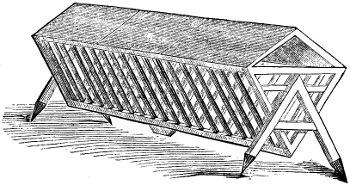
AN ENGLISH RACK FOR FEEDING SHEEP.
Essentially differing, in type and virulence, from the preceding, is an epidemic, or, more properly speaking, an epizoötic malady, which, as often as once in every eight or ten years, sweeps over extended sections of the Northern States, destroying more sheep than all other diseases combined. It commonly makes its appearance in winters characterized by rapid and violent changes of temperature, which are spoken of by the farmers as “bad winters” for sheep. The disease is sometimes termed the “distemper,” and also, but erroneously, “grub in the head.” The winter of 1846-7 proved peculiarly destructive to sheep in New York, and some of the adjoining States; some owners losing one-half, others three-quarters, and a few seven-eighths, of their flocks. One person lost five hundred out of eight hundred; another, nine hundred out of a thousand. These severe losses, however, mainly fell on the holders of the delicate Saxons, and perhaps, generally, on those possessing not the best accommodations, or the greatest degree of energy and skill.
Symptoms. The primary and main disease, in such instances, is a species of catarrh; differing, however, from ordinary catarrh in its diagnosis, and in the extent of the lesions accompanying both the primary and the symptomatic diseases. The animals affected do not, necessarily, at first show any signs of violent colds, as coughing, sneezing, or labored respiration; the only indications of catarrh noticed, oftentimes, being a nasal discharge. Animals having this discharge appear dull and drooping; their eyes run a little, and are partially closed; the caruncle and lids look pale; their movements are languid, and there is an indisposition to eat; the pulse is nearly natural, though at times somewhat too languid. In a few days these symptoms are evidently aggravated; there is rapid emaciation, accompanied with debility; the countenance is exceedingly dull and drooping; the eye is kept more than half closed; the caruncle, lids, etc., are almost bloodless; a gummy, yellow secretion about the eye; thick, glutinous mucus adhering in and about the nostrils; appetite feeble; pulse languid; and muscular energy greatly prostrated. They rapidly grow weaker, stumble, and fall as they walk, and soon become unable to rise; the appetite grows feebler; the mucus at the nose is, in some instances, tinged with dark, grumous blood; the respiration becomes oppressed; and the animals die within a day or two after they become unable to rise. Upon a post-mortem examination, the mucous membrane lining the whole nasal cavity is found highly congested and thickened throughout its entire extent, accompanied with the most intense inflammation; slight ulcers are found on the membranous lining, at the junction of the cellular ethmoid bones with the cribriform plate, in the ethmoidal cells; and the inflammation extends to the mucous membrane of the pharynx, and some inches, from two to four, of the upper portion of the œsophagus.
No sheep, affected with this disease, recovers after emaciation and debility have proceeded to any great extent. In the generality of instances, the time, from the first observed symptoms until death, varies from ten to fifteen days; although death, in some cases, results more speedily.
Treatment. Nothing has been found so serviceable as mercury, which, from its action on the entire secretory system, powerfully tends to relieve the congested membranes of the head. Dissolve one grain of bi-chloride of mercury—corrosive sublimate—in two ounces of water; and give one-half ounce of the water, or one-eighth of a grain of corrosive sublimate, daily, in two doses. To stimulate and open the bowels, give, also, rhubarb in a decoction, the equivalent of ten or fifteen grains at a dose, accompanied with the ordinary carminative and stomachic adjuvants, ginger and gentian in infusion.
COLIC.
Sheep are occasionally seen, particularly in the winter, lying down and rising every moment or two, and constantly stretching their fore and hind legs so far apart that their bellies almost touch the ground. They appear to be in much pain, refuse all food, and not unfrequently die, unless relieved. This disease, popularly known as the “stretches,” is erroneously attributed to an involution of the part of the intestine within another; it being, in reality, a species of flatulent colic, induced by costiveness.
Treatment. Half an ounce of Epsom salts, a drachm of Jamaica ginger, and sixty drops of essence of peppermint. The salts alone, however, will effect the cure; as will, also, an equivalent dose of linseed oil, or even hog’s lard.
COSTIVENESS.
This difficulty is removed by giving two table-spoonfuls of castor oil every twelve hours, till the trouble ceases; or give one ounce of Epsom salts. This may be assisted by an injection of warm weak suds and molasses.
DIARRHŒA.
Common diarrhœa—purging, or scours—manifests itself simply by the copiousness and fluidity of the alvine evacuations. It is generally owing to improper food, as bad hay, or noxious weeds; to a sudden change, as from dry food to fresh grass; to an excess, as from overloading the stomach; and sometimes to cold and wet. It is important to clearly distinguish this disease from dysentery. In diarrhœa, there is no apparent general fever; the appetite remains good; the stools are thin and watery, but unaccompanied with slime, or mucus, and blood; odor of the fæces is far less offensive than in dysentery; and the general condition of the animal is but little changed. When it is light, and not of long continuance, no remedy is called for, since it is a healthful provision of Nature for the more rapid expulsion of some offending matter in the system, which, if retained, might lead to disease.
Treatment. Confinement to dry food for a day or two, and a gradual return to it, often suffices, in the case of grown sheep. With lambs, especially if attacked in the fall, the disease is more serious. If the purging is severe, and especially if any mucus is observed with the fæces, the feculent matter should be removed from the bowels by a gentle cathartic; half a drachm of rhubarb, or an ounce of linseed oil, or half an ounce of Epsom salts to a lamb. This should be followed by an astringent; and, in nine cases out of ten, the latter will serve in the first instance. Give one quarter of an ounce of prepared chalk in half a pint of tepid milk, once a day for two or three days; at the end of which, and frequently after the first dose, the purging will have ordinarily abated, or entirely ceased.
“Sheep’s cordial” is also a safe and excellent remedy—in severe cases, better than simple chalk and milk. Take of prepared chalk, one ounce; powdered catechu, half an ounce; powdered Jamaica ginger, two drachms; and powdered opium, half a drachm; mix with half a pint of peppermint water; give two or three table-spoonfuls morning and night to a grown sheep, and half that quantity to a lamb.
DISEASE OF THE BIFLEX CANAL.
From the introduction of foreign bodies into the biflex canal, or from other causes, it occasionally becomes the seat of inflammation. This canal is a small orifice, opening externally on the point of each pastern, immediately above the cleft between the toes. It bifurcates within, a tube passing down on each side of the inner face of the pastern, winding round and ending in a cul de sac. Inflammation of this canal causes an enlargement and redness of the pastern, particularly about the external orifice of the canal. The toes are thrown wide apart by the tumor. It rarely attacks more than one foot, and should not be allowed to proceed to the point of ulceration which it will do, if neglected. There is none of that soreness and disorganization between the back part of the toes, and none of that peculiar fetor which distinguishes the hoof-ail, with which disease it is sometimes confounded.
Treatment. Scarify the coronet, making one or two deeper incisions in the principal swelling around the mouth of the canal; and cover the foot with tar.
DYSENTERY.
This is occasioned by an inflammation of the mucous or inner coat of the larger intestines, causing a preternatural increase in their secretions, and a morbid alteration in their character. It is frequently consequent on that form of diarrhœa, which is caused by an inflammation of the mucous coat of the smaller intestines. The inflammation extends throughout the whole alimentary canal, increases in virulence, and becomes dysentery, a disease frequently dangerous and obstinate in its character, but, fortunately, not common among sheep, generally, in the United States. Its diagnosis differs from that of diarrhœa, in several readily observed particulars. There is evident fever; the appetite is capricious, commonly very feeble; the stools are as thin as in diarrhœa, or even thinner, but much more adhesive, in consequence of the presence of large quantities of mucus. As the erosion of the intestines advances, the fæces are tinged with blood; their odor is intolerably offensive; and the animal rapidly wastes away, the course of the disease extending from a few days to several weeks.
Treatment. Moderate bleeding should be resorted to, in the first or inflammatory shape, or whenever decided febrile symptoms are found to be present. Two doses of physic having been administered, astringents are serviceable. The “sheep’s cordial,” already described, is as good as any; and to this, tonics may soon begin to be added; an additional quantity of ginger may enter into the composition of the cordial, and gentian powder will be an useful auxiliary. With this, as an excellent stimulus to cause the sphincter of the anus to contract, and also the mouths of the innumerable secretory and exhalent vessels opening on the inner surface of the intestines, a half grain of strychnine may be combined. Smaller doses should be given for three or four days.
FLIES.
The proper treatment, upon the appearance of flies or maggots, has already been detailed under the head of “Feeding and Management,” to which the reader is referred.
FOULS.
Sheep are much less subject to this disease than cattle are; but encounter it, if kept in wet, filthy yards, or on moist, poachy ground. It is an irritation of the integument in the cleft of the foot, slightly resembling incipient hoof-ail, and producing lameness. It occasions, however, no serious structural disorganization, disappears without treatment, is not contagious, and appears in the wet weather of spring and fall, instead of in the dry, hot period of summer, when the hoof-ail rages most. A little solution of blue vitriol, or a little spirits of turpentine—either followed by a coating of warm tar—promptly cures it.
For foul noses, dip a small swab in tar, then roll it in salt; put some on the nose, and compel the sheep to swallow a small quantity.
FRACTURES.
If there be no wound of the soft parts, the bone simply being broken, the treatment is extremely easy. Apply a piece of wet leather, taking care to ease the limb when swelling supervenes. When the swelling is considerable, and fever present, the best course is to open a vein of the head or neck, allowing a quantity of blood to escape, proportioned to the size and condition of the animal, and the urgency of the symptoms. Purgatives in such cases should never be neglected. Epsom salts, in ounce doses, given either as a gruel or a drench, will be found to answer the purpose well. If the broken bones are kept steady, the cure will be complete in from three to four weeks, the process of reunion always proceeding faster in a young than in an old sheep. Should the soft parts be injured to any extent, or the ends of the bone protrude, recovery is very uncertain; and it will become a question whether it would not be better to convert the animal at once into mutton.
GARGET.
This is an inflammation of the udder, sometimes known as “caked bag,” with or without general inflammation. Where it is simply an inflammation of the udder, it is usually caused by too great an accumulation of milk in the latter prior to lambing, or in consequence of the death of the lamb.
Treatment. Drawing the milk partly from the bag, so that the hungry lamb will butt and work at it an unusual time in pursuit of its food, and bathing it a few times in cold water, usually suffices. If the lamb is dead, the milk should be drawn a few times, at increasing intervals, washing the udder for some time in cold water at each milking. In cases of obdurate induration, the udder should be anointed with iodine ointment. If there is general fever in the system, an ounce of Epsom salts may be given. If suppuration forms, the part affected should be opened with the lancet.
GOITRE.
The “swelled neck” in lambs is, like the goitre, or bronchocele, an enlargement of the thyroid glands, and is strikingly analogous to that disease, if not identical with it. It is congenital. The glands at birth are from the size of a pigeon’s egg to that of a hen’s egg, though more elongated and flattened than an egg in their form. The lamb is exceedingly feeble, and often perishes almost without an effort to suck. Many even make no effort to rise, and die as soon as they are dropped. It is rare, indeed, that one lives.
A considerable number of lambs annually perish from this disease, which does not appear to be an epizoötic, though it is more prevalent in some seasons than in others. It does not seem to depend upon the water, or any other natural circumstances of a region, as goitre is generally supposed to, since it may not prevail in the same flock, or on the same farm, once in ten years; nor can it be readily traced to any particular kind of food. When it does appear, however, its attacks are rarely isolated; from which circumstance some have inferred that it is induced by some local or elimentary cause. Losses from this disease have ranged from ten per cent. to twenty, thirty, and even fifty per cent. of the whole number of lambs. Possibly, high condition in the ewes may be one of the inducing causes.
Treatment. None is known which will reach the case. Should one having the disease chance to live, it would scarcely be worth while to attempt reducing the entanglement of the glands. Perhaps keeping the breeding-ewes uniformly in fair, plump, but not high condition, would be as effectual a preventive as any.
GRUB IN THE HEAD.
What is popularly known as the “grub” is the larva of the œstrus oris, or gad-fly of the sheep. It is composed of five rings; is tiger-colored on the back and belly, sprinkled with spots and patches of brown; its wings are striped.
The sheep gad-fly is led by instinct to deposit its eggs within the nostrils of the sheep. Its attempts to do this—most common in July, August, and September—are always indicated by the sheep, which collect in close clumps, with their heads inward, and their noses thrust close to the ground, and into it, if any loose dirt or sand is within reach. If the fly succeeds in depositing its egg, the latter is immediately hatched by the warmth and moisture of the part, and the young grubs, or larvæ, crawl up the nose, finding their devious way to the sinuses, where, by means of their tentaculæ, or feelers, they attach themselves to the mucous membrane lining those cavities. During the ascent of the larvæ, the sheep stamps, tosses its head violently, and often dashes away from its companions wildly over the field. The larvæ remain on the sinuses, feeding on the mucus secreted by the membrane, and apparently creating no further annoyance, until ready to assume their pupa form in the succeeding spring.
Having remained in the sinuses during the fall and winter, they abandon them as the warm weather approaches in the latter part of spring. They crawl down the nose, creating even greater irritation and excitement than when they originally ascended, drop on the ground, and rapidly burrow into it. In a few hours, the skin of the larvæ has contracted, become of a dark-brown color, and it has assumed the form of chrysalis. This fly never eats; the male, after impregnating two or three females, dies; and the latter, having deposited their ova in the nostrils of the sheep, also soon perish.
The larvæ in the heads of sheep may, and probably do, add to the irritation of those inflammatory diseases, such as catarrh, which attack the membranous lining of the nasal cavities; and they are a powerful source of momentary irritation in the first instance, when ascending to, and descending from, their lodging-place in the head. But in the interval between these events, extending over a period of several months, not a movement of the sheep indicates the least annoyance at their presence. They are, moreover, found in the heads of nearly all sheep, the healthy as well as the diseased, at the proper season.
Treatment. Though the presence of the grub constitutes no disease, some think it well to diminish their number by all convenient means. One simple way of effecting this is, by turning up with a plough a furrow of earth in the sheep-pasture, into which the sheep will thrust their noses on the approach of the œstrus, and thus many of them escape its attacks. Some farmers smear the noses of their sheep occasionally With tar, the odor of which is believed to repel the fly. Another plan, deemed efficacious in dislodging the larvæ from the sinuses, is as follows: Take half a pound of good Scotch snuff, and two quarts of boiling water; stir, and let it stand till cold. Inject about a table-spoonful of this liquid and sediment up each nostril, with a syringe; repeat this three or four times, at intervals, from the middle of October till January. The efficacy of the snuff will be increased by adding half an ounce of asafœtida, pounded in a little water. The effects on the sheep are immediate prostration and apparent death; but they will soon recover. A decoction of tobacco affords a substitute for snuff; and some recommend blowing tobacco smoke through the tail of a pipe into each nostril.
HOOF-AIL.
The first symptom of this troublesome malady, known, likewise, as foot-ail, which is ordinarily noticed, is a lameness of one or both of the fore-feet. On daily examining, however, the feet of a flock which have the disease among them, it will readily be seen that the lesions manifest themselves for several days before they are followed with lameness.
The horny covering of the sheep’s foot extends up, gradually thinning out, some way between the toes and divisions of the hoof, and above these horny walls the cleft is lined with skin. When the points of the toes are spread apart, this skin is shown in front, covered with short, soft hair. The back part of the toes, or the heels, can be separated only to a little distance, and the skin in the cleft above them is naked. In a healthy foot, the skin throughout the whole cleft is as firm, dry, and uneroded as on any other part of the animal.
The first symptom of hoof-ail is a slight erosion, accompanied with inflammation and heat of the naked skin in the back parts of the clefts, immediately above the heels. The skin assumes a macerated appearance, and is kept moist by the presence of a sanious discharge from the ulcerated surface. As the inflammation extends, the friction of the parts causes pain, and the sheep limps. At this stage, the foot, externally, in a great majority of cases, exhibits not the least trace of disease, with the exception of a slight redness, and sometimes the appearance of a small sore at the upper edge of the cleft, when viewed from behind.
The ulceration of the surface rapidly extends. The thin upper edges of the inner walls of the hoof are disorganized, and an ulceration is established between the hoof and the fleshy sole. A purulent fetid matter is discharged from the cavity. The extent of the separation increases daily, and the ulcers also form sinuses deep into the fleshy sole. The bottom of the hoof disappears, eaten away by the acrid matter, and the outer walls, entirely separated from the flesh, hang only by their attachments at the coronet. The whole fleshy sole is now entirely disorganized, and the entire foot is a mass of black, putrid ulceration; or, as more commonly happens, the fly has struck it, and a dense mass of writhing maggots cover the surface, and burrow in every cavity.
The fore-feet are generally first attacked; and, most usually but one of them. The animal at first manifests but little constitutional disturbance, and eats as usual. By the time that any considerable disorganization of the structures has taken place in the first foot, and sometimes sooner, the other forefoot is attacked. That becoming as lame as the first, the miserable animal seeks its food on its knees; and, if forced to rise, its strange, hobbling gait betrays the intense agony occasioned by bringing its feet in contact with the ground. There is a bare spot under the brisket, of the size of a man’s hand, which looks red and inflamed. There is a degree of general fever, and the appetite is dull. The animal rapidly loses condition. The appearance of the maggot soon closes the scene. Where the rotten foot is brought in contact with the side, in lying down, the filthy, ulcerous matter adheres to, and saturates the short wool—it being but a month and a half, or two months, after shearing—and maggots are either carried there by the foot, or they are soon generated there. A black crust is speedily formed round the spot, which is the decomposition of the surrounding structures; and innumerable maggots are at work below, burrowing into the integuments and muscles, and eating up the wretched animal alive. The black, festering mass rapidly spreads, and the poor sufferer perishes, apparently in tortures the most excruciating.
Sometimes but one forefoot is attacked, and subsequently one or both hind ones. There is no uniformity in this particular; and it is a singular fact that, when two or even three of the feet are dreadfully diseased, the fourth may be entirely sound. So, also, one foot may be cured, while every other one is laboring under the malady. The highly offensive odor of the ulcerated feet is so peculiar that it is strictly characteristic of the disease, and would reveal its character, to one familiar with it, in the darkest night.
Hoof-ail is probably propagated in this country exclusively by inoculation—the contact of the matter of a diseased foot with the integuments lining the bifurcation of a healthy foot. That it is propagated in some of the ways classed under the ordinary designation of contagion, is certain. That it may be propagated by inoculation, has been established by experiment. The matter of diseased feet has been placed on the skin lining the cleft of a healthy foot under a variety of circumstances—sometimes when that skin is in its ordinary and natural state, sometimes after a very slight scorification, sometimes when macerated by moisture; and under each of these circumstances the disease has been communicated. The same inference may be drawn, also, from the manner in which the disease attacks flocks. The whole, or any considerable number, though sometimes rapidly, are never simultaneously attacked, as would be expected, among animals so gregarious, if the disease could be transmitted by simple contact, inhaling the breath, or other effluvium.
The matter of diseased feet is left on grass, straw, and other substances, and thus is brought in contact with the inner surfaces of healthy feet. Sheep, therefore, contract the disease from being driven over the pastures, yarded on the straw, etc., where diseased sheep have been, perhaps even days, before. The matter would probably continue to inoculate, until dried up by the air and heat, or washed away by the rains. The stiff, upright stems of closely mown grass, as on meadows, are almost as well calculated to receive the matter of diseased feet, and deposit it in the clefts of healthy ones, as any means which could be artificially devised. It is not entirely safe to drive healthy sheep over roads, and especially into washing-yards, or sheep-houses, where diseased sheep have been, until rain has fallen, or sufficient time has elapsed for the matter to dry up. On the moist bottom of a washing-yard, and particularly in houses or sheds, kept from sun and wind and rain, this matter might be preserved for some time in a condition to inoculate.
When the disease has been well kept under during the first season of its attack, but not entirely eradicated, it will almost or entirely disappear as cold weather approaches, and it does not manifest itself until the warm weather of the succeeding summer. It then assumes a mitigated form; the sheep are not rapidly and simultaneously attacked; there seems to be less inflammatory action constitutionally, and in the diseased parts; the course of the disease is less malignant and more tardy, and it more readily yields to treatment. If well kept under the second summer, it is still milder the third. A sheep will occasionally be seen to limp; but its condition will scarcely be affected, and dangerous symptoms will rarely supervene. One or two applications made during the summer, in a manner presently to be described, will suffice to keep the disease under. At this point, a little vigor in the treatment will rapidly extinguish the disease.
Treatment. The preparation of the foot, where any separate individual treatment is resolved upon, is always necessary, at least in bad cases. Sheep should be yarded for the operation immediately after a rain, if practicable, as the hoofs can then be readily cut. In a dry time, and after a night which left no dew upon the grass, their hoofs are almost as tough as horn. They must be driven through no mud, or soft dung, on their way to the yard, which would double the labor of cleaning their feet. The yard should be small, so that they can be easily caught, and it must be kept well littered down, to prevent their filling their feet with their own excrement. If the straw is wetted, their hoofs will not, of course, dry and harden as rapidly as in dry straw. If the yard could be built over a shallow, gravelly-bottomed brook, it would be an admirable arrangement; for this purpose, a portion of any little brook might be prepared, by planking the bottom, and widening it, if desirable. By such means the hoofs would be kept so soft that the greatest and most unpleasant part of the labor, as ordinarily performed, would be in a great measure saved, and they would be kept free from that dung which, by any other arrangement, will, more or less, get into their clefts.
The principal operator seats himself on a chair, having within his reach a couple of good knives, a whetstone, the powerful toe-nippers already described, a bucket of water with a couple of linen rags in it, together with such medicines as may be deemed necessary. The assistant catches a sheep and lays it partly on its back and rump, between the legs of the foreman, the head coming up about to his middle. The assistant then kneels on some straw, or seats himself on a low stool at the hinder extremity of the sheep. If the hoofs are long, and especially if they are dry and tough, the assistant presents each foot to the operator who shortens the hoof with the toe-nippers. If there is any filth between the toes, each man takes his rag from the bucket of water, and draws it between the toes, and rinses it, until the filth is removed. Each then takes a knife, and the process of paring away the horn commences, upon the effectual performance of which all else depends. A glance at the foot will show whether it is the seat of the diseased action. The least experience cannot fail in properly settling this question. An experienced finger, even, placed upon the back of the pastern close above the heel, will at once detect the local inflammation, in the dark, by its heat.
If the disease is in the first stage—that is, if there are merely erosion and ulceration of the cuticle and flesh in the cleft above the walls of the hoof—no paring is necessary. But if ulceration has established itself between the hoof and the fleshy sole, the ulcerated parts, however extensive, must be entirely stripped of their horny covering, no matter what amount of time and care it may require. It is better not to wound the sole so as to cause it to bleed freely, as the running blood will wash off the subsequent application; but no fear of wounding the sole must prevent a full compliance with the rule laid down above. At the worst, the blood will stop flowing after a little while, during which time no application needs to be made to the foot.
If the foot is in the third stage—a mass of rottenness, and filled with maggots—pour, in the first place, a little spirits of turpentine—a bottle of which, with a quill through the cork, should be always ready—on the maggots, and most of them will immediately decamp, and the others can be removed with a probe or small stick. Then remove every particle of loose horn, though it should take the entire hoof, as it generally will in such cases. The foot should next be cleansed with a solution of chloride of lime, in the proportion of one pound of chloride to one gallon of water. If this is not at hand, plunging the foot repeatedly in hot water, just short of scalding hot, will answer every purpose. The great object is to clean the foot thoroughly. If there is any considerable “proud flesh,” it should be removed with a pair of scissors, or by the actual cautery—hot iron.
The following are some of the most popular remedies: Take two ounces of blue vitriol and two ounces of verdigris, to a junk-bottle of wine; or spirits of turpentine, tar, and verdigris in equal parts; or three quarts of alcohol, one pint of spirits of turpentine, one pint of strong vinegar, one pound of blue vitriol, one pound of copperas, one and a half pounds of verdigris, one pound of alum, and one pound of saltpetre, pounded fine; mix in a close bottle, shake every day, and let it stand six or eight days before using; also mix two pounds of honey and two quarts of tar, which must be applied after the preceding compound. Or apply diluted aquafortis—nitric acid—with a feather to the ulcerated surface; or diluted oil of vitriol—sulphuric acid—in the same way; or the same of muriatic acid; or dip the foot in tar nearly at the boiling point.
In the first and second stages of the disease, before the ulcers have formed sinuses into the sole, and wholly or partly destroyed its structure, the best application is a saturated solution of blue vitriol—sulphate of copper. In the third stage, when the foot is a festering mass of corruption, after it has been cleansed as already directed, it requires some strong caustic to remove the unhealthy granulations—the dead muscular structures—and to restore healthy action. Lunar caustic, which is preferable to any other application, is too expensive; chloride of antimony is excellent, but frequently unattainable in the country drug-stores; and muriatic acid, or even nitric or sulphuric acids, may be used instead. The diseased surface is touched with the caustic, applied with a swab, formed by fastening a little tow on the end of a stick, until the objects above pointed out are attained. The foot is then treated with the solution of blue vitriol, and subsequently coated over with tar which has been boiled, and is properly cooled, for the purpose of protecting the raw wound from dirt, flies, etc. Sheep in this stage of the disease should certainly be separated from the main flock, and looked to as often as once in three days. With this degree of attention, their cure will be rapid, and the obliterated structures of the foot will be restored with astonishing rapidity.
The common method of using the solution of blue vitriol is to pour it from a bottle with a quill in the cork, into the foot, when the animal lies on its back between the operators, as already described. In this way a few cents’ worth of vitriol will answer for a large number of sheep. The method is, however, imperfect; since, without extraordinary care, there will almost always be some slight ulcerations not uncovered by the knife, which the solution will not reach, the passages to them being devious, and perhaps nearly or quite closed. The disease will thus be only temporarily suppressed, not cured.
A flock of sheep which were in the second season of the disease, had been but little looked to during the summer, and as cold weather set in, many of them became considerably lame, and some of them quite so. Their feet were thoroughly pared; and into a large washing-tub, in which two sheep could conveniently stand, a saturated solution of blue vitriol and water, as hot as could be endured by the hand even for a moment, was poured. The liquid was about four inches deep on the bottom of the tub, and was kept at that depth by frequent additions of hot solution. As soon as a sheep’s feet were pared, it was placed in the tub, and held there by the neck. A second one was then prepared, and placed beside it; when the third was ready, the first was taken out; and so on. Two sheep were thus constantly in the tub, each remaining some five minutes. The cure was perfect; there was not a lame sheep in the flock during the winter or the next summer. The hot liquid penetrated to every cavity of the foot; and doubtless had a far more decisive effect, even on the uncovered ulcers, than would have been produced by merely wetting them. The expense attending the operation was about four cents per sheep. Three such applications, at intervals of a week, would effectually cure the disease, since every new case would thus be arrested and cured before it would have time to inoculate others. It would, undoubtedly, accomplish this at any time of year, and even during the first and most malignant prevalence of the contagion, provided the paring was sufficiently thorough. The second and third parings would be a mere trifle; and the liquid left at the first and second applications could again be used. Thus sheep could be cured at about twelve cents per head, which is much cheaper, in the long run, than any ordinary temporizing method, where the cost of a few pounds of blue vitriol is counted, but not the time consumed; and the disease is thus kept lingering in the flock for years.
Some Northern farmers drive their sheep over dusty roads as a remedy for this disease; and in cases of ordinary virulence, especially where the disease is chronic, it seems to dry up the ulcers, and keep the malady under. Sheep are also sometimes cured by keeping them on a dry surface, and driving them over a barn-floor daily, which is well covered with quick-lime. It may sometimes, and under peculiar circumstances, be cured by dryness, and repeated washing with soap-suds.
Many farmers select rainy weather as the time for doctoring their sheep. Their feet are then soft, and it is therefore on all accounts good economy, when the feet are to be pared, and each separately treated, provided they can be kept in sheep-houses, or under shelters of any kind, until the rain is over, and the grass again dry. If immediately let out in wet grass of any length, the vitriol or other application is measurably washed away. This is avoided by many, by dipping the feet in more tar—an admirable plan under such circumstances.
A flock of sheep which have been cured of the hoof-ail, is considered more valuable than one which has never had it. They are far less liable to contract the disease from any casual exposure; and its ravages are far less violent and general among them.
This ailment should not be confounded with a temporary soreness, or inflammation of the hoof, occasioned by the irritation from the long, rough grasses which abound in low situations, which is removed with the cause; or, if it continues, white paint or tar may be applied, after a thorough washing.
HOOVE.
This is not common, to any dangerous degree, among sheep; but, if turned upon clover when their stomachs are empty, it will sometimes ensue.
Hoove is a distension of the paunch by gas extricated from the fermentation of its vegetable contents, and evolved more rapidly, or in larger quantities, than can be neutralized by the natural alkaline secretions of the stomach. When the distention is great, the blood is prevented from circulating in the vessels of the rumen, and is determined to the head. The diaphragm is mechanically obstructed from making its ordinary contractions, and respiration, therefore, becomes difficult and imperfect. Death, in such cases, soon supervenes.
Treatment. In ordinary cases, gentle but prolonged driving will effect a cure. When the animal appears swelled almost to bursting, and is disinclined to move, it is better to open the paunch at once. At the most protruberant point of the swelling, on the left side, a little below the hip bone, plunge a trochar or knife, sharp at the point and dull on the edge, into the stomach. The gas will rapidly escape, carrying with it some of the liquid and solid contents of the stomach. If no measures are taken to prevent it, the peristaltic motion, as well as the collapse of the stomach, will soon cause the orifices through the abdomen and paunch not to coincide, and thus portions of the contents of the former will escape into the cavity of the latter.
However perfect the cure of hoove, these substances in the belly will ultimately produce fatal irritation. To prevent this, a canula, or little tube, should be inserted through both orifices as soon as the puncture is made. Where the case is not imminent, alkalies have sometimes been successfully administered, which combine with the carbonic acid gas, and thus at once reduce its volume. A flexible probang, or in default of it, a rattan, or grape-vine, with a knot on the end, may be gently forced down the gullet, and the gas thus permitted to escape.
HYDATID ON THE BRAIN.
The symptoms of this disease, known as turnsick, sturdy, staggers, water in the head, etc., are a dull, moping appearance, the sheep separating from the flock, a wandering and blue appearance of the eye, and sometimes partial or total blindness; the sheep appears unsteady in its walk, will sometimes stop suddenly and fall down, at others gallop across the field, and, after the disease has existed for some time, will almost constantly move round in a circle—there seems, indeed, to be an aberration of the intellect of the animal. These symptoms, though rarely all present in the same subject, are yet sufficiently marked to prevent any mistake as to the nature of the disease.
On examining the brain of sheep thus affected, what appears to be a watery bladder, called a hydatid, is found, which may be either small or of the size of a hen’s egg. This hydatid, one of the class of entozoöns, has been termed by naturalists the hydatis polycephalus cerebralis, or many-headed hydatid of the brain; these heads being irregularly distributed on the surface of the bladder, and on the front part of each head there is a mouth surrounded by minute sharp hooks within a ring of sucking disks. These disks serve as the means of attachment, by forming a vacuum, and bring the mouth in contact with the surface, and thus, by the aid of the hooks, the parasite is nourished. The coats of the hydatid are disposed in several layers, one of which appears to possess a muscular power. These facts are developed by the microscope, which also discloses numerous little bodies adhering to the internal membrane. The fluid in the bladder is usually clear but occasionally turbid, and then it has been found to contain a number of minute worms.
Treatment. This is deemed an almost incurable disorder. Where the hydatid is not imbedded in the brain, its constant pressure, singularly enough, causes a portion of the cranium to be absorbed, and finally the part immediately over the hydatid becomes thin and soft enough to yield under the pressure of the finger.
When such a spot is discovered, the English veterinarians usually dissect back the muscular integuments, remove a portion of the bone, carefully divide the investing membranes of the brain, and then, if possible, remove the hydatid whole; or, failing to do this, remove its fluid contents. The membranes and integuments are then restored to their position, and an adhesive plaster placed over the whole. The French veterinarians usually simply puncture the cranium and the cyst with a trochar, and laying the sheep on its back, allow the fluid to run out through the orifice thus made. A common awl would answer every purpose for such a puncture; and the puncture is the preferable method for the unskilled practitioner. An instance is, indeed, recorded of a cure having been effected, where the animal had been given up, by boring with a gimlet into the soft place on the head, when the water rushed out, and the sheep immediately followed the others to the pasture.
When, however, the hazard and cruelty attending the operation, under the most favorable circumstances, are considered, as well as the conceded liability of a return of the malady—the growth of new hydatids—it is evident that in this country, it would not be worth while, except in the case of uncommonly valuable sheep, to adopt any other remedy than depriving the miserable animal of life.
OBSTRUCTION OF THE GULLET.
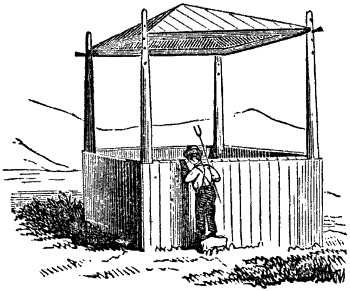
A BARRACK FOR STORING SHEEP-FODDER.
After pouring a little oil in the throat, the obstructing substance which occasions the “choking,” can frequently be removed up or down by external manipulation. If not, it may usually be forced down with the flexible probang, described in “Cattle and their Diseases,” or a flexible rod, the head of which is guarded by a knot, or a little bag of flax-seed. The latter having been dipped in hot water for a minute or two, is partly converted into mucilage, which constantly exudes through the cloth, and protects the œsophagus, or gullet, from laceration. But little force must be used, and the whole operation conducted with the utmost care and gentleness; or the œsophagus will be so far lacerated as to produce death, although the obstruction is removed.
OPHTHALMIA.
Ophthalmia, or inflammation of the eyes, is not uncommon in this country; but it is little noticed, as, in most cases, it disappears in a few days, or, at worst, is only followed by cataract, which, being usually confined to one eye, does not appreciably effect the value of the animal, and therefore has no influence on its market price.
Treatment. Some recommend blowing pulverized red chalk in the inflamed eye; others squirt into it tobacco juice. As a matter of humanity, blood may be drawn from under the eye, and the eye bathed in tepid water, and occasionally with a weak solution of the sulphate of zinc combined with tincture of opium. These latter applications diminish the pain, and hasten the cure.
PALSY.
Paralysis, or palsy, is a diminution or entire loss of the powers of motion in some parts of the body. In the winter, poor lambs, or poor pregnant ewes, or poor feeble ewes immediately after yeaning in the spring, occasionally lose the power of walking or standing rather too suddenly to have it referable to increasing debility. The animal seems to have lost all strength in its loins, and the hind-quarters are powerless; it makes ineffectual attempts to rise, and cannot stand if placed upon its feet.
Treatment. Warmth, gentle stimulants, and good nursing may raise the patient; but, in the vast majority of cases, it is more economical and equally humane, to deprive it of life at once.
PELT-ROT.
This is often mistaken for the scab, but it is, in fact, a different and less dangerous disease. The wool falls off, and leaves the sheep nearly naked; but it is attended with no soreness, though a reddish crust will cover the skin, from the wool which has dropped. It generally arises from hard keeping and much exposure to cold and wet; and, in fact, the animal often dies in severe weather from the cold it suffers on account of the loss of its coat.
The remedy is full feeding, a warm stall, and anointing the hard part of the skin with tar, oil, and butter. Some, however, do nothing for it, scarcely considering it a disease. Such say that if the condition of a poor sheep is raised as suddenly as practicable, by generous keep in the winter, the wool is very apt to drop off; and, if yet cold, the sheep will require warm shelter.
PNEUMONIA.
Pneumonia—or inflammation of the lungs—is not a common disease in the Northern States; but undoubted cases of it sometimes occur, after sheep have been exposed to sudden cold, particularly when recently shorn. The adhesions occasionally witnessed between the lungs and pleura of slaughtered sheep, betray the former existence of this disease in the animal—though, in many instances, it was so slight as to be mistaken, at the time, for a hard cold.
Symptoms. The animal is dull, ceases to ruminate, neglects its food, drinks frequently and largely, and its breathing is rapid and laborious; the eye is clouded; the nose discharges a tenacious, fetid matter; the teeth are ground frequently, so that the sound is audible at some distance; the pulse is at first hard and rapid, sometimes intermits, but before death it becomes weak. During the height of the fever, the flanks heave violently; there is a hard, painful cough during the first stages, which becomes weaker, and seems to be accompanied with more pain as death approaches.
After death, the lungs are found more or less hepatized—that is, permanently condensed and engorged with blood, so that their structure resembles that of the hepar, or liver—and they have so far lost their integrity that they are torn asunder by the slightest force. It may here be remarked that when sheep die from any cause, with their blood in them, the lungs have a dark, hepatized appearance. Whether they are actually hepatized or not, can readily be decided by compressing the windpipe, so that air cannot escape through it, and then between such compression and the body of the lungs, in a closely fitting orifice, inserting a goose-quill, or other tube, and continuing to blow until the lungs are inflated as far as they can be. As they inflate, they will become of a lighter color, and plainly manifest their cellular structure. If any portions of them cannot be inflated, and retain their dark, liver-like consistence, and color, they exhibit hepatization—the result of high inflammatory action—and a state utterly incompatible, in the living animal, with the discharge of the natural functions of the viscus.
Treatment. In the first, or inflammatory stages, bleeding and aperients are clearly called for. Some recommend early and copious bleeding, repeated, if necessary, in a few hours; this followed by aperient medicines, such as two ounces of Epsom salts, which may be repeated in smaller doses, if the bowels are not sufficiently relaxed. The following sedative may also be given with gruel, twice a day: nitrate of potash, one drachm; powdered digitalis, one scruple; and tartarized antimony, one scruple.
While depletion may be of inestimable value during the continuance—the short continuance—of the febrile state, yet excitation like this will soon be followed by corresponding exhaustion, when the bleeding and purging would be murderous expedients; and gentian, ginger, and the spirits of nitrous ether will afford the only hope of cure.
POISON.
Sheep will often, in the winter or spring, eat greedily of the low laurel. The animal appears afterward to be dull and stupid, swells a little, and is constantly gulping up a feverish fluid, which it swallows again; a part of it will trickle out of its mouth, and discolor its lips. The plant probably brings on a fermentation in the stomach, and nature endeavors to throw off the poisonous herb by retching or vomiting.
Treatment. In the early stages, if the greenish fluid be allowed to escape from the stomach, the animal generally recovers. To effect this, gag the sheep, which may be done in this manner: Take a stick of the size of the wrist, six inches long—place it in the animal’s mouth—tie a string to one end of it, pass it over the head and down to the other end, and there make it fast. The fluid will then run from the mouth as fast as thrown up from the stomach. In addition to this, give roasted onions and sweetened milk freely. A better plan, however, is to force a gill of melted lard down the throat; or, boil for an hour the twigs of the white ash, and give one-half to one gill of the strong liquor immediately; to be repeated, if not successful. Drenchers of milk and castor-oil are also recommended.
ROT.
This disease, which sometimes causes the death of a million of sheep, in England, in a single year, is comparatively unknown in this country. It prevails somewhat in the Western States, from allowing sheep to pasture on land that is overflowed with water. Even a crop of green oats, early in the fall, before a frost comes; has been known to rot young sheep.
Symptoms. The first are by no means strongly marked; there is no loss of condition, but rather the contrary, to all appearance. A paleness and want of liveliness of the membranes, generally, may be considered as the first symptoms, to which may be added a yellowness of the caruncle at the corner of the eye. When in warm, sultry, or rainy weather, sheep that are grazing on low and moist lands, feed rapidly, and some of them die suddenly, there is ground for fearing that they have contracted the rot. This suspicion will be farther increased if, a few days afterward, the sheep begin to shrink and grow flaccid about the loins. By pressure about the hips at this time, a crackling is perceptible now or soon afterward, the countenance looks pale, and upon parting the fleece, the skin is found to have changed its vermilion tint for a pale red, and the wool is easily separated from the felt; and as the disorder advances, the skin becomes dappled with yellow or black spots. To these symptoms succeed increased dullness, loss of condition, and greater paleness of the mucous membranes, the eye-lids becoming almost white, and afterward yellow. This yellowness extends to other parts of the body, and a watery fluid appears under the skin, the latter becoming loose and flabby, and the wool coming off readily. The symptoms of dropsy often extend over the body, and sometimes the sheep becomes chockered, as it is termed; a large swelling forms under the jaw, which, from the appearance of the fluid which it contains, is sometimes called the watery poke. The duration of the disease is uncertain; the animal occasionally dies shortly after becoming affected, but more frequently it extends to from three to six months, the sheep gradually losing flesh and pining away, particularly if, as is frequently the case, an obstinate purging supervenes.
Post-mortem. The whole cellular tissue is found to be infiltrated, and a yellow serous fluid everywhere follows the knife. The muscles are soft and flabby, having the appearance of being macerated. The kidneys are pale, flaccid, and infiltrated. The mesenteric glands are enlarged, and engorged with yellow serous fluid. The belly is frequently filled with water, or purulent matter; the peritoneum is everywhere thickened, and the bowels adhere together by means of an unnatural growth. The heart is enlarged and softened, and the lungs are filled with tubercles. The principal alterations of structure are in the liver, which is pale, livid, and broken down with the slightest pressure; and on being boiled, it will almost dissolve away. When the liver is not pale, it is often curiously spotted; in some cases it is speckled, like the back of a toad; some parts of it, however, are hard and schirrous; others are ulcerated, and the biliary ducts are filled with flukes. The malady is, unquestionably, inflammation of the liver. This fluke is from three-quarters of an inch to an inch and a quarter in length, and from one-third to one-half an inch in its greatest breadth. These fluke-worms undoubtedly aggravate the disease, and perpetuate a state of irritability and disorganization, which must necessarily undermine the strength of any animal.
Treatment. This must, to a considerable extent, be very unsatisfactory. After the use of dry food and dry bedding, one of the best preventives is the abundant use of pure salt. In violent attacks, take eight, ten, or twelve ounces of blood, according to the circumstances of the case; to this, let a dose of physic succeed—two or three ounces of Epsom salts; and to these means add a change of diet, good hay in the field, and hay, straw, or chaff in the yard. After the operation of the physic—an additional dose having been administered, oftentimes, in order to quicken the action of the first—two or three grains of calomel may be given daily, mixed with half the quantity of opium, in order to secure its beneficial, and ward off its injurious effects on the ruminant. To this should be added common salt, which acts as a purgative and a tonic. A mild tonic, as well as an aperient, is plainly indicated soon after the commencement of rot. The doses should be from two to three drachms, repeated morning and night. When the inflammatory stage is clearly passed, stronger tonics may be added to the salt, and there are none superior to the gentian and ginger roots; from one to two drachms of each, finely pounded, may be added to each dose of the salt. The sheep having a little recovered from the disease, should still continue on the best and driest pasture on the farm, and should always have salt within their reach. The rot is not infectious.
SCAB.
This is a cutaneous disease, analogous to the mange in horses and the itch in man, and is caused and propagated by a minute insect, the acarus.
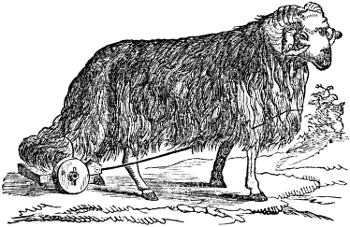
THE BROAD-TAILED SHEEP.
If one or more female acari are placed on the wool of a sound sheep, they quickly travel to the root of it, and bury themselves in the skin, the place at which they penetrate being scarcely visible, or only distinguishable by a minute red point. On the tenth or twelfth day, a little swelling may be detected with the finger, and the skin changes its color, and has a greenish blue tint. The pustule is now rapidly formed, and about the sixteenth day breaks, when the mothers again appear, with their little ones attached to their feet, and covered by a portion of the shell of the egg from which they have just escaped. These little ones immediately set to work, penetrate the neighboring skin, bury themselves beneath it, find their proper nourishment, and grow and propagate, until the poor creature has myriads of them preying upon him. It is not wonderful that, under such circumstances, he should speedily sink. The male acari, when placed on the sound skin of a sheep, will likewise burrow their way and disappear for a while, the pustule rising in due time; but the itching and the scab soon disappear without the employment of any remedy. The female brings forth from eight to fifteen young at a time.
In the United States, this disease is comparatively little known, and never originates spontaneously. The fact, that short-woolled sheep—like the Merino—are much less subject to its attacks, is probably one reason for this slight comparative prevalence. The disease spreads from individual to individual, and from flock to flock, not only by means of direct contact, but by the acari left on posts, stones, and other substances against which diseased sheep have rubbed themselves. Healthy sheep are, therefore, liable to contract the malady, if turned on pastures previously occupied by scabby sheep, although some considerable time may have elapsed since the departure of the latter.
The sheep laboring under the scab is exceedingly restless. It rubs itself with violence against trees, stones, fences, etc.; scratches itself with its feet, bites its sores, and tears off its wool with its teeth; as the pustules are broken, their matter escapes, and forms scabs, causing red, inflamed sores, which constantly extend, increasing the misery of the tortured animal; if unrelieved, he pines away, and soon perishes.
The post-mortem appearances are very uncertain and inconclusive. There is generally chronic inflammation of the intestines, with the presence of a great number of worms. The liver is occasionally schirrous, and the spleen enlarged; and there are frequently serous effusions in the belly, and sometimes in the chest. There has been evident sympathy between the digestive and the cutaneous systems.
Treatment. First, separate the sheep; then cut off the wool as far as the skin feels hard to the finger; the scab is then washed with soap-suds, and rubbed hard With a shoe-brush, so that it may be cleansed and broken. For this use take a decoction of tobacco, to which add one-third, by measure, of the lye of wood-ashes, as much hog’s lard as will be dissolved by the lye, a small quantity of tar from a tar-bucket, which contains grease, and about one-eighth of the whole, by measure, of spirits of turpentine. This liquor is rubbed upon the part infected, and spread to a little distance around it, in three washings, with an interval of three days each. This will invariably effect a cure, when the disorder is only partial.
Or, the following: Dip the sheep in an infusion of arsenic, in the proportion of half a pound of arsenic to twelve gallons of water. The sheep should be previously washed in soap and water. The infusion must not be permitted to enter the mouth or nostrils.